coolant FORD EXPEDITION 2002 1.G User Guide
[x] Cancel search | Manufacturer: FORD, Model Year: 2002, Model line: EXPEDITION, Model: FORD EXPEDITION 2002 1.GPages: 280, PDF Size: 2.32 MB
Page 237 of 280
5. Fill the coolant reservoir slowly with the proper coolant mixture (see
above), to within the ªcold fill rangeº or the ªcold fullº level on the
reservoir. If you removed the radiator cap in an overflow system, fill the
radiator until the coolant is visible and radiator is almost full.
6. Replace the cap. Turn until tightly installed. (Cap must be tightly
installed to prevent coolant loss.)
After any coolant has been added, check the coolant concentration see
Checking Engine Coolant section). If the concentration is not 50/50
(protection to ±34É F/±36É C), drain some coolant and adjust the
concentration. It may take several drains and additions to obtain a 50/50
coolant concentration.
Whenever coolant has been added, the coolant level in the coolant
reservoir should be checked the next few times you drive the vehicle. If
necessary, add enough 50/50 concentration of engine coolant and
distilled water to bring the liquid level to the proper level.
If you have to add more than 1.0 liter (1.0 quart) of engine coolant per
month, have your dealer check the engine cooling system. Your cooling
system may have a leak. Operating an engine with a low level of coolant
can result in engine overheating and possible engine damage.
Recycled engine coolant
Ford Motor Company recommends the use of a recycled engine coolant
produced by Ford-approved processes in vehicles originally equipped
with Motorcraft Premium Engine Coolant (green-colored). However, not
all coolant recycling processes produce coolant that meets Ford
specification ESE-M97B44±A. Use of such coolant may harm the engine
and cooling system components.
Ford Motor Company does NOT recommend the use of recycled engine
coolant in vehicles originally equipped with Motorcraft Premium Gold
Engine Coolant since a Ford-approved recycling process is not yet
available.
Used engine coolant should be disposed of in an appropriate
manner. Follow your community's regulations and standards for recycling
and disposing of automotive fluids.
Coolant refill capacity
To find out how much fluid your vehicle's cooling system can hold, refer
toRefill capacitiesin this chapter.
Maintenance and specifications
237
Page 238 of 280
![FORD EXPEDITION 2002 1.G User Guide Fill your engine coolant reservoir as outlined inAdding engine coolant
in this chapter.
Severe climates
If you drive in extremely cold climates (less than ±36É C [±34É F]):
²It may be necessary t](/img/11/4911/w960_4911-237.png "FORD EXPEDITION 2002 1.G User Guide Fill your engine coolant reservoir as outlined inAdding engine coolant
in this chapter.
Severe climates
If you drive in extremely cold climates (less than ±36É C [±34É F]):
²It may be necessary t")
Fill your engine coolant reservoir as outlined inAdding engine coolant
in this chapter.
Severe climates
If you drive in extremely cold climates (less than ±36É C [±34É F]):
²It may be necessary to increase the coolant concentration
above 50%.
²NEVER increase the coolant concentration above 60%.
²Increased engine coolant concentrations above 60% will
decrease the overheat protection characteristics of the engine
coolant and may cause engine damage.
²Refer to the chart on the coolant container to ensure the
coolant concentration in your vehicle will provide adequate
freeze protection at the temperatures in which you drive in the
winter months.
If you drive in extremely hot climates:
²It is still necessary to maintain the coolant concentration
above 40%.
²NEVER decrease the coolant concentration below 40%.
²Decreased engine coolant concentrations below 40% will
decrease the corrosion protection characteristics of the engine
coolant and may cause engine damage.
²Decreased engine coolant concentrations below 40% will
decrease the freeze protection characteristics of the engine
coolant and may cause engine damage.
²Refer to the chart on the coolant container to ensure the
coolant concentration in your vehicle will provide adequate
protection at the temperatures in which you drive.
Vehicles driven year-round in non-extreme climates should use a 50/50
mixture of engine coolant and distilled water for optimum cooling system
and engine protection.
What you should know about fail-safe cooling
If the engine coolant supply is depleted, this feature allows the vehicle to
be driven temporarily before incremental component damage is incurred.
The ªfail-safeº distance depends on ambient temperatures, vehicle load
and terrain.
Maintenance and specifications
238
Page 239 of 280
How fail-safe cooling works
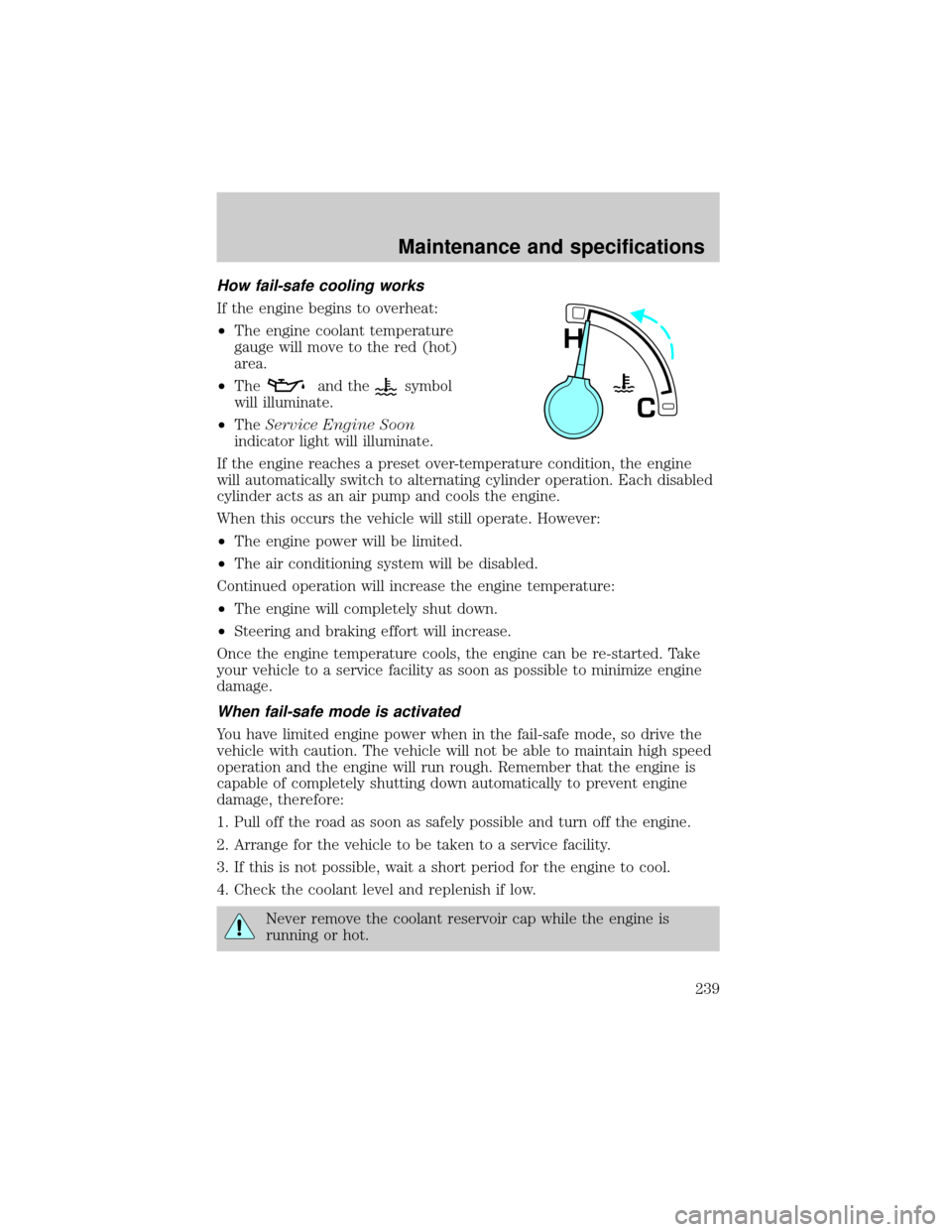
If the engine begins to overheat:
²The engine coolant temperature
gauge will move to the red (hot)
area.
²The
and thesymbol
will illuminate.
²TheService Engine Soon
indicator light will illuminate.
If the engine reaches a preset over-temperature condition, the engine
will automatically switch to alternating cylinder operation. Each disabled
cylinder acts as an air pump and cools the engine.
When this occurs the vehicle will still operate. However:
²The engine power will be limited.
²The air conditioning system will be disabled.
Continued operation will increase the engine temperature:
²The engine will completely shut down.
²Steering and braking effort will increase.
Once the engine temperature cools, the engine can be re-started. Take
your vehicle to a service facility as soon as possible to minimize engine
damage.
When fail-safe mode is activated
You have limited engine power when in the fail-safe mode, so drive the
vehicle with caution. The vehicle will not be able to maintain high speed
operation and the engine will run rough. Remember that the engine is
capable of completely shutting down automatically to prevent engine
damage, therefore:
1. Pull off the road as soon as safely possible and turn off the engine.
2. Arrange for the vehicle to be taken to a service facility.
3. If this is not possible, wait a short period for the engine to cool.
4. Check the coolant level and replenish if low.
Never remove the coolant reservoir cap while the engine is
running or hot.
C
H
Maintenance and specifications
239
Page 250 of 280
Allow the vehicle to sit for at least eight hours without starting the
engine. Then, start the engine and complete the above driving cycle. The
engine must warm up to its normal operating temperature. Once started,
do not turn off the engine until the above driving cycle is complete.
CHECKING AND ADDING POWER STEERING FLUID
Check the power steering fluid. Refer to the scheduled maintenance
guide for the service interval schedules. If adding fluid is necessary, use
only Ford Premium Power Steering Fluid.
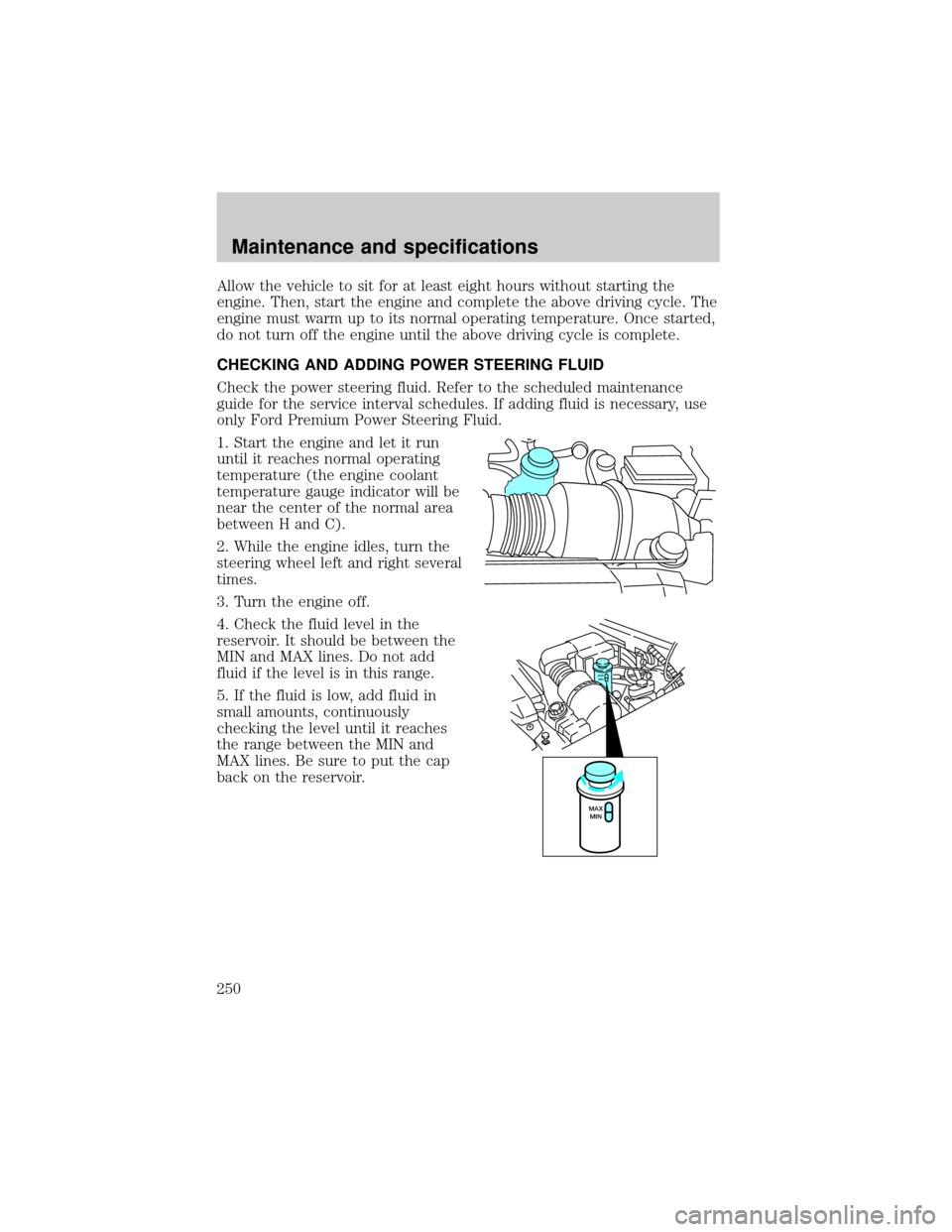
1. Start the engine and let it run
until it reaches normal operating
temperature (the engine coolant
temperature gauge indicator will be
near the center of the normal area
between H and C).
2. While the engine idles, turn the
steering wheel left and right several
times.
3. Turn the engine off.
4. Check the fluid level in the
reservoir. It should be between the
MIN and MAX lines. Do not add
fluid if the level is in this range.
5. If the fluid is low, add fluid in
small amounts, continuously
checking the level until it reaches
the range between the MIN and
MAX lines. Be sure to put the cap
back on the reservoir.
MAX
MIN
MAX
MIN
Maintenance and specifications
250
Page 261 of 280
Fluid Ford Part
NameApplication Capacity
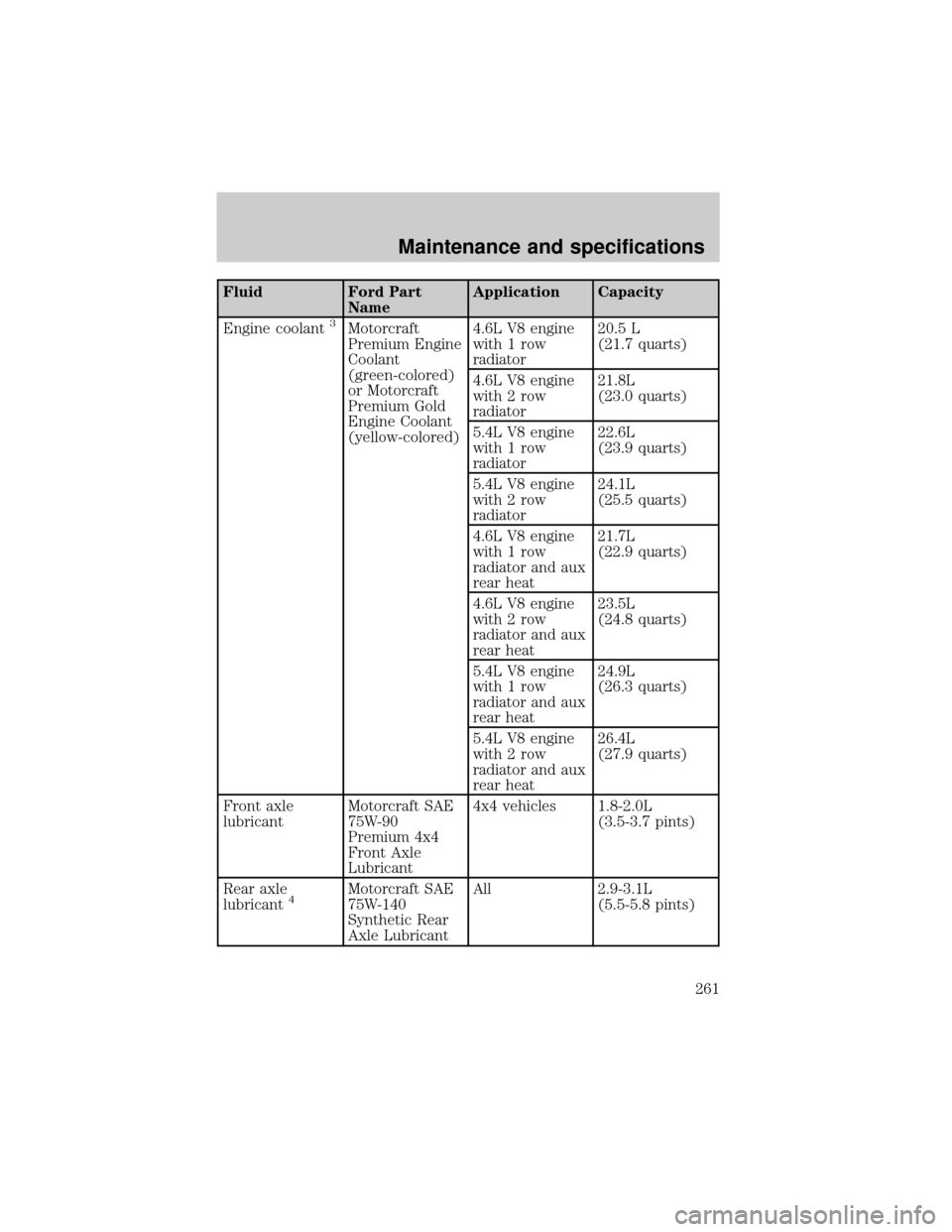
Engine coolant
3Motorcraft
Premium Engine
Coolant
(green-colored)
or Motorcraft
Premium Gold
Engine Coolant
(yellow-colored)4.6L V8 engine
with 1 row
radiator20.5 L
(21.7 quarts)
4.6L V8 engine
with 2 row
radiator21.8L
(23.0 quarts)
5.4L V8 engine
with 1 row
radiator22.6L
(23.9 quarts)
5.4L V8 engine
with 2 row
radiator24.1L
(25.5 quarts)
4.6L V8 engine
with 1 row
radiator and aux
rear heat21.7L
(22.9 quarts)
4.6L V8 engine
with 2 row
radiator and aux
rear heat23.5L
(24.8 quarts)
5.4L V8 engine
with 1 row
radiator and aux
rear heat24.9L
(26.3 quarts)
5.4L V8 engine
with 2 row
radiator and aux
rear heat26.4L
(27.9 quarts)
Front axle
lubricantMotorcraft SAE
75W-90
Premium 4x4
Front Axle
Lubricant4x4 vehicles 1.8-2.0L
(3.5-3.7 pints)
Rear axle
lubricant
4Motorcraft SAE
75W-140
Synthetic Rear
Axle LubricantAll 2.9-3.1L
(5.5-5.8 pints)
Maintenance and specifications
261
Page 262 of 280
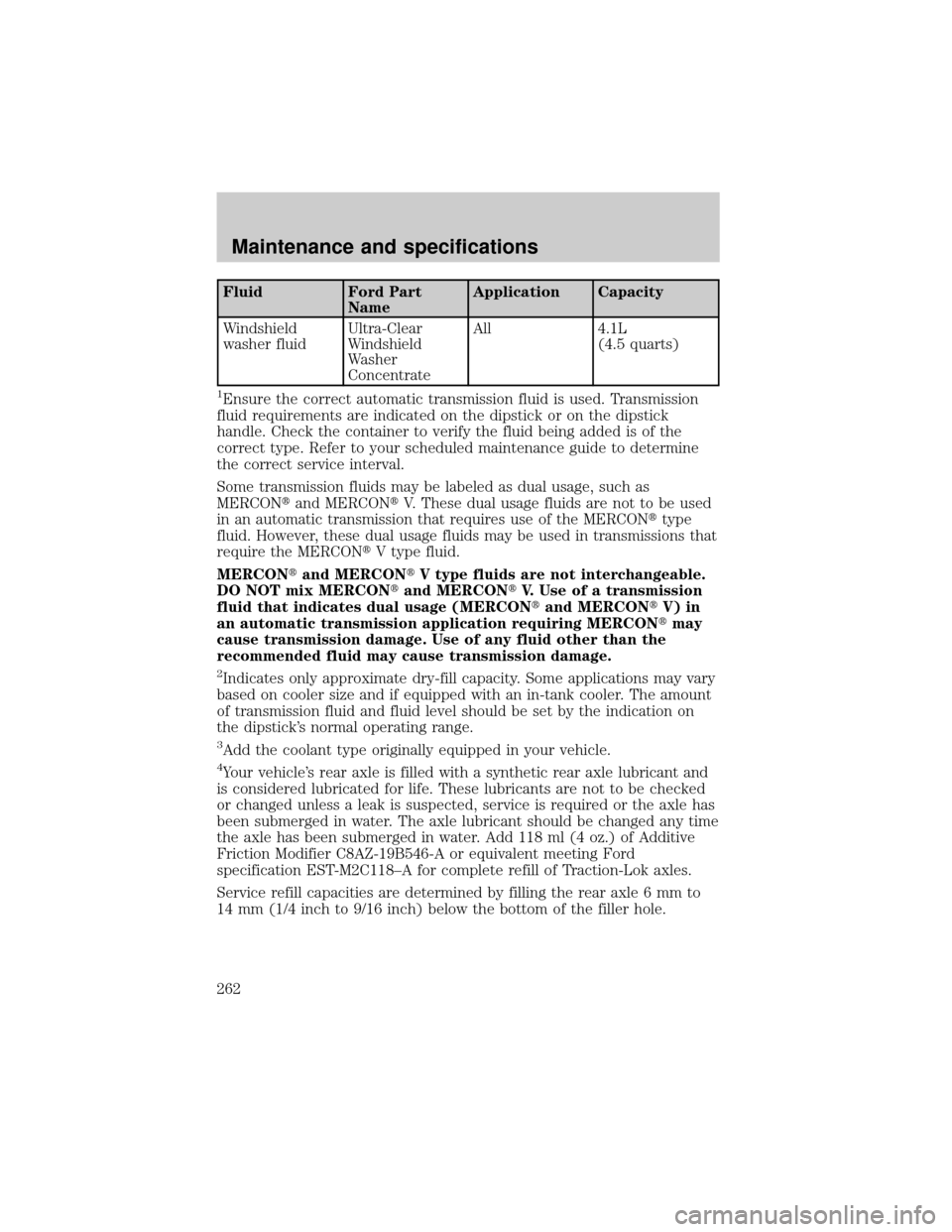
Fluid Ford Part
NameApplication Capacity
Windshield
washer fluidUltra-Clear
Windshield
Washer
ConcentrateAll 4.1L
(4.5 quarts)
1Ensure the correct automatic transmission fluid is used. Transmission
fluid requirements are indicated on the dipstick or on the dipstick
handle. Check the container to verify the fluid being added is of the
correct type. Refer to your scheduled maintenance guide to determine
the correct service interval.
Some transmission fluids may be labeled as dual usage, such as
MERCONtand MERCONtV. These dual usage fluids are not to be used
in an automatic transmission that requires use of the MERCONttype
fluid. However, these dual usage fluids may be used in transmissions that
require the MERCONtV type fluid.
MERCONtand MERCONtV type fluids are not interchangeable.
DO NOT mix MERCONtand MERCONtV. Use of a transmission
fluid that indicates dual usage (MERCONtand MERCONtV) in
an automatic transmission application requiring MERCONtmay
cause transmission damage. Use of any fluid other than the
recommended fluid may cause transmission damage.
2Indicates only approximate dry-fill capacity. Some applications may vary
based on cooler size and if equipped with an in-tank cooler. The amount
of transmission fluid and fluid level should be set by the indication on
the dipstick's normal operating range.
3Add the coolant type originally equipped in your vehicle.
4Your vehicle's rear axle is filled with a synthetic rear axle lubricant and
is considered lubricated for life. These lubricants are not to be checked
or changed unless a leak is suspected, service is required or the axle has
been submerged in water. The axle lubricant should be changed any time
the axle has been submerged in water. Add 118 ml (4 oz.) of Additive
Friction Modifier C8AZ-19B546-A or equivalent meeting Ford
specification EST-M2C118±A for complete refill of Traction-Lok axles.
Service refill capacities are determined by filling the rear axle 6 mm to
14 mm (1/4 inch to 9/16 inch) below the bottom of the filler hole.
Maintenance and specifications
262
Page 263 of 280
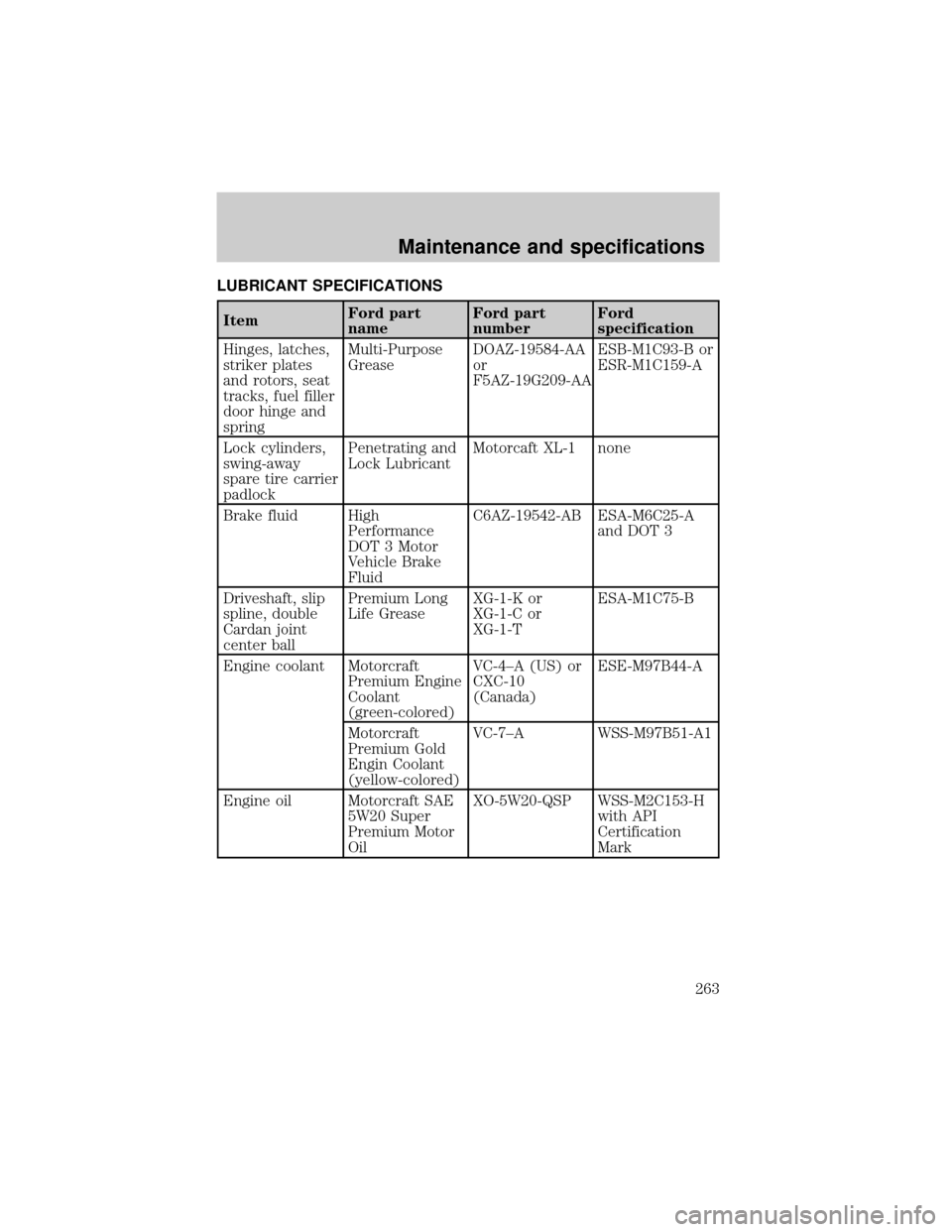
LUBRICANT SPECIFICATIONS
ItemFord part
nameFord part
numberFord
specification
Hinges, latches,
striker plates
and rotors, seat
tracks, fuel filler
door hinge and
springMulti-Purpose
GreaseDOAZ-19584-AA
or
F5AZ-19G209-AAESB-M1C93-B or
ESR-M1C159-A
Lock cylinders,
swing-away
spare tire carrier
padlockPenetrating and
Lock LubricantMotorcaft XL-1 none
Brake fluid High
Performance
DOT 3 Motor
Vehicle Brake
FluidC6AZ-19542-AB ESA-M6C25-A
and DOT 3
Driveshaft, slip
spline, double
Cardan joint
center ballPremium Long
Life GreaseXG-1-K or
XG-1-C or
XG-1-TESA-M1C75-B
Engine coolant Motorcraft
Premium Engine
Coolant
(green-colored)VC-4±A (US) or
CXC-10
(Canada)ESE-M97B44-A
Motorcraft
Premium Gold
Engin Coolant
(yellow-colored)VC-7±A WSS-M97B51-A1
Engine oil Motorcraft SAE
5W20 Super
Premium Motor
OilXO-5W20-QSP WSS-M2C153-H
with API
Certification
Mark
Maintenance and specifications
263
Page 273 of 280

A
Accessory delay ..........................80
Air bag supplemental
restraint system ........132±133, 137
and child safety seats ............135
description ......................133, 137
disposal ....................................140
driver air bag ..................135, 138
indicator light ...........12, 137, 139
operation .........................135, 138
passenger air bag ...........135, 138
side air bag ..............................137
Air cleaner filter ...............254, 259
Air conditioning ..........................50
auxiliary heater and air
conditioner ................................55
manual heating and air
conditioning system .................47
Air suspension ...........................158
description ..............................158
warning light .............................12
Ambulance packages ....................7
Antifreeze
(see Engine coolant) ................234
Anti-lock brake system
(see Brakes) ..............................155
Anti-theft system
warning light .............................13
Armrests ....................................110
Automatic transmission
driving an automatic
overdrive .................................162
fluid, adding ............................252
fluid, checking ........................252
fluid, refill capacities ..............260
fluid, specification ..................265Auxiliary power point .................78
Axle
lubricant specifications ..263, 265
refill capacities ........................260
traction lok ..............................159
B
Battery .......................................231
acid, treating emergencies .....231
charging system
warning light .............................12
jumping a disabled battery ....202
maintenance-free ....................231
replacement, specifications ...259
servicing ..................................231
voltage gauge ............................16
Belt minder ...............................128
Brakes ........................................154
anti-lock ...................................155
anti-lock brake system (ABS)
warning light .....................11, 156
brake warning light ..................11
fluid, checking and adding ....251
fluid, refill capacities ..............260
fluid, specifications .........263, 265
lubricant specifications ..263, 265
parking ....................................156
pedals (see Power
adjustable foot pedals) ............82
shift interlock ..........................161
Break-in period .............................5
C
Capacities for refilling fluids ....260
Cassette tape player ...................18
CD changer .................................42
Certification Label ....................268
Index
273
Page 274 of 280

Child safety restraints ..............140
child safety belts ....................140
Child safety seats ......................141
attaching with
tether straps ...................146±147
in front seat ............................143
in rear seat ..............143, 145±146
Cleaning your vehicle
engine compartment ..............219
exterior ....................................223
instrument cluster lens ..........222
instrument panel ....................221
interior .....................................222
plastic parts ....................220±221
safety belts ..............................223
washing ....................................218
waxing .....................................218
wheels ......................................219
windows ..................................223
wiper blades ............................221
woodtone trim ........................223
Clock ......................................24, 35
Compass, electronic ..............74, 80
calibration .................................76
set zone adjustment .................75
Console ........................................92
overhead ........................71±72, 77
rear ............................................93
Controls
power seat ...............................110
Coolant
checking and adding ..............234
refill capacities ................237, 260
specifications ..................263, 265
Cruise control
(see Speed control) ....................83
Customer Assistance ................186Ford accessories
for your vehicle ......................224
Ford Extended
Service Plan ............................210
Getting assistance outside
the U.S. and Canada ..............214
Getting roadside assistance ...186
Getting the
service you need ....................208
Ordering additional
owner's literature ...................215
The Dispute
Settlement Board ...................211
Utilizing the Mediation/
Arbitration Program ...............214
D
Daytime running lamps
(see Lamps) ................................60
Defrost
rear window ..............................58
Dipstick
automatic
transmission fluid ...................252
engine oil .................................228
Doors
door ajar warning .....................13
lubricant specifications ..........263
Driveline universal joint
and slip yoke .............................254
Driving under special
conditions ..........................170, 173
sand .........................................172
snow and ice ...........................174
through water .................172, 176
Index
274
Page 275 of 280

E
Emergencies, roadside
jump-starting ..........................202
Emission control system ..........248
Engine ................................265±266
check engine/
service engine soon light .........10
cleaning ...................................219
coolant .....................................234
fail-safe coolant ......................238
idle speed control ...................231
lubrication
specifications ..................263, 265
refill capacities ........................260
service points ..........................227
starting after a collision .........187
Engine block heater .................153
Engine oil ..................................228
change oil soon warning,
message center .......................228
checking and adding ..............228
dipstick ....................................228
filter, specifications ........230, 259
recommendations ...................230
refill capacities ........................260
specifications ..................263, 265
Exhaust fumes ..........................154
F
Fail safe cooling ........................238
Floor mats ...................................93
Fluid capacities .........................260
Foglamps .....................................59
Four-Wheel Drive
vehicles ................................14, 167
control trac .............................167description ..............................167
driving off road .......................169
electronic shift ........................168
indicator light ...........................14
preparing to
drive your vehicle ...................160
Fuel ............................................240
calculating fuel economy .......245
cap ...........................................242
capacity ...................................260
choosing the right fuel ...........243
comparisons with EPA fuel
economy estimates .................248
detergent in fuel .....................244
filling your vehicle
with fuel ..................240, 242, 245
filter, specifications ........244, 259
fuel pump shut-off switch .....187
gauge .........................................16
improving fuel economy ........245
low fuel warning light ..............12
octane rating ...........243, 265±266
quality ......................................243
running out of fuel .................244
safety information relating
to automotive fuels ................240
Fuses ..................................189±190
G
Garage door opener ..............72, 86
Gas cap (see Fuel cap) ............242
Gas mileage
(see Fuel economy) .................245
Gauges .........................................14
battery voltage gauge ...............16
engine coolant
temperature gauge ...................15
engine oil pressure gauge ........15
fuel gauge ..................................16
Index
275