child restraint FORD EXPEDITION 2005 2.G Owner's Manual
[x] Cancel search | Manufacturer: FORD, Model Year: 2005, Model line: EXPEDITION, Model: FORD EXPEDITION 2005 2.GPages: 368, PDF Size: 11.76 MB
Page 205 of 368
Installing child safety seats in the center front seating position
Always transport children 12 years old and under in the rear
seats and always properly use appropriate child restraints.
It is safer to install child safety seats in seating positions that
have child seat anchors. The front seat has no tether anchor nor
does it have LATCH anchors.
1. Lengthen the lap belt. To lengthen the belt, hold the tongue so that its
bottom is perpendicular to the direction of webbing while sliding the
tongue up the webbing.
2. Place the child safety seat in the center seating position.
3. Route the tongue and webbing through the child seat according to the
child seat manufacturer’s instructions.
4. Insert the belt tongue into the proper buckle for the center seating
position until you hear a snap and feel it latch. Make sure the tongue is
securely fastened to the buckle by pulling on tongue.
5. Push down on the child seat with your knee while pulling on the loose
end of the lap belt webbing to tighten the belt.
6. Before placing the child into the child seat, forcibly move the child
seat from side to side and forward to make sure that the seat is held
securely. If the child seat moves excessively, repeat steps 5 through 6, or
properly install the child seat in a different position.
Attaching child safety seats with tether straps
Most new forward-facing child safety seats include a tether strap which
goes over the back of the seat and hooks to an anchoring point. Tether
straps are available as an accessory for many older safety seats. Contact
the manufacturer of your child seat for information about ordering a
tether strap.
Some of the rear seats of your vehicle are equipped with built-in tether
strap anchors located behind the seats as described below.
In the third row center seating position, the tether anchor is a loop at
the bottom of the seatback.
The tether strap anchors in your vehicle are in the following positions
(shown from top view):
REVIEW COPY
2005 Expedition(exd), Owners Guide (post-2002-fmt)(own2002),
Market:USA_English(fus)
Seating and Safety Restraints
205
Page 206 of 368
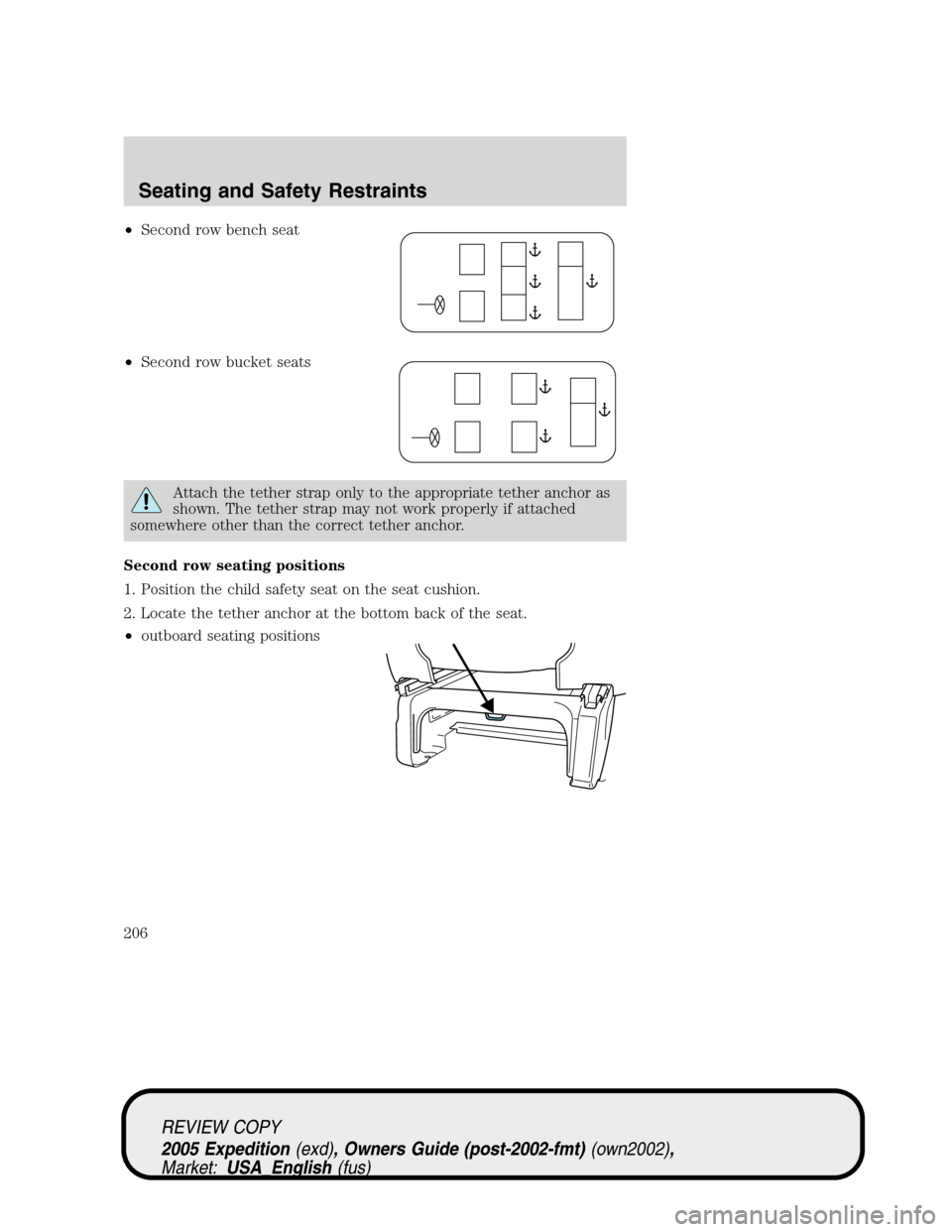
•Second row bench seat
•Second row bucket seats
Attach the tether strap only to the appropriate tether anchor as
shown. The tether strap may not work properly if attached
somewhere other than the correct tether anchor.
Second row seating positions
1. Position the child safety seat on the seat cushion.
2. Locate the tether anchor at the bottom back of the seat.
•outboard seating positions
REVIEW COPY
2005 Expedition(exd), Owners Guide (post-2002-fmt)(own2002),
Market:USA_English(fus)
Seating and Safety Restraints
206
Page 207 of 368
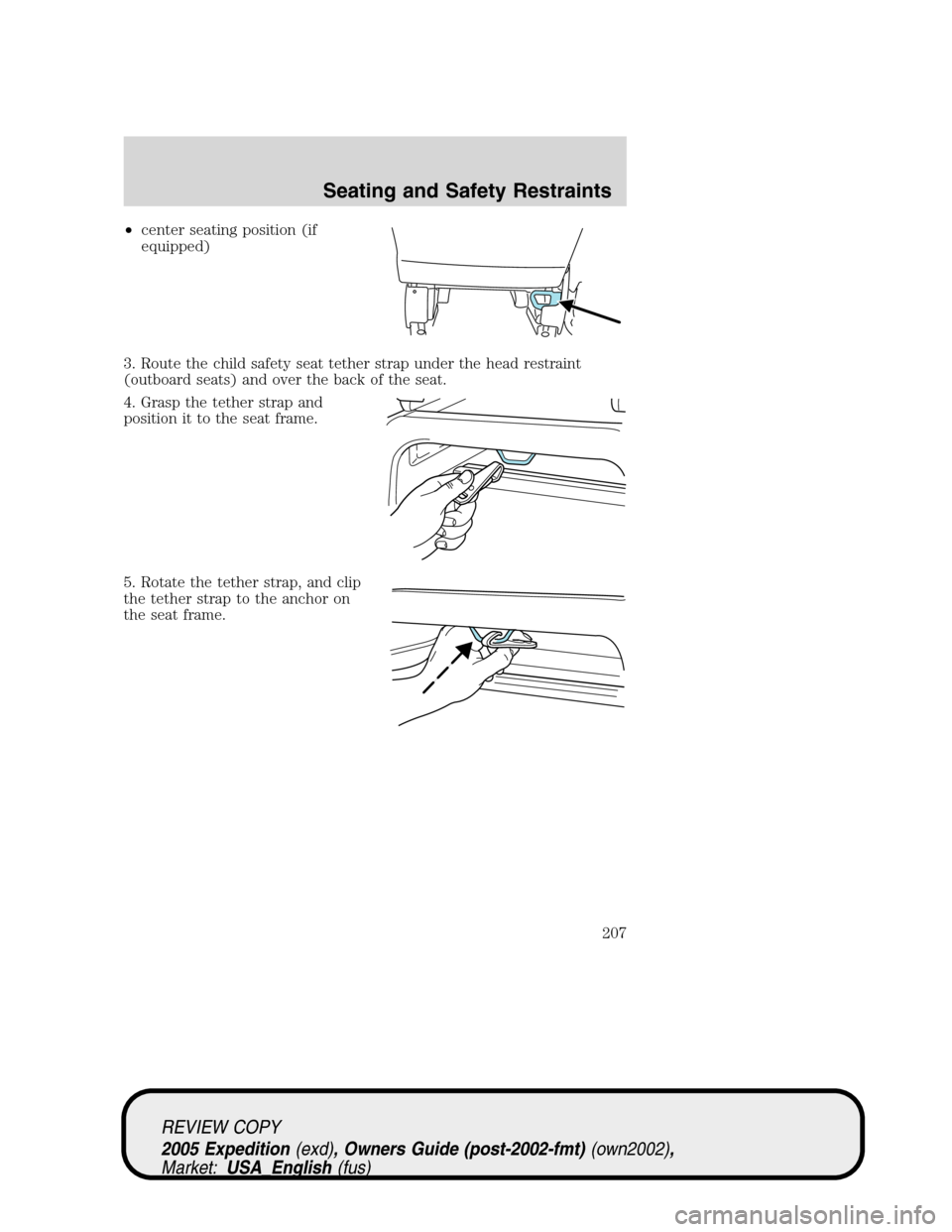
•center seating position (if
equipped)
3. Route the child safety seat tether strap under the head restraint
(outboard seats) and over the back of the seat.
4. Grasp the tether strap and
position it to the seat frame.
5. Rotate the tether strap, and clip
the tether strap to the anchor on
the seat frame.
REVIEW COPY
2005 Expedition(exd), Owners Guide (post-2002-fmt)(own2002),
Market:USA_English(fus)
Seating and Safety Restraints
207
Page 208 of 368
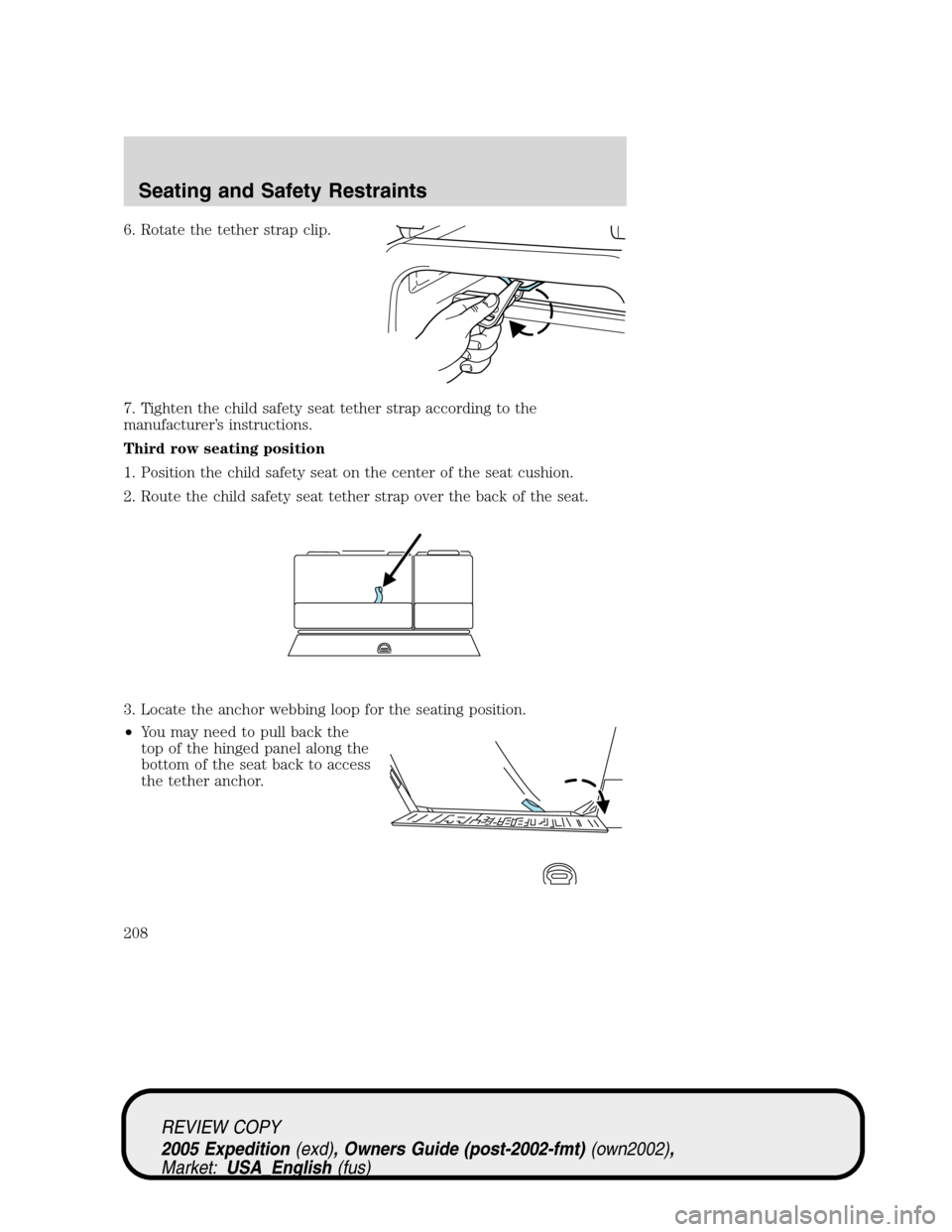
6. Rotate the tether strap clip.
7. Tighten the child safety seat tether strap according to the
manufacturer’s instructions.
Third row seating position
1. Position the child safety seat on the center of the seat cushion.
2. Route the child safety seat tether strap over the back of the seat.
3. Locate the anchor webbing loop for the seating position.
•You may need to pull back the
top of the hinged panel along the
bottom of the seat back to access
the tether anchor.
REVIEW COPY
2005 Expedition(exd), Owners Guide (post-2002-fmt)(own2002),
Market:USA_English(fus)
Seating and Safety Restraints
208
Page 209 of 368
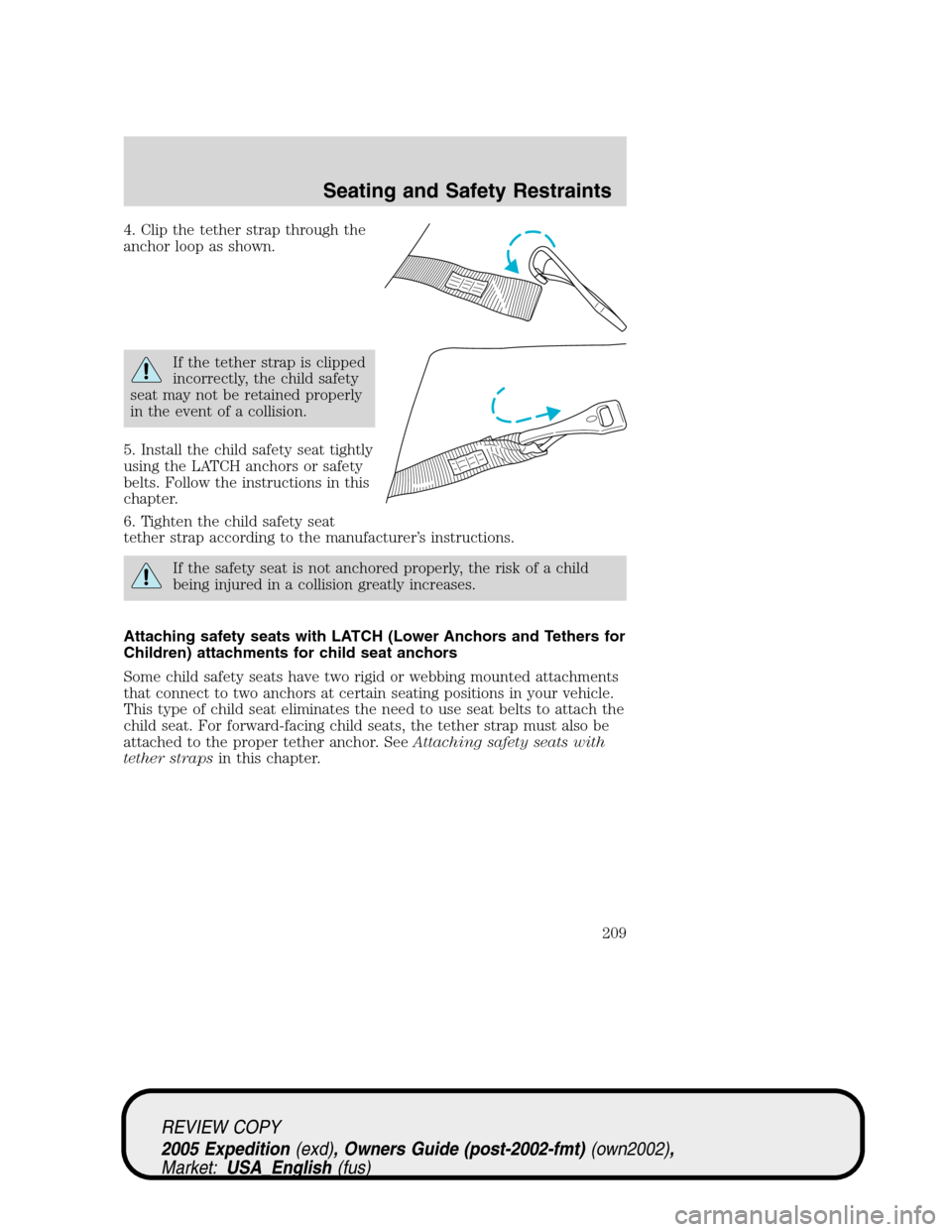
4. Clip the tether strap through the
anchor loop as shown.
If the tether strap is clipped
incorrectly, the child safety
seat may not be retained properly
in the event of a collision.
5. Install the child safety seat tightly
using the LATCH anchors or safety
belts. Follow the instructions in this
chapter.
6. Tighten the child safety seat
tether strap according to the manufacturer’s instructions.
If the safety seat is not anchored properly, the risk of a child
being injured in a collision greatly increases.
Attaching safety seats with LATCH (Lower Anchors and Tethers for
Children) attachments for child seat anchors
Some child safety seats have two rigid or webbing mounted attachments
that connect to two anchors at certain seating positions in your vehicle.
This type of child seat eliminates the need to use seat belts to attach the
child seat. For forward-facing child seats, the tether strap must also be
attached to the proper tether anchor. SeeAttaching safety seats with
tether strapsin this chapter.
REVIEW COPY
2005 Expedition(exd), Owners Guide (post-2002-fmt)(own2002),
Market:USA_English(fus)
Seating and Safety Restraints
209
Page 210 of 368
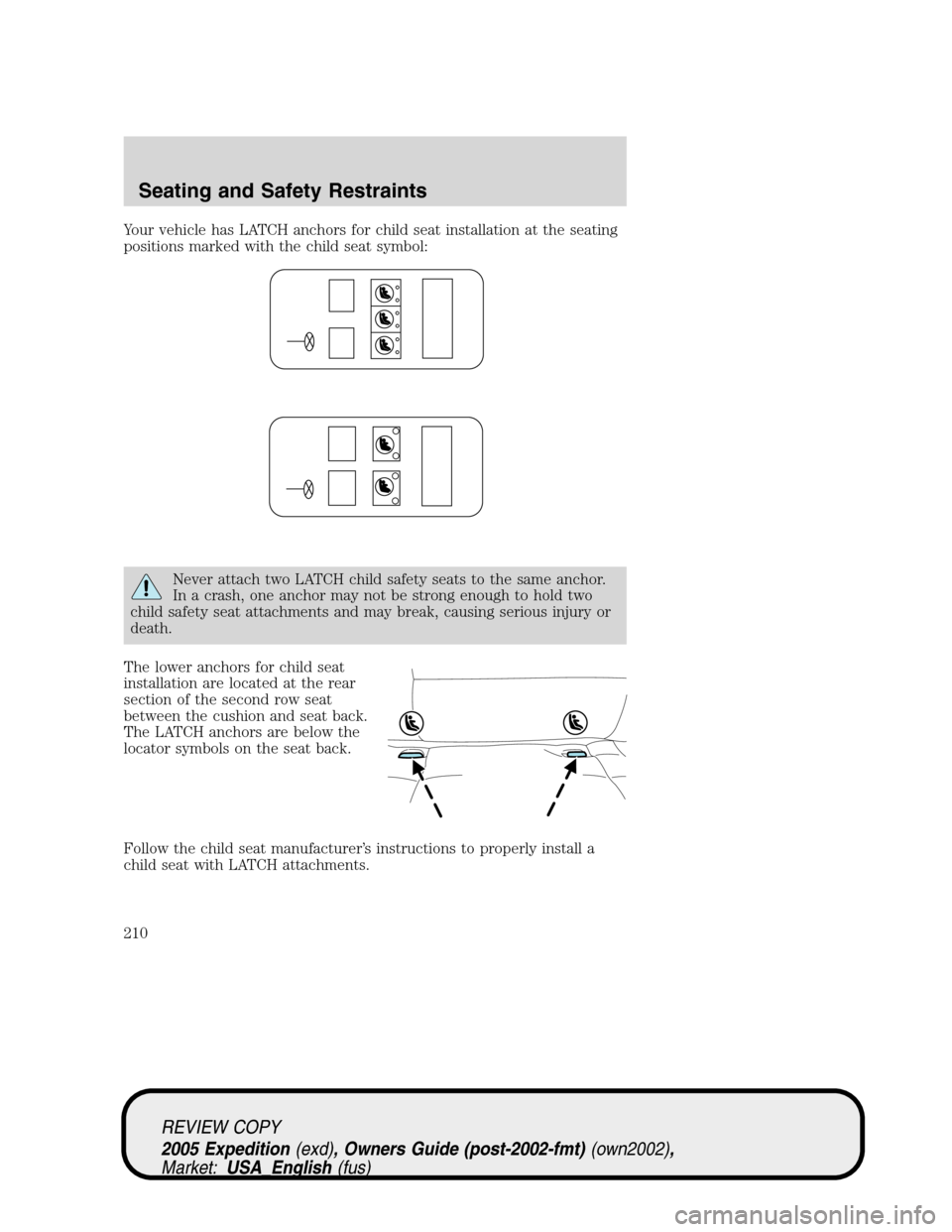
Your vehicle has LATCH anchors for child seat installation at the seating
positions marked with the child seat symbol:
Never attach two LATCH child safety seats to the same anchor.
In a crash, one anchor may not be strong enough to hold two
child safety seat attachments and may break, causing serious injury or
death.
The lower anchors for child seat
installation are located at the rear
section of the second row seat
between the cushion and seat back.
The LATCH anchors are below the
locator symbols on the seat back.
Follow the child seat manufacturer’s instructions to properly install a
child seat with LATCH attachments.
REVIEW COPY
2005 Expedition(exd), Owners Guide (post-2002-fmt)(own2002),
Market:USA_English(fus)
Seating and Safety Restraints
210
Page 211 of 368
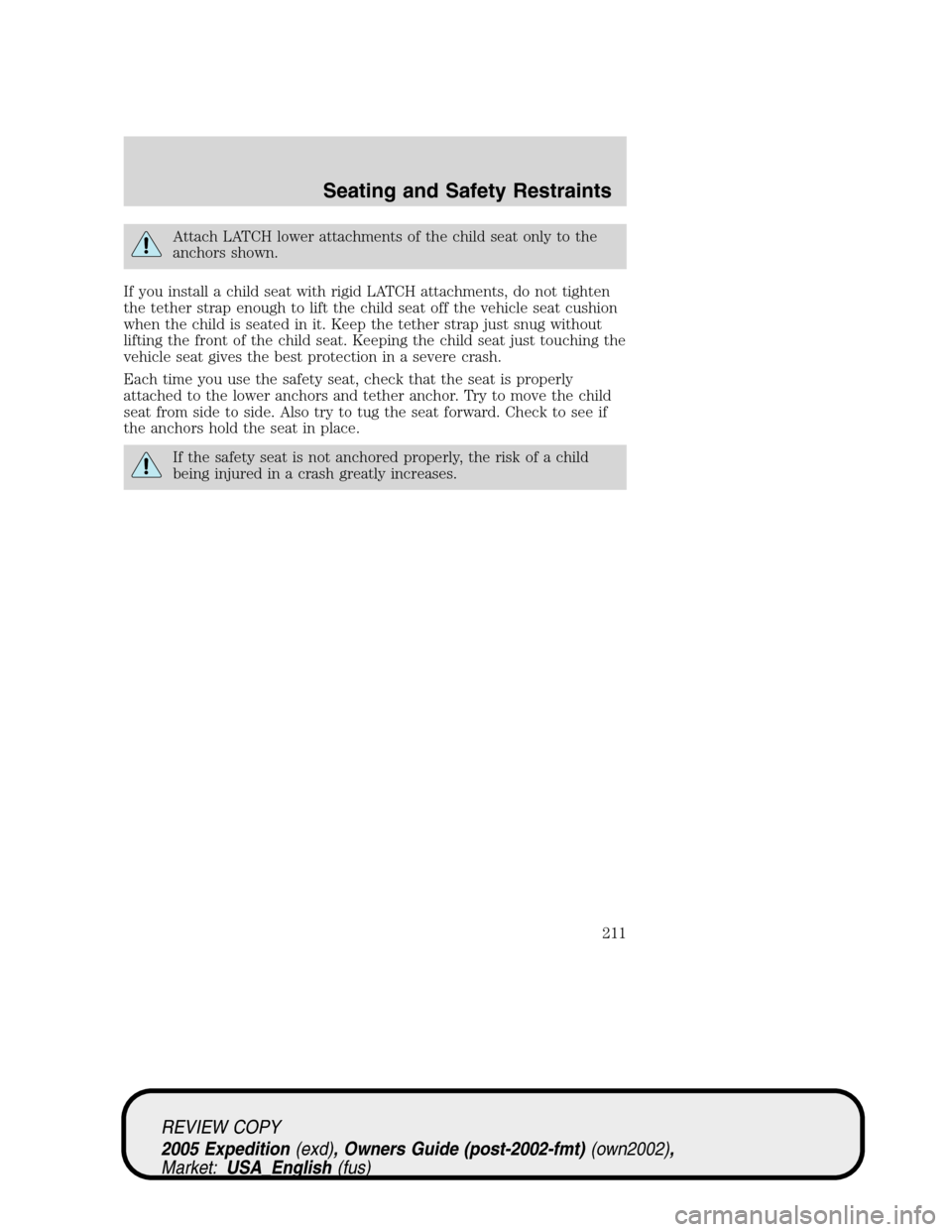
Attach LATCH lower attachments of the child seat only to the
anchors shown.
If you install a child seat with rigid LATCH attachments, do not tighten
the tether strap enough to lift the child seat off the vehicle seat cushion
when the child is seated in it. Keep the tether strap just snug without
lifting the front of the child seat. Keeping the child seat just touching the
vehicle seat gives the best protection in a severe crash.
Each time you use the safety seat, check that the seat is properly
attached to the lower anchors and tether anchor. Try to move the child
seat from side to side. Also try to tug the seat forward. Check to see if
the anchors hold the seat in place.
If the safety seat is not anchored properly, the risk of a child
being injured in a crash greatly increases.
REVIEW COPY
2005 Expedition(exd), Owners Guide (post-2002-fmt)(own2002),
Market:USA_English(fus)
Seating and Safety Restraints
211
Page 212 of 368
NOTICE TO UTILITY VEHICLE AND TRUCK OWNERS
Utility vehicles and trucks handle
differently than passenger cars in
the various driving conditions that
are encountered on streets,
highways and off-road. Utility
vehicles and trucks are not designed
for cornering at speeds as high as
passenger cars any more than
low-slung sports cars are designed
to perform satisfactorily under
off-road conditions.
Utility vehicles have a significantly higher rollover rate than
other types of vehicles. To reduce the risk of serious injury or
death from a rollover or other crash you must:
•Avoid sharp turns and abrupt maneuvers;
•Drive at safe speeds for the conditions;
•Keep tires properly inflated;
•Never overload or improperly load your vehicle; and
•Make sure every passenger is properly restrained.
In a rollover crash, an unbelted person is significantly more likely
to die than a person wearing a seat belt. All occupants must
wear safety belts and children/infants must use appropriate restraints
to minimize the risk of injury or ejection.
Study yourOwner’s Guideand any supplements for specific information
about equipment features, instructions for safe driving and additional
precautions to reduce the risk of an accident or serious injury.
VEHICLE CHARACTERISTICS
4WD and AWD Systems (if equipped)
A vehicle equipped with AWD or 4WD (when you select the 4WD mode)
has the ability to use all four wheels to power itself. This increases
traction which may enable you to safely drive over terrain and road
conditions that a conventional two-wheel drive vehicle cannot.
REVIEW COPY
2005 Expedition(exd), Owners Guide (post-2002-fmt)(own2002),
Market:USA_English(fus)
Tires, Wheels and Loading
Tires, Wheels and Loading
212
Page 362 of 368
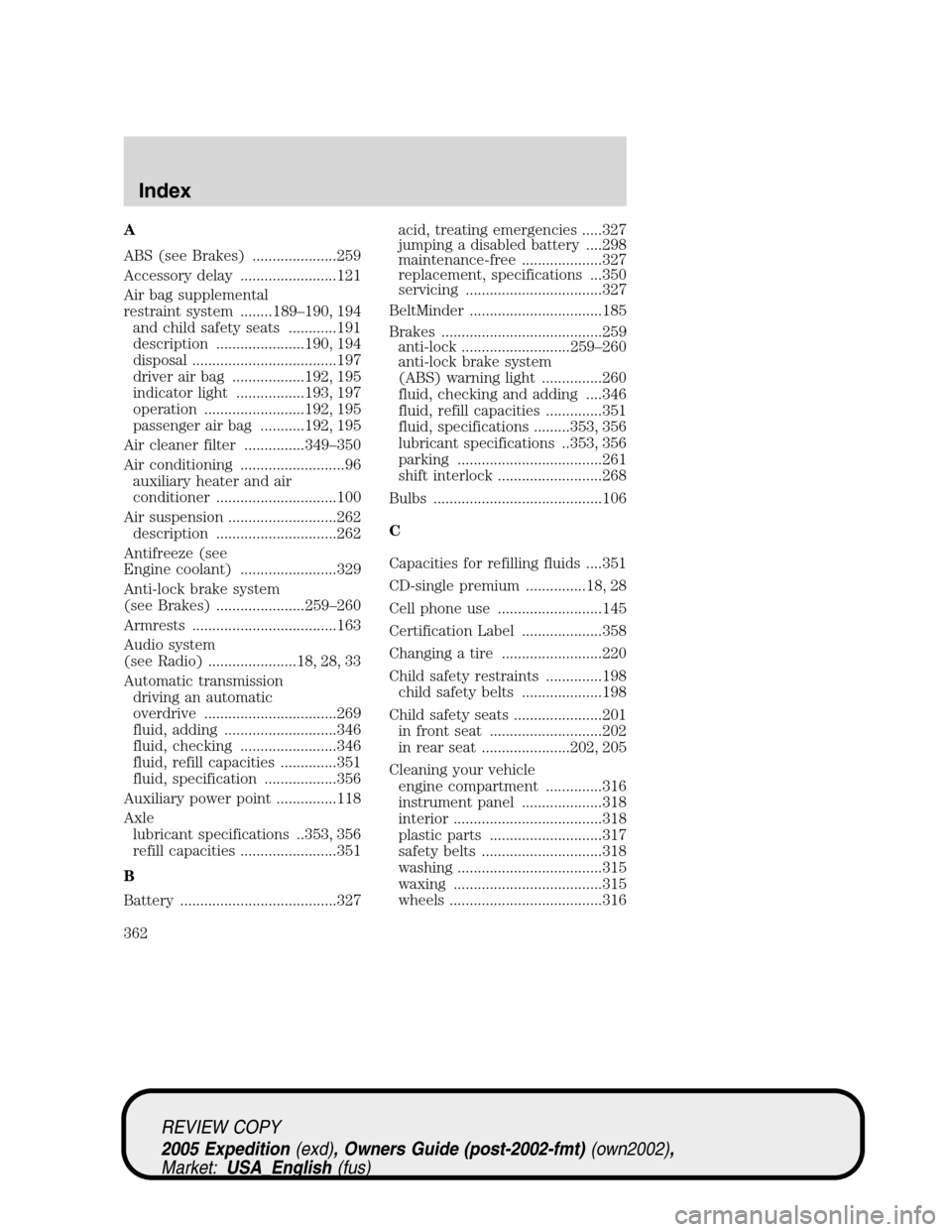
A
ABS (see Brakes) .....................259
Accessory delay ........................121
Air bag supplemental
restraint system ........189–190, 194
and child safety seats ............191
description ......................190, 194
disposal ....................................197
driver air bag ..................192, 195
indicator light .................193, 197
operation .........................192, 195
passenger air bag ...........192, 195
Air cleaner filter ...............349–350
Air conditioning ..........................96
auxiliary heater and air
conditioner ..............................100
Air suspension ...........................262
description ..............................262
Antifreeze (see
Engine coolant) ........................329
Anti-lock brake system
(see Brakes) ......................259–260
Armrests ....................................163
Audio system
(see Radio) ......................18, 28, 33
Automatic transmission
driving an automatic
overdrive .................................269
fluid, adding ............................346
fluid, checking ........................346
fluid, refill capacities ..............351
fluid, specification ..................356
Auxiliary power point ...............118
Axle
lubricant specifications ..353, 356
refill capacities ........................351
B
Battery .......................................327acid, treating emergencies .....327
jumping a disabled battery ....298
maintenance-free ....................327
replacement, specifications ...350
servicing ..................................327
BeltMinder .................................185
Brakes ........................................259
anti-lock ...........................259–260
anti-lock brake system
(ABS) warning light ...............260
fluid, checking and adding ....346
fluid, refill capacities ..............351
fluid, specifications .........353, 356
lubricant specifications ..353, 356
parking ....................................261
shift interlock ..........................268
Bulbs ..........................................106
C
Capacities for refilling fluids ....351
CD-single premium ...............18, 28
Cell phone use ..........................145
Certification Label ....................358
Changing a tire .........................220
Child safety restraints ..............198
child safety belts ....................198
Child safety seats ......................201
in front seat ............................202
in rear seat ......................202, 205
Cleaning your vehicle
engine compartment ..............316
instrument panel ....................318
interior .....................................318
plastic parts ............................317
safety belts ..............................318
washing ....................................315
waxing .....................................315
wheels ......................................316
REVIEW COPY
2005 Expedition(exd), Owners Guide (post-2002-fmt)(own2002),
Market:USA_English(fus)
Index
Index
362
Page 366 of 368
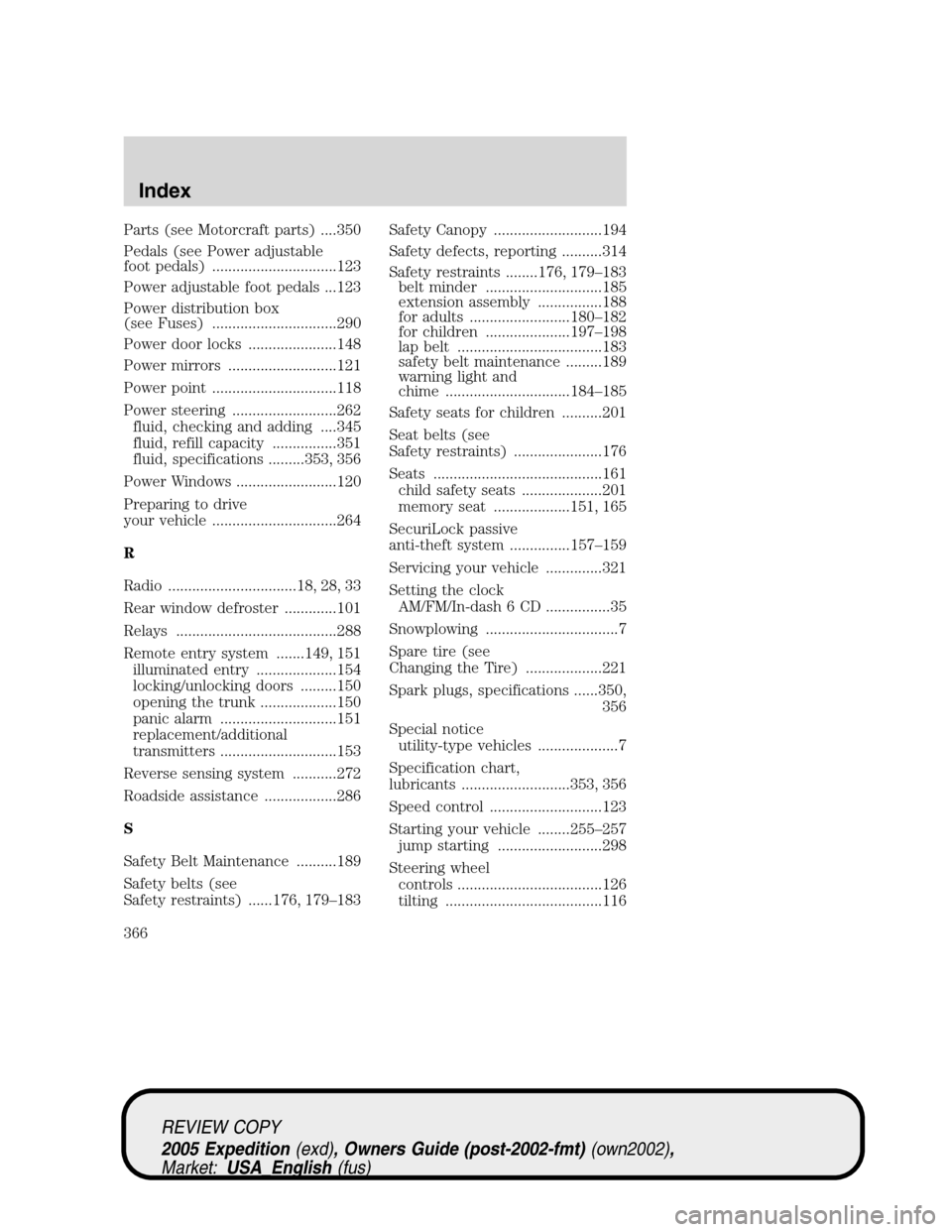
Parts (see Motorcraft parts) ....350
Pedals (see Power adjustable
foot pedals) ...............................123
Power adjustable foot pedals ...123
Power distribution box
(see Fuses) ...............................290
Power door locks ......................148
Power mirrors ...........................121
Power point ...............................118
Power steering ..........................262
fluid, checking and adding ....345
fluid, refill capacity ................351
fluid, specifications .........353, 356
Power Windows .........................120
Preparing to drive
your vehicle ...............................264
R
Radio ................................18, 28, 33
Rear window defroster .............101
Relays ........................................288
Remote entry system .......149, 151
illuminated entry ....................154
locking/unlocking doors .........150
opening the trunk ...................150
panic alarm .............................151
replacement/additional
transmitters .............................153
Reverse sensing system ...........272
Roadside assistance ..................286
S
Safety Belt Maintenance ..........189
Safety belts (see
Safety restraints) ......176, 179–183Safety Canopy ...........................194
Safety defects, reporting ..........314
Safety restraints ........176, 179–183
belt minder .............................185
extension assembly ................188
for adults .........................180–182
for children .....................197–198
lap belt ....................................183
safety belt maintenance .........189
warning light and
chime ...............................184–185
Safety seats for children ..........201
Seat belts (see
Safety restraints) ......................176
Seats ..........................................161
child safety seats ....................201
memory seat ...................151, 165
SecuriLock passive
anti-theft system ...............157–159
Servicing your vehicle ..............321
Setting the clock
AM/FM/In-dash 6 CD ................35
Snowplowing .................................7
Spare tire (see
Changing the Tire) ...................221
Spark plugs, specifications ......350,
356
Special notice
utility-type vehicles ....................7
Specification chart,
lubricants ...........................353, 356
Speed control ............................123
Starting your vehicle ........255–257
jump starting ..........................298
Steering wheel
controls ....................................126
tilting .......................................116
REVIEW COPY
2005 Expedition(exd), Owners Guide (post-2002-fmt)(own2002),
Market:USA_English(fus)
Index
366