battery FORD EXPLORER 1997 2.G User Guide
[x] Cancel search | Manufacturer: FORD, Model Year: 1997, Model line: EXPLORER, Model: FORD EXPLORER 1997 2.GPages: 236, PDF Size: 2.43 MB
Page 169 of 236
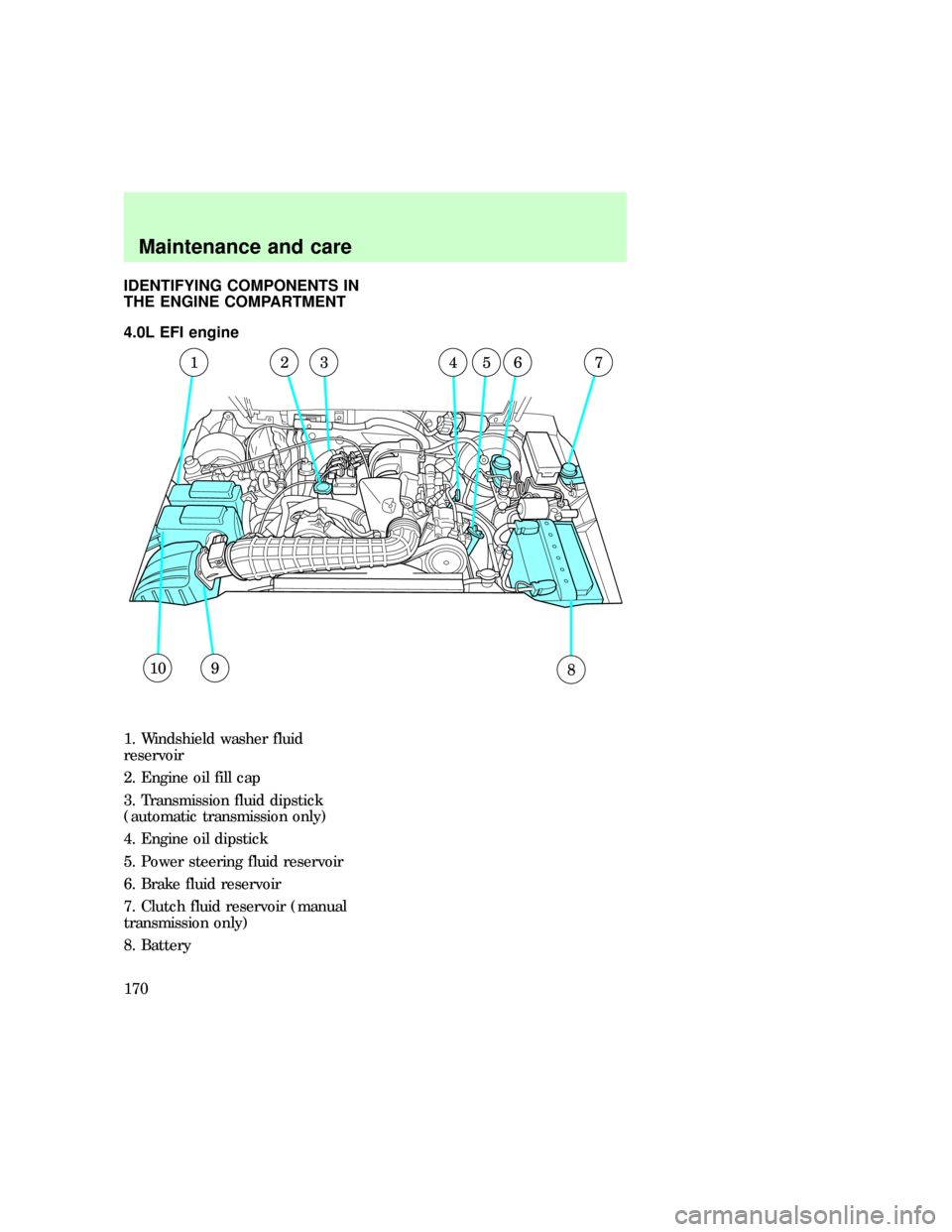
IDENTIFYING COMPONENTS IN
THE ENGINE COMPARTMENT
4.0L EFI engine
1. Windshield washer fluid
reservoir
2. Engine oil fill cap
3. Transmission fluid dipstick
(automatic transmission only)
4. Engine oil dipstick
5. Power steering fluid reservoir
6. Brake fluid reservoir
7. Clutch fluid reservoir (manual
transmission only)
8. Battery
10
1235674
89
com_4.0L-ohv
Maintenance and care
170
Page 170 of 236
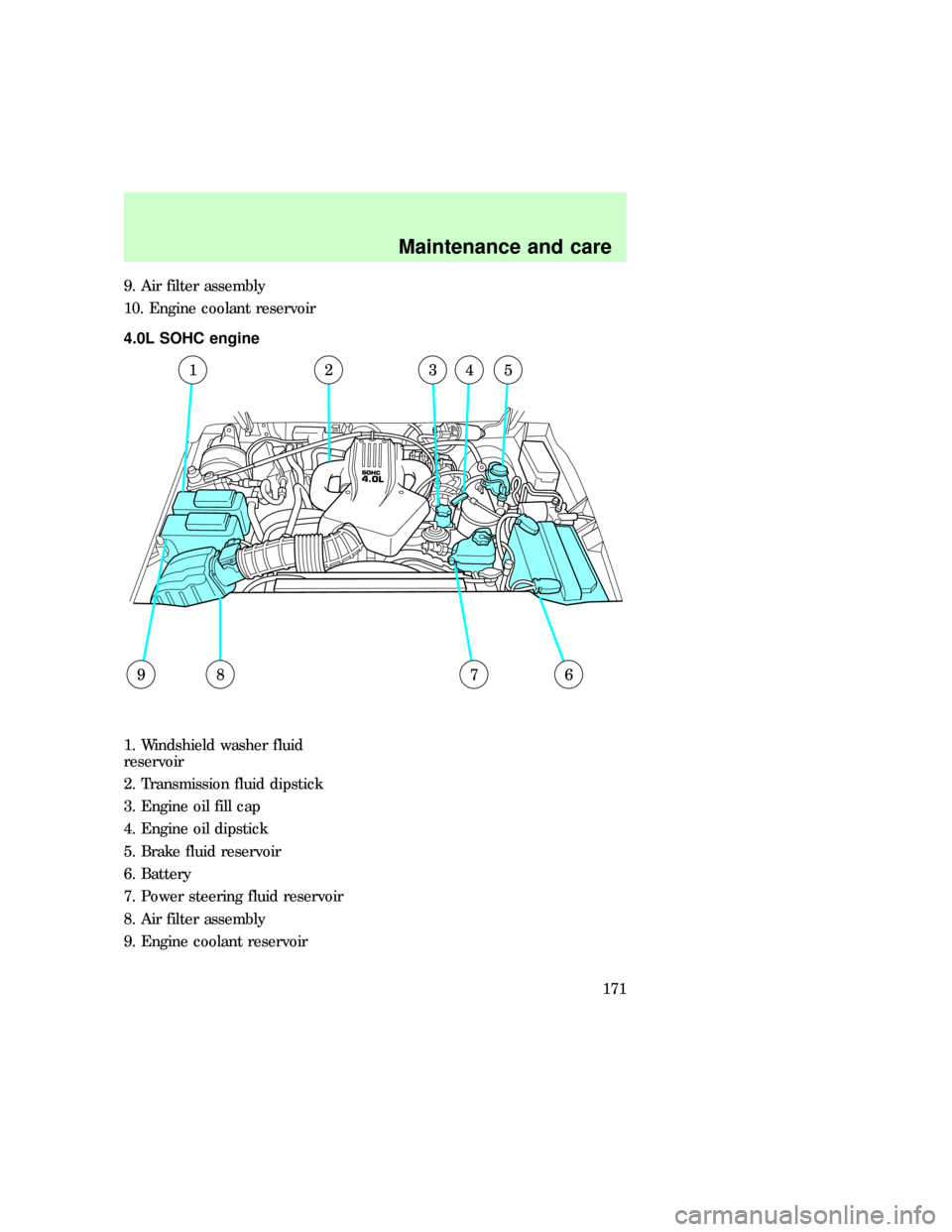
9. Air filter assembly
10. Engine coolant reservoir
4.0L SOHC engine
1. Windshield washer fluid
reservoir
2. Transmission fluid dipstick
3. Engine oil fill cap
4. Engine oil dipstick
5. Brake fluid reservoir
6. Battery
7. Power steering fluid reservoir
8. Air filter assembly
9. Engine coolant reservoir
9
13425
867
com_4.0L-ohc
com_5.0L
Maintenance and care
171
Page 171 of 236
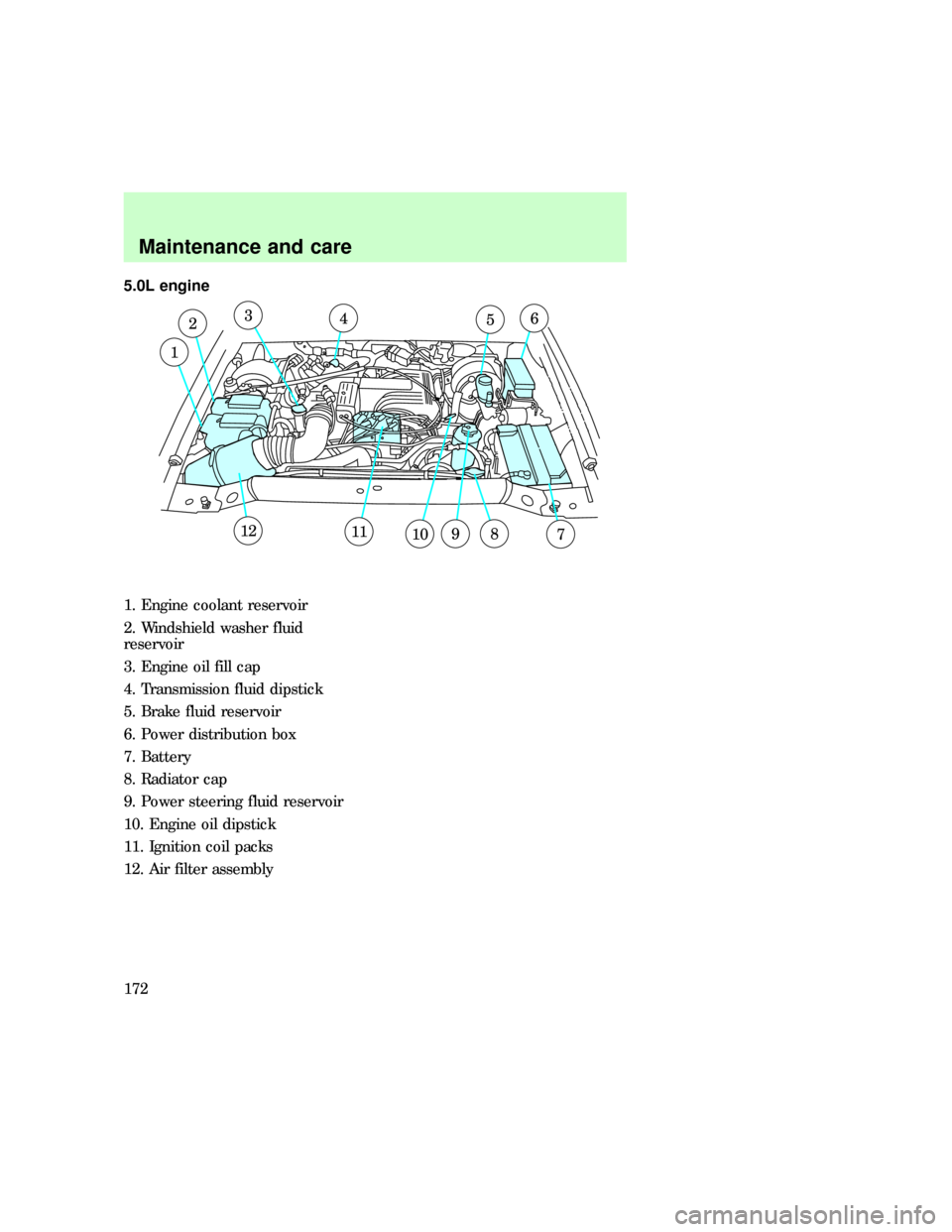
5.0L engine
1. Engine coolant reservoir
2. Windshield washer fluid
reservoir
3. Engine oil fill cap
4. Transmission fluid dipstick
5. Brake fluid reservoir
6. Power distribution box
7. Battery
8. Radiator cap
9. Power steering fluid reservoir
10. Engine oil dipstick
11. Ignition coil packs
12. Air filter assembly
1
236
7
54
81011912
com_check-add_oil.01
Maintenance and care
172
Page 187 of 236
lubricate the driveline joint
according to the maintenance
intervals specified in theService
Guide.
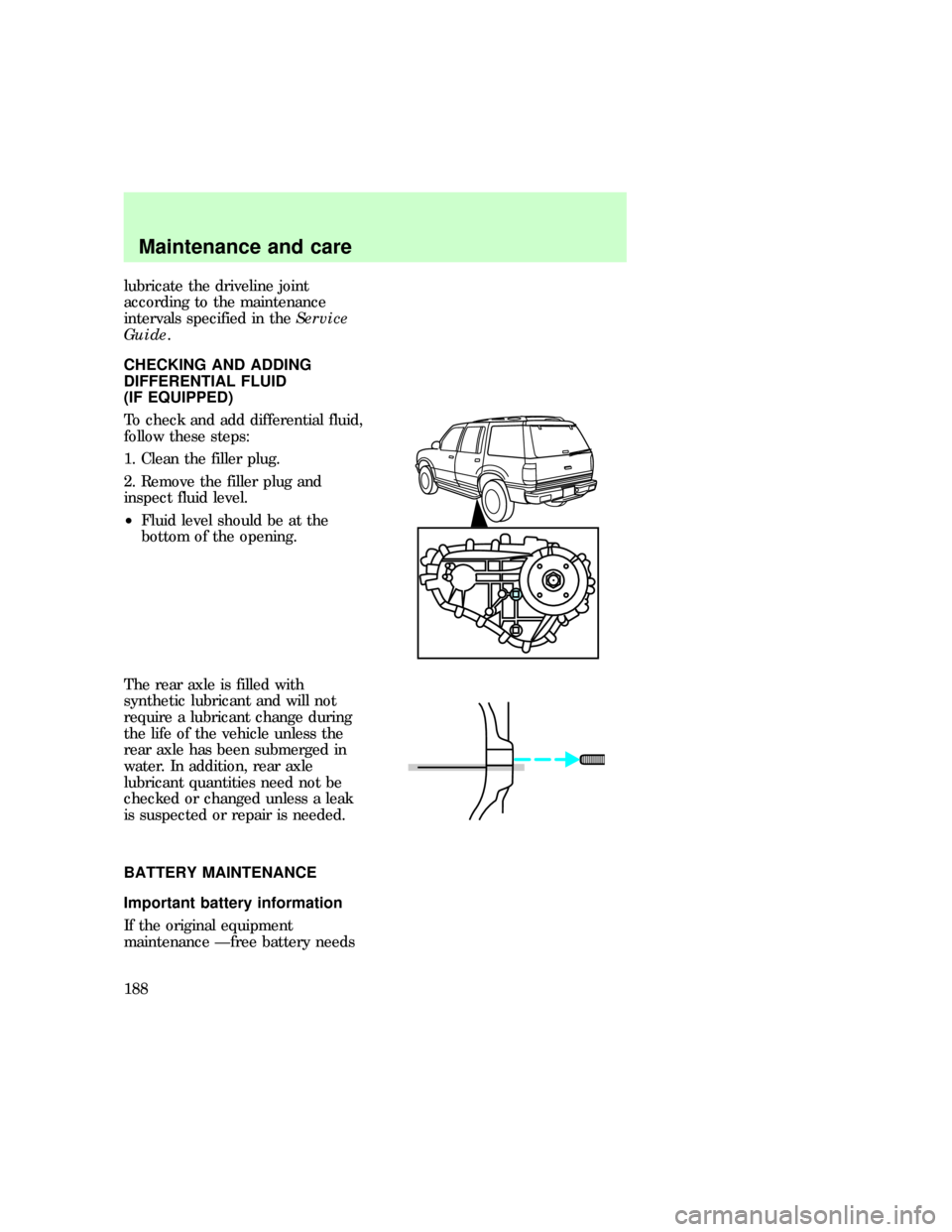
CHECKING AND ADDING
DIFFERENTIAL FLUID
(IF EQUIPPED)
To check and add differential fluid,
follow these steps:
1. Clean the filler plug.
2. Remove the filler plug and
inspect fluid level.
²Fluid level should be at the
bottom of the opening.
The rear axle is filled with
synthetic lubricant and will not
require a lubricant change during
the life of the vehicle unless the
rear axle has been submerged in
water. In addition, rear axle
lubricant quantities need not be
checked or changed unless a leak
is suspected or repair is needed.
BATTERY MAINTENANCE
Important battery information
If the original equipment
maintenance Ðfree battery needs
uno_differentail_fluid
uno_battery_title
uno_info_battery
Maintenance and care
188
Page 188 of 236
replacement, it may be replaced
with a low-maintenance battery.
For information on appropriate
replacement batteries, refer to
Motorcraft partsin theCapacities
and specificationschapter.
Applying too much
pressure on the ends when
lifting a battery could cause acid
to spill. Lift the battery with a
carrier or with your hands on the
opposite corners.
Batteries normally produce
explosive gases which can
cause personal injury. Do not
allow flames, sparks or lit
tobacco to come near the
battery. Always cover your face
and protect your eyes and also
provide ventilation.
Follow these steps to
minimize risk of personal
injury.
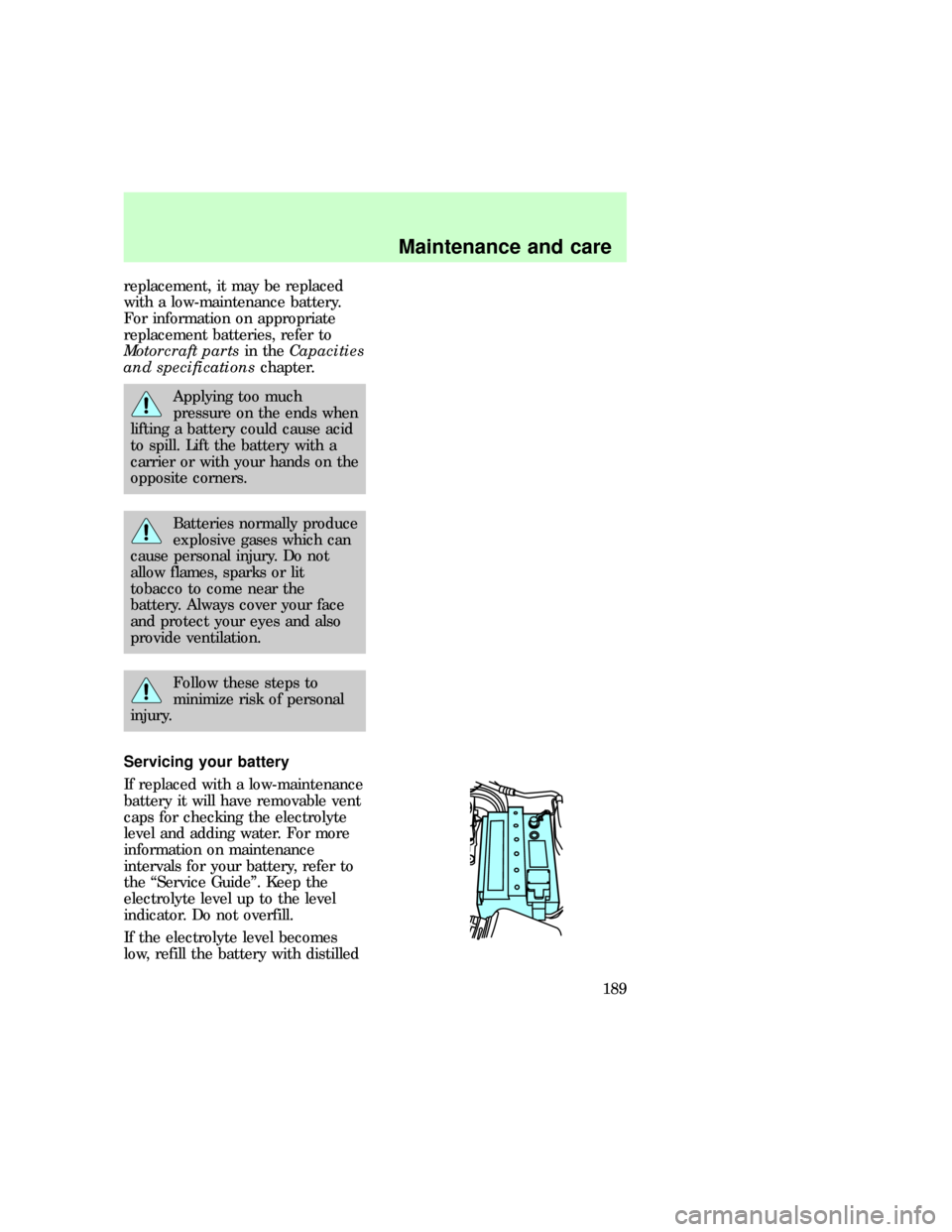
Servicing your battery
If replaced with a low-maintenance
battery it will have removable vent
caps for checking the electrolyte
level and adding water. For more
information on maintenance
intervals for your battery, refer to
the ªService Guideº. Keep the
electrolyte level up to the level
indicator. Do not overfill.
If the electrolyte level becomes
low, refill the battery with distilled
uno_servicing_battery
Maintenance and care
189
Page 189 of 236

water. If necessary, distilled water
may be substituted with tap water
that is not hard and does not have
high mineral or alkali content. If
the battery needs water often,
have the charging system checked
for a possible malfunction.
Relearning the idle function
Because your vehicle's engine is
electronically controlled, some
control conditions are maintained
by power from the battery. When
the battery is disconnected or a
new battery is installed, the
computer must ªrelearnº its idle
conditions before your vehicle can
drive properly. To begin this
process:
Maintenance and care
190
Page 190 of 236
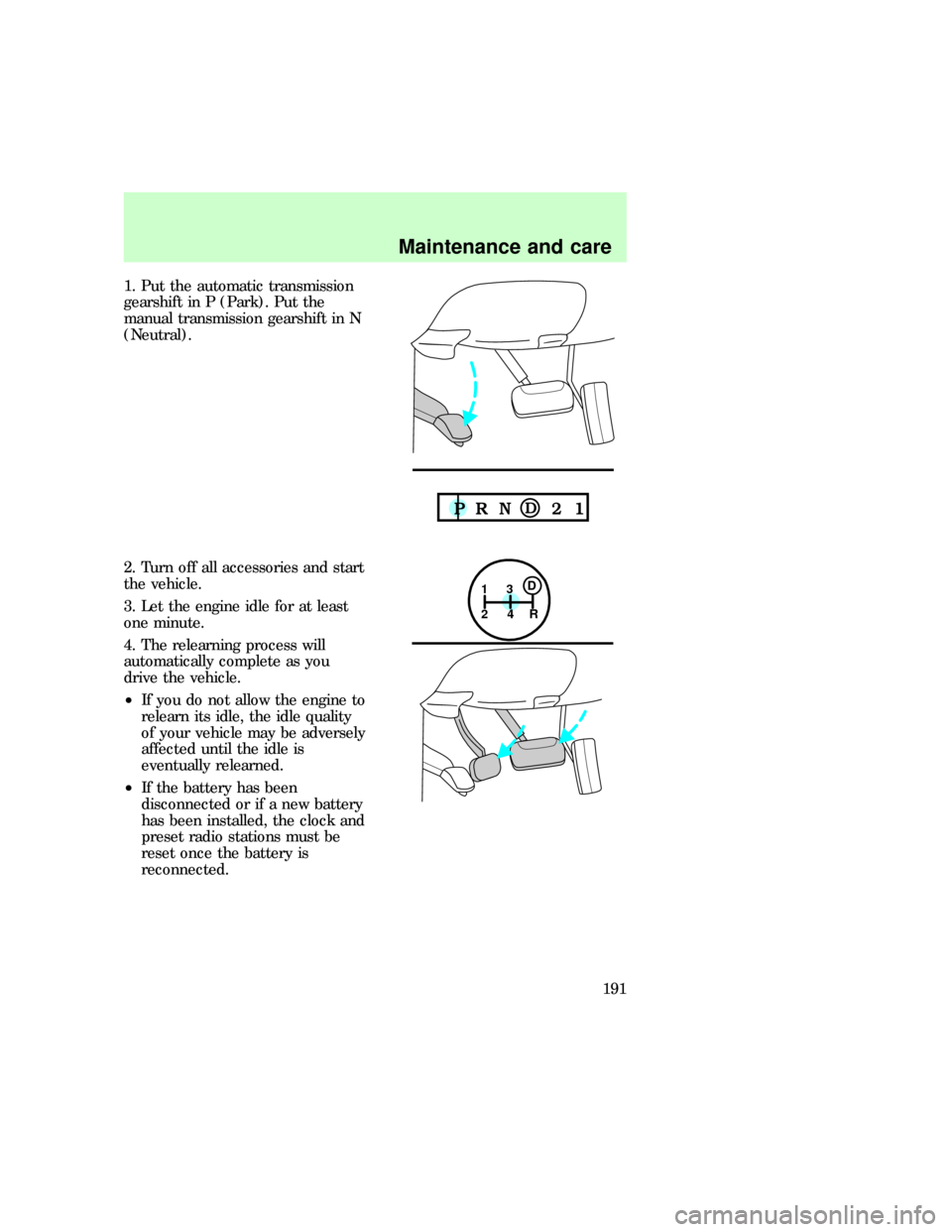
1. Put the automatic transmission
gearshift in P (Park). Put the
manual transmission gearshift in N
(Neutral).
2. Turn off all accessories and start
the vehicle.
3. Let the engine idle for at least
one minute.
4. The relearning process will
automatically complete as you
drive the vehicle.
²If you do not allow the engine to
relearn its idle, the idle quality
of your vehicle may be adversely
affected until the idle is
eventually relearned.
²If the battery has been
disconnected or if a new battery
has been installed, the clock and
preset radio stations must be
reset once the battery is
reconnected.
1
24R3D
Maintenance and care
191
Page 191 of 236
Always dispose of automotive
batteries in a responsible manner.
Follow your community's local
standards for disposal. Call your
local recycling center to find out
more about recycling automotive
batteries.
Battery saver control feature
Your vehicle is equipped with a
battery saver control feature
designed to prevent your battery
from accidental wear down due to
doors left ajar. For information on
the system and its function, refer
to theControls and features
chapter.
AIR CLEANER FILTER
MAINTENANCE
Refer to the ªService Guideº for
the appropriate intervals for
changing the air cleaner filter.
Do not start your engine
with the air cleaner
removed and do not remove it
while the engine is running.
uno_saver_battery_feature
uno_air_filter_maint
uno_changing_air_filter
Maintenance and care
192
Page 208 of 236

the on-board diagnostic (OBD-II)
system. If your ªcheck
engine/service engine soonº light is
on, reference the applicable light
description in theWarning Lights
and Gaugessection of your
owners guide. Your vehicle may
not pass the I/M test with the
ªcheck engine/service engine soonº
light on.
If the vehicle's powertrain system
or its battery has just been
serviced, the OBD-II system is
reset to a ªnot ready for I/M testº
condition. To ready the OBD-II
system for I/M testing, a minimum
of 30 minutes of city and highway
driving is necessary as described
below:
²First, at least ten minutes of
driving on an expressway or
highway.
²Next, at least twenty minutes
driving in stop and go, city type
traffic with at least four idle
periods.
Allow the vehicle to sit for at least
8 hours without starting the
engine. Then, start the engine and
complete the above driving cycle.
The engine must warm up to it's
normal operating temperature.
Once started, do not turn off the
engine until the above driving
cycle is complete.
Maintenance and care
209
Page 221 of 236

MOTORCRAFT PART NUMBERS
Component 4.0L EFI
engine4.0L SOHC
engine5.0L engine
Air filter FA-1616 FA-1658 FA-1658
Fuel filter FG-872 FG-872 FG-872
Battery
(standard)BXT-58 BXT-58 BXT-65-650
Battery
(optional)BXT-65-650 BXT-65-650 BXT-65-850
Oil filter FL-1A FL-1A FL-820S
PCV valve EV-225 EV-225 EV-152
Spark plug
1AGSF-22PP2AGSF-22PP2AWSF-32EE3
1
Refer to the Vehicle Emission
Control Information (VECI) decal
in the engine for gap
specifications. If a spark plug must
be replaced, use only spark plugs
with the service number suffix
letter EE as shown on the engine
decal.
2If a spark plug is removed for
inspection, it must be reinstalled in
the same cylinder. Cylinder
numbers 1, 2, 3 have a PG suffix.
Cylinder numbers 4, 5, 6 have a P
suffix.
3If a spark plug is removed for
inspection it must be reinstalled in
the same cylinder. Cylinder
numbers 1, 2, 3, 4 have an EG
suffix. Cylinder numbers 5, 6, 7, 8
have an E suffix.
com_explorer-part-numbers
Capacities and specifications
222