wheel FORD EXPLORER 1997 2.G Owner's Manual
[x] Cancel search | Manufacturer: FORD, Model Year: 1997, Model line: EXPLORER, Model: FORD EXPLORER 1997 2.GPages: 236, PDF Size: 2.43 MB
Page 162 of 236

WRECKER TOWING
Ford recommends that your
vehicle be towed with wheel lift
and dollies or flatbed equipment.
Do not tow with slingbelt
equipment. Ford Motor Company
has not developed or approved a
T-hook or slingbelt towing
procedure.
For vehicles equipped with control
trac, the ignition must be in the
OFF position when towing.
When calling for a tow truck, tell
the operator what kind of vehicle
you have. A towing manual is
available for Ford Motor Company
Roadside emergencies
163
Page 163 of 236

for all authorized tow truck
operators. Have your tow truck
driver refer to this manual for
proper hook-up and towing
procedures.
Neutral tow kit accessory
Neutral tow feature is an option
which can be activated at any
dealership that has a Service Bay
Diagnostic System (SBDS). When
activated the feature may be
enabled by following the
instruction located on the visor or
the headliner.
The feature is available on vehicles
with Control Trac and automatic
transmission only. It is not
available on vehicles with
All-Wheel Drive.
There are no wrecker or
recreational vehicle towing
restrictions on method or distance
if the above feature is activated
and enabled.
See your dealer for more
information.
uno_tow-kit
Roadside emergencies
164
Page 165 of 236
could get caught in moving
parts. Take precautions with
long hair.
²Do not work on a vehicle with
the engine running in an
enclosed space, unless you are
sure you have enough
ventilation.
²Keep all lit cigarettes, open
flames and other lit material
away from the battery and all
fuel related parts.
If you disconnect the battery, the
engine must ªrelearnº its idle
conditions before your vehicle will
drive properly, as explained in
Batteryin this chapter.
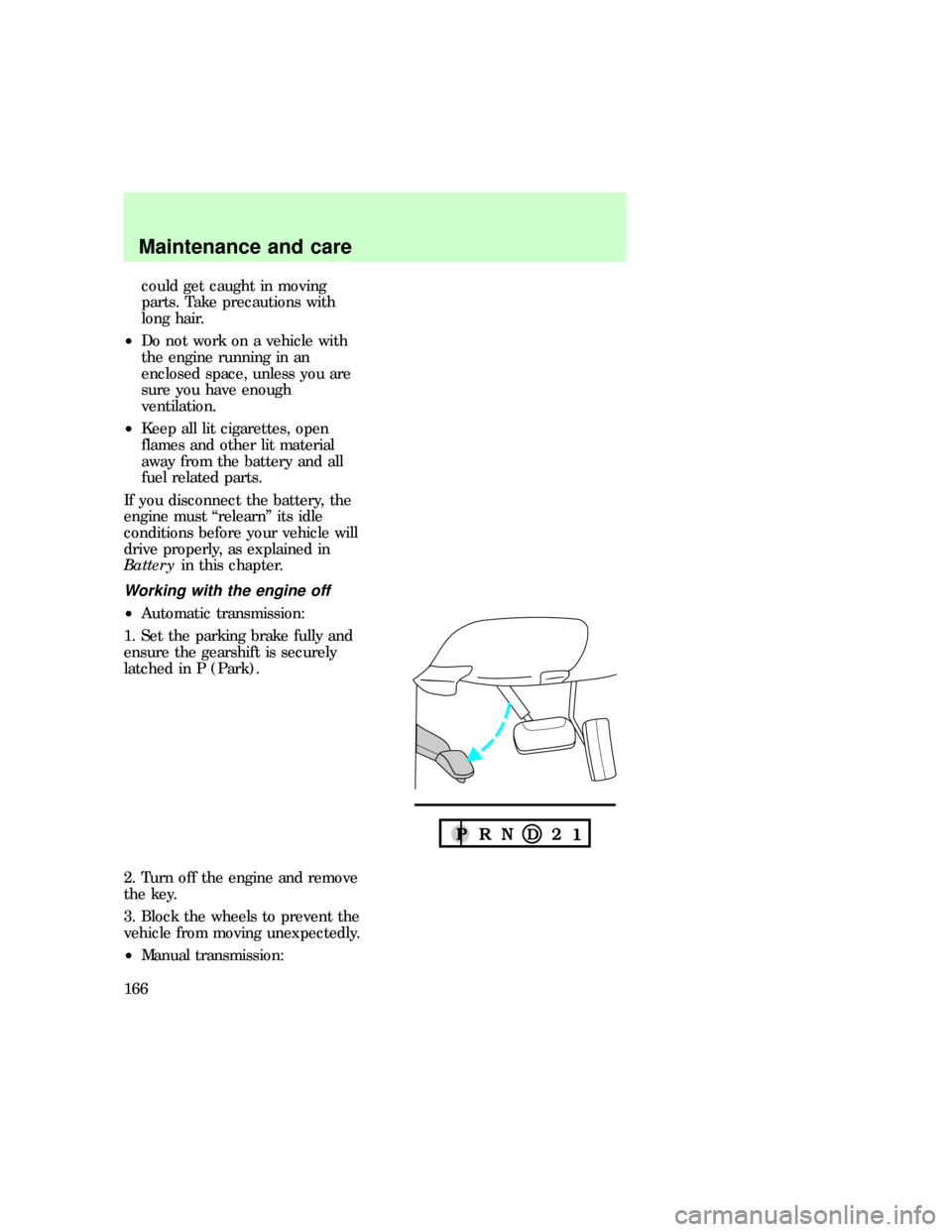
Working with the engine off
²Automatic transmission:
1. Set the parking brake fully and
ensure the gearshift is securely
latched in P (Park).
2. Turn off the engine and remove
the key.
3. Block the wheels to prevent the
vehicle from moving unexpectedly.
²Manual transmission:
uno_working_off
Maintenance and care
166
Page 166 of 236
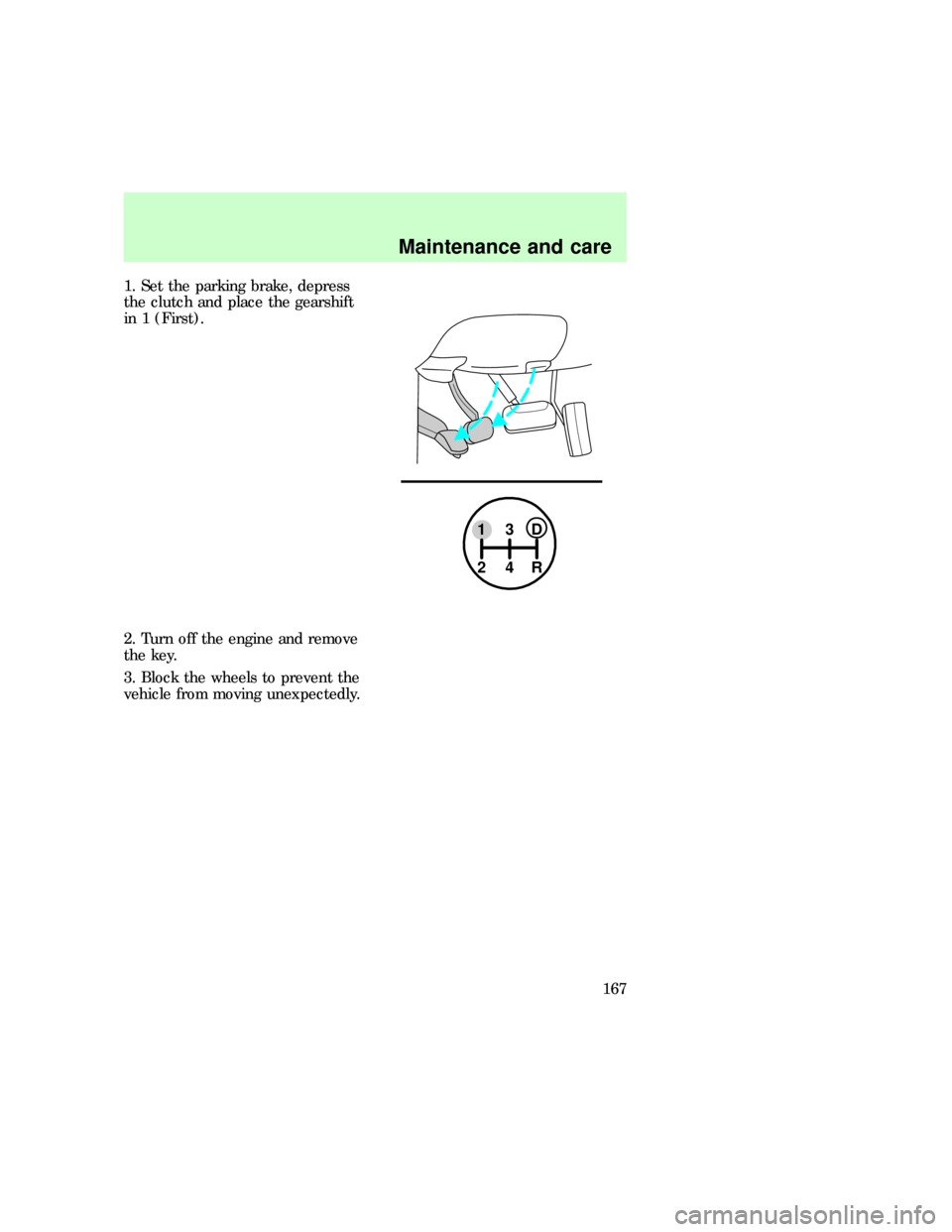
1. Set the parking brake, depress
the clutch and place the gearshift
in 1 (First).
2. Turn off the engine and remove
the key.
3. Block the wheels to prevent the
vehicle from moving unexpectedly.
13D
24R
uno_working_on
Maintenance and care
167
Page 167 of 236
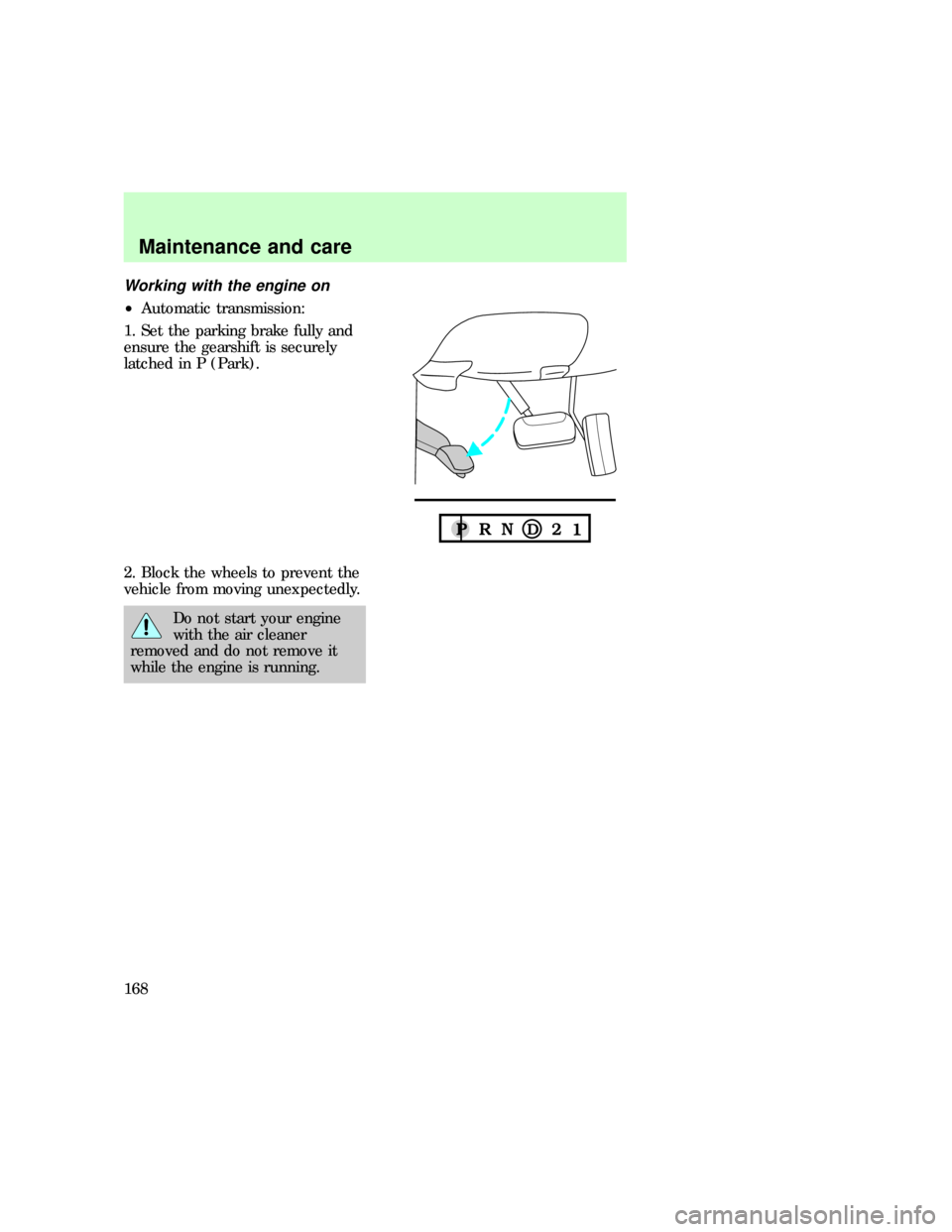
Working with the engine on
²Automatic transmission:
1. Set the parking brake fully and
ensure the gearshift is securely
latched in P (Park).
2. Block the wheels to prevent the
vehicle from moving unexpectedly.
Do not start your engine
with the air cleaner
removed and do not remove it
while the engine is running.
Maintenance and care
168
Page 168 of 236
²Manual transmission:
1. Set the parking brake fully, and
make sure the gearshift is securely
latched in Neutral.
2. Block the wheels to prevent the
vehicle from moving unexpectedly.
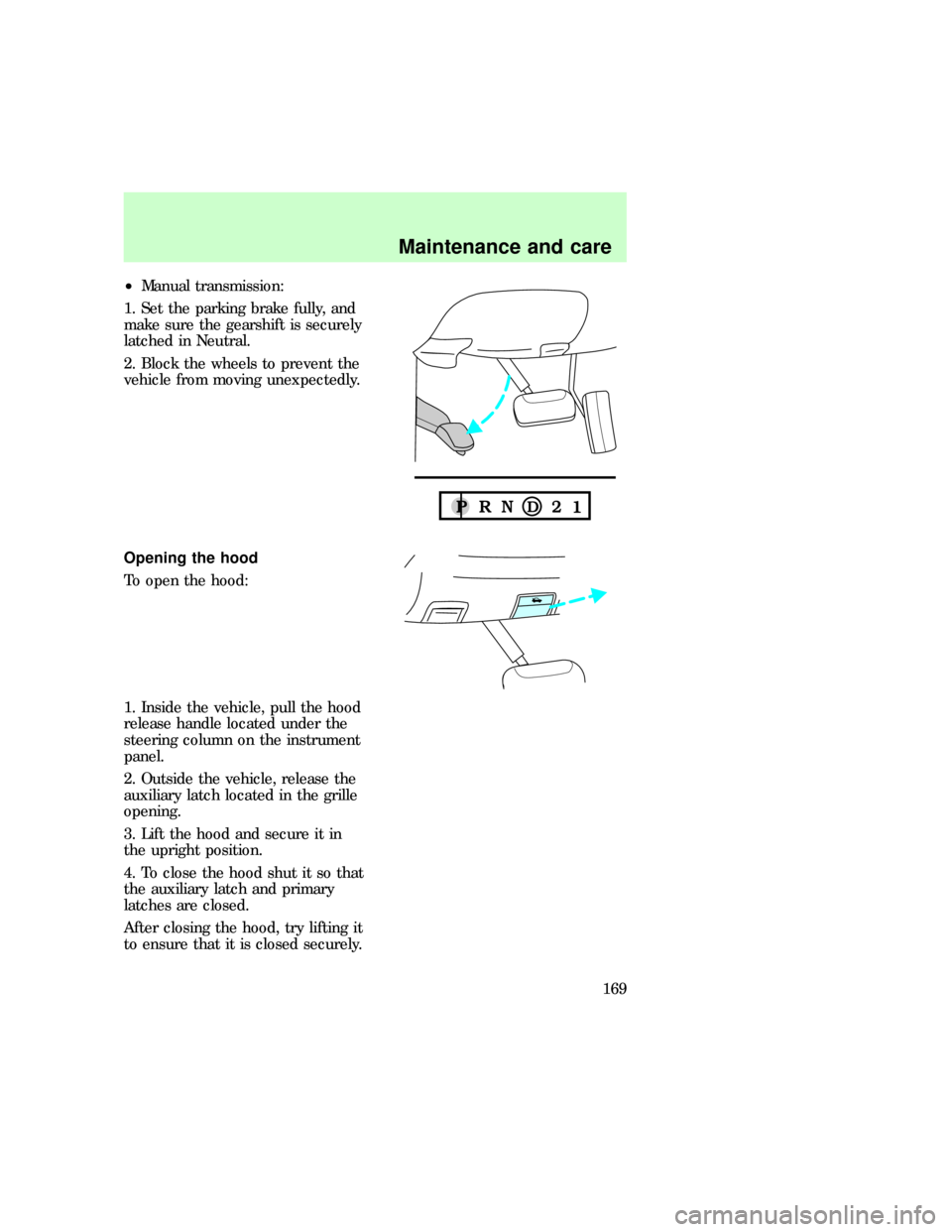
Opening the hood
To open the hood:
1. Inside the vehicle, pull the hood
release handle located under the
steering column on the instrument
panel.
2. Outside the vehicle, release the
auxiliary latch located in the grille
opening.
3. Lift the hood and secure it in
the upright position.
4. To close the hood shut it so that
the auxiliary latch and primary
latches are closed.
After closing the hood, try lifting it
to ensure that it is closed securely.
uno_opening_hood
com_engine-comp
Maintenance and care
169
Page 196 of 236
Warning: The traction grade
assigned to this tire is based on
braking (straightahead) traction
tests and does not include
cornering (turning) traction.
Temperature A B C
The temperature grades are A (the
highest), B, and C, representing
the tire's resistance to the
generation of heat and its ability to
dissipate heat when tested under
controlled conditions on a
specified indoor laboratory test
wheel. Sustained high temperature
can cause the material of the tire
to degenerate and reduce tire life,
and excessive temperature can
lead to sudden tire failure. The
grade C corresponds to a level of
performance which all passenger
car tires must meet under the
Federal Motor Vehicle Safety
Standard No. 109. Grades B and A
represent higher levels of
performance on the laboratory test
wheel than the minimum required
by law.
The temperature grade for
this tire is established for a
tire that is properly inflated and
not overloaded. Excessive speed,
underinflation, or excessive
loading, either separately or in
combination, can cause heat
buildup and possible tire failure.
Checking the tire pressure
Check the tire pressure
periodically and inflate tires as
com_temperature_abc.01
uno_pressure_tires
Maintenance and care
197
Page 199 of 236
Make sure that all
replacement tires are of
the same size, type, load-carrying
capacity and tread design (e.g.,
ªAll Terrainº, etc.), as originally
offered by Ford.
Do not replace your tires
with ªhigh performanceª
tires or larger size tires.
Failure to follow these
precautions may adversely
affect the handling of the vehicle
and make it easier to lose control
and roll over.
Refer to the Safety Compliance
Certification label to determine the
specific size tire and wheel Ford
Motor Company recommends for
use on this vehicle.
When purchasing replacement tires
for your vehicle, consult your
dealer or qualified service
technician to ensure that the
correct tire types are used.
uno_snow_tires
Maintenance and care
200
Page 215 of 236

any bugs and tar before waxing
vehicle. Use cleaning fluid or
alcohol with a clean cloth to
remove. Use tar remover to
remove any tar spots.
Repairing paint chips
Minor scratches or paint damage
from road debris may be repaired
with touch-up paint, paint repair
foil or aerosol paint spray from the
Ford accessory line. Observe the
application instructions on the
products.
Remove particles such as bird
droppings, tree sap, insect
remains, tar spots, road salt and
industrial fallout immediately.
Cleaning the wheels
Wash the wheels with the same
detergent you use to clean the
body of your vehicle. Do not use
acid-based wheel cleaners, steel
wool, fuel or strong detergents.
Never use abrasives that will
damage the finish of special wheel
surfaces. Use a tar remover to
remove grease and tar.
Cleaning the engine
Engines are more efficient when
they are clean because grease and
dirt buildup act as insulators and
keep the engine warmer than
normal. Follow these guidelines to
clean your engine:
²Take care when using a power
washer to clean the engine. The
com_repairing_chips
uno_wheels_cleaning
com_engine_cleaning.01
Maintenance and care
216
Page 226 of 236

ItemFord Part
NameFord Part
NumberFord
Specification
Accelerator
throttle lever
ball studPremium Long
Life GreaseXG-1-C ESA-M1C175-B
Ford
conventional and
traction lok rear
axlesMotorcraft SAE
Premium Rear
Axle LubricantXY-80W90-QL
123WSP-M2C197-A
Dana axles
(front)4x4 Gear Oil F1TZ-19580-A WSL-M2C191-A
Transfer case -
Four wheel
driveMotorcraft
MERCONt
Automatic
Transmission
FluidXT-2-QDX MERCONt
Brake and
clutch pedal
shaftPremium
Long-life GreaseXG-1-C or K ESA-M1C75-B
5-speed manual
transmissionMotorcraft
MERCON
tAutomatic
transmission
fluidXT-2-QDX MERCONt
Trnafer case
Front Output
Slip ShaftPremium
Long-Life GreaseXG-1-G or K ESA-M1C75-B
14.0 L Explorer Conventional and
Traction-lok rear axles are filled
with XY-80W90±QL, Ford
specification WSP-M2C197±A.
25.0 L Explorer Conventional and
Traction-Lok rear axles are filled
with Motorcraft Premium Synthetic
rear axle lubricant, F1TZ-19580±B,
Ford specification WSL-M2C192±A.
Capacities and specifications
227