brake FORD EXPLORER 1997 2.G Severe Duty Supplement Manual
[x] Cancel search | Manufacturer: FORD, Model Year: 1997, Model line: EXPLORER, Model: FORD EXPLORER 1997 2.GPages: 28, PDF Size: 0.36 MB
Page 5 of 28

Battery cables and connections5,000 km (3,000 miles)
or every three months
Fluid leaks5,000 km (3,000 miles)
or every three months
Brake fluid level5,000 km (3,000 miles)
or every three months
Front disc brake pads5,000 km (3,000 miles)
or every three months
Rear disc brake pads10,000 km (6,000
miles) or every six
months
IMPORTANT MAINTENANCE
PRECAUTIONS
For more information on
maintenance procedures and
precautions for your vehicle, refer
to theMaintenance and care
chapter of your ªOwner Guideº.
To determine the lubricant
specifications required for each
component, refer to the
Capacities and specifications
chapter of the ªOwner Guideº.
Storing your vehicle
During extended periods of vehicle
storage (60 days or more),
oxidation may cause gasoline to
deteriorate. Such deterioration
could be detrimental to your
vehicle's systems and performance.
A commercial fuel stabilizer (Ford
Gas Stabilizer E8AZ-19C544±A
[ESE-M99C112±A] or equivalent
should be added to vehicles when
Maintenance recommendations
5
Page 7 of 28
maintenance. Follow these general
safety precautions:
²Wear safety glasses for eye
protection.
²Use safety stands whenever a
procedure requires you to work
under the vehicle.
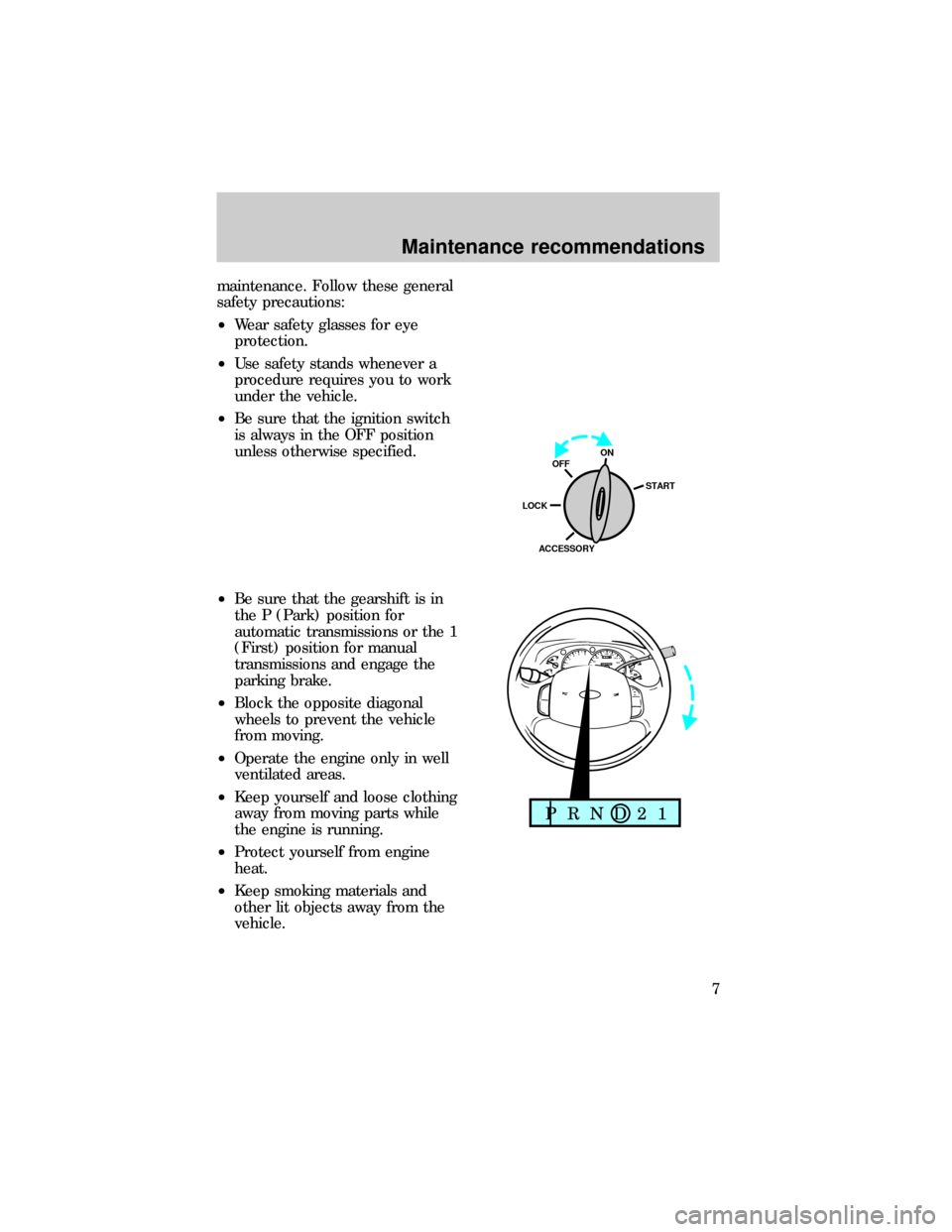
²Be sure that the ignition switch
is always in the OFF position
unless otherwise specified.
²Be sure that the gearshift is in
the P (Park) position for
automatic transmissions or the 1
(First) position for manual
transmissions and engage the
parking brake.
²Block the opposite diagonal
wheels to prevent the vehicle
from moving.
²Operate the engine only in well
ventilated areas.
²Keep yourself and loose clothing
away from moving parts while
the engine is running.
²Protect yourself from engine
heat.
²Keep smoking materials and
other lit objects away from the
vehicle.
ON
START
LOCK
ACCESSORYOFF
406080100
120
140
160
180000000oooo12345
6H
C
F- +H
H
L L
P R N D 2 1
Maintenance recommendations
7
Page 9 of 28
Manual transmission and
differential fluid (if equipped)
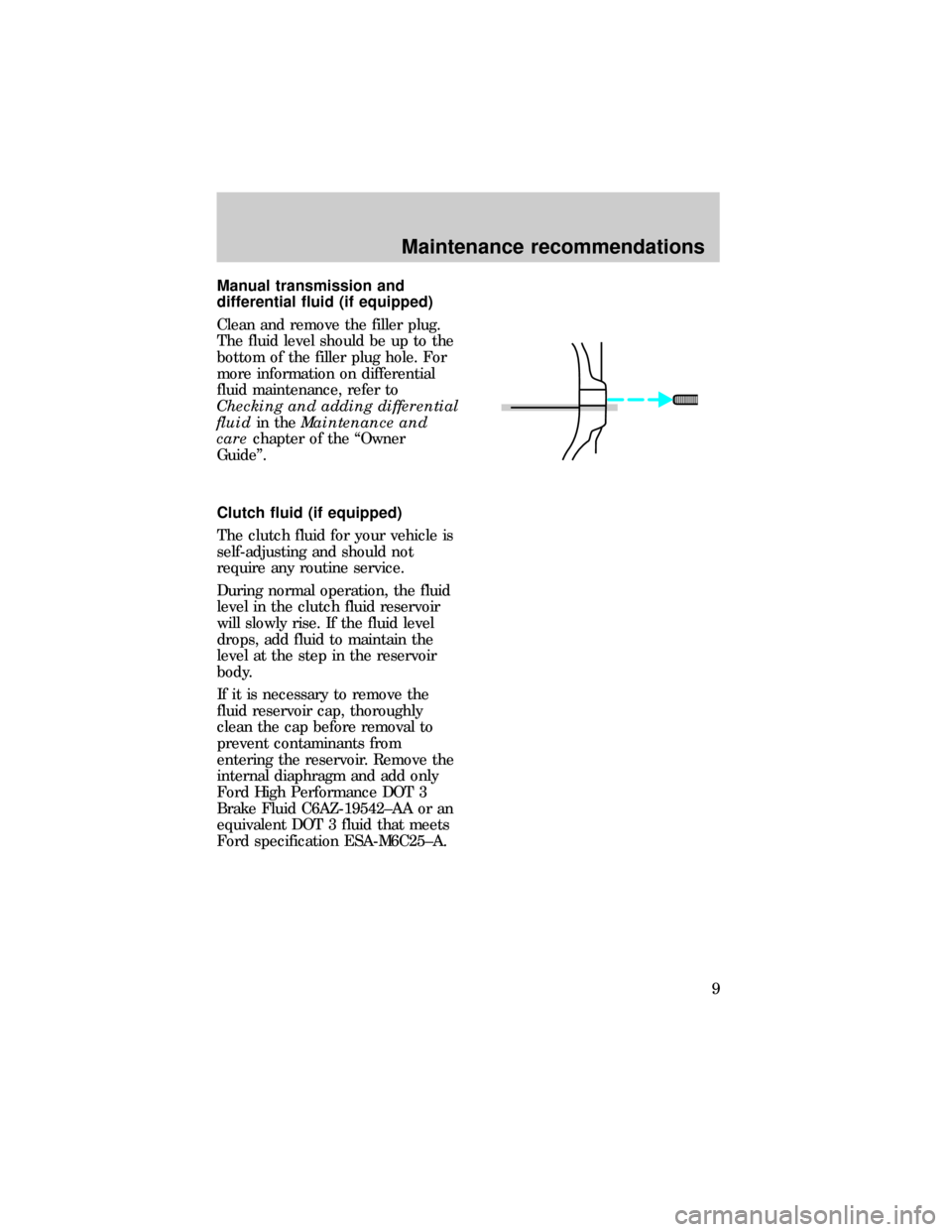
Clean and remove the filler plug.
The fluid level should be up to the
bottom of the filler plug hole. For
more information on differential
fluid maintenance, refer to
Checking and adding differential
fluidin theMaintenance and
carechapter of the ªOwner
Guideº.
Clutch fluid (if equipped)
The clutch fluid for your vehicle is
self-adjusting and should not
require any routine service.
During normal operation, the fluid
level in the clutch fluid reservoir
will slowly rise. If the fluid level
drops, add fluid to maintain the
level at the step in the reservoir
body.
If it is necessary to remove the
fluid reservoir cap, thoroughly
clean the cap before removal to
prevent contaminants from
entering the reservoir. Remove the
internal diaphragm and add only
Ford High Performance DOT 3
Brake Fluid C6AZ-19542±AA or an
equivalent DOT 3 fluid that meets
Ford specification ESA-M6C25±A.
Maintenance recommendations
9
Page 19 of 28

Heavy-duty battery special
service
Special service vehicles are
equipped with a maintenance-free
battery which does not require the
addition of water or other regular
service.
Installing aftermarket equipment
When installing aftermarket
equipment, avoid using fasteners
that are too long for the
application or are in an area that
might damage other vehicle
components (i.e., wiring, brake
lines, fuel tank and lines,
powertrain components exhaust
system, suspension, etc.).
Do not make electrical connections
to vehicle electrical systems not
specifically designed for
aftermarket equipment installation.
Do not install and components into
the Powertrain control module
(PCM) harness. Connecting into
this system may affect engine and
transmission operation. As an
example, connection of
aftermarket electrical equipment
into the brake light circuit or any
other circuit which is connected to
the PCM, anti-lock brake
computer, air bag system,
transmission or any other vehicle
system may cause vehicle
malfunction.
Severe duty equipment
19