brake light FORD EXPLORER 2002 3.G Owner's Manual
[x] Cancel search | Manufacturer: FORD, Model Year: 2002, Model line: EXPLORER, Model: FORD EXPLORER 2002 3.GPages: 312, PDF Size: 3.28 MB
Page 223 of 312

Do not attempt to push start your vehicle. Automatic
transmissions do not have push-start capability.
Preparing your vehicle
When the battery is disconnected or a new battery is installed, the
transmission must relearn its adaptive strategy. As a result of this, the
transmission may shift firmly. This operation is considered normal and
will not effect function or durability of the transmission. Over time, the
adaptive learning process will fully update transmission operation to its
optimum shift feel.
1.Use only a 12±volt supply to start your vehicle.
2. Do not disconnect the battery of the disabled vehicle as this could
damage the vehicle's electrical system.
3.
Park the booster vehicle close to the hood of the disabled vehicle
making sure the two vehiclesdo nottouch. Set the parking brake on both
vehicles and stay clear of the engine cooling fan and other moving parts.
4. Check all battery terminals and remove any excessive corrosion before
you attach the battery cables. Ensure that vent caps are tight and level.
5. Turn the heater fan on in both vehicles to protect any electrical
surges. Turn all other accessories off.
Connecting the jumper cables
1. Connect the positive (+) booster cable to the positive (+) terminal of
the discharged battery.
Note:In the illustrations,lightning boltsare used to designate the
assisting (boosting) battery.
+–+–
Roadside emergencies
223
Page 252 of 312
Batteries normally produce explosive gases which can cause
personal injury. Therefore, do not allow flames, sparks or lighted
substances to come near the battery. When working near the battery,
always shield your face and protect your eyes. Always provide proper
ventilation.
When lifting a plastic-cased battery, excessive pressure on the
end walls could cause acid to flow through the vent caps,
resulting in personal injury and/or damage to the vehicle or battery.
Lift the battery with a battery carrier or with your hands on opposite
corners.
Keep batteries out of reach of children. Batteries contain sulfuric
acid. Avoid contact with skin, eyes or clothing. Shield your eyes
when working near the battery to protect against possible splashing of
acid solution. In case of acid contact with skin or eyes, flush
immediately with water for a minimum of 15 minutes and get prompt
medical attention. If acid is swallowed, call a physician immediately.
Battery posts, terminals and related accessories contain lead and
lead compounds.Wash hands after handling.
Because your vehicle's engine is electronically controlled by a computer,
some control conditions are maintained by power from the battery. When
the battery is disconnected or a new battery is installed, the engine must
relearn its idle and fuel trim strategy for optimum driveability and
performance. To begin this process:
1. With the vehicle at a complete stop, set the parking brake.
2. Put the gearshift in P (Park), turn off all accessories and start the
engine.
3. Run the engine until it reaches normal operating temperature.
4. Allow the engine to idle for at least one minute.
5. Turn the A/C on and allow the engine to idle for at least one minute.
6. Drive the vehicle to complete the relearning process.
²The vehicle may need to be driven to relearn the idle and fuel trim
strategy.
Maintenance and care
252
Page 267 of 312

²Idling for long periods of time (greater than one minute) may waste
fuel.
²Anticipate stopping; slowing down may eliminate the need to stop.
²Sudden or hard accelerations may reduce fuel economy.
²Slow down gradually.
²Driving at reasonable speeds (traveling at 88 km/h [55 mph] uses 15%
less fuel than traveling at 105 km/h [65 mph]).
²Revving the engine before turning it off may reduce fuel economy.
²Using the air conditioner or defroster may reduce fuel economy.
²You may want to turn off the speed control in hilly terrain if
unnecessary shifting between third and fourth gear occurs.
Unnecessary shifting of this type could result in reduced fuel
economy.
²Warming up a vehicle on cold mornings is not required and may
reduce fuel economy.
²Resting your foot on the brake pedal while driving may reduce fuel
economy.
²Combine errands and minimize stop-and-go driving.
Maintenance
²Keep tires properly inflated and use only recommended size.
²Operating a vehicle with the wheels out of alignment will reduce fuel
economy.
²Use recommended engine oil. Refer toLubricant Specifications.
²Perform all regularly scheduled maintenance items. Follow the
recommended maintenance schedule and owner maintenance checks
found in your vehicle scheduled maintenance guide.
Conditions
²Heavily loading a vehicle or towing a trailer may reduce fuel economy
at any speed.
²Carrying unnecessary weight may reduce fuel economy (approximately
0.4 km/L [1 mpg] is lost for every 180 kg [400 lb] of weight carried).
²Adding certain accessories to your vehicle (for example bug
deflectors, rollbars/light bars, running boards, ski/luggage racks) may
reduce fuel economy.
Maintenance and care
267
Page 270 of 312

Readiness for Inspection/Maintenance (I/M) testing
In some localities, it may be a legal requirement to pass an I/M test of
the on-board diagnostics system. If your ªCheck Engine/Service Engine
Soonº light is on, refer to the description in theWarning Lights and
Chimessection of theInstrumentationchapter. Your vehicle may not
pass the I/M test with the ªCheck Engine/Service Engine Soonº light on.
If the vehicle's powertrain system or its battery has just been serviced,
the on-board diagnostics system is reset to a ªnot ready for I/M testº
condition. To ready the on-board diagnostics system for I/M testing, a
minimum of 30 minutes of city and highway driving is necessary as
described below:
²First, at least 10 minutes of driving on an expressway or highway.
²Next, at least 20 minutes driving in stop-and-go, city-type traffic with
at least four idle periods.
Allow the vehicle to sit for at least eight hours without starting the
engine. Then, start the engine and complete the above driving cycle. The
engine must warm up to its normal operating temperature. Once started,
do not turn off the engine until the above driving cycle is complete.
BULBS
Replacing exterior bulbs
Check the operation of the following lamps frequently:
²Headlamps
²Foglamps
²High-mount brakelamp
²Brakelamps
²Turn signals
²License plate lamp
²Tail lamps
²Back-up lamps
Do not remove lamp bulbs unless they can be replaced immediately with
new ones. If a bulb is removed for an extended period of time,
contaminants may enter the lamp housings and affect lamp performance.
Maintenance and care
270
Page 272 of 312
If the bulb is accidentally touched, it should be cleaned with rubbing
alcohol before being used.
1. Install the new bulb in lamp assembly by pushing straight in and
turning to lock in position. You may need to turn the bulb slightly to
align the grooves in the plastic base with the tabs in the lamp assembly.
2. Connect the electrical connector to the bulb.
3. Install the headlamp on vehicle by aligning the lamp on the vehicle,
push rearward to fully seat the lamp assembly then push the two
retainer pins down.
4. Turn the headlamps on and make sure they work properly. If the
headlamp was correctly aligned before you changed the bulb, you should
not need to align it again.
Replacing front parking lamp/turn signal/sidemarker bulbs
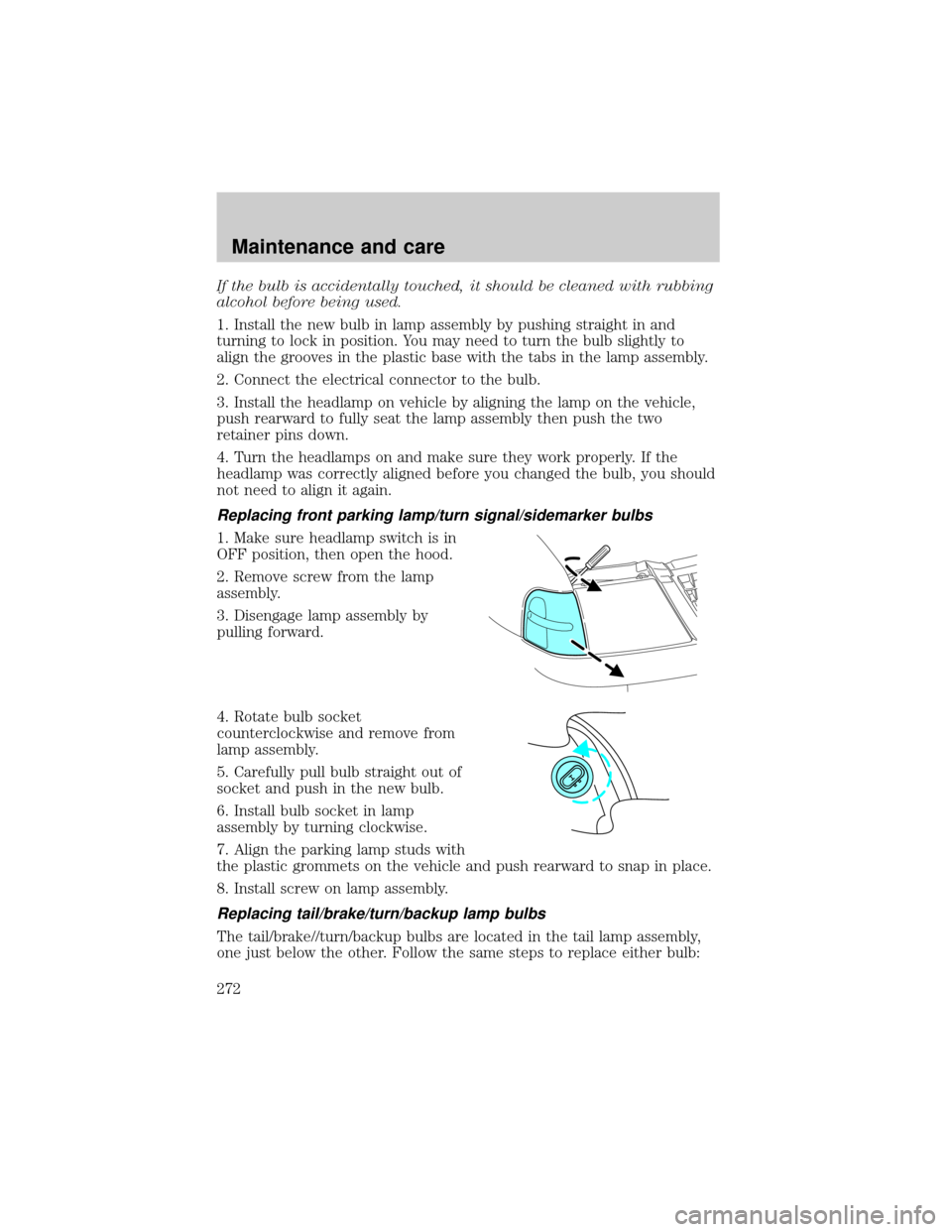
1. Make sure headlamp switch is in
OFF position, then open the hood.
2. Remove screw from the lamp
assembly.
3. Disengage lamp assembly by
pulling forward.
4. Rotate bulb socket
counterclockwise and remove from
lamp assembly.
5. Carefully pull bulb straight out of
socket and push in the new bulb.
6. Install bulb socket in lamp
assembly by turning clockwise.
7. Align the parking lamp studs with
the plastic grommets on the vehicle and push rearward to snap in place.
8. Install screw on lamp assembly.
Replacing tail/brake/turn/backup lamp bulbs
The tail/brake//turn/backup bulbs are located in the tail lamp assembly,
one just below the other. Follow the same steps to replace either bulb:
Maintenance and care
272
Page 274 of 312
Replacing high-mount brake lamp bulbs
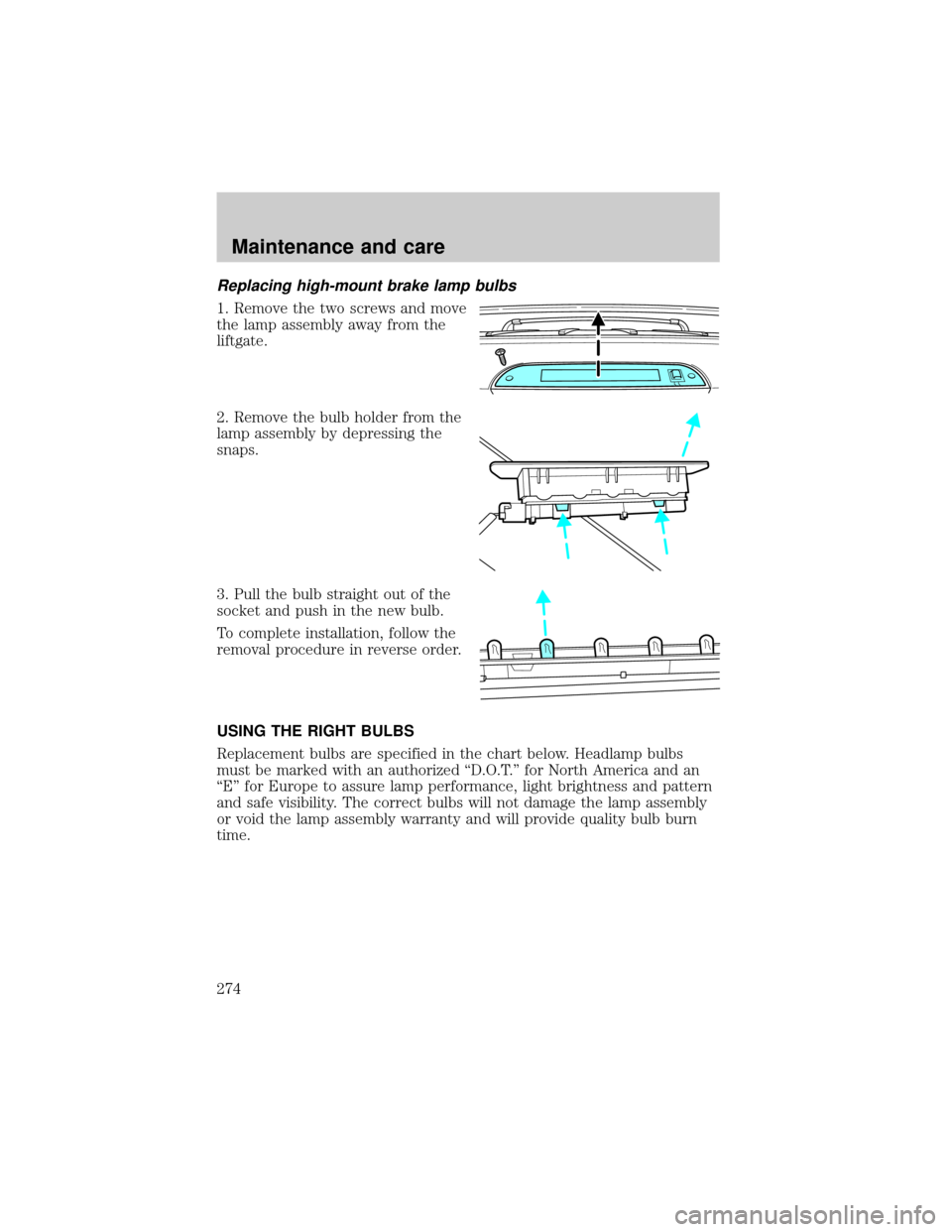
1. Remove the two screws and move
the lamp assembly away from the
liftgate.
2. Remove the bulb holder from the
lamp assembly by depressing the
snaps.
3. Pull the bulb straight out of the
socket and push in the new bulb.
To complete installation, follow the
removal procedure in reverse order.
USING THE RIGHT BULBS
Replacement bulbs are specified in the chart below. Headlamp bulbs
must be marked with an authorized ªD.O.T.º for North America and an
ªEº for Europe to assure lamp performance, light brightness and pattern
and safe visibility. The correct bulbs will not damage the lamp assembly
or void the lamp assembly warranty and will provide quality bulb burn
time.
Maintenance and care
274
Page 304 of 312

A
Air bag supplemental
restraint system ................155, 159
and child safety seats ............157
description ......................155, 159
disposal ....................................162
driver air bag ..................157, 160
indicator light ...........10, 159, 161
operation .........................157, 160
passenger air bag ...........157, 160
side air bag ..............................159
Air cleaner filter .......................283
Air conditioning ..........................33
automatic temperature
control system ..........................37
auxiliary heater and air
conditioner ................................46
rear seat controls .....................47
Ambulance packages ....................3
Antifreeze
(see Engine coolant) ................241
Anti-lock brake system
(see Brakes) ......................176±177
Anti-theft system ......................125
arming the system ..................125
disarming a
triggered system .....................126
warning light .............................11
Audio system (see Radio) ...51, 74
Automatic transmission
driving an automatic
overdrive .................................182
fluid, adding ............................248
fluid, checking ........................248
fluid, refill capacities ..............283
fluid, specification ..................287
Auxiliary power point ...............112Axle
lubricant specifications ..285, 287
refill capacities ........................283
traction lok ..............................194
B
Battery .......................................251
acid, treating emergencies .....251
charging system
warning light .............................11
jumping a disabled battery ....222
maintenance-free ....................251
replacement, specifications ...283
servicing ..................................251
voltage gauge ............................16
Belt minder ...............................151
Brakes ........................................176
anti-lock ...........................176±177
anti-lock brake system
(ABS) warning light .........11, 177
brake warning light ..................10
fluid, checking and adding ....240
fluid, refill capacities ..............283
fluid, specifications .........285, 287
lubricant specifications ..285, 287
parking ....................................177
pedals (see Power
adjustable foot pedals) ............30
shift interlock ..........................180
Break-in period .............................3
C
Capacities for refilling fluids ....283
Cargo cover ...............................115
Certification Label ....................289
Child safety restraints ..............162
child safety belts ....................162
Index
304
Page 308 of 312

fog lamps ...................................28
headlamps .................................28
headlamps, flash to pass ..........29
instrument panel, dimming .....29
interior lamps .........................102
replacing bulbs ...............270±274
Lane change indicator
(see Turn signal) ........................89
Liftgate ..............................114, 117
Lights, warning and indicator ......8
air bag ........................................10
anti-lock brakes (ABS) ....11, 177
anti-theft ...................................11
brake ..........................................10
charging system ........................11
cruise indicator .........................12
door ajar ....................................12
fuel cap light .............................10
high beam .................................11
overdrive off ..............................12
safety belt .................................10
service engine soon ....................8
speed control ............................95
turn signal indicator .................11
Load limits .................................194
GAWR ......................................194
GVWR ......................................194
trailer towing ..........................194
Loading instructions .................196
Locks
autolock ...................................124
childproof ................................110
doors ........................................109
Lubricant specifications ...285, 287
Lumbar support, seats .............135
M
Manual transmission .................185fluid capacities ........................283
lubricant specifications ..........287
reverse .....................................187
Message center ...........................19
english/metric button ...............23
system check button ................24
warning messages .....................24
Mirrors .......................................108
automatic dimming
rearview mirror .......................107
cleaning ...................................282
fold away .................................111
heated ......................................111
programmable memory ..........117
side view mirrors (power) .....110
Moon roof ..................................102
Motorcraft parts ................265, 283
O
Octane rating ............................262
Odometer .....................................15
Oil (see Engine oil) ..................235
P
Panic alarm feature,
remote entry system ................117
Parking brake ............................177
Parts (see Motorcraft parts) ....283
Pedals (see Power
adjustable foot pedals) ...............30
Power adjustable foot pedals .....30
Power distribution box
(see Fuses) ...............................213
Power door locks ......................109
Power steering ..........................178
Index
308