brake FORD EXPLORER 2003 3.G Repair Manual
[x] Cancel search | Manufacturer: FORD, Model Year: 2003, Model line: EXPLORER, Model: FORD EXPLORER 2003 3.GPages: 272, PDF Size: 4.64 MB
Page 222 of 272
1. Make sure the vehicle is on level ground.
2. Turn the engine off and wait a few minutes for the oil to drain into the
oil pan.
3. Set the parking brake and ensure the gearshift is securely latched in P
(Park).
4. Open the hood. Protect yourself from engine heat.
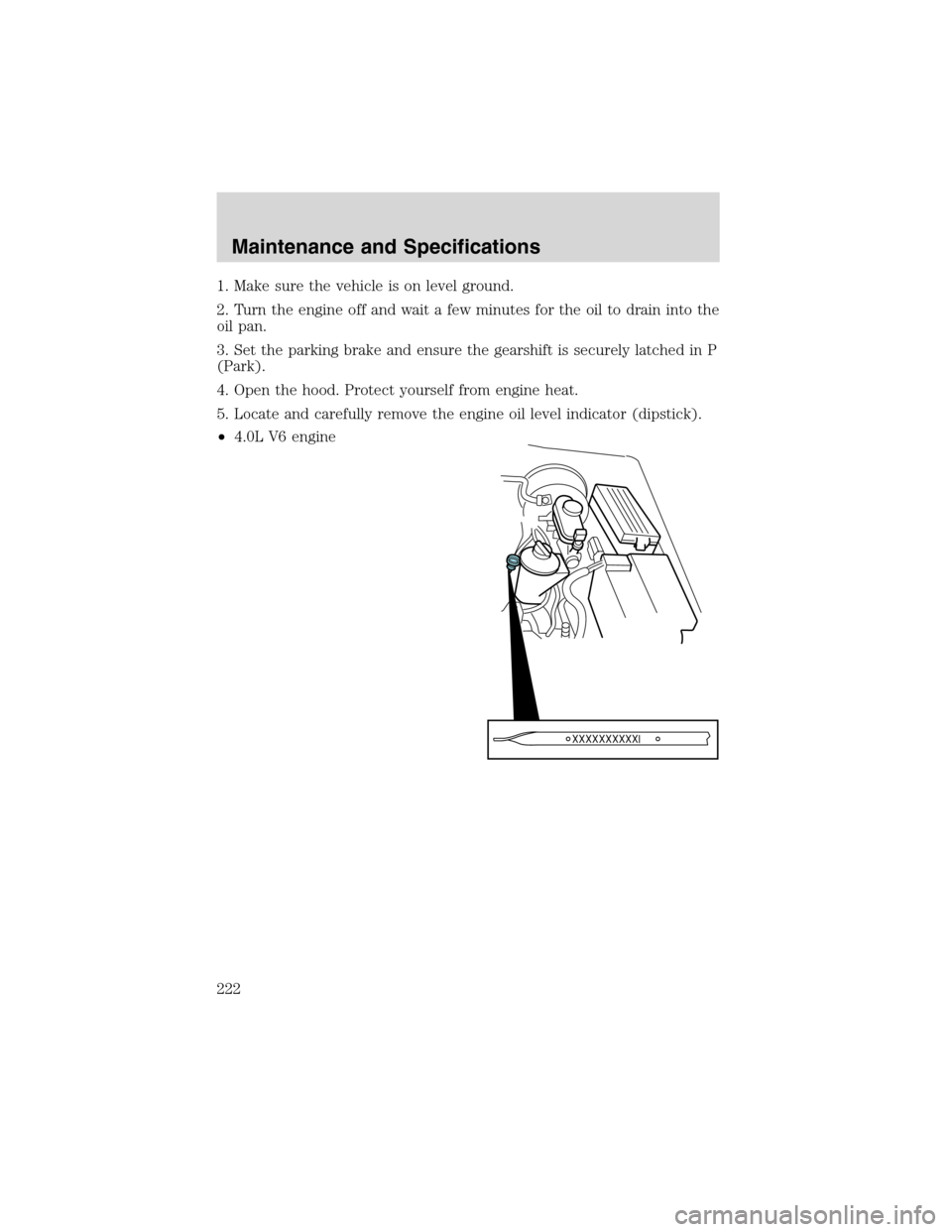
5. Locate and carefully remove the engine oil level indicator (dipstick).
•4.0L V6 engine
Maintenance and Specifications
222
Page 228 of 272
When lifting a plastic-cased battery, excessive pressure on the
end walls could cause acid to flow through the vent caps,
resulting in personal injury and/or damage to the vehicle or battery.
Lift the battery with a battery carrier or with your hands on opposite
corners.
Keep batteries out of reach of children. Batteries contain sulfuric
acid. Avoid contact with skin, eyes or clothing. Shield your eyes
when working near the battery to protect against possible splashing of
acid solution. In case of acid contact with skin or eyes, flush
immediately with water for a minimum of 15 minutes and get prompt
medical attention. If acid is swallowed, call a physician immediately.
Battery posts, terminals and related accessories contain lead and
lead compounds.Wash hands after handling.
Because your vehicle’s engine is electronically controlled by a computer,
some control conditions are maintained by power from the battery. When
the battery is disconnected or a new battery is installed, the engine must
relearn its idle and fuel trim strategy for optimum driveability and
performance. To begin this process:
1. With the vehicle at a complete stop, set the parking brake.
2. Put the gearshift lever in P (Park), turn off all accessories and start
the engine.
3. Run the engine until it reaches normal operating temperature.
4. Allow the engine to idle for at least one minute.
5. Turn the A/C on and allow the engine to idle for at least one minute.
6. Drive the vehicle to complete the relearning process.
•The vehicle may need to be driven to relearn the idle and fuel trim
strategy.
•If you do not allow the engine to relearn its idle trim, the idle
quality of your vehicle may be adversely affected until the idle
trim is eventually relearned.
When the battery is disconnected or a new battery installed, the
transmission must relearn its adaptive strategy. As a result of this, the
transmission may shift firmly. This operation is considered normal and
will not affect function or durability of the transmission. Over time the
adaptive learning process will fully update transmission operation to its
optimum shift feel.
Maintenance and Specifications
228
Page 243 of 272
Driving style—good driving and fuel economy habits
Give consideration to the lists that follow and you may be able to change
a number of variables and improve your fuel economy.
Habits
•Smooth, moderate operation can yield up to 10% savings in fuel.
•Steady speeds without stopping will usually give the best fuel
economy.
•Idling for long periods of time (greater than one minute) may waste
fuel.
•Anticipate stopping; slowing down may eliminate the need to stop.
•Sudden or hard accelerations may reduce fuel economy.
•Slow down gradually.
•Driving at reasonable speeds (traveling at 88 km/h [55 mph] uses 15%
less fuel than traveling at 105 km/h [65 mph]).
•Revving the engine before turning it off may reduce fuel economy.
•Using the air conditioner or defroster may reduce fuel economy.
•You may want to turn off the speed control in hilly terrain if
unnecessary shifting between third and fourth gear occurs.
Unnecessary shifting of this type could result in reduced fuel
economy.
•Warming up a vehicle on cold mornings is not required and may
reduce fuel economy.
•Resting your foot on the brake pedal while driving may reduce fuel
economy.
•Combine errands and minimize stop-and-go driving.
Maintenance
•Keep tires properly inflated and use only recommended size.
•Operating a vehicle with the wheels out of alignment will reduce fuel
economy.
•Use recommended engine oil. Refer toLubricant specificationsin
this chapter.
•Perform all regularly scheduled maintenance items. Follow the
recommended maintenance schedule and owner maintenance checks
found in your vehicle scheduled maintenance guide.
Conditions
•Heavily loading a vehicle or towing a trailer may reduce fuel economy
at any speed.
Maintenance and Specifications
243
Page 247 of 272
2. While the engine idles, turn the steering wheel left and right several
times.
3. Turn the engine off.
4. Check the fluid level in the reservoir.
5. The fluid level should be between the MIN and MAX lines. Do not add
fluid if the level is in this range.
6. If the fluid is low, add fluid in small amounts, continuously checking
the level until it reaches the correct operating range. Be sure to put the
cap back on the reservoir.
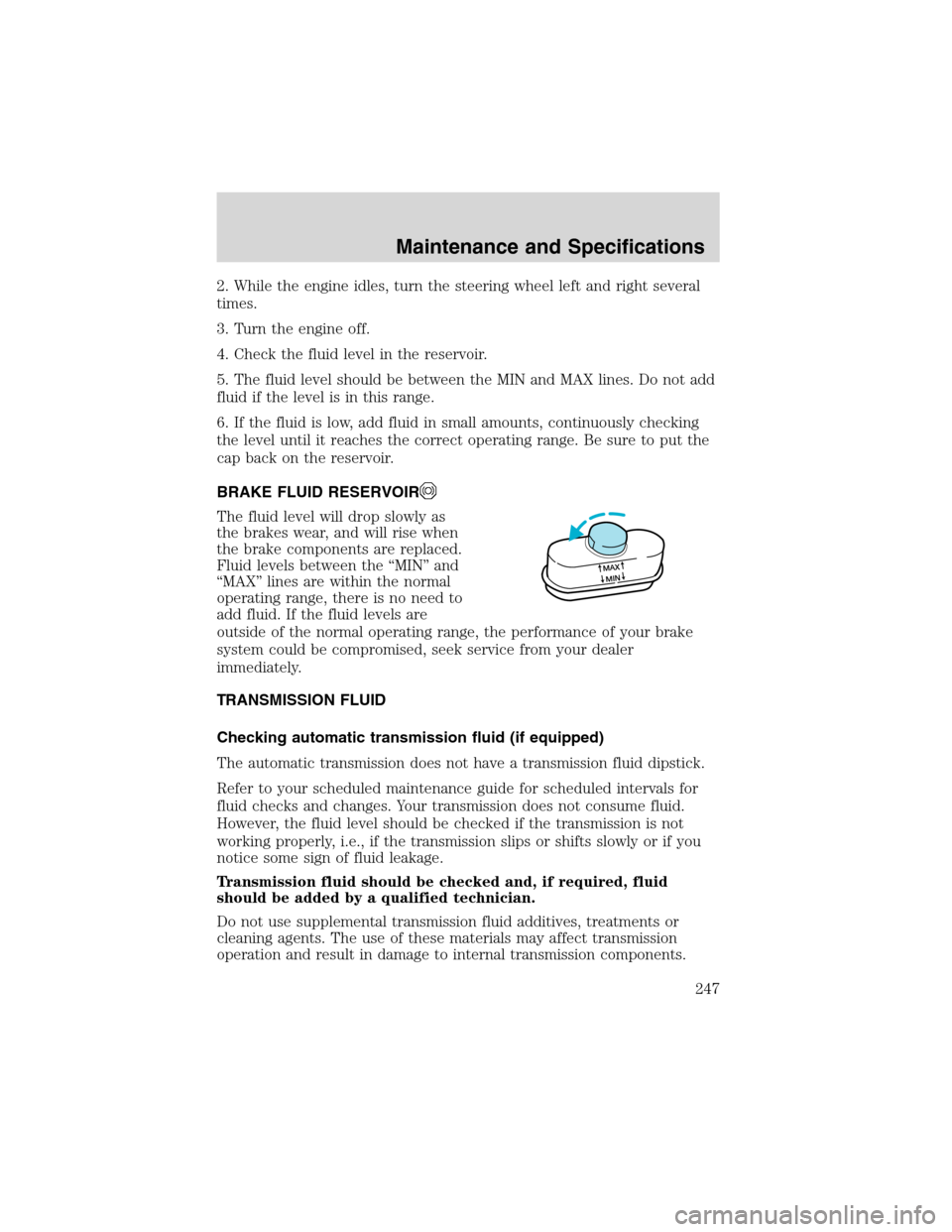
BRAKE FLUID RESERVOIR
The fluid level will drop slowly as
the brakes wear, and will rise when
the brake components are replaced.
Fluid levels between the“MIN”and
“MAX”lines are within the normal
operating range, there is no need to
add fluid. If the fluid levels are
outside of the normal operating range, the performance of your brake
system could be compromised, seek service from your dealer
immediately.
TRANSMISSION FLUID
Checking automatic transmission fluid (if equipped)
The automatic transmission does not have a transmission fluid dipstick.
Refer to your scheduled maintenance guide for scheduled intervals for
fluid checks and changes. Your transmission does not consume fluid.
However, the fluid level should be checked if the transmission is not
working properly, i.e., if the transmission slips or shifts slowly or if you
notice some sign of fluid leakage.
Transmission fluid should be checked and, if required, fluid
should be added by a qualified technician.
Do not use supplemental transmission fluid additives, treatments or
cleaning agents. The use of these materials may affect transmission
operation and result in damage to internal transmission components.
MAX
MIN
Maintenance and Specifications
247
Page 253 of 272
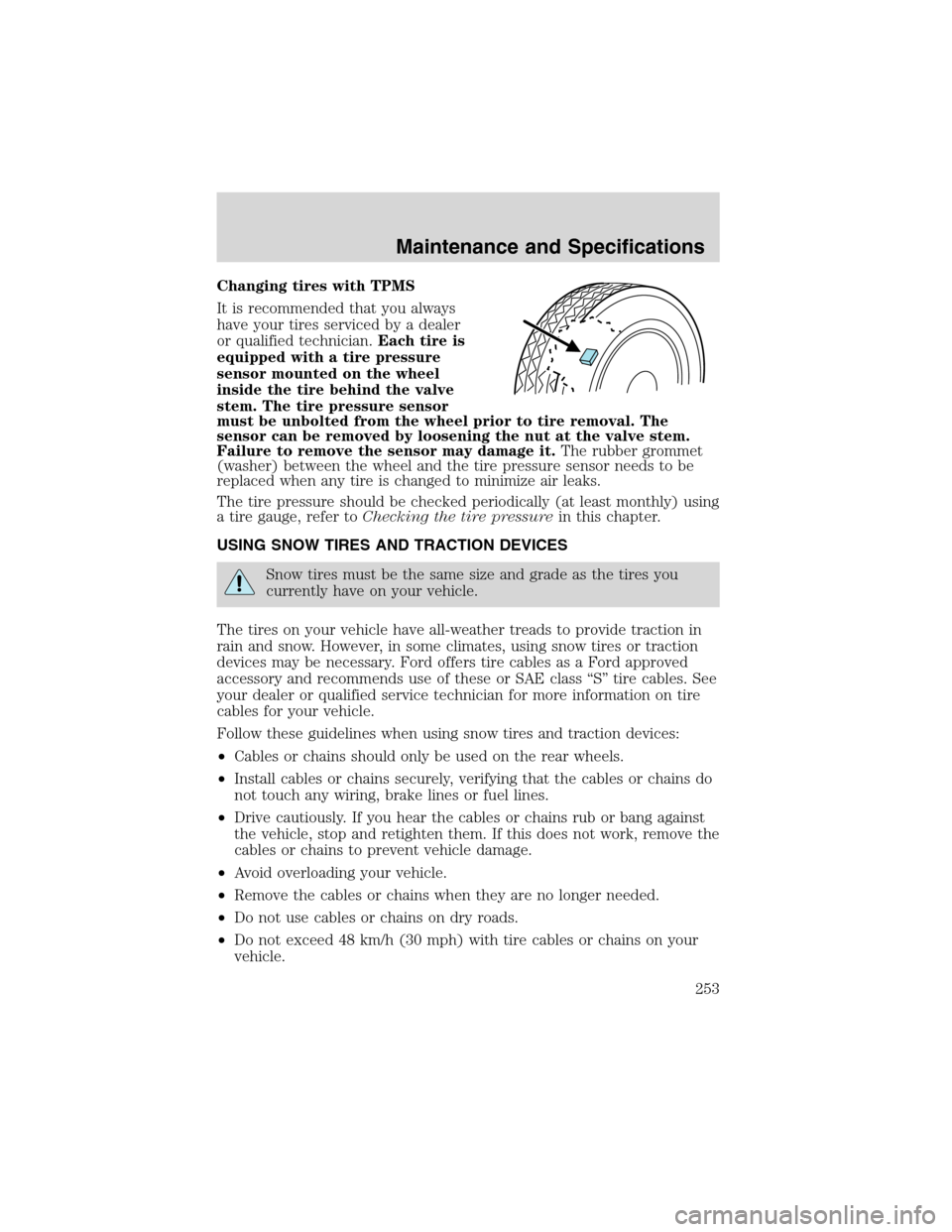
Changing tires with TPMS
It is recommended that you always
have your tires serviced by a dealer
or qualified technician.Each tire is
equipped with a tire pressure
sensor mounted on the wheel
inside the tire behind the valve
stem. The tire pressure sensor
must be unbolted from the wheel prior to tire removal. The
sensor can be removed by loosening the nut at the valve stem.
Failure to remove the sensor may damage it.The rubber grommet
(washer) between the wheel and the tire pressure sensor needs to be
replaced when any tire is changed to minimize air leaks.
The tire pressure should be checked periodically (at least monthly) using
a tire gauge, refer toChecking the tire pressurein this chapter.
USING SNOW TIRES AND TRACTION DEVICES
Snow tires must be the same size and grade as the tires you
currently have on your vehicle.
The tires on your vehicle have all-weather treads to provide traction in
rain and snow. However, in some climates, using snow tires or traction
devices may be necessary. Ford offers tire cables as a Ford approved
accessory and recommends use of these or SAE class“S”tire cables. See
your dealer or qualified service technician for more information on tire
cables for your vehicle.
Follow these guidelines when using snow tires and traction devices:
•Cables or chains should only be used on the rear wheels.
•Install cables or chains securely, verifying that the cables or chains do
not touch any wiring, brake lines or fuel lines.
•Drive cautiously. If you hear the cables or chains rub or bang against
the vehicle, stop and retighten them. If this does not work, remove the
cables or chains to prevent vehicle damage.
•Avoid overloading your vehicle.
•Remove the cables or chains when they are no longer needed.
•Do not use cables or chains on dry roads.
•Do not exceed 48 km/h (30 mph) with tire cables or chains on your
vehicle.
Maintenance and Specifications
253
Page 254 of 272
Consult your dealer for information on other Ford approved methods of
traction control.
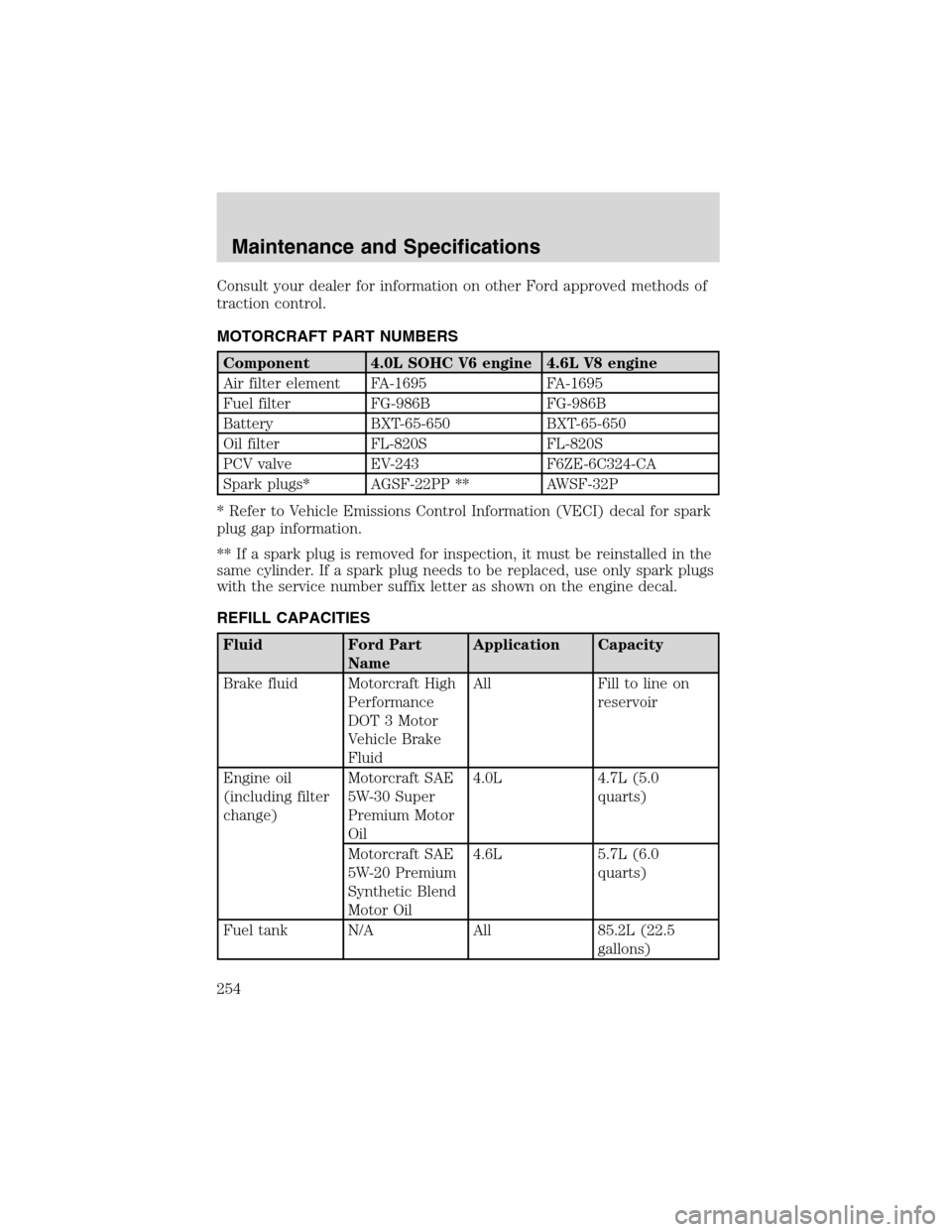
MOTORCRAFT PART NUMBERS
Component 4.0L SOHC V6 engine 4.6L V8 engine
Air filter element FA-1695 FA-1695
Fuel filter FG-986B FG-986B
Battery BXT-65-650 BXT-65-650
Oil filter FL-820S FL-820S
PCV valve EV-243 F6ZE-6C324-CA
Spark plugs* AGSF-22PP ** AWSF-32P
* Refer to Vehicle Emissions Control Information (VECI) decal for spark
plug gap information.
** If a spark plug is removed for inspection, it must be reinstalled in the
same cylinder. If a spark plug needs to be replaced, use only spark plugs
with the service number suffix letter as shown on the engine decal.
REFILL CAPACITIES
Fluid Ford Part
NameApplication Capacity
Brake fluid Motorcraft High
Performance
DOT 3 Motor
Vehicle Brake
FluidAll Fill to line on
reservoir
Engine oil
(including filter
change)Motorcraft SAE
5W-30 Super
Premium Motor
Oil4.0L 4.7L (5.0
quarts)
Motorcraft SAE
5W-20 Premium
Synthetic Blend
Motor Oil4.6L 5.7L (6.0
quarts)
Fuel tank N/A All 85.2L (22.5
gallons)
Maintenance and Specifications
254
Page 257 of 272
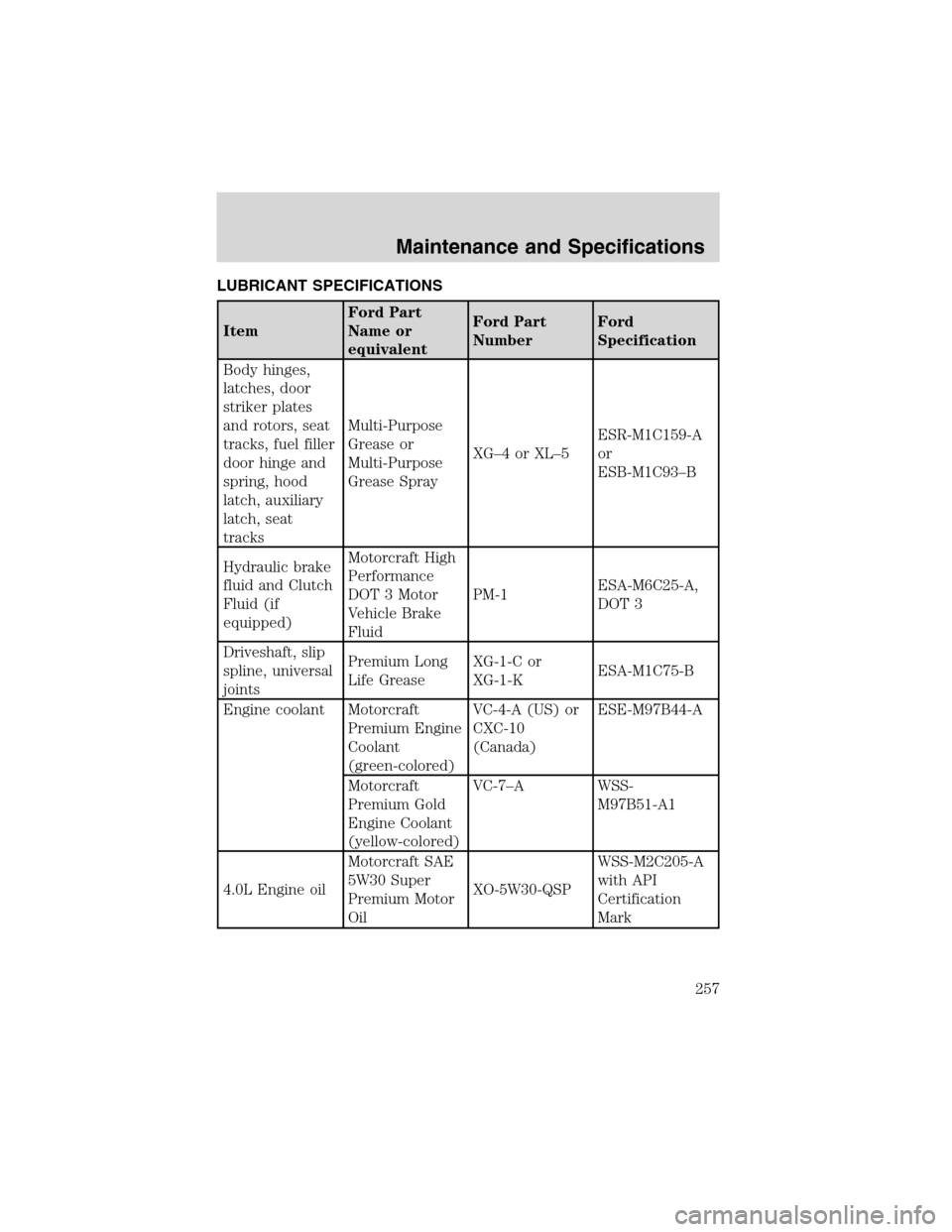
LUBRICANT SPECIFICATIONS
ItemFord Part
Name or
equivalentFord Part
NumberFord
Specification
Body hinges,
latches, door
striker plates
and rotors, seat
tracks, fuel filler
door hinge and
spring, hood
latch, auxiliary
latch, seat
tracksMulti-Purpose
Grease or
Multi-Purpose
Grease SprayXG–4orXL–5ESR-M1C159-A
or
ESB-M1C93–B
Hydraulic brake
fluid and Clutch
Fluid (if
equipped)Motorcraft High
Performance
DOT 3 Motor
Vehicle Brake
FluidPM-1ESA-M6C25-A,
DOT 3
Driveshaft, slip
spline, universal
jointsPremium Long
Life GreaseXG-1-C or
XG-1-KESA-M1C75-B
Engine coolant Motorcraft
Premium Engine
Coolant
(green-colored)VC-4-A (US) or
CXC-10
(Canada)ESE-M97B44-A
Motorcraft
Premium Gold
Engine Coolant
(yellow-colored)VC-7–A WSS-
M97B51-A1
4.0L Engine oilMotorcraft SAE
5W30 Super
Premium Motor
OilXO-5W30-QSPWSS-M2C205-A
with API
Certification
Mark
Maintenance and Specifications
257
Page 262 of 272
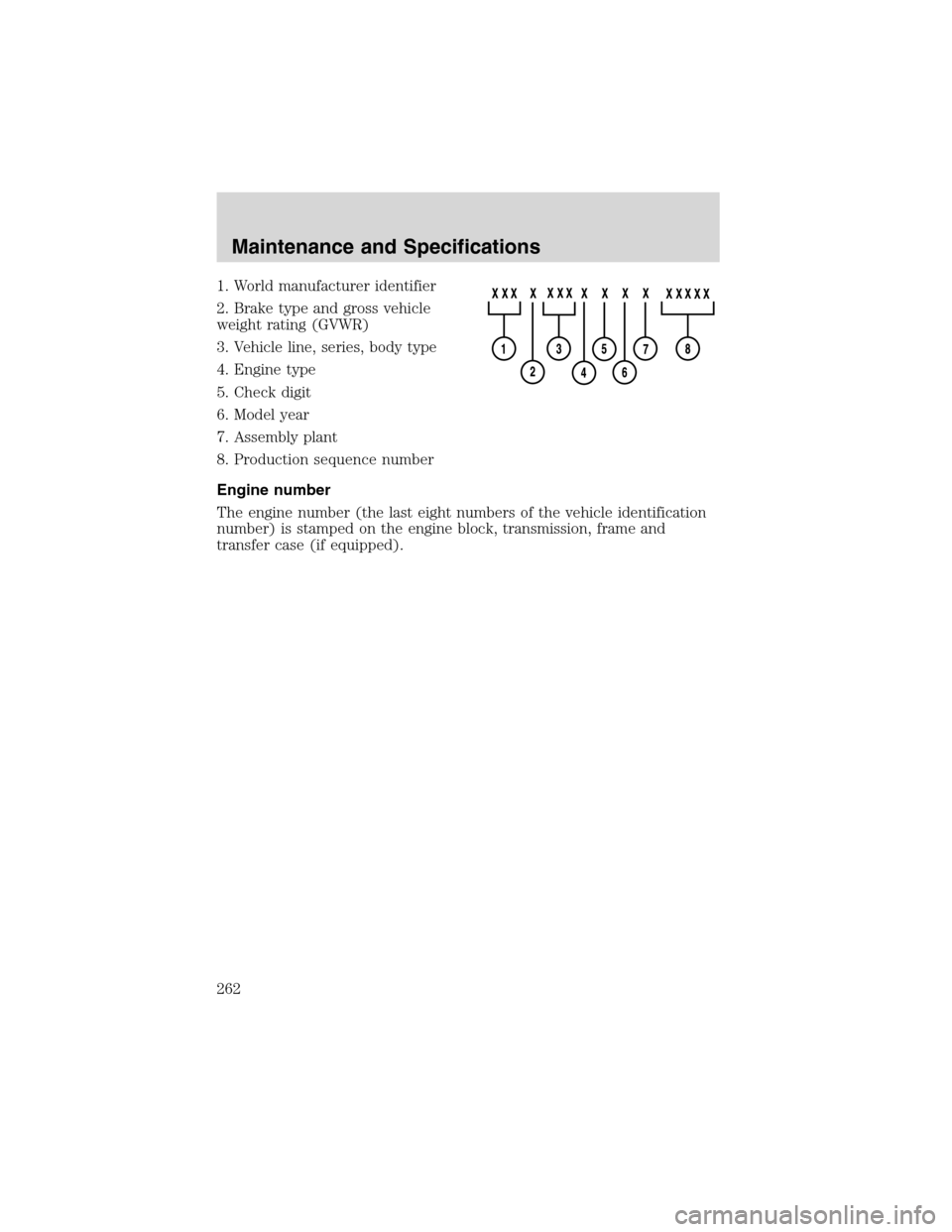
1. World manufacturer identifier
2. Brake type and gross vehicle
weight rating (GVWR)
3. Vehicle line, series, body type
4. Engine type
5. Check digit
6. Model year
7. Assembly plant
8. Production sequence number
Engine number
The engine number (the last eight numbers of the vehicle identification
number) is stamped on the engine block, transmission, frame and
transfer case (if equipped).
Maintenance and Specifications
262
Page 267 of 272
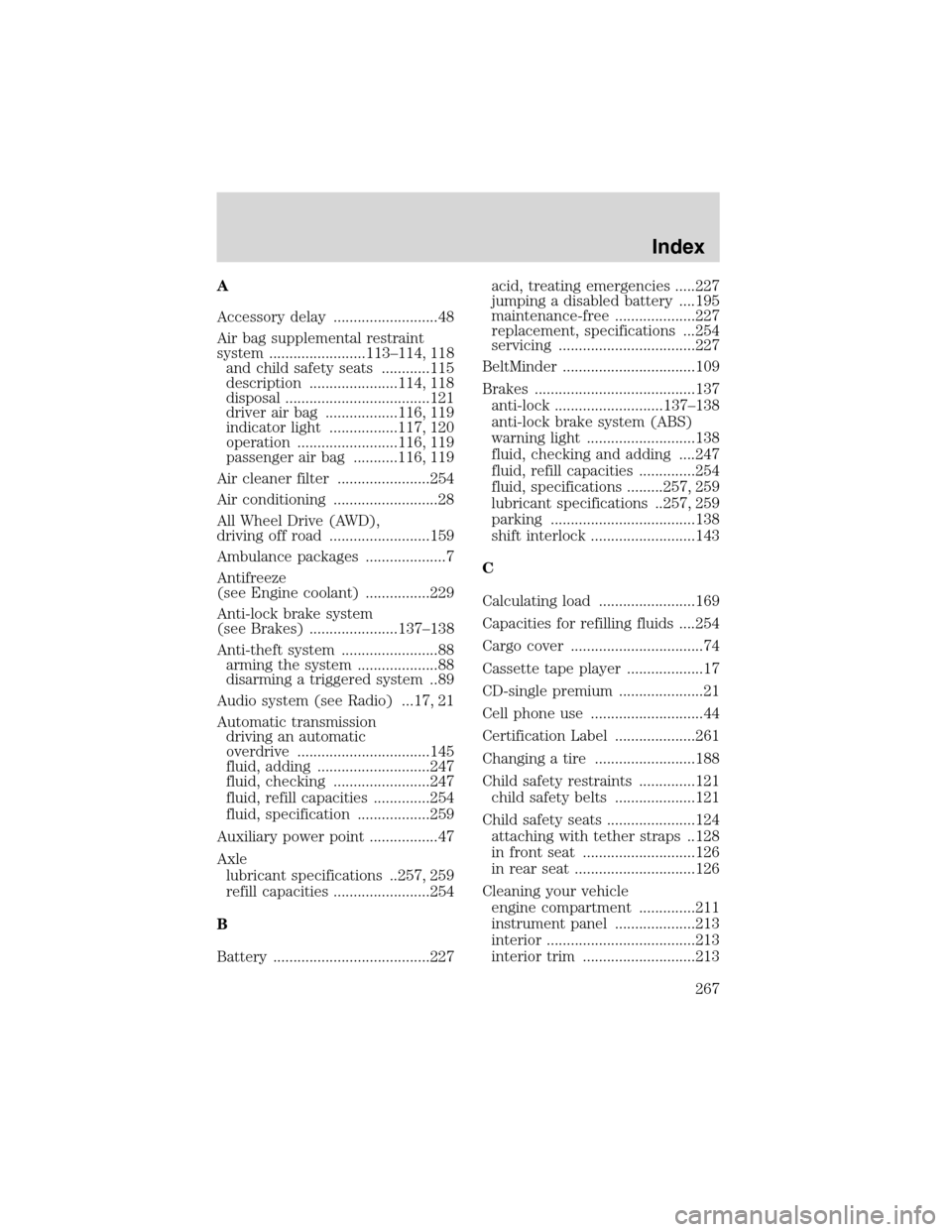
A
Accessory delay ..........................48
Air bag supplemental restraint
system ........................113–114, 118
and child safety seats ............115
description ......................114, 118
disposal ....................................121
driver air bag ..................116, 119
indicator light .................117, 120
operation .........................116, 119
passenger air bag ...........116, 119
Air cleaner filter .......................254
Air conditioning ..........................28
All Wheel Drive (AWD),
driving off road .........................159
Ambulance packages ....................7
Antifreeze
(see Engine coolant) ................229
Anti-lock brake system
(see Brakes) ......................137–138
Anti-theft system ........................88
arming the system ....................88
disarming a triggered system ..89
Audio system (see Radio) ...17, 21
Automatic transmission
driving an automatic
overdrive .................................145
fluid, adding ............................247
fluid, checking ........................247
fluid, refill capacities ..............254
fluid, specification ..................259
Auxiliary power point .................47
Axle
lubricant specifications ..257, 259
refill capacities ........................254
B
Battery .......................................227acid, treating emergencies .....227
jumping a disabled battery ....195
maintenance-free ....................227
replacement, specifications ...254
servicing ..................................227
BeltMinder .................................109
Brakes ........................................137
anti-lock ...........................137–138
anti-lock brake system (ABS)
warning light ...........................138
fluid, checking and adding ....247
fluid, refill capacities ..............254
fluid, specifications .........257, 259
lubricant specifications ..257, 259
parking ....................................138
shift interlock ..........................143
C
Calculating load ........................169
Capacities for refilling fluids ....254
Cargo cover .................................74
Cassette tape player ...................17
CD-single premium .....................21
Cell phone use ............................44
Certification Label ....................261
Changing a tire .........................188
Child safety restraints ..............121
child safety belts ....................121
Child safety seats ......................124
attaching with tether straps ..128
in front seat ............................126
in rear seat ..............................126
Cleaning your vehicle
engine compartment ..............211
instrument panel ....................213
interior .....................................213
interior trim ............................213
Index
267
Page 270 of 272
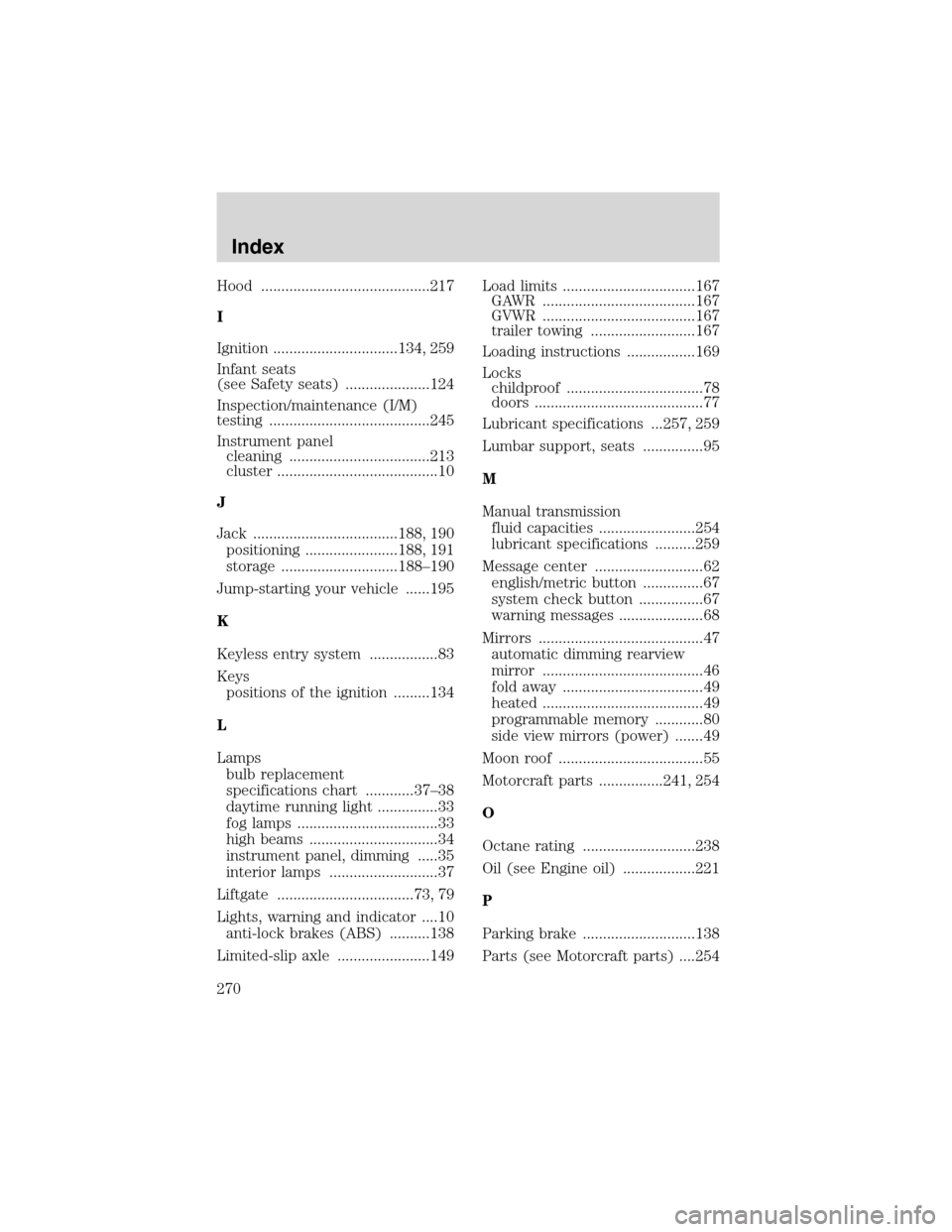
Hood ..........................................217
I
Ignition ...............................134, 259
Infant seats
(see Safety seats) .....................124
Inspection/maintenance (I/M)
testing ........................................245
Instrument panel
cleaning ...................................213
cluster ........................................10
J
Jack ....................................188, 190
positioning .......................188, 191
storage .............................188–190
Jump-starting your vehicle ......195
K
Keyless entry system .................83
Keys
positions of the ignition .........134
L
Lamps
bulb replacement
specifications chart ............37–38
daytime running light ...............33
fog lamps ...................................33
high beams ................................34
instrument panel, dimming .....35
interior lamps ...........................37
Liftgate ..................................73, 79
Lights, warning and indicator ....10
anti-lock brakes (ABS) ..........138
Limited-slip axle .......................149Load limits .................................167
GAWR ......................................167
GVWR ......................................167
trailer towing ..........................167
Loading instructions .................169
Locks
childproof ..................................78
doors ..........................................77
Lubricant specifications ...257, 259
Lumbar support, seats ...............95
M
Manual transmission
fluid capacities ........................254
lubricant specifications ..........259
Message center ...........................62
english/metric button ...............67
system check button ................67
warning messages .....................68
Mirrors .........................................47
automatic dimming rearview
mirror ........................................46
fold away ...................................49
heated ........................................49
programmable memory ............80
side view mirrors (power) .......49
Moon roof ....................................55
Motorcraft parts ................241, 254
O
Octane rating ............................238
Oil (see Engine oil) ..................221
P
Parking brake ............................138
Parts (see Motorcraft parts) ....254
Index
270