wheel FORD EXPLORER 2004 3.G Repair Manual
[x] Cancel search | Manufacturer: FORD, Model Year: 2004, Model line: EXPLORER, Model: FORD EXPLORER 2004 3.GPages: 296, PDF Size: 5.77 MB
Page 266 of 296
wheels may be out of alignment. Have a qualified technician at a
reputable repair facility check the wheel alignment periodically.
Wheel misalignment in the front or the rear can cause uneven and rapid
treadwear of your tires and should be corrected by a qualified technician
at a reputable repair facility. Front wheel drive (FWD) vehicles, and
those with independent front suspension require alignment of all four
wheels.
The tires should also be balanced periodically. An unbalanced tire and
wheel assembly may result in irregular tire wear.
Tire rotation
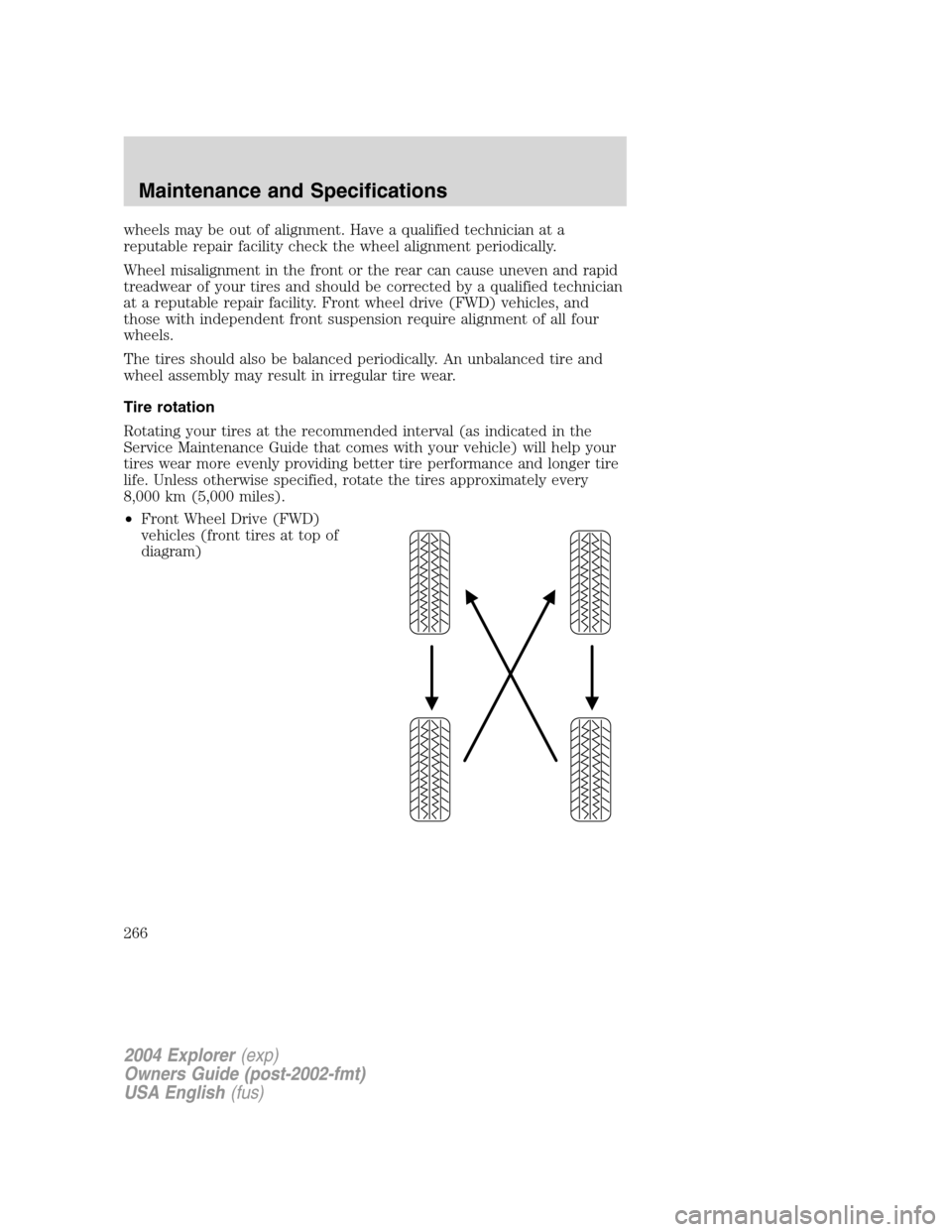
Rotating your tires at the recommended interval (as indicated in the
Service Maintenance Guide that comes with your vehicle) will help your
tires wear more evenly providing better tire performance and longer tire
life. Unless otherwise specified, rotate the tires approximately every
8,000 km (5,000 miles).
•Front Wheel Drive (FWD)
vehicles (front tires at top of
diagram)
2004 Explorer(exp)
Owners Guide (post-2002-fmt)
USA English(fus)
Maintenance and Specifications
266
Page 267 of 296
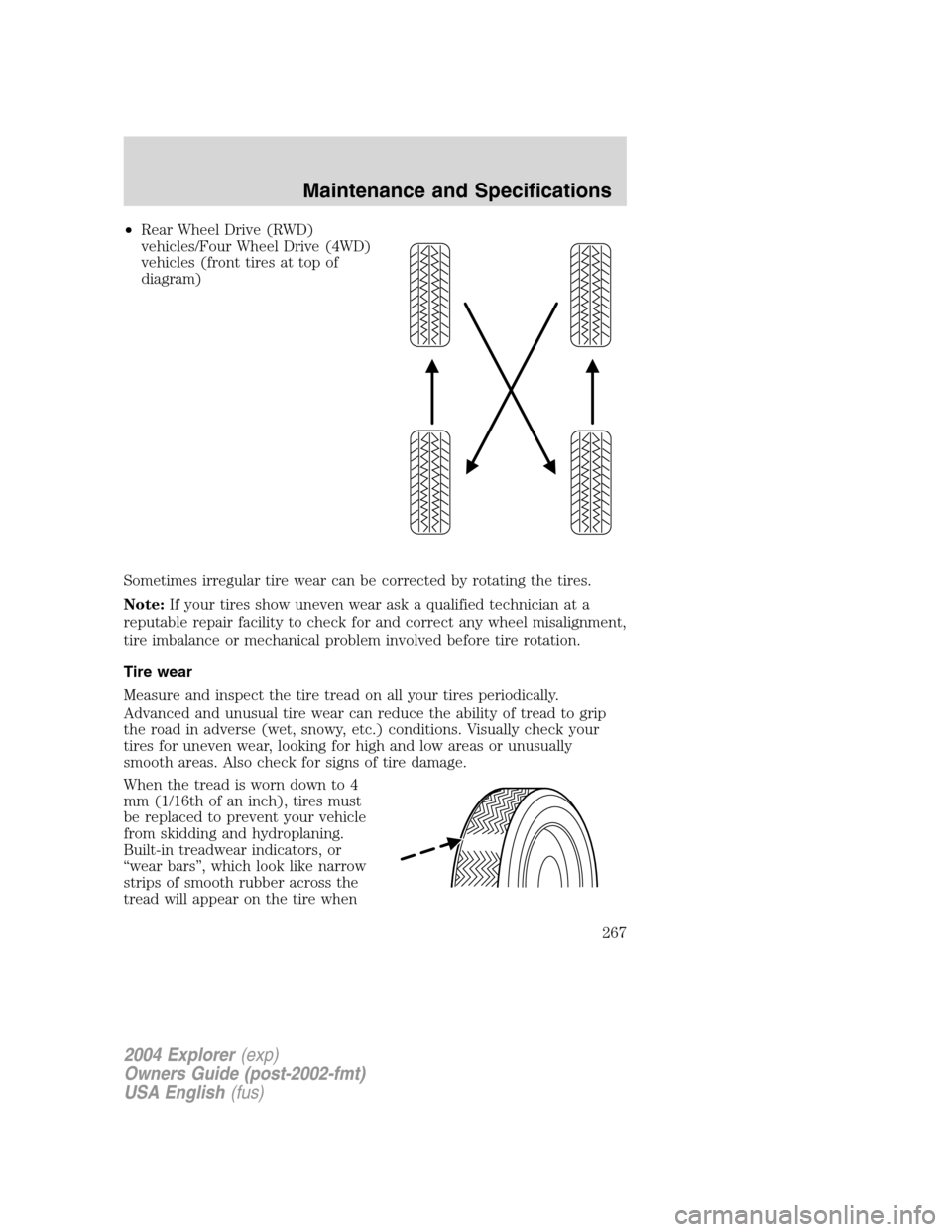
•Rear Wheel Drive (RWD)
vehicles/Four Wheel Drive (4WD)
vehicles (front tires at top of
diagram)
Sometimes irregular tire wear can be corrected by rotating the tires.
Note:If your tires show uneven wear ask a qualified technician at a
reputable repair facility to check for and correct any wheel misalignment,
tire imbalance or mechanical problem involved before tire rotation.
Tire wear
Measure and inspect the tire tread on all your tires periodically.
Advanced and unusual tire wear can reduce the ability of tread to grip
the road in adverse (wet, snowy, etc.) conditions. Visually check your
tires for uneven wear, looking for high and low areas or unusually
smooth areas. Also check for signs of tire damage.
When the tread is worn down to 4
mm (1/16th of an inch), tires must
be replaced to prevent your vehicle
from skidding and hydroplaning.
Built-in treadwear indicators, or
“wear bars”, which look like narrow
strips of smooth rubber across the
tread will appear on the tire when
2004 Explorer(exp)
Owners Guide (post-2002-fmt)
USA English(fus)
Maintenance and Specifications
267
Page 269 of 296
closest safe area out of traffic. This may further damage the flat tire, but
your safety is more important.
If you feel a sudden vibration or ride disturbance while driving or you
suspect your tire or vehicle has been damaged, immediately reduce your
speed. Drive with caution until you can safely pull off the road. Stop and
inspect the tire for damage. If the tire is under-inflated or damaged,
deflate it, remove wheel and replace it with your spare tire and wheel. If
you cannot detect a cause, have the vehicle towed to the nearest repair
facility or tire dealer to have the vehicle inspected.
Tire pressure monitoring system (TPMS)(if equipped)
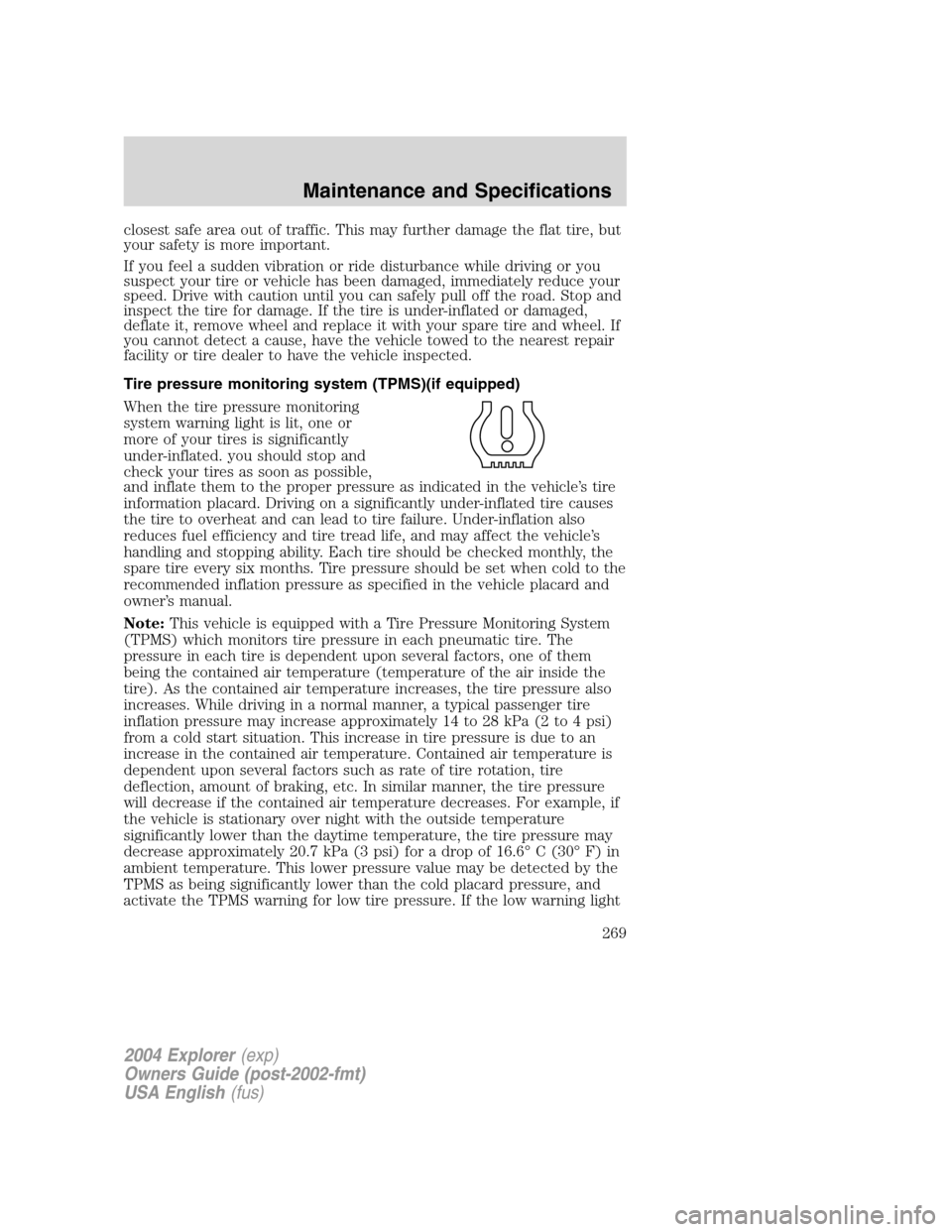
When the tire pressure monitoring
system warning light is lit, one or
more of your tires is significantly
under-inflated. you should stop and
check your tires as soon as possible,
and inflate them to the proper pressure as indicated in the vehicle’s tire
information placard. Driving on a significantly under-inflated tire causes
the tire to overheat and can lead to tire failure. Under-inflation also
reduces fuel efficiency and tire tread life, and may affect the vehicle’s
handling and stopping ability. Each tire should be checked monthly, the
spare tire every six months. Tire pressure should be set when cold to the
recommended inflation pressure as specified in the vehicle placard and
owner’s manual.
Note:This vehicle is equipped with a Tire Pressure Monitoring System
(TPMS) which monitors tire pressure in each pneumatic tire. The
pressure in each tire is dependent upon several factors, one of them
being the contained air temperature (temperature of the air inside the
tire). As the contained air temperature increases, the tire pressure also
increases. While driving in a normal manner, a typical passenger tire
inflation pressure may increase approximately 14 to 28 kPa (2 to 4 psi)
from a cold start situation. This increase in tire pressure is due to an
increase in the contained air temperature. Contained air temperature is
dependent upon several factors such as rate of tire rotation, tire
deflection, amount of braking, etc. In similar manner, the tire pressure
will decrease if the contained air temperature decreases. For example, if
the vehicle is stationary over night with the outside temperature
significantly lower than the daytime temperature, the tire pressure may
decrease approximately 20.7 kPa (3 psi) for a drop of 16.6° C (30° F) in
ambient temperature. This lower pressure value may be detected by the
TPMS as being significantly lower than the cold placard pressure, and
activate the TPMS warning for low tire pressure. If the low warning light
2004 Explorer(exp)
Owners Guide (post-2002-fmt)
USA English(fus)
Maintenance and Specifications
269
Page 270 of 296
is on, visually check each tire to verify that no tire is flat. If one or more
tires are flat, repair of fix as necessary. If all tires appear to be inflated,
carefully drive the vehicle to the nearest location where air can be added
to the tires. Turn the ignition to the “off” position. Inflate all the tires to
the recommended cold pressure.
The system uses radio-frequency to monitor the tire pressure on all tires
excluding the spare tire. The sensors transmit the tire pressure readings
to the receiver module located in the vehicle. The receiver module then
electronically transmits the status to the message center. For more tire
warning information, refer to theMessage Centerin theDriver controls
chapter.
This device complies with part 15 of the FCC rules and with RS-210 of
Industry Canada. Operation is subject to the following two conditions:
(1) This device may not cause harmful interference, and (2) This device
must accept any interference received, including interference that may
cause undesired operation.
The tire pressure monitoring system is NOT a substitute for
manually checking tire pressure. The tire pressure should be
checked periodically (at least monthly) using a tire gauge, see
Checking the tire pressurein this chapter. Failure to properly
maintain your tire pressure could increase the risk of tire failure, loss
of control, vehicle rollover and personal injury.
Changing tires with TPMS
It is recommended that you always
have your tires serviced by a dealer
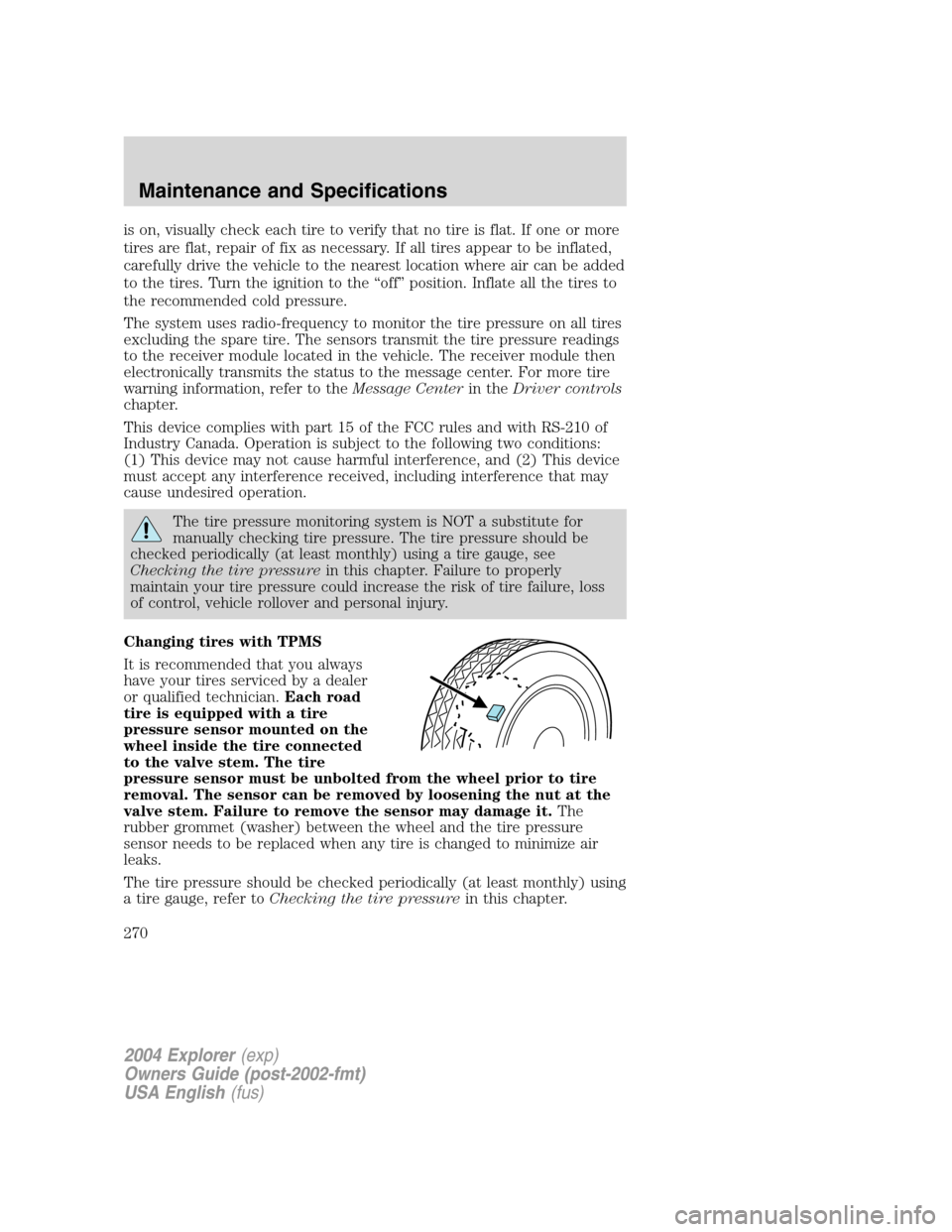
or qualified technician.Each road
tire is equipped with a tire
pressure sensor mounted on the
wheel inside the tire connected
to the valve stem. The tire
pressure sensor must be unbolted from the wheel prior to tire
removal. The sensor can be removed by loosening the nut at the
valve stem. Failure to remove the sensor may damage it.The
rubber grommet (washer) between the wheel and the tire pressure
sensor needs to be replaced when any tire is changed to minimize air
leaks.
The tire pressure should be checked periodically (at least monthly) using
a tire gauge, refer toChecking the tire pressurein this chapter.
2004 Explorer(exp)
Owners Guide (post-2002-fmt)
USA English(fus)
Maintenance and Specifications
270
Page 271 of 296
USING SNOW TIRES AND TRACTION DEVICES
Snow tires must be the same size and grade as the tires you
currently have on your vehicle.
The tires on your vehicle have all-weather treads to provide traction in
rain and snow. However, in some climates, using snow tires or traction
devices may be necessary. Ford offers tire cables as a Ford approved
accessory and recommends use of these or SAE class “S” tire cables. See
your dealer or qualified service technician for more information on tire
cables for your vehicle.
Follow these guidelines when using snow tires and traction devices:
•Cables or chains should only be used on the rear wheels.
•Install cables or chains securely, verifying that the cables or chains do
not touch any wiring, brake lines or fuel lines.
•Drive cautiously. If you hear the cables or chains rub or bang against
the vehicle, stop and retighten them. If this does not work, remove the
cables or chains to prevent vehicle damage.
•Avoid overloading your vehicle.
•Remove the cables or chains when they are no longer needed.
•Do not use cables or chains on dry roads.
•Do not exceed 48 km/h (30 mph) with tire cables or chains on your
vehicle.
Consult your dealer for information on other Ford approved methods of
traction control.
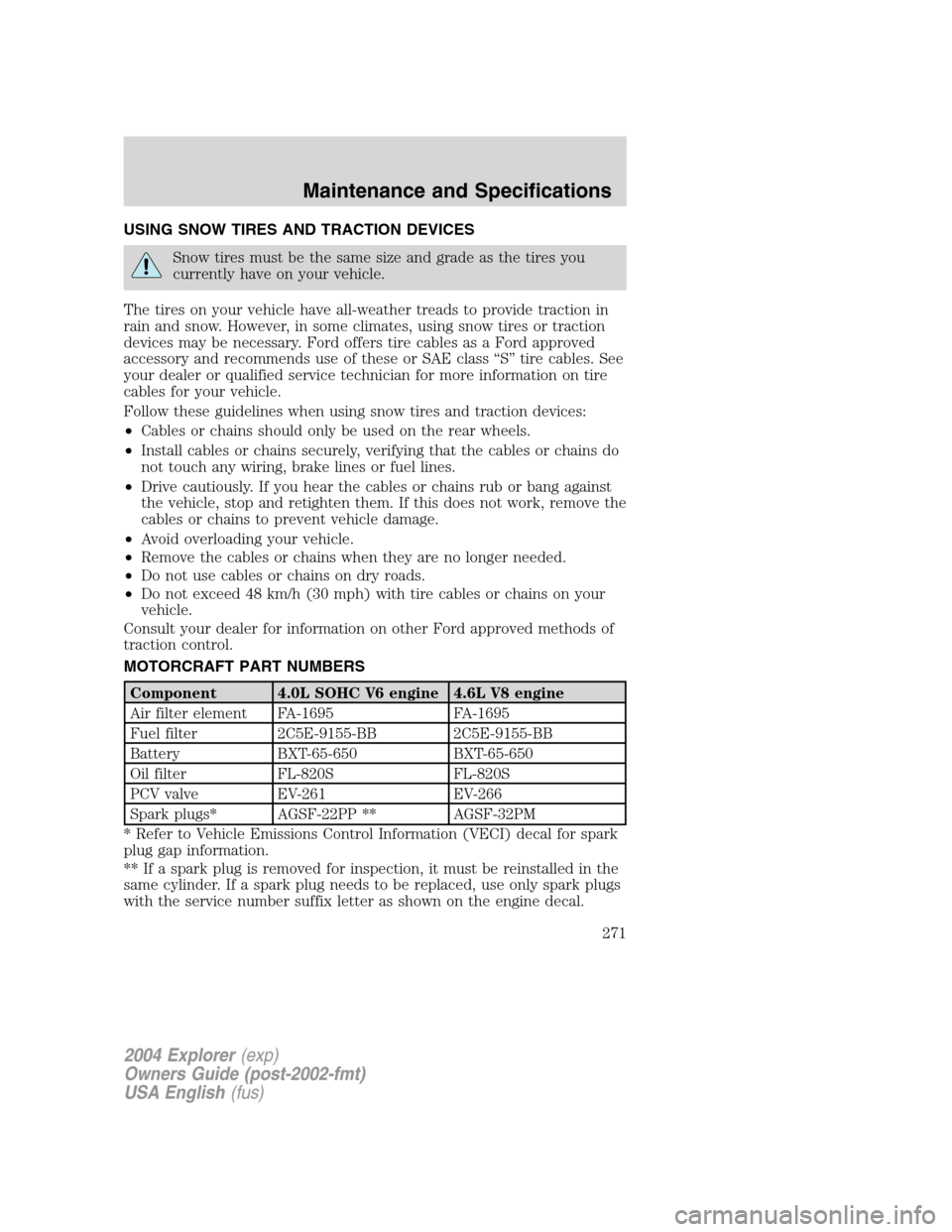
MOTORCRAFT PART NUMBERS
Component 4.0L SOHC V6 engine 4.6L V8 engine
Air filter element FA-1695 FA-1695
Fuel filter 2C5E-9155-BB 2C5E-9155-BB
Battery BXT-65-650 BXT-65-650
Oil filter FL-820S FL-820S
PCV valve EV-261 EV-266
Spark plugs* AGSF-22PP ** AGSF-32PM
* Refer to Vehicle Emissions Control Information (VECI) decal for spark
plug gap information.
** If a spark plug is removed for inspection, it must be reinstalled in the
same cylinder. If a spark plug needs to be replaced, use only spark plugs
with the service number suffix letter as shown on the engine decal.
2004 Explorer(exp)
Owners Guide (post-2002-fmt)
USA English(fus)
Maintenance and Specifications
271
Page 277 of 296
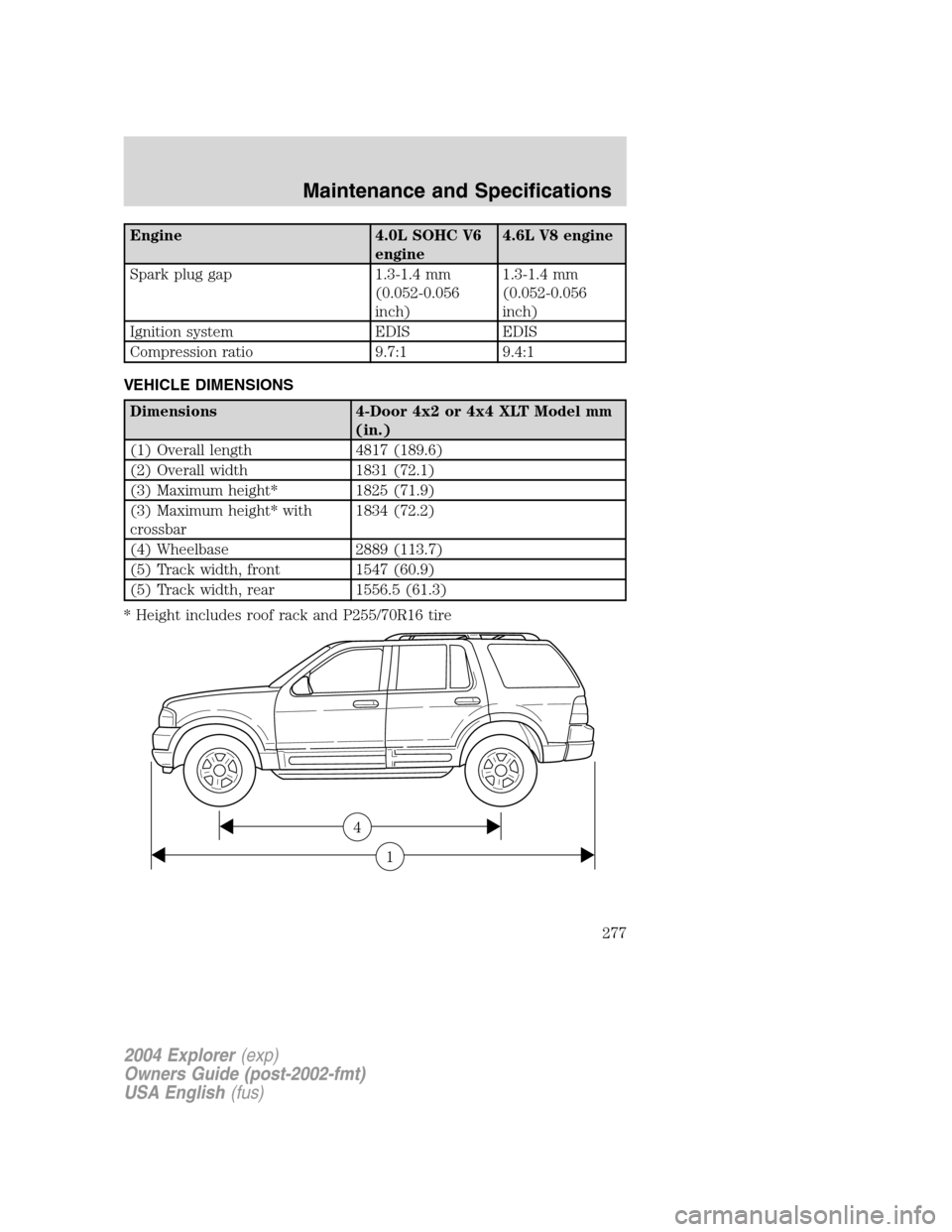
Engine 4.0L SOHC V6
engine4.6L V8 engine
Spark plug gap 1.3-1.4 mm
(0.052-0.056
inch)1.3-1.4 mm
(0.052-0.056
inch)
Ignition system EDIS EDIS
Compression ratio 9.7:1 9.4:1
VEHICLE DIMENSIONS
Dimensions 4-Door 4x2 or 4x4 XLT Model mm
(in.)
(1) Overall length 4817 (189.6)
(2) Overall width 1831 (72.1)
(3) Maximum height* 1825 (71.9)
(3) Maximum height* with
crossbar1834 (72.2)
(4) Wheelbase 2889 (113.7)
(5) Track width, front 1547 (60.9)
(5) Track width, rear 1556.5 (61.3)
* Height includes roof rack and P255/70R16 tire
1
4
2004 Explorer(exp)
Owners Guide (post-2002-fmt)
USA English(fus)
Maintenance and Specifications
277
Page 281 of 296
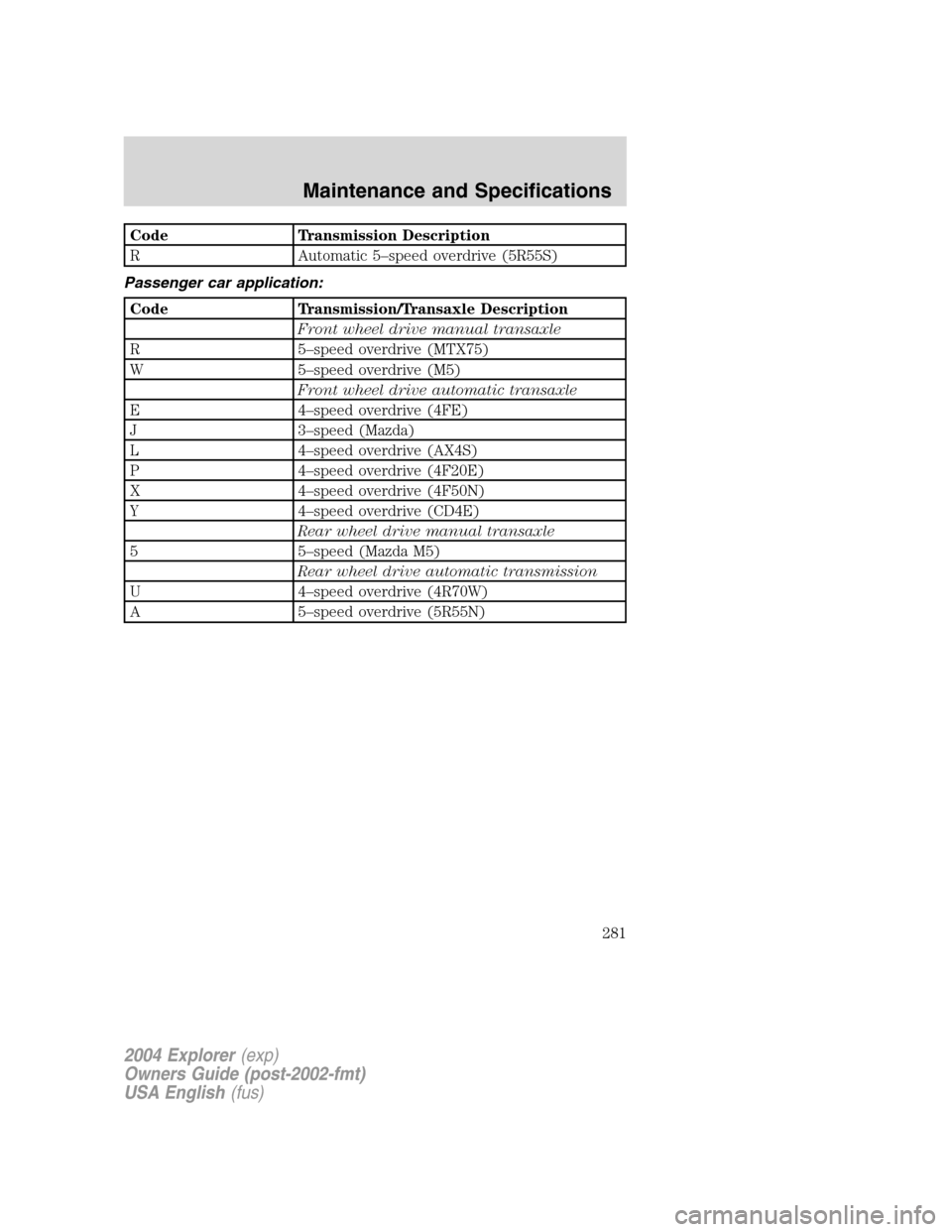
Code Transmission Description
R Automatic 5–speed overdrive (5R55S)
Passenger car application:
Code Transmission/Transaxle Description
Front wheel drive manual transaxle
R 5–speed overdrive (MTX75)
W 5–speed overdrive (M5)
Front wheel drive automatic transaxle
E 4–speed overdrive (4FE)
J 3–speed (Mazda)
L 4–speed overdrive (AX4S)
P 4–speed overdrive (4F20E)
X 4–speed overdrive (4F50N)
Y 4–speed overdrive (CD4E)
Rear wheel drive manual transaxle
5 5–speed (Mazda M5)
Rear wheel drive automatic transmission
U 4–speed overdrive (4R70W)
A 5–speed overdrive (5R55N)
2004 Explorer(exp)
Owners Guide (post-2002-fmt)
USA English(fus)
Maintenance and Specifications
281
Page 282 of 296
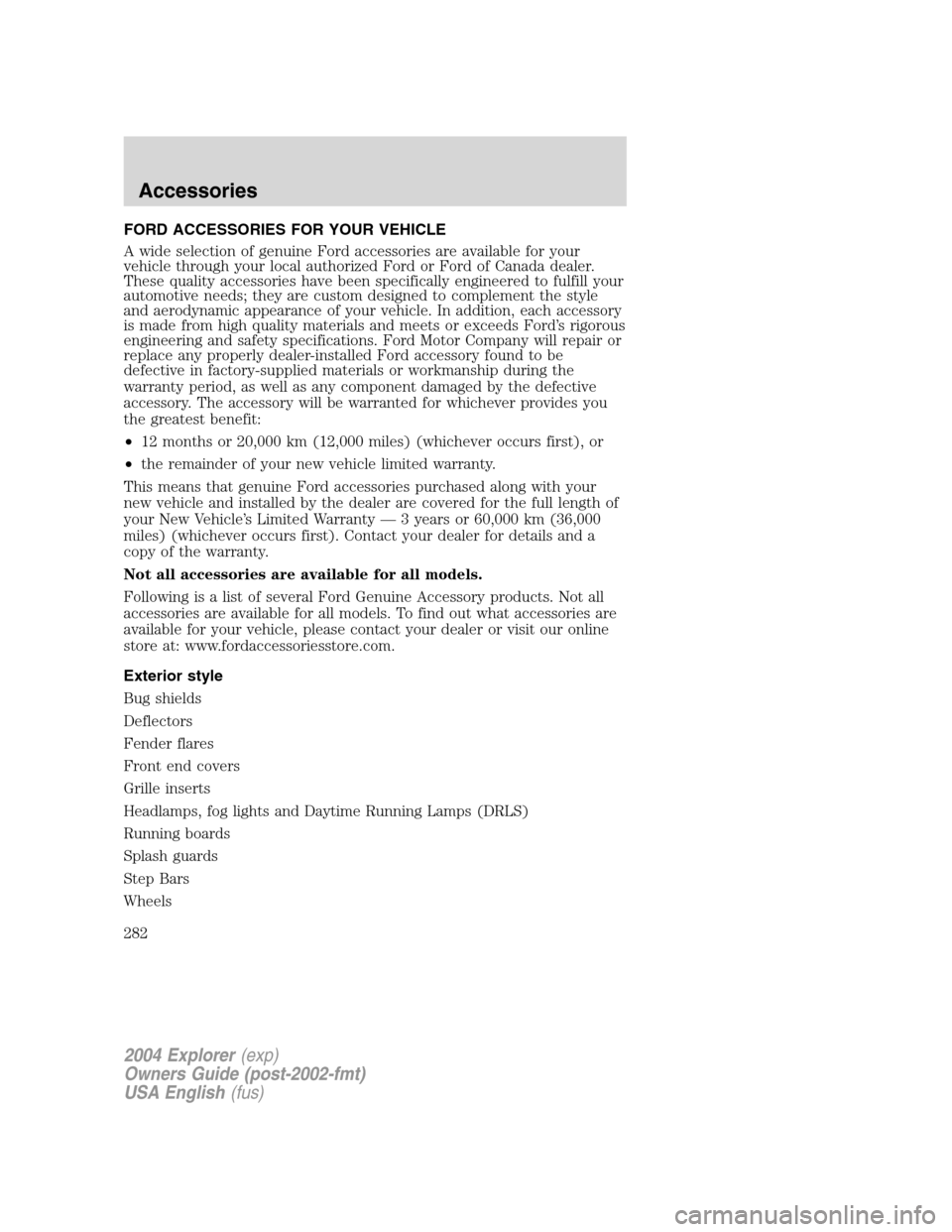
FORD ACCESSORIES FOR YOUR VEHICLE
A wide selection of genuine Ford accessories are available for your
vehicle through your local authorized Ford or Ford of Canada dealer.
These quality accessories have been specifically engineered to fulfill your
automotive needs; they are custom designed to complement the style
and aerodynamic appearance of your vehicle. In addition, each accessory
is made from high quality materials and meets or exceeds Ford’s rigorous
engineering and safety specifications. Ford Motor Company will repair or
replace any properly dealer-installed Ford accessory found to be
defective in factory-supplied materials or workmanship during the
warranty period, as well as any component damaged by the defective
accessory. The accessory will be warranted for whichever provides you
the greatest benefit:
•12 months or 20,000 km (12,000 miles) (whichever occurs first), or
•the remainder of your new vehicle limited warranty.
This means that genuine Ford accessories purchased along with your
new vehicle and installed by the dealer are covered for the full length of
your New Vehicle’s Limited Warranty — 3 years or 60,000 km (36,000
miles) (whichever occurs first). Contact your dealer for details and a
copy of the warranty.
Not all accessories are available for all models.
Following is a list of several Ford Genuine Accessory products. Not all
accessories are available for all models. To find out what accessories are
available for your vehicle, please contact your dealer or visit our online
store at: www.fordaccessoriesstore.com.
Exterior style
Bug shields
Deflectors
Fender flares
Front end covers
Grille inserts
Headlamps, fog lights and Daytime Running Lamps (DRLS)
Running boards
Splash guards
Step Bars
Wheels
2004 Explorer(exp)
Owners Guide (post-2002-fmt)
USA English(fus)
Accessories
Accessories
282
Page 283 of 296
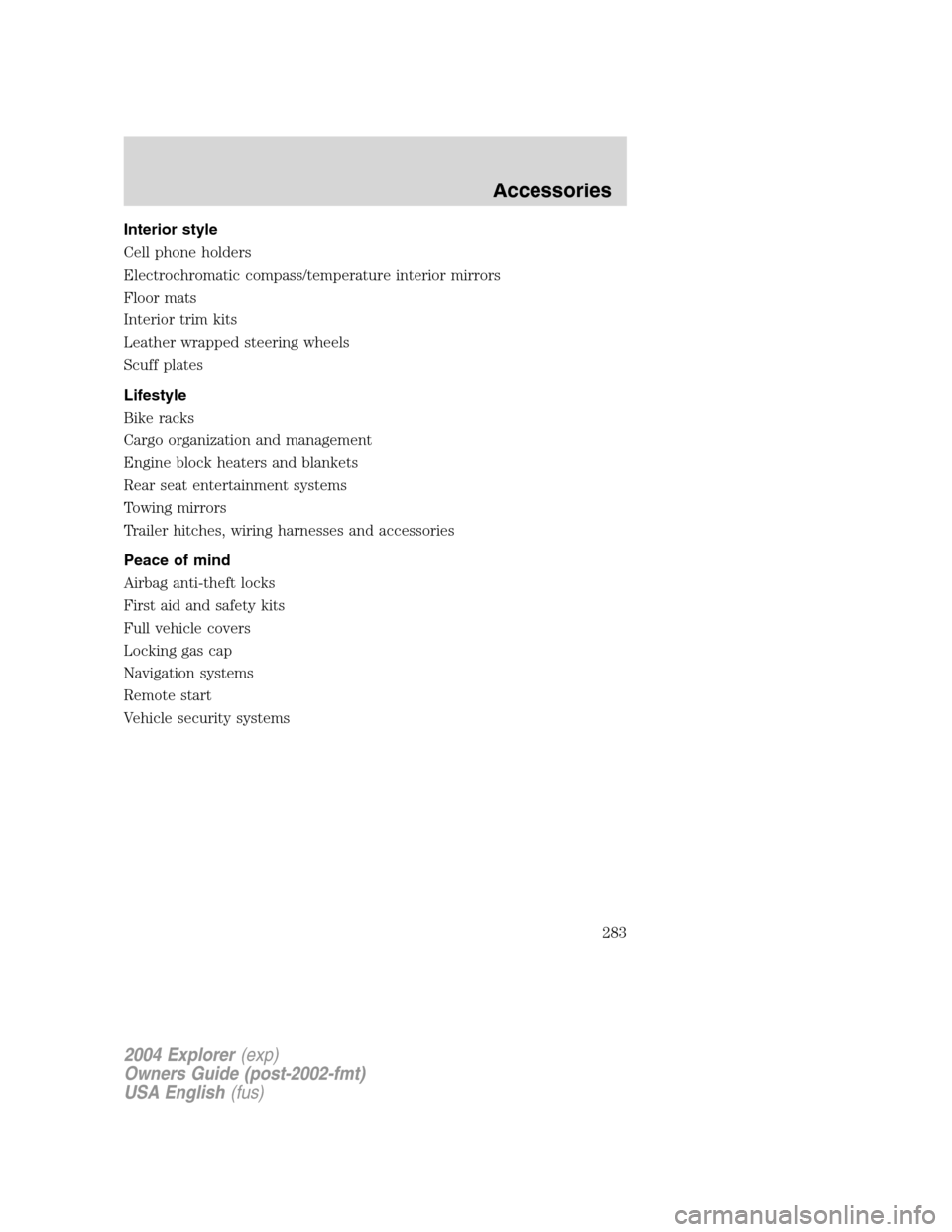
Interior style
Cell phone holders
Electrochromatic compass/temperature interior mirrors
Floor mats
Interior trim kits
Leather wrapped steering wheels
Scuff plates
Lifestyle
Bike racks
Cargo organization and management
Engine block heaters and blankets
Rear seat entertainment systems
Towing mirrors
Trailer hitches, wiring harnesses and accessories
Peace of mind
Airbag anti-theft locks
First aid and safety kits
Full vehicle covers
Locking gas cap
Navigation systems
Remote start
Vehicle security systems
2004 Explorer(exp)
Owners Guide (post-2002-fmt)
USA English(fus)
Accessories
283
Page 285 of 296
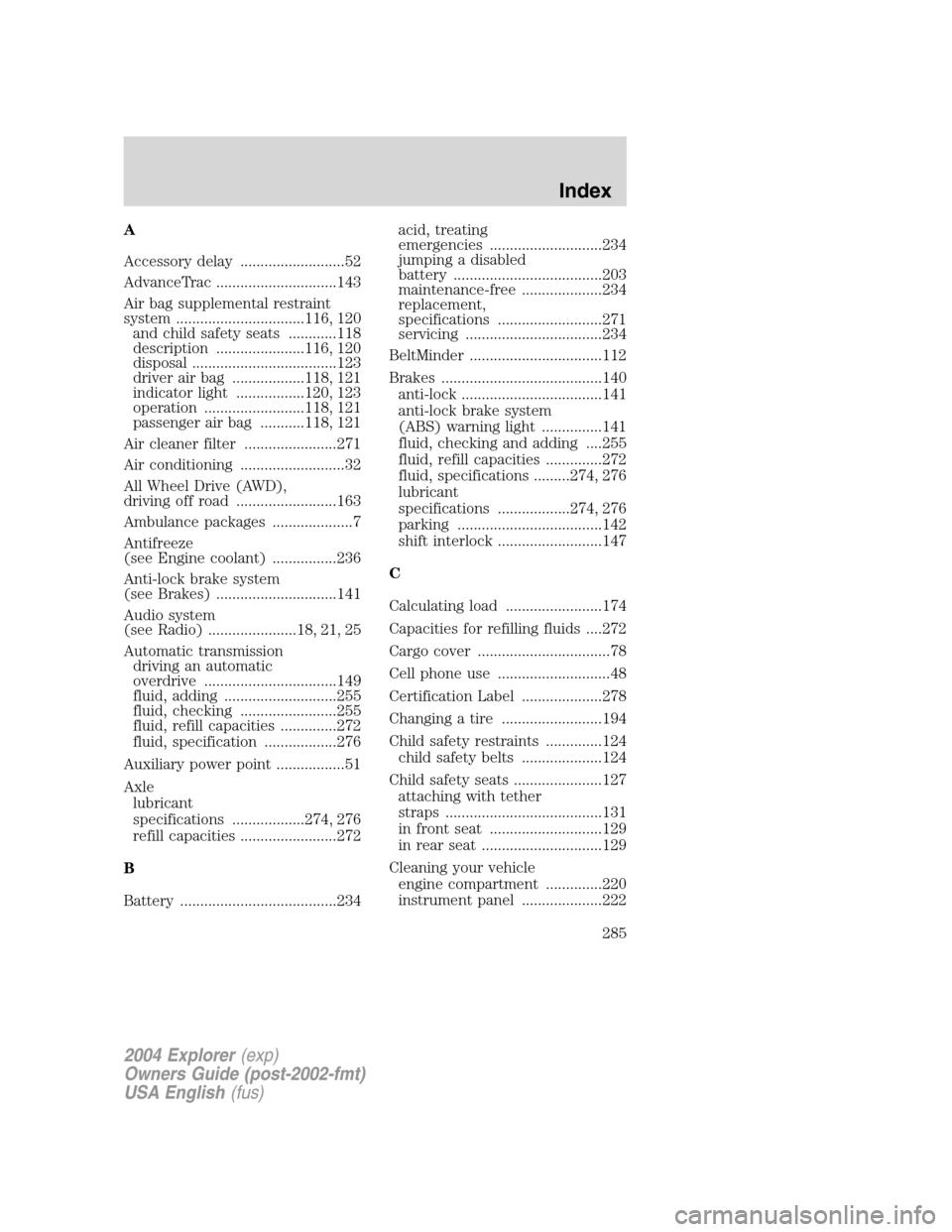
A
Accessory delay ..........................52
AdvanceTrac ..............................143
Air bag supplemental restraint
system ................................116, 120
and child safety seats ............118
description ......................116, 120
disposal ....................................123
driver air bag ..................118, 121
indicator light .................120, 123
operation .........................118, 121
passenger air bag ...........118, 121
Air cleaner filter .......................271
Air conditioning ..........................32
All Wheel Drive (AWD),
driving off road .........................163
Ambulance packages ....................7
Antifreeze
(see Engine coolant) ................236
Anti-lock brake system
(see Brakes) ..............................141
Audio system
(see Radio) ......................18, 21, 25
Automatic transmission
driving an automatic
overdrive .................................149
fluid, adding ............................255
fluid, checking ........................255
fluid, refill capacities ..............272
fluid, specification ..................276
Auxiliary power point .................51
Axle
lubricant
specifications ..................274, 276
refill capacities ........................272
B
Battery .......................................234acid, treating
emergencies ............................234
jumping a disabled
battery .....................................203
maintenance-free ....................234
replacement,
specifications ..........................271
servicing ..................................234
BeltMinder .................................112
Brakes ........................................140
anti-lock ...................................141
anti-lock brake system
(ABS) warning light ...............141
fluid, checking and adding ....255
fluid, refill capacities ..............272
fluid, specifications .........274, 276
lubricant
specifications ..................274, 276
parking ....................................142
shift interlock ..........................147
C
Calculating load ........................174
Capacities for refilling fluids ....272
Cargo cover .................................78
Cell phone use ............................48
Certification Label ....................278
Changing a tire .........................194
Child safety restraints ..............124
child safety belts ....................124
Child safety seats ......................127
attaching with tether
straps .......................................131
in front seat ............................129
in rear seat ..............................129
Cleaning your vehicle
engine compartment ..............220
instrument panel ....................222
2004 Explorer(exp)
Owners Guide (post-2002-fmt)
USA English(fus)
Index
Index
285