weight FORD EXPLORER 2005 3.G User Guide
[x] Cancel search | Manufacturer: FORD, Model Year: 2005, Model line: EXPLORER, Model: FORD EXPLORER 2005 3.GPages: 320, PDF Size: 8.62 MB
Page 194 of 320
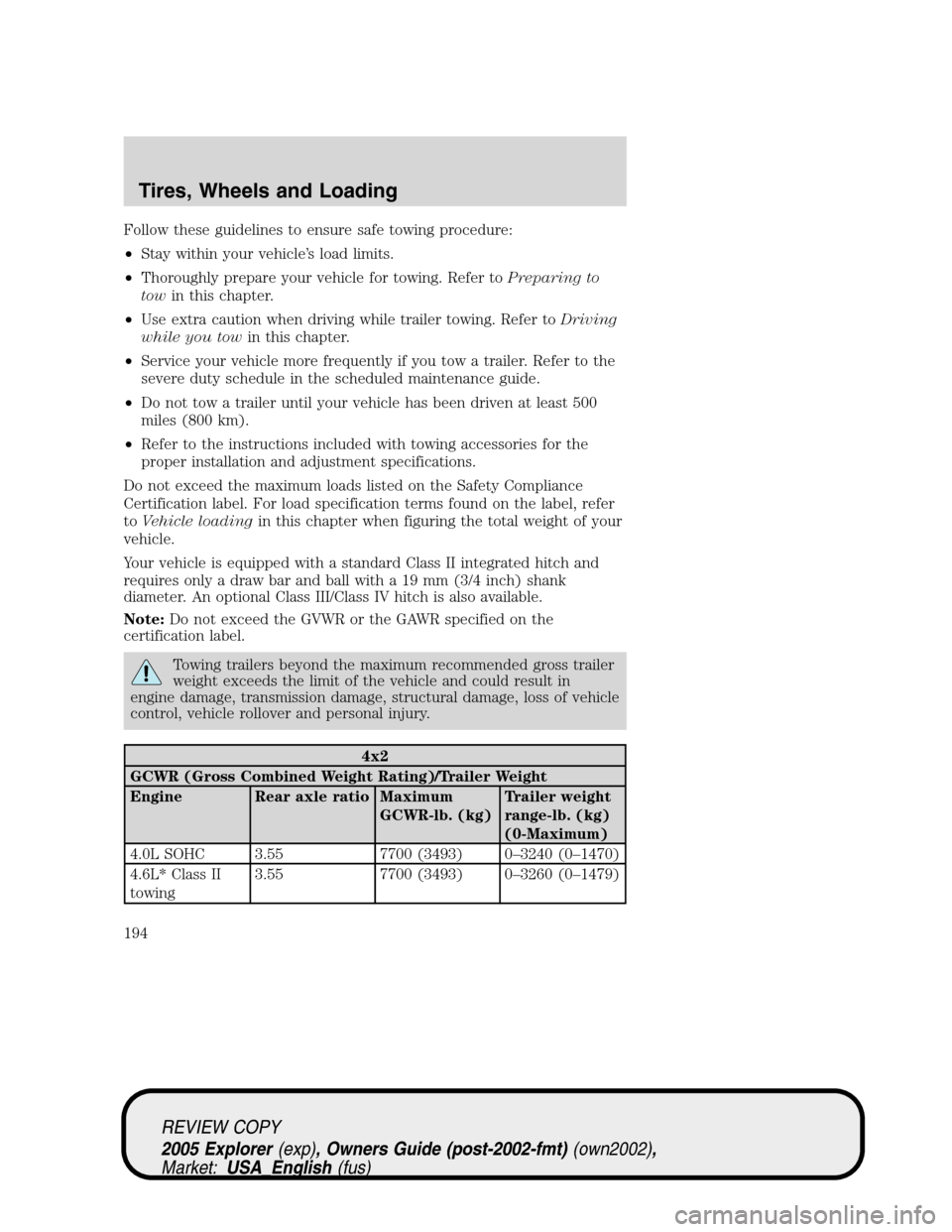
Follow these guidelines to ensure safe towing procedure:
•Stay within your vehicle’s load limits.
•Thoroughly prepare your vehicle for towing. Refer toPreparing to
towin this chapter.
•Use extra caution when driving while trailer towing. Refer toDriving
while you towin this chapter.
•Service your vehicle more frequently if you tow a trailer. Refer to the
severe duty schedule in the scheduled maintenance guide.
•Do not tow a trailer until your vehicle has been driven at least 500
miles (800 km).
•Refer to the instructions included with towing accessories for the
proper installation and adjustment specifications.
Do not exceed the maximum loads listed on the Safety Compliance
Certification label. For load specification terms found on the label, refer
toVehicle loadingin this chapter when figuring the total weight of your
vehicle.
Your vehicle is equipped with a standard Class II integrated hitch and
requires only a draw bar and ball with a 19 mm (3/4 inch) shank
diameter. An optional Class III/Class IV hitch is also available.
Note:Do not exceed the GVWR or the GAWR specified on the
certification label.
Towing trailers beyond the maximum recommended gross trailer
weight exceeds the limit of the vehicle and could result in
engine damage, transmission damage, structural damage, loss of vehicle
control, vehicle rollover and personal injury.
4x2
GCWR (Gross Combined Weight Rating)/Trailer Weight
Engine Rear axle ratio Maximum
GCWR-lb. (kg)Trailer weight
range-lb. (kg)
(0-Maximum)
4.0L SOHC 3.55 7700 (3493) 0–3240 (0–1470)
4.6L* Class II
towing3.55 7700 (3493) 0–3260 (0–1479)
REVIEW COPY
2005 Explorer(exp), Owners Guide (post-2002-fmt)(own2002),
Market:USA_English(fus)
Tires, Wheels and Loading
194
Page 195 of 320
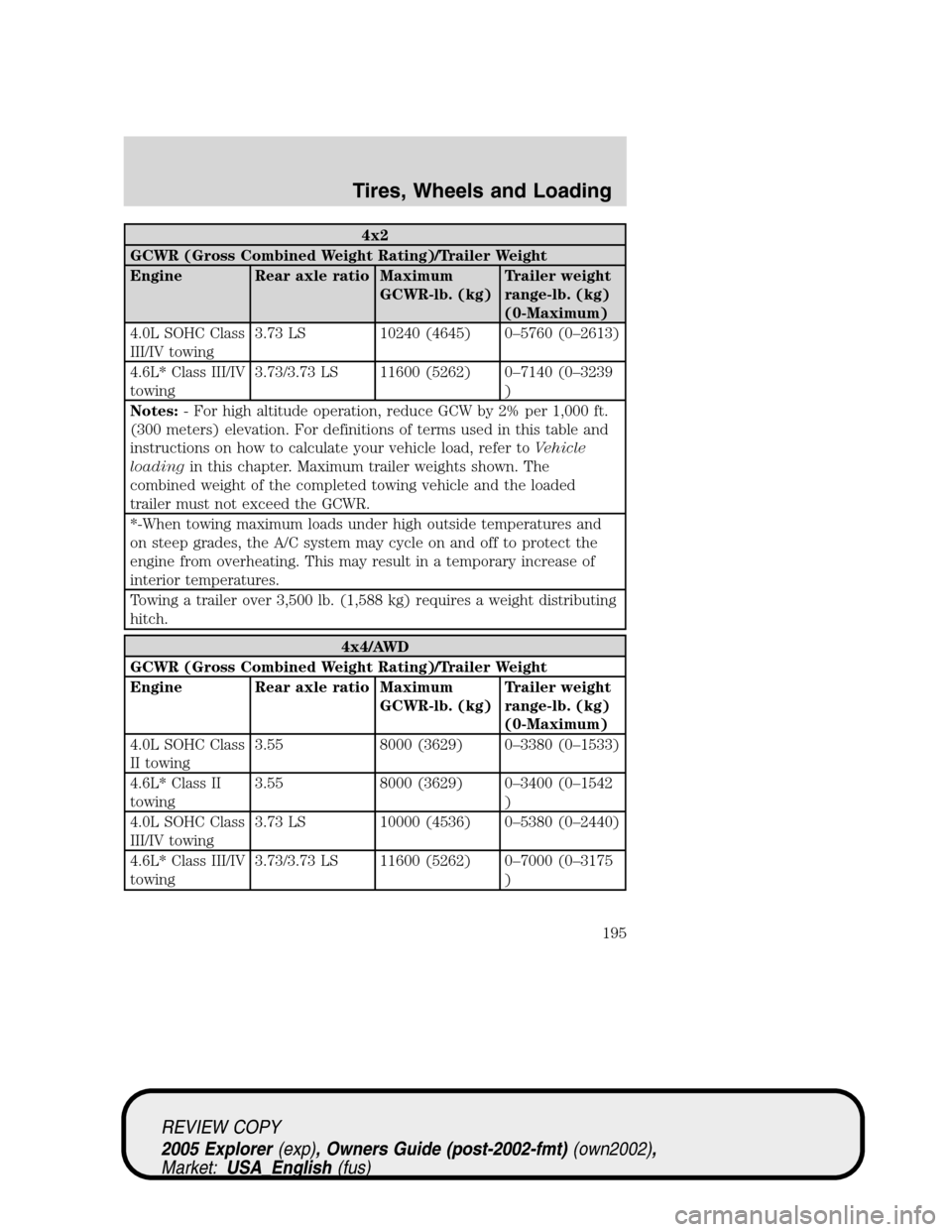
4x2
GCWR (Gross Combined Weight Rating)/Trailer Weight
Engine Rear axle ratio Maximum
GCWR-lb. (kg)Trailer weight
range-lb. (kg)
(0-Maximum)
4.0L SOHC Class
III/IV towing3.73 LS 10240 (4645) 0–5760 (0–2613)
4.6L* Class III/IV
towing3.73/3.73 LS 11600 (5262) 0–7140 (0–3239
)
Notes:- For high altitude operation, reduce GCW by 2% per 1,000 ft.
(300 meters) elevation. For definitions of terms used in this table and
instructions on how to calculate your vehicle load, refer toVehicle
loadingin this chapter. Maximum trailer weights shown. The
combined weight of the completed towing vehicle and the loaded
trailer must not exceed the GCWR.
*-When towing maximum loads under high outside temperatures and
on steep grades, the A/C system may cycle on and off to protect the
engine from overheating. This may result in a temporary increase of
interior temperatures.
Towing a trailer over 3,500 lb. (1,588 kg) requires a weight distributing
hitch.
4x4/AWD
GCWR (Gross Combined Weight Rating)/Trailer Weight
Engine Rear axle ratio Maximum
GCWR-lb. (kg)Trailer weight
range-lb. (kg)
(0-Maximum)
4.0L SOHC Class
II towing3.55 8000 (3629) 0–3380 (0–1533)
4.6L* Class II
towing3.55 8000 (3629) 0–3400 (0–1542
)
4.0L SOHC Class
III/IV towing3.73 LS 10000 (4536) 0–5380 (0–2440)
4.6L* Class III/IV
towing3.73/3.73 LS 11600 (5262) 0–7000 (0–3175
)
REVIEW COPY
2005 Explorer(exp), Owners Guide (post-2002-fmt)(own2002),
Market:USA_English(fus)
Tires, Wheels and Loading
195
Page 196 of 320
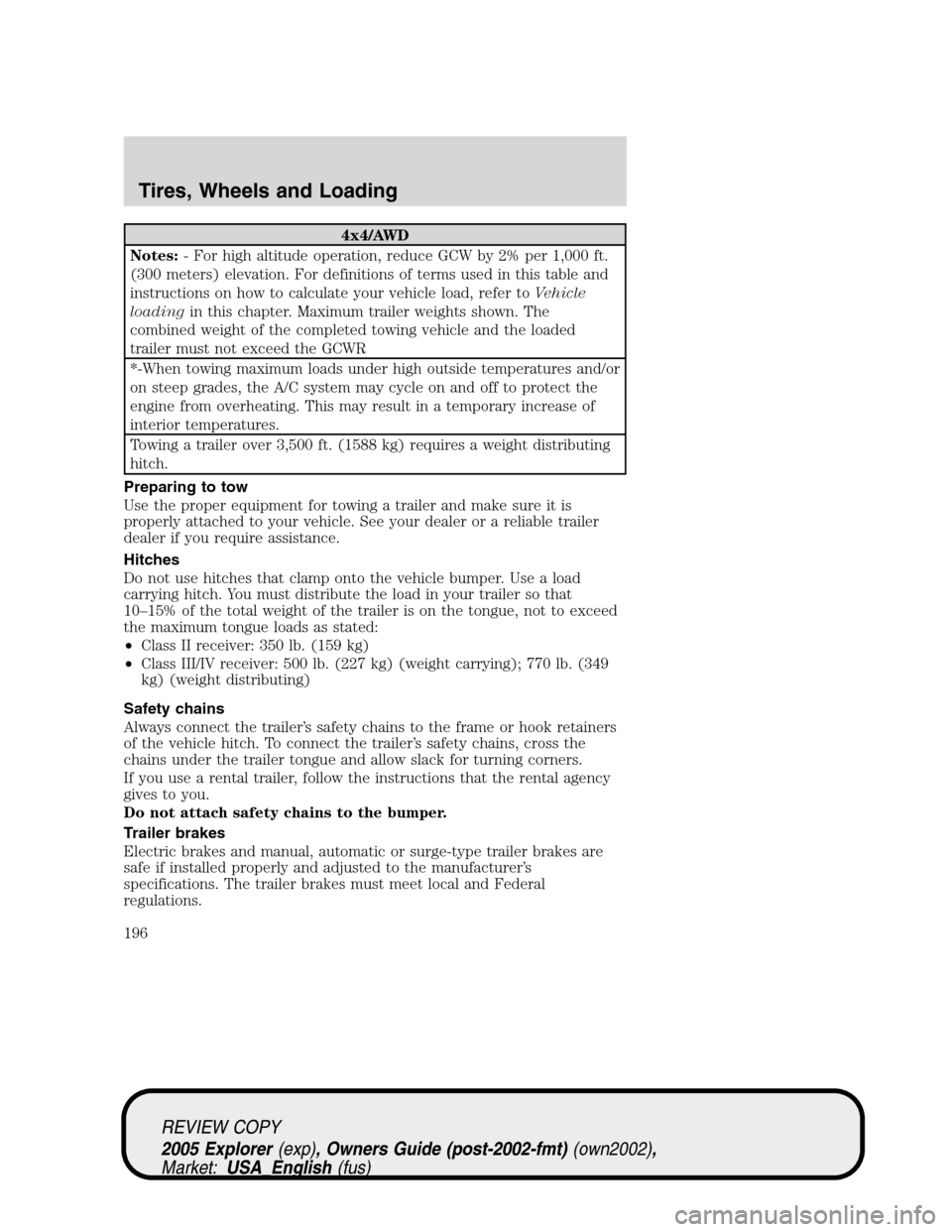
4x4/AWD
Notes:- For high altitude operation, reduce GCW by 2% per 1,000 ft.
(300 meters) elevation. For definitions of terms used in this table and
instructions on how to calculate your vehicle load, refer toVehicle
loadingin this chapter. Maximum trailer weights shown. The
combined weight of the completed towing vehicle and the loaded
trailer must not exceed the GCWR
*-When towing maximum loads under high outside temperatures and/or
on steep grades, the A/C system may cycle on and off to protect the
engine from overheating. This may result in a temporary increase of
interior temperatures.
Towing a trailer over 3,500 ft. (1588 kg) requires a weight distributing
hitch.
Preparing to tow
Use the proper equipment for towing a trailer and make sure it is
properly attached to your vehicle. See your dealer or a reliable trailer
dealer if you require assistance.
Hitches
Do not use hitches that clamp onto the vehicle bumper. Use a load
carrying hitch. You must distribute the load in your trailer so that
10–15% of the total weight of the trailer is on the tongue, not to exceed
the maximum tongue loads as stated:
•Class II receiver: 350 lb. (159 kg)
•Class III/IV receiver: 500 lb. (227 kg) (weight carrying); 770 lb. (349
kg) (weight distributing)
Safety chains
Always connect the trailer’s safety chains to the frame or hook retainers
of the vehicle hitch. To connect the trailer’s safety chains, cross the
chains under the trailer tongue and allow slack for turning corners.
If you use a rental trailer, follow the instructions that the rental agency
gives to you.
Do not attach safety chains to the bumper.
Trailer brakes
Electric brakes and manual, automatic or surge-type trailer brakes are
safe if installed properly and adjusted to the manufacturer’s
specifications. The trailer brakes must meet local and Federal
regulations.
REVIEW COPY
2005 Explorer(exp), Owners Guide (post-2002-fmt)(own2002),
Market:USA_English(fus)
Tires, Wheels and Loading
196
Page 198 of 320
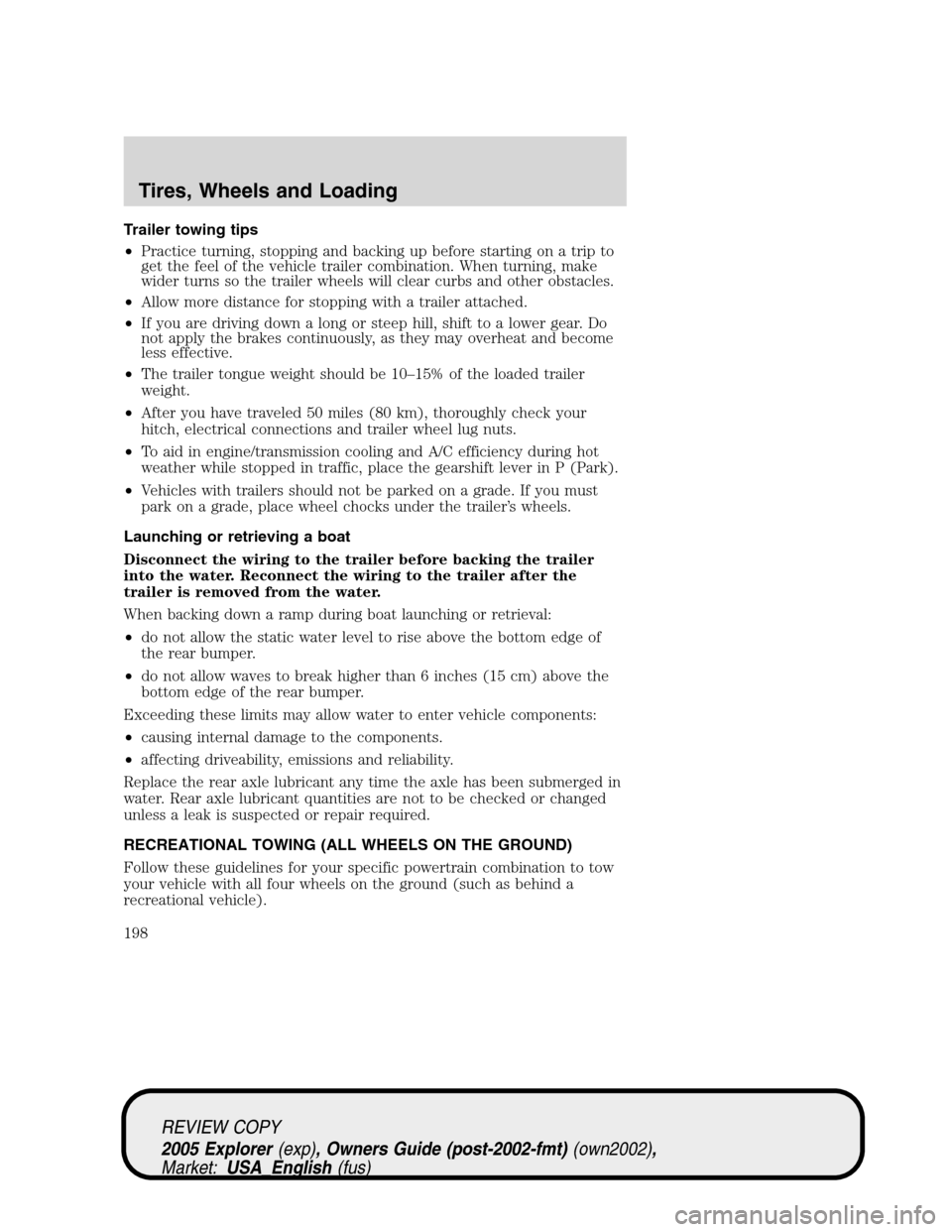
Trailer towing tips
•Practice turning, stopping and backing up before starting on a trip to
get the feel of the vehicle trailer combination. When turning, make
wider turns so the trailer wheels will clear curbs and other obstacles.
•Allow more distance for stopping with a trailer attached.
•If you are driving down a long or steep hill, shift to a lower gear. Do
not apply the brakes continuously, as they may overheat and become
less effective.
•The trailer tongue weight should be 10–15% of the loaded trailer
weight.
•After you have traveled 50 miles (80 km), thoroughly check your
hitch, electrical connections and trailer wheel lug nuts.
•To aid in engine/transmission cooling and A/C efficiency during hot
weather while stopped in traffic, place the gearshift lever in P (Park).
•Vehicles with trailers should not be parked on a grade. If you must
park on a grade, place wheel chocks under the trailer’s wheels.
Launching or retrieving a boat
Disconnect the wiring to the trailer before backing the trailer
into the water. Reconnect the wiring to the trailer after the
trailer is removed from the water.
When backing down a ramp during boat launching or retrieval:
•do not allow the static water level to rise above the bottom edge of
the rear bumper.
•do not allow waves to break higher than 6 inches (15 cm) above the
bottom edge of the rear bumper.
Exceeding these limits may allow water to enter vehicle components:
•causing internal damage to the components.
•affecting driveability, emissions and reliability.
Replace the rear axle lubricant any time the axle has been submerged in
water. Rear axle lubricant quantities are not to be checked or changed
unless a leak is suspected or repair required.
RECREATIONAL TOWING (ALL WHEELS ON THE GROUND)
Follow these guidelines for your specific powertrain combination to tow
your vehicle with all four wheels on the ground (such as behind a
recreational vehicle).
REVIEW COPY
2005 Explorer(exp), Owners Guide (post-2002-fmt)(own2002),
Market:USA_English(fus)
Tires, Wheels and Loading
198
Page 295 of 320
•Perform all regularly scheduled maintenance items. Follow the
recommended maintenance schedule and owner maintenance checks
found in your vehicle scheduled maintenance guide.
Conditions
•Heavily loading a vehicle or towing a trailer may reduce fuel economy
at any speed.
•Carrying unnecessary weight may reduce fuel economy (approximately
1 mpg [0.4 km/L] is lost for every 400 lb [180 kg] of weight carried).
•Adding certain accessories to your vehicle (for example bug
deflectors, rollbars/light bars, running boards, ski/luggage racks) may
reduce fuel economy.
•Fuel economy may decrease with lower temperatures during the first
8–10 miles (12–16 km) of driving.
•Driving on flat terrain offers improved fuel economy as compared to
driving on hilly terrain.
•Transmissions give their best fuel economy when operated in the top
cruise gear and with steady pressure on the gas pedal.
•Four-wheel-drive operation (if equipped) is less fuel efficient than
two-wheel-drive operation.
•Close windows for high speed driving.
Flex fuel (E-85) cruising range
Because E-85 fuel contains less energy per gallon than gasoline, you will
experience an increase in fuel consumption. You can expect your Miles
Per Gallon (MPG) and your driving range to decrease by about 30%
compared to gasoline operation.
EPA window sticker
Every new vehicle should have the EPA window sticker. Contact your
dealer if the window sticker is not supplied with your vehicle. The EPA
window sticker should be your guide for the fuel economy comparisons
with other vehicles.
It is important to note the box in the lower left corner of the window
sticker. These numbers represent the Range of MPG (L/100 km)
expected on the vehicle under optimum conditions. Your fuel economy
may vary depending upon the method of operation and conditions.
REVIEW COPY
2005 Explorer(exp), Owners Guide (post-2002-fmt)(own2002),
Market:USA_English(fus)
Maintenance and Specifications
295
Page 309 of 320
Vehicle identification number
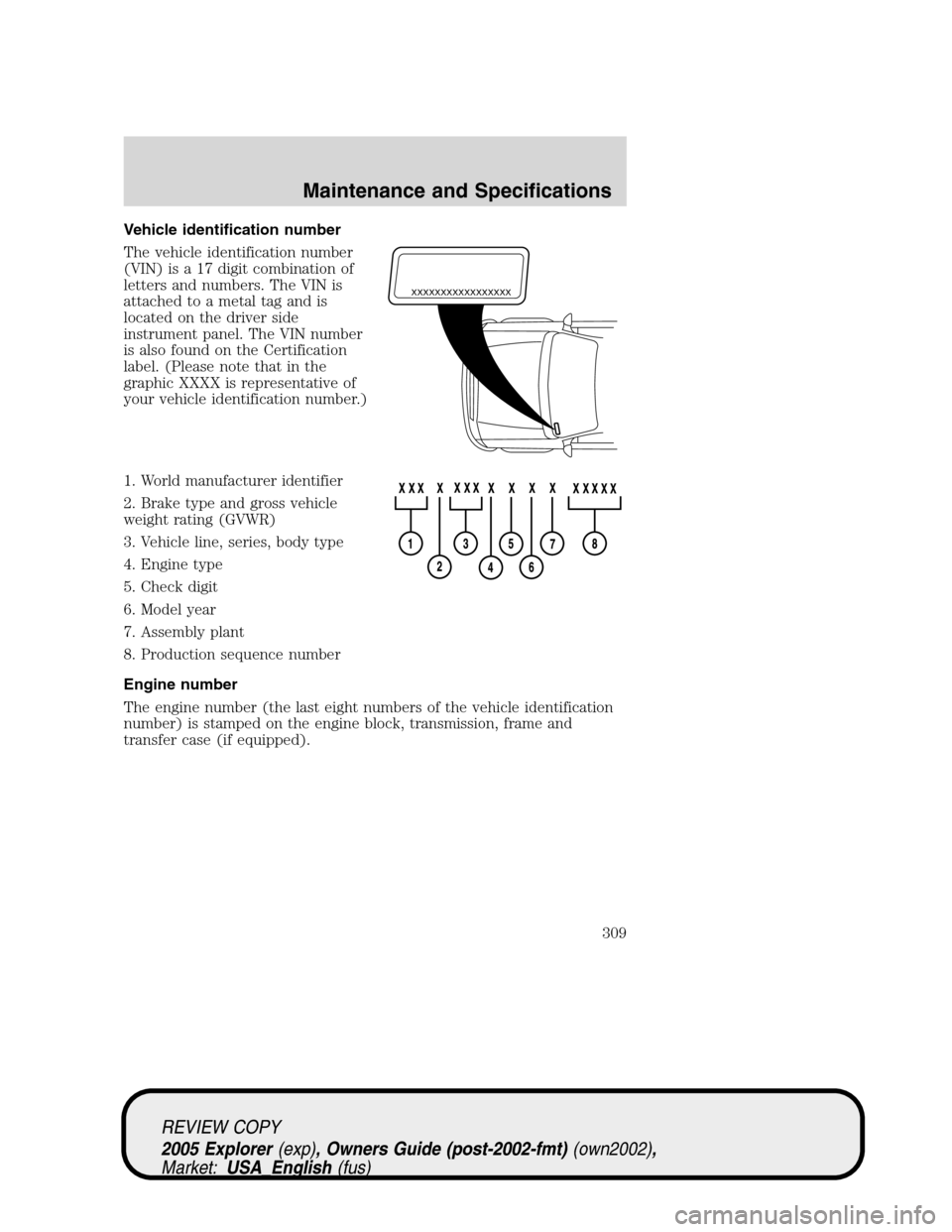
The vehicle identification number
(VIN) is a 17 digit combination of
letters and numbers. The VIN is
attached to a metal tag and is
located on the driver side
instrument panel. The VIN number
is also found on the Certification
label. (Please note that in the
graphic XXXX is representative of
your vehicle identification number.)
1. World manufacturer identifier
2. Brake type and gross vehicle
weight rating (GVWR)
3. Vehicle line, series, body type
4. Engine type
5. Check digit
6. Model year
7. Assembly plant
8. Production sequence number
Engine number
The engine number (the last eight numbers of the vehicle identification
number) is stamped on the engine block, transmission, frame and
transfer case (if equipped).
XXXXXXXXXXXXXXXXX
REVIEW COPY
2005 Explorer(exp), Owners Guide (post-2002-fmt)(own2002),
Market:USA_English(fus)
Maintenance and Specifications
309
Page 311 of 320
Interior style
Electrochromatic compass/temperature interior mirrors
Floor mats
Leather wrapped steering wheels
Scuff plates
Lifestyle
Bike racks
Cargo organization and management
Rear seat entertainment systems
Towing mirrors
Trailer hitches, wiring harnesses and accessories
Peace of mind
First aid and highway safety kits
Full vehicle covers
Locking gas cap
Navigation systems
Remote start
Vehicle security systems
Keyless entry keypad
For maximum vehicle performance, keep the following information in
mind when adding accessories or equipment to your vehicle:
•When adding accessories, equipment, passengers and luggage to your
vehicle, do not exceed the total weight capacity of the vehicle or of
the front or rear axle (GVWR or GAWR as indicated on the Safety
Compliance Certification label). Consult your dealer for specific weight
information.
REVIEW COPY
2005 Explorer(exp), Owners Guide (post-2002-fmt)(own2002),
Market:USA_English(fus)
Accessories
311
Page 315 of 320
idle speed control ...................278
lubrication
specifications ..................304, 306
refill capacities ........................302
service points ..................270–271
starting after a collision .........234
Engine block heater .................203
Engine oil ..................................273
checking and adding ..............273
dipstick ....................................273
filter, specifications ........276, 301
recommendations ...................276
refill capacities ........................302
specifications ..................304, 306
Exhaust fumes ..........................203
F
Fail safe cooling ........................285
Flexible Fuel Vehicle (FFV) ....286
Floor mats ...................................95
Fluid capacities .........................302
Foglamps .....................................53
Four-Wheel Drive vehicles .......217
driving off road ...............219, 226
indicator light .........................217
preparing to drive your
vehicle .....................................209
Fuel ............................................286
calculating fuel
economy ............................86, 292
cap ...........................................291
capacity ...................................302
choosing the right fuel ...........289
comparisons with EPA fuel
economy estimates .................295
detergent in fuel .....................291
filling your vehicle with
fuel ...........................286, 291–292filter, specifications ........292, 301
fuel pump shut-off switch .....234
improving fuel economy ........292
octane rating ...........289, 306–307
quality ......................................290
running out of fuel .................291
safety information relating to
automotive fuels .....................286
Fuel - flex fuel vehicle
(FFV) .................................286, 289
Fuses ..................................235, 237
G
Garage door opener ....................66
Garage Door Opener
(see Homelink wireless control
system) ........................................77
Gas cap (see Fuel cap) ............291
Gas mileage
(see Fuel economy) .................292
Gauges .........................................15
GAWR (Gross Axle Weight
Rating)
calculating ...............................193
GVWR (Gross Vehicle Weight
Rating)
calculating ...............................193
H
Hazard flashers .........................234
Head restraints .........................112
Headlamps
aiming ........................................55
bulb specifications ....................57
daytime running lights .............53
flash to pass ..............................54
high beam .................................54
REVIEW COPY
2005 Explorer(exp), Owners Guide (post-2002-fmt)(own2002),
Market:USA_English(fus)
Index
315