4WD FORD EXPLORER 2006 4.G User Guide
[x] Cancel search | Manufacturer: FORD, Model Year: 2006, Model line: EXPLORER, Model: FORD EXPLORER 2006 4.GPages: 328, PDF Size: 3.59 MB
Page 231 of 328
how much air is released from your tires and/or how long you drive the
vehicle under these conditions.
Avoid excessive speed because vehicle momentum can work against you
and cause the vehicle to become stuck to the point that assistance may
be required from another vehicle. Remember, you may be able to back
out the way you came if you proceed with caution.
Mud and water
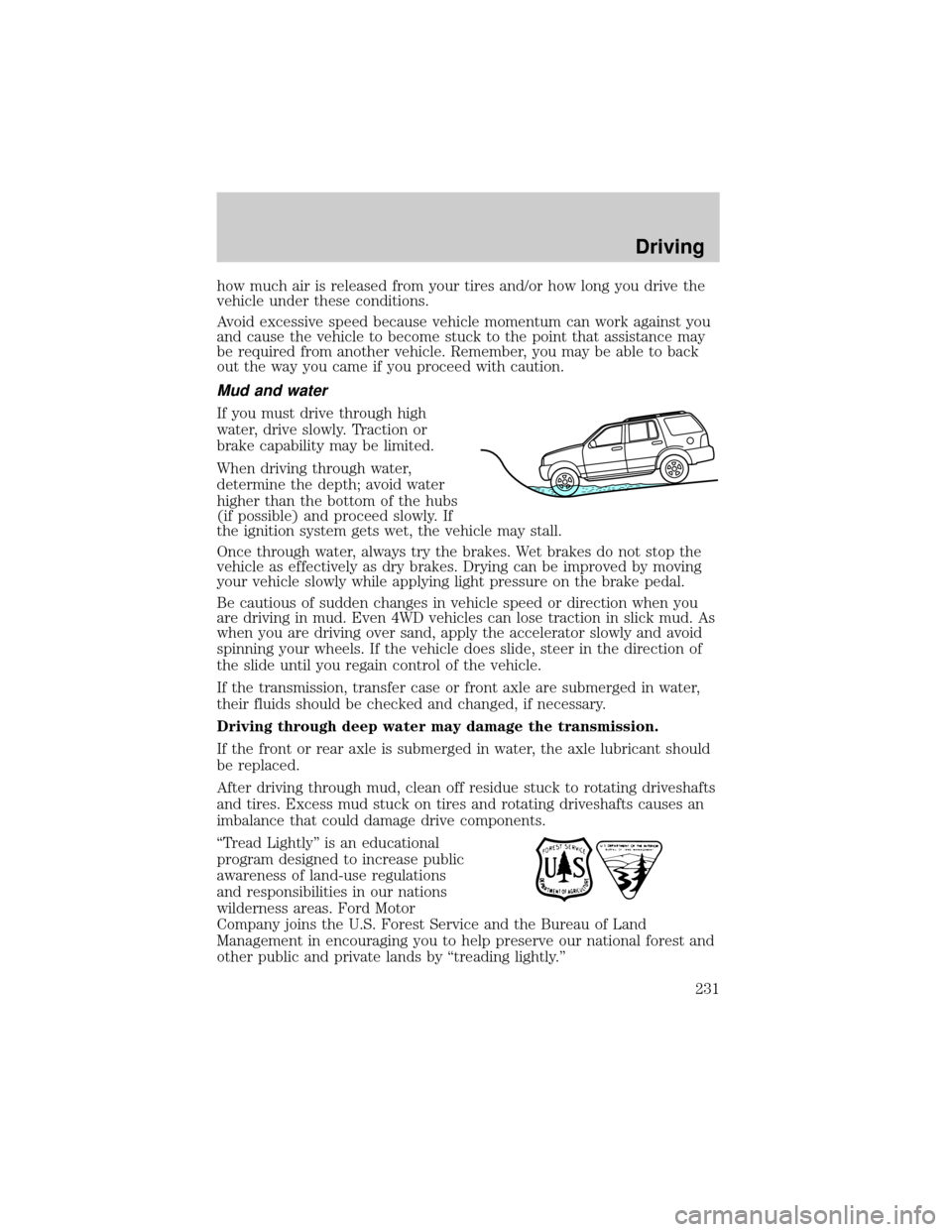
If you must drive through high
water, drive slowly. Traction or
brake capability may be limited.
When driving through water,
determine the depth; avoid water
higher than the bottom of the hubs
(if possible) and proceed slowly. If
the ignition system gets wet, the vehicle may stall.
Once through water, always try the brakes. Wet brakes do not stop the
vehicle as effectively as dry brakes. Drying can be improved by moving
your vehicle slowly while applying light pressure on the brake pedal.
Be cautious of sudden changes in vehicle speed or direction when you
are driving in mud. Even 4WD vehicles can lose traction in slick mud. As
when you are driving over sand, apply the accelerator slowly and avoid
spinning your wheels. If the vehicle does slide, steer in the direction of
the slide until you regain control of the vehicle.
If the transmission, transfer case or front axle are submerged in water,
their fluids should be checked and changed, if necessary.
Driving through deep water may damage the transmission.
If the front or rear axle is submerged in water, the axle lubricant should
be replaced.
After driving through mud, clean off residue stuck to rotating driveshafts
and tires. Excess mud stuck on tires and rotating driveshafts causes an
imbalance that could damage drive components.
ªTread Lightlyº is an educational
program designed to increase public
awareness of land-use regulations
and responsibilities in our nations
wilderness areas. Ford Motor
Company joins the U.S. Forest Service and the Bureau of Land
Management in encouraging you to help preserve our national forest and
other public and private lands by ªtreading lightly.º
Driving
231
Page 233 of 328

Driving on snow and ice
4WD vehicles have advantages over 2WD vehicles in snow and ice but
can skid like any other vehicle.
Should you start to slide while driving on snowy or icy roads, turn the
steering wheel in the direction of the slide until you regain control.
Avoid sudden applications of power and quick changes of direction on
snow and ice. Apply the accelerator slowly and steadily when starting
from a full stop.
Avoid sudden braking as well. Although a 4WD vehicle may accelerate
better than a two-wheel drive vehicle in snow and ice, it won't stop any
faster, because as in other vehicles, braking occurs at all four wheels. Do
not become overconfident as to road conditions.
Make sure you allow sufficient distance between you and other vehicles
for stopping. Drive slower than usual and consider using one of the lower
gears. In emergency stopping situations, avoid locking of the wheels. Use
a ªsqueezeº technique, push on the brake pedal with a steadily increasing
force which allows the wheels to brake yet continue to roll so that you
may steer in the direction you want to travel. If you lock the wheels,
release the brake pedal and repeat the squeeze technique. If your vehicle
is equipped with a Four Wheel Anti-Lock Brake System (ABS), apply the
brake steadily. Do not ªpumpº the brakes. Refer to theBrakessection of
this chapter for additional information on the operation of the anti-lock
brake system.
Never drive with chains on the front tires of 4WD vehicles without also
putting them on the rear tires. This could cause the rear to slide and
swing around during braking.
Maintenance and Modifications
The suspension and steering systems on your vehicle have been designed
and tested to provide predictable performance whether loaded or empty
and durable load carrying capability. For this reason, Ford Motor
Company strongly recommends that you do not make modifications such
as adding or removing parts (such as lift kits or stabilizer bars) or by
using replacement parts not equivalent to the original factory equipment.
Any modifications to a vehicle that raise the center of gravity can make
it more likely the vehicle will roll over as a result of a loss of control.
Ford Motor Company recommends that caution be used with any vehicle
equipped with a high load or device (such as ladder racks or pickup box
cover).
Driving
233
Page 248 of 328

²Use snow chains on the end of the vehicle with the dissimilar spare
tire
²Use more than one dissimilar spare tire at a time
²Use commercial car washing equipment
²Try to repair the dissimilar spare tire
Use of one of the dissimilar spare tires listed above at any one wheel
location can lead to impairment of the following:
²Handling, stability and braking performance
²Comfort and noise
²Ground clearance and parking at curbs
²Winter weather driving capability
²Wet weather driving capability
For vehicles equipped with 4WD, it is not recommended that the vehicle
be operated in 4WD modes with a temporary emergency spare tire. If
4WD operation is necessary, do not operate above speeds of 10 mph (16
km/h) or for distances above 50 miles (80 km).
3.Full-size dissimilar spare without label on wheel
When driving with the full-size dissimilar spare tire/wheel,do not:
²Exceed 70 mph (113 km/h)
²Use more than one dissimilar spare tire/wheel at a time
²Use commercial car washing equipment
²Use snow chains on the end of the vehicle with the dissimilar spare
tire/wheel
The usage of a full-size dissimilar spare tire/wheel can lead to
impairment of the following:
²Handling, stability and braking performance
²Comfort and noise
²Ground clearance and parking at curbs
²Winter weather driving capability
²Wet weather driving capability
²All-Wheel driving capability (if applicable)
²Load leveling adjustment (if applicable)
Roadside Emergencies
248
Page 309 of 328
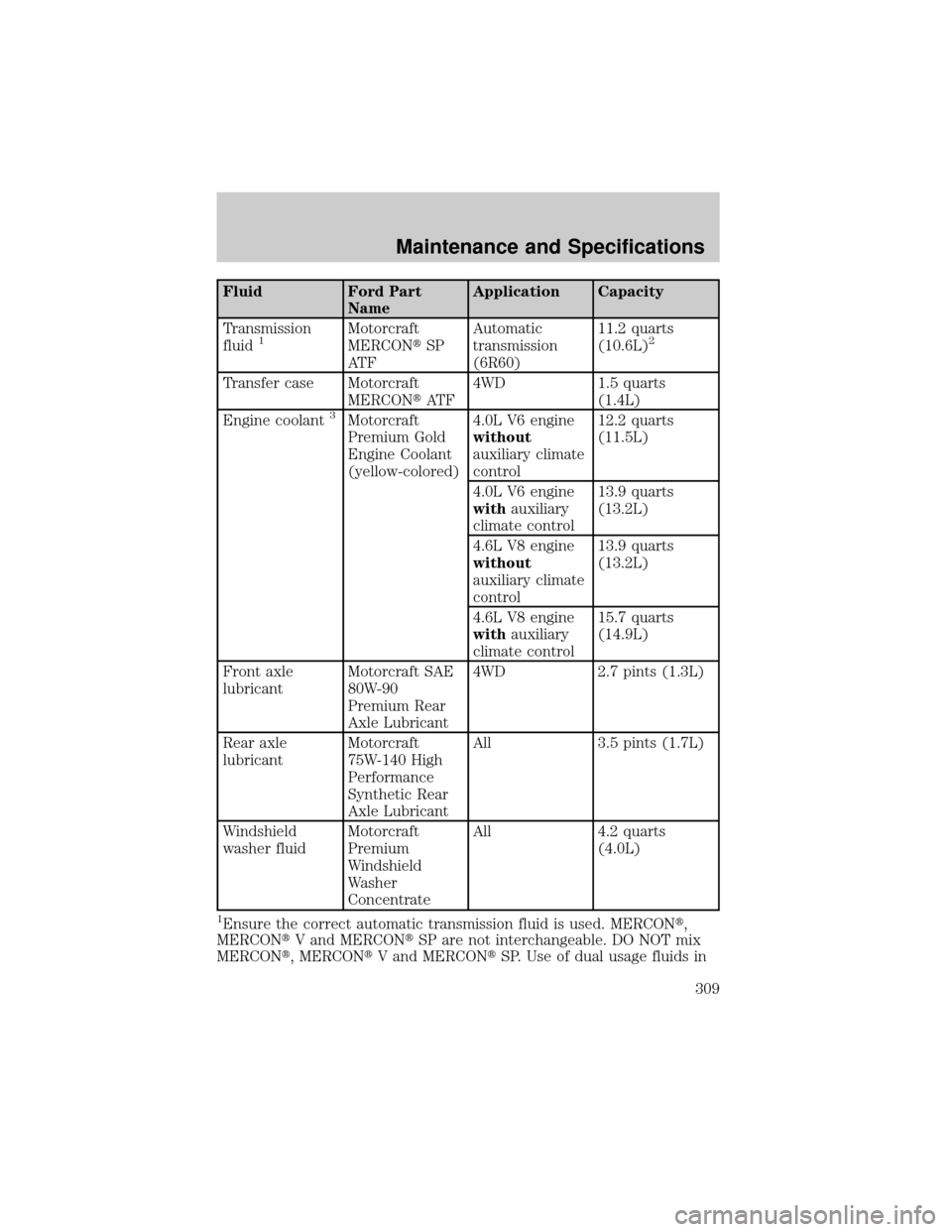
Fluid Ford Part
NameApplication Capacity
Transmission
fluid
1Motorcraft
MERCONtSP
AT FAutomatic
transmission
(6R60)11.2 quarts
(10.6L)2
Transfer case Motorcraft
MERCONtAT F4WD 1.5 quarts
(1.4L)
Engine coolant
3Motorcraft
Premium Gold
Engine Coolant
(yellow-colored)4.0L V6 engine
without
auxiliary climate
control12.2 quarts
(11.5L)
4.0L V6 engine
withauxiliary
climate control13.9 quarts
(13.2L)
4.6L V8 engine
without
auxiliary climate
control13.9 quarts
(13.2L)
4.6L V8 engine
withauxiliary
climate control15.7 quarts
(14.9L)
Front axle
lubricantMotorcraft SAE
80W-90
Premium Rear
Axle Lubricant4WD 2.7 pints (1.3L)
Rear axle
lubricantMotorcraft
75W-140 High
Performance
Synthetic Rear
Axle LubricantAll 3.5 pints (1.7L)
Windshield
washer fluidMotorcraft
Premium
Windshield
Washer
ConcentrateAll 4.2 quarts
(4.0L)
1Ensure the correct automatic transmission fluid is used. MERCONt,
MERCONtV and MERCONtSP are not interchangeable. DO NOT mix
MERCONt, MERCONtV and MERCONtSP. Use of dual usage fluids in
Maintenance and Specifications
309
Page 312 of 328
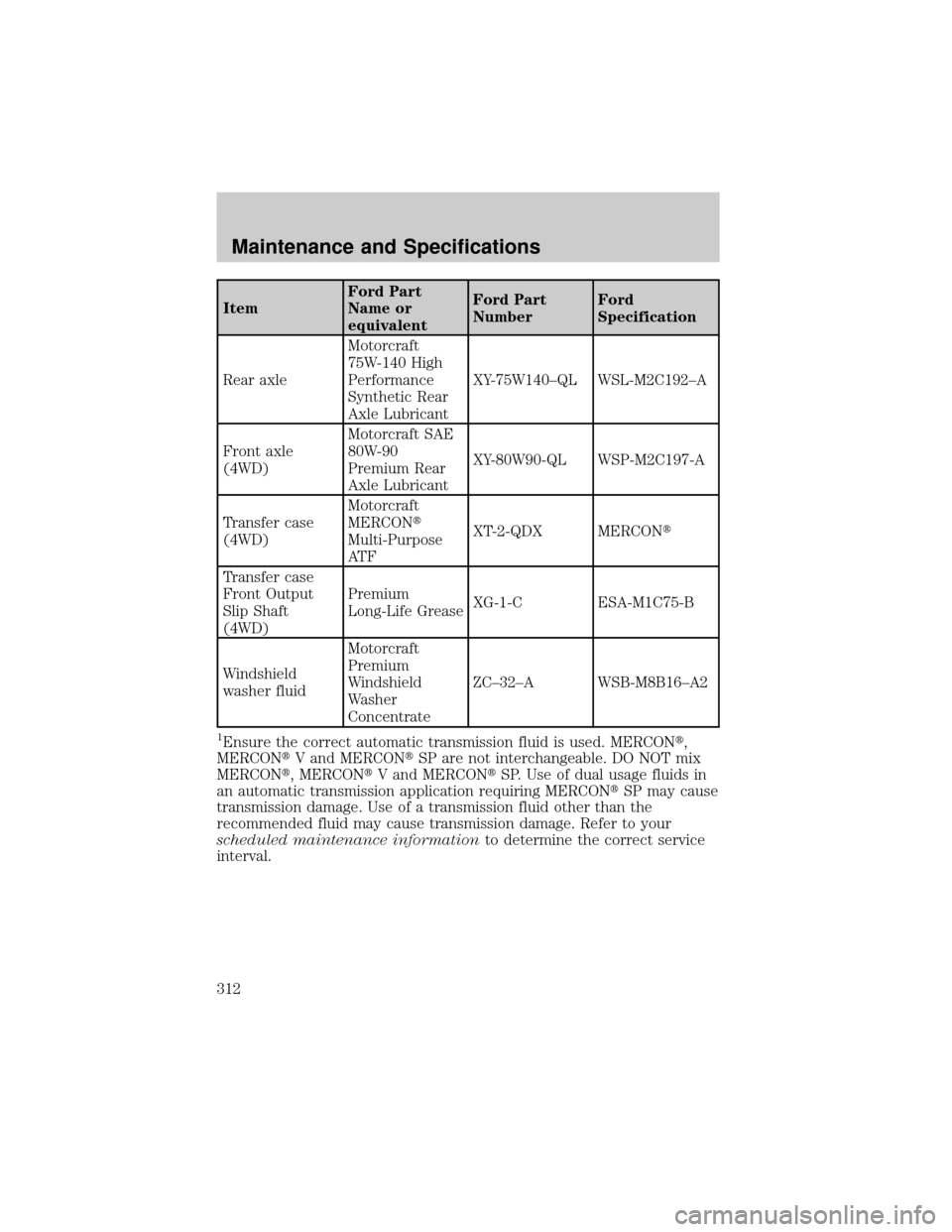
ItemFord Part
Name or
equivalentFord Part
NumberFord
Specification
Rear axleMotorcraft
75W-140 High
Performance
Synthetic Rear
Axle LubricantXY-75W140±QL WSL-M2C192±A
Front axle
(4WD)Motorcraft SAE
80W-90
Premium Rear
Axle LubricantXY-80W90-QL WSP-M2C197-A
Transfer case
(4WD)Motorcraft
MERCONt
Multi-Purpose
AT FXT-2-QDX MERCONt
Transfer case
Front Output
Slip Shaft
(4WD)Premium
Long-Life GreaseXG-1-C ESA-M1C75-B
Windshield
washer fluidMotorcraft
Premium
Windshield
Washer
ConcentrateZC±32±A WSB-M8B16±A2
1Ensure the correct automatic transmission fluid is used. MERCONt,
MERCONtV and MERCONtSP are not interchangeable. DO NOT mix
MERCONt, MERCONtV and MERCONtSP. Use of dual usage fluids in
an automatic transmission application requiring MERCONtSP may cause
transmission damage. Use of a transmission fluid other than the
recommended fluid may cause transmission damage. Refer to your
scheduled maintenance informationto determine the correct service
interval.
Maintenance and Specifications
312