belt FORD EXPLORER 2006 4.G User Guide
[x] Cancel search | Manufacturer: FORD, Model Year: 2006, Model line: EXPLORER, Model: FORD EXPLORER 2006 4.GPages: 328, PDF Size: 3.59 MB
Page 130 of 328
It is extremely dangerous to ride in a cargo area, inside or
outside of a vehicle. In a collision, people riding in these areas
are more likely to be seriously injured or killed. Do not allow people to
ride in any area of your vehicle that is not equipped with seats and
safety belts. Be sure everyone in your vehicle is in a seat and using a
safety belt properly.
In a rollover crash, an unbelted person is significantly more likely
to die than a person wearing a safety belt.
Each seating position in your vehicle has a specific safety belt
assembly which is made up of one buckle and one tongue that
are designed to be used as a pair. 1) Use the shoulder belt on the
outside shoulder only. Never wear the shoulder belt under the arm. 2)
Never swing the safety belt around your neck over the inside shoulder.
3) Never use a single belt for more than one person.
Always transport children 12 years old and under in the back
seat and always properly use appropriate child restraints.
Safety belts and seats can become hot in a vehicle that has been
closed up in sunny weather; they could burn a small child. Check
seat covers and buckles before you place a child anywhere near them.
Energy Management Feature
²This vehicle has a safety belt system with an energy management
feature at the front seating positions to help further reduce the risk of
injury in the event of a head-on collision.
²This safety belt system has a retractor assembly that is designed to
extend the safety belt webbing in a controlled manner. This helps
reduce the belt force acting on the user's chest.
BELT AND RETRACTOR ASSEMBLY MUST BE REPLACED if
the safety belt assembly automatic locking retractor feature or
any other safety belt function is not operating properly when checked
by an authorized dealer. Failure to replace the Belt and Retractor
assembly could increase the risk of injury in collisions.
Seating and Safety Restraints
130
Page 131 of 328
Combination lap and shoulder belts
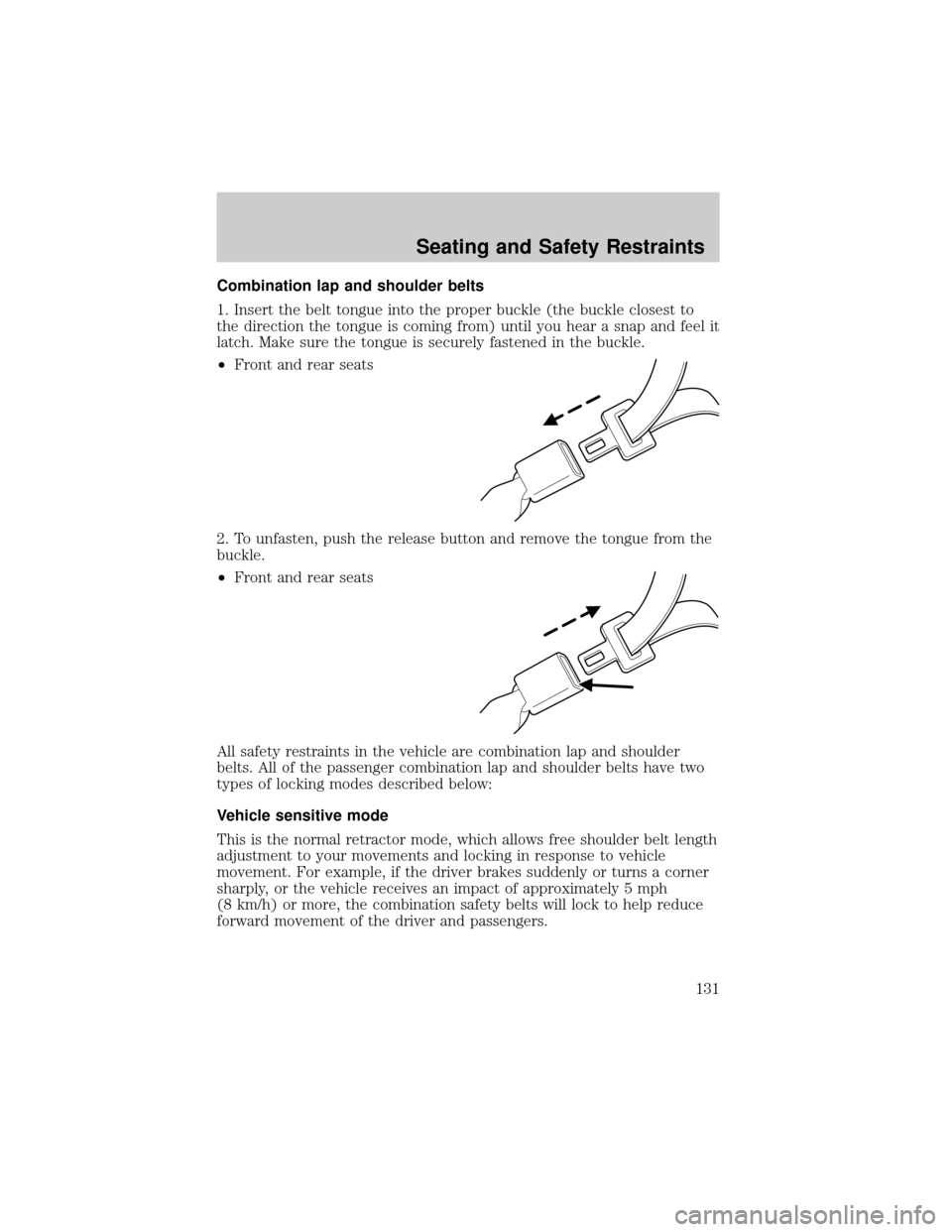
1. Insert the belt tongue into the proper buckle (the buckle closest to
the direction the tongue is coming from) until you hear a snap and feel it
latch. Make sure the tongue is securely fastened in the buckle.
²Front and rear seats
2. To unfasten, push the release button and remove the tongue from the
buckle.
²Front and rear seats
All safety restraints in the vehicle are combination lap and shoulder
belts. All of the passenger combination lap and shoulder belts have two
types of locking modes described below:
Vehicle sensitive mode
This is the normal retractor mode, which allows free shoulder belt length
adjustment to your movements and locking in response to vehicle
movement. For example, if the driver brakes suddenly or turns a corner
sharply, or the vehicle receives an impact of approximately 5 mph
(8 km/h) or more, the combination safety belts will lock to help reduce
forward movement of the driver and passengers.
Seating and Safety Restraints
131
Page 132 of 328
Automatic locking mode
When to use the automatic locking mode
In this mode, the shoulder belt is automatically pre-locked. The belt will
still retract to remove any slack in the shoulder belt. The automatic
locking mode is not available on the driver safety belt.
This mode should be usedany timea child safety seat, except a
booster, is installed in passenger front or rear seating positions. Children
12 years old and under should be properly restrained in the rear seat
whenever possible. Refer toSafety restraints for childrenorSafety
seats for childrenlater in this chapter.
How to use the automatic locking mode
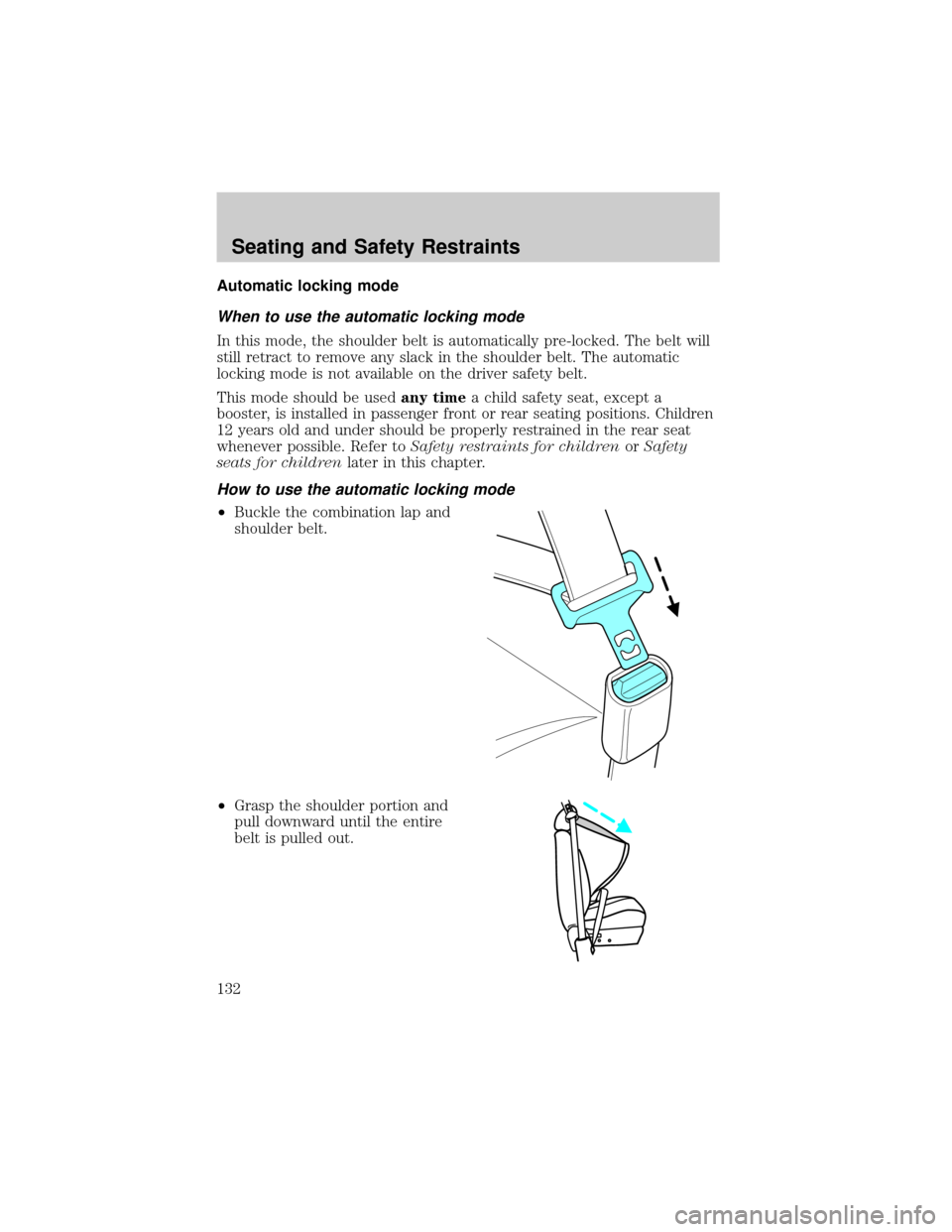
²Buckle the combination lap and
shoulder belt.
²Grasp the shoulder portion and
pull downward until the entire
belt is pulled out.
Seating and Safety Restraints
132
Page 133 of 328
²Allow the belt to retract. As the belt retracts, you will hear a clicking
sound. This indicates the safety belt is now in the automatic locking
mode.
How to disengage the automatic locking mode
Unbuckle the combination lap and shoulder belt and allow it to retract
completely to disengage the automatic locking mode and activate the
vehicle sensitive (emergency) locking mode.
After any vehicle collision, the combination lap and shoulder belt
system at all passenger seating positions must be checked by an
authorized dealer to verify that the ªautomatic locking retractorº
feature for child seats is still functioning properly, in addition to other
checks for proper safety belt system function.
BELT AND RETRACTOR ASSEMBLY MUST BE REPLACED if the
safety belt assembly ªautomatic locking retractorº feature or any
other safety belt function is not operating properly. In addition, all safety
belts should be checked for proper function. Failure to replace the belt
and retractor assembly could increase the risk of injury in collisions.
Safety belt pretensioner
Your vehicle is equipped with safety belt pretensioners at the driver and
right front passenger seating positions.
The safety belt pretensioner removes some slack from the safety belt
system at the start of a crash. The safety belt pretensioner uses the
same crash sensor system as the front airbags and Safety Canopyy
system (if equipped). When the safety belt pretensioner deploys, the lap
and shoulder belt are tightened.
When the optional Safety Canopyysystem and/or the front airbags are
activated, the safety belt pretensioners for the driver and right front
passenger seating positions will be activated when the respective seatbelt
is properly buckled.
The driver and front passenger seat belt system (including
retractors, buckles and height adjusters) must be replaced if the
vehicle is involved in a collision that results in deployment of front
airbags, seat-mounted side airbags and Safety Canopyy(if equipped),
and safety belt pretensioners.
Refer to theSafety belt maintenancesection in this chapter.
Seating and Safety Restraints
133
Page 134 of 328

Front safety belt height adjustment
Your vehicle has safety belt height
adjustments at the front outboard
seating positions. Adjust the height
of the shoulder belt so the belt rests
across the middle of your shoulder.
To adjust the shoulder belt height,
squeeze and hold the buttons on the
side and slide the height adjuster up
or down. Release the buttons and
pull down on the height adjuster to
make sure it is locked in place.
Position the safety belt height adjusters so that the belt rests
across the middle of your shoulder. Failure to adjust the safety
belt properly could reduce the effectiveness of the safety belt and
increase the risk of injury in a collision.
Second row comfort guide
The second row outboard
lap/shoulder belt is equipped with a
belt comfort guide. This guide is
attached to the quarter trim panel
and is used to adjust the comfort of
the shoulder belt for smaller
occupants in the outboard second
row seats.
Seating and Safety Restraints
134
Page 135 of 328
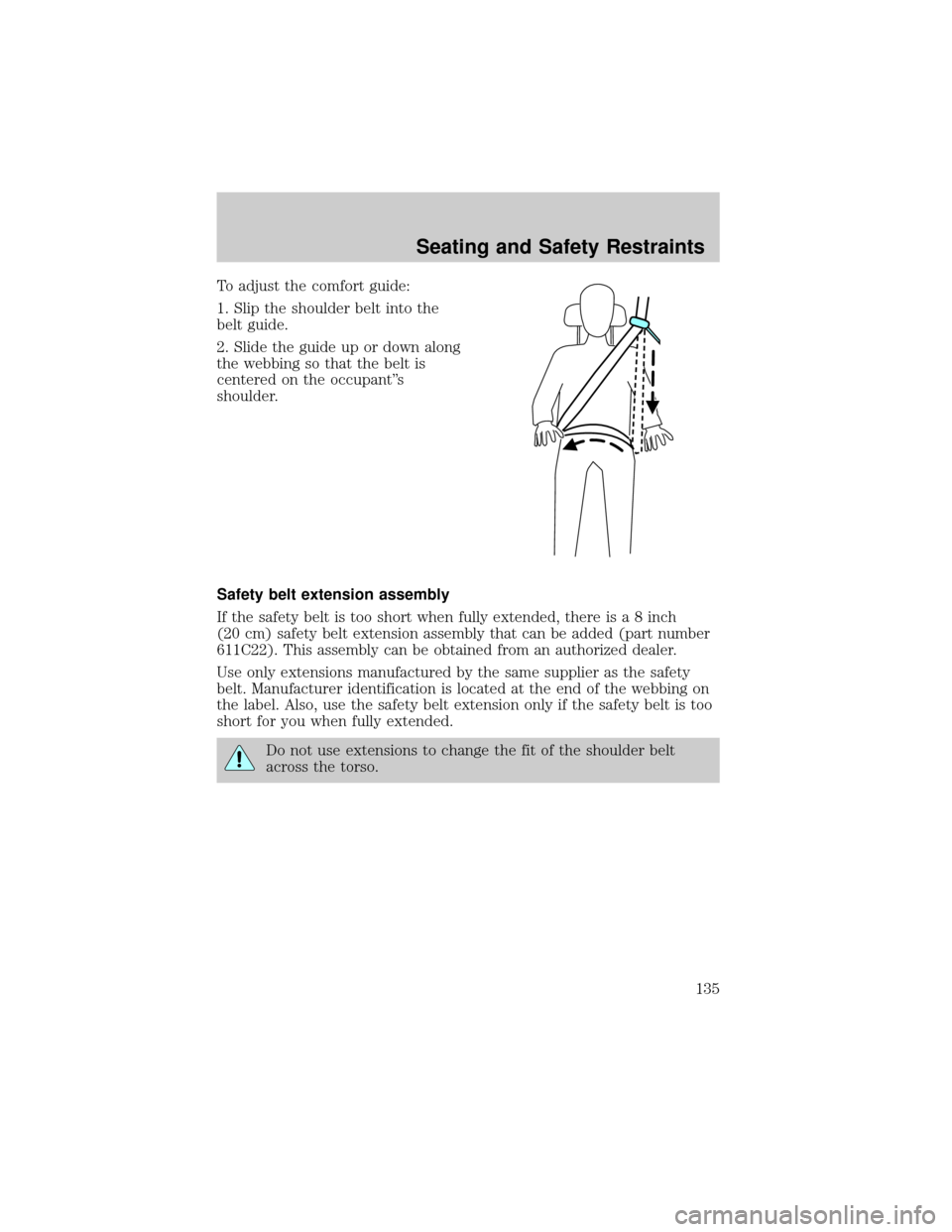
To adjust the comfort guide:
1. Slip the shoulder belt into the
belt guide.
2. Slide the guide up or down along
the webbing so that the belt is
centered on the occupant''s
shoulder.
Safety belt extension assembly
If the safety belt is too short when fully extended, there is a 8 inch
(20 cm) safety belt extension assembly that can be added (part number
611C22). This assembly can be obtained from an authorized dealer.
Use only extensions manufactured by the same supplier as the safety
belt. Manufacturer identification is located at the end of the webbing on
the label. Also, use the safety belt extension only if the safety belt is too
short for you when fully extended.
Do not use extensions to change the fit of the shoulder belt
across the torso.
Seating and Safety Restraints
135
Page 136 of 328
Safety belt warning light and indicator chime
The safety belt warning light illuminates in the instrument cluster and a
chime sounds to remind the occupants to fasten their safety belts.
Conditions of operation
If... Then...
The driver's or front
passenger's safety belt is not
buckled before the ignition
switch is turned to the ON
position...The safety belt warning light
illuminates 1-2 minutes and the
warning chime sounds 4-8 seconds.
The driver's or front
passenger's safety belt is
buckled while the indicator
light is illuminated and the
warning chime is sounding...The safety belt warning light and
warning chime turn off.
The driver's or front
passenger's safety belt is
buckled before the ignition
switch is turned to the ON
position...The safety belt warning light and
indicator chime remain off.
BeltMinderY
The BeltMinderyfeature is a supplemental warning to the safety belt
warning function. This feature provides additional reminders by
intermittently sounding a chime and illuminating the safety belt warning
light in the instrument cluster when the driver's and front passenger's
safety belt is unbuckled.
The BeltMinderyfeature uses information from the front passenger
sensing system to determine if a front seat passenger is present and
therefore potentially in need of a warning. To avoid activating the
BeltMinderyfeature for objects placed in the front passenger seat,
warnings will only be given to large front seat occupants as determined
by the front passenger sensing system.
Seating and Safety Restraints
136
Page 137 of 328
Both the driver's and passenger's safety belt usages are monitored and
either may activate the BeltMinderyfeature. The warnings are the same
for the driver and the front passenger. If the BeltMinderywarnings have
expired (warnings for approximately 5 minutes) for one occupant (driver
or front passenger), the other occupant can still activate the
BeltMinderyfeature.
If... Then...
The driver's and front
passenger's safety belts are
buckled before the ignition
switch is turned to the ON
position or less than 1-2
minutes have elapsed since the
ignition switch has been turned
ON...The BeltMinderyfeature will not
activate.
The driver's or front
passenger's safety belt is not
buckled when the vehicle has
reached at least 3 mph (5
km/h) and 1-2 minutes have
elapsed since the ignition
switch has been turned to
ON...The BeltMinderyfeature is activated -
the safety belt warning light
illuminates and the warning chime
sounds for 6 seconds every 30
seconds, repeating for approximately
5 minutes or until the safety belts are
buckled.
The driver's or front
passenger's safety belt becomes
unbuckled for approximately 1
minute while the vehicle is
traveling at least 3 mph (5
km/h) and more than 1-2
minutes have elapsed since the
ignition switch has been turned
to ON...The BeltMinderyfeature is activated -
the safety belt warning light
illuminates and the warning chime
sounds for 6 seconds every 30
seconds, repeating for approximately
5 minutes or until the safety belts are
buckled.
Seating and Safety Restraints
137
Page 138 of 328
The following are reasons most often given for not wearing safety belts
(All statistics based on U.S. data):
Reasons given... Consider...
ªCrashes are rare eventsº36700 crashes occur every day.The
more we drive, the more we are exposed
to ªrareº events, even for good drivers.1
in 4 of us will be seriously injured in a
crash during our lifetime.
ªI'm not going farº3of4fatal crashes occur within25miles
(40 km) of home.
ªBelts are uncomfortableº We design our safety belts to enhance
comfort. If you are uncomfortable - try
different positions for the safety belt
upper anchorage and seatback which
should be as upright as possible; this can
improve comfort.
ªI was in a hurryºPrime time for an accident.
BeltMinderyreminds us to take a few
seconds to buckle up.
ªSafety belts don't workºSafety belts,when used properly,
reduce risk of deathto front seat
occupants by45% in cars,and by60%
in light trucks.
ªTraffic is lightºNearly 1 of 2 deaths occur in
single-vehicle crashes,many when no
other vehicles are around.
ªBelts wrinkle my clothesº Possibly, but a serious crash can do much
more than wrinkle your clothes,
particularly if you are unbelted.
ªThe people I'm with don't
wear beltsºSet the example, teen deaths occur 4
times more often in vehicles with TWO or
MORE people. Children and younger
brothers/sisters imitate behavior they see.
ªI have an airbagº Airbags offer greater protection when
used with safety belts. Frontal airbags are
not designed to inflate in rear and side
crashes or rollovers.
Seating and Safety Restraints
138
Page 139 of 328
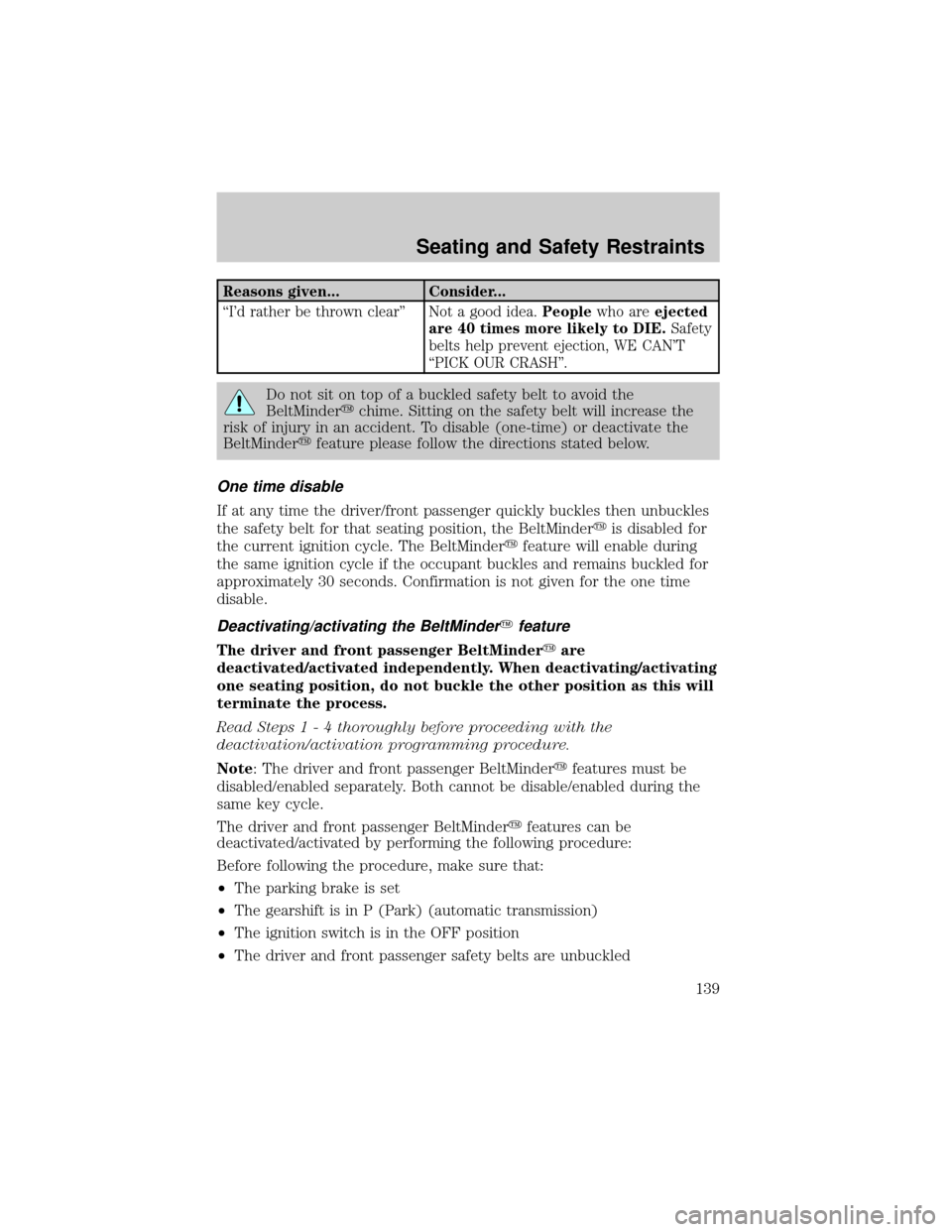
Reasons given... Consider...
ªI'd rather be thrown clearº Not a good idea.Peoplewho areejected
are 40 times more likely to DIE.Safety
belts help prevent ejection, WE CAN'T
ªPICK OUR CRASHº.
Do not sit on top of a buckled safety belt to avoid the
BeltMinderychime. Sitting on the safety belt will increase the
risk of injury in an accident. To disable (one-time) or deactivate the
BeltMinderyfeature please follow the directions stated below.
One time disable
If at any time the driver/front passenger quickly buckles then unbuckles
the safety belt for that seating position, the BeltMinderyis disabled for
the current ignition cycle. The BeltMinderyfeature will enable during
the same ignition cycle if the occupant buckles and remains buckled for
approximately 30 seconds. Confirmation is not given for the one time
disable.
Deactivating/activating the BeltMinderYfeature
The driver and front passenger BeltMinderyare
deactivated/activated independently. When deactivating/activating
one seating position, do not buckle the other position as this will
terminate the process.
Read Steps1-4thoroughly before proceeding with the
deactivation/activation programming procedure.
Note: The driver and front passenger BeltMinderyfeatures must be
disabled/enabled separately. Both cannot be disable/enabled during the
same key cycle.
The driver and front passenger BeltMinderyfeatures can be
deactivated/activated by performing the following procedure:
Before following the procedure, make sure that:
²The parking brake is set
²The gearshift is in P (Park) (automatic transmission)
²The ignition switch is in the OFF position
²The driver and front passenger safety belts are unbuckled
Seating and Safety Restraints
139