steering FORD EXPLORER 2006 4.G Owner's Manual
[x] Cancel search | Manufacturer: FORD, Model Year: 2006, Model line: EXPLORER, Model: FORD EXPLORER 2006 4.GPages: 328, PDF Size: 3.59 MB
Page 246 of 328
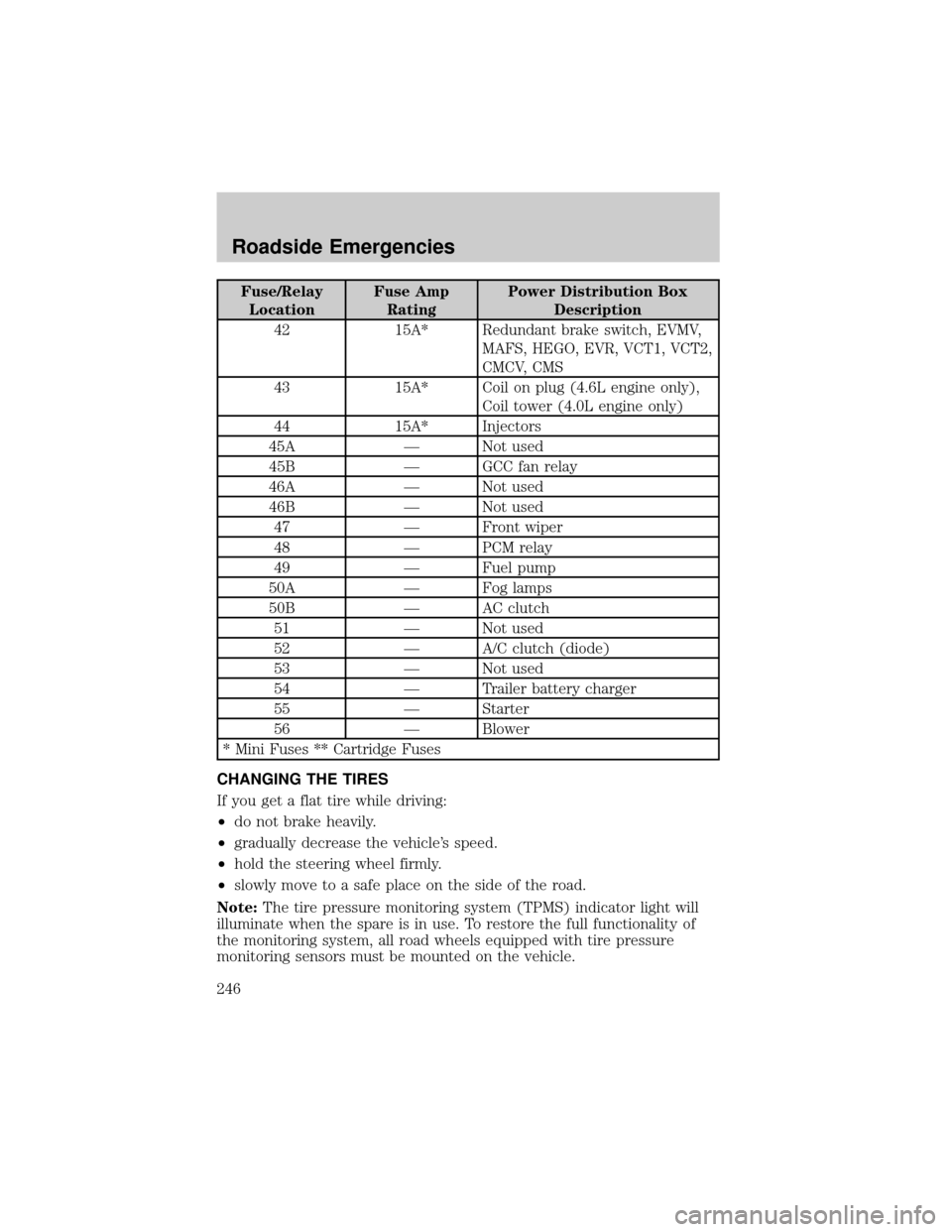
Fuse/Relay
LocationFuse Amp
RatingPower Distribution Box
Description
42 15A* Redundant brake switch, EVMV,
MAFS, HEGO, EVR, VCT1, VCT2,
CMCV, CMS
43 15A* Coil on plug (4.6L engine only),
Coil tower (4.0L engine only)
44 15A* Injectors
45A Ð Not used
45B Ð GCC fan relay
46A Ð Not used
46B Ð Not used
47 Ð Front wiper
48 Ð PCM relay
49 Ð Fuel pump
50A Ð Fog lamps
50B Ð AC clutch
51 Ð Not used
52 Ð A/C clutch (diode)
53 Ð Not used
54 Ð Trailer battery charger
55 Ð Starter
56 Ð Blower
* Mini Fuses ** Cartridge Fuses
CHANGING THE TIRES
If you get a flat tire while driving:
²do not brake heavily.
²gradually decrease the vehicle's speed.
²hold the steering wheel firmly.
²slowly move to a safe place on the side of the road.
Note:The tire pressure monitoring system (TPMS) indicator light will
illuminate when the spare is in use. To restore the full functionality of
the monitoring system, all road wheels equipped with tire pressure
monitoring sensors must be mounted on the vehicle.
Roadside Emergencies
246
Page 249 of 328
When driving with the full-size dissimilar spare tire/wheel additional
caution should be given to:
²Towing a trailer
²Driving vehicles equipped with a camper body
²Driving vehicles with a load on the cargo rack
Drive cautiously when using a full-size dissimilar spare tire/wheel and
seek service as soon as possible.
Stopping and securing the vehicle
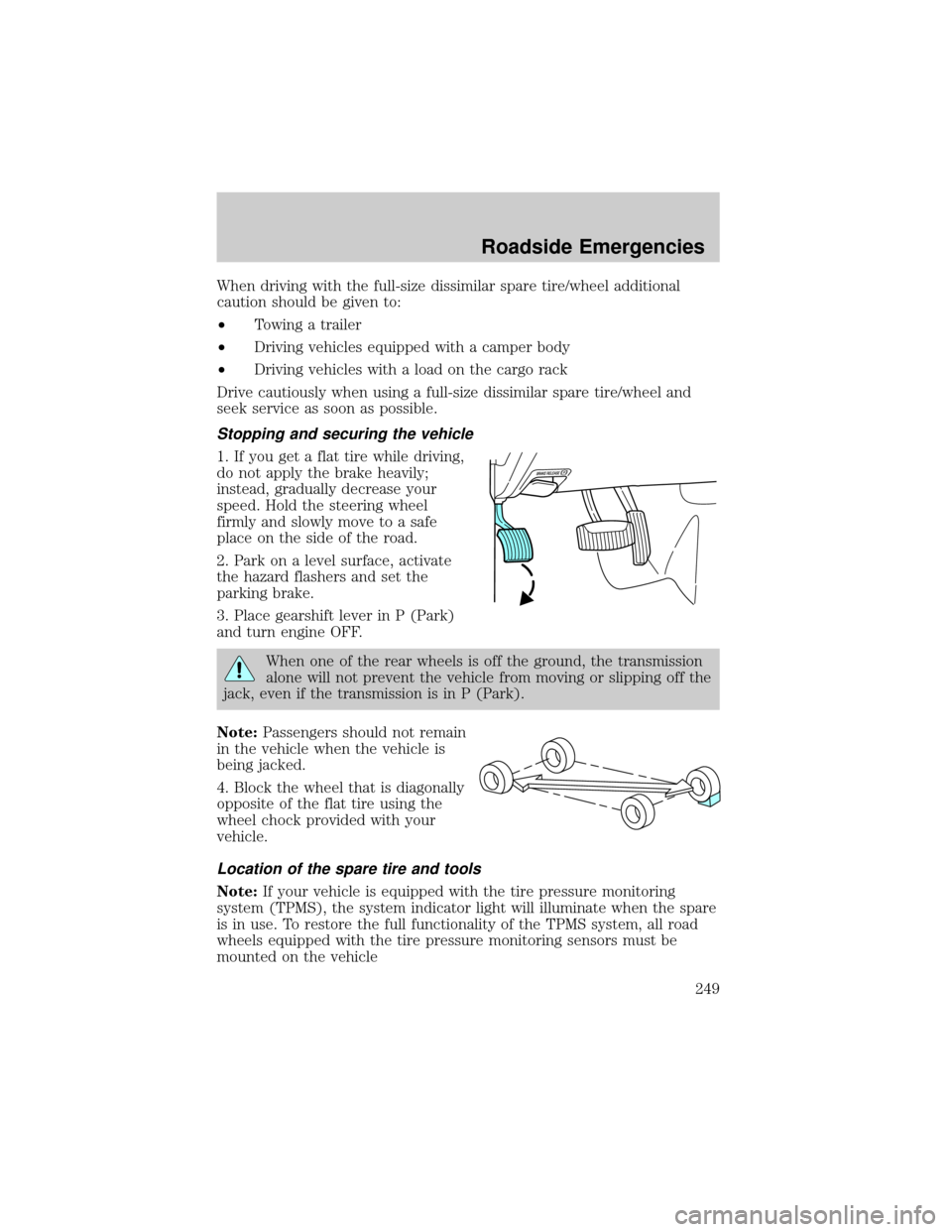
1. If you get a flat tire while driving,
do not apply the brake heavily;
instead, gradually decrease your
speed. Hold the steering wheel
firmly and slowly move to a safe
place on the side of the road.
2. Park on a level surface, activate
the hazard flashers and set the
parking brake.
3. Place gearshift lever in P (Park)
and turn engine OFF.
When one of the rear wheels is off the ground, the transmission
alone will not prevent the vehicle from moving or slipping off the
jack, even if the transmission is in P (Park).
Note:Passengers should not remain
in the vehicle when the vehicle is
being jacked.
4. Block the wheel that is diagonally
opposite of the flat tire using the
wheel chock provided with your
vehicle.
Location of the spare tire and tools
Note:If your vehicle is equipped with the tire pressure monitoring
system (TPMS), the system indicator light will illuminate when the spare
is in use. To restore the full functionality of the TPMS system, all road
wheels equipped with the tire pressure monitoring sensors must be
mounted on the vehicle
Roadside Emergencies
249
Page 273 of 328
Do not use chemical solvents or strong detergents when cleaning
the steering wheel or instrument panel to avoid contamination of
the airbag system.
²Be certain to wash or wipe your hands clean if you have been in
contact with certain products such as insect repellent and suntan
lotion in order to avoid possible damage to the interior painted
surfaces.
INTERIOR TRIM
²Clean the interior trim areas with a damp cloth, then with a clean, dry
cloth.
²Do not use household or glass cleaners as these may damage the
finish.
INTERIOR
For fabric, carpets, cloth seats, safety belts and seats equipped with side
airbags:
²Remove dust and loose dirt with a vacuum cleaner.
²Remove light stains and soil with Motorcraft Professional Strength
Carpet & Upholstery Cleaner (ZC-54).
²If grease or tar is present on the material, spot-clean the area first
with Motorcraft Spot and Stain Remover (ZC-14).
²If a ring forms on the fabric after spot cleaning, clean the entire area
immediately (but do not oversaturate) or the ring will set.
²Do not use household cleaning products or glass cleaners, which can
stain and discolor the fabric and affect the flame retardant abilities of
the seat materials.
Do not use cleaning solvents, bleach or dye on the vehicle's
safety belts, as these actions may weaken the belt webbing.
Do not use chemical solvents or strong detergents when cleaning
the seat-mounted side airbag (if equipped). Such products could
contaminate the side airbag system and affect performance of the side
airbag in a collision.
Cleaning
273
Page 278 of 328
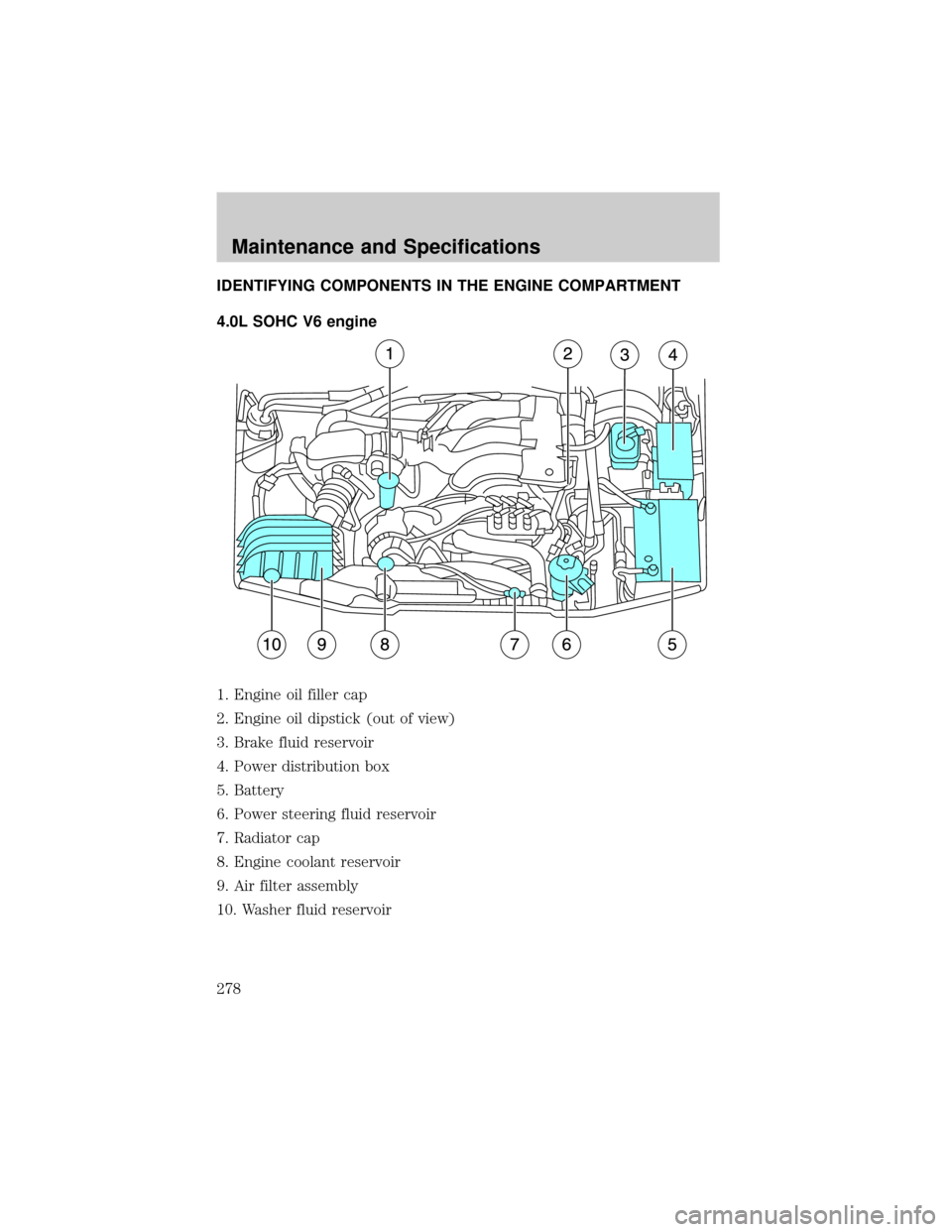
IDENTIFYING COMPONENTS IN THE ENGINE COMPARTMENT
4.0L SOHC V6 engine
1. Engine oil filler cap
2. Engine oil dipstick (out of view)
3. Brake fluid reservoir
4. Power distribution box
5. Battery
6. Power steering fluid reservoir
7. Radiator cap
8. Engine coolant reservoir
9. Air filter assembly
10. Washer fluid reservoir
Maintenance and Specifications
278
Page 279 of 328
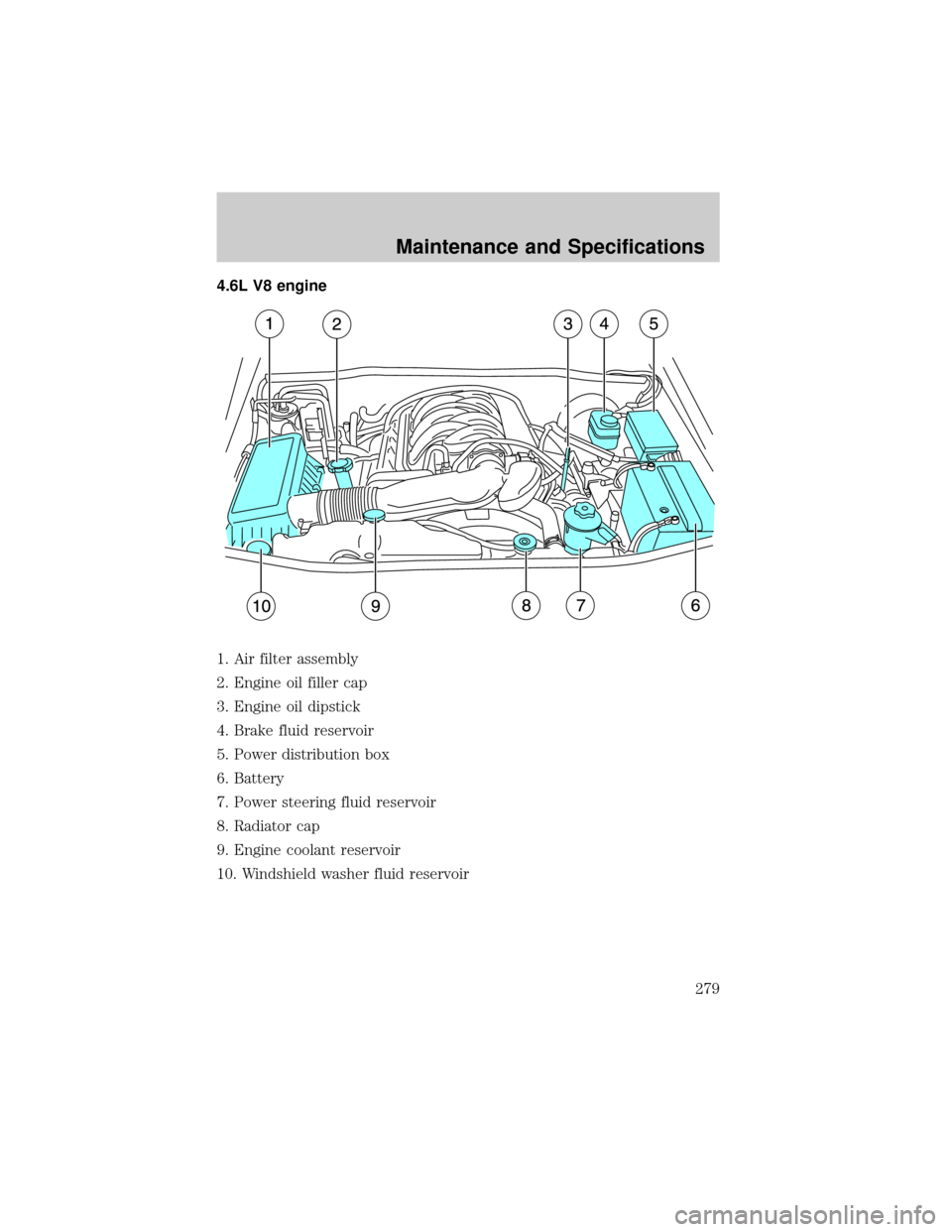
4.6L V8 engine
1. Air filter assembly
2. Engine oil filler cap
3. Engine oil dipstick
4. Brake fluid reservoir
5. Power distribution box
6. Battery
7. Power steering fluid reservoir
8. Radiator cap
9. Engine coolant reservoir
10. Windshield washer fluid reservoir
Maintenance and Specifications
279
Page 293 of 328
Vehicles driven year-round in non-extreme climates should use a 50/50
mixture of engine coolant and distilled water for optimum cooling system
and engine protection.
What you should know about fail-safe cooling (4.6L V8 engine only)
If the engine coolant supply is depleted, this feature allows the vehicle to
be driven temporarily before incremental component damage is incurred.
The ªfail-safeº distance depends on ambient temperatures, vehicle load
and terrain.
Fail-safe cooling and engine oil temperature sensor (4.6L V8 only)
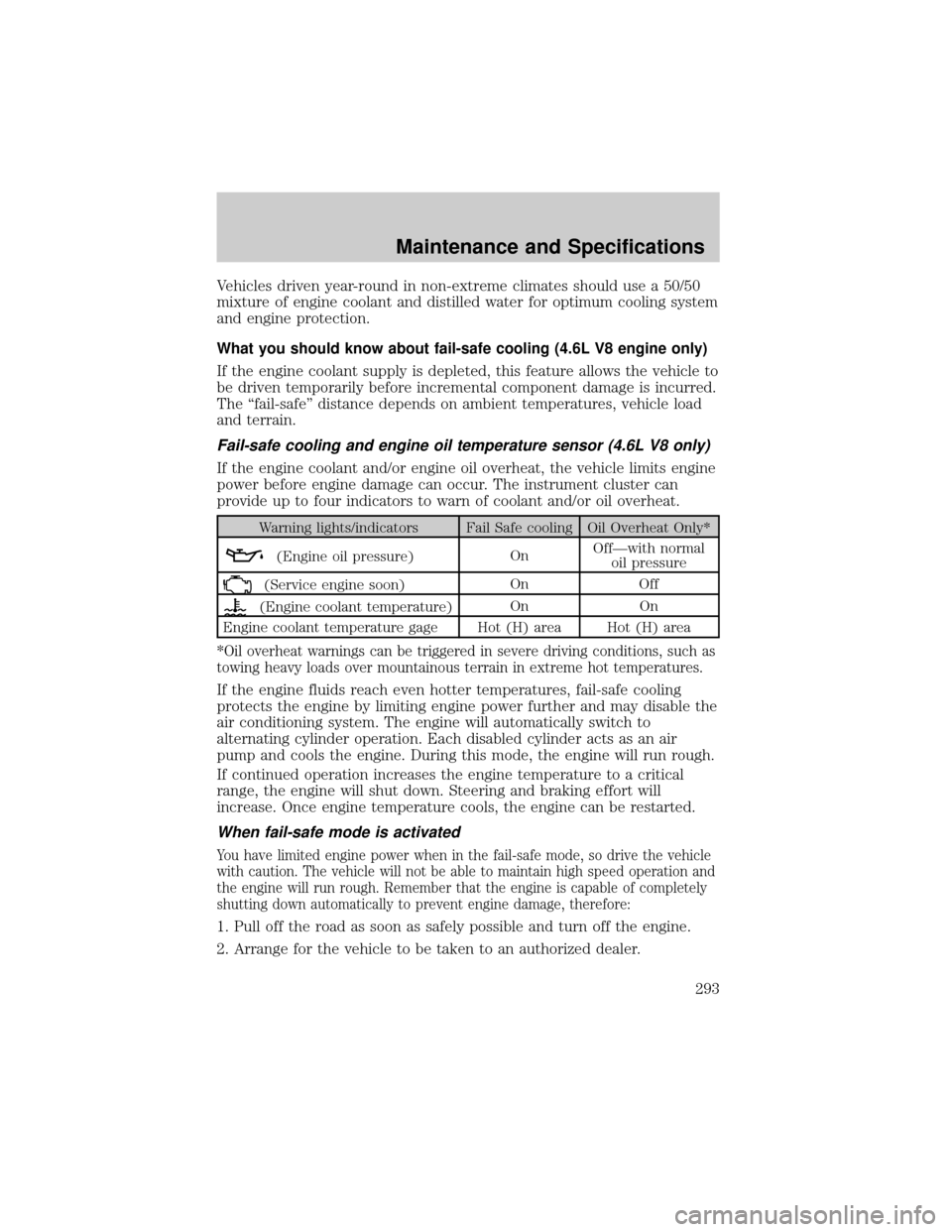
If the engine coolant and/or engine oil overheat, the vehicle limits engine
power before engine damage can occur. The instrument cluster can
provide up to four indicators to warn of coolant and/or oil overheat.
Warning lights/indicators Fail Safe cooling Oil Overheat Only*
(Engine oil pressure)OnOffÐwith normal
oil pressure
(Service engine soon)On Off
(Engine coolant temperature)On On
Engine coolant temperature gage Hot (H) area Hot (H) area
*Oil overheat warnings can be triggered in severe driving conditions, such as
towing heavy loads over mountainous terrain in extreme hot temperatures.
If the engine fluids reach even hotter temperatures, fail-safe cooling
protects the engine by limiting engine power further and may disable the
air conditioning system. The engine will automatically switch to
alternating cylinder operation. Each disabled cylinder acts as an air
pump and cools the engine. During this mode, the engine will run rough.
If continued operation increases the engine temperature to a critical
range, the engine will shut down. Steering and braking effort will
increase. Once engine temperature cools, the engine can be restarted.
When fail-safe mode is activated
You have limited engine power when in the fail-safe mode, so drive the vehicle
with caution. The vehicle will not be able to maintain high speed operation and
the engine will run rough. Remember that the engine is capable of completely
shutting down automatically to prevent engine damage, therefore:
1. Pull off the road as soon as safely possible and turn off the engine.
2. Arrange for the vehicle to be taken to an authorized dealer.
Maintenance and Specifications
293
Page 304 of 328
Readiness for Inspection/Maintenance (I/M) testing
In some localities, it may be a legal requirement to pass an I/M test of
the on-board diagnostics system. If your
indicator is on, refer to
the description in theWarning lights and chimessection of the
Instrument Clusterchapter. Your vehicle may not pass the I/M test with
the
indicator on.
If the vehicle's powertrain system or its battery has just been serviced,
the on-board diagnostics system is reset to a ªnot ready for I/M testº
condition. To ready the on-board diagnostics system for I/M testing, a
minimum of 30 minutes of city and highway driving is necessary as
described below:
²First, at least 10 minutes of driving on an expressway or highway.
²Next, at least 20 minutes driving in stop-and-go, city-type traffic with
at least four idle periods.
Allow the vehicle to sit for at least eight hours without starting the
engine. Then, start the engine and complete the above driving cycle. The
engine must warm up to its normal operating temperature. Once started,
do not turn off the engine until the above driving cycle is complete.
POWER STEERING FLUID
Check the power steering fluid. Refer to thescheduled maintenance
guidefor the service interval schedules. If adding fluid is necessary, use
only MERCONtAT F.
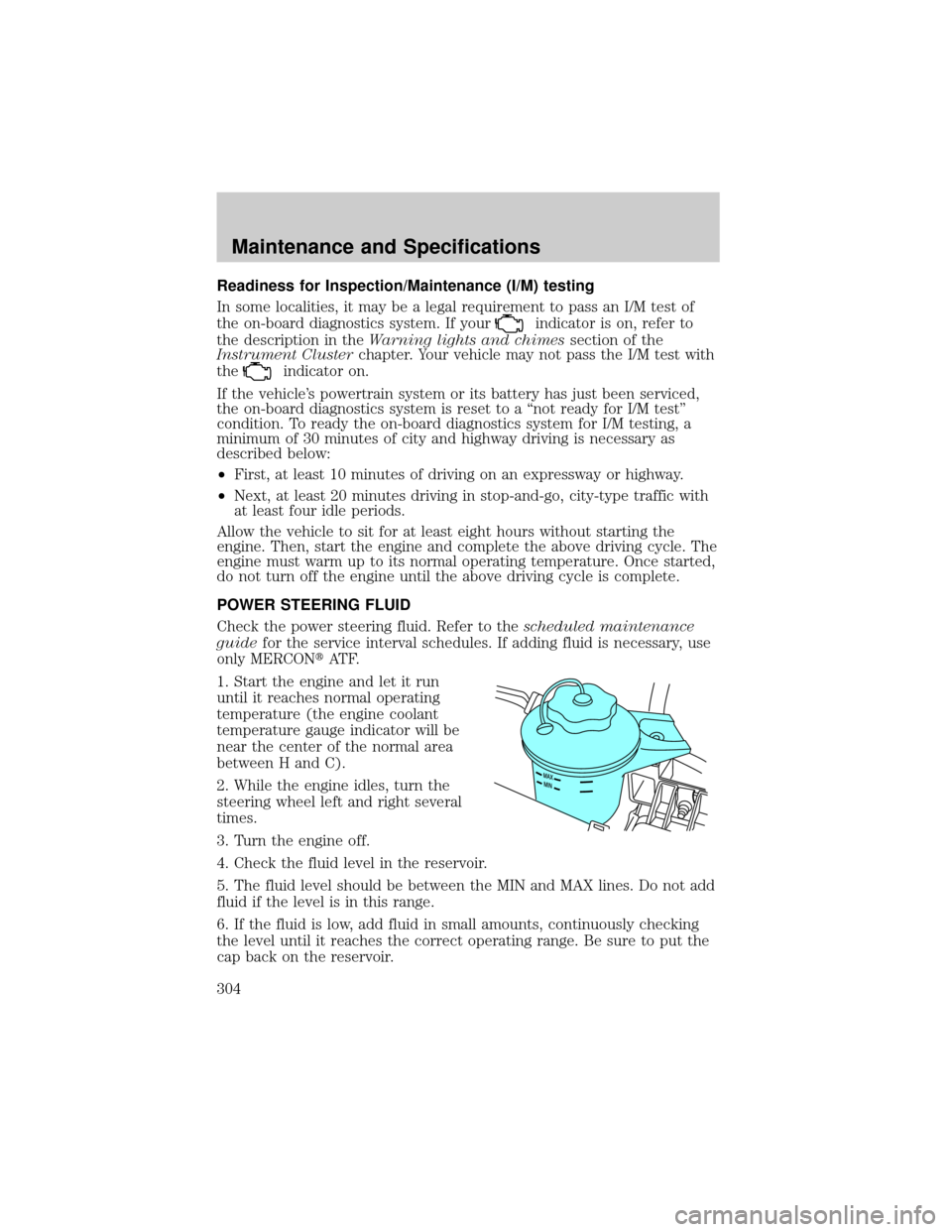
1. Start the engine and let it run
until it reaches normal operating
temperature (the engine coolant
temperature gauge indicator will be
near the center of the normal area
between H and C).
2. While the engine idles, turn the
steering wheel left and right several
times.
3. Turn the engine off.
4. Check the fluid level in the reservoir.
5. The fluid level should be between the MIN and MAX lines. Do not add
fluid if the level is in this range.
6. If the fluid is low, add fluid in small amounts, continuously checking
the level until it reaches the correct operating range. Be sure to put the
cap back on the reservoir.
Maintenance and Specifications
304
Page 308 of 328
Replace the spark plugs with ones that meet Ford material and
design specifications for your vehicle, such as Motorcraft or
equivalent replacement parts. The customer warranty may be void
for any damage to the engine if such spark plugs are not used.
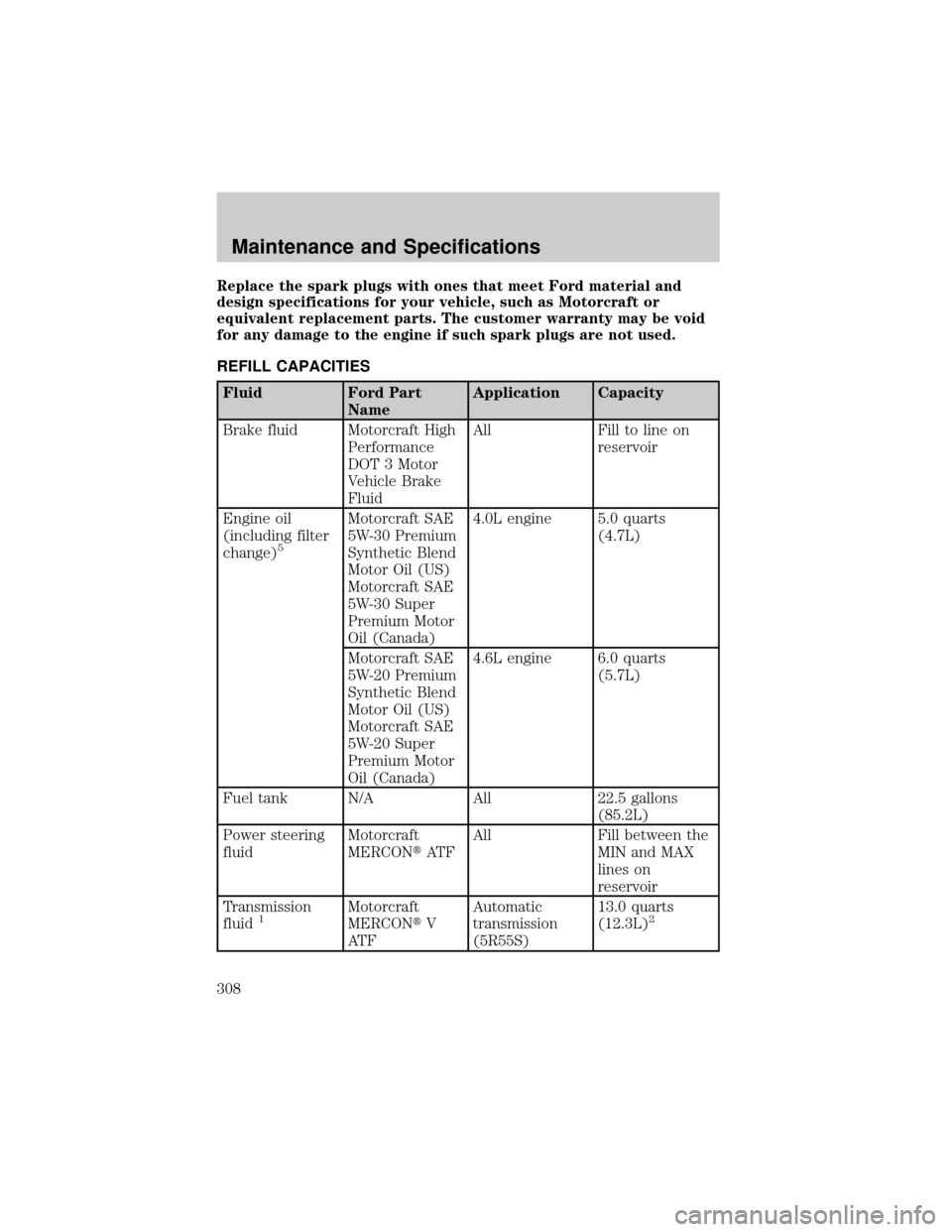
REFILL CAPACITIES
Fluid Ford Part
NameApplication Capacity
Brake fluid Motorcraft High
Performance
DOT 3 Motor
Vehicle Brake
FluidAll Fill to line on
reservoir
Engine oil
(including filter
change)
5
Motorcraft SAE
5W-30 Premium
Synthetic Blend
Motor Oil (US)
Motorcraft SAE
5W-30 Super
Premium Motor
Oil (Canada)4.0L engine 5.0 quarts
(4.7L)
Motorcraft SAE
5W-20 Premium
Synthetic Blend
Motor Oil (US)
Motorcraft SAE
5W-20 Super
Premium Motor
Oil (Canada)4.6L engine 6.0 quarts
(5.7L)
Fuel tank N/A All 22.5 gallons
(85.2L)
Power steering
fluidMotorcraft
MERCONtAT FAll Fill between the
MIN and MAX
lines on
reservoir
Transmission
fluid
1Motorcraft
MERCONtV
AT FAutomatic
transmission
(5R55S)13.0 quarts
(12.3L)2
Maintenance and Specifications
308
Page 311 of 328
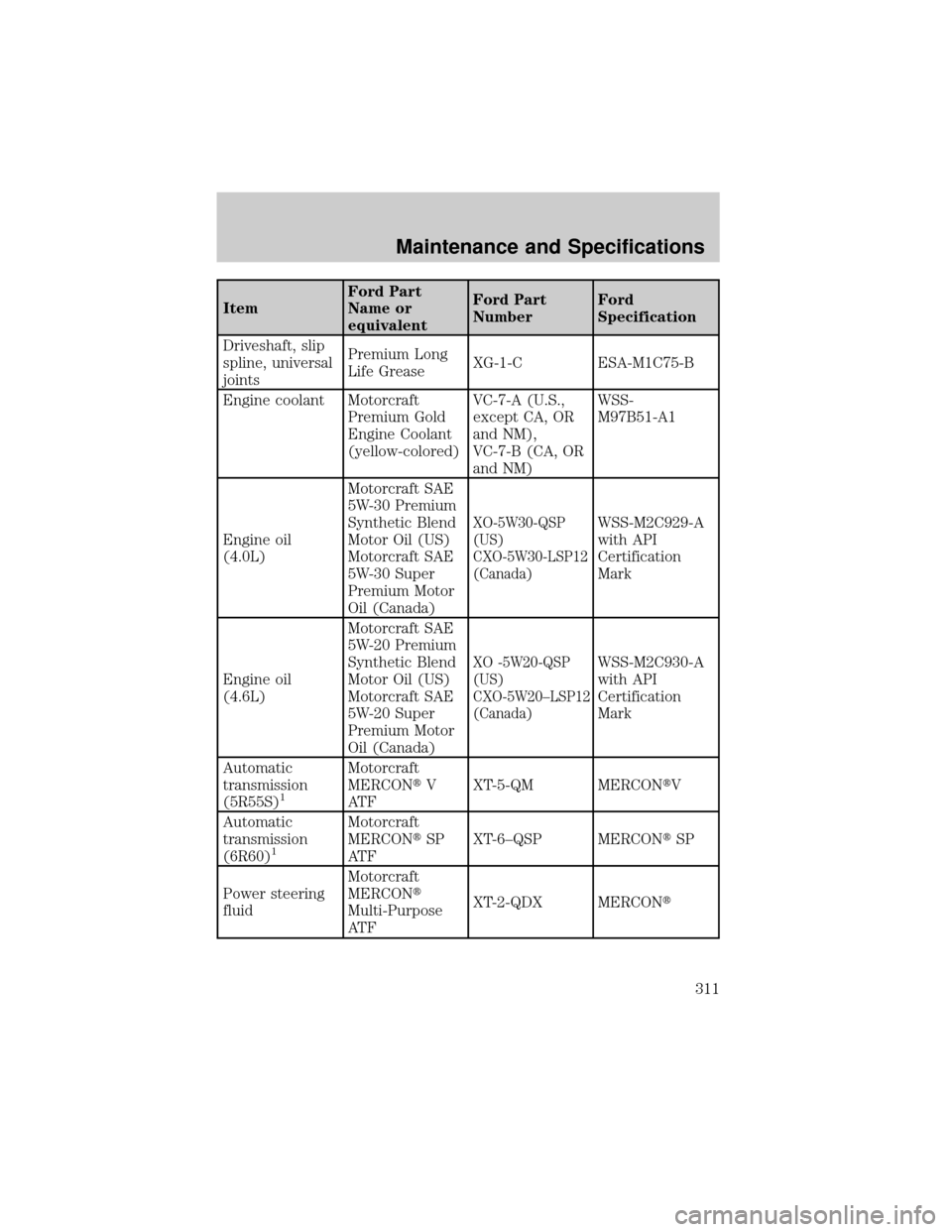
ItemFord Part
Name or
equivalentFord Part
NumberFord
Specification
Driveshaft, slip
spline, universal
jointsPremium Long
Life GreaseXG-1-C ESA-M1C75-B
Engine coolant Motorcraft
Premium Gold
Engine Coolant
(yellow-colored)VC-7-A (U.S.,
except CA, OR
and NM),
VC-7-B (CA, OR
and NM)WSS-
M97B51-A1
Engine oil
(4.0L)Motorcraft SAE
5W-30 Premium
Synthetic Blend
Motor Oil (US)
Motorcraft SAE
5W-30 Super
Premium Motor
Oil (Canada)
XO-5W30-QSP
(US)
CXO-5W30-LSP12
(Canada)WSS-M2C929-A
with API
Certification
Mark
Engine oil
(4.6L)Motorcraft SAE
5W-20 Premium
Synthetic Blend
Motor Oil (US)
Motorcraft SAE
5W-20 Super
Premium Motor
Oil (Canada)
XO -5W20-QSP
(US)
CXO-5W20±LSP12
(Canada)WSS-M2C930-A
with API
Certification
Mark
Automatic
transmission
(5R55S)
1
Motorcraft
MERCONtV
AT FXT-5-QM MERCONtV
Automatic
transmission
(6R60)
1
Motorcraft
MERCONtSP
AT FXT-6±QSP MERCONtSP
Power steering
fluidMotorcraft
MERCONt
Multi-Purpose
AT FXT-2-QDX MERCONt
Maintenance and Specifications
311
Page 321 of 328

wheels ......................................270
wiper blades ............................272
Climate control (see Air
conditioning or Heating) ............37
Clock adjust
6-CD in dash .............................29
Compass, electronic ....................75
calibration .................................77
set zone adjustment ...........76, 89
Console ........................................56
overhead ....................................54
rear ............................................56
Controls
power seat ...............................116
steering column ........................62
Coolant
checking and adding ..............288
refill capacities ................292, 308
specifications ..................310, 313
Cruise control
(see Speed control) ....................60
Customer Assistance ................235
Ford Extended Service
Plan ..........................................266
Getting assistance outside
the U.S. and Canada ..............267
Getting roadside assistance ...235
Getting the service you
need .........................................262
Ordering additional owner's
literature .................................267
Utilizing the
Mediation/Arbitration
Program ...................................265
D
Daytime running lamps
(see Lamps) ................................43Defrost
rear window ..............................41
Dipstick
automatic transmission
fluid ..........................................305
engine oil .................................281
Doors
lubricant specifications ..........310
Driveline universal joint and
slip yoke ....................................306
Driving under special
conditions ..................224, 228, 232
sand .........................................230
snow and ice ...........................233
through water .................231, 234
Dual automatic temperature
control (DATC) ...........................37
DVD system .................................34
E
Electronic message center ...69, 80
Emergencies, roadside
jump-starting ..........................256
Emergency Flashers .................237
Emission control system ..........302
Engine ........................................313
cleaning ...................................270
coolant .....................................288
fail-safe cooling .......................293
idle speed control ...................286
lubrication
specifications ..................310, 313
refill capacities ........................308
service points ..................278±279
starting after a collision .........237
Engine block heater .................209
Engine oil ..................................281
Index
321