ABS FORD EXPLORER 2006 4.G Owners Manual
[x] Cancel search | Manufacturer: FORD, Model Year: 2006, Model line: EXPLORER, Model: FORD EXPLORER 2006 4.GPages: 328, PDF Size: 3.59 MB
Page 14 of 328
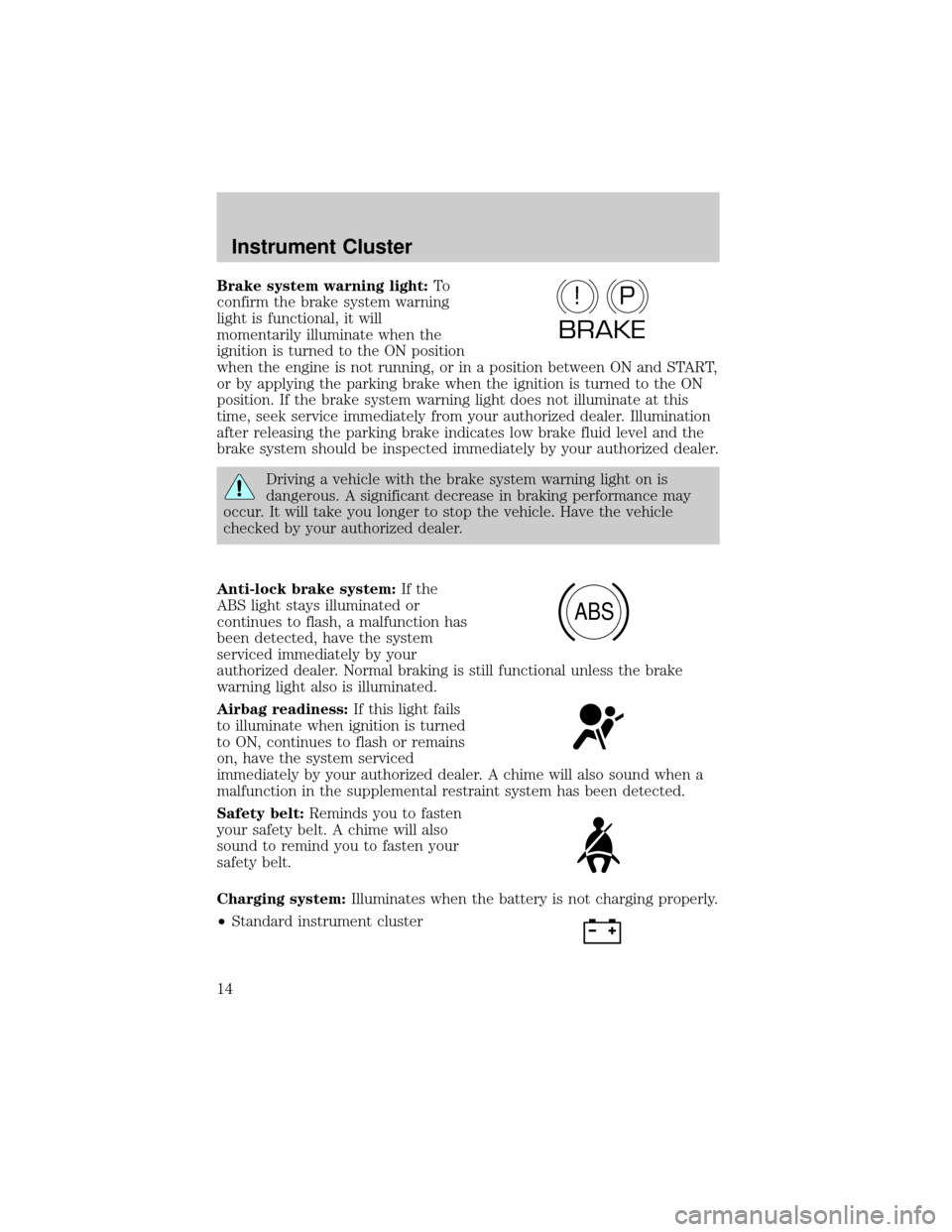
Brake system warning light:To
confirm the brake system warning
light is functional, it will
momentarily illuminate when the
ignition is turned to the ON position
when the engine is not running, or in a position between ON and START,
or by applying the parking brake when the ignition is turned to the ON
position. If the brake system warning light does not illuminate at this
time, seek service immediately from your authorized dealer. Illumination
after releasing the parking brake indicates low brake fluid level and the
brake system should be inspected immediately by your authorized dealer.
Driving a vehicle with the brake system warning light on is
dangerous. A significant decrease in braking performance may
occur. It will take you longer to stop the vehicle. Have the vehicle
checked by your authorized dealer.
Anti-lock brake system:If the
ABS light stays illuminated or
continues to flash, a malfunction has
been detected, have the system
serviced immediately by your
authorized dealer. Normal braking is still functional unless the brake
warning light also is illuminated.
Airbag readiness:If this light fails
to illuminate when ignition is turned
to ON, continues to flash or remains
on, have the system serviced
immediately by your authorized dealer. A chime will also sound when a
malfunction in the supplemental restraint system has been detected.
Safety belt:Reminds you to fasten
your safety belt. A chime will also
sound to remind you to fasten your
safety belt.
Charging system:Illuminates when the battery is not charging properly.
²Standard instrument cluster
P!
BRAKE
ABS
Instrument Cluster
14
Page 210 of 328
To reduce the risk of electrical shock, do not use your heater
with ungrounded electrical systems or two-pronged (cheater)
adapters.
BRAKES
Occasional brake noise is normal. If a metal-to-metal, continuous grinding
or continuous squeal sound is present, the brake linings may be worn-out
and should be inspected by an authorized dealer. If the vehicle has
continuous vibration or shudder in the steering wheel while braking, the
vehicle should be inspected by an authorized dealer.
Refer toBrake system warning
lightin theInstrument Cluster
chapter for information on the brake
system warning light.
Four-wheel anti-lock brake system (ABS)
Your vehicle is equipped with an Anti-lock Braking System (ABS). This
system helps you maintain steering control during emergency stops by
keeping the brakes from locking. Noise from the ABS pump motor and
brake pedal pulsation may be observed during ABS braking and the
brake pedal may suddenly travel a little farther as soon as ABS braking is
done and normal brake operation resumes. These are normal
characteristics of the ABS and should be no reason for concern.
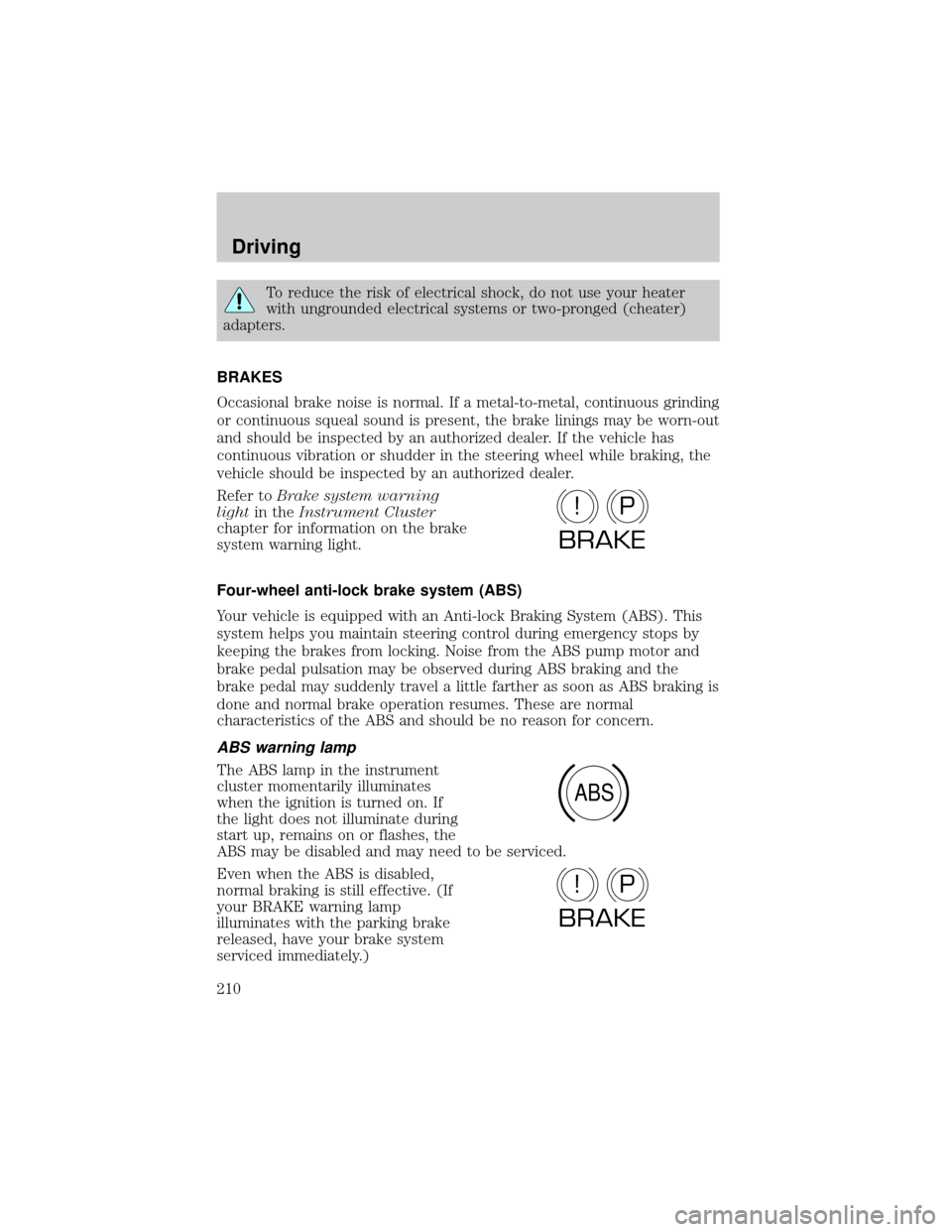
ABS warning lamp
The ABS lamp in the instrument
cluster momentarily illuminates
when the ignition is turned on. If
the light does not illuminate during
start up, remains on or flashes, the
ABS may be disabled and may need to be serviced.
Even when the ABS is disabled,
normal braking is still effective. (If
your BRAKE warning lamp
illuminates with the parking brake
released, have your brake system
serviced immediately.)
P!
BRAKE
ABS
P!
BRAKE
Driving
210
Page 214 of 328

Driving conditions that may activate AdvanceTractwith RSC include:
²Emergency lane-change
²Taking a turn too fast
²Quick maneuvering to avoid an accident, pedestrian or obstacle
AdvanceTractwith RSC button and icon functionality
The AdvanceTractwith RSC system automatically turns on each time
the engine is started. AdvanceTractwith RSC system status is indicated
by a warning indicator light with a ªsliding carº icon in the instrument
cluster that will flash when the system is active. In R (Reverse), ABS and
the Traction Control feature will continue to function, however ESC and
RSC are disabled.
The AdvanceTractwith RSC button
allows the driver to control certain
features of the AdvanceTractwith
RSC system below 25 mph (40
km/h). If an attempt is made to
disable the AdvanceTractwith RSC
system above 25 mph (40 km/h), the ªsliding carº icon will illuminate
solid if pressed momentarily, however, the AdvanceTractwith RSC
system will remain enabled until the vehicle speed drops below 25 mph
(40 km/h). Pressing the AdvanceTractwith RSC button momentarily will
disable engine Traction Control, ESC, and RSC and illuminate the ªsliding
carº icon solid. From the default/start-up state, the AdvanceTractwith
RSC system will have no lights illuminated (ªsliding carº lamp off). The
AdvanceTractwith RSC ªsliding carº lamp will illuminate when the
AdvanceTractwith RSC button is pressed momentarily.
When the AdvanceTractwith RSC system has been turned off (pressing
the AdvanceTractwith RSC button momentarily) the ªsliding carº lamp
will illuminate solid.
Pressing and holding the AdvanceTractwith RSC button for more than
five seconds will further disable the brake portion of the Traction Control
feature and the ªsliding carº icon will flash momentarily, then illuminate
solid. The ªsliding carº icon will illuminate solid if pressed momentarily.
All these conditions are normal during AdvanceTractwith RSC
operation. Refer to the following table.
Driving
214
Page 233 of 328

Driving on snow and ice
4WD vehicles have advantages over 2WD vehicles in snow and ice but
can skid like any other vehicle.
Should you start to slide while driving on snowy or icy roads, turn the
steering wheel in the direction of the slide until you regain control.
Avoid sudden applications of power and quick changes of direction on
snow and ice. Apply the accelerator slowly and steadily when starting
from a full stop.
Avoid sudden braking as well. Although a 4WD vehicle may accelerate
better than a two-wheel drive vehicle in snow and ice, it won't stop any
faster, because as in other vehicles, braking occurs at all four wheels. Do
not become overconfident as to road conditions.
Make sure you allow sufficient distance between you and other vehicles
for stopping. Drive slower than usual and consider using one of the lower
gears. In emergency stopping situations, avoid locking of the wheels. Use
a ªsqueezeº technique, push on the brake pedal with a steadily increasing
force which allows the wheels to brake yet continue to roll so that you
may steer in the direction you want to travel. If you lock the wheels,
release the brake pedal and repeat the squeeze technique. If your vehicle
is equipped with a Four Wheel Anti-Lock Brake System (ABS), apply the
brake steadily. Do not ªpumpº the brakes. Refer to theBrakessection of
this chapter for additional information on the operation of the anti-lock
brake system.
Never drive with chains on the front tires of 4WD vehicles without also
putting them on the rear tires. This could cause the rear to slide and
swing around during braking.
Maintenance and Modifications
The suspension and steering systems on your vehicle have been designed
and tested to provide predictable performance whether loaded or empty
and durable load carrying capability. For this reason, Ford Motor
Company strongly recommends that you do not make modifications such
as adding or removing parts (such as lift kits or stabilizer bars) or by
using replacement parts not equivalent to the original factory equipment.
Any modifications to a vehicle that raise the center of gravity can make
it more likely the vehicle will roll over as a result of a loss of control.
Ford Motor Company recommends that caution be used with any vehicle
equipped with a high load or device (such as ladder racks or pickup box
cover).
Driving
233
Page 295 of 328
Observe the following guidelines when handling automotive fuel:
²Extinguish all smoking materials
and any open flames before
refueling your vehicle.
²Always turn off the vehicle before
refueling.
²Automotive fuels can be harmful
or fatal if swallowed. Fuel such as gasoline is highly toxic and if
swallowed can cause death or permanent injury. If fuel is swallowed,
call a physician immediately, even if no symptoms are immediately
apparent. The toxic effects of fuel may not be visible for hours.
²Avoid inhaling fuel vapors. Inhaling too much fuel vapor of any kind
can lead to eye and respiratory tract irritation. In severe cases,
excessive or prolonged breathing of fuel vapor can cause serious
illness and permanent injury.
²Avoid getting fuel liquid in your eyes. If fuel is splashed in the eyes,
remove contact lenses (if worn), flush with water for 15 minutes and
seek medical attention. Failure to seek proper medical attention could
lead to permanent injury.
²Fuels can also be harmful if absorbed through the skin. If fuel is
splashed on the skin and/or clothing, promptly remove contaminated
clothing and wash skin thoroughly with soap and water. Repeated or
prolonged skin contact with fuel liquid or vapor causes skin irritation.
²
Be particularly careful if you are taking ªAntabuseº or other forms of
disulfiram for the treatment of alcoholism. Breathing gasoline vapors, or
skin contact could cause an adverse reaction. In sensitive individuals,
serious personal injury or sickness may result. If fuel is splashed on the
skin, promptly wash skin thoroughly with soap and water. Consult a
physician immediately if you experience an adverse reaction.
When refueling always shut the engine off and never allow
sparks or open flames near the filler neck. Never smoke while
refueling. Fuel vapor is extremely hazardous under certain conditions.
Care should be taken to avoid inhaling excess fumes.
The flow of fuel through a fuel pump nozzle can produce static
electricity, which can cause a fire if fuel is pumped into an
ungrounded fuel container.
Maintenance and Specifications
295
Page 320 of 328

A
Accessory delay ..........................58
AdvanceTrac ..............................212
Air cleaner filter ...............306±307
Air conditioning ..........................37
Airbag supplemental
restraint system ........141, 150, 152
and child safety seats ............143
description ..............141, 150, 152
disposal ....................................155
driver airbag ............143, 151, 153
indicator light .................150, 155
operation .................143, 151, 153
passenger airbag .....143, 151, 153
side airbag ...............................150
Ambulance packages ....................8
Antifreeze
(see Engine coolant) ................288
Anti-lock brake system
(see Brakes) ..............................210
Audio system
(see Radio) ......................21, 25, 29
Automatic transmission
driving an automatic
overdrive .........................218, 221
fluid, adding ............................305
fluid, checking ........................305
fluid, refill capacities ..............308
fluid, specification ..................313
Auxiliary power point .................55
Axle
lubricant specifications ..310, 313
refill capacities ........................308
B
Battery .......................................286acid, treating emergencies .....286
jumping a disabled battery ....256
maintenance-free ....................286
replacement, specifications ...307
servicing ..................................286
BeltMinder .................................136
Brakes ........................................210
anti-lock ...................................210
anti-lock brake system (ABS)
warning light ...........................210
fluid, checking and adding ....305
fluid, refill capacities ..............308
fluid, specifications .........310, 313
lubricant specifications ..310, 313
parking ....................................211
shift interlock ..........................217
C
Calculating load ........................199
Capacities for refilling fluids ....308
Cargo cover ...........................94±95
Cassette tape player .............21, 25
Cell phone use ..............................8
Changing a tire .........................246
Child safety restraints ..............156
child safety belts ....................156
Child safety seats ......................160
attaching with tether straps ..164
in front seat ............................161
in rear seat ..............................161
Cleaning your vehicle
engine compartment ..............270
instrument panel ....................272
interior .....................................273
interior trim ............................273
plastic parts ............................272
washing ....................................269
waxing .....................................269
Index
320
Page 323 of 328

Inspection/maintenance (I/M)
testing ........................................304
Instrument panel
cleaning ...................................272
cluster ........................................12
J
Jack ....................................246, 250
positioning .......................246, 252
storage .....................246, 249±250
Jump-starting your vehicle ......256
K
Keyless entry system ...............106
autolock ...........................108±109
Keys
positions of the ignition .........207
L
Lamps
bulb replacement
specifications chart ............46±47
daytime running light ...............43
fog lamps ...................................42
interior lamps ...........................46
Liftgate ................................96, 102
Lights, warning and indicator ....12
anti-lock brakes (ABS) ..........210
Load limits .................................192
Loading instructions .................199
Locks
autolock ...........................108±109
childproof ................................100
doors ..........................................98
Lubricant specifications ...310, 313
Lug nuts ....................................255Luggage rack ...............................97
Lumbar support, seats .....116, 119
M
Message center ...............69, 80±81
english/metric button .........73, 85
system check button ..........72, 84
warning messages ...............77, 91
Mirrors .........................................53
automatic dimming rearview
mirror ........................................58
fold away ...................................59
heated ........................................59
side view mirrors (power) .......58
Moon roof ....................................64
Motorcraft parts ........274, 294, 307
N
Navigation system .......................34
O
Octane rating ............................298
Oil (see Engine oil) ..................281
P
Parking brake ............................211
Parts (see Motorcraft parts) ....307
Passenger Occupant
Classification Sensor .................127
Pedals (see Power adjustable
foot pedals) .................................59
Power adjustable foot pedals .....59
Power distribution box
(see Fuses) ...............................243
Power door locks ........................98
Index
323