service FORD EXPLORER 2006 4.G Severe Duty Supplement Manual
[x] Cancel search | Manufacturer: FORD, Model Year: 2006, Model line: EXPLORER, Model: FORD EXPLORER 2006 4.GPages: 12, PDF Size: 0.08 MB
Page 1 of 12
Introduction
2
Maintenance and care
4
Special service equipment
6
All rights reserved. Reproduction by any means, electronic or mechanical
including photocopying, recording or by any information storage and retrieval
system or translation in whole or part is not permitted without written
authorization from Ford Motor Company. Ford may change the contents without
notice and without incurring obligation.
Copyright © 2006 Ford Motor Company
Table of Contents
1
2006 Explorer(exp)
Supplement
USA(fus)
Page 2 of 12
ABOUT THIS SUPPLEMENT
This booklet supplements your Owner’s guide and is part of the owner’s
portfolio. It is intended to aid the operators of special service or fleet
vehicles which are subjected to severe duty or high mileage usage.
Some of the information in this supplement utilizes instructions from the
Owner’s Guide. Please read this supplement carefully and completely.
Refer to the Owner’s Guide for complete vehicle information.
The information found in this supplement was in effect at the time of
printing. Ford Motor Company reserves the right to change the contents
without notice and without incurring obligation.
WARNINGS
Warnings remind you to be especially careful in those areas of the
vehicle where carelessness can cause damage to your vehicle or possible
personal injury to yourself, your passengers or others. Please read all
warnings carefully.
•Warnings are identified by this symbol
ABOUT THE WARRANTIES
The normal vehicle warranties will apply to your vehicle. For further
information, refer to your Warranty Information Booklet in the owner’s
portfolio.
Specified maintenance procedures must be followed. Repairs must be
made by trained personnel.
It is important that your vehicle be properly maintained by qualified Ford
service technicians. If a problem occurs, it is important that properly
trained personnel diagnose and repair the cause. If your vehicle is not
maintained in accordance with approved service procedures, damage
may occur and your warranty may be invalidated.
Failure to maintain your special service or fleet vehicle properly
may restrict warranty coverage, reduce vehicle performance and
operation and may adversely affect the safety of the vehicle.
2006 Explorer(exp)
Supplement
USA(fus)
Introduction
2
Page 4 of 12

MAINTENANCE CHECKS AND SERVICES
Refer to your Owner’s Guide for detailed information and procedures for
the following checks and services. If the check or service is not listed in
the Owner’s Guide, refer to the Workshop Manual which can be
purchased from your dealer.
The following maintenance checks should be performed according to the
Scheduled Maintenance Guide, using the intervals listed under the
Owner Check and Services.
•Check engine oil fluid level
•Check windshield washer fluid level
•Check power steering fluid level
•Check engine cooling system fluid level and protection
•Check tires for wear and correct air pressure
•Check battery connections
•Check parking brake for proper operation
•Check safety warning lamps for proper operation
•Check seat belts and latches for wear and proper operation
•Lubricate all hinges, latches and outside locks
The following maintenance services should be performed according to
the Scheduled Maintenance Guide, using the service intervals listed
under theSpecial Operating Conditions.
•Replace engine oil and filter
•Replace transmission fluid and filter
•Replace fuel filter
•Replace spark plugs
•Replace rear axle lubricant
•Replace engine air filter element
•Inspect brake system
•Inspect and lubricate U-joints
All other maintenance checks and services should be performed
according to the Scheduled Maintenance Guide, using the intervals listed
under theNormal Schedule.
2006 Explorer(exp)
Supplement
USA(fus)
Maintenance and care
4
Page 6 of 12
SPECIAL SERVICE OPTIONS
The Explorer is not designed nor intended to be used as a pursuit
vehicle or an ambulance.
Your vehicle’s optional equipment is designed to meet Ford Corporate
Product Standards. However, the equipment does not meet corporate
guidelines relative to police packages. Therefore, the optional equipment
is only intended for use in limited law enforcement service. Use of DSO
special service options does not imply nor allow use of your Explorer as
a pursuit vehicle (excessive speed), nor as an ambulance..
EQUIPMENT INSTALLATION
Important equipment installation information
When installing aftermarket equipment, avoid using fasteners that are too
long for the application or are in an area that might damage other
vehicle components (i.e., electrical wiring, brake lines, fuel tank and
lines, powertrain components, exhaust system, suspension, etc.).
When installing aftermarket equipment to the roof, be sure to locate
wires between the headliner and the roof before drilling. This will
prevent damage to the wire harness or interior headliner.
Do not make any electrical connections to the vehicle’s electrical system
at a point not specifically designed for installation of aftermarket
electrical equipment.
Do not install aftermarket equipment into the brake light circuit or any
other electrical circuit which is connected to the powertrain control
module (PCM), anti-lock brake system (ABS), air bag supplemental
restraint system (SRS) or transmission. Connecting into these systems
may affect engine and transmission operation and may cause vehicle
malfunction.
Do not install aftermarket equipment near the air bag deployment zones.
Failure to do so may inhibit the functioning of the supplemental restraint
system in the event of a collision. Refer toAir bag deployment zonesin
this chapter.
Do not place objects or mount equipment on or near the air bag
cover on the side of the seatbacks of the front seats or in front
seat areas that may come into contact with a deploying air bag. Failure
to follow these instructions may increase the risk of personal injury in
the event of a collision.
2006 Explorer(exp)
Supplement
USA(fus)
Special service equipment
6
Page 7 of 12
Installation of mobile communication systems
The Federal Communication Commission (FCC) regulates the use of
mobile communication systems such as two-way radios, telephones and
anti-theft alarms that are equipped with radio transmitters. If you install
this equipment in your vehicle, you should comply with those rules. All
Ford Motor Company vehicles are in compliance with FCC regulations
(CFR 47 Part 15) and SAE J551d for radiated electromagnetic emissions.
Mobile communication systems not designed for automotive use or not
properly installed, may cause the engine to stumble, stall or affect
electronically controlled transmission operation. In addition, such
systems themselves may be damaged or their operation affected by the
normal operating conditions of your vehicle. Citizen Band (CB)
transceivers, garage door openers, and other electrical transmitters
whose power output of 5 watts or less, will not ordinarily affect your
vehicle’s operation.
Mobile communication systems may harm the operation of your
vehicle, particularly if they are not designed for automotive use
or are not properly installed.
Ford Motor Company has no control over the installation, design
or manufacture of mobile communication systems. Ford Motor
Company cannot assume responsibility for any adverse effects or
damages that may result if this type of equipment is used.
Malfunction of aftermarket electronic equipment should be resolved by
the equipment manufacturer.
2006 Explorer(exp)
Supplement
USA(fus)
Special service equipment
7
Page 8 of 12
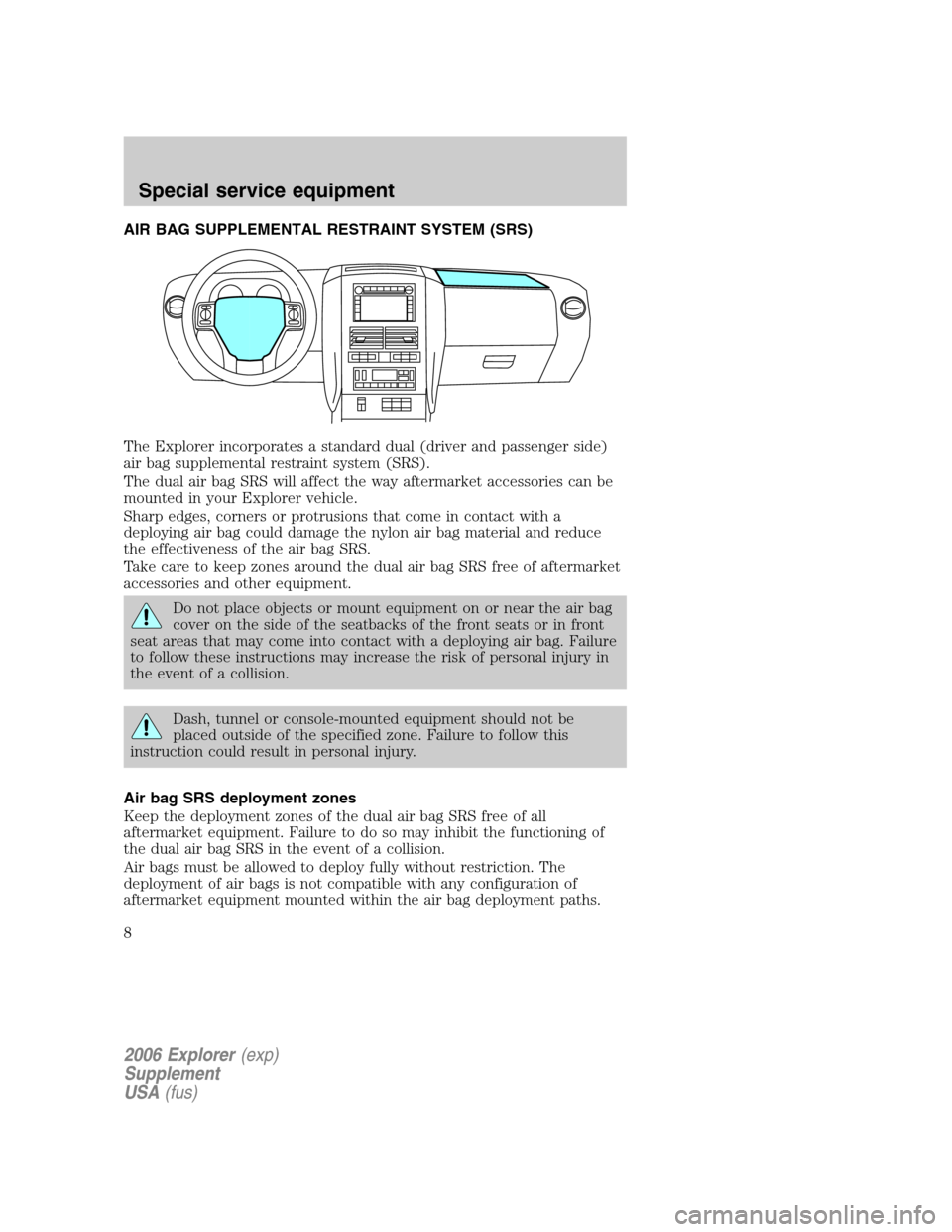
AIR BAG SUPPLEMENTAL RESTRAINT SYSTEM (SRS)
The Explorer incorporates a standard dual (driver and passenger side)
air bag supplemental restraint system (SRS).
The dual air bag SRS will affect the way aftermarket accessories can be
mounted in your Explorer vehicle.
Sharp edges, corners or protrusions that come in contact with a
deploying air bag could damage the nylon air bag material and reduce
the effectiveness of the air bag SRS.
Take care to keep zones around the dual air bag SRS free of aftermarket
accessories and other equipment.
Do not place objects or mount equipment on or near the air bag
cover on the side of the seatbacks of the front seats or in front
seat areas that may come into contact with a deploying air bag. Failure
to follow these instructions may increase the risk of personal injury in
the event of a collision.
Dash, tunnel or console-mounted equipment should not be
placed outside of the specified zone. Failure to follow this
instruction could result in personal injury.
Air bag SRS deployment zones
Keep the deployment zones of the dual air bag SRS free of all
aftermarket equipment. Failure to do so may inhibit the functioning of
the dual air bag SRS in the event of a collision.
Air bags must be allowed to deploy fully without restriction. The
deployment of air bags is not compatible with any configuration of
aftermarket equipment mounted within the air bag deployment paths.
2006 Explorer(exp)
Supplement
USA(fus)
Special service equipment
8
Page 9 of 12
Equipment mounted or placed within the deployment zones of the dual
air bag SRS will reduce the effectiveness of the air bags, damage the air
bags and potentially damage or dislodge the equipment, which may
result in personal injury.
Do not place objects or mount equipment on or near the air bag
cover on the side of the seatbacks of the front seats or in front
seat areas that may come into contact with a deploying air bag. Failure
to follow these instructions may increase the risk of personal injury in
the event of a collision.
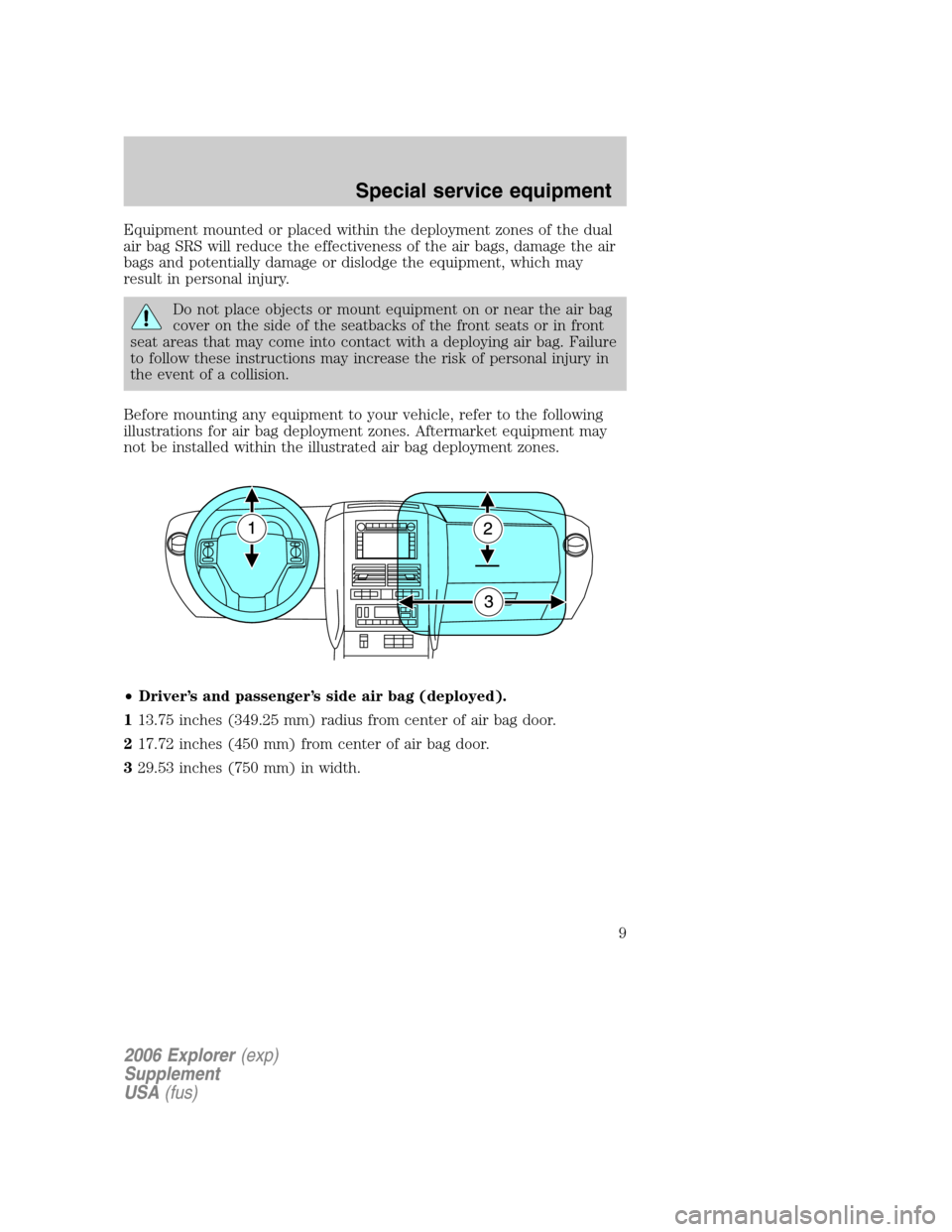
Before mounting any equipment to your vehicle, refer to the following
illustrations for air bag deployment zones. Aftermarket equipment may
not be installed within the illustrated air bag deployment zones.
•Driver’s and passenger’s side air bag (deployed).
113.75 inches (349.25 mm) radius from center of air bag door.
217.72 inches (450 mm) from center of air bag door.
329.53 inches (750 mm) in width.
2006 Explorer(exp)
Supplement
USA(fus)
Special service equipment
9
Page 10 of 12
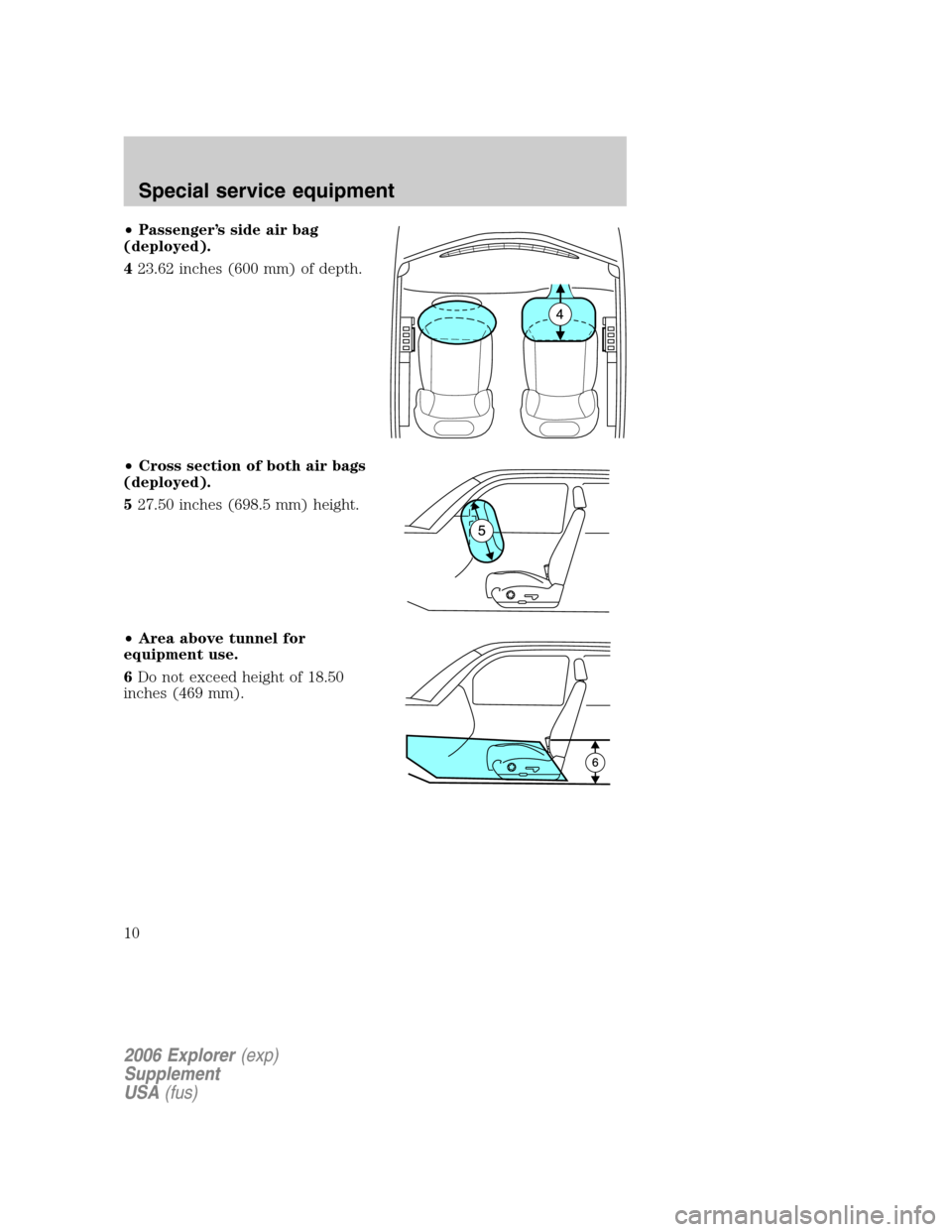
•Passenger’s side air bag
(deployed).
423.62 inches (600 mm) of depth.
•Cross section of both air bags
(deployed).
527.50 inches (698.5 mm) height.
•Area above tunnel for
equipment use.
6Do not exceed height of 18.50
inches (469 mm).
2006 Explorer(exp)
Supplement
USA(fus)
Special service equipment
10
Page 11 of 12
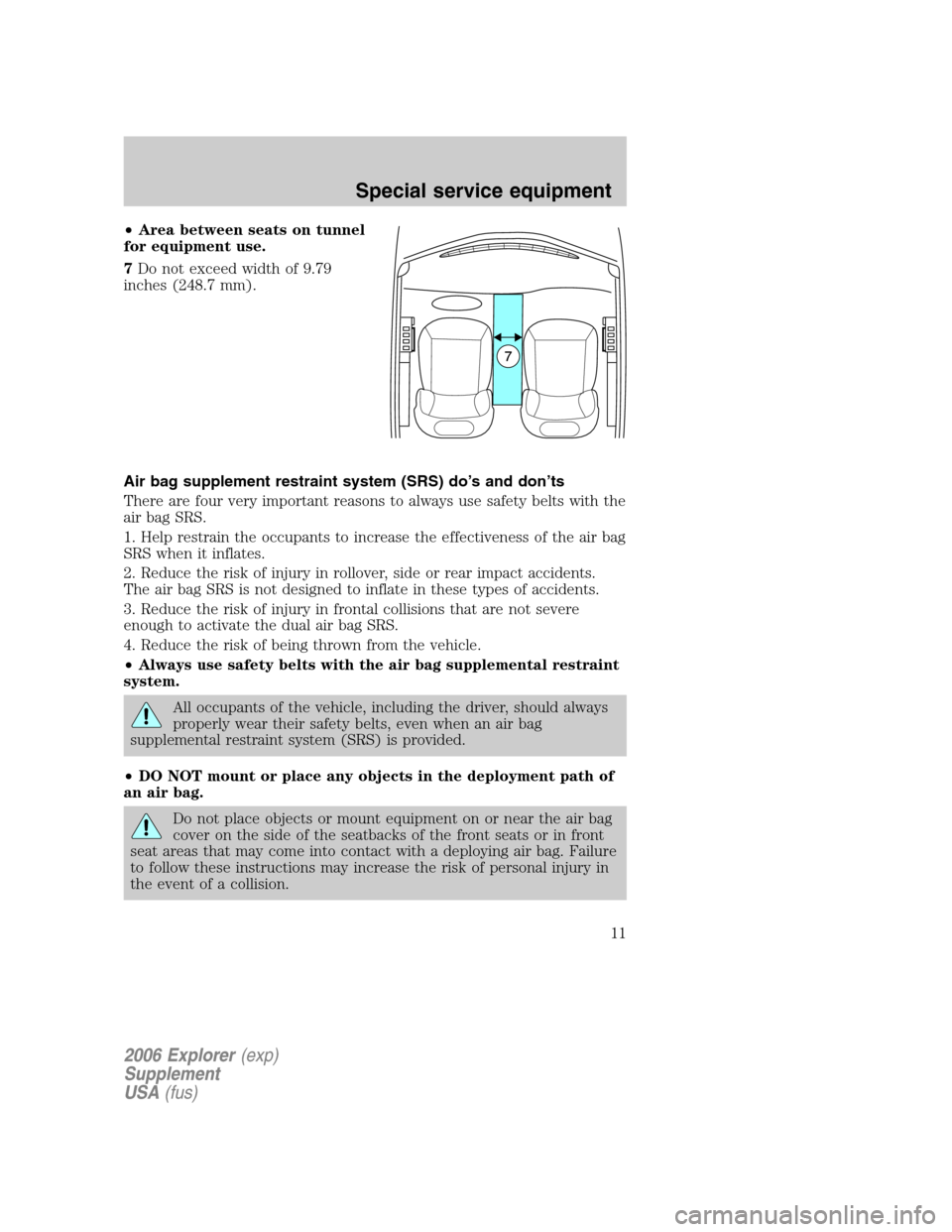
•Area between seats on tunnel
for equipment use.
7Do not exceed width of 9.79
inches (248.7 mm).
Air bag supplement restraint system (SRS) do’s and don’ts
There are four very important reasons to always use safety belts with the
air bag SRS.
1. Help restrain the occupants to increase the effectiveness of the air bag
SRS when it inflates.
2. Reduce the risk of injury in rollover, side or rear impact accidents.
The air bag SRS is not designed to inflate in these types of accidents.
3. Reduce the risk of injury in frontal collisions that are not severe
enough to activate the dual air bag SRS.
4. Reduce the risk of being thrown from the vehicle.
•Always use safety belts with the air bag supplemental restraint
system.
All occupants of the vehicle, including the driver, should always
properly wear their safety belts, even when an air bag
supplemental restraint system (SRS) is provided.
•DO NOT mount or place any objects in the deployment path of
an air bag.
Do not place objects or mount equipment on or near the air bag
cover on the side of the seatbacks of the front seats or in front
seat areas that may come into contact with a deploying air bag. Failure
to follow these instructions may increase the risk of personal injury in
the event of a collision.
2006 Explorer(exp)
Supplement
USA(fus)
Special service equipment
11
Page 12 of 12
•DO NOT attempt to tamper with, disconnect or deactivate the
dual air bag SRS.
Do not attempt to service, repair, or modify the air bag
supplemental restraint system (SRS) or its fuses. See your Ford
or Lincoln Mercury dealer.
Tampering with the dual air bag SRS could cause the air bags to
inflate or become inoperative which may result in possible
personal injury.
Disconnecting or deactivating the air bag SRS could result in
liability exposure to the owner of the vehicle.
Special air bag supplement restraint system (SRS) concerns
•This vehicle cannot be special ordered without the dual air bag
supplement restraint system (SRS).
•The installation of some types of push bumpers could affect the timing
of air bag deployment.
•When transporting a passenger whose hands are restrained, it is
recommended that the passenger is seated in the rear of the vehicle,
upright as possible and properly restrained with the safety belt. If it is
necessary to transport an individual in the front seat, the passenger’s
seat should be adjusted as far rearward as possible and the individual
properly restrained with the safety belt.
•This vehicle is not designed nor intended for use as an ambulance or
pursuit vehicle. However, high speed braking or uneven road surfaces
will not cause inadvertent air bag inflation.
2006 Explorer(exp)
Supplement
USA(fus)
Special service equipment
12