clock FORD EXPLORER SPORT TRAC 2002 User Guide
[x] Cancel search | Manufacturer: FORD, Model Year: 2002, Model line: EXPLORER SPORT TRAC, Model: FORD EXPLORER SPORT TRAC 2002Pages: 200, PDF Size: 3.34 MB
Page 136 of 200
Removing the jack
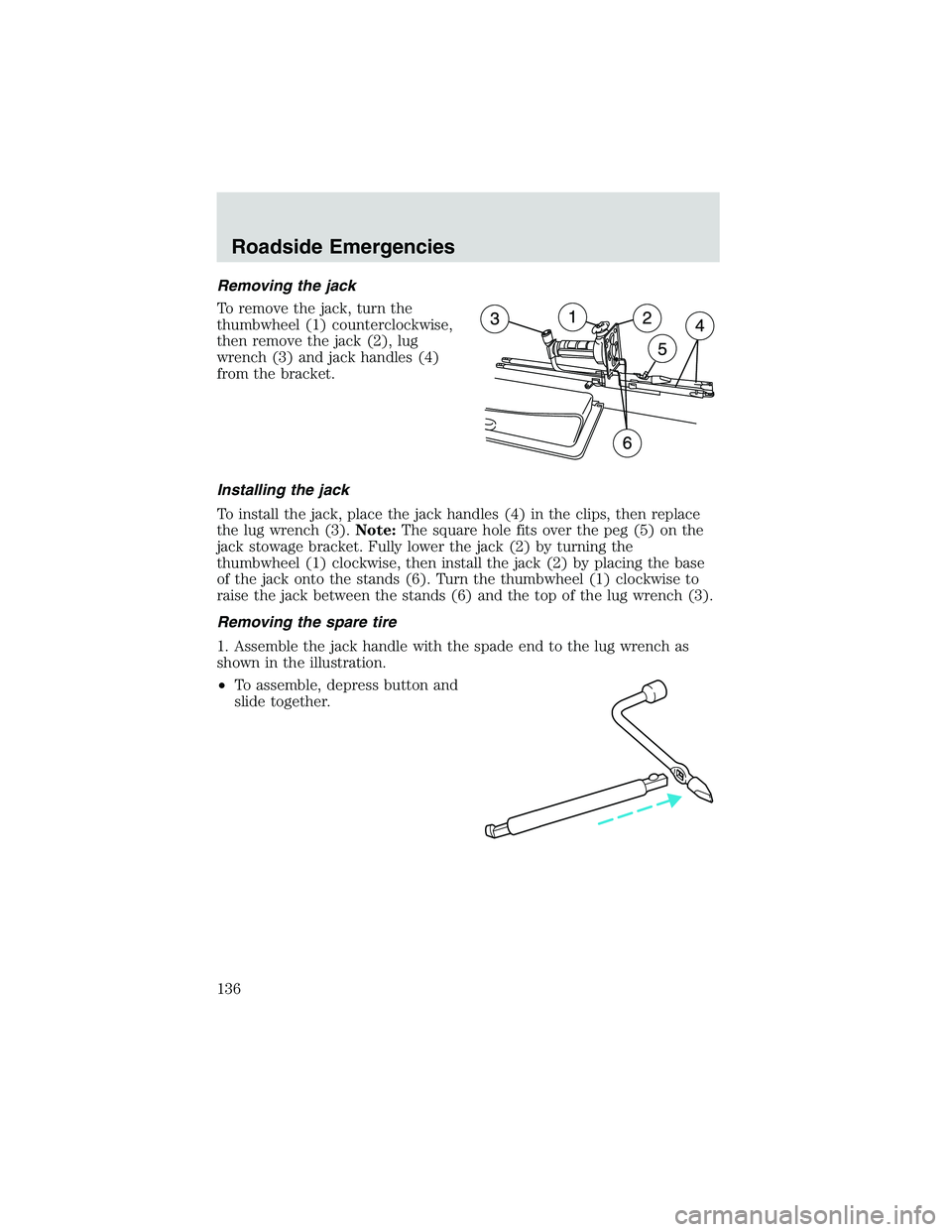
To remove the jack, turn the
thumbwheel (1) counterclockwise,
then remove the jack (2), lug
wrench (3) and jack handles (4)
from the bracket.
Installing the jack
To install the jack, place the jack handles (4) in the clips, then replace
the lug wrench (3).Note:The square hole fits over the peg (5) on the
jack stowage bracket. Fully lower the jack (2) by turning the
thumbwheel (1) clockwise, then install the jack (2) by placing the base
of the jack onto the stands (6). Turn the thumbwheel (1) clockwise to
raise the jack between the stands (6) and the top of the lug wrench (3).
Removing the spare tire
1. Assemble the jack handle with the spade end to the lug wrench as
shown in the illustration.
•To assemble, depress button and
slide together.
Roadside Emergencies
136
Page 137 of 200
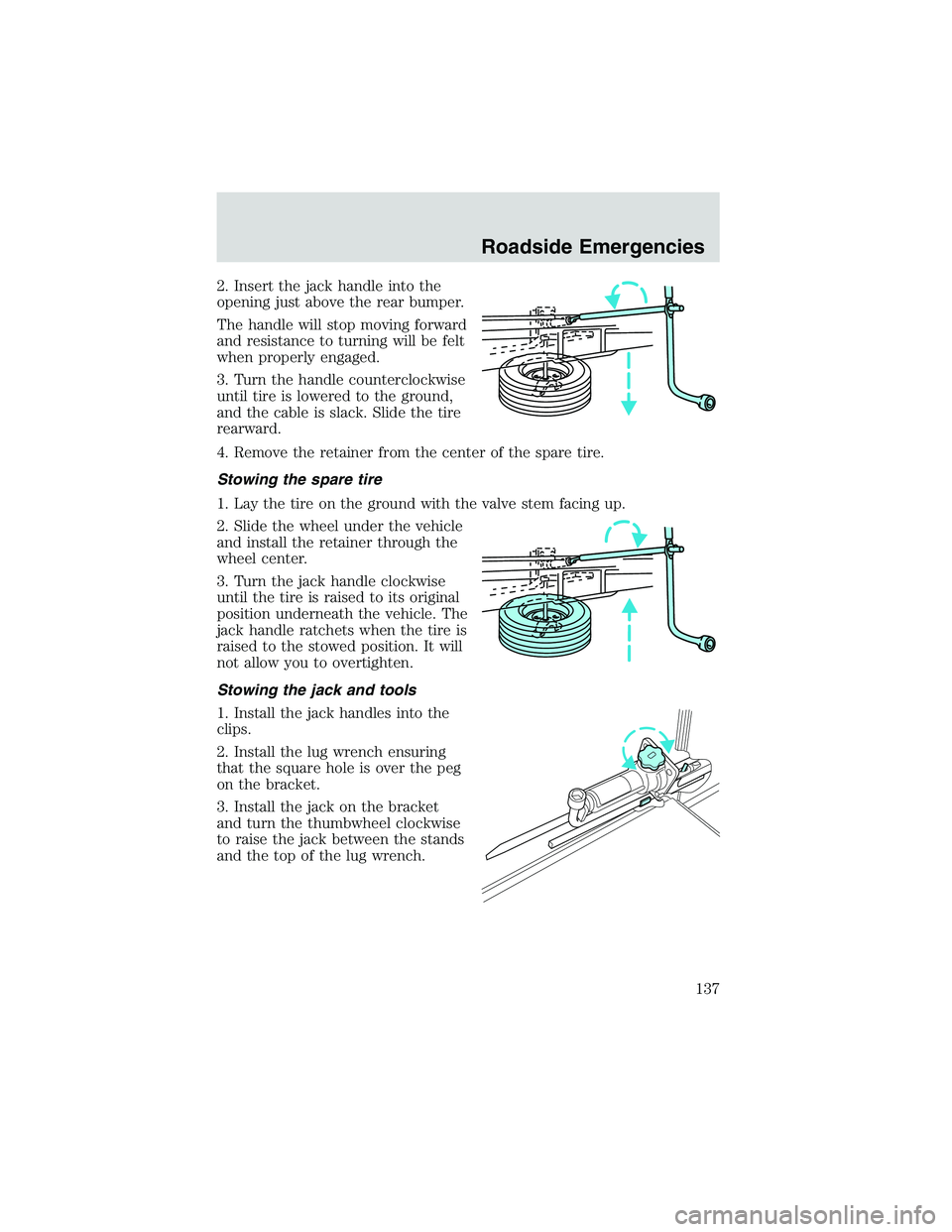
2. Insert the jack handle into the
opening just above the rear bumper.
The handle will stop moving forward
and resistance to turning will be felt
when properly engaged.
3. Turn the handle counterclockwise
until tire is lowered to the ground,
and the cable is slack. Slide the tire
rearward.
4. Remove the retainer from the center of the spare tire.
Stowing the spare tire
1. Lay the tire on the ground with the valve stem facing up.
2. Slide the wheel under the vehicle
and install the retainer through the
wheel center.
3. Turn the jack handle clockwise
until the tire is raised to its original
position underneath the vehicle. The
jack handle ratchets when the tire is
raised to the stowed position. It will
not allow you to overtighten.
Stowing the jack and tools
1. Install the jack handles into the
clips.
2. Install the lug wrench ensuring
that the square hole is over the peg
on the bracket.
3. Install the jack on the bracket
and turn the thumbwheel clockwise
to raise the jack between the stands
and the top of the lug wrench.
Roadside Emergencies
137
Page 139 of 200
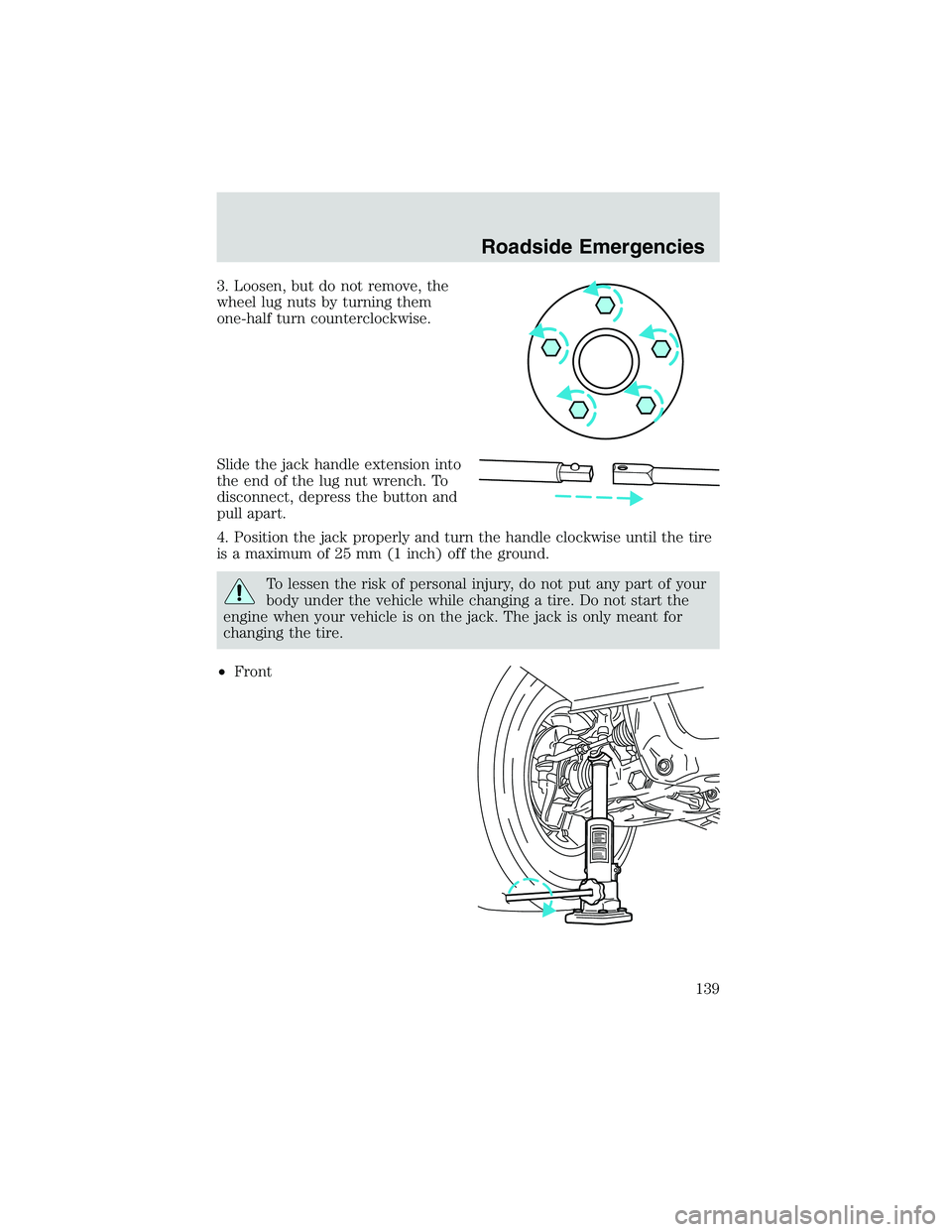
3. Loosen, but do not remove, the
wheel lug nuts by turning them
one-half turn counterclockwise.
Slide the jack handle extension into
the end of the lug nut wrench. To
disconnect, depress the button and
pull apart.
4. Position the jack properly and turn the handle clockwise until the tire
is a maximum of 25 mm (1 inch) off the ground.
To lessen the risk of personal injury, do not put any part of your
body under the vehicle while changing a tire. Do not start the
engine when your vehicle is on the jack. The jack is only meant for
changing the tire.
•Front
Roadside Emergencies
139
Page 140 of 200
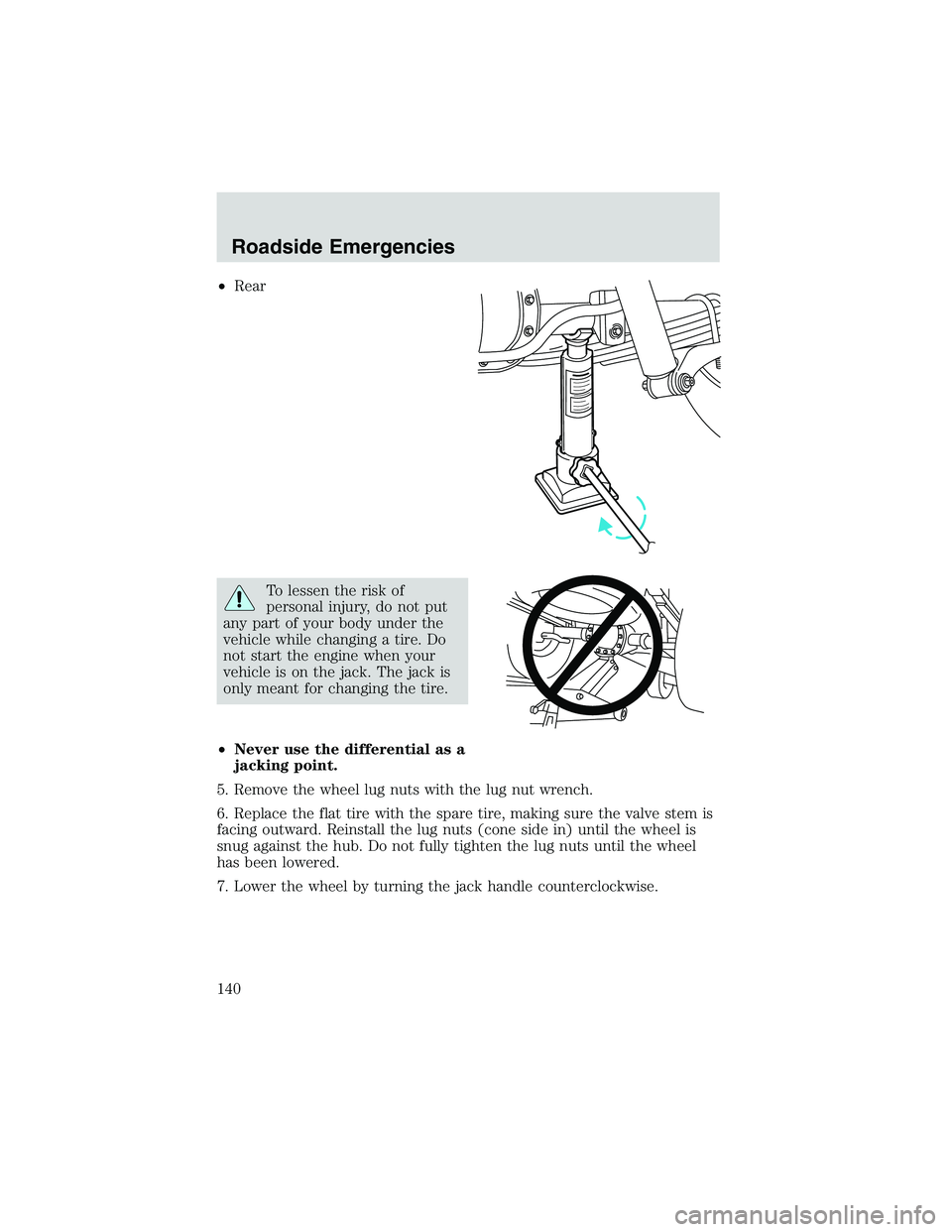
•Rear
To lessen the risk of
personal injury, do not put
any part of your body under the
vehicle while changing a tire. Do
not start the engine when your
vehicle is on the jack. The jack is
only meant for changing the tire.
•Never use the differential as a
jacking point.
5. Remove the wheel lug nuts with the lug nut wrench.
6. Replace the flat tire with the spare tire, making sure the valve stem is
facing outward. Reinstall the lug nuts (cone side in) until the wheel is
snug against the hub. Do not fully tighten the lug nuts until the wheel
has been lowered.
7. Lower the wheel by turning the jack handle counterclockwise.
Roadside Emergencies
140
Page 165 of 200
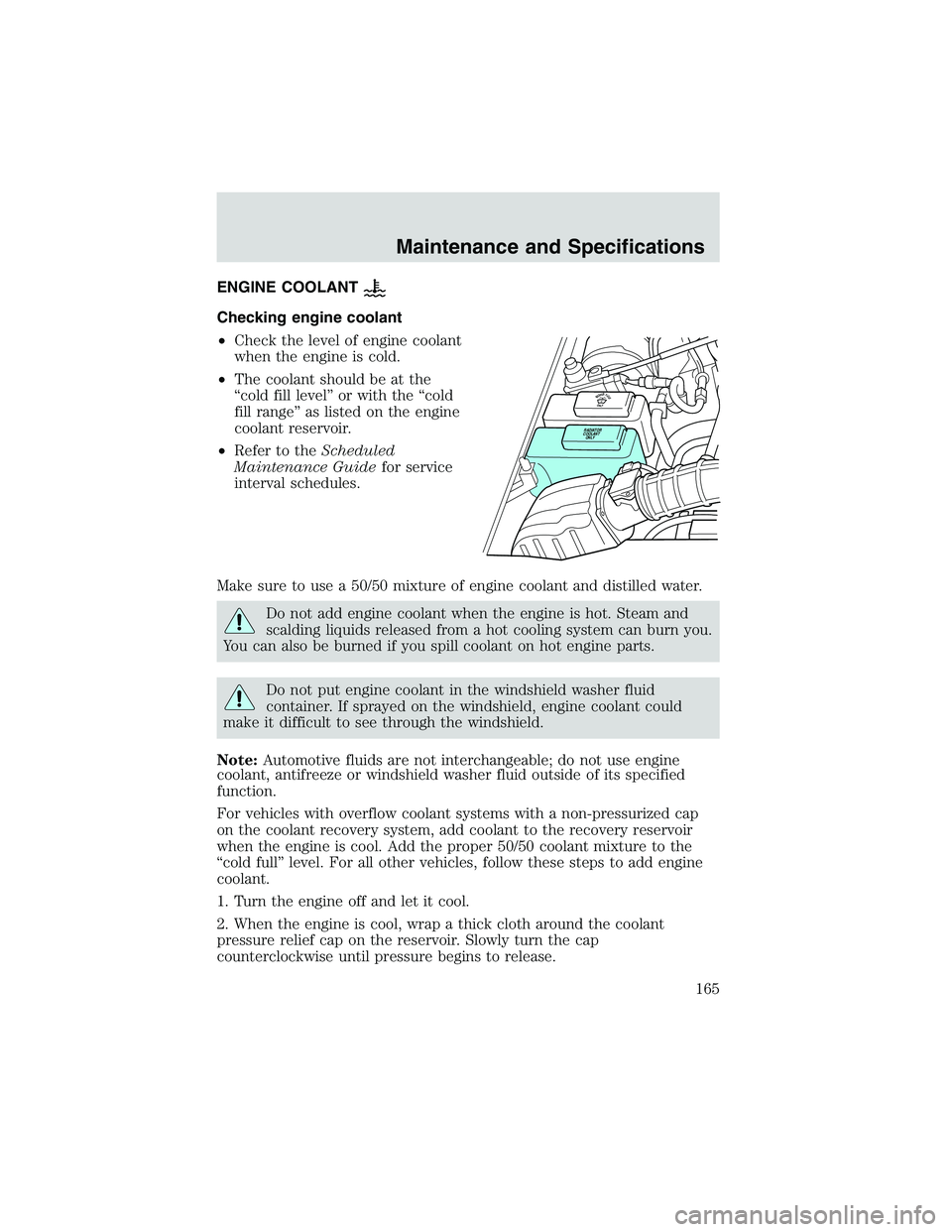
ENGINE COOLANT
Checking engine coolant
•Check the level of engine coolant
when the engine is cold.
•The coolant should be at the
“cold fill level”or with the“cold
fill range”as listed on the engine
coolant reservoir.
•Refer to theScheduled
Maintenance Guidefor service
interval schedules.
Make sure to use a 50/50 mixture of engine coolant and distilled water.
Do not add engine coolant when the engine is hot. Steam and
scalding liquids released from a hot cooling system can burn you.
You can also be burned if you spill coolant on hot engine parts.
Do not put engine coolant in the windshield washer fluid
container. If sprayed on the windshield, engine coolant could
make it difficult to see through the windshield.
Note:Automotive fluids are not interchangeable; do not use engine
coolant, antifreeze or windshield washer fluid outside of its specified
function.
For vehicles with overflow coolant systems with a non-pressurized cap
on the coolant recovery system, add coolant to the recovery reservoir
when the engine is cool. Add the proper 50/50 coolant mixture to the
“cold full”level. For all other vehicles, follow these steps to add engine
coolant.
1. Turn the engine off and let it cool.
2. When the engine is cool, wrap a thick cloth around the coolant
pressure relief cap on the reservoir. Slowly turn the cap
counterclockwise until pressure begins to release.
RADIATOR
COOLANT
ONLY
WASHERFLUIDONLY
Maintenance and Specifications
165
Page 170 of 200
Running out of fuel
Running out of fuel may have an adverse affect on powertrain
components.
•You may need to cycle the ignition from off to on several times after
refueling to allow the fuel system to pump the fuel from the tank to
the engine.
•Your“Check Engine”indicator may come on.
Fuel filler cap
When fueling:
1. Turn the engine off.
2. Carefully turn the filler cap counterclockwise 1/8 of a turn until it
stops.
3. Pull to remove the cap.
4. To install the cap, align the tabs on the cap with the notches on the
filler pipe.
5. Turn the filler cap clockwise 1/8 of a turn until it stops.
If the“Check Fuel Cap”indicator
illuminates and stays on after you
start the engine, the cap may not be
properly installed.
If you must replace the fuel
filler cap, replace it with a fuel filler cap that is designed for your
vehicle.
If you do not use the proper fuel filler cap, excessive pressure or
vacuum in the fuel tank may damage the fuel system or cause
the fuel cap to disengage in a collision, which may result in personal
injury.
Fuel filter
Refer to theScheduled Maintenance Guidefor the appropriate
replacement intervals. Replace the fuel filter with an authorized
Motorcraft part.
ESSENTIALS OF GOOD FUEL ECONOMY
We do not recommend taking fuel economy measurements during the
first 1,600 km (1,000 miles) of driving. You will get a more accurate
measurement after 3,000 km - 5,000 km (2,000 miles - 3,000 miles)
CHECK
FUEL
CAP
Maintenance and Specifications
170
Page 194 of 200
A
Air bag supplemental restraint
system ....................................83–84
and child safety seats ..............85
description ................................84
disposal ......................................87
driver air bag ............................86
indicator light ...........................87
operation ...................................86
passenger air bag .....................86
Air cleaner filter .......................183
Anti-lock brake system
(see Brakes) ......................103–104
Audio system (see Radio) ...14, 27
Automatic transmission
driving an automatic
overdrive .................................107
fluid, refill capacities ..............183
fluid, specification ..................188
Auxiliary power point .................44
Axle
lubricant specifications ..186, 188
refill capacities ........................183
traction lok ..............................105
B
Battery
replacement, specifications ...183
BeltMinder ...................................79
Brakes ........................................103
anti-lock ...........................103–104
anti-lock brake system (ABS)
warning light ...........................103
fluid, refill capacities ..............183
fluid, specifications .........186, 188
lubricant specifications ..186, 188
parking ....................................104
shift interlock ..........................106C
Capacities for refilling fluids ....183
Cargo cage ...................................55
Cassette tape player ...................27
CD-single premium .....................14
Certification Label ....................190
Child safety restraints ................88
child safety belts ......................88
Child safety seats ........................91
attaching with tether straps ....96
in front seat ..............................92
in rear seat ..........................92, 95
Cleaning your vehicle
engine compartment ..............154
instrument panel ....................156
interior .....................................156
plastic parts ............................155
washing ....................................153
waxing .....................................153
wheels ......................................154
wiper blades ............................155
woodtone trim ........................156
Clock ............................................27
Clutch
operation while driving ..........109
recommended shift speeds ....109
Compass/temperature display ...52
Console ........................................42
floor ...........................................42
overhead ....................................42
Controls
power seat .................................69
Coolant
refill capacities ........................183
specifications ..................186, 188
Customer Assistance ................125
Index
194