tow FORD F-150 2020 Owners Manual
[x] Cancel search | Manufacturer: FORD, Model Year: 2020, Model line: F-150, Model: FORD F-150 2020Pages: 625, PDF Size: 7.98 MB
Page 5 of 625
Anti-Theft Alarm
...........................................84
Power Running Boards
Using Power Running Boards ...................
86
Steering Wheel
Adjusting the Steering Wheel - Vehicles With: Manual Adjustable Steering
Column .........................................................
88
Adjusting the Steering Wheel - Vehicles With: Power Adjustable Steering
Column .........................................................
88
Audio Control .................................................
90
Voice Control ..................................................
90
Cruise Control - Vehicles With: Adaptive Cruise Control ............................................
90
Cruise Control - Vehicles With: Cruise Control ...........................................................
91
Information Display Control .......................
91
Heated Steering Wheel ...............................
91
Horn .....................................................................
91
Adjustable Pedals
Adjusting the Pedals ....................................
92
Wipers and Washers
Windshield Wipers ........................................
93
Autowipers ......................................................
93
Windshield Washers ....................................
94
Lighting
General Information .....................................
95
Lighting Control .............................................
95
Autolamps .......................................................
96
Instrument Lighting Dimmer ....................
96
Daytime Running Lamps - Vehicles With: Daytime Running Lamps (DRL) .........
96
Daytime Running Lamps - Vehicles With: Configurable Daytime Running Lamps
........................................................................\
...
97
Front Fog Lamps ...........................................
97
Direction Indicators ......................................
98Spot Lamps
....................................................
98
Interior Lamps ................................................
98
Ambient Lighting ..........................................
99
Cargo Lamps ..................................................
99
Automatic High Beam Control
What Is Automatic High Beam Control ........................................................................\
..
101
Switching Automatic High Beam Control On and Off ..................................................
101
Automatic High Beam Control Indicators ........................................................................\
..
101
Overriding Automatic High Beam Control ........................................................................\
.
102
Windows and Mirrors
Power Windows ...........................................
103
Exterior Mirrors .............................................
104
Interior Mirror .................................................
107
Sliding Windows .........................................
108
Sun Visors ......................................................
108
Moonroof ........................................................
109
Instrument Cluster
Gauges ...............................................................
111
Warning Lamps and Indicators ...............
114
Audible Warnings and Indicators ...........
118
Information Displays
General Information ...................................
120
Information Messages ...............................
132
Climate Control
Manual Climate Control .............................
151
Automatic Climate Control ......................
152
Hints on Controlling the Interior Climate - Vehicles With: Automatic
Temperature Control .............................
154
2
F-150 (TFC) Canada/United States of America, enUSA, Edition date: 201907, Third-Printing- Table of Contents
Page 7 of 625
Selective Catalytic Reductant System -
Diesel ...........................................................207
Diesel Particulate Filter ..............................
212
Transmission
Automatic Transmission ...........................
217
Four-Wheel Drive
Using Four-Wheel Drive ...........................
223
Rear Axle
Electronic Locking Differential ................
231
Brakes
General Information ..................................
233
Hints on Driving With Anti-Lock Brakes ........................................................................\
234
Electric Parking Brake ...............................
234
Hill Start Assist ............................................
235
Traction Control
Principle of Operation ...............................
237
Using Traction Control ..............................
237
Stability Control
Principle of Operation ...............................
238
Using Stability Control ..............................
239
Hill Descent Control
Principle of Operation ................................
241
Using Hill Descent Control .......................
241
Parking Aids
Principle of Operation ...............................
242
Rear Parking Aid ..........................................
242
Active Park Assist .......................................
243
Rear View Camera ......................................
247
360 Degree Camera ..................................
250Cruise Control
What Is Cruise Control
..............................
253
Switching Cruise Control On and Off ........................................................................\
253
Setting the Cruise Control Speed .........
253
Canceling the Set Speed .........................
254
Resuming the Set Speed .........................
254
Cruise Control Indicators .........................
254
Using Adaptive Cruise Control - Vehicles With: Adaptive Cruise Control ...........
254
Driving Aids
Driver Alert ......................................................
261
Lane Keeping System ...............................
262
Blind Spot Information System ............
266
Cross Traffic Alert .......................................
270
Steering ...........................................................
273
Pre-Collision Assist ....................................
274
Drive Control .................................................
278
Load Carrying
Load Retaining Fixtures .............................
281
Load Limit ......................................................
282
Bed Access ...................................................
286
Bed Ramps ....................................................
287
Towing
Towing a Trailer ...........................................
290
Trailer Reversing Aids ................................
292
Trailer Sway Control ..................................
302
Recommended Towing Weights ..........
302
Essential Towing Checks ..........................
314
Towing the Vehicle on Four Wheels ......
321
Driving Hints
Economical Driving ....................................
324
Off-Road Driving .........................................
324
Breaking-In ....................................................
326
Driving Through Water ..............................
326
4
F-150 (TFC) Canada/United States of America, enUSA, Edition date: 201907, Third-Printing- Table of Contents
Page 8 of 625
Snow Plowing
...............................................327
Floor Mats ......................................................
329
Roadside Emergencies
Roadside Assistance ..................................
331
Hazard Flashers ...........................................
332
Fuel Shutoff ..................................................
332
Jump Starting the Vehicle .......................
333
Post-Crash Alert System .........................
335
Transporting the Vehicle ..........................
335
Towing Points ..............................................
336
Customer Assistance
Getting the Services You Need ..............
337
In California (U.S. Only) ...........................
338
The Better Business Bureau (BBB) Auto Line Program (U.S. Only) ....................
339
Utilizing the Mediation/Arbitration Program (Canada Only) ......................
340
Getting Assistance Outside the U.S. and Canada ......................................................
340
Ordering Additional Owner's Literature ........................................................................\
342
Reporting Safety Defects (U.S. Only) ........................................................................\
342
Reporting Safety Defects (Canada Only) ........................................................................\
342
Fuses
Fuse Specification Chart .........................
344
Changing a Fuse ..........................................
353
Maintenance
General Information ..................................
355
Opening and Closing the Hood .............
355
Under Hood Overview - 2.7L EcoBoost™ ........................................................................\
356
Under Hood Overview - 3.0L Diesel ......
357
Under Hood Overview - 3.3L ..................
358
Under Hood Overview - 3.5L Ecoboost™ ........................................................................\
359 Under Hood Overview - 5.0L
.................
360
Engine Oil Dipstick - Gasoline .................
361
Engine Oil Dipstick - Diesel ......................
361
Engine Oil Check - Gasoline ....................
361
Engine Oil Check - Diesel .........................
362
Oil Change Indicator Reset .....................
363
Changing the Engine Air Filter - Gasoline ........................................................................\
364
Changing the Engine Air Filter - Diesel ........................................................................\
364
Draining the Fuel Filter Water Trap - Diesel ..........................................................
366
Engine Coolant Check ..............................
366
Automatic Transmission Fluid Check ........................................................................\
.
371
Transfer Case Fluid Check ........................
371
Brake Fluid Check ........................................
372
Power Steering Fluid Check ....................
373
Changing the 12V Battery .........................
373
Adjusting the Headlamps ........................
375
Washer Fluid Check ...................................
376
Fuel Filter - Diesel .......................................
376
Fuel Filter - Gasoline ..................................
376
Checking the Wiper Blades .....................
376
Changing the Wiper Blades .....................
377
Changing a Bulb ...........................................
377
Vehicle Care
General Information ..................................
382
Cleaning Products ......................................
382
Cleaning the Exterior .................................
383
Waxing ............................................................
384
Cleaning the Engine ..................................
384
Cleaning the Exhaust - Diesel ...............
385
Cleaning the Windows and Wiper Blades ........................................................................\
385
Cleaning the Interior ..................................
385
Cleaning the Instrument Panel and Instrument Cluster Lens ......................
386
Cleaning Leather Seats ............................
387
Repairing Minor Paint Damage .............
388
5
F-150 (TFC) Canada/United States of America, enUSA, Edition date: 201907, Third-Printing- Table of Contents
Page 17 of 625
Entertainment Data
Data recorded includes, for example:
•
Music, videos or album art.
• Contacts and corresponding address
book entries.
• Navigation destinations.
Services That We Provide
If you use our services, we collect and use
data, for example, account information,
vehicle location and driving characteristics,
that could identify you. We transmit this
data through a dedicated, protected
connection. We only collect and use data
to enable your use of our services to which
you have subscribed, with your consent or
where permitted by law. For additional
information, see the terms and conditions
of the services to which you have
subscribed.
Services That Third Parties
Provide
We recommend that you review the terms
and conditions and data privacy
information for any services to which you
subscribe. We take no responsibility for
services that third parties provide.
Vehicles With a Modem (If Equipped) The modem has a SIM. The
modem was enabled when your
vehicle was built and periodically
sends messages to stay connected to the
cell phone network, receive automatic
software updates and send vehicle-related
information to us, for example, diagnostic
information. These messages could
include information that identifies your
vehicle, the SIM and the electronic serial
number of the modem. Cell phone network
service providers could have access to
additional information, for example, cell
phone network tower identification. Note:
The modem continues to send this
information unless you disable the modem
or stop the modem from sharing vehicle
data by changing the modem settings.
See
Connected Vehicle (page 471).
Note: The service can be unavailable or
interrupted for a number of reasons, for
example, environmental or topographical
conditions and data plan coverage.
Note: To find out if your vehicle has a
modem, visit
www .For dC onne c t e d . c om .
Vehicles With a Connectivity
Device
(If Equipped) The connectivity device has a
SIM. The connectivity device was
enabled when your vehicle was
built and periodically sends messages to
stay connected to the cell phone network.
These messages could include information
that identifies your vehicle, the SIM and the
electronic serial number of the connectivity
device. Cell phone network service
providers could have access to additional
information, for example, cell phone
network tower identification.
Note: The connectivity device continues to
send this information unless you disable the
connectivity device. To find out more about
having the connectivity device disabled,
contact the Ford Customer Relationship
Center. Disabling this connectivity device is
permanent. See Connected Vehicle (page
471
).
If FordPass is connected to your vehicle,
Ford also receives additional information,
for example, location and vehicle data. See
FordPass Terms and Privacy Policy. For
additional information about our privacy
policy, visit
www .For dC onne c t e d . c om or
refer to your local Ford website.
14
F-150 (TFC) Canada/United States of America, enUSA, Edition date: 201907, Third-Printing- Introduction E314755
Page 22 of 625
PROTECTING THE
ENVIRONMENT
You should play your part in protecting the
environment. Correct vehicle usage and
the authorized disposal of waste, cleaning
and lubrication materials are significant
steps toward this aim.
For additional information about our
sustainability progress and initiatives, visit
www
.sus t ainabilit y .f or d . c om .
19
F-150 (TFC) Canada/United States of America, enUSA, Edition date: 201907, Third-Printing- Environment
Page 23 of 625
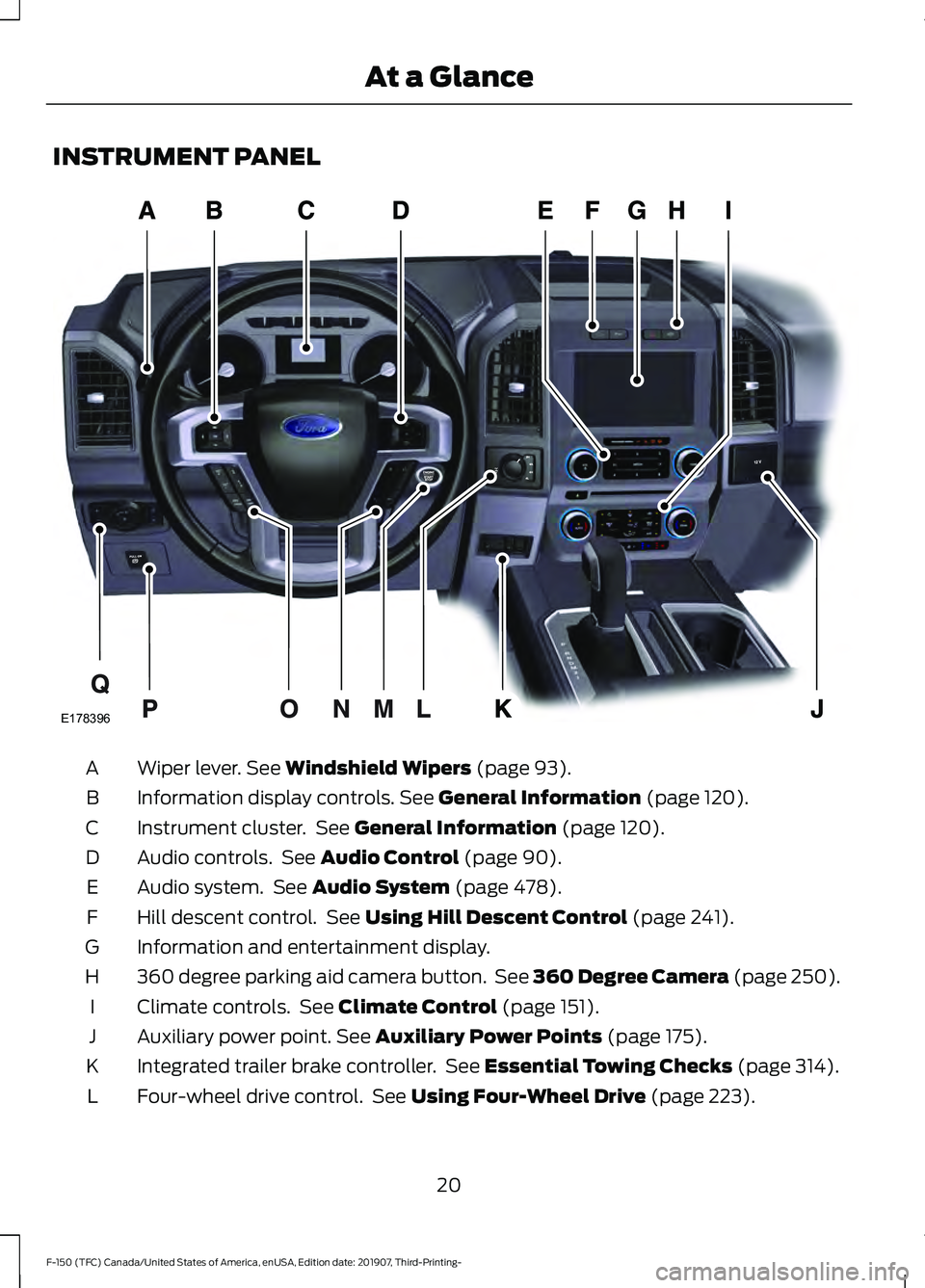
INSTRUMENT PANEL
Wiper lever. See Windshield Wipers (page 93).
A
Information display controls.
See General Information (page 120).
B
Instrument cluster. See
General Information (page 120).
C
Audio controls. See
Audio Control (page 90).
D
Audio system. See
Audio System (page 478).
E
Hill descent control. See
Using Hill Descent Control (page 241).
F
Information and entertainment display.
G
360 degree parking aid camera button. See 360 Degree Camera (page 250).
H
Climate controls. See
Climate Control (page 151).
I
Auxiliary power point.
See Auxiliary Power Points (page 175).
J
Integrated trailer brake controller. See
Essential Towing Checks (page 314).
K
Four-wheel drive control. See
Using Four-Wheel Drive (page 223).
L
20
F-150 (TFC) Canada/United States of America, enUSA, Edition date: 201907, Third-Printing- At a GlanceE178396
Page 29 of 625
Note:
The automatic locking mode is
available on the front passenger and rear
seats. This vehicle does not require the use
of a locking clip.
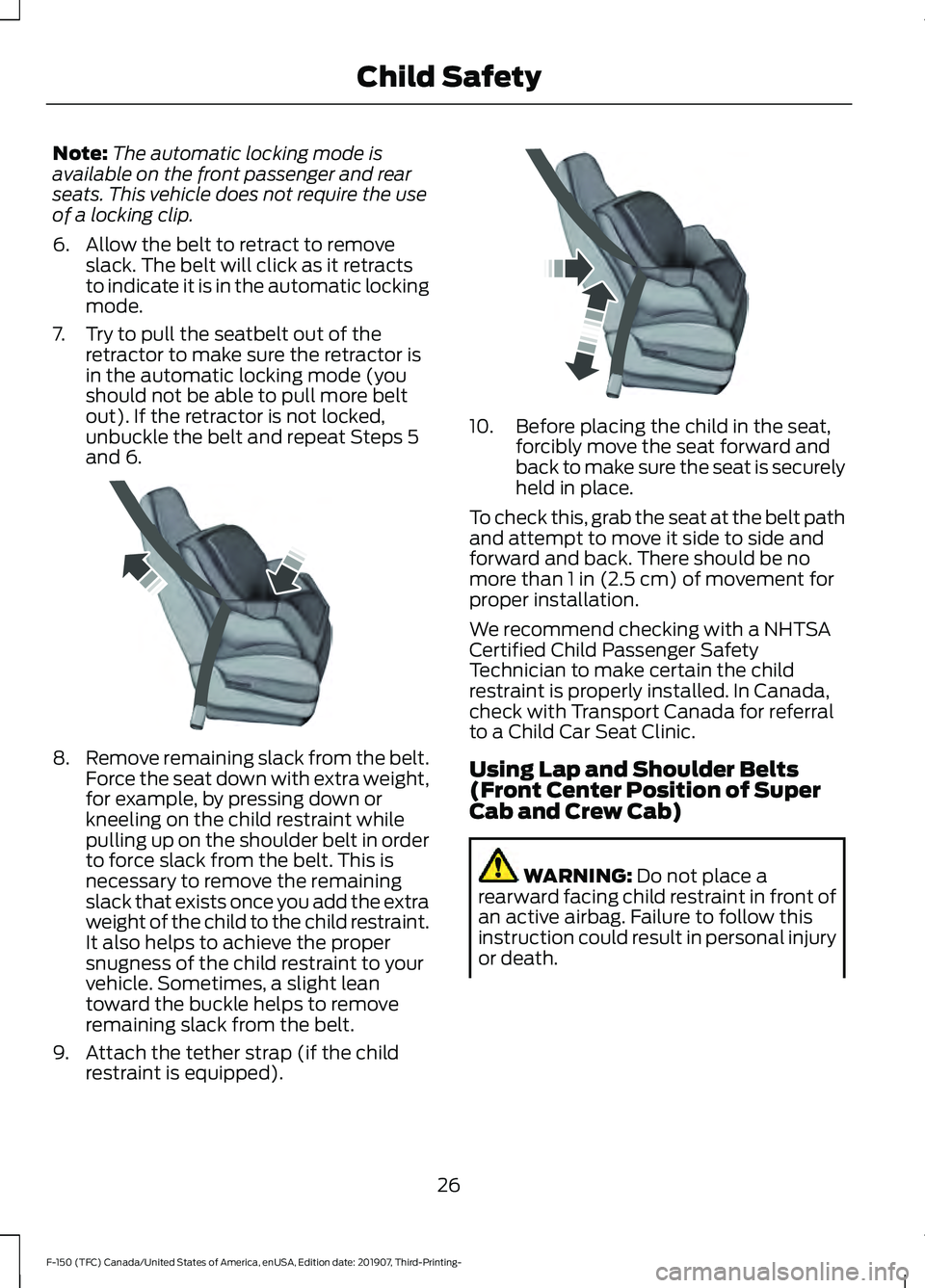
6. Allow the belt to retract to remove slack. The belt will click as it retracts
to indicate it is in the automatic locking
mode.
7. Try to pull the seatbelt out of the retractor to make sure the retractor is
in the automatic locking mode (you
should not be able to pull more belt
out). If the retractor is not locked,
unbuckle the belt and repeat Steps 5
and 6. 8.
Remove remaining slack from the belt.
Force the seat down with extra weight,
for example, by pressing down or
kneeling on the child restraint while
pulling up on the shoulder belt in order
to force slack from the belt. This is
necessary to remove the remaining
slack that exists once you add the extra
weight of the child to the child restraint.
It also helps to achieve the proper
snugness of the child restraint to your
vehicle. Sometimes, a slight lean
toward the buckle helps to remove
remaining slack from the belt.
9. Attach the tether strap (if the child restraint is equipped). 10. Before placing the child in the seat,
forcibly move the seat forward and
back to make sure the seat is securely
held in place.
To check this, grab the seat at the belt path
and attempt to move it side to side and
forward and back. There should be no
more than 1 in (2.5 cm) of movement for
proper installation.
We recommend checking with a NHTSA
Certified Child Passenger Safety
Technician to make certain the child
restraint is properly installed. In Canada,
check with Transport Canada for referral
to a Child Car Seat Clinic.
Using Lap and Shoulder Belts
(Front Center Position of Super
Cab and Crew Cab) WARNING:
Do not place a
rearward facing child restraint in front of
an active airbag. Failure to follow this
instruction could result in personal injury
or death.
26
F-150 (TFC) Canada/United States of America, enUSA, Edition date: 201907, Third-Printing- Child SafetyE142533 E142534
Page 33 of 625
Note:
Unlike the standard seatbelt, the
inflatable seatbelt's unique lap portion locks
the child restraint for installation. The ability
for the shoulder portion of the belt to move
freely is normal, even after the lap belt has
been put into the automatic locking mode.
Note: The lock-off device on some child
restraints may not accommodate the
shoulder portion of the inflatable seatbelt.
Follow all instructions provided by the
manufacturer of the child restraint regarding
the necessary and proper use of the lock-off
device. In some instances, these devices
have been provided only for use in vehicles
with seatbelt systems that would otherwise
require a locking clip.
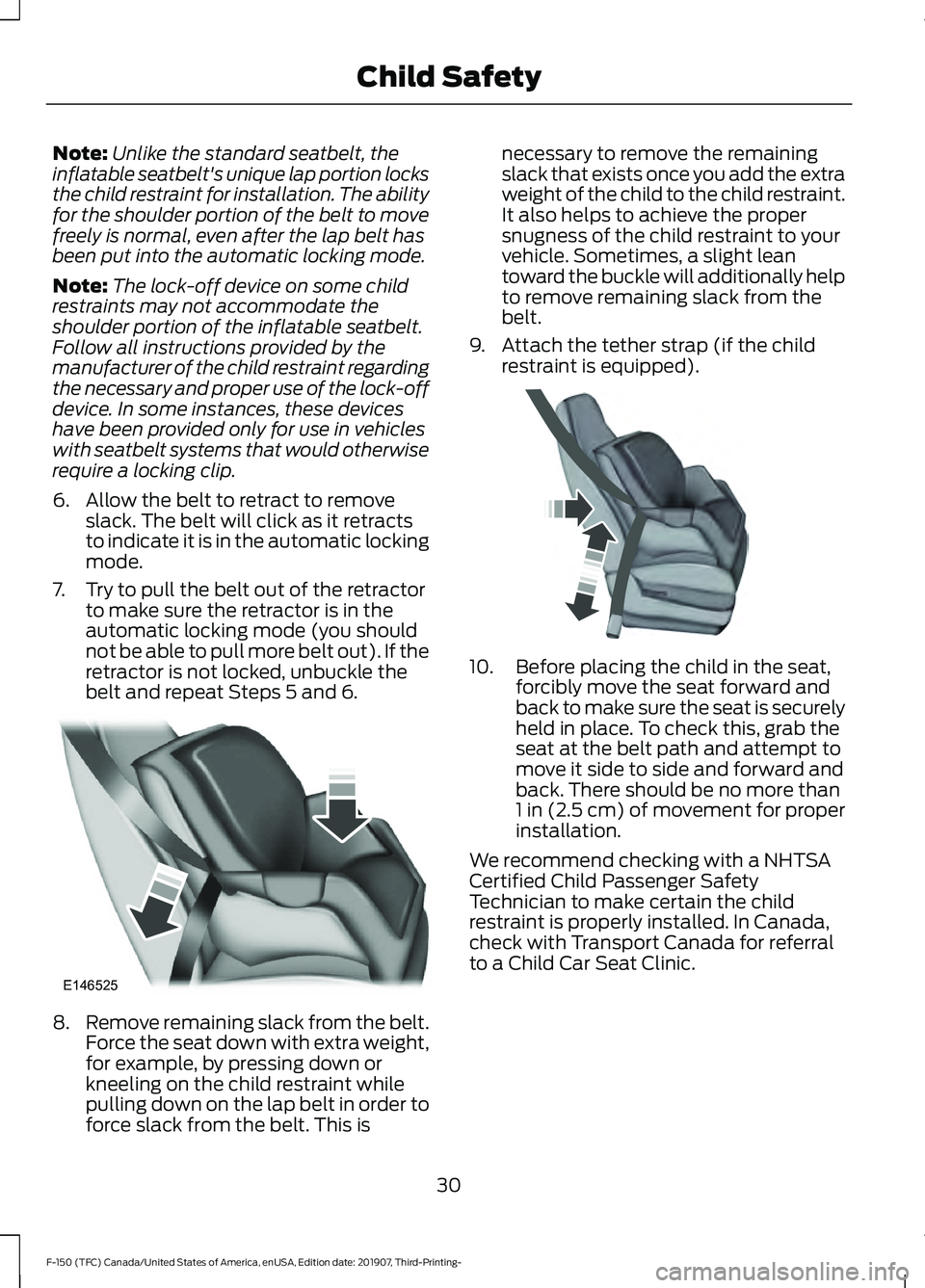
6. Allow the belt to retract to remove slack. The belt will click as it retracts
to indicate it is in the automatic locking
mode.
7. Try to pull the belt out of the retractor to make sure the retractor is in the
automatic locking mode (you should
not be able to pull more belt out). If the
retractor is not locked, unbuckle the
belt and repeat Steps 5 and 6. 8.
Remove remaining slack from the belt.
Force the seat down with extra weight,
for example, by pressing down or
kneeling on the child restraint while
pulling down on the lap belt in order to
force slack from the belt. This is necessary to remove the remaining
slack that exists once you add the extra
weight of the child to the child restraint.
It also helps to achieve the proper
snugness of the child restraint to your
vehicle. Sometimes, a slight lean
toward the buckle will additionally help
to remove remaining slack from the
belt.
9. Attach the tether strap (if the child restraint is equipped). 10. Before placing the child in the seat,
forcibly move the seat forward and
back to make sure the seat is securely
held in place. To check this, grab the
seat at the belt path and attempt to
move it side to side and forward and
back. There should be no more than
1 in (2.5 cm) of movement for proper
installation.
We recommend checking with a NHTSA
Certified Child Passenger Safety
Technician to make certain the child
restraint is properly installed. In Canada,
check with Transport Canada for referral
to a Child Car Seat Clinic.
30
F-150 (TFC) Canada/United States of America, enUSA, Edition date: 201907, Third-Printing- Child SafetyE146525 E142534
Page 40 of 625
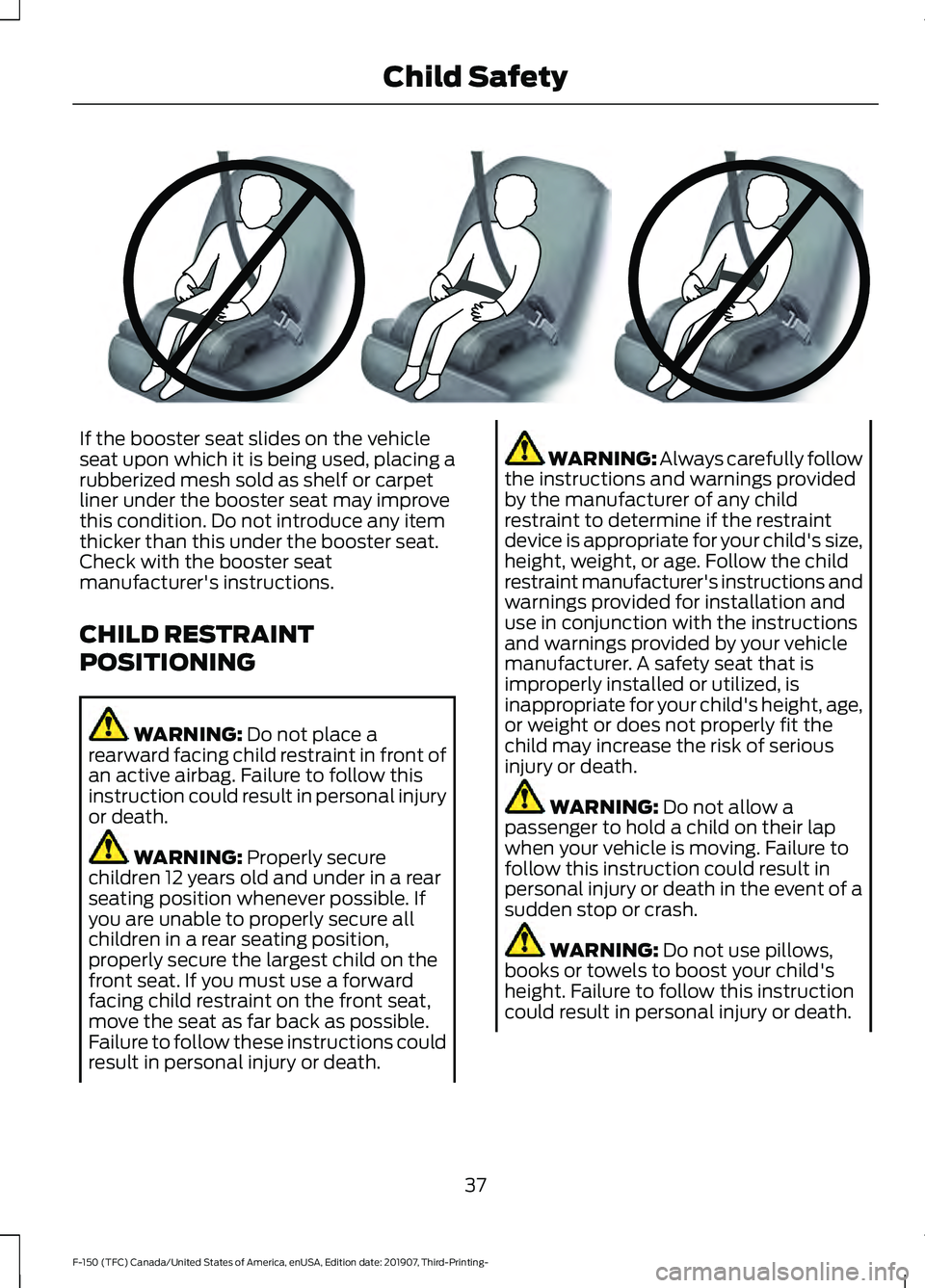
If the booster seat slides on the vehicle
seat upon which it is being used, placing a
rubberized mesh sold as shelf or carpet
liner under the booster seat may improve
this condition. Do not introduce any item
thicker than this under the booster seat.
Check with the booster seat
manufacturer's instructions.
CHILD RESTRAINT
POSITIONING
WARNING: Do not place a
rearward facing child restraint in front of
an active airbag. Failure to follow this
instruction could result in personal injury
or death. WARNING:
Properly secure
children 12 years old and under in a rear
seating position whenever possible. If
you are unable to properly secure all
children in a rear seating position,
properly secure the largest child on the
front seat. If you must use a forward
facing child restraint on the front seat,
move the seat as far back as possible.
Failure to follow these instructions could
result in personal injury or death. WARNING: Always carefully follow
the instructions and warnings provided
by the manufacturer of any child
restraint to determine if the restraint
device is appropriate for your child's size,
height, weight, or age. Follow the child
restraint manufacturer's instructions and
warnings provided for installation and
use in conjunction with the instructions
and warnings provided by your vehicle
manufacturer. A safety seat that is
improperly installed or utilized, is
inappropriate for your child's height, age,
or weight or does not properly fit the
child may increase the risk of serious
injury or death. WARNING:
Do not allow a
passenger to hold a child on their lap
when your vehicle is moving. Failure to
follow this instruction could result in
personal injury or death in the event of a
sudden stop or crash. WARNING:
Do not use pillows,
books or towels to boost your child's
height. Failure to follow this instruction
could result in personal injury or death.
37
F-150 (TFC) Canada/United States of America, enUSA, Edition date: 201907, Third-Printing- Child SafetyE142597
Page 44 of 625
•
Height adjuster at the front outboard
seating positions.
• Safety belt pretensioner at the front
outboard seating positions. •
Safety belt warning light and chime. •
Crash sensors and monitoring system
with readiness indicator.
The safety belt pretensioners at the front
seating positions are designed to tighten
the safety belts when activated. In frontal
and near-frontal crashes, the safety belt
pretensioners may be activated alone or,
if the crash is of sufficient severity, together
with the front airbags. In side crashes and
rollovers, the pretensioners will be
activated when the Safety Canopy is
activated.
FASTENING THE SEATBELTS
Standard belts shown, inflatable belts
similar
The front outermost and rear safety
restraints in the vehicle are combination
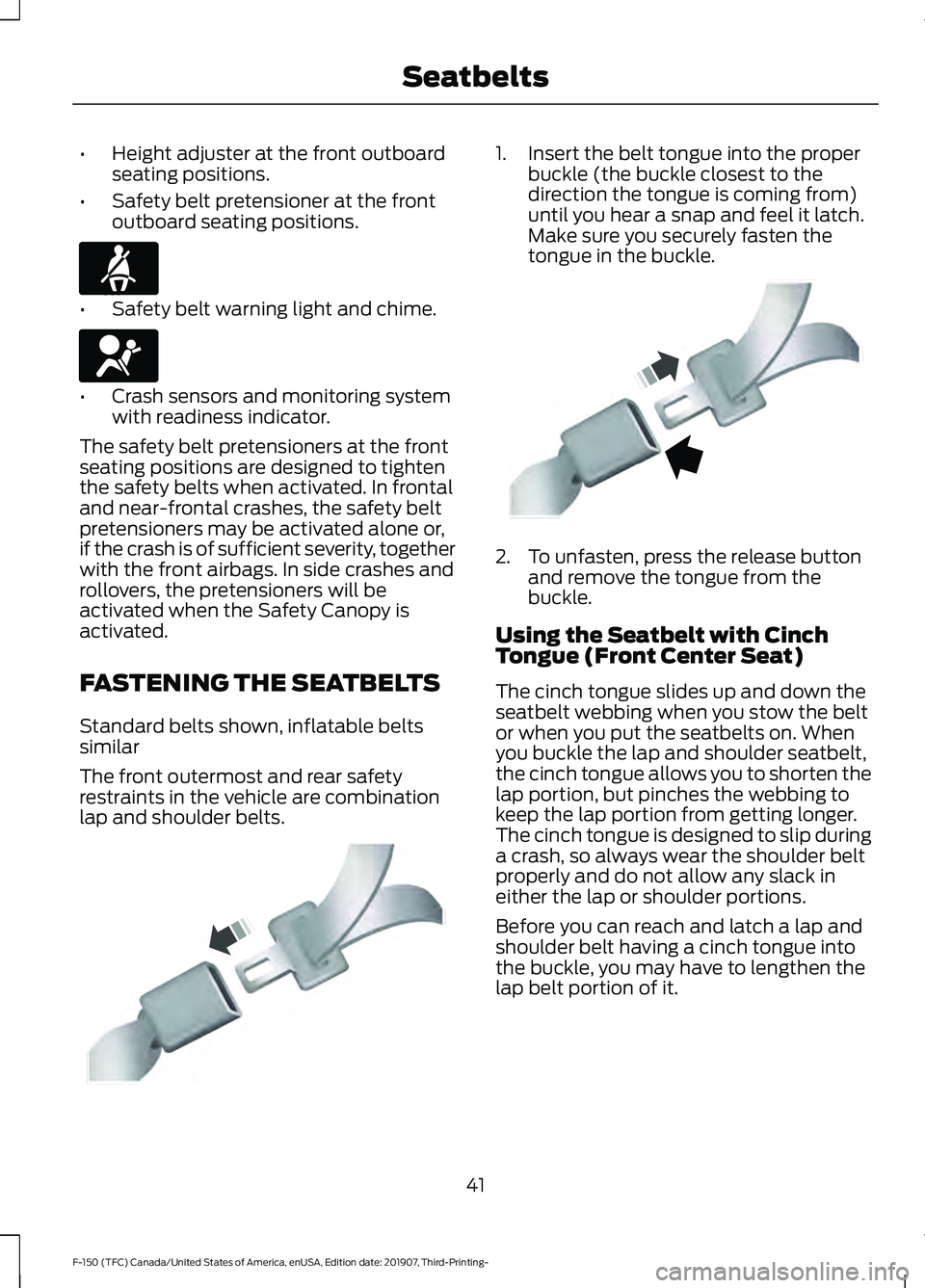
lap and shoulder belts. 1. Insert the belt tongue into the proper
buckle (the buckle closest to the
direction the tongue is coming from)
until you hear a snap and feel it latch.
Make sure you securely fasten the
tongue in the buckle. 2. To unfasten, press the release button
and remove the tongue from the
buckle.
Using the Seatbelt with Cinch
Tongue (Front Center Seat)
The cinch tongue slides up and down the
seatbelt webbing when you stow the belt
or when you put the seatbelts on. When
you buckle the lap and shoulder seatbelt,
the cinch tongue allows you to shorten the
lap portion, but pinches the webbing to
keep the lap portion from getting longer.
The cinch tongue is designed to slip during
a crash, so always wear the shoulder belt
properly and do not allow any slack in
either the lap or shoulder portions.
Before you can reach and latch a lap and
shoulder belt having a cinch tongue into
the buckle, you may have to lengthen the
lap belt portion of it.
41
F-150 (TFC) Canada/United States of America, enUSA, Edition date: 201907, Third-Printing- SeatbeltsE71880 E67017 E142587 E142588