belt FORD F-150 2022 Owners Manual
[x] Cancel search | Manufacturer: FORD, Model Year: 2022, Model line: F-150, Model: FORD F-150 2022Pages: 750, PDF Size: 12.96 MB
Page 5 of 750
About Us - Raptor
SVT
......................................................................19
Team RS ............................................................
19
Ford Performance ..........................................
19
Contacting Us
Contacting Us .................................................
20
Introduction
About This Publication ................................
22
Using This Publication .................................
23
Symbols Glossary
Symbols Used on Your Vehicle ................
24
Data Privacy
Data Privacy .....................................................
27
Service Data ....................................................
28
Event Data .......................................................
28
Settings Data ..................................................
29
Connected Vehicle Data .............................
29
Mobile Device Data ......................................
30
Emergency Call System Data ..................
30
At a Glance - Raptor
Unique Features ..............................................
31
Visual Search
Steering Wheel ...............................................
32
Steering Wheel - Raptor .............................
33
Steering Wheel - Police Responder .......
34
Instrument Panel ...........................................
35
Instrument Panel - Raptor ........................
36
Instrument Panel - Police Responder ........................................................................\
...
37
Vehicle Interior ...............................................
38
Vehicle Interior - Raptor ..............................
39
Vehicle Interior - Police Responder ........
40
Front Exterior ...................................................
41Front Exterior - Raptor
................................
42
Front Exterior - Police Responder ...........
43
Rear Exterior ....................................................
44
Rear Exterior - Raptor ..................................
45
Rear Exterior - Police Responder ............
46
Child Safety
Child Safety Precautions ............................
47
Child Restraint Anchor Points ..................
48
Child Restraints .............................................
50
Installing Child Restraints ...........................
51
Booster Seats .................................................
58
Child Safety Locks ........................................
60
Seatbelts
Seatbelt Precautions ....................................
61
Fastening and Unfastening the Seatbelts ........................................................................\
..
62
Sensitive Locking Mode ..............................
63
Automatic Locking Mode ...........................
63
Adjusting the Seatbelts During Pregnancy ....................................................
64
Adjusting the Seatbelt Height .................
64
Adjusting the Seatbelt Length .................
65
Seatbelt Reminder .......................................
65
Checking the Seatbelts ...............................
67
Seatbelt Extensions .....................................
68
Personal Safety System ™
What Is the Personal Safety System ........................................................................\
..
69
How Does the Personal Safety System Work ..............................................................
69
Personal Safety System Components ........................................................................\
..
69
Airbags
How Do the Front Airbags Work ..............
70
How Do the Side Airbags Work ................
70
How Do the Knee Airbags Work ................
71
1
2022 F-150 (TFD) Canada/United States of America, enUSA, Edition date: 202109, First-Printing Table of Contents
Page 18 of 750
Breaking-In
....................................................455
Driving Economically .................................
455
Driving in Special Conditions .................
456
Floor Mats .....................................................
456
Snow Plowing - Vehicles Without: Snow Plow Mode
Snow Plowing Precautions ....................
458
Snow Plowing - Vehicles With: Snow Plow Mode
Snow Plowing Precautions ....................
459
Operating Your Vehicle With a Snowplow .................................................
459
Snowplow Mode ........................................
460
Crash and Breakdown Information
Roadside Assistance .................................
462
High Voltage Battery Vehicle Precautions - Hybrid Electric Vehicle (HEV) .........
463
Switching the Hazard Flashers On and Off ................................................................
464
Jump Starting the Vehicle .......................
464
Post-Crash Alert System ........................
466
Automatic Crash Shutoff ........................
466
Recovery Towing .........................................
467
Transporting the Vehicle .........................
468
Towing Your Vehicle
Towing Your Vehicle Precautions .........
469
Recreationally Towing Your Vehicle - 4x4 ..............................................................
469
Recreationally Towing Your Vehicle - 4x2 ........................................................................\
.
471
Emergency Towing ......................................
471
Towing Your Vehicle – Troubleshooting ........................................................................\
.
471 Fuses
Fuse Precautions
.........................................
472
Under Hood Fuse Box ...............................
472
Body Control Module Fuse Box .............
478
Identifying Fuse Types ..............................
481
Fuses – Troubleshooting ..........................
481
Maintenance
Maintenance Precautions .......................
482
Opening and Closing the Hood .............
482
Under Hood Overview - 2.7L EcoBoost™ ........................................................................\
483
Under Hood Overview - 3.3L .................
484
Under Hood Overview - 3.5L Ecoboost™ .......................................................................
485
Under Hood Overview - 3.5L, Hybrid Electric Vehicle (HEV) .........................
486
Under Hood Overview - 5.0L .................
487
Engine Oil ......................................................
488
Checking the Coolant ...............................
489
Engine Air Filter ...........................................
493
Changing the Fuel Filter - Gasoline ......
493
Changing the 12V Battery ........................
494
Adjusting the Headlamps - Vehicles With: LED Headlamps ..........................
496
Adjusting the Headlamps - Vehicles With: Halogen Headlamps .................
497
Exterior Bulbs ..............................................
499
Interior Bulbs ...............................................
508
Drive Belt Routing - 2.7L EcoBoost™, Vehicles With: Dual Generators .......
508
Drive Belt Routing - 2.7L EcoBoost™, Vehicles With: Single Generator ......
508
Drive Belt Routing - 3.3L ..........................
508
Drive Belt Routing - 3.5L Ecoboost™, Vehicles With: Dual Generators .......
509
Drive Belt Routing - 3.5L Ecoboost™, Vehicles With: Single Generator ......
509
Drive Belt Routing - 3.5L, Hybrid Electric Vehicle (HEV) ..........................................
509
Drive Belt Routing - 5.0L, Vehicles With: Dual Generators .....................................
509
14
2022 F-150 (TFD) Canada/United States of America, enUSA, Edition date: 202109, First-Printing Table of Contents
Page 19 of 750
Drive Belt Routing - 5.0L, Vehicles With:
Single Generator ......................................510
Vehicle Care
Cleaning Products ........................................
511
Cleaning the Exterior ...................................
511
Cleaning the Interior ...................................
513
Repairing Minor Paint Damage ..............
515
Waxing Your Vehicle ...................................
516
Storing Your Vehicle
Preparing Your Vehicle for Storage .......
517
Removing Your Vehicle From Storage ........................................................................\
.
518
Wheel and Tire Information
Locating the Tire label ...............................
519
Department of Transportation Uniform Tire Quality Grades .................................
519
Information on the Tire Sidewall ..........
520
Glossary of Tire Terminology ..................
525
Tire Replacement Requirements .........
526
Using Snow Chains ....................................
528
Using Bead-Lock Wheels - Raptor ......
530
Tire Care
Checking the Tire Pressures ...................
532
Inflating the Tires ........................................
532
Inspecting the Tire for Wear ...................
533
Inspecting the Tire for Damage .............
533
Inspecting the Wheel Valve Stems ......
534
Tire Rotation .................................................
534
Tire Pressure Monitoring System
What Is the Tire Pressure Monitoring System .......................................................
536
Tire Pressure Monitoring System Overview ....................................................
536
Tire Pressure Monitoring System Precautions ...............................................
537Tire Pressure Monitoring System
Limitations .................................................
537
Viewing the Tire Pressures ......................
538
Resetting Tire Pressure Monitoring System .......................................................
538
Tire Pressure Monitoring System – Troubleshooting .......................................
541
Changing a Road Wheel
Changing a Flat Tire ...................................
543
Changing a Flat Tire - Raptor/Tremor .......................................................................
549
Wheel Nuts ...................................................
556
Capacities and Specifications
Engine Specifications - 2.7L EcoBoost™ ........................................................................\
558
Engine Specifications - 3.3L ...................
559
Engine Specifications - 3.5L Ecoboost™ .......................................................................
560
Engine Specifications - 3.5L, Hybrid Electric Vehicle (HEV) ...........................
561
Engine Specifications - 5.0L ..................
562
Motorcraft Parts - 2.7L EcoBoost™ .....
563
Motorcraft Parts - 3.3L .............................
564
Motorcraft Parts - 3.5L Ecoboost™ .....
565
Motorcraft Parts - 3.5L, Hybrid Electric Vehicle (HEV) ..........................................
566
Motorcraft Parts - 5.0L .............................
567
Motorcraft Parts - Raptor .......................
568
Engine Oil Capacity and Specification - 2.7L EcoBoost™ .....................................
569
Engine Oil Capacity and Specification - 3.3L ..............................................................
570
Engine Oil Capacity and Specification - 3.5L Ecoboost™ ......................................
572
Engine Oil Capacity and Specification - 3.5L, Hybrid Electric Vehicle (HEV)
........................................................................\
574
Engine Oil Capacity and Specification - 5.0L ..............................................................
576
15
2022 F-150 (TFD) Canada/United States of America, enUSA, Edition date: 202109, First-Printing Table of Contents
Page 28 of 750
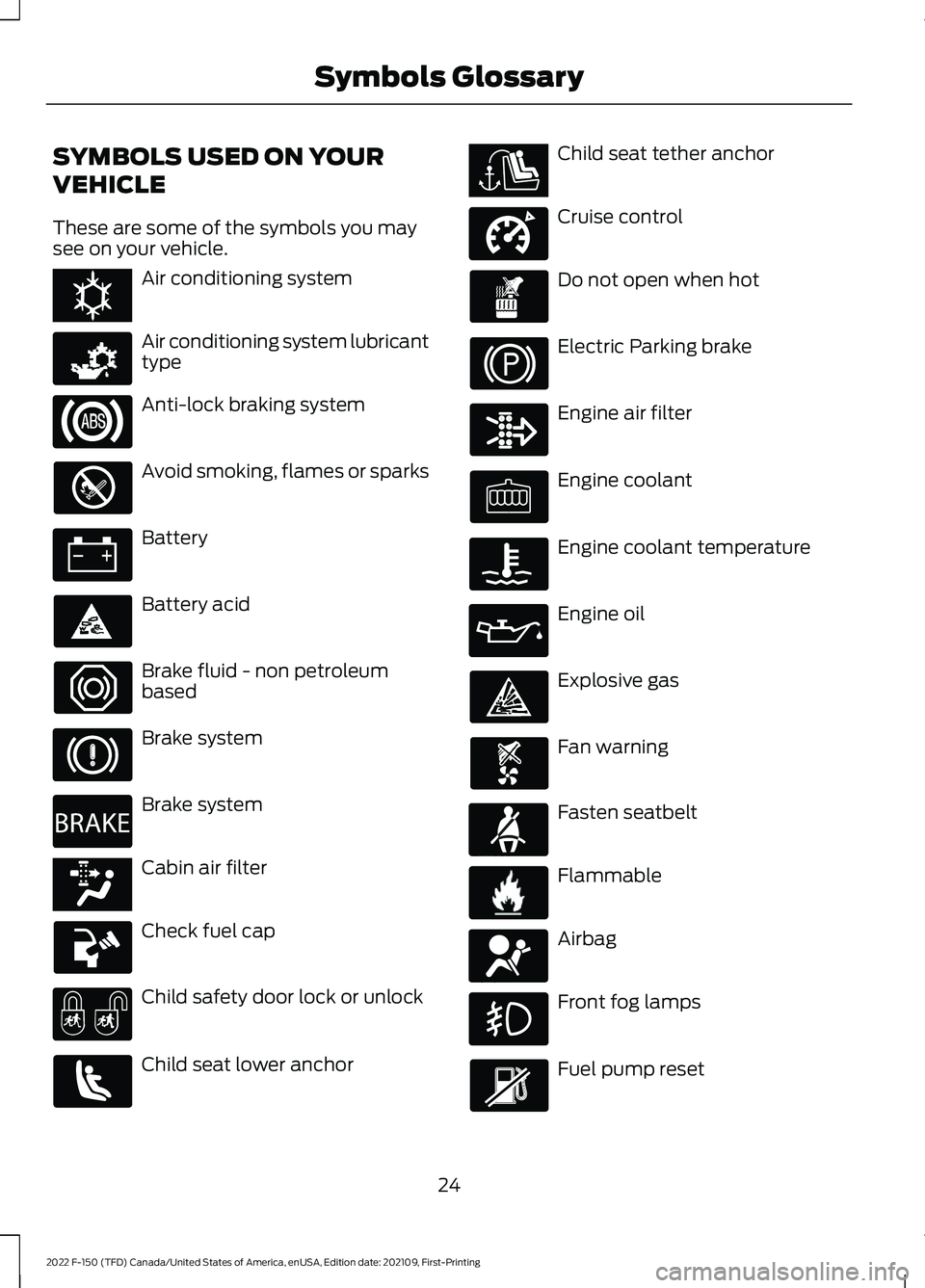
SYMBOLS USED ON YOUR
VEHICLE
These are some of the symbols you may
see on your vehicle.
Air conditioning system
Air conditioning system lubricant
type
Anti-lock braking system
Avoid smoking, flames or sparks
Battery
Battery acid
Brake fluid - non petroleum
based
Brake system
Brake system
Cabin air filter
Check fuel cap
Child safety door lock or unlock
Child seat lower anchor Child seat tether anchor
Cruise control
Do not open when hot
Electric Parking brake
Engine air filter
Engine coolant
Engine coolant temperature
Engine oil
Explosive gas
Fan warning
Fasten seatbelt
Flammable
Airbag
Front fog lamps
Fuel pump reset
24
2022 F-150 (TFD) Canada/United States of America, enUSA, Edition date: 202109, First-Printing Symbols GlossaryE162384 E231157 E270480 E139223 E141128 E332905 E71880 E231160 E67017
Page 31 of 750
WARNING: Do not connect
wireless plug-in devices to the data link
connector. Unauthorized third parties
could gain access to vehicle data and
impair the performance of safety related
systems. Only allow repair facilities that
follow our service and repair instructions
to connect their equipment to the data
link connector.
We respect your privacy and are
committed to protecting it. The
information contained in this manual was
correct at the time of publication, but as
technology rapidly changes, we
recommend that you visit the local Ford
website for the latest information.
Your vehicle has electronic control units
that have data recording functionality and
the ability to permanently or temporarily
store data. This data could include
information on the condition and status of
your vehicle, vehicle maintenance
requirements, events and malfunctions.
The types of data that can be recorded are
described in this section. Some of the data
recorded is stored in event logs or error
logs.
Note: Error logs are reset following a service
or repair.
Note: We may provide information in
response to requests from law enforcement,
other government authorities and third
parties acting with lawful authority or
through a legal process. Such information
could be used by them in legal proceedings.
Data recorded includes, for example:
• Operating states of system
components, for example fuel level,
tire pressure and battery charge level.
• Vehicle and component status, for
example wheel speed, deceleration,
lateral acceleration and seatbelt
status. •
Events or errors in essential systems,
for example headlamps and brakes.
• System responses to driving situations,
for example airbag deployment and
stability control.
• Environmental conditions, for example
temperature.
Some of this data, when used in
combination with other information, for
example an accident report, damage to a
vehicle or eyewitness statements, could
be associated with a specific person.
Services That We Provide
If you use our services, we collect and use
data, for example account information,
vehicle location and driving characteristics,
that could identify you. We transmit this
data through a dedicated, protected
connection. We only collect and use data
to enable your use of our services to which
you have subscribed, with your consent or
where permitted by law. For additional
information, see the terms and conditions
of the services to which you have
subscribed.
For additional information about our
privacy policy, refer to the local Ford
website.
Services That Third Parties
Provide
We recommend that you review the terms
and conditions and data privacy
information for any services equipped with
your vehicle or to which you subscribe. We
take no responsibility for services that third
parties provide.
Where equipped, SiriusXM with 360L could
use the modem. To disable, turn off the
SiriusXM with 360L or Vehicle Connectivity
setting. See Enabling and Disabling the
Modem
(page 597).
27
2022 F-150 (TFD) Canada/United States of America, enUSA, Edition date: 202109, First-Printing Data Privacy
Page 32 of 750
SERVICE DATA
Service data recorders in your vehicle are
capable of collecting and storing
diagnostic information about your vehicle.
This potentially includes information about
the performance or status of various
systems and modules in the vehicle, such
as engine, throttle, steering or brake
systems. In order to properly diagnose and
service your vehicle, Ford Motor Company
(Ford of Canada in Canada), and service
and repair facilities may access or share
among them vehicle diagnostic
information received through a direct
connection to your vehicle when
diagnosing or servicing your vehicle.
Additionally, Ford Motor Company (Ford
of Canada, in Canada) may, where
permitted by law, use vehicle diagnostic
information for vehicle improvement or
with other information we may have about
you, for example, your contact information,
to offer you products or services that may
interest you. Data may be provided to our
service providers such as part suppliers
that may help diagnose malfunctions, and
who are similarly obligated to protect data.
We retain this data only as long as
necessary to perform these functions or to
comply with law. We may provide
information where required in response to
official requests to law enforcement or
other government authorities or third
parties acting with lawful authority or court
order, and such information may be used
in legal proceedings. For U.S. only (if
equipped), if you choose to use connected
apps and services, you consent that certain
diagnostic information may also be
accessed electronically by Ford Motor
Company and Ford authorized service
facilities, and that the diagnostic
information may be used to provide
services to you, personalizing your
experience, troubleshoot, and to improve
products and services and offer you
products and services that may interest
you, where permitted by law. For Canada
only, for more information, please review
the Ford of Canada privacy policy at
www.ford.ca, including our U.S. data
storage and use of service providers in
other jurisdictions who may be subject to
legal requirements in Canada, the United
States and other countries applicable to
them, for example, lawful requirements to
disclose personal information to
governmental authorities in those
countries.
EVENT DATA
This vehicle is equipped with an event data
recorder. The main purpose of an event
data recorder is to record, in certain crash
or near crash-like situations, such as an
airbag deployment or hitting a road
obstacle; this data will assist in
understanding how a vehicle
’s systems
performed. The event data recorder is
designed to record data related to vehicle
dynamics and safety systems for a short
period of time, typically 30 seconds or less.
The event data recorder in this vehicle is
designed to record such data as:
• How various systems in your vehicle
were operating.
• Whether or not the driver and
passenger seatbelts were
buckled/fastened.
• How far (if at all) the driver was
depressing the accelerator and/or the
brake pedal.
• How fast the vehicle was traveling.
• Where the driver was positioning the
steering wheel.
This data can help provide a better
understanding of the circumstances in
which crashes and injuries occur.
28
2022 F-150 (TFD) Canada/United States of America, enUSA, Edition date: 202109, First-Printing Data Privacy
Page 52 of 750
WARNING: Do not allow a
passenger to hold a child on their lap
when your vehicle is moving. Failure to
follow this instruction could result in
personal injury or death in the event of a
sudden stop or crash. WARNING:
Do not use pillows,
books or towels to boost your child's
height. Failure to follow this instruction
could result in personal injury or death. WARNING:
Properly secure child
restraints or booster seats when they are
not in use. They could become projectiles
in a sudden stop or crash. Failure to
follow this instruction could result in
personal injury or death. WARNING: Do not put the shoulder
section of the seatbelt or allow the child
to put the shoulder section of the
seatbelt under their arm or behind their
back. Failure to follow this instruction
could reduce the effectiveness of the
seatbelt and increase the risk of injury or
death in a crash. WARNING:
Do not leave children
or pets unattended in your vehicle.
Failure to follow this instruction could
result in personal injury or death.
When installing a child restraint with
seatbelts:
• Place the vehicle seat in the upright
position before you install the child
restraint.
• Use the correct seatbelt buckle for that
seating position.
• Insert the belt tongue into the buckle.
Make sure the tongue is securely
fastened in the buckle. •
Keep the buckle release button
pointing up and away from the child
restraint, with the tongue between the
child restraint and the release button,
to prevent accidental unbuckling.
• Put the seatbelt in the automatic
locking mode.
CHILD RESTRAINT ANCHOR
POINTS
WHAT ARE THE CHILD RESTRAINT
ANCHOR POINTS
Anchor points allow you to quickly and
safely install a child restraint.
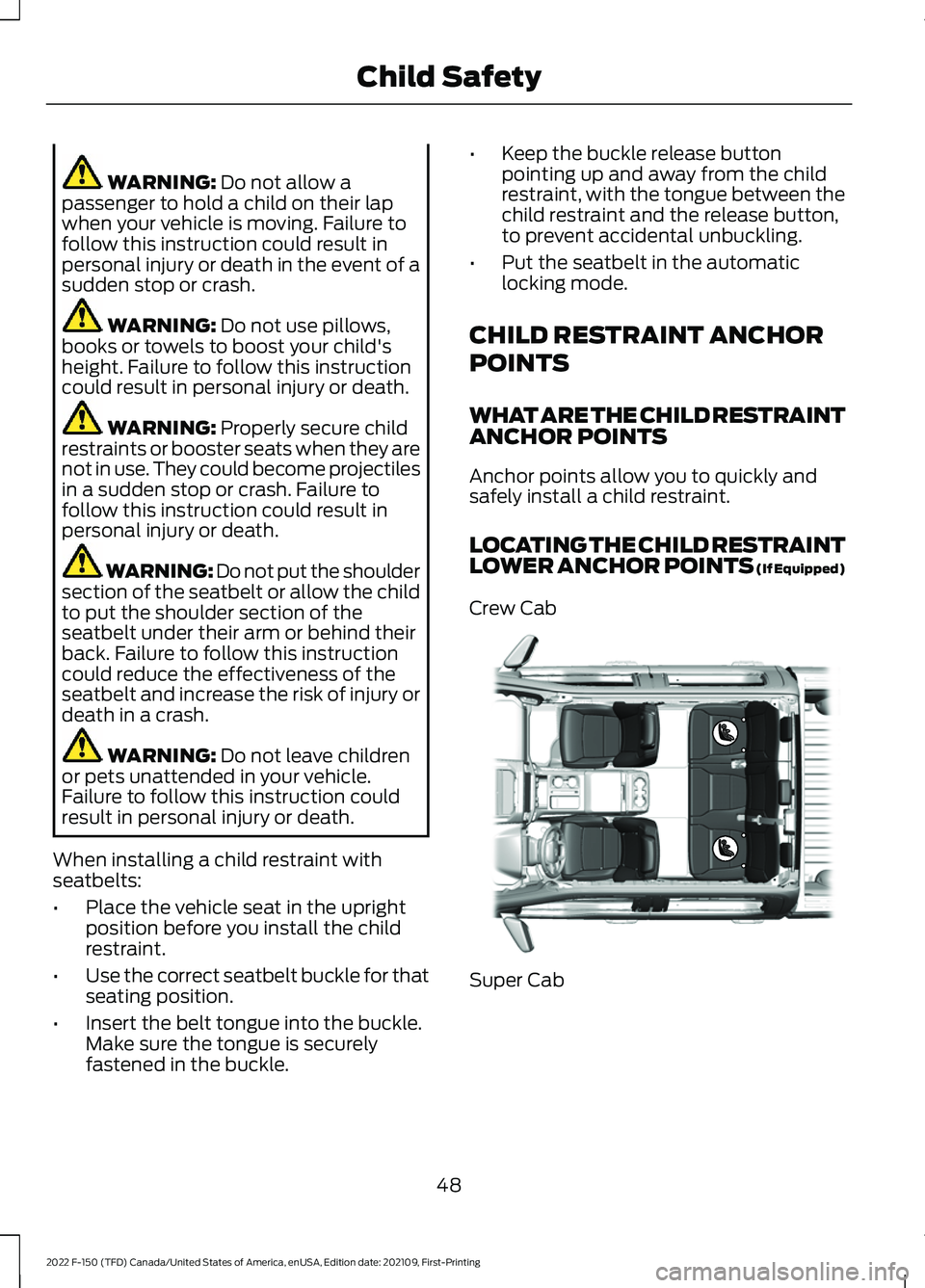
LOCATING THE CHILD RESTRAINT
LOWER ANCHOR POINTS (If Equipped)
Crew Cab Super Cab
48
2022 F-150 (TFD) Canada/United States of America, enUSA, Edition date: 202109, First-Printing Child SafetyE308373
Page 54 of 750
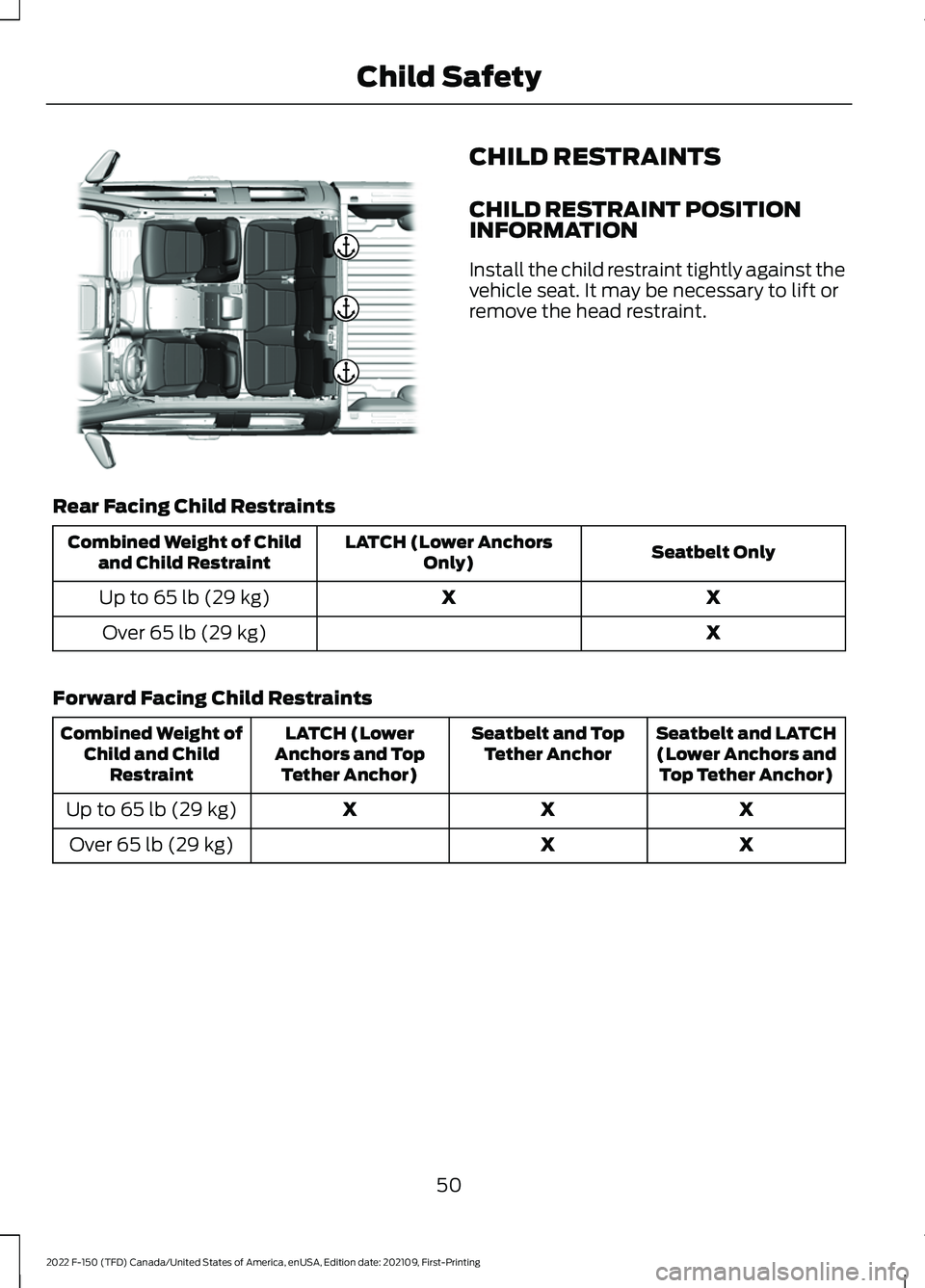
CHILD RESTRAINTS
CHILD RESTRAINT POSITION
INFORMATION
Install the child restraint tightly against the
vehicle seat. It may be necessary to lift or
remove the head restraint.
Rear Facing Child Restraints Seatbelt Only
LATCH (Lower Anchors
Only)
Combined Weight of Child
and Child Restraint
X
X
Up to 65 lb (29 kg)
X
Over
65 lb (29 kg)
Forward Facing Child Restraints Seatbelt and LATCH
(Lower Anchors and Top Tether Anchor)
Seatbelt and Top
Tether Anchor
LATCH (Lower
Anchors and Top Tether Anchor)
Combined Weight of
Child and Child Restraint
X
X
X
Up to
65 lb (29 kg)
X
X
Over
65 lb (29 kg)
50
2022 F-150 (TFD) Canada/United States of America, enUSA, Edition date: 202109, First-Printing Child SafetyE308396
Page 55 of 750
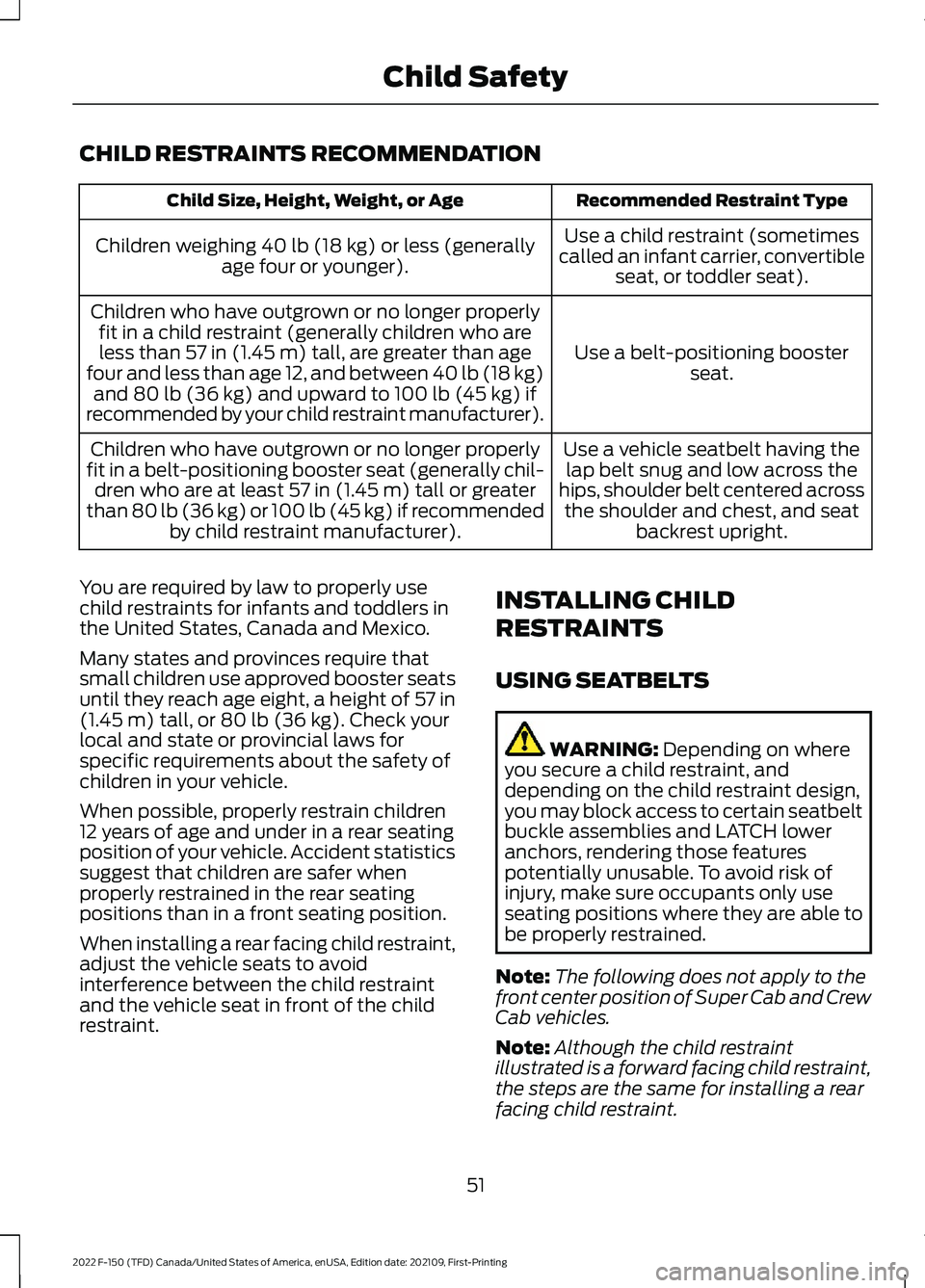
CHILD RESTRAINTS RECOMMENDATION
Recommended Restraint Type
Child Size, Height, Weight, or Age
Use a child restraint (sometimes
called an infant carrier, convertible seat, or toddler seat).
Children weighing 40 lb (18 kg) or less (generally
age four or younger).
Use a belt-positioning boosterseat.
Children who have outgrown or no longer properly
fit in a child restraint (generally children who areless than
57 in (1.45 m) tall, are greater than age
four and less than age 12, and between 40 lb (18 kg) and
80 lb (36 kg) and upward to 100 lb (45 kg) if
recommended by your child restraint manufacturer).
Use a vehicle seatbelt having thelap belt snug and low across the
hips, shoulder belt centered across the shoulder and chest, and seat backrest upright.
Children who have outgrown or no longer properly
fit in a belt-positioning booster seat (generally chil- dren who are at least
57 in (1.45 m) tall or greater
than 80 lb (36 kg) or 100 lb (45 kg) if recommended by child restraint manufacturer).
You are required by law to properly use
child restraints for infants and toddlers in
the United States, Canada and Mexico.
Many states and provinces require that
small children use approved booster seats
until they reach age eight, a height of 57 in
(1.45 m)
tall, or 80 lb (36 kg). Check your
local and state or provincial laws for
specific requirements about the safety of
children in your vehicle.
When possible, properly restrain children
12 years of age and under in a rear seating
position of your vehicle. Accident statistics
suggest that children are safer when
properly restrained in the rear seating
positions than in a front seating position.
When installing a rear facing child restraint,
adjust the vehicle seats to avoid
interference between the child restraint
and the vehicle seat in front of the child
restraint. INSTALLING CHILD
RESTRAINTS
USING SEATBELTS WARNING:
Depending on where
you secure a child restraint, and
depending on the child restraint design,
you may block access to certain seatbelt
buckle assemblies and LATCH lower
anchors, rendering those features
potentially unusable. To avoid risk of
injury, make sure occupants only use
seating positions where they are able to
be properly restrained.
Note: The following does not apply to the
front center position of Super Cab and Crew
Cab vehicles.
Note: Although the child restraint
illustrated is a forward facing child restraint,
the steps are the same for installing a rear
facing child restraint.
51
2022 F-150 (TFD) Canada/United States of America, enUSA, Edition date: 202109, First-Printing Child Safety
Page 56 of 750
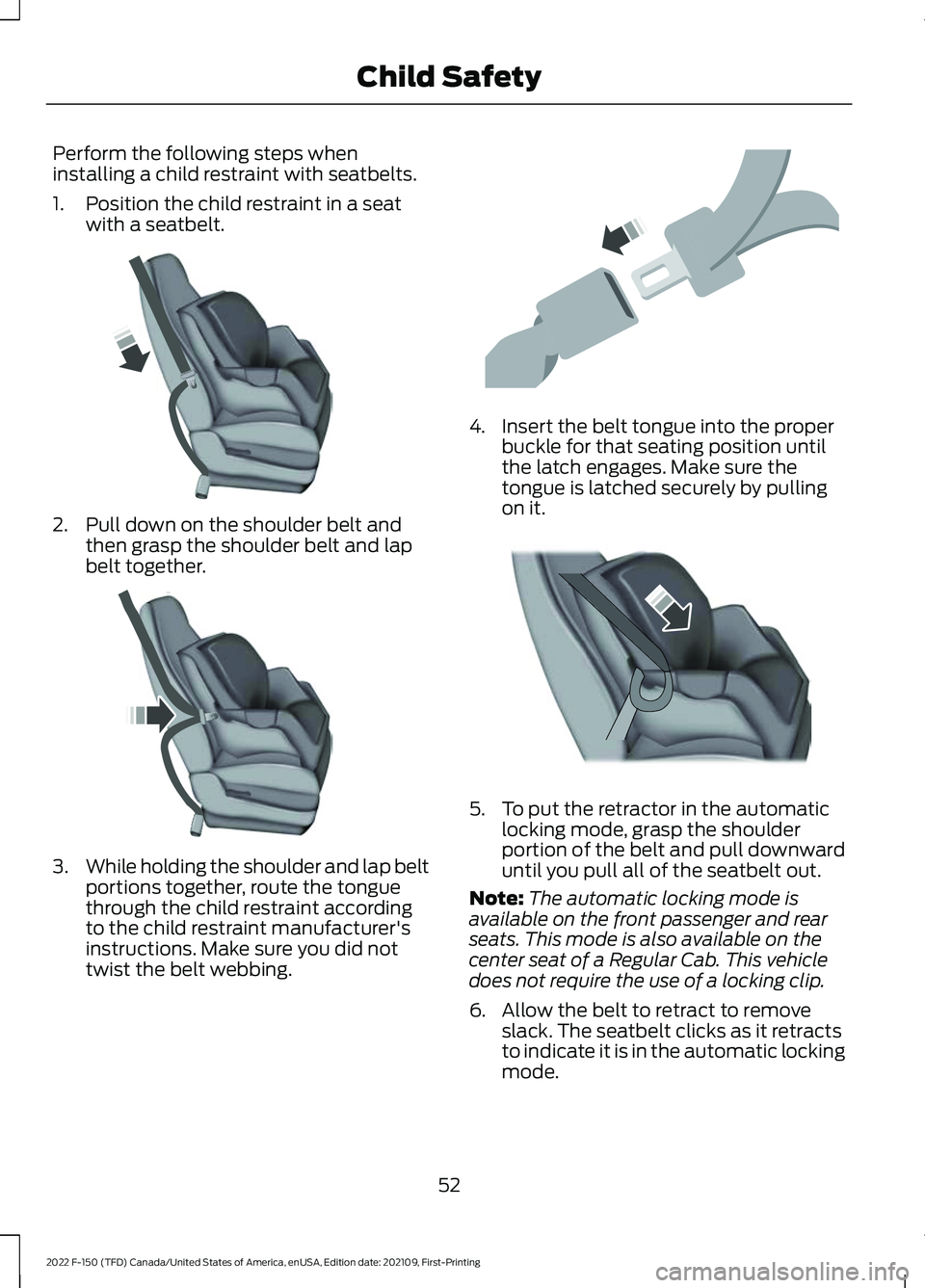
Perform the following steps when
installing a child restraint with seatbelts.
1. Position the child restraint in a seat
with a seatbelt. 2. Pull down on the shoulder belt and
then grasp the shoulder belt and lap
belt together. 3.
While holding the shoulder and lap belt
portions together, route the tongue
through the child restraint according
to the child restraint manufacturer's
instructions. Make sure you did not
twist the belt webbing. 4. Insert the belt tongue into the proper
buckle for that seating position until
the latch engages. Make sure the
tongue is latched securely by pulling
on it. 5. To put the retractor in the automatic
locking mode, grasp the shoulder
portion of the belt and pull downward
until you pull all of the seatbelt out.
Note: The automatic locking mode is
available on the front passenger and rear
seats. This mode is also available on the
center seat of a Regular Cab. This vehicle
does not require the use of a locking clip.
6. Allow the belt to retract to remove slack. The seatbelt clicks as it retracts
to indicate it is in the automatic locking
mode.
52
2022 F-150 (TFD) Canada/United States of America, enUSA, Edition date: 202109, First-Printing Child SafetyE142529 E142530 E142531 E142875