brake FORD F-59 2019 Owner's Manual
[x] Cancel search | Manufacturer: FORD, Model Year: 2019, Model line: F-59, Model: FORD F-59 2019Pages: 176, PDF Size: 9.98 MB
Page 56 of 176
ESSENTIAL TOWING CHECKS
Follow these guidelines for safe towing:
•Do not tow a trailer until you drive yourvehicle at least 1,000 mi (1,600 km).
•Consult your local motor vehicle lawsfor towing a trailer.
•See the instructions included withtowing accessories for the properinstallation and adjustmentspecifications.
•Service your vehicle more frequently ifyou tow a trailer. See ScheduledMaintenance (page 145).
•If you use a rental trailer, follow theinstructions the rental agency givesyou.
Another chapter of this manual containsload specification terms found on the tirelabel and Safety Compliance label andinstructions on calculating your vehicle'sload. See Load Limit (page 45).
Remember to account for the trailertongue weight as part of your vehicle loadwhen calculating the total vehicle weight.
Hitches
Do not use a hitch that either clamps ontothe bumper or attaches to the axle.
Distribute the trailer load so 10-15% of thetotal trailer weight is on the tongue.
Weight-Distributing Hitches
WARNING: Do not adjust thespring bars so that your vehicle's rearbumper is higher than before attachingthe trailer. Doing so will defeat thefunction of the weight-distributing hitch,which may cause unpredictablehandling, and could result in seriouspersonal injury.
When hooking-up a trailer using aweight-distributing hitch, always use thefollowing procedure:
1.Park the loaded vehicle, without thetrailer, on a level surface.
2.Measure the height to the top of yourvehicle’s front wheel opening on thefender. This is H1.
3.Securely attach the loaded trailer toyour vehicle without theweight-distributing bars connected.
4.Measure the height to the top of yourvehicle’s front wheel opening on thefender a second time. This is H2.
5.Install and adjust the tension in theweight-distributing bars so that theheight of your vehicle’s front wheelopening on the fender is approximatelyhalfway between H1 and H2.
6.Check that the trailer is level or slightlynose down toward your vehicle. If not,adjust the ball height accordingly andrepeat Steps 1-6.
7.Lock the bar tension adjuster in place.
8.Check that the trailer tongue securelyattaches and locks onto the hitch.
9.Install safety chains, lighting and trailerbrake controls as required by law or thetrailer manufacturer.
Safety Chains
Note:Never attach safety chains to thebumper.
Always connect the safety chains to thehook retainers of your vehicle hitch.
To connect the safety chains, cross themunder the trailer tongue and allow enoughslack for turning tight corners. Do not allowthe chains to drag on the ground.
53
Motorhome (TY3) Canada/United States of America, enUSA, Edition date: 201803, Third-Printing-Towing
Page 57 of 176
Trailer Brakes
WARNING: Do not connect atrailer's hydraulic brake system directlyto your vehicle's brake system. Yourvehicle may not have enough brakingpower and your chances of having acollision greatly increase.
Electric brakes and manual, automatic orsurge-type trailer brakes are safe if youinstall them properly and adjust them tothe manufacturer's specifications. Thetrailer brakes must meet local and federalregulations.
The rating for the tow vehicle's brakingsystem operation is at the gross vehicleweight rating, not the gross combinedweight rating.
Separate functioning brake systemsare required for safe control of towedvehicles and trailers weighing morethan 1500 lb (680 kg) when loaded.
Trailer Lamps
WARNING: Never connect anytrailer lamp wiring to the vehicle's taillamp wiring; this may damage theelectrical system resulting in fire. Contactyour authorized dealer as soon aspossible for assistance in proper trailertow wiring installation. Additionalelectrical equipment may be required.
Trailer lamps are required on most towedvehicles. Make sure all running lights, brakelights, direction indicators and hazard lightsare working.
Before Towing a Trailer
Practice turning, stopping and backing upto get the feel of your vehicle-trailercombination before starting on a trip.When turning, make wider turns so thetrailer wheels clear curbs and otherobstacles.
When Towing a Trailer
•Do not drive faster than 70 mph(113 km/h) during the first 500 mi(800 km).
•Do not make full-throttle starts.
•Check your hitch, electrical connectionsand trailer wheel lug nuts thoroughlyafter you have traveled 50 mi (80 km).
•When stopped in congested or heavytraffic during hot weather, place thegearshift in park (P) to aid engine andtransmission cooling and to help airconditioning performance.
•Switch off the speed control withheavy loads or in hilly terrain. Thespeed control may turn offautomatically when you are towing onlong, steep grades.
•Shift to a lower gear when driving downa long or steep hill. Do not apply thebrakes continuously, as they mayoverheat and become less effective.
•If your transmission is equipped with aGrade Assist or Tow/Haul feature, usethis feature when towing. This providesengine braking and helps eliminateexcessive transmission shifting foroptimum fuel economy andtransmission cooling.
•Allow more distance for stopping witha trailer attached. Anticipate stops andbrake gradually.
•Avoid parking on a grade. However, ifyou must park on a grade:
1.Turn the steering wheel to point yourvehicle tires away from traffic flow.
54
Motorhome (TY3) Canada/United States of America, enUSA, Edition date: 201803, Third-Printing-Towing
Page 58 of 176
2.Set your vehicle parking brake.
3.Place the automatic transmission inpark (P).
4.Place wheel chocks in the front andback of the trailer wheels. (Chocks notincluded with vehicle.)
Launching or Retrieving a Boat orPersonal Watercraft (PWC)
Note:Disconnect the wiring to the trailerbefore backing the trailer into the water.
Note:Reconnect the wiring to the trailerafter removing the trailer from the water.
When backing down a ramp during boatlaunching or retrieval:
•Do not allow the static water level torise above the bottom edge of the rearbumper.
•Do not allow waves to break higherthan 6 in (15 cm) above the bottomedge of the rear bumper.
Exceeding these limits may allow water toenter vehicle components:
•Causing internal damage to thecomponents.
•Affecting driveability, emissions andreliability.
Replace the rear axle lubricant anytimethe rear axle has been submerged in water.Water may have contaminated the rearaxle lubricant, which is not normallychecked or changed unless a leak issuspected or other axle repair is required.
TOWING THE VEHICLE ON
FOUR WHEELS
Emergency Towing
WARNING: If your vehicle has asteering wheel lock make sure theignition is in the accessory or on positionwhen being towed.
If your vehicle becomes inoperable(without access to wheel dollies,car-hauling trailer, or flatbed transportvehicle), it can be flat-towed (all wheelson the ground, regardless of the powertrainand transmission configuration) under thefollowing conditions:
•Your vehicle is facing forward fortowing in a forward direction.
•Place the transmission in position N. Ifyou cannot move the transmission intoN, you may need to override it.
•Maximum speed is 35 mph (56 km/h).
•Maximum distance is 50 mi (80 km).
55
Motorhome (TY3) Canada/United States of America, enUSA, Edition date: 201803, Third-Printing-Towing
Page 60 of 176
•Warm up your vehicle on coldmornings.
•Use the air conditioner or frontdefroster.
•Use the speed control in hilly terrain.
•Rest your foot on the brake pedal whiledriving.
•Drive a heavily loaded vehicle or tow atrailer.
•Carry unnecessary weight(approximately 1 mpg [0.4 km/L] islost for every 400 lb [180 kilogram] ofweight carried).
•Driving with the wheels out ofalignment.
Conditions
•Heavily loading a vehicle or towing atrailer may reduce fuel economy at anyspeed.
•Adding certain accessories to yourvehicle (for example bug deflectors,rollbars, light bars, running boards, skiracks or luggage racks) may reducefuel economy.
•To maximize the fuel economy, drivewith the tonneau cover installed (ifequipped).
•Using fuel blended with alcohol maylower fuel economy.
•Fuel economy may decrease with lowertemperatures during the first 5–10 mi(12–16 km) of driving.
•Driving on flat terrain offers improvedfuel economy as compared to drivingon hilly terrain.
•Transmissions give their best fueleconomy when operated in the topcruise gear and with steady pressureon the gas pedal.
•Four-wheel-drive operation (ifequipped) is less fuel efficient thantwo-wheel-drive operation.
•Close the windows for high-speeddriving.
DRIVING THROUGH WATER
WARNING: Do not drive throughflowing or deep water as you may losecontrol of your vehicle.
Note:Driving through standing water cancause vehicle damage.
Note:Engine damage can occur if waterenters the air filter.
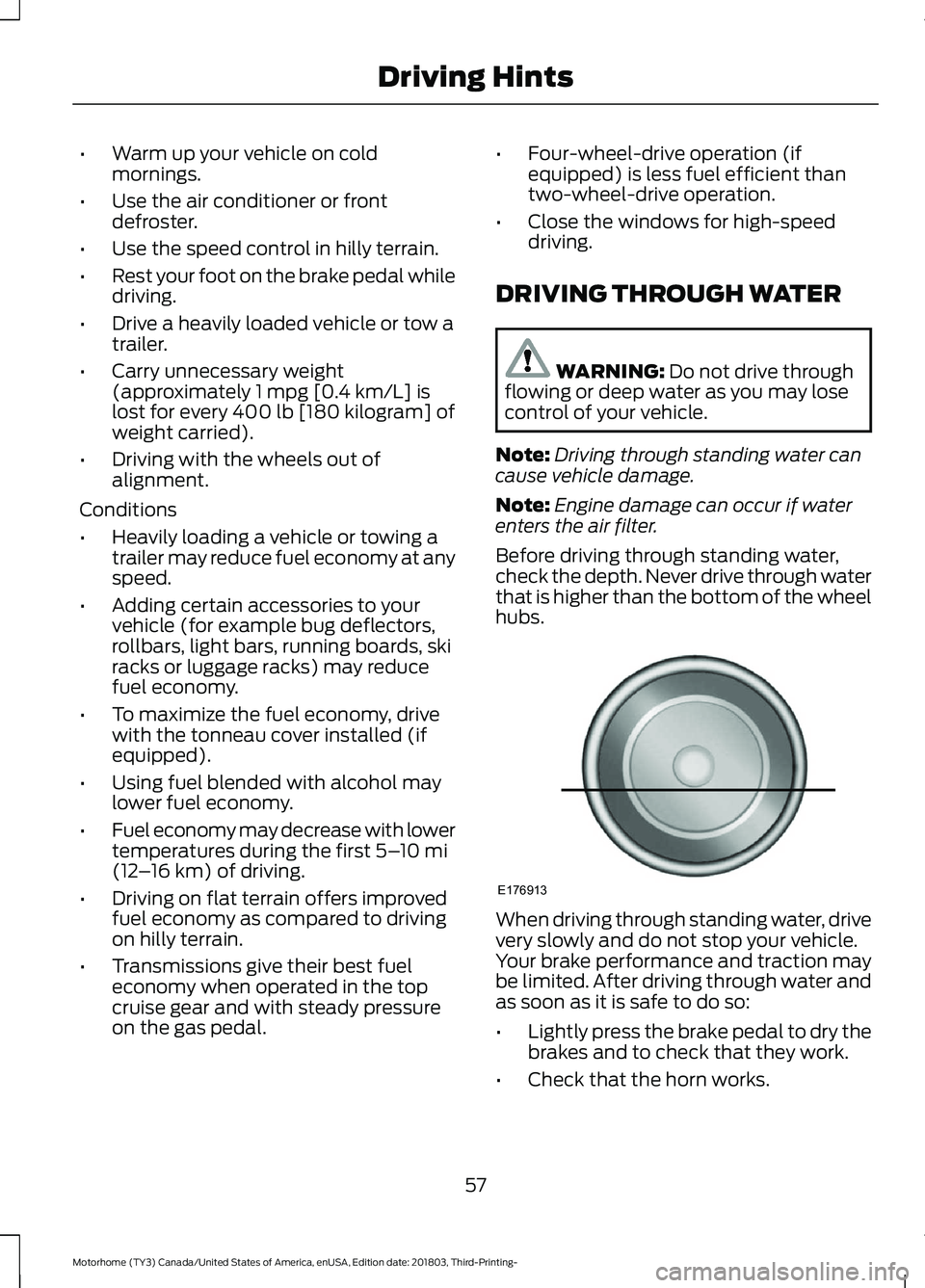
Before driving through standing water,check the depth. Never drive through waterthat is higher than the bottom of the wheelhubs.
When driving through standing water, drivevery slowly and do not stop your vehicle.Your brake performance and traction maybe limited. After driving through water andas soon as it is safe to do so:
•Lightly press the brake pedal to dry thebrakes and to check that they work.
•Check that the horn works.
57
Motorhome (TY3) Canada/United States of America, enUSA, Edition date: 201803, Third-Printing-Driving HintsE176913
Page 75 of 176
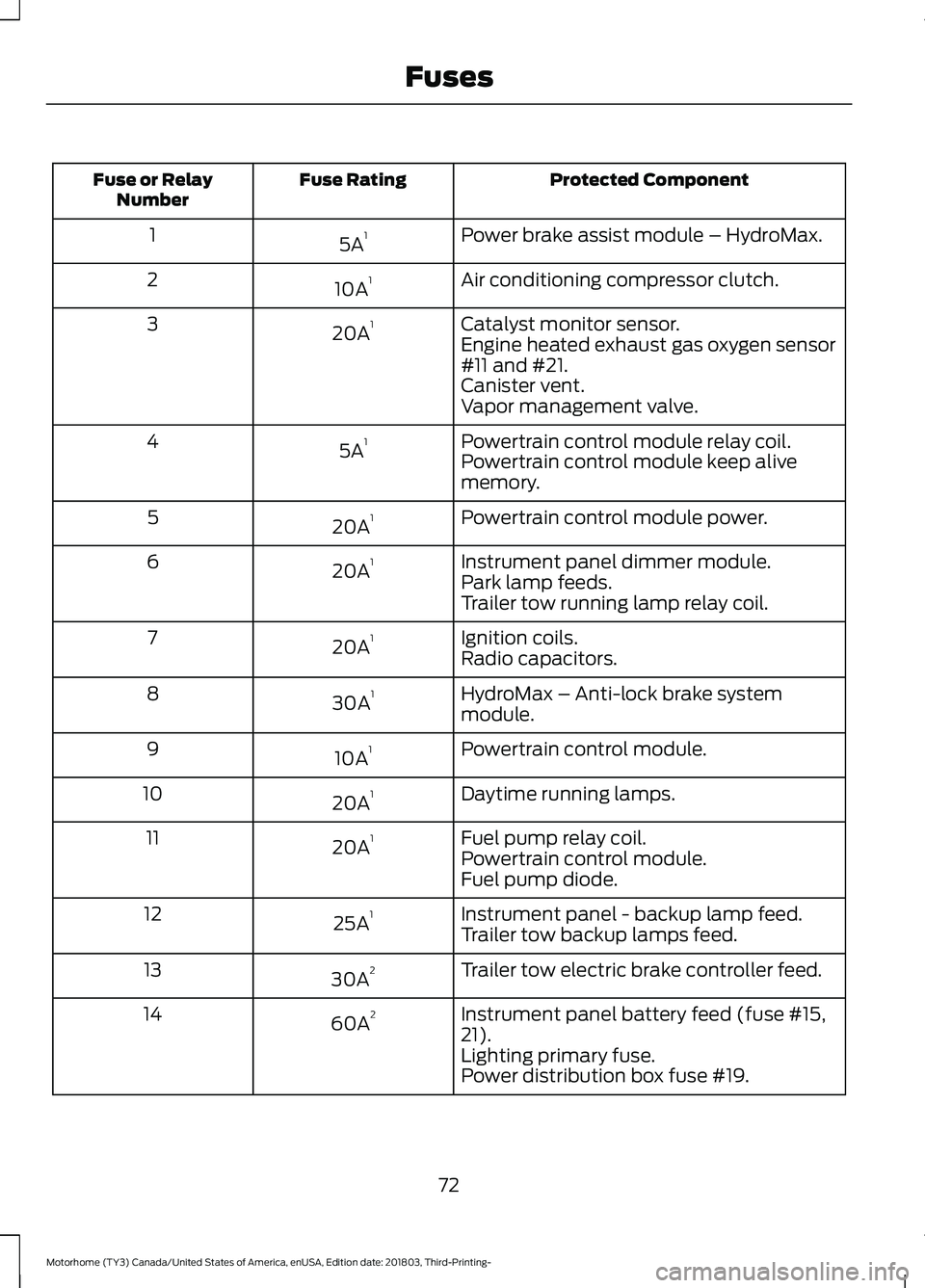
Protected ComponentFuse RatingFuse or RelayNumber
Power brake assist module – HydroMax.5A11
Air conditioning compressor clutch.10A12
Catalyst monitor sensor.20A13Engine heated exhaust gas oxygen sensor#11 and #21.Canister vent.Vapor management valve.
Powertrain control module relay coil.5A14Powertrain control module keep alivememory.
Powertrain control module power.20A15
Instrument panel dimmer module.20A16Park lamp feeds.Trailer tow running lamp relay coil.
Ignition coils.20A17Radio capacitors.
HydroMax – Anti-lock brake systemmodule.30A18
Powertrain control module.10A19
Daytime running lamps.20A110
Fuel pump relay coil.20A111Powertrain control module.Fuel pump diode.
Instrument panel - backup lamp feed.25A112Trailer tow backup lamps feed.
Trailer tow electric brake controller feed.30A213
Instrument panel battery feed (fuse #15,21).60A214
Lighting primary fuse.Power distribution box fuse #19.
72
Motorhome (TY3) Canada/United States of America, enUSA, Edition date: 201803, Third-Printing-Fuses
Page 76 of 176
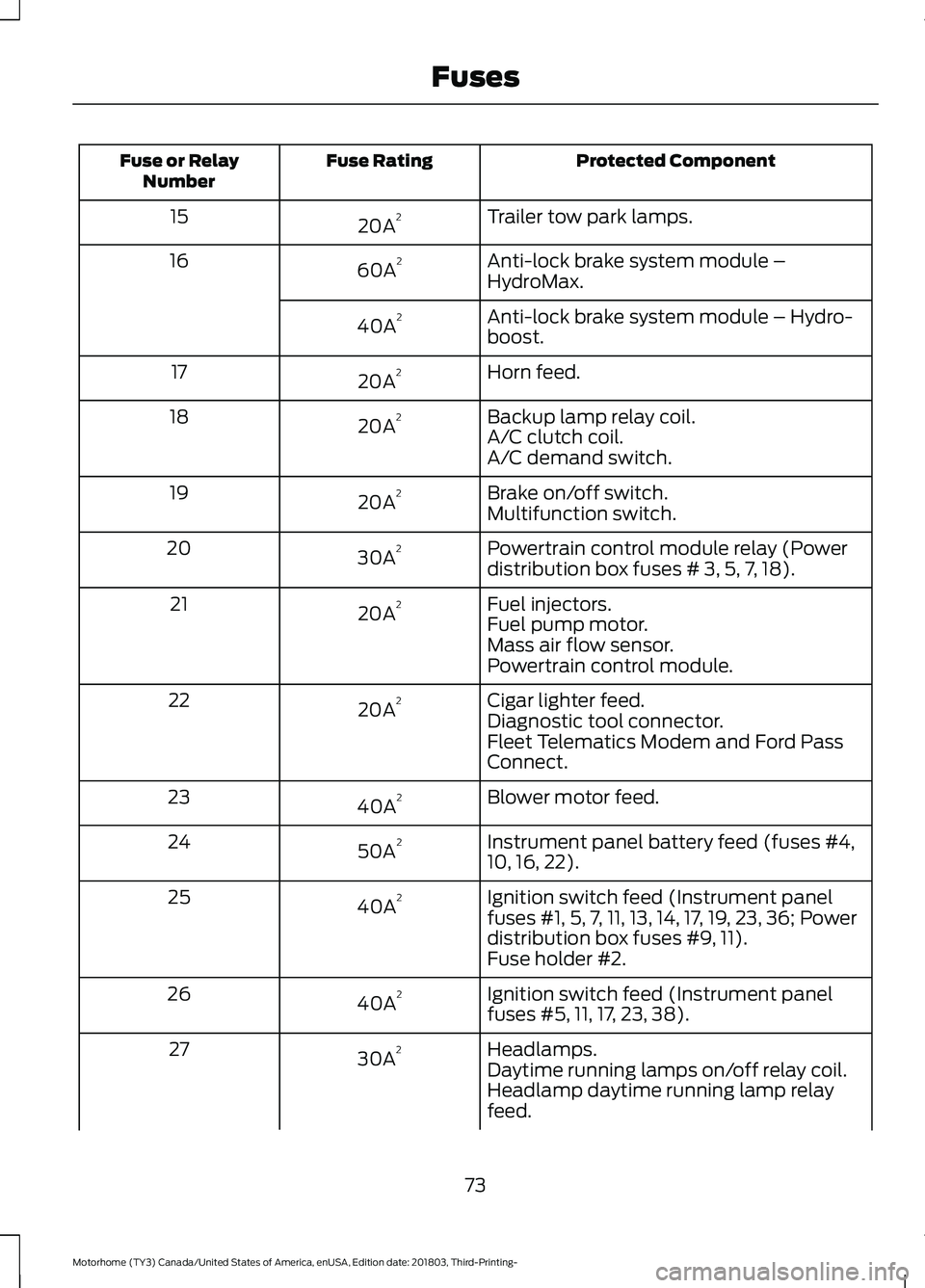
Protected ComponentFuse RatingFuse or RelayNumber
Trailer tow park lamps.20A215
Anti-lock brake system module –HydroMax.60A216
Anti-lock brake system module – Hydro-boost.40A2
Horn feed.20A217
Backup lamp relay coil.20A218A/C clutch coil.A/C demand switch.
Brake on/off switch.20A219Multifunction switch.
Powertrain control module relay (Powerdistribution box fuses # 3, 5, 7, 18).30A220
Fuel injectors.20A221Fuel pump motor.Mass air flow sensor.Powertrain control module.
Cigar lighter feed.20A222Diagnostic tool connector.Fleet Telematics Modem and Ford PassConnect.
Blower motor feed.40A223
Instrument panel battery feed (fuses #4,10, 16, 22).50A224
Ignition switch feed (Instrument panelfuses #1, 5, 7, 11, 13, 14, 17, 19, 23, 36; Powerdistribution box fuses #9, 11).
40A225
Fuse holder #2.
Ignition switch feed (Instrument panelfuses #5, 11, 17, 23, 38).40A226
Headlamps.30A227Daytime running lamps on/off relay coil.Headlamp daytime running lamp relayfeed.
73
Motorhome (TY3) Canada/United States of America, enUSA, Edition date: 201803, Third-Printing-Fuses
Page 77 of 176
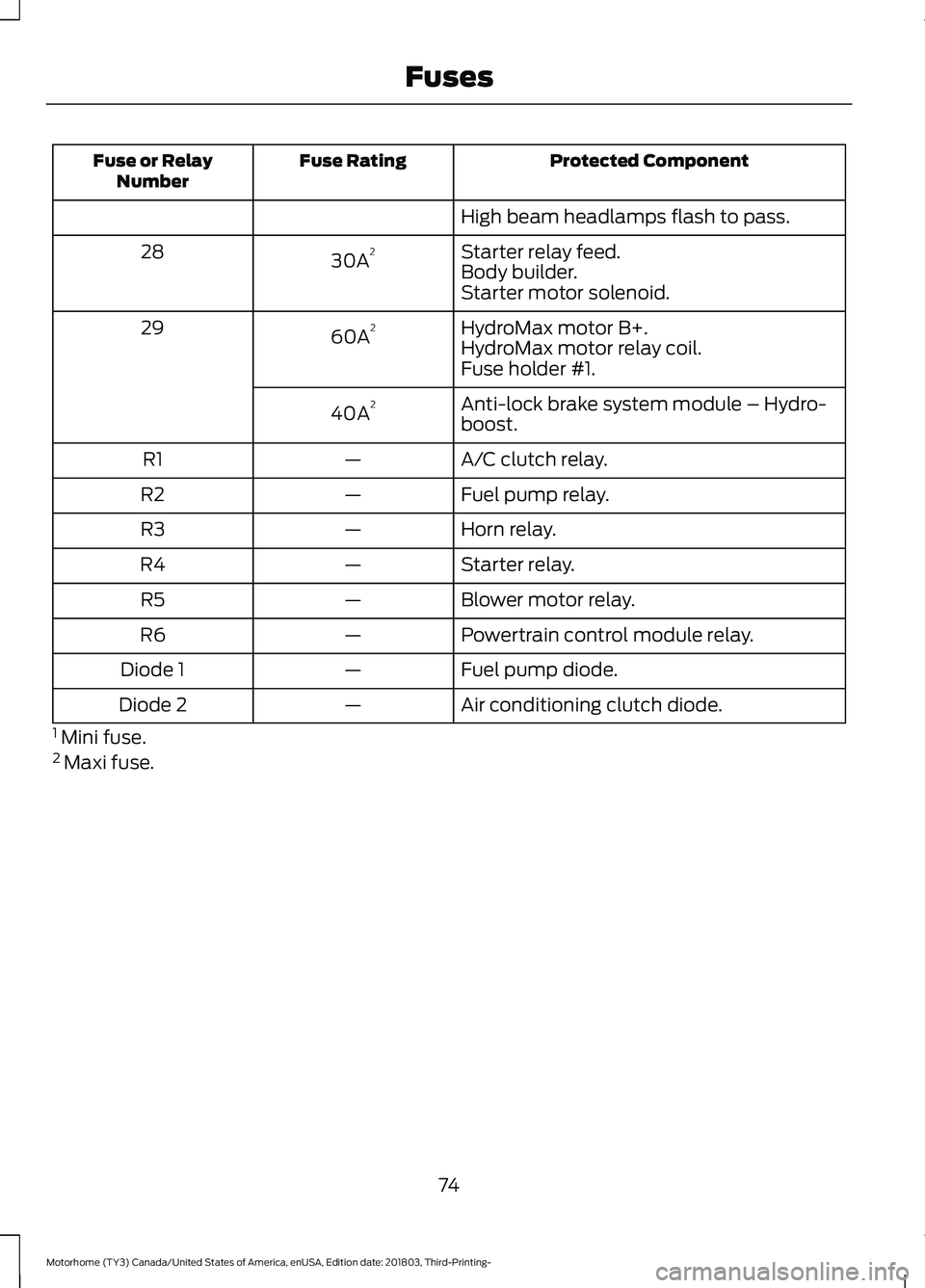
Protected ComponentFuse RatingFuse or RelayNumber
High beam headlamps flash to pass.
Starter relay feed.30A228Body builder.Starter motor solenoid.
HydroMax motor B+.60A229HydroMax motor relay coil.Fuse holder #1.
Anti-lock brake system module – Hydro-boost.40A2
A/C clutch relay.—R1
Fuel pump relay.—R2
Horn relay.—R3
Starter relay.—R4
Blower motor relay.—R5
Powertrain control module relay.—R6
Fuel pump diode.—Diode 1
Air conditioning clutch diode.—Diode 2
1 Mini fuse.2 Maxi fuse.
74
Motorhome (TY3) Canada/United States of America, enUSA, Edition date: 201803, Third-Printing-Fuses
Page 78 of 176
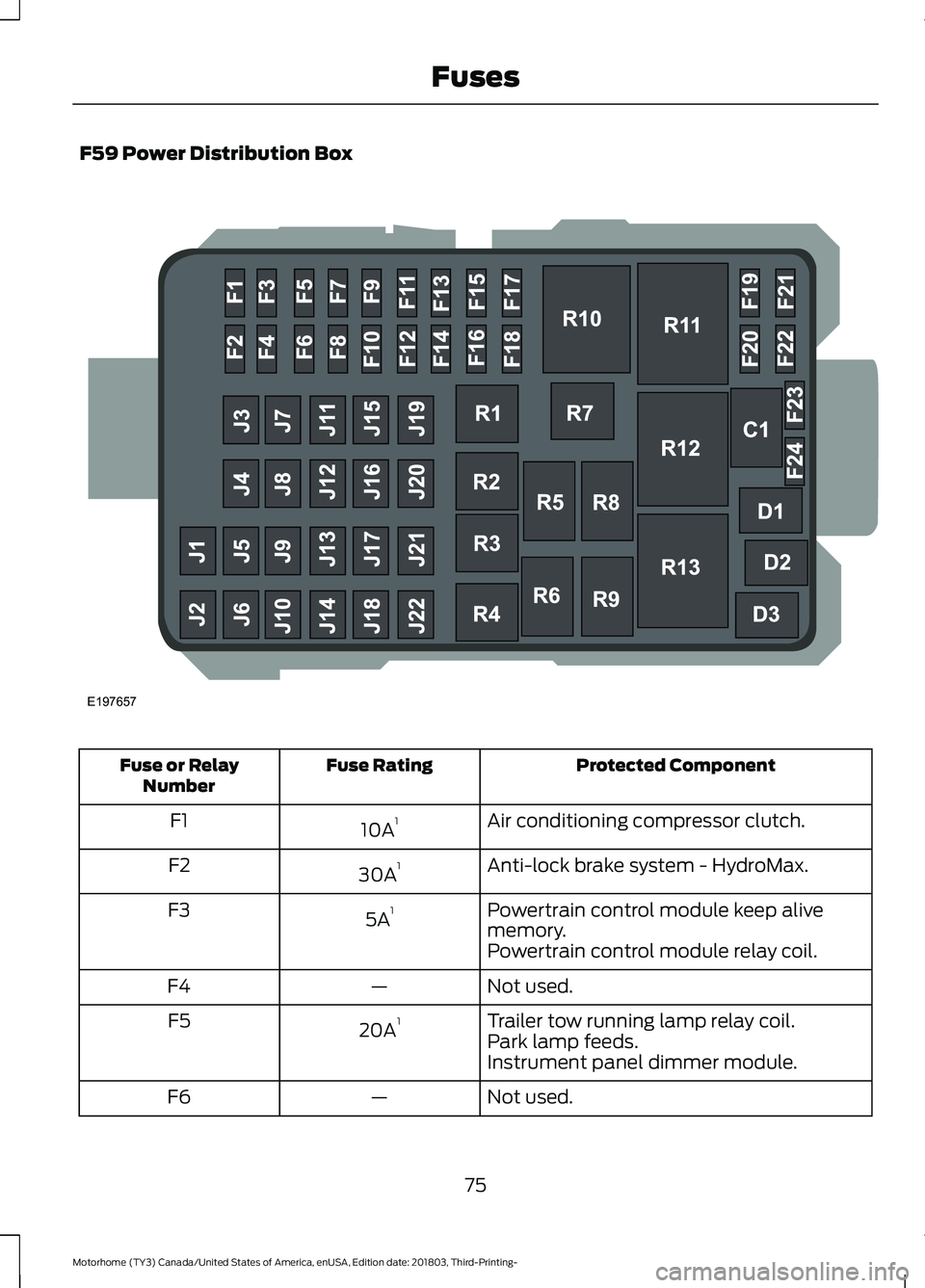
F59 Power Distribution Box
Protected ComponentFuse RatingFuse or RelayNumber
Air conditioning compressor clutch.10A1F1
Anti-lock brake system - HydroMax.30A1F2
Powertrain control module keep alivememory.5A1F3
Powertrain control module relay coil.
Not used.—F4
Trailer tow running lamp relay coil.20A1F5Park lamp feeds.Instrument panel dimmer module.
Not used.—F6
75
Motorhome (TY3) Canada/United States of America, enUSA, Edition date: 201803, Third-Printing-FusesE197657
Page 79 of 176
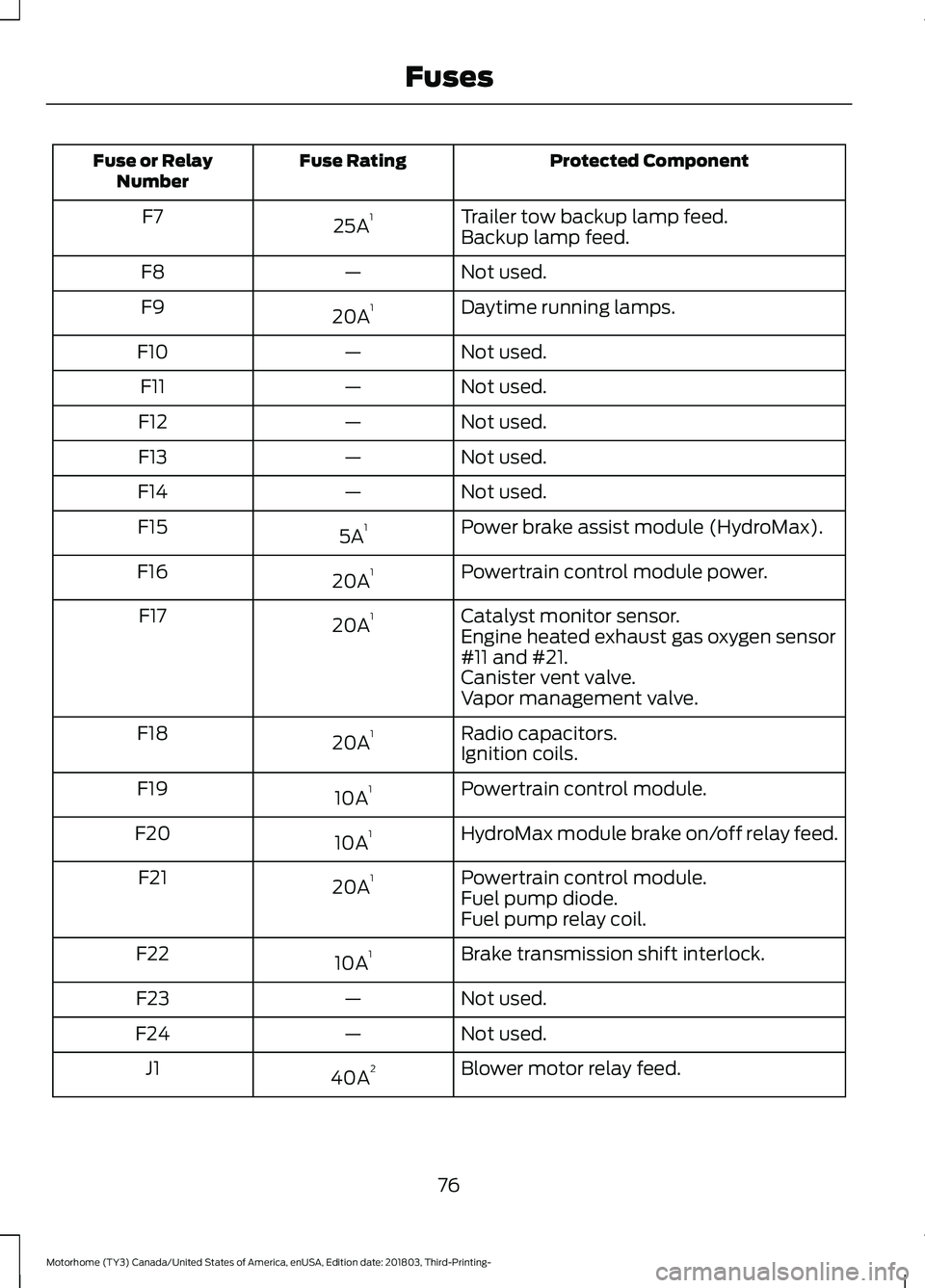
Protected ComponentFuse RatingFuse or RelayNumber
Trailer tow backup lamp feed.25A1F7Backup lamp feed.
Not used.—F8
Daytime running lamps.20A1F9
Not used.—F10
Not used.—F11
Not used.—F12
Not used.—F13
Not used.—F14
Power brake assist module (HydroMax).5A1F15
Powertrain control module power.20A1F16
Catalyst monitor sensor.20A1F17Engine heated exhaust gas oxygen sensor#11 and #21.Canister vent valve.Vapor management valve.
Radio capacitors.20A1F18Ignition coils.
Powertrain control module.10A1F19
HydroMax module brake on/off relay feed.10A1F20
Powertrain control module.20A1F21Fuel pump diode.Fuel pump relay coil.
Brake transmission shift interlock.10A1F22
Not used.—F23
Not used.—F24
Blower motor relay feed.40A2J1
76
Motorhome (TY3) Canada/United States of America, enUSA, Edition date: 201803, Third-Printing-Fuses
Page 80 of 176
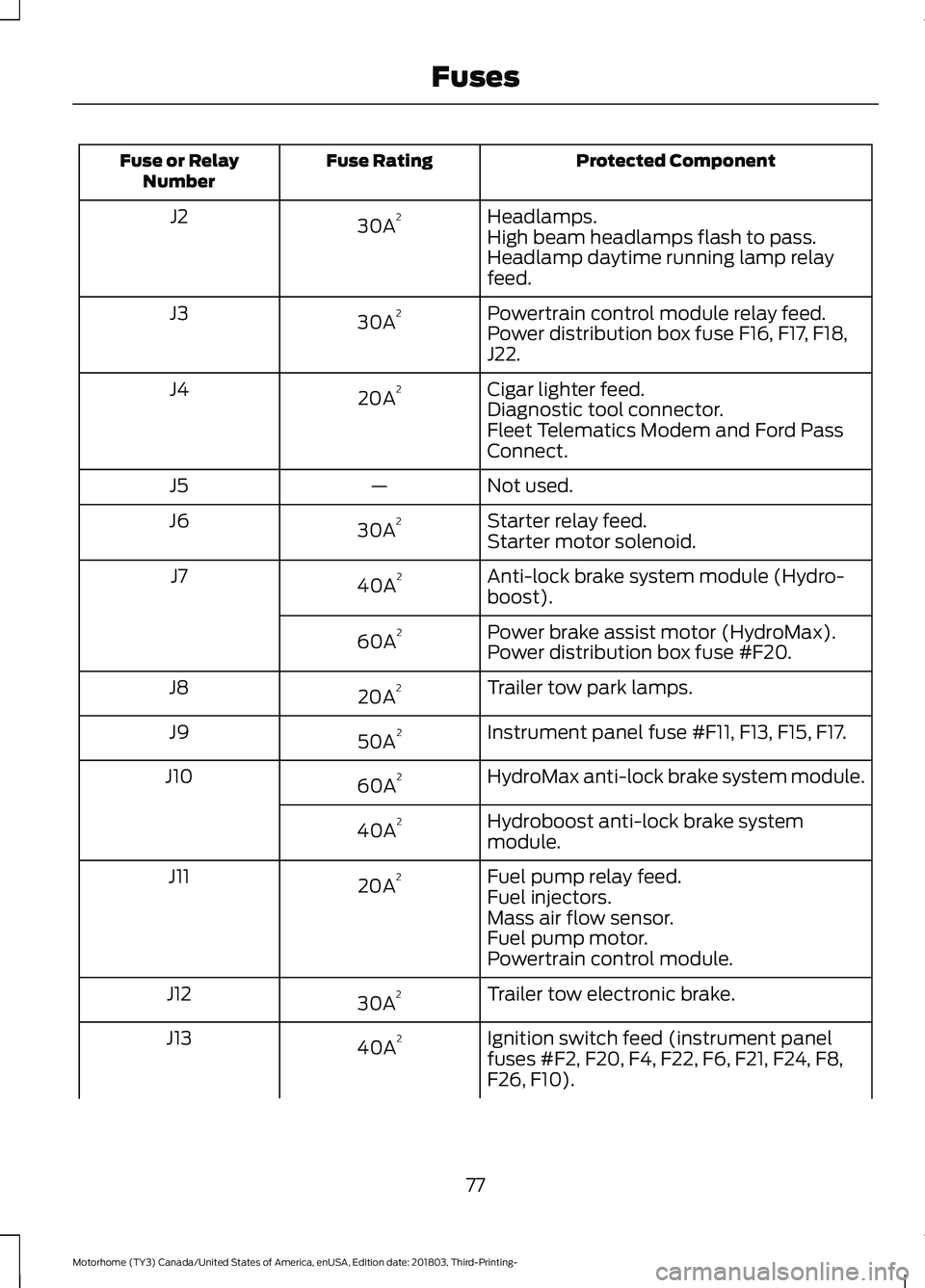
Protected ComponentFuse RatingFuse or RelayNumber
Headlamps.30A2J2High beam headlamps flash to pass.Headlamp daytime running lamp relayfeed.
Powertrain control module relay feed.30A2J3Power distribution box fuse F16, F17, F18,J22.
Cigar lighter feed.20A2J4Diagnostic tool connector.Fleet Telematics Modem and Ford PassConnect.
Not used.—J5
Starter relay feed.30A2J6Starter motor solenoid.
Anti-lock brake system module (Hydro-boost).40A2J7
Power brake assist motor (HydroMax).60A2
Power distribution box fuse #F20.
Trailer tow park lamps.20A2J8
Instrument panel fuse #F11, F13, F15, F17.50A2J9
HydroMax anti-lock brake system module.60A2J10
Hydroboost anti-lock brake systemmodule.40A2
Fuel pump relay feed.20A2J11Fuel injectors.Mass air flow sensor.Fuel pump motor.Powertrain control module.
Trailer tow electronic brake.30A2J12
Ignition switch feed (instrument panelfuses #F2, F20, F4, F22, F6, F21, F24, F8,F26, F10).
40A2J13
77
Motorhome (TY3) Canada/United States of America, enUSA, Edition date: 201803, Third-Printing-Fuses