fuel FORD F-59 2019 Owner's Manual
[x] Cancel search | Manufacturer: FORD, Model Year: 2019, Model line: F-59, Model: FORD F-59 2019Pages: 176, PDF Size: 9.98 MB
Page 59 of 176
BREAKING-IN
You need to break in new tires forapproximately 300 mi (480 km). Duringthis time, your vehicle may exhibit someunusual driving characteristics.
Avoid driving too fast during the first1,000 mi (1,600 km). Vary your speedfrequently and change up through thegears early. Do not labor the engine.
Do not tow during the first 1,000 mi(1,600 km).
REDUCED ENGINE
PERFORMANCE
WARNING: If you continue to driveyour vehicle when the engine isoverheating, the engine could stopwithout warning. Failure to follow thisinstruction could result in the loss ofcontrol of your vehicle.
If the engine coolant temperature gaugeneedle moves to the upper limit position,the engine is overheating. See Gauges(page 16).
You must only drive your vehicle for a shortdistance if the engine overheats. Thedistance you can travel depends onambient temperature, vehicle load andterrain. The engine continues to operatewith limited power for a short period oftime.
If the engine temperature continues to rise,the fuel supply to the engine reduces. Theair conditioning switches off and the enginecooling fan operates continually.
1.Gradually reduce your speed and stopyour vehicle as soon as it is safe to doso.
2.Immediately switch the engine off toprevent severe engine damage.
3.Wait for the engine to cool down.
4.Check the coolant level. See EngineCoolant Check (page 96).
5.Have your vehicle checked as soon aspossible.
ECONOMICAL DRIVING
Your fuel economy is affected by severalthings, such as how you drive, theconditions you drive under, and how youmaintain your vehicle.
You may improve your fuel economy bykeeping these things in mind:
•Accelerate and slow down in a smooth,moderate fashion.
•Drive at steady speeds withoutstopping.
•Anticipate stops; slowing down mayeliminate the need to stop.
•Combine errands and minimizestop-and-go driving.
•Close the windows for high-speeddriving.
•Drive at reasonable speeds (travelingat 55 mph [88 km/h] uses 15% lessfuel than traveling at 65 mph [105km/h]).
•Keep the tires properly inflated and useonly the recommended size.
•Use the recommended engine oil.
•Perform all regularly scheduledmaintenance.
Avoid these actions; they reduce your fueleconomy:
•Sudden accelerations or hardaccelerations.
•Revving the engine before turning it off.
•Idle for periods longer than one minute.
56
Motorhome (TY3) Canada/United States of America, enUSA, Edition date: 201803, Third-Printing-Driving Hints
Page 60 of 176
•Warm up your vehicle on coldmornings.
•Use the air conditioner or frontdefroster.
•Use the speed control in hilly terrain.
•Rest your foot on the brake pedal whiledriving.
•Drive a heavily loaded vehicle or tow atrailer.
•Carry unnecessary weight(approximately 1 mpg [0.4 km/L] islost for every 400 lb [180 kilogram] ofweight carried).
•Driving with the wheels out ofalignment.
Conditions
•Heavily loading a vehicle or towing atrailer may reduce fuel economy at anyspeed.
•Adding certain accessories to yourvehicle (for example bug deflectors,rollbars, light bars, running boards, skiracks or luggage racks) may reducefuel economy.
•To maximize the fuel economy, drivewith the tonneau cover installed (ifequipped).
•Using fuel blended with alcohol maylower fuel economy.
•Fuel economy may decrease with lowertemperatures during the first 5–10 mi(12–16 km) of driving.
•Driving on flat terrain offers improvedfuel economy as compared to drivingon hilly terrain.
•Transmissions give their best fueleconomy when operated in the topcruise gear and with steady pressureon the gas pedal.
•Four-wheel-drive operation (ifequipped) is less fuel efficient thantwo-wheel-drive operation.
•Close the windows for high-speeddriving.
DRIVING THROUGH WATER
WARNING: Do not drive throughflowing or deep water as you may losecontrol of your vehicle.
Note:Driving through standing water cancause vehicle damage.
Note:Engine damage can occur if waterenters the air filter.
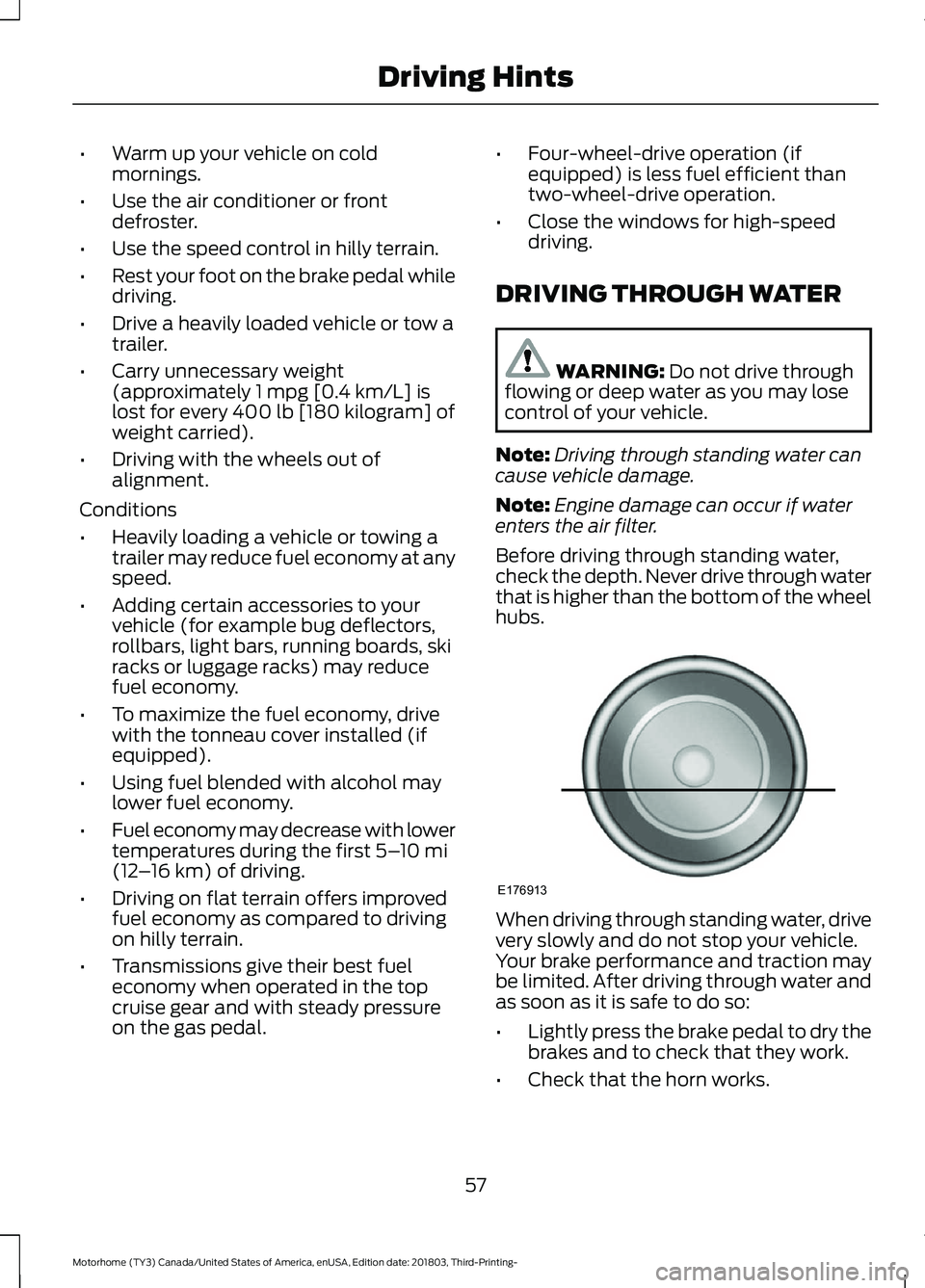
Before driving through standing water,check the depth. Never drive through waterthat is higher than the bottom of the wheelhubs.
When driving through standing water, drivevery slowly and do not stop your vehicle.Your brake performance and traction maybe limited. After driving through water andas soon as it is safe to do so:
•Lightly press the brake pedal to dry thebrakes and to check that they work.
•Check that the horn works.
57
Motorhome (TY3) Canada/United States of America, enUSA, Edition date: 201803, Third-Printing-Driving HintsE176913
Page 62 of 176
ROADSIDE ASSISTANCE
Vehicles Sold in the United States:Getting Roadside Assistance
To fully assist you should you have avehicle concern, Ford Motor Companyoffers a complimentary roadsideassistance program. This program isseparate from the New Vehicle LimitedWarranty.
The service is available:
•24 hours a day, seven days a week.
•For the coverage period supplied withyour vehicle.
Roadside Assistance covers:
•A flat tire change with a good spare(except vehicles supplied with a tireinflation kit).
•Battery jump start.
•Lock-out assistance (key replacementcost is the customer's responsibility).
•Fuel delivery — independent servicecontractors, if not prohibited by state,local or municipal law, shall deliver upto 2 gal (8 L) of gasoline or 5 gal (20 L)of diesel fuel to a disabled vehicle.Roadside Assistance limits fuel deliveryservice to two no-charge occurrenceswithin a 12-month period.
•Winch out — available within 100 ft(30 m) of a paved or countymaintained road, no recoveries.
•Towing — independent servicecontractors, if not prohibited by state,local or municipal law, shall tow Fordeligible vehicles to an authorized dealerwithin 35 mi (56 km) of thedisablement location or to the nearestauthorized dealer. If a memberrequests a tow to an authorized dealerthat is more than 35 mi (56 km) fromthe disablement location, the membershall be responsible for any mileagecosts in excess of 35 mi (56 km).
•Roadside Assistance includes up to$200 for a towed trailer if the disabledeligible vehicle requires service at thenearest authorized dealer. If the towingvehicle is operational but the trailer isnot, then the trailer does not qualify forany roadside services.
Vehicles Sold in the United States:Using Roadside Assistance
Complete the roadside assistanceidentification card and place it in yourwallet for quick reference. This card is inthe Owner's Manual kit.
United States vehicle customers whorequire Roadside Assistance, call1-800-241-3673.
If you need to arrange roadside assistancefor yourself, Ford Motor Companyreimburses a reasonable amount fortowing to the nearest dealership within35 mi (56 km). To obtain reimbursementinformation, United States vehiclecustomers call 1-800-241-3673.Customers need to submit their originalreceipts.
59
Motorhome (TY3) Canada/United States of America, enUSA, Edition date: 201803, Third-Printing-Roadside Emergencies
Page 64 of 176
Park the booster vehicle close to the hoodof the disabled vehicle, making sure thetwo vehicles do not touch.
Connecting the Jumper Cables
WARNING: Do not attach thecables to fuel lines, engine rocker covers,the intake manifold or electricalcomponents as grounding points. Stayclear of moving parts. To avoid reversepolarity connections, make sure that youcorrectly identify the positive (+) andnegative (-) terminals on both thedisabled and booster vehicles beforeconnecting the cables.
WARNING: Do not attach the endof the positive cable to the studs orL-shaped eyelet located above thepositive (+) terminal of your vehicle’sbattery. High current may flow throughand cause damage to the fuses.
WARNING: Do not connect theend of the second cable to the negative(-) terminal of the battery to be jumped.A spark may cause an explosion of thegases that surround the battery.
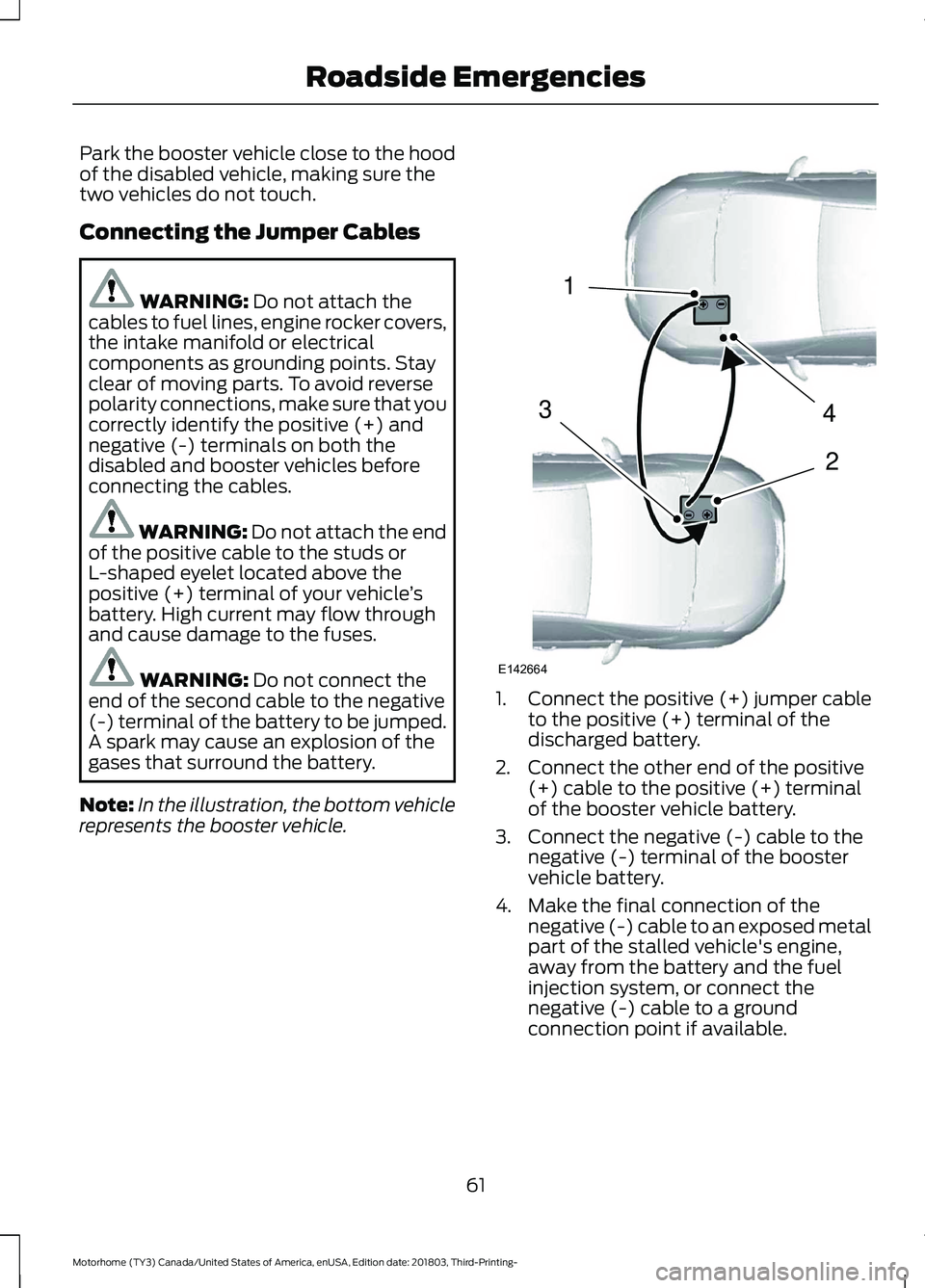
Note:In the illustration, the bottom vehiclerepresents the booster vehicle.
1.Connect the positive (+) jumper cableto the positive (+) terminal of thedischarged battery.
2.Connect the other end of the positive(+) cable to the positive (+) terminalof the booster vehicle battery.
3.Connect the negative (-) cable to thenegative (-) terminal of the boostervehicle battery.
4.Make the final connection of thenegative (-) cable to an exposed metalpart of the stalled vehicle's engine,away from the battery and the fuelinjection system, or connect thenegative (-) cable to a groundconnection point if available.
61
Motorhome (TY3) Canada/United States of America, enUSA, Edition date: 201803, Third-Printing-Roadside Emergencies4213E142664
Page 70 of 176
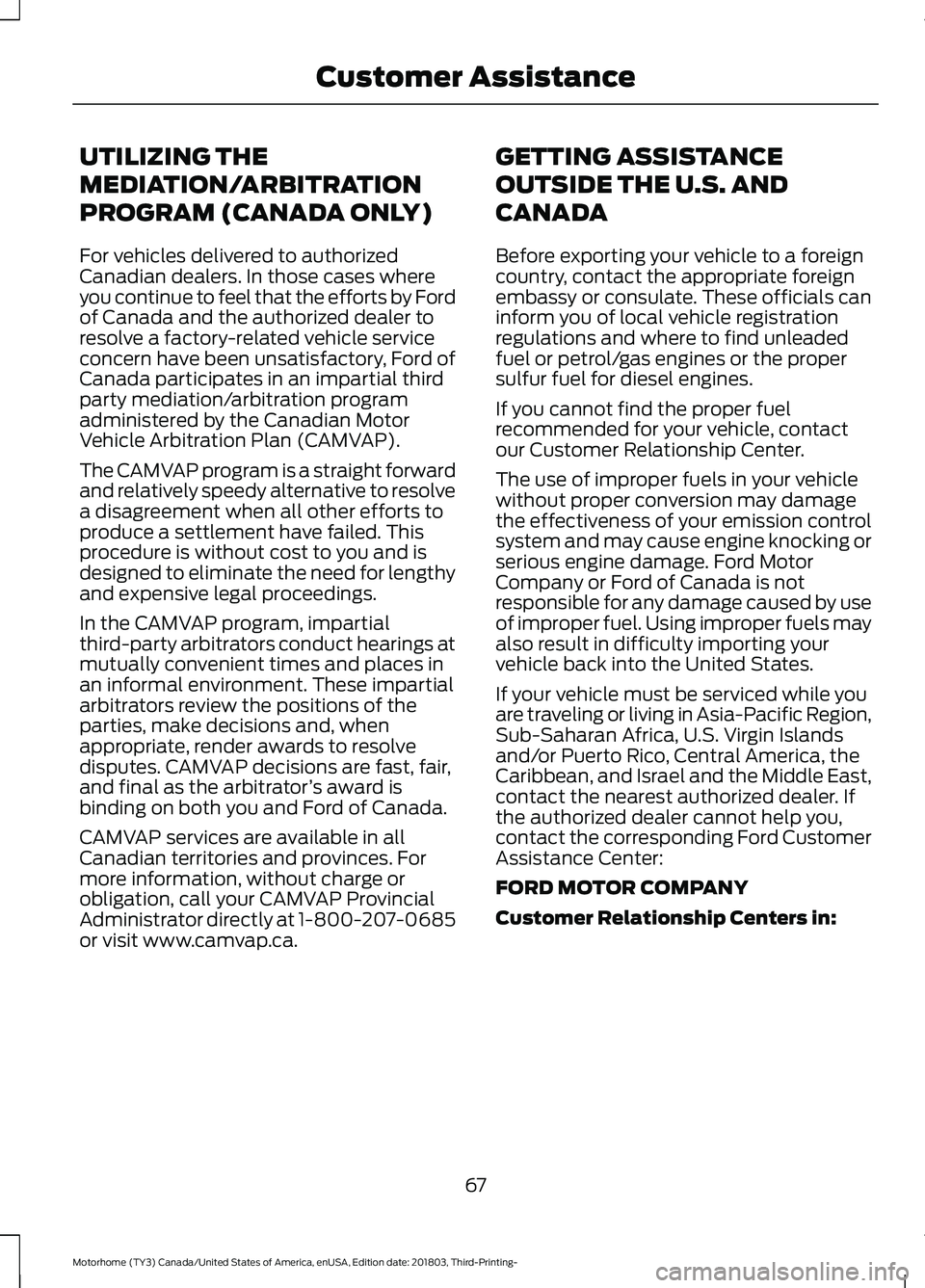
UTILIZING THE
MEDIATION/ARBITRATION
PROGRAM (CANADA ONLY)
For vehicles delivered to authorizedCanadian dealers. In those cases whereyou continue to feel that the efforts by Fordof Canada and the authorized dealer toresolve a factory-related vehicle serviceconcern have been unsatisfactory, Ford ofCanada participates in an impartial thirdparty mediation/arbitration programadministered by the Canadian MotorVehicle Arbitration Plan (CAMVAP).
The CAMVAP program is a straight forwardand relatively speedy alternative to resolvea disagreement when all other efforts toproduce a settlement have failed. Thisprocedure is without cost to you and isdesigned to eliminate the need for lengthyand expensive legal proceedings.
In the CAMVAP program, impartialthird-party arbitrators conduct hearings atmutually convenient times and places inan informal environment. These impartialarbitrators review the positions of theparties, make decisions and, whenappropriate, render awards to resolvedisputes. CAMVAP decisions are fast, fair,and final as the arbitrator’s award isbinding on both you and Ford of Canada.
CAMVAP services are available in allCanadian territories and provinces. Formore information, without charge orobligation, call your CAMVAP ProvincialAdministrator directly at 1-800-207-0685or visit www.camvap.ca.
GETTING ASSISTANCE
OUTSIDE THE U.S. AND
CANADA
Before exporting your vehicle to a foreigncountry, contact the appropriate foreignembassy or consulate. These officials caninform you of local vehicle registrationregulations and where to find unleadedfuel or petrol/gas engines or the propersulfur fuel for diesel engines.
If you cannot find the proper fuelrecommended for your vehicle, contactour Customer Relationship Center.
The use of improper fuels in your vehiclewithout proper conversion may damagethe effectiveness of your emission controlsystem and may cause engine knocking orserious engine damage. Ford MotorCompany or Ford of Canada is notresponsible for any damage caused by useof improper fuel. Using improper fuels mayalso result in difficulty importing yourvehicle back into the United States.
If your vehicle must be serviced while youare traveling or living in Asia-Pacific Region,Sub-Saharan Africa, U.S. Virgin Islandsand/or Puerto Rico, Central America, theCaribbean, and Israel and the Middle East,contact the nearest authorized dealer. Ifthe authorized dealer cannot help you,contact the corresponding Ford CustomerAssistance Center:
FORD MOTOR COMPANY
Customer Relationship Centers in:
67
Motorhome (TY3) Canada/United States of America, enUSA, Edition date: 201803, Third-Printing-Customer Assistance
Page 75 of 176
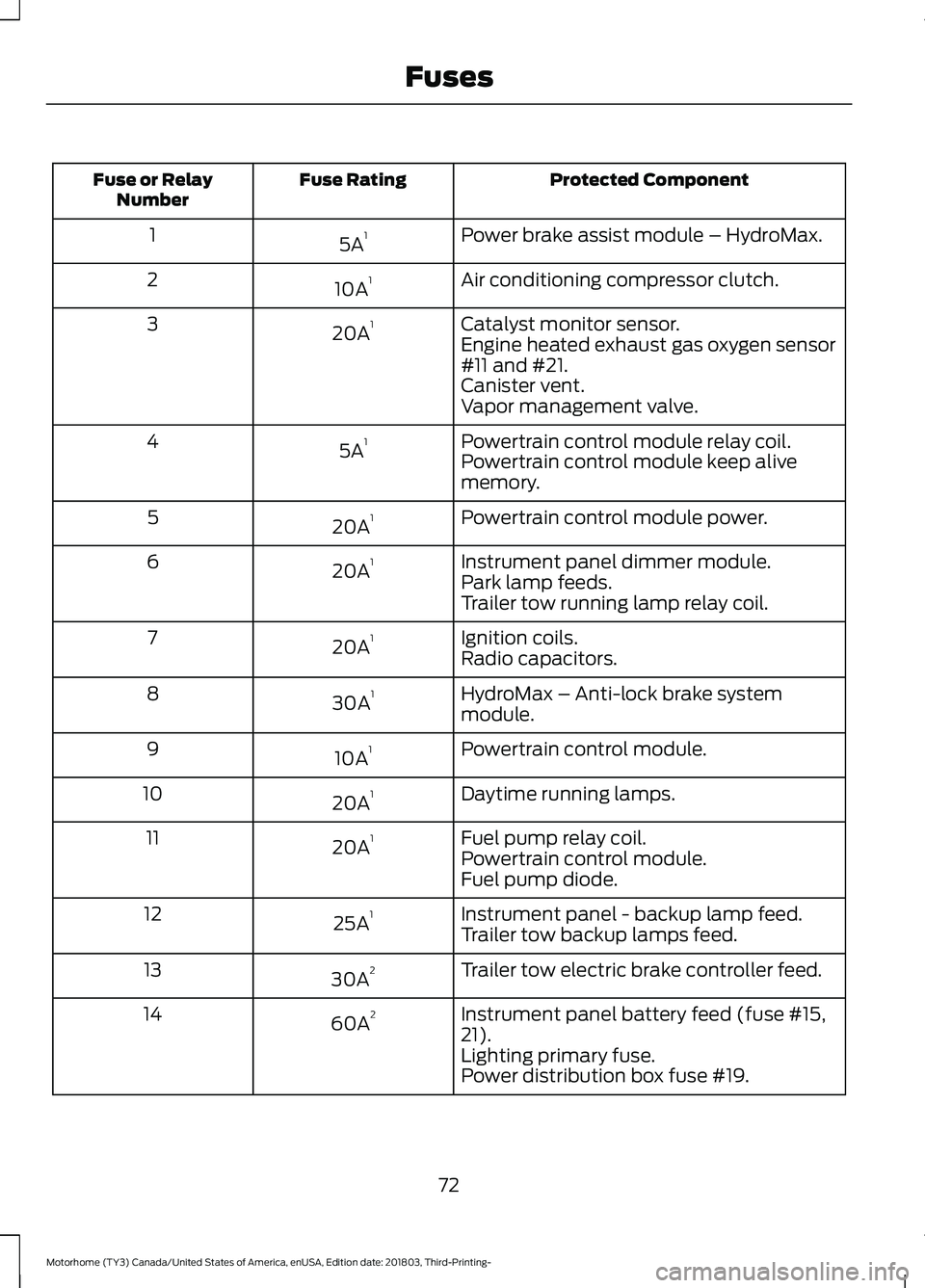
Protected ComponentFuse RatingFuse or RelayNumber
Power brake assist module – HydroMax.5A11
Air conditioning compressor clutch.10A12
Catalyst monitor sensor.20A13Engine heated exhaust gas oxygen sensor#11 and #21.Canister vent.Vapor management valve.
Powertrain control module relay coil.5A14Powertrain control module keep alivememory.
Powertrain control module power.20A15
Instrument panel dimmer module.20A16Park lamp feeds.Trailer tow running lamp relay coil.
Ignition coils.20A17Radio capacitors.
HydroMax – Anti-lock brake systemmodule.30A18
Powertrain control module.10A19
Daytime running lamps.20A110
Fuel pump relay coil.20A111Powertrain control module.Fuel pump diode.
Instrument panel - backup lamp feed.25A112Trailer tow backup lamps feed.
Trailer tow electric brake controller feed.30A213
Instrument panel battery feed (fuse #15,21).60A214
Lighting primary fuse.Power distribution box fuse #19.
72
Motorhome (TY3) Canada/United States of America, enUSA, Edition date: 201803, Third-Printing-Fuses
Page 76 of 176
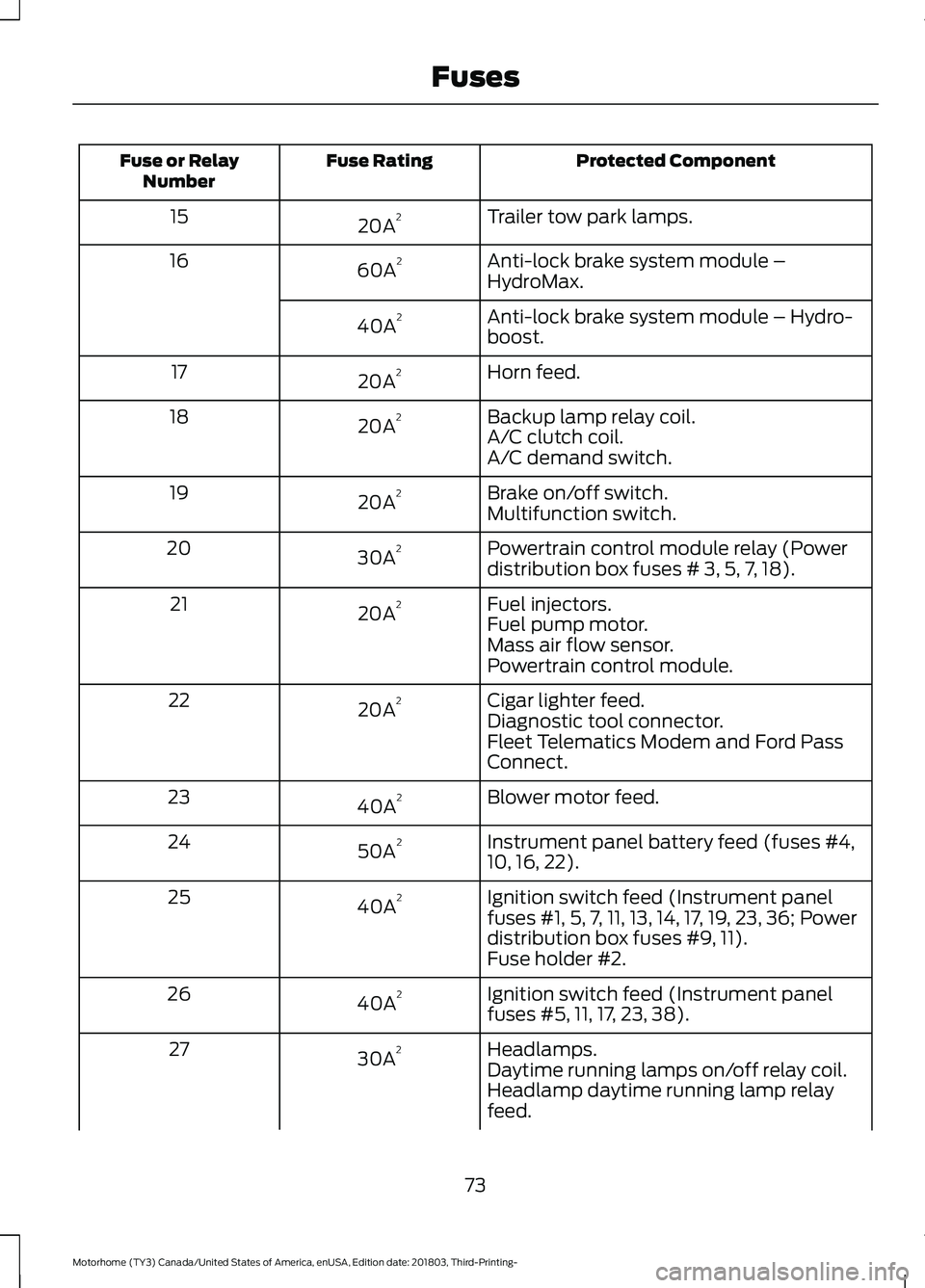
Protected ComponentFuse RatingFuse or RelayNumber
Trailer tow park lamps.20A215
Anti-lock brake system module –HydroMax.60A216
Anti-lock brake system module – Hydro-boost.40A2
Horn feed.20A217
Backup lamp relay coil.20A218A/C clutch coil.A/C demand switch.
Brake on/off switch.20A219Multifunction switch.
Powertrain control module relay (Powerdistribution box fuses # 3, 5, 7, 18).30A220
Fuel injectors.20A221Fuel pump motor.Mass air flow sensor.Powertrain control module.
Cigar lighter feed.20A222Diagnostic tool connector.Fleet Telematics Modem and Ford PassConnect.
Blower motor feed.40A223
Instrument panel battery feed (fuses #4,10, 16, 22).50A224
Ignition switch feed (Instrument panelfuses #1, 5, 7, 11, 13, 14, 17, 19, 23, 36; Powerdistribution box fuses #9, 11).
40A225
Fuse holder #2.
Ignition switch feed (Instrument panelfuses #5, 11, 17, 23, 38).40A226
Headlamps.30A227Daytime running lamps on/off relay coil.Headlamp daytime running lamp relayfeed.
73
Motorhome (TY3) Canada/United States of America, enUSA, Edition date: 201803, Third-Printing-Fuses
Page 77 of 176
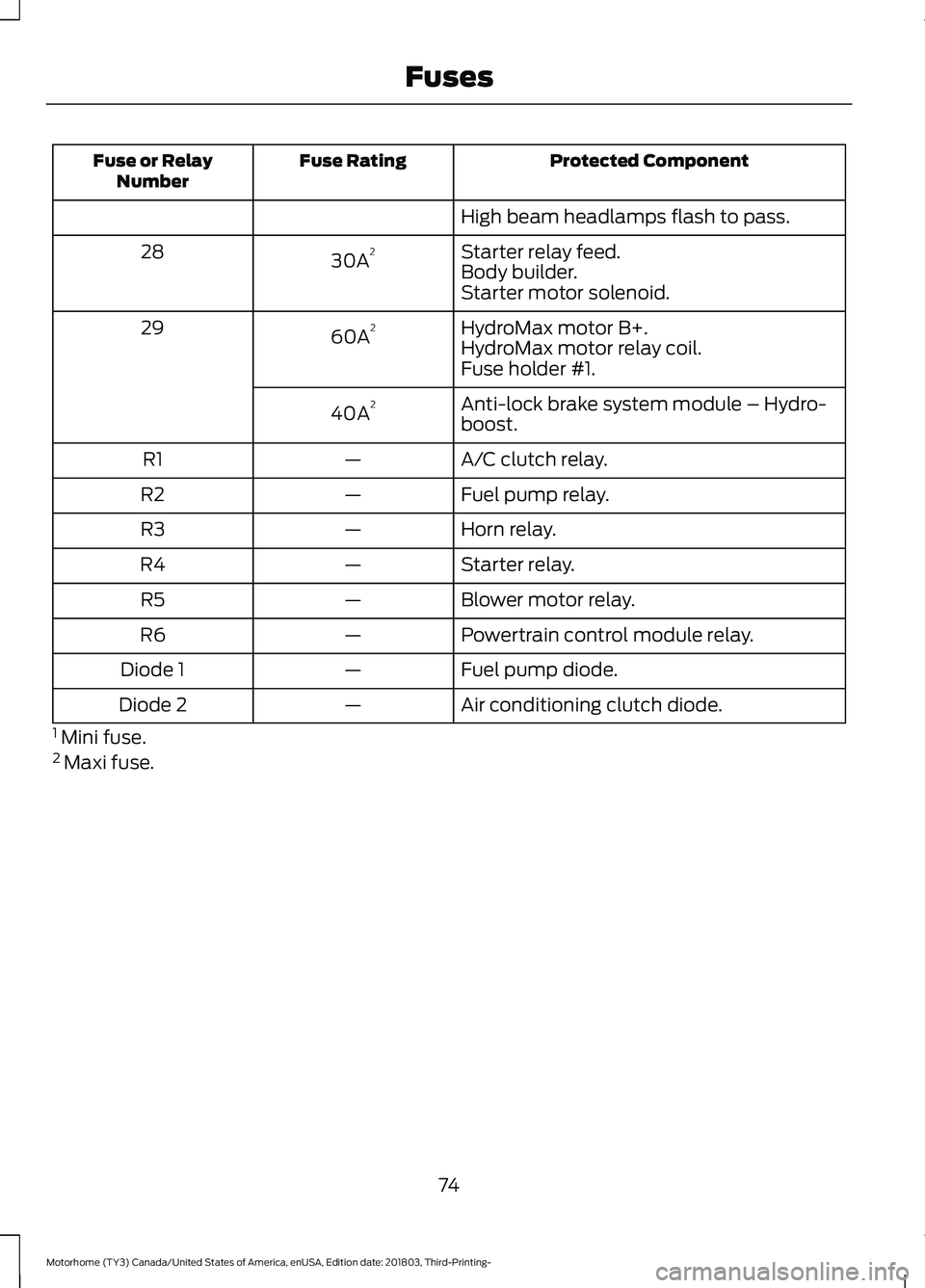
Protected ComponentFuse RatingFuse or RelayNumber
High beam headlamps flash to pass.
Starter relay feed.30A228Body builder.Starter motor solenoid.
HydroMax motor B+.60A229HydroMax motor relay coil.Fuse holder #1.
Anti-lock brake system module – Hydro-boost.40A2
A/C clutch relay.—R1
Fuel pump relay.—R2
Horn relay.—R3
Starter relay.—R4
Blower motor relay.—R5
Powertrain control module relay.—R6
Fuel pump diode.—Diode 1
Air conditioning clutch diode.—Diode 2
1 Mini fuse.2 Maxi fuse.
74
Motorhome (TY3) Canada/United States of America, enUSA, Edition date: 201803, Third-Printing-Fuses
Page 79 of 176
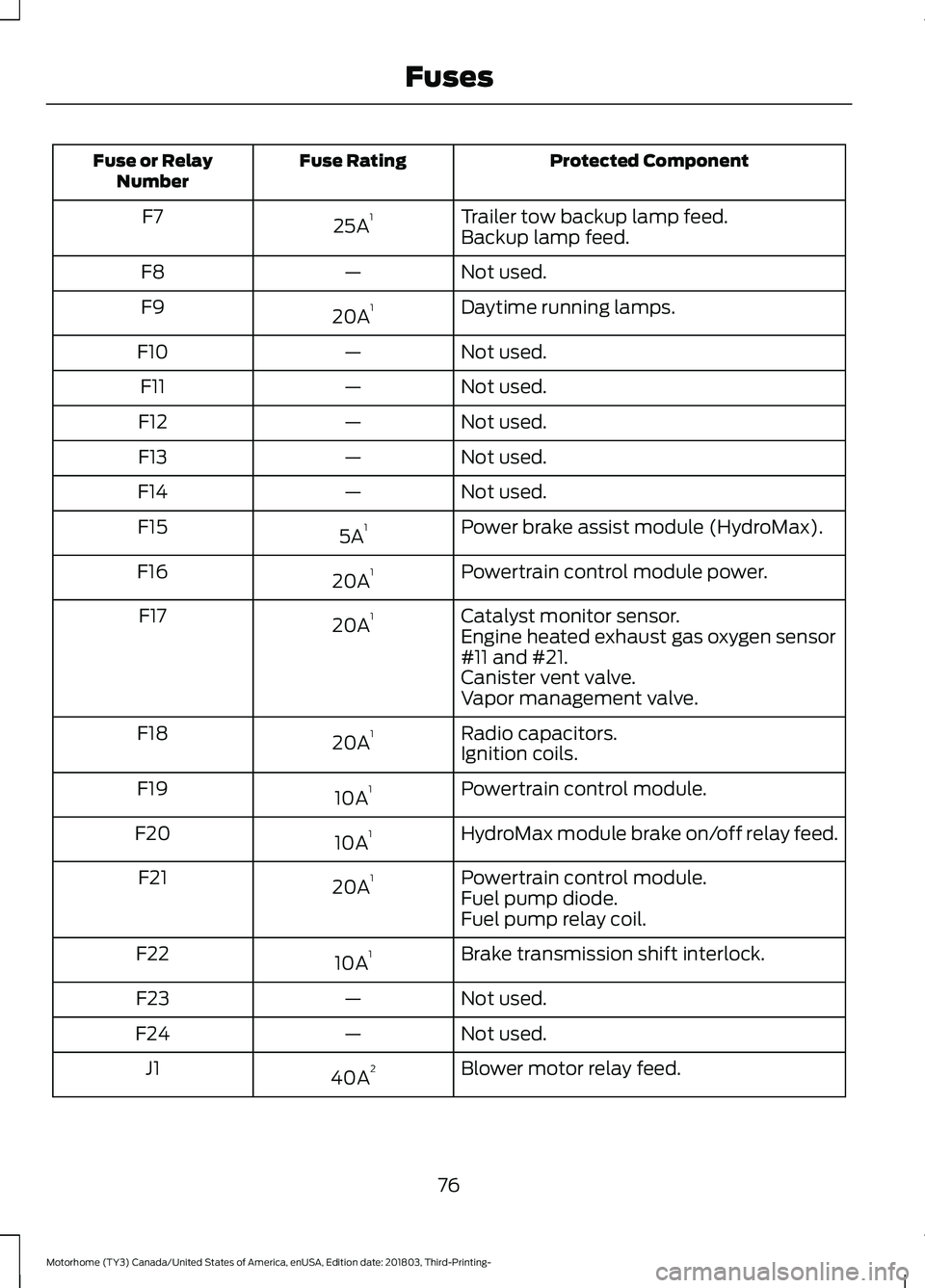
Protected ComponentFuse RatingFuse or RelayNumber
Trailer tow backup lamp feed.25A1F7Backup lamp feed.
Not used.—F8
Daytime running lamps.20A1F9
Not used.—F10
Not used.—F11
Not used.—F12
Not used.—F13
Not used.—F14
Power brake assist module (HydroMax).5A1F15
Powertrain control module power.20A1F16
Catalyst monitor sensor.20A1F17Engine heated exhaust gas oxygen sensor#11 and #21.Canister vent valve.Vapor management valve.
Radio capacitors.20A1F18Ignition coils.
Powertrain control module.10A1F19
HydroMax module brake on/off relay feed.10A1F20
Powertrain control module.20A1F21Fuel pump diode.Fuel pump relay coil.
Brake transmission shift interlock.10A1F22
Not used.—F23
Not used.—F24
Blower motor relay feed.40A2J1
76
Motorhome (TY3) Canada/United States of America, enUSA, Edition date: 201803, Third-Printing-Fuses
Page 80 of 176
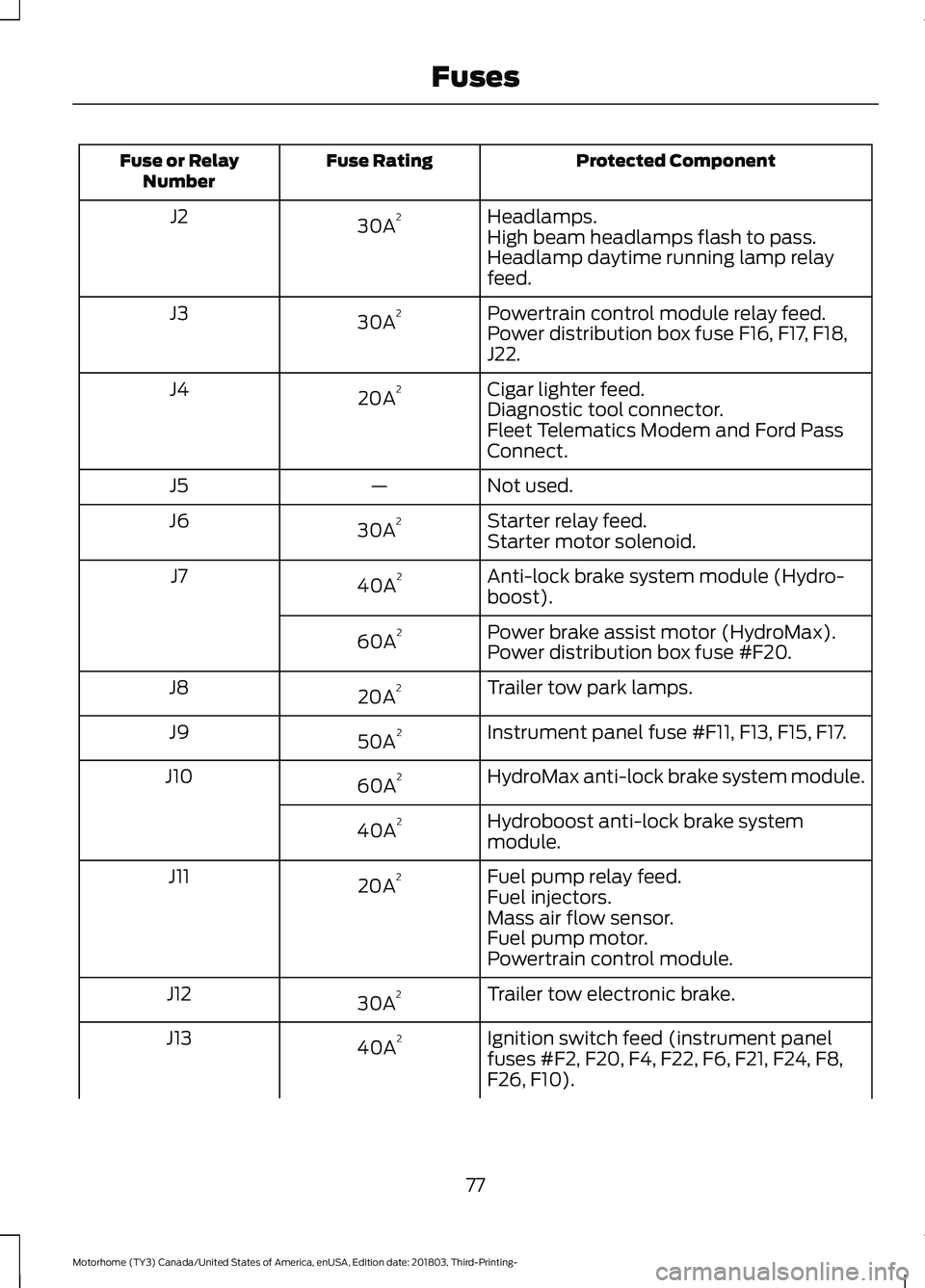
Protected ComponentFuse RatingFuse or RelayNumber
Headlamps.30A2J2High beam headlamps flash to pass.Headlamp daytime running lamp relayfeed.
Powertrain control module relay feed.30A2J3Power distribution box fuse F16, F17, F18,J22.
Cigar lighter feed.20A2J4Diagnostic tool connector.Fleet Telematics Modem and Ford PassConnect.
Not used.—J5
Starter relay feed.30A2J6Starter motor solenoid.
Anti-lock brake system module (Hydro-boost).40A2J7
Power brake assist motor (HydroMax).60A2
Power distribution box fuse #F20.
Trailer tow park lamps.20A2J8
Instrument panel fuse #F11, F13, F15, F17.50A2J9
HydroMax anti-lock brake system module.60A2J10
Hydroboost anti-lock brake systemmodule.40A2
Fuel pump relay feed.20A2J11Fuel injectors.Mass air flow sensor.Fuel pump motor.Powertrain control module.
Trailer tow electronic brake.30A2J12
Ignition switch feed (instrument panelfuses #F2, F20, F4, F22, F6, F21, F24, F8,F26, F10).
40A2J13
77
Motorhome (TY3) Canada/United States of America, enUSA, Edition date: 201803, Third-Printing-Fuses