transmission oil FORD F-650/750 2022 User Guide
[x] Cancel search | Manufacturer: FORD, Model Year: 2022, Model line: F-650/750, Model: FORD F-650/750 2022Pages: 379, PDF Size: 5.29 MB
Page 226 of 379
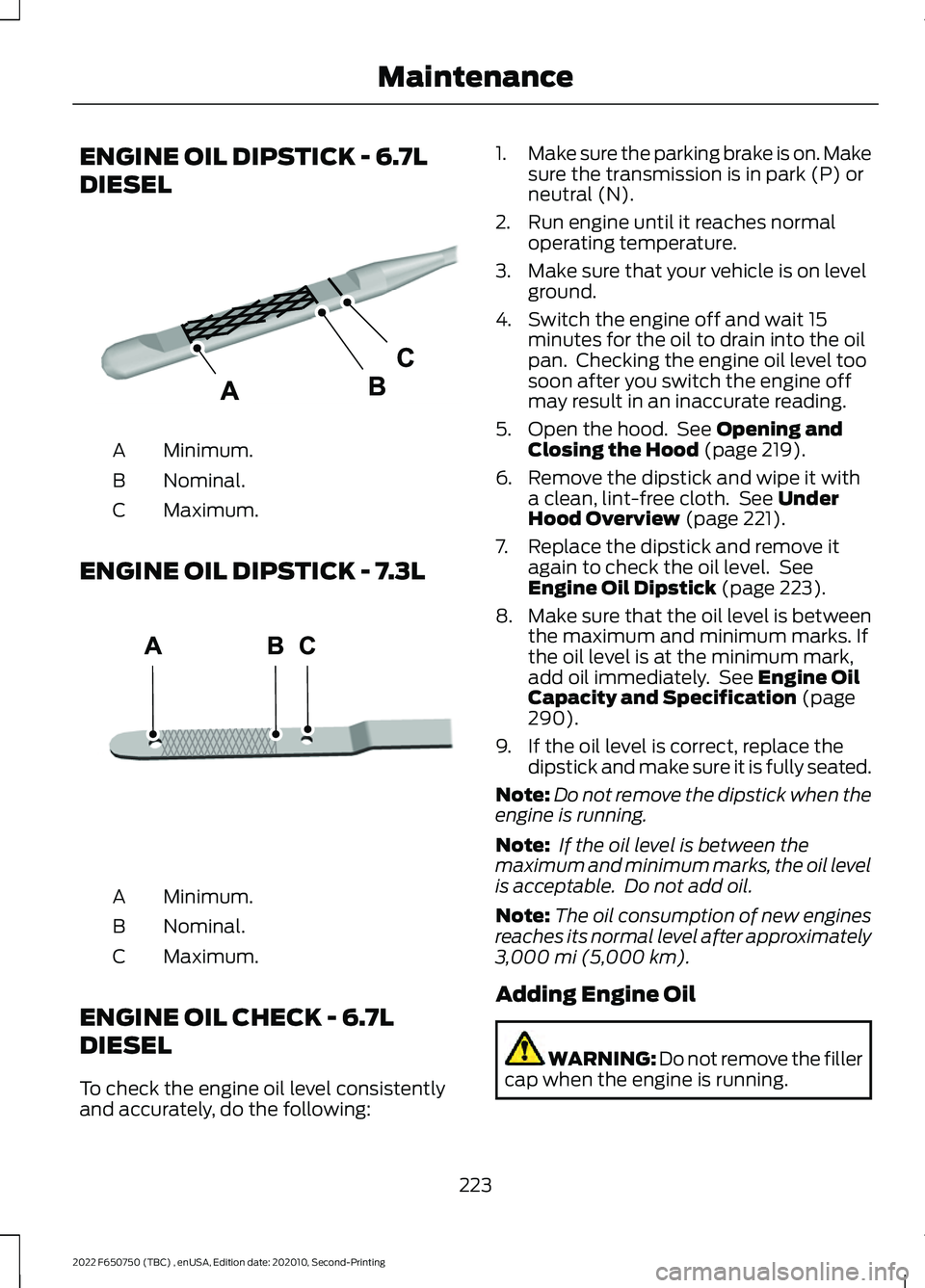
ENGINE OIL DIPSTICK - 6.7L
DIESEL
Minimum.
A
Nominal.
B
Maximum.
C
ENGINE OIL DIPSTICK - 7.3L Minimum.
A
Nominal.
B
Maximum.
C
ENGINE OIL CHECK - 6.7L
DIESEL
To check the engine oil level consistently
and accurately, do the following: 1.
Make sure the parking brake is on. Make
sure the transmission is in park (P) or
neutral (N).
2. Run engine until it reaches normal operating temperature.
3. Make sure that your vehicle is on level ground.
4. Switch the engine off and wait 15 minutes for the oil to drain into the oil
pan. Checking the engine oil level too
soon after you switch the engine off
may result in an inaccurate reading.
5. Open the hood. See Opening and
Closing the Hood (page 219).
6. Remove the dipstick and wipe it with a clean, lint-free cloth. See
Under
Hood Overview (page 221).
7. Replace the dipstick and remove it again to check the oil level. See
Engine Oil Dipstick
(page 223).
8. Make sure that the oil level is between
the maximum and minimum marks. If
the oil level is at the minimum mark,
add oil immediately. See
Engine Oil
Capacity and Specification (page
290).
9. If the oil level is correct, replace the dipstick and make sure it is fully seated.
Note: Do not remove the dipstick when the
engine is running.
Note: If the oil level is between the
maximum and minimum marks, the oil level
is acceptable. Do not add oil.
Note: The oil consumption of new engines
reaches its normal level after approximately
3,000 mi (5,000 km)
.
Adding Engine Oil WARNING: Do not remove the filler
cap when the engine is running.
223
2022 F650750 (TBC) , enUSA, Edition date: 202010, Second-Printing MaintenanceE249448 E250320
Page 261 of 379
Follow the tire manufacturer's
recommended cold inflation pressure for
the tire size, load range (ply rating) and
steer axle loading typical for their operation
(each steer axle tire equals ½ steer axle
loading).
Special applications may warrant a setting
based on experience with the type of tire
operating loads and conditions. Radial tires
are more sensitive to toe-in setting than
bias ply tires. Fine tuning school bus
alignment to line-haul truck standards
does not drastically improve tire tread life.
STEERING SYSTEM
INSPECTION
WARNING: Failure to maintain the
steering system in proper condition can
cause reduced steering ability resulting
in property damage, personal injury or
death.
Note: Have any steering problems
immediately corrected by a qualified service
technician.
Ask your service technician to examine the
steering mechanism. Only minor
adjustments may be necessary.
Regular inspections should include:
• Checking the tie rod, drag link end
clamp bolts and ball joints for proper
tightness.
• Checking for installation and spread of
cotter pins and tightness of nuts at
both ends of the tie rod and drag link.
• Checking that the pitman arm (steering
arm at steering gear) mounting is tight
and locked. Check system for leaks or
hose chafing. Repair immediately, if
necessary. •
Maintaining proper steering gear and
power steering pump lubricant levels.
• Checking steering column joint bolts
and steering linkage, particularly for
body-to-chassis clearance.
Steering Column Joint Bolts
As a good maintenance practice, check
steering column joint bolt tightness every
60,000 mi (96,000 km)
or annually,
whichever occurs first. Do not overtighten
the bolts.
Hydraulic System
Whenever draining and refilling the power
steering's hydraulic system for any reason,
bleed air from the system before returning
the vehicle to service. Failure to bleed the
hydraulic system properly can result in
degradation of power system performance.
Consult an authorized dealer who is aware
of the proper procedures for filling and
bleeding the system.
SUSPENSION SYSTEM
INSPECTION
Note: Do not adjust air suspension height
to any setting other than the specified
setting. Altering the height setting changes
the driveline angle and may result in
unwarrantable component damage, such
as transmission component damage.
Verify drive axle air suspension height and
height control valve performance at engine
oil change intervals.
Periodically check:
• Condition of spring leaves for evidence
of fatigue, bending or breakage.
• Condition of suspension mounting
brackets and bushings.
• Torque rod mounting fasteners for
tightness.
258
2022 F650750 (TBC) , enUSA, Edition date: 202010, Second-Printing Maintenance
Page 291 of 379
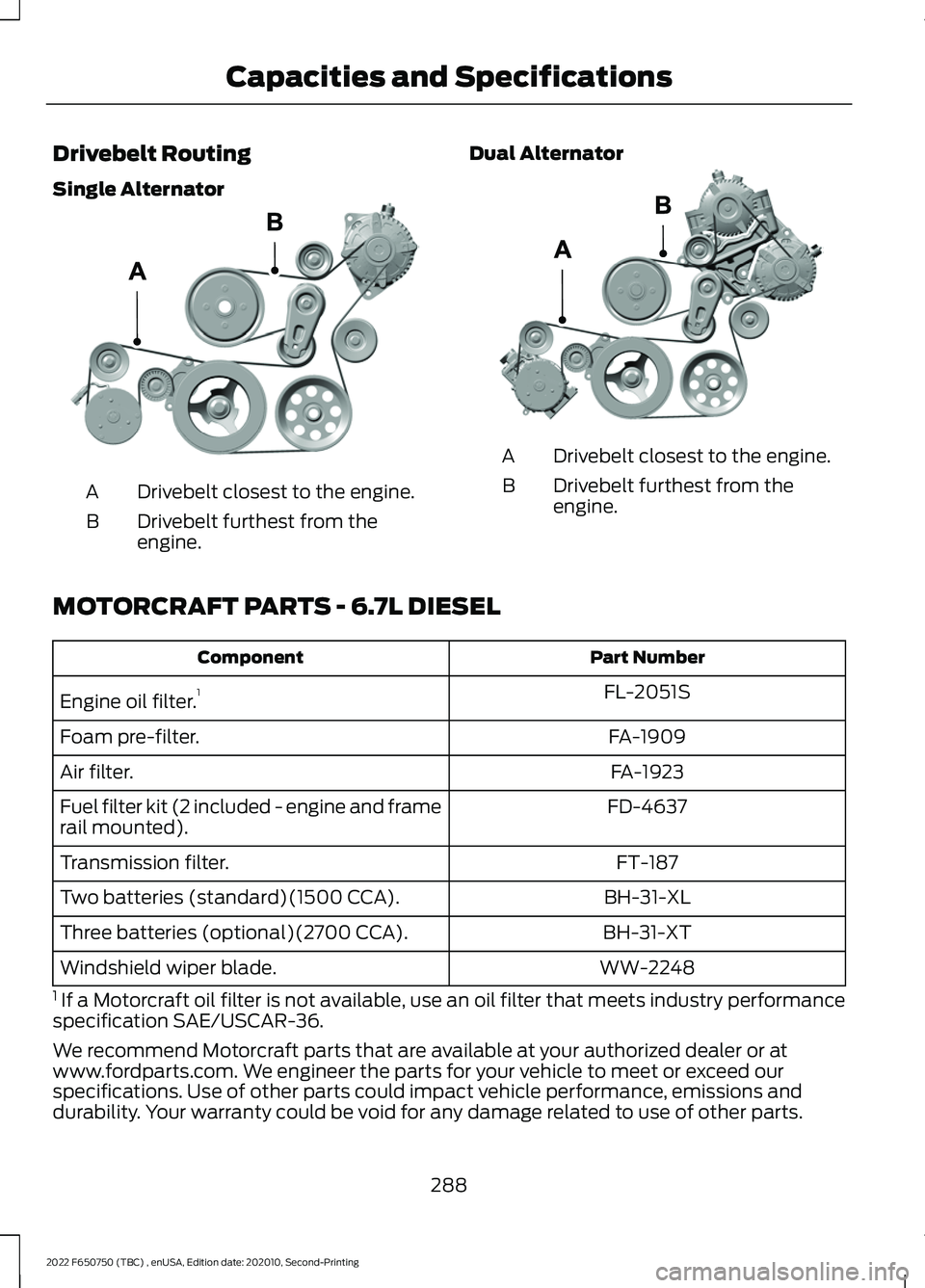
Drivebelt Routing
Single Alternator
Drivebelt closest to the engine.
A
Drivebelt furthest from the
engine.
B Dual Alternator Drivebelt closest to the engine.
A
Drivebelt furthest from the
engine.
B
MOTORCRAFT PARTS - 6.7L DIESEL Part Number
Component
FL-2051S
Engine oil filter. 1
FA-1909
Foam pre-filter.
FA-1923
Air filter.
FD-4637
Fuel filter kit (2 included - engine and frame
rail mounted).
FT-187
Transmission filter.
BH-31-XL
Two batteries (standard)(1500 CCA).
BH-31-XT
Three batteries (optional)(2700 CCA).
WW-2248
Windshield wiper blade.
1 If a Motorcraft oil filter is not available, use an oil filter that meets industry performance
specification SAE/USCAR-36.
We recommend Motorcraft parts that are available at your authorized dealer or at
www.fordparts.com. We engineer the parts for your vehicle to meet or exceed our
specifications. Use of other parts could impact vehicle performance, emissions and
durability. Your warranty could be void for any damage related to use of other parts.
288
2022 F650750 (TBC) , enUSA, Edition date: 202010, Second-Printing Capacities and SpecificationsE305075 E298579
Page 292 of 379
MOTORCRAFT PARTS - 7.3L
Motorcraft Part Number
Component
FA-1923
Air filter element.
BH-31-XT
One battery (standard)(900 CCA).
BH-31-XT
Two batteries (optional)(except for Limited
Series)(1800 CCA total).
BH-31-XT
Three batteries (optional)(2700 CCA).
FL-820-S
Engine oil filter. 1
SP-589
Spark plug.
FT-187
Transmission fluid filter.
WW-2248
Windshield wiper blade.
1 If a Motorcraft oil filter is not available, use an oil filter that meets industry performance
specification SAE/USCAR-36.
We recommend Motorcraft parts that are available at your authorized dealer or at
www.fordparts.com. We engineer these parts for your vehicle and to meet or exceed our
specifications. Use of other parts could impact vehicle performance, emissions and
durability. Your warranty could be void for any damage related to use of other parts.
289
2022 F650750 (TBC) , enUSA, Edition date: 202010, Second-Printing Capacities and Specifications
Page 307 of 379
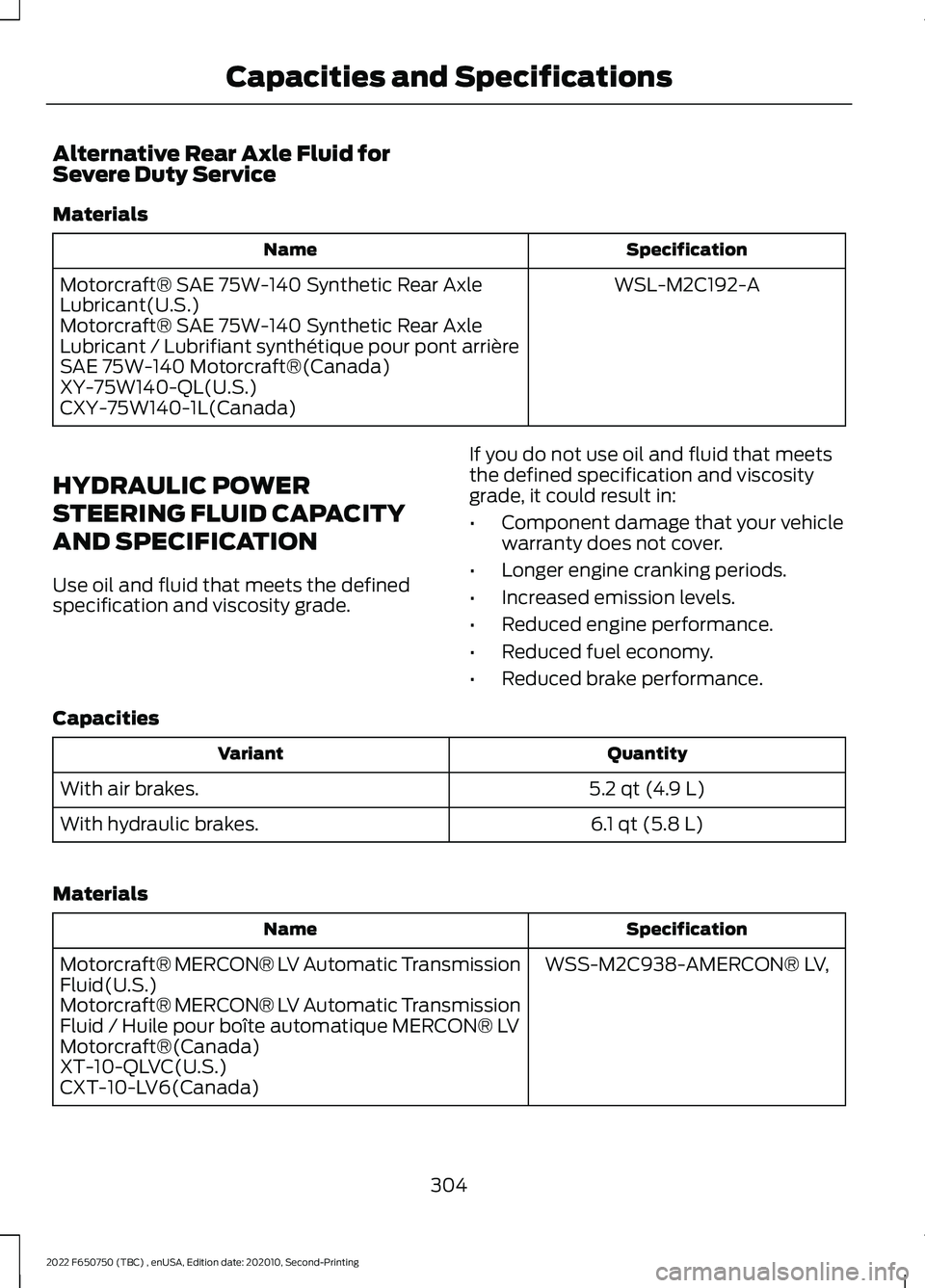
Alternative Rear Axle Fluid for
Severe Duty Service
Materials
Specification
Name
WSL-M2C192-A
Motorcraft® SAE 75W-140 Synthetic Rear Axle
Lubricant(U.S.)
Motorcraft® SAE 75W-140 Synthetic Rear Axle
Lubricant / Lubrifiant synthétique pour pont arrière
SAE 75W-140 Motorcraft®(Canada)
XY-75W140-QL(U.S.)
CXY-75W140-1L(Canada)
HYDRAULIC POWER
STEERING FLUID CAPACITY
AND SPECIFICATION
Use oil and fluid that meets the defined
specification and viscosity grade. If you do not use oil and fluid that meets
the defined specification and viscosity
grade, it could result in:
•
Component damage that your vehicle
warranty does not cover.
• Longer engine cranking periods.
• Increased emission levels.
• Reduced engine performance.
• Reduced fuel economy.
• Reduced brake performance.
Capacities Quantity
Variant
5.2 qt (4.9 L)
With air brakes.
6.1 qt (5.8 L)
With hydraulic brakes.
Materials Specification
Name
WSS-M2C938-AMERCON® LV,
Motorcraft® MERCON® LV Automatic Transmission
Fluid(U.S.)
Motorcraft® MERCON® LV Automatic Transmission
Fluid / Huile pour boîte automatique MERCON® LV
Motorcraft®(Canada)
XT-10-QLVC(U.S.)
CXT-10-LV6(Canada)
304
2022 F650750 (TBC) , enUSA, Edition date: 202010, Second-Printing Capacities and Specifications
Page 328 of 379
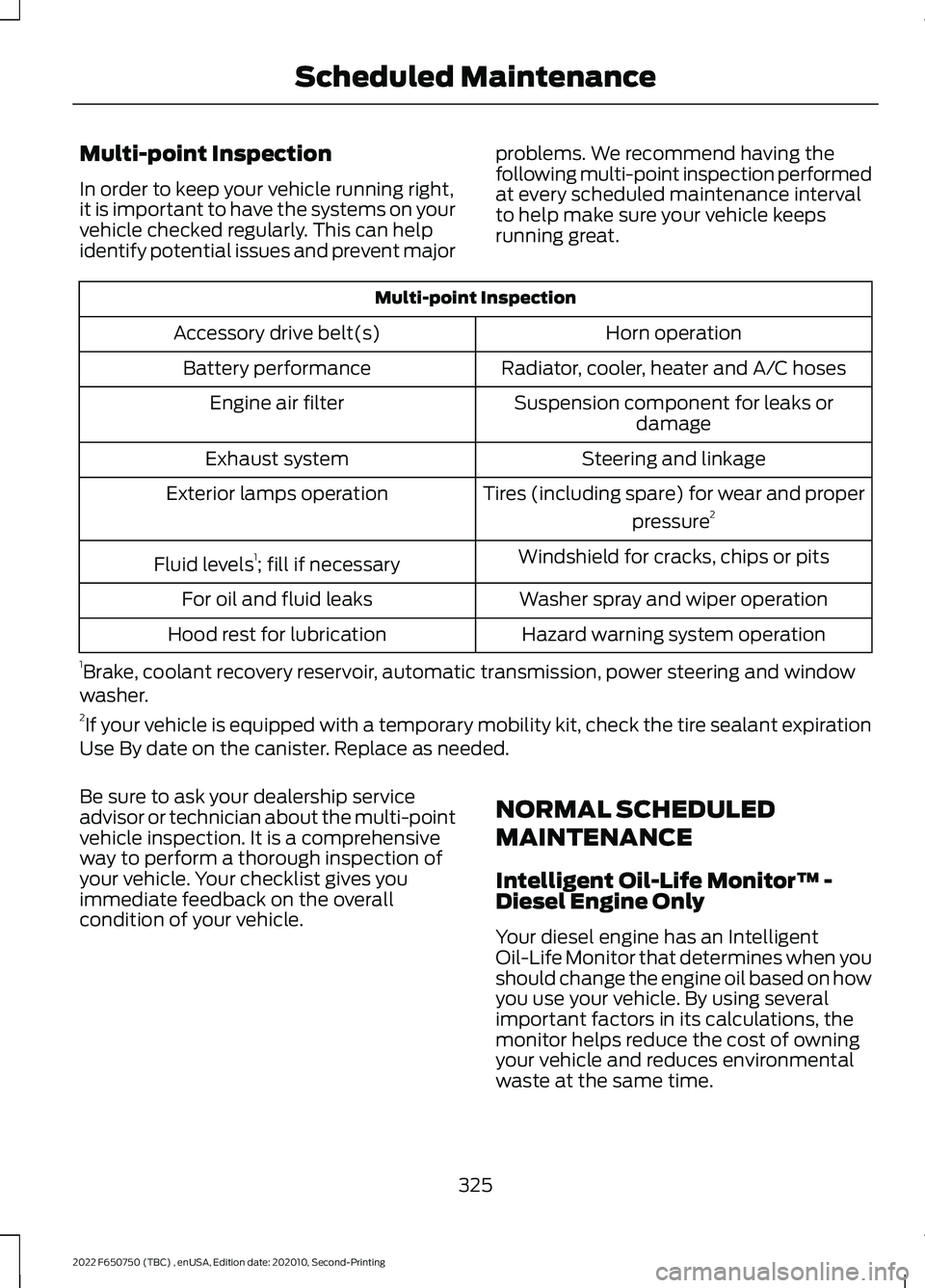
Multi-point Inspection
In order to keep your vehicle running right,
it is important to have the systems on your
vehicle checked regularly. This can help
identify potential issues and prevent major
problems. We recommend having the
following multi-point inspection performed
at every scheduled maintenance interval
to help make sure your vehicle keeps
running great.Multi-point Inspection
Horn operation
Accessory drive belt(s)
Radiator, cooler, heater and A/C hoses
Battery performance
Suspension component for leaks ordamage
Engine air filter
Steering and linkage
Exhaust system
Tires (including spare) for wear and properpressure2
Exterior lamps operation
Windshield for cracks, chips or pits
Fluid levels 1
; fill if necessary
Washer spray and wiper operation
For oil and fluid leaks
Hazard warning system operation
Hood rest for lubrication
1 Brake, coolant recovery reservoir, automatic transmission, power steering and window
washer.
2 If your vehicle is equipped with a temporary mobility kit, check the tire sealant expiration
Use By date on the canister. Replace as needed.
Be sure to ask your dealership service
advisor or technician about the multi-point
vehicle inspection. It is a comprehensive
way to perform a thorough inspection of
your vehicle. Your checklist gives you
immediate feedback on the overall
condition of your vehicle. NORMAL SCHEDULED
MAINTENANCE
Intelligent Oil-Life Monitor™ -
Diesel Engine Only
Your diesel engine has an Intelligent
Oil-Life Monitor that determines when you
should change the engine oil based on how
you use your vehicle. By using several
important factors in its calculations, the
monitor helps reduce the cost of owning
your vehicle and reduces environmental
waste at the same time.
325
2022 F650750 (TBC) , enUSA, Edition date: 202010, Second-Printing Scheduled Maintenance
Page 330 of 379
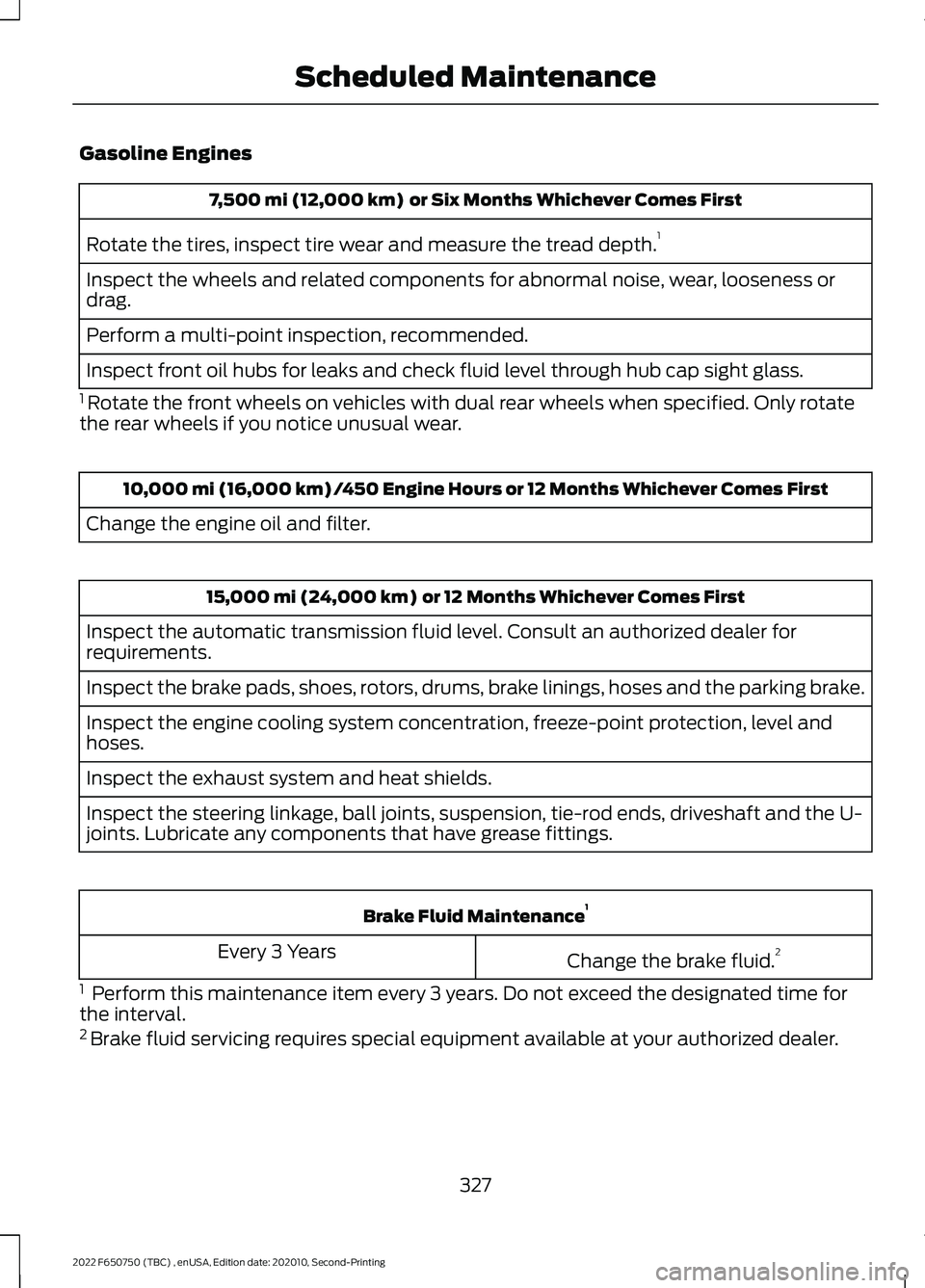
Gasoline Engines
7,500 mi (12,000 km) or Six Months Whichever Comes First
Rotate the tires, inspect tire wear and measure the tread depth. 1
Inspect the wheels and related components for abnormal noise, wear, looseness or
drag.
Perform a multi-point inspection, recommended.
Inspect front oil hubs for leaks and check fluid level through hub cap sight glass.
1 Rotate the front wheels on vehicles with dual rear wheels when specified. Only rotate
the rear wheels if you notice unusual wear. 10,000 mi (16,000 km) /450 Engine Hours or 12 Months Whichever Comes First
Change the engine oil and filter. 15,000 mi (24,000 km) or 12 Months Whichever Comes First
Inspect the automatic transmission fluid level. Consult an authorized dealer for
requirements.
Inspect the brake pads, shoes, rotors, drums, brake linings, hoses and the parking brake.
Inspect the engine cooling system concentration, freeze-point protection, level and
hoses.
Inspect the exhaust system and heat shields.
Inspect the steering linkage, ball joints, suspension, tie-rod ends, driveshaft and the U-
joints. Lubricate any components that have grease fittings. Brake Fluid Maintenance
1
Change the brake fluid. 2
Every 3 Years
1 Perform this maintenance item every 3 years. Do not exceed the designated time for
the interval.
2 Brake fluid servicing requires special equipment available at your authorized dealer.
327
2022 F650750 (TBC) , enUSA, Edition date: 202010, Second-Printing Scheduled Maintenance
Page 331 of 379
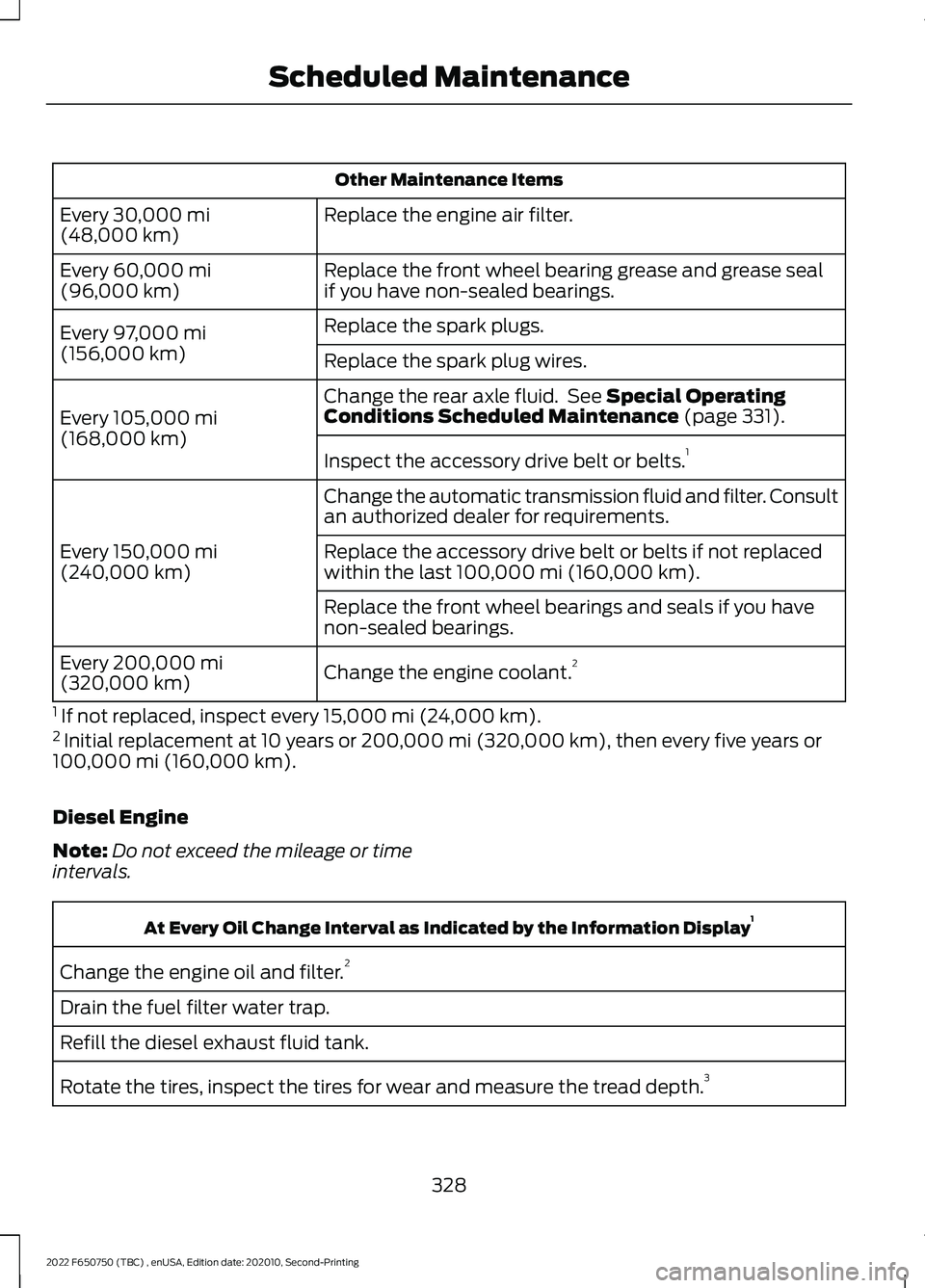
Other Maintenance Items
Replace the engine air filter.
Every 30,000 mi
(48,000 km)
Replace the front wheel bearing grease and grease seal
if you have non-sealed bearings.
Every
60,000 mi
(96,000 km)
Replace the spark plugs.
Every
97,000 mi
(156,000 km) Replace the spark plug wires.
Change the rear axle fluid. See
Special Operating
Conditions Scheduled Maintenance (page 331).
Every 105,000 mi
(168,000 km)
Inspect the accessory drive belt or belts. 1
Change the automatic transmission fluid and filter. Consult
an authorized dealer for requirements.
Every
150,000 mi
(240,000 km) Replace the accessory drive belt or belts if not replaced
within the last 100,000 mi (160,000 km).
Replace the front wheel bearings and seals if you have
non-sealed bearings.
Change the engine coolant. 2
Every
200,000 mi
(320,000 km)
1 If not replaced, inspect every
15,000 mi (24,000 km).
2 Initial replacement at 10 years or
200,000 mi (320,000 km), then every five years or
100,000 mi (160,000 km).
Diesel Engine
Note: Do not exceed the mileage or time
intervals. At Every Oil Change Interval as Indicated by the Information Display
1
Change the engine oil and filter. 2
Drain the fuel filter water trap.
Refill the diesel exhaust fluid tank.
Rotate the tires, inspect the tires for wear and measure the tread depth. 3
328
2022 F650750 (TBC) , enUSA, Edition date: 202010, Second-Printing Scheduled Maintenance
Page 332 of 379
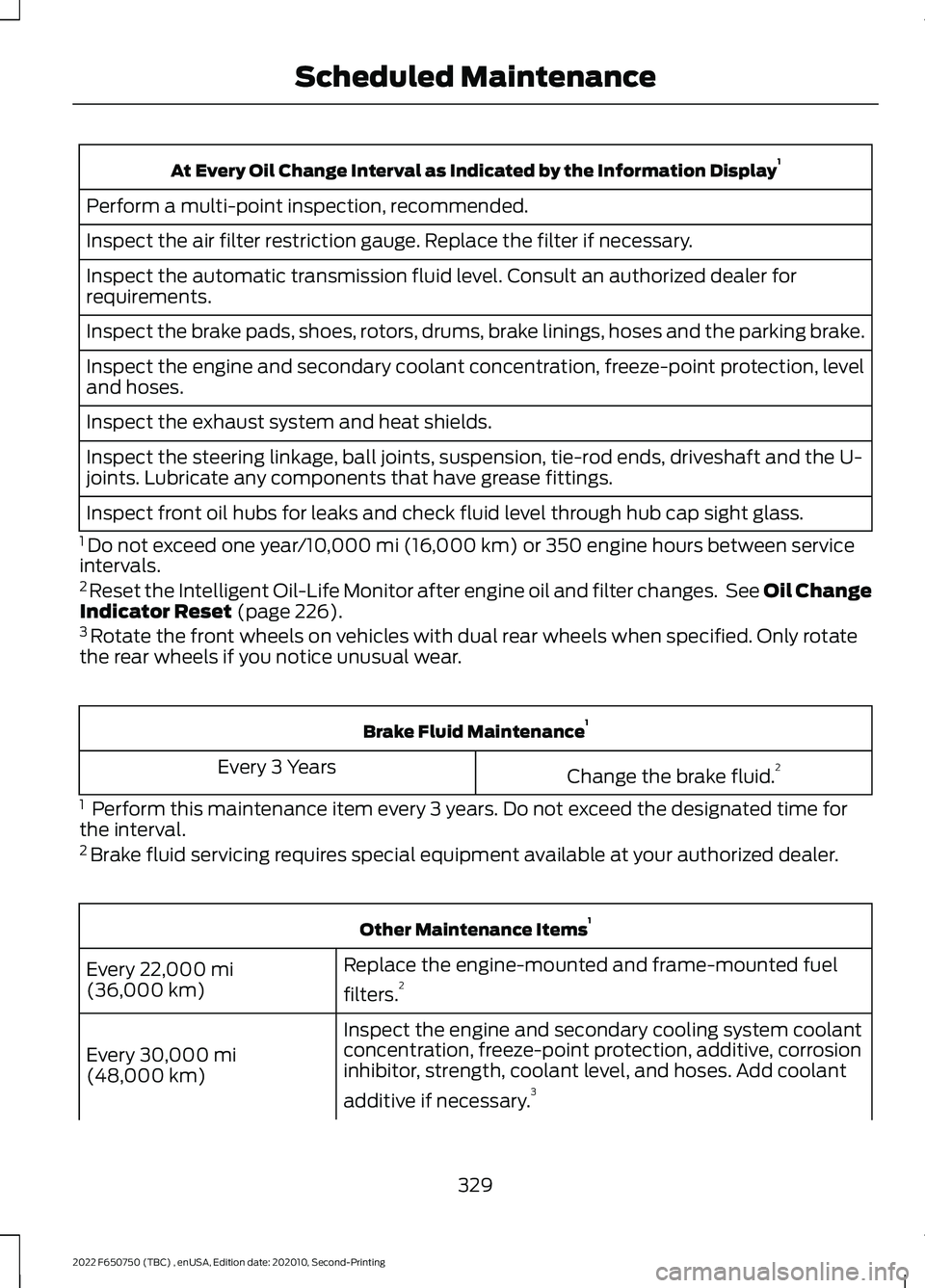
At Every Oil Change Interval as Indicated by the Information Display
1
Perform a multi-point inspection, recommended.
Inspect the air filter restriction gauge. Replace the filter if necessary.
Inspect the automatic transmission fluid level. Consult an authorized dealer for
requirements.
Inspect the brake pads, shoes, rotors, drums, brake linings, hoses and the parking brake.
Inspect the engine and secondary coolant concentration, freeze-point protection, level
and hoses.
Inspect the exhaust system and heat shields.
Inspect the steering linkage, ball joints, suspension, tie-rod ends, driveshaft and the U-
joints. Lubricate any components that have grease fittings.
Inspect front oil hubs for leaks and check fluid level through hub cap sight glass.
1 Do not exceed one year/10,000 mi (16,000 km) or 350 engine hours between service
intervals.
2 Reset the Intelligent Oil-Life Monitor after engine oil and filter changes. See Oil Change
Indicator Reset
(page 226).
3 Rotate the front wheels on vehicles with dual rear wheels when specified. Only rotate
the rear wheels if you notice unusual wear. Brake Fluid Maintenance
1
Change the brake fluid. 2
Every 3 Years
1 Perform this maintenance item every 3 years. Do not exceed the designated time for
the interval.
2 Brake fluid servicing requires special equipment available at your authorized dealer. Other Maintenance Items
1
Replace the engine-mounted and frame-mounted fuel
filters. 2
Every
22,000 mi
(36,000 km)
Inspect the engine and secondary cooling system coolant
concentration, freeze-point protection, additive, corrosion
inhibitor, strength, coolant level, and hoses. Add coolant
additive if necessary.3
Every
30,000 mi
(48,000 km)
329
2022 F650750 (TBC) , enUSA, Edition date: 202010, Second-Printing Scheduled Maintenance
Page 333 of 379
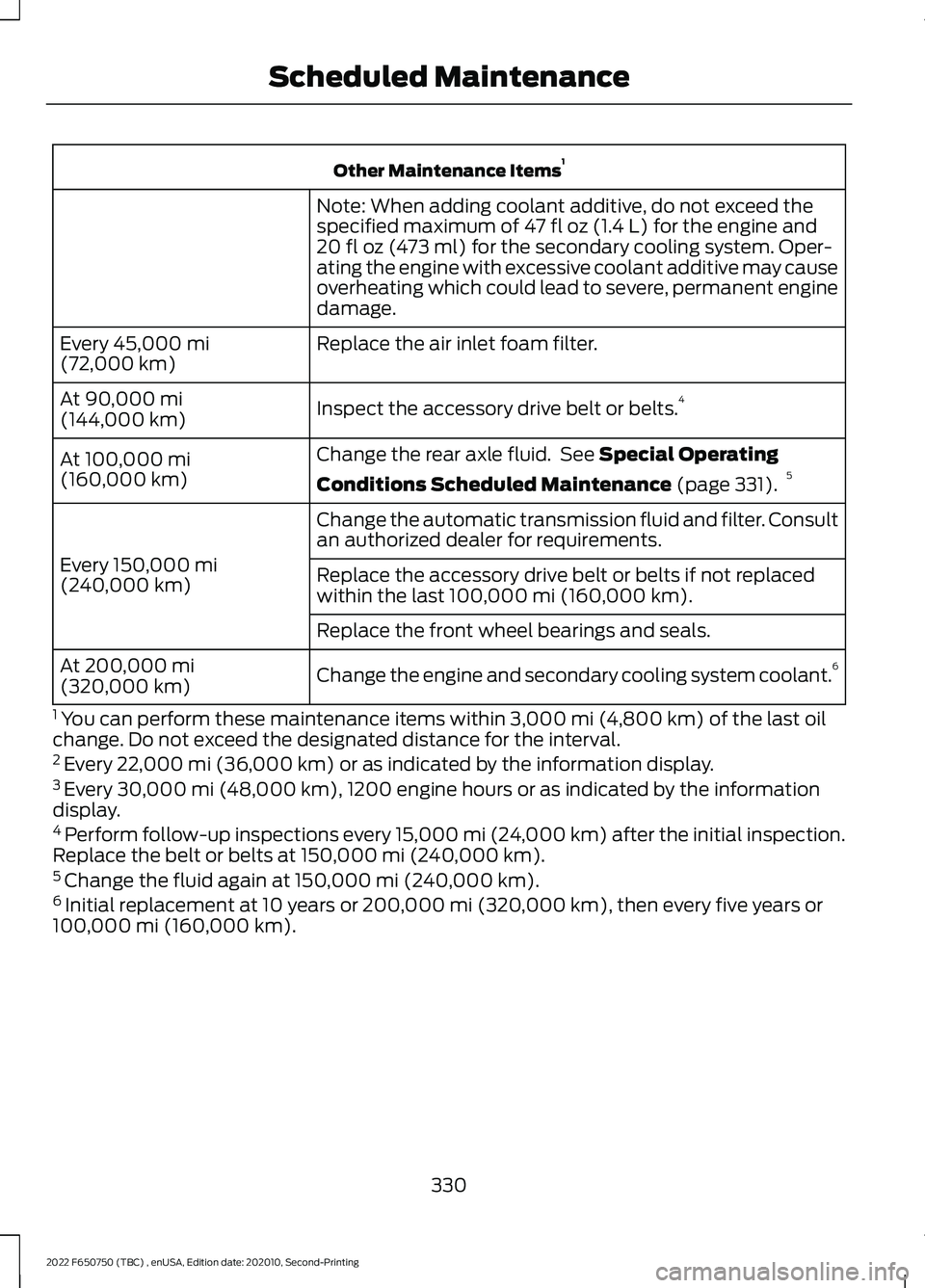
Other Maintenance Items
1
Note: When adding coolant additive, do not exceed the
specified maximum of 47 fl oz (1.4 L) for the engine and
20 fl oz (473 ml) for the secondary cooling system. Oper-
ating the engine with excessive coolant additive may cause
overheating which could lead to severe, permanent engine
damage.
Replace the air inlet foam filter.
Every
45,000 mi
(72,000 km)
Inspect the accessory drive belt or belts. 4
At
90,000 mi
(144,000 km)
Change the rear axle fluid. See
Special Operating
Conditions Scheduled Maintenance
(page 331). 5
At
100,000 mi
(160,000 km)
Change the automatic transmission fluid and filter. Consult
an authorized dealer for requirements.
Every
150,000 mi
(240,000 km) Replace the accessory drive belt or belts if not replaced
within the last
100,000 mi (160,000 km).
Replace the front wheel bearings and seals.
Change the engine and secondary cooling system coolant. 6
At
200,000 mi
(320,000 km)
1 You can perform these maintenance items within
3,000 mi (4,800 km) of the last oil
change. Do not exceed the designated distance for the interval.
2 Every
22,000 mi (36,000 km) or as indicated by the information display.
3 Every
30,000 mi (48,000 km), 1200 engine hours or as indicated by the information
display.
4 Perform follow-up inspections every 15,000 mi (24,000 km) after the initial inspection.
Replace the belt or belts at
150,000 mi (240,000 km).
5 Change the fluid again at
150,000 mi (240,000 km).
6 Initial replacement at 10 years or
200,000 mi (320,000 km), then every five years or
100,000 mi (160,000 km).
330
2022 F650750 (TBC) , enUSA, Edition date: 202010, Second-Printing Scheduled Maintenance