automatic transmission FORD F-650/750 2022 Owners Manual
[x] Cancel search | Manufacturer: FORD, Model Year: 2022, Model line: F-650/750, Model: FORD F-650/750 2022Pages: 379, PDF Size: 5.29 MB
Page 5 of 379
Windows and Mirrors
Power Windows
............................................59
Exterior Mirrors ..............................................
60
Interior Mirror ..................................................
62
Sun Visors ........................................................
62
Instrument Cluster
Gauges ..............................................................
63
Warning Lamps and Indicators ...............
66
Audible Warnings and Indicators ............
69
Information Displays
General Information .....................................
70
Information Messages .................................
74
Climate Control
Manual Climate Control .............................
85
Hints on Controlling the Interior Climate ........................................................................\
..
86
Heated Exterior Mirrors ...............................
87
Seats
Sitting in the Correct Position ..................
88
Head Restraints .............................................
88
Manual Seats .................................................
90
Power Seats .....................................................
91
Rear Seats ........................................................
93
Front Seat Armrest .......................................
94
Rear Seat Armrest ........................................
94
Auxiliary Power Points
Auxiliary Power Points ................................
95
USB Ports
Locating the USB Ports ...............................
97
Playing Media Using the USB Port .........
97
Charging a Device .........................................
98Storage Compartments
Overhead Console
........................................
99
Starting and Stopping the Engine
General Information ..................................
100
Ignition Switch .............................................
100
Starting a Gasoline Engine .......................
101
Starting a Diesel Engine ............................
102
Switching Off the Engine .........................
103
Engine Idle Shutdown ...............................
103
Engine Block Heater ...................................
104
Fuel and Refueling
Safety Precautions .....................................
105
Fuel Quality - Diesel ...................................
106
Fuel Quality - Gasoline .............................
109
Running Out of Fuel - Diesel ....................
110
Running Out of Fuel - Gasoline ...............
110
Refueling - Diesel .........................................
110
Refueling - Gasoline .....................................
111
Fuel Consumption ........................................
112
Fuel Tank Selector Switch .........................
114
Engine Emission Control
Emission Law .................................................
115
Catalytic Converter ......................................
116
Selective Catalytic Reductant System - Diesel ............................................................
118
Diesel Particulate Filter ..............................
122
Transmission
Automatic Transmission ...........................
128
Power Take-Off ............................................
133
Rear Axle
General Information ...................................
134
Electronic Locking Differential ...............
134
2-Speed Rear Axle ......................................
135
2
2022 F650750 (TBC) , enUSA, Edition date: 202010, Second-Printing Table of Contents
Page 7 of 379

........................................................................\
.197
Reporting Safety Defects (Canada Only) .............................................")
Reporting Safety Defects (U.S. Only)
........................................................................\
.197
Reporting Safety Defects (Canada Only) ........................................................................\
198
Fuses
Fuse Specification Chart ..........................
199
Changing a Fuse ..........................................
207
Vehicle Inspection Guide
Vehicle Inspection Information .............
209
Maintenance
General Information ...................................
218
Opening and Closing the Hood ..............
219
Under Hood Overview - 6.7L Diesel ......
221
Under Hood Overview - 7.3L ...................
222
Engine Oil Dipstick - 6.7L Diesel ............
223
Engine Oil Dipstick - 7.3L ..........................
223
Engine Oil Check - 6.7L Diesel ................
223
Engine Oil Check - 7.3L .............................
224
Changing the Engine Oil and Oil Filter ........................................................................\
225
Oil Change Indicator Reset .....................
226
Changing the Engine Air Filter - 6.7L Diesel ...........................................................
227
Changing the Engine Air Filter - 7.3L .....
229
Draining the Fuel Filter Water Trap - 6.7L Diesel ............................................................
231
Engine Coolant Check - 6.7L Diesel ......
232
Engine Coolant Check - 7.3L ...................
237
Automatic Transmission Fluid Check ........................................................................\
.
241
Brake Fluid Check .......................................
243
Power Steering Fluid Check ...................
244
Changing the 12V Battery ........................
245
Adjusting the Headlamps .......................
246
Washer Fluid Check ...................................
248
Fuel Filter - 7.3L ...........................................
248
Checking the Wiper Blades ....................
248
Changing the Wiper Blades ....................
248Removing a Headlamp
............................
249
Changing a Bulb .........................................
249
Changing the Engine-Mounted and Diesel Fuel Conditioner Module Fuel
Filters - 6.7L Diesel .................................
250
Electrical System Inspection ..................
253
Air Induction System Inspection ...........
253
Exhaust System Inspection ....................
254
Brake System Inspection .........................
254
Axle Inspection .............................................
257
Steering System Inspection ...................
258
Suspension System Inspection .............
258
Frame and Tow Hook Inspection .........
259
Rear Axle Fluid Check ...............................
259
Spring U-Bolt Check ..................................
259
Vehicle Care
General Information ...................................
261
Cleaning Products .......................................
261
Cleaning the Exterior .................................
262
Waxing ............................................................
263
Cleaning the Engine ...................................
263
Cleaning the Windows and Wiper Blades ........................................................................\
264
Cleaning the Interior ..................................
264
Cleaning the Instrument Panel and Instrument Cluster Lens ......................
265
Repairing Minor Paint Damage .............
265
Cleaning the Wheels .................................
265
Vehicle Storage ...........................................
266
Wheels and Tires
Tire Care .........................................................
268
Using Snow Chains ....................................
283
Changing a Road Wheel ..........................
283
Technical Specifications ..........................
285
Capacities and Specifications
Engine Specifications - 6.7L Diesel ......
286
4
2022 F650750 (TBC) , enUSA, Edition date: 202010, Second-Printing Table of Contents
Page 8 of 379
Engine Specifications - 7.3L
....................287
Motorcraft Parts - 6.7L Diesel ................
288
Motorcraft Parts - 7.3L ..............................
289
Bulb Specification Chart .........................
290
Engine Oil Capacity and Specification - 6.7L Diesel .................................................
290
Engine Oil Capacity and Specification - 7.3L ...............................................................
293
Cooling System Capacity and Specification - 6.7L Diesel ..................
295
Cooling System Capacity and Specification - 7.3L ................................
296
Fuel Tank Capacity - Diesel ....................
296
Fuel Tank Capacity - Gasoline ...............
297
Air Conditioning System Capacity and Specification - 6.7L Diesel ..................
298
Air Conditioning System Capacity and Specification - 7.3L ................................
299
Washer Fluid Specification .....................
299
Diesel Exhaust Fluid Capacity and Specification ...........................................
300
Automatic Transmission Fluid Capacity and Specification ...................................
300
Brake Fluid Specification ..........................
301
Rear Axle Fluid Capacity and Specification - Diesel ............................
302
Rear Axle Fluid Capacity and Specification - Gasoline ......................
303
Hydraulic Power Steering Fluid Capacity and Specification ...................................
304
Vehicle Identification
Vehicle Identification Number ..............
305
Connected Vehicle
Connected Vehicle Requirements .......
306
Connected Vehicle Limitations .............
306
Connecting the Vehicle to a Mobile Network - Vehicles With: Modem .....
306
Connected Vehicle – Troubleshooting ........................................................................\
307 Audio System
General Information
..................................
308
Audio Unit .....................................................
308
Digital Radio ...................................................
311
Connecting a Bluetooth® Device ..........
313
Streaming Bluetooth Audio .....................
314
Playing Media From a USB Device ........
314
Audio Input Jack ...........................................
314
USB Port .........................................................
315
Using Voice Recognition ...........................
316
Accessories
Auxiliary Switches ........................................
317
Ford Protect
Ford Protect ...................................................
319
Scheduled Maintenance
General Maintenance Information ........
321
Normal Scheduled Maintenance ..........
325
Special Operating Conditions Scheduled Maintenance ..............................................
331
Customer Information
Rollover Warning ........................................
340
Radio Frequency Certification Labels .......................................................................
340
Appendices
Electromagnetic Compatibility .............
345
End User License Agreement ................
348
5
2022 F650750 (TBC) , enUSA, Edition date: 202010, Second-Printing Table of Contents
Page 26 of 379
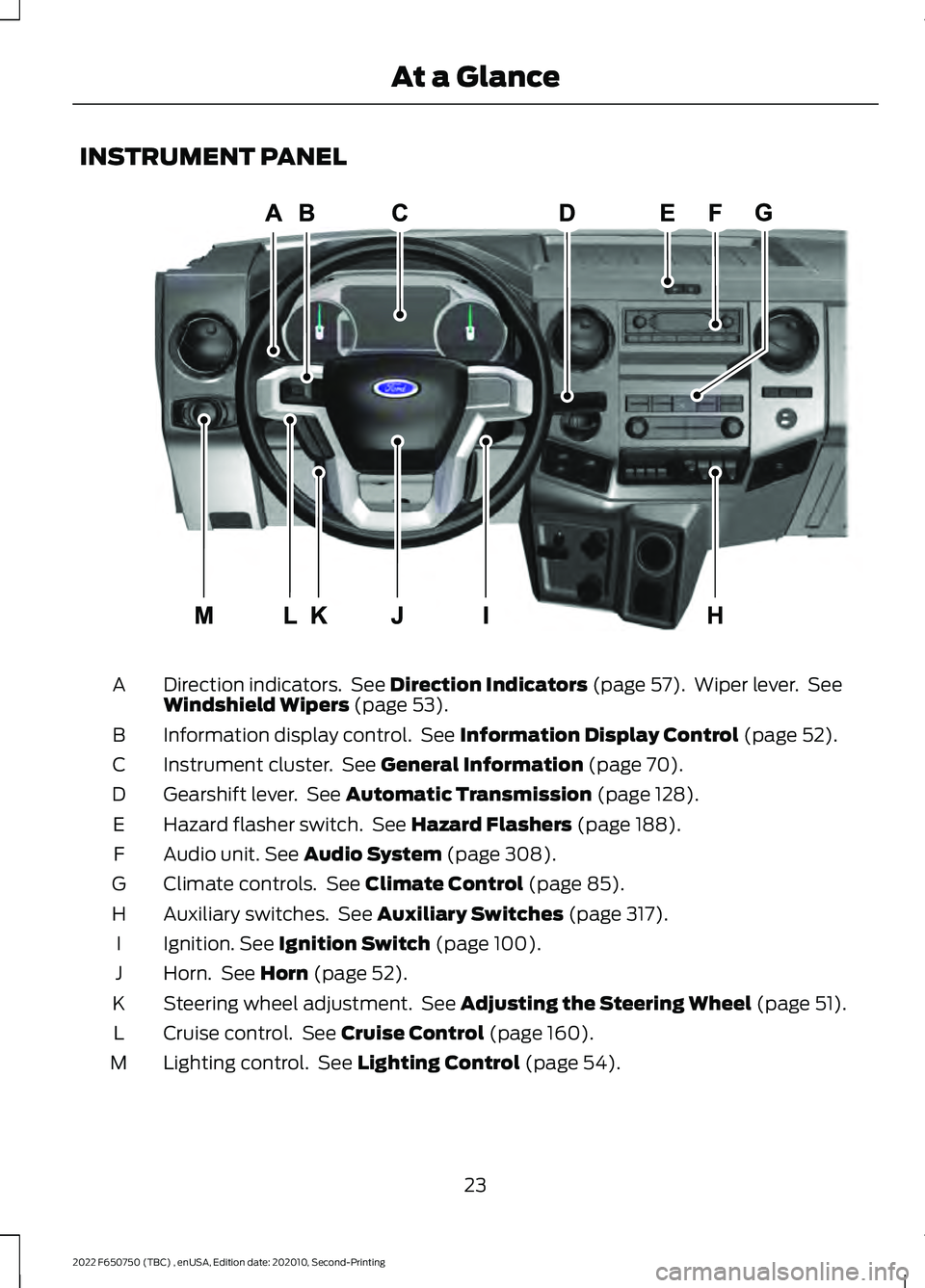
INSTRUMENT PANEL
Direction indicators. See Direction Indicators (page 57). Wiper lever. See
Windshield Wipers (page 53).
A
Information display control. See
Information Display Control (page 52).
B
Instrument cluster. See
General Information (page 70).
C
Gearshift lever. See
Automatic Transmission (page 128).
D
Hazard flasher switch. See
Hazard Flashers (page 188).
E
Audio unit.
See Audio System (page 308).
F
Climate controls. See
Climate Control (page 85).
G
Auxiliary switches. See
Auxiliary Switches (page 317).
H
Ignition.
See Ignition Switch (page 100).
I
Horn. See
Horn (page 52).
J
Steering wheel adjustment. See
Adjusting the Steering Wheel (page 51).
K
Cruise control. See
Cruise Control (page 160).
L
Lighting control. See
Lighting Control (page 54).
M
23
2022 F650750 (TBC) , enUSA, Edition date: 202010, Second-Printing At a GlanceE307565
Page 59 of 379
DAYTIME RUNNING LAMPS -
VEHICLES WITH: DAYTIME
RUNNING LAMPS (DRL) (IF
EQUIPPED) WARNING:
The daytime running
lamps system does not activate the rear
lamps and may not provide adequate
lighting during low visibility driving
conditions. Make sure you switch the
headlamps on, as appropriate, during all
low visibility conditions. Failure to do so
may result in a crash.
The system turns the lamps on in daylight
conditions.
To switch the system on, switch the
lighting control to any position except
headlamps.
DAYTIME RUNNING LAMPS -
VEHICLES WITH:
CONFIGURABLE DAYTIME
RUNNING LAMPS WARNING:
The daytime running
lamps system does not activate the rear
lamps and may not provide adequate
lighting during low visibility driving
conditions. Make sure you switch the
headlamps on, as appropriate, during all
low visibility conditions. Failure to do so
may result in a crash.
Switch the daytime running lamps on or
off using the information display. See
General Information
(page 70). The daytime running lamps turn on when:
1. The lamps are on in the information
display.
2. You switch the ignition on.
3. The transmission is not in park (P) for vehicles with automatic transmissions
or you release the parking brake for
vehicles with manual transmissions.
4. The lighting control is in the autolamps
position.
5. The headlamps are off.
The other lighting control switch positions
do not turn on the daytime running lamps.
If the daytime running lamps are off in the
information display, the lamps stay off in
all switch positions.
AUTOMATIC HIGH BEAM
CONTROL
(IF EQUIPPED) WARNING:
The system does not
relieve you of your responsibility to drive
with due care and attention. You may
need to override the system if it does not
turn the high beams on or off.
The system turns on high beams if it is dark
enough and no other traffic is present. If it
detects an approaching vehicle ’s
headlamps or tail lamps, or street lighting
ahead, the system turns off high beams
before they can distract other road users.
Low beams remain on.
Note: The system may not operate properly
if the sensor is blocked. Keep the windshield
free from obstruction or damage.
Note: The system may not operate properly
in cold or inclement conditions. You can
switch on the high beams by overriding the
system.
56
2022 F650750 (TBC) , enUSA, Edition date: 202010, Second-Printing Lighting
Page 78 of 379
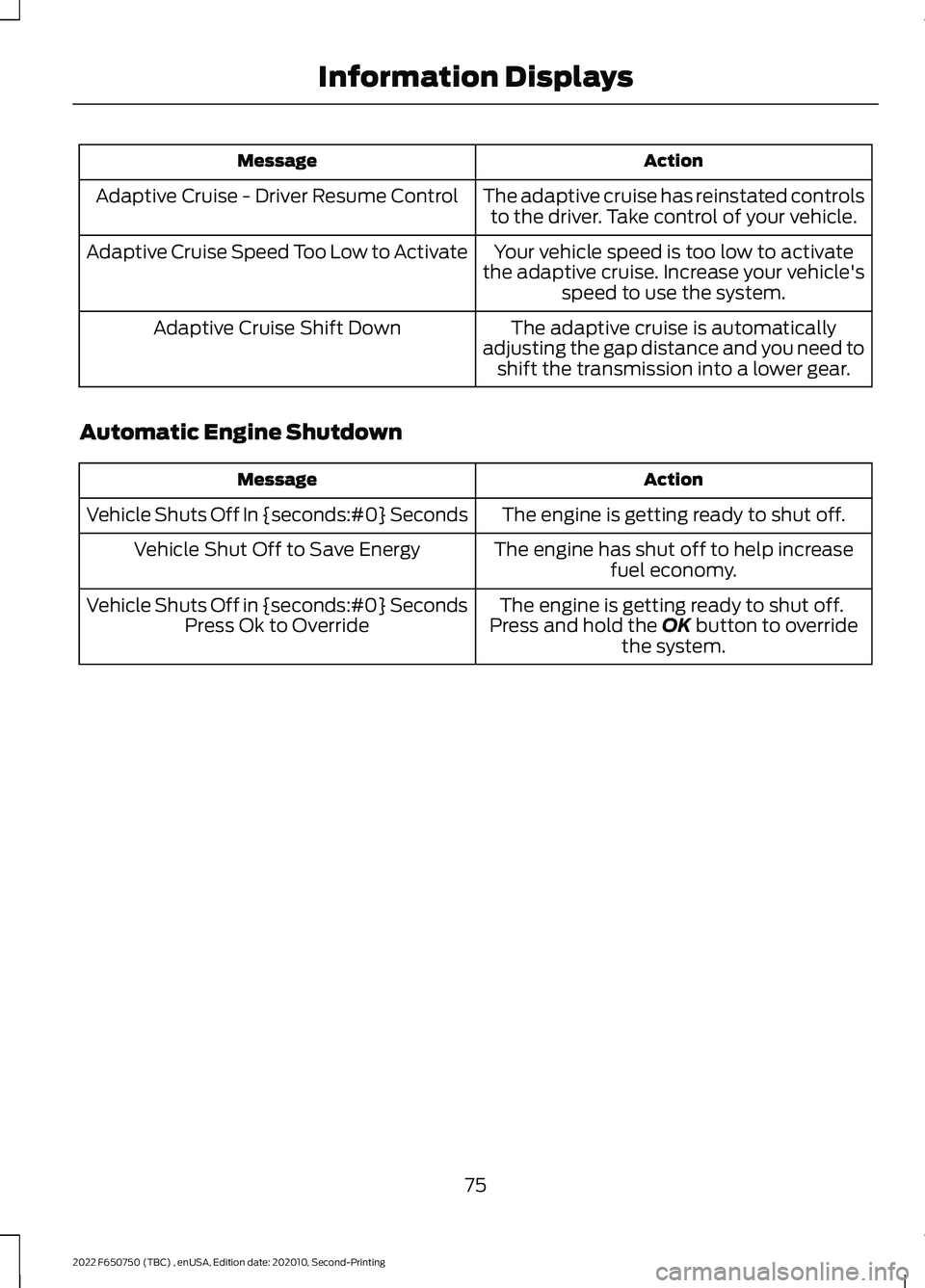
Action
Message
The adaptive cruise has reinstated controlsto the driver. Take control of your vehicle.
Adaptive Cruise - Driver Resume Control
Your vehicle speed is too low to activate
the adaptive cruise. Increase your vehicle's speed to use the system.
Adaptive Cruise Speed Too Low to Activate
The adaptive cruise is automatically
adjusting the gap distance and you need to shift the transmission into a lower gear.
Adaptive Cruise Shift Down
Automatic Engine Shutdown Action
Message
The engine is getting ready to shut off.
Vehicle Shuts Off In {seconds:#0} Seconds
The engine has shut off to help increasefuel economy.
Vehicle Shut Off to Save Energy
The engine is getting ready to shut off.
Press and hold the OK button to override
the system.
Vehicle Shuts Off in {seconds:#0} Seconds
Press Ok to Override
75
2022 F650750 (TBC) , enUSA, Edition date: 202010, Second-Printing Information Displays
Page 121 of 379
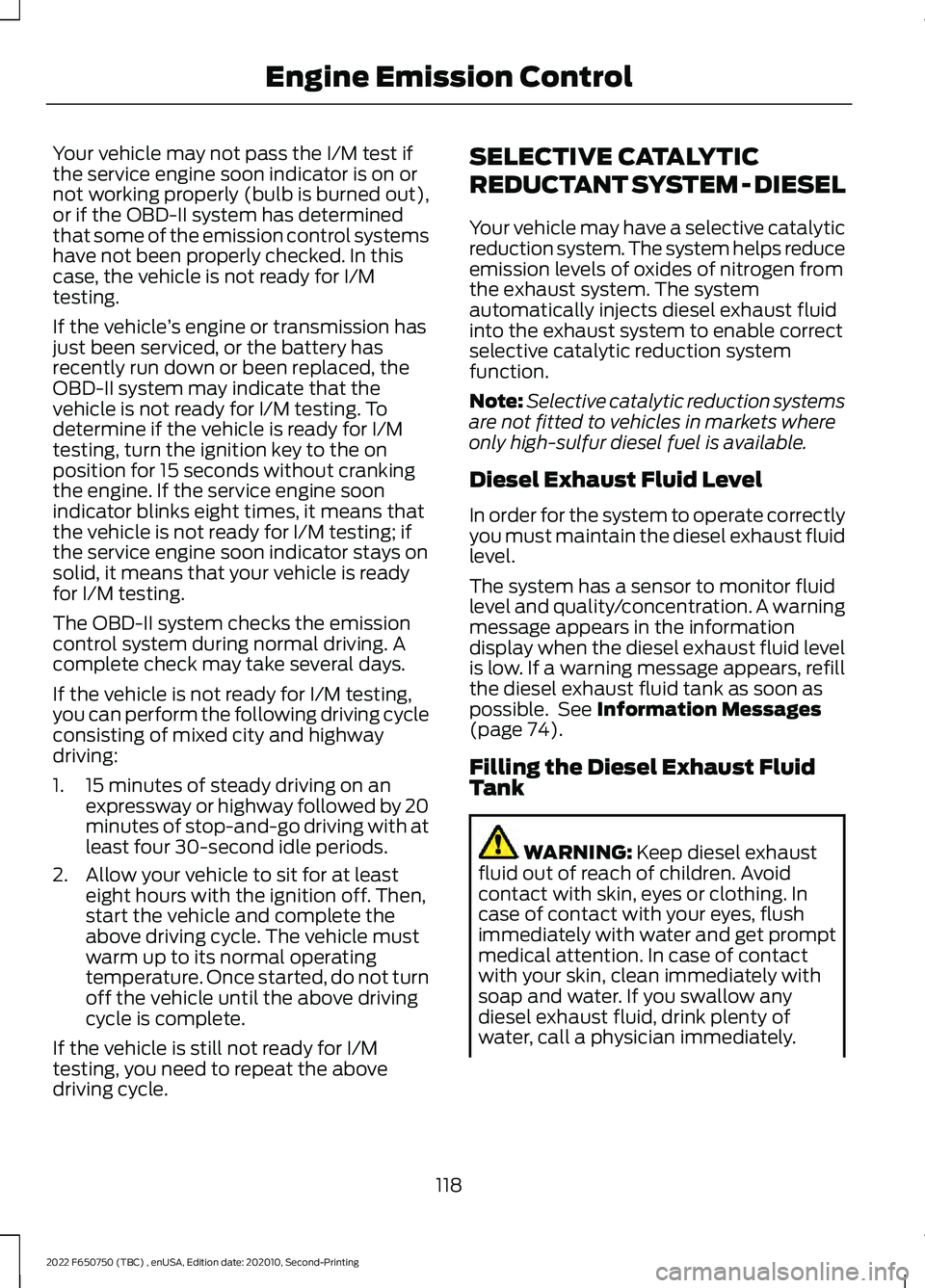
Your vehicle may not pass the I/M test if
the service engine soon indicator is on or
not working properly (bulb is burned out),
or if the OBD-II system has determined
that some of the emission control systems
have not been properly checked. In this
case, the vehicle is not ready for I/M
testing.
If the vehicle
’s engine or transmission has
just been serviced, or the battery has
recently run down or been replaced, the
OBD-II system may indicate that the
vehicle is not ready for I/M testing. To
determine if the vehicle is ready for I/M
testing, turn the ignition key to the on
position for 15 seconds without cranking
the engine. If the service engine soon
indicator blinks eight times, it means that
the vehicle is not ready for I/M testing; if
the service engine soon indicator stays on
solid, it means that your vehicle is ready
for I/M testing.
The OBD-II system checks the emission
control system during normal driving. A
complete check may take several days.
If the vehicle is not ready for I/M testing,
you can perform the following driving cycle
consisting of mixed city and highway
driving:
1. 15 minutes of steady driving on an expressway or highway followed by 20
minutes of stop-and-go driving with at
least four 30-second idle periods.
2. Allow your vehicle to sit for at least eight hours with the ignition off. Then,
start the vehicle and complete the
above driving cycle. The vehicle must
warm up to its normal operating
temperature. Once started, do not turn
off the vehicle until the above driving
cycle is complete.
If the vehicle is still not ready for I/M
testing, you need to repeat the above
driving cycle. SELECTIVE CATALYTIC
REDUCTANT SYSTEM - DIESEL
Your vehicle may have a selective catalytic
reduction system. The system helps reduce
emission levels of oxides of nitrogen from
the exhaust system. The system
automatically injects diesel exhaust fluid
into the exhaust system to enable correct
selective catalytic reduction system
function.
Note:
Selective catalytic reduction systems
are not fitted to vehicles in markets where
only high-sulfur diesel fuel is available.
Diesel Exhaust Fluid Level
In order for the system to operate correctly
you must maintain the diesel exhaust fluid
level.
The system has a sensor to monitor fluid
level and quality/concentration. A warning
message appears in the information
display when the diesel exhaust fluid level
is low. If a warning message appears, refill
the diesel exhaust fluid tank as soon as
possible. See Information Messages
(page 74).
Filling the Diesel Exhaust Fluid
Tank WARNING:
Keep diesel exhaust
fluid out of reach of children. Avoid
contact with skin, eyes or clothing. In
case of contact with your eyes, flush
immediately with water and get prompt
medical attention. In case of contact
with your skin, clean immediately with
soap and water. If you swallow any
diesel exhaust fluid, drink plenty of
water, call a physician immediately.
118
2022 F650750 (TBC) , enUSA, Edition date: 202010, Second-Printing Engine Emission Control
Page 131 of 379
AUTOMATIC TRANSMISSION
WARNING: Apply the parking
brake, shift into park (P), switch the
ignition off and remove the key before
you leave your vehicle. Failure to follow
this instruction could result in personal
injury or death.
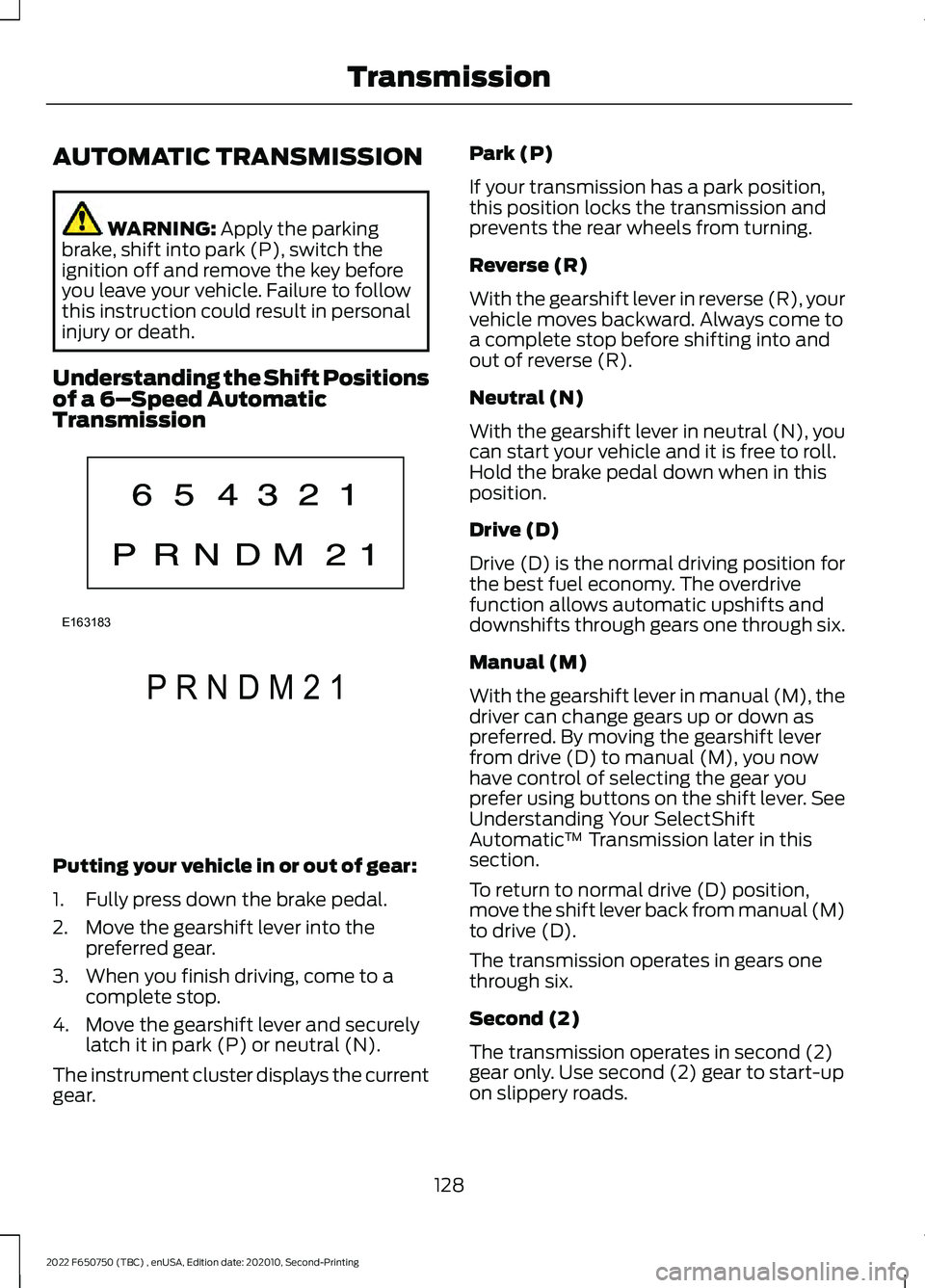
Understanding the Shift Positions
of a 6– Speed Automatic
Transmission Putting your vehicle in or out of gear:
1. Fully press down the brake pedal.
2. Move the gearshift lever into the
preferred gear.
3. When you finish driving, come to a complete stop.
4. Move the gearshift lever and securely latch it in park (P) or neutral (N).
The instrument cluster displays the current
gear. Park (P)
If your transmission has a park position,
this position locks the transmission and
prevents the rear wheels from turning.
Reverse (R)
With the gearshift lever in reverse (R), your
vehicle moves backward. Always come to
a complete stop before shifting into and
out of reverse (R).
Neutral (N)
With the gearshift lever in neutral (N), you
can start your vehicle and it is free to roll.
Hold the brake pedal down when in this
position.
Drive (D)
Drive (D) is the normal driving position for
the best fuel economy. The overdrive
function allows automatic upshifts and
downshifts through gears one through six.
Manual (M)
With the gearshift lever in manual (M), the
driver can change gears up or down as
preferred. By moving the gearshift lever
from drive (D) to manual (M), you now
have control of selecting the gear you
prefer using buttons on the shift lever. See
Understanding Your SelectShift
Automatic
™ Transmission later in this
section.
To return to normal drive (D) position,
move the shift lever back from manual (M)
to drive (D).
The transmission operates in gears one
through six.
Second (2)
The transmission operates in second (2)
gear only. Use second (2) gear to start-up
on slippery roads.
128
2022 F650750 (TBC) , enUSA, Edition date: 202010, Second-Printing TransmissionE163183 P R N D M 2 1E307627
Page 132 of 379
First (1)
•
The transmission operates in first (1)
gear only.
• Provides maximum engine braking.
• Allows upshifts by moving gearshift
lever.
• Does not downshift into first (1) gear
at high speeds; allows for first (1) gear
when vehicle reaches slower speeds.
Forced downshifts
• Allowed in drive (D) with the tow/haul
feature on or off.
• Press the accelerator to the floor.
• Allows transmission to select an
appropriate gear.
Tow/Haul Mode To activate tow/haul, press the
button on the gearshift lever
once. The TOW HAUL indicator
light illuminates in the instrument cluster.
The tow/haul feature:
• Delays upshifts to reduce the frequency
of transmission shifting.
• Provides engine braking in all forward
gears, which slows your vehicle and
assists you in controlling your vehicle
when descending a grade.
• Depending on driving conditions and
load conditions, could downshift the
transmission to slow your vehicle and
help to control your vehicle speed
when descending a hill, without
pressing the accelerator pedal. Tapping
the brake pedal downshifts the
transmission to provide additional
braking, only if the downshift does not
cause an engine overspeed condition. The tow/haul feature improves
transmission operation when towing a
trailer or a heavy load. All transmission
gear ranges are available when using
tow/haul.
Note:
Under certain conditions, the
automatic tow/haul feature engages, and
the TOW HAUL indicator comes on without
pressing the Tow/Haul button.
To deactivate the tow/haul feature and
return to normal driving mode, press the
button on the gearshift lever twice. The
TOW HAUL light deactivates. Tow/haul
also deactivates when you power down
your vehicle. WARNING: Do not use tow/haul
when the road surface is slippery. Failure
to follow this instruction could result in
the loss of control of your vehicle. WARNING:
Do not use diesel
engine exhaust braking when the road
surface is slippery. Failure to follow this
instruction could result in the loss of
control of your vehicle.
Understanding Your SelectShift™
Automatic Transmission
Your vehicle has a SelectShift Automatic
transmission gearshift lever. SelectShift
Automatic transmission gives you the
ability to change gears up or down, without
a clutch, as you prefer.
129
2022 F650750 (TBC) , enUSA, Edition date: 202010, Second-Printing TransmissionE161509
Page 134 of 379
To prevent the engine from running at too
low an RPM, which could cause it to stall,
SelectShift still makes some downshifts
if it has determined that you have not
downshifted in time. Although SelectShift
makes some downshifts for you, it still
allows you to downshift at any time if the
SelectShift determines that there is no
damage to the engine from over-revving.
SelectShift does not automatically upshift,
even if the engine is approaching the RPM
limit. Shift manually by pressing the +
button.
Note:
Engine damage could occur if you rev
the engine excessively and hold it without
shifting.
Progressive Range Selection - PRS
(If Equipped)
Progressive Range Selection gives you the
ability to lockout gears from the automatic
shifting range. This could provide you with
an improved driving experience, for
example, in slippery conditions or when
experiencing a steep slope.
With the gearshift lever in drive (D), press
the – button to activate progressive range
selection. The instrument cluster indicates
the available and selected gears.
All available gears display with the current
gear indicated. Press the – button again to
lock out gears beginning with the highest
gear. Example: press the – button twice to
lock out 6th and 5th gears. Only the
available gears display, and the
transmission shifts between the available
gears. Press the + button to unlock gears
to allow the transmission to shift to higher
gears. The transmission shifts within the
gear range you select. Automatic Transmission at a stop
(If Equipped)
Your transmission could reduce the load
on the engine when the vehicle stops, and
the gear selector is in drive (D) to reduce
fuel consumption and emissions. The
transmission resumes operation when you
release the brake. This feature activates
when the transmission is sufficiently
warmed, and the vehicle is on a level slope.
Automatic Transmission Adaptive
Learning
This feature could increase durability and
provide consistent shift feel over the life
of your vehicle. A new vehicle or
transmission may have firm shifts, soft
shifts, or both. This is normal and does not
affect the function or durability of the
transmission. Over time, the adaptive
learning process fully updates transmission
operation.
Brake-Shift Interlock
WARNING: Do not drive your
vehicle until you verify that the
stoplamps are working. WARNING:
When doing this
procedure, you need to take the
transmission out of park (P) which
means your vehicle can roll freely. To
avoid unwanted vehicle movement,
always fully apply the parking brake prior
to doing this procedure. Use wheels
chocks if appropriate. WARNING:
If the parking brake is
fully released, but the brake warning
lamp remains illuminated, the brakes
may not be working properly. Have your
vehicle checked as soon as possible.
131
2022 F650750 (TBC) , enUSA, Edition date: 202010, Second-Printing Transmission