heater FORD F-650/750 2022 Owners Manual
[x] Cancel search | Manufacturer: FORD, Model Year: 2022, Model line: F-650/750, Model: FORD F-650/750 2022Pages: 379, PDF Size: 5.29 MB
Page 5 of 379
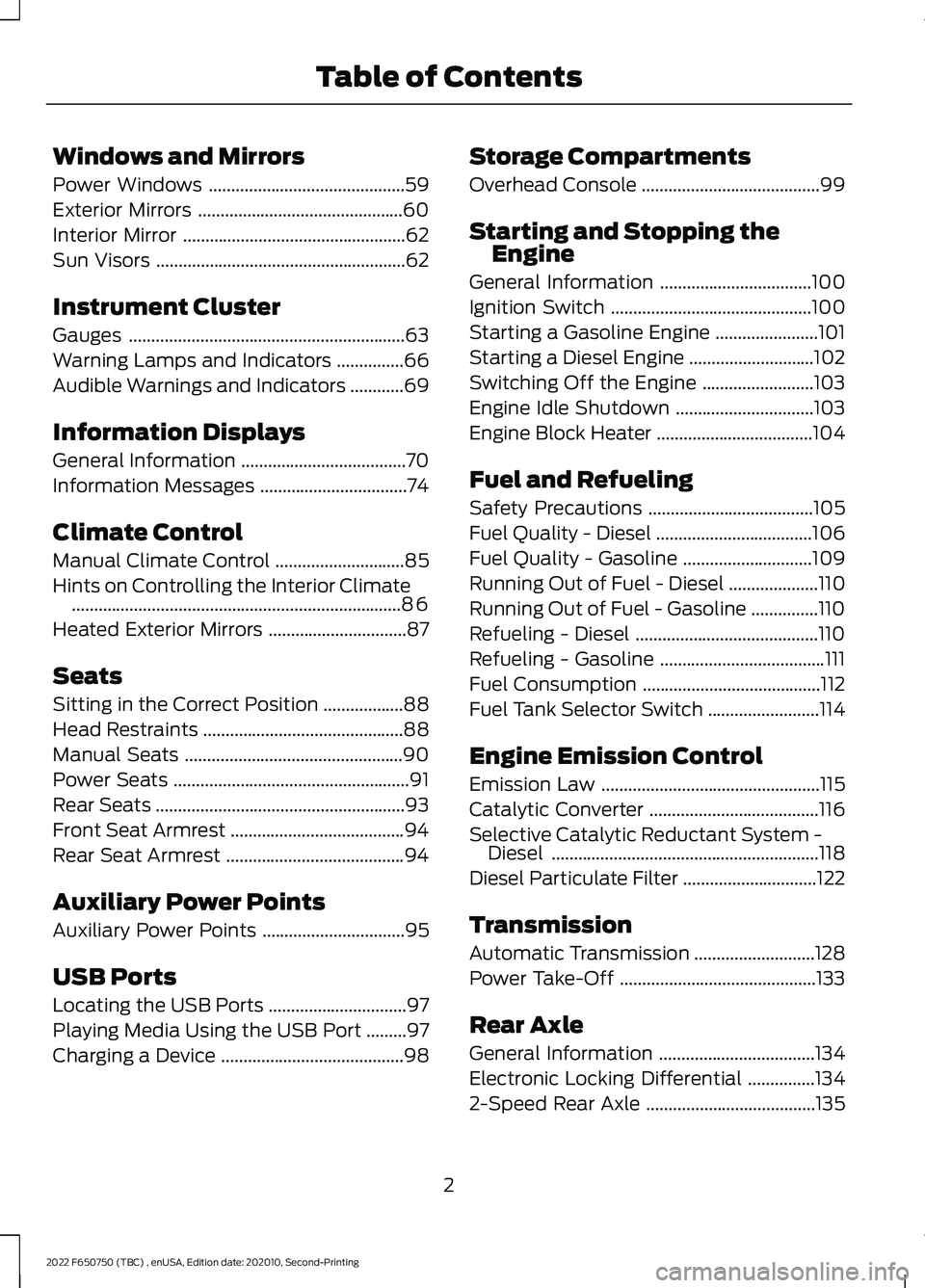
Windows and Mirrors
Power Windows
............................................59
Exterior Mirrors ..............................................
60
Interior Mirror ..................................................
62
Sun Visors ........................................................
62
Instrument Cluster
Gauges ..............................................................
63
Warning Lamps and Indicators ...............
66
Audible Warnings and Indicators ............
69
Information Displays
General Information .....................................
70
Information Messages .................................
74
Climate Control
Manual Climate Control .............................
85
Hints on Controlling the Interior Climate ........................................................................\
..
86
Heated Exterior Mirrors ...............................
87
Seats
Sitting in the Correct Position ..................
88
Head Restraints .............................................
88
Manual Seats .................................................
90
Power Seats .....................................................
91
Rear Seats ........................................................
93
Front Seat Armrest .......................................
94
Rear Seat Armrest ........................................
94
Auxiliary Power Points
Auxiliary Power Points ................................
95
USB Ports
Locating the USB Ports ...............................
97
Playing Media Using the USB Port .........
97
Charging a Device .........................................
98Storage Compartments
Overhead Console
........................................
99
Starting and Stopping the Engine
General Information ..................................
100
Ignition Switch .............................................
100
Starting a Gasoline Engine .......................
101
Starting a Diesel Engine ............................
102
Switching Off the Engine .........................
103
Engine Idle Shutdown ...............................
103
Engine Block Heater ...................................
104
Fuel and Refueling
Safety Precautions .....................................
105
Fuel Quality - Diesel ...................................
106
Fuel Quality - Gasoline .............................
109
Running Out of Fuel - Diesel ....................
110
Running Out of Fuel - Gasoline ...............
110
Refueling - Diesel .........................................
110
Refueling - Gasoline .....................................
111
Fuel Consumption ........................................
112
Fuel Tank Selector Switch .........................
114
Engine Emission Control
Emission Law .................................................
115
Catalytic Converter ......................................
116
Selective Catalytic Reductant System - Diesel ............................................................
118
Diesel Particulate Filter ..............................
122
Transmission
Automatic Transmission ...........................
128
Power Take-Off ............................................
133
Rear Axle
General Information ...................................
134
Electronic Locking Differential ...............
134
2-Speed Rear Axle ......................................
135
2
2022 F650750 (TBC) , enUSA, Edition date: 202010, Second-Printing Table of Contents
Page 80 of 379
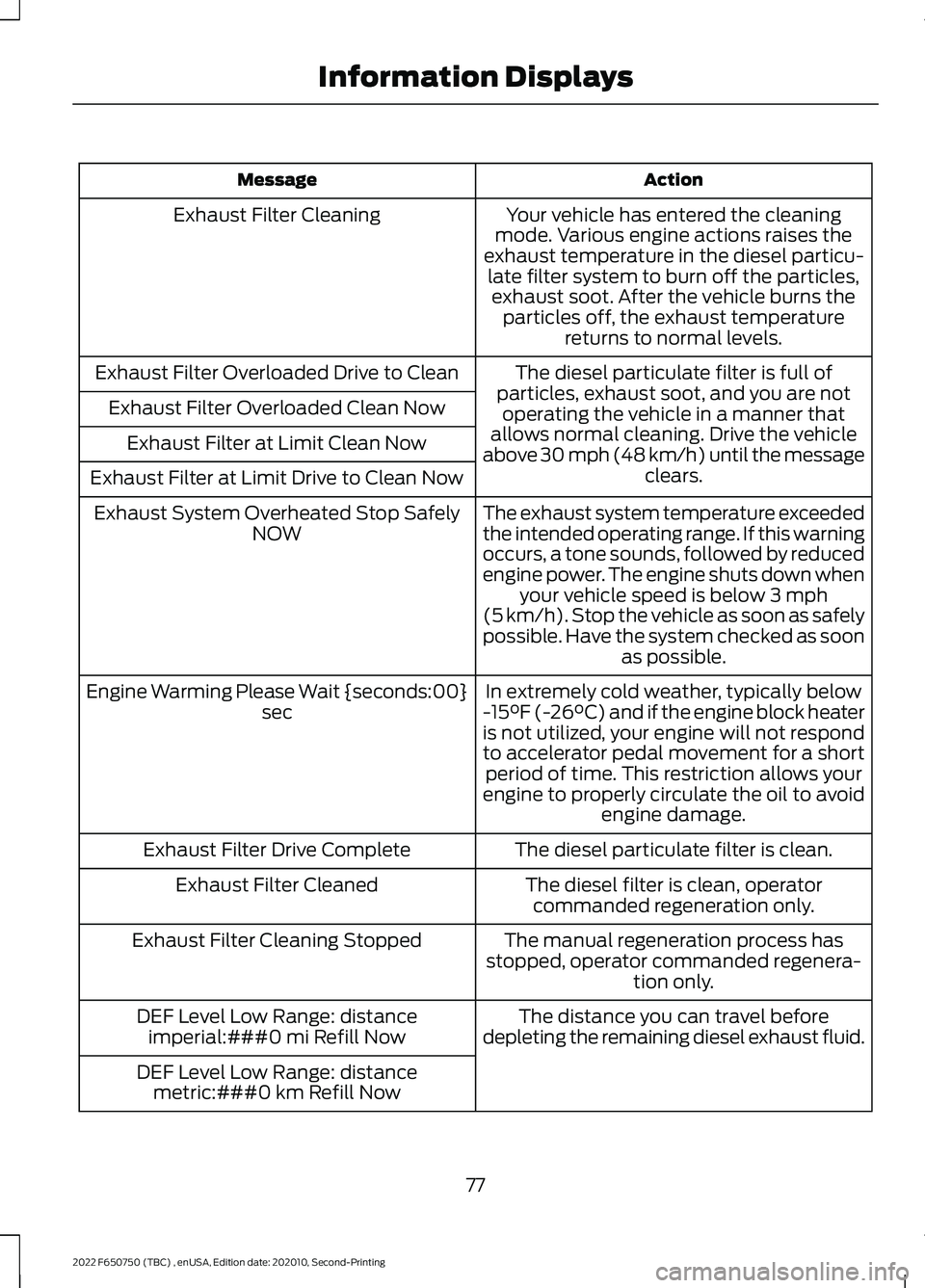
Action
Message
Your vehicle has entered the cleaning
mode. Various engine actions raises the
exhaust temperature in the diesel particu- late filter system to burn off the particles,exhaust soot. After the vehicle burns the particles off, the exhaust temperature returns to normal levels.
Exhaust Filter Cleaning
The diesel particulate filter is full of
particles, exhaust soot, and you are not operating the vehicle in a manner that
allows normal cleaning. Drive the vehicle
above 30 mph (48 km/h) until the message clears.
Exhaust Filter Overloaded Drive to Clean
Exhaust Filter Overloaded Clean Now Exhaust Filter at Limit Clean Now
Exhaust Filter at Limit Drive to Clean Now The exhaust system temperature exceeded
the intended operating range. If this warning
occurs, a tone sounds, followed by reduced
engine power. The engine shuts down whenyour vehicle speed is below 3 mph
(5 km/h). Stop the vehicle as soon as safely
possible. Have the system checked as soon as possible.
Exhaust System Overheated Stop Safely
NOW
In extremely cold weather, typically below
-15°F (-26°C) and if the engine block heater is not utilized, your engine will not respond
to accelerator pedal movement for a short period of time. This restriction allows your
engine to properly circulate the oil to avoid engine damage.
Engine Warming Please Wait {seconds:00}
sec
The diesel particulate filter is clean.
Exhaust Filter Drive Complete
The diesel filter is clean, operatorcommanded regeneration only.
Exhaust Filter Cleaned
The manual regeneration process has
stopped, operator commanded regenera- tion only.
Exhaust Filter Cleaning Stopped
The distance you can travel before
depleting the remaining diesel exhaust fluid.
DEF Level Low Range: distance
imperial:###0 mi Refill Now
DEF Level Low Range: distance metric:###0 km Refill Now
77
2022 F650750 (TBC) , enUSA, Edition date: 202010, Second-Printing Information Displays
Page 105 of 379
Important Ventilating Information
If you stop your vehicle and then leave the
engine idling for long periods of time, we
recommend that you do one of the
following:
•
Open the windows at least 1 in (3 cm).
• Set your climate control to outside air.
STARTING A DIESEL ENGINE
Read all starting instructions carefully
before you start your vehicle.
Diesel Engine Fast Start Glow Plug
System
The diesel engine glow system consists of:
• Eight glow plugs, one per cylinder.
• Glow plug control module.
• Engine coolant temperature sensor.
• Barometric pressure sensor.
• Environmental temperature sensor.
The powertrain and glow plug control
modules electronically control the glow
plug system. After you switch the ignition
on, the glow plug control module
immediately energizes the glow plugs. The
glow plug control module, using the engine
coolant temperature, barometric pressure
sensor and environmental temperature
sensor, determines how long the glow
plugs stay energized. The required time for
the glow plugs to be energized decreases
as the coolant temperature, barometric
pressure and environmental temperature
increase.
Before starting the engine, check the
following:
• Make sure all occupants fasten their
seatbelt.
• Make sure the headlamps and
electrical accessories are off.
• Make sure the parking brake is on. •
Make sure the transmission is in park
(P) or neutral (N).
• Turn the ignition key to the on position.
Note: Do not press the accelerator during
starting.
1. Fully press the brake pedal.
2. Turn the key to the start position to start the engine. Release the key when
the engine starts.
Cold Weather Starting WARNING: Do not use starting
fluid, for example ether, in the air intake
system. Such fluid could cause
immediate explosive damage to the
engine and possible personal injury. WARNING:
Do not mix diesel with
gasoline, gasohol or alcohol. This could
cause an explosion.
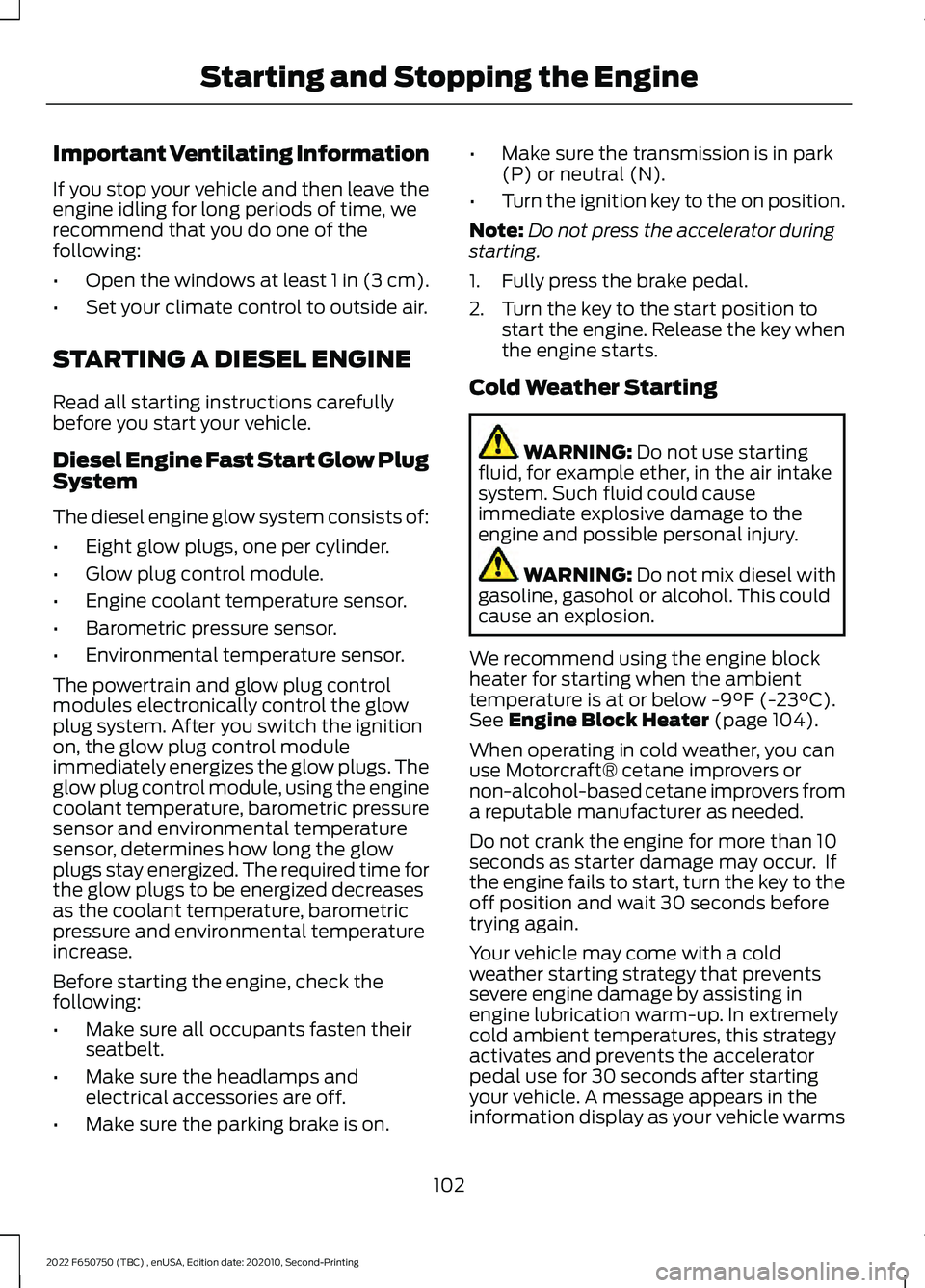
We recommend using the engine block
heater for starting when the ambient
temperature is at or below
-9°F (-23°C).
See Engine Block Heater (page 104).
When operating in cold weather, you can
use Motorcraft® cetane improvers or
non-alcohol-based cetane improvers from
a reputable manufacturer as needed.
Do not crank the engine for more than 10
seconds as starter damage may occur. If
the engine fails to start, turn the key to the
off position and wait 30 seconds before
trying again.
Your vehicle may come with a cold
weather starting strategy that prevents
severe engine damage by assisting in
engine lubrication warm-up. In extremely
cold ambient temperatures, this strategy
activates and prevents the accelerator
pedal use for 30 seconds after starting
your vehicle. A message appears in the
information display as your vehicle warms
102
2022 F650750 (TBC) , enUSA, Edition date: 202010, Second-Printing Starting and Stopping the Engine
Page 107 of 379
The engine idle shutdown timer does not
start if:
•
The engine is operating in battery
charge protect or power take-off mode.
• The exhaust emission control device is
regenerating.
ENGINE BLOCK HEATER (IF
EQUIPPED) WARNING:
Failure to follow engine
block heater instructions could result in
property damage or serious personal
injury. WARNING: Do not use your heater
with ungrounded electrical systems or
two-pronged adapters. There is a risk of
electrical shock.
Note: The heater is most effective when
outdoor temperatures are below
0°F
(-18°C).
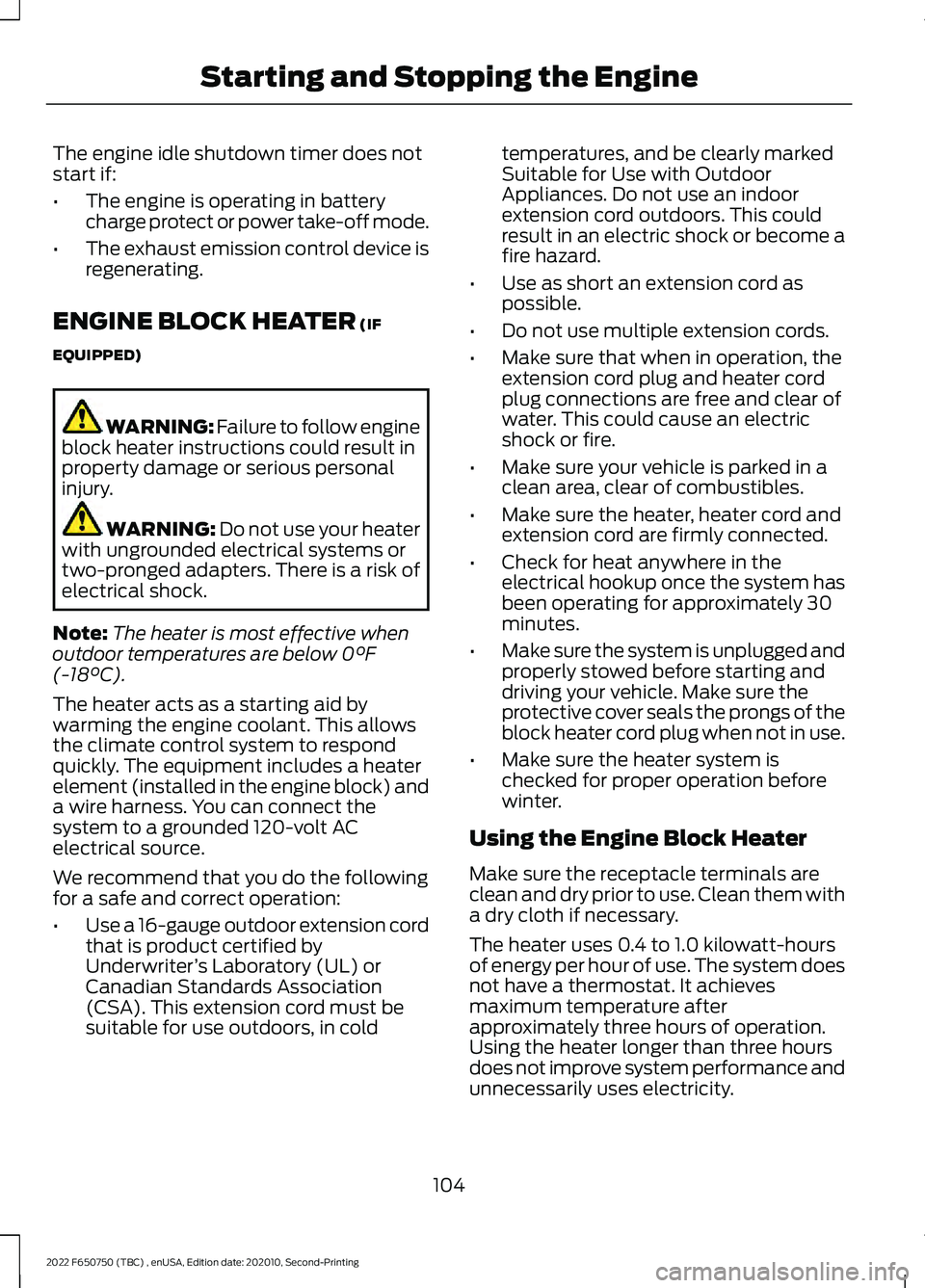
The heater acts as a starting aid by
warming the engine coolant. This allows
the climate control system to respond
quickly. The equipment includes a heater
element (installed in the engine block) and
a wire harness. You can connect the
system to a grounded 120-volt AC
electrical source.
We recommend that you do the following
for a safe and correct operation:
• Use a 16-gauge outdoor extension cord
that is product certified by
Underwriter ’s Laboratory (UL) or
Canadian Standards Association
(CSA). This extension cord must be
suitable for use outdoors, in cold temperatures, and be clearly marked
Suitable for Use with Outdoor
Appliances. Do not use an indoor
extension cord outdoors. This could
result in an electric shock or become a
fire hazard.
• Use as short an extension cord as
possible.
• Do not use multiple extension cords.
• Make sure that when in operation, the
extension cord plug and heater cord
plug connections are free and clear of
water. This could cause an electric
shock or fire.
• Make sure your vehicle is parked in a
clean area, clear of combustibles.
• Make sure the heater, heater cord and
extension cord are firmly connected.
• Check for heat anywhere in the
electrical hookup once the system has
been operating for approximately 30
minutes.
• Make sure the system is unplugged and
properly stowed before starting and
driving your vehicle. Make sure the
protective cover seals the prongs of the
block heater cord plug when not in use.
• Make sure the heater system is
checked for proper operation before
winter.
Using the Engine Block Heater
Make sure the receptacle terminals are
clean and dry prior to use. Clean them with
a dry cloth if necessary.
The heater uses 0.4 to 1.0 kilowatt-hours
of energy per hour of use. The system does
not have a thermostat. It achieves
maximum temperature after
approximately three hours of operation.
Using the heater longer than three hours
does not improve system performance and
unnecessarily uses electricity.
104
2022 F650750 (TBC) , enUSA, Edition date: 202010, Second-Printing Starting and Stopping the Engine
Page 187 of 379
alcohol based additives to correct fuel
gelling. This may result in damage to the
fuel injectors and system. Use the proper
anti-gel and performance improvement
product. See Engine Oil Capacity and
Specification (page 290).
Your vehicle is equipped with a fuel and
water separator that recirculates fuel from
the engine to help prevent fuel filter
clogging. To avoid engine fuel starvation
during cold weather operation of
32°F
(0°C) or below, we recommended that
the fuel level in your tank should not drop
below 1⁄4 full. This helps prevent air from
entering the fuel system and stalling the
engine.
Your vehicle is equipped with a selective
catalyst reduction system that uses Diesel
Exhaust Fluid (DEF) to operate properly.
You need to replenish your vehicle ’s DEF
at certain intervals. When filling your
vehicle ’s DEF tank in cold weather, you
must take special care to prevent damage
to the tank. See
Selective Catalytic
Reductant System (page 118).
In cold weather below
32°F (0°C), the
engine may slowly increase to a higher idle
speed if left idling in park (P) or neutral
(N).
If you operate your vehicle in a heavy
snowstorm or blowing snow conditions,
snow and ice can clog the engine air
induction. If this occurs, the engine may
experience a significant reduction in power
output. At the earliest opportunity, clear
all the snow or ice away from inside the air
filter assembly. Remove the air cleaner
cover and the pleated paper filter, leaving
the foam filter in and remove any snow or
ice. Make sure you install the foam filter
correctly in place. Remove any debris,
snow or ice on the foam filter by brushing
the surface with soft brush. Once you have
cleared all of the debris, reinstall the air
filter and assembly. Do not use water, solvents, or a hard brush
for cleaning the foam filter. WARNING:
To reduce the risk of
vehicle damage and/or personal burn
injuries do not start your engine with the
air filter removed and do not remove it
while the engine is running.
In order to operate the engine in
temperatures of 32°F (0°C) or lower, read
the following instructions:
• Make sure that the batteries are of
sufficient size and are fully charged.
Check other electrical components to
make sure they are in optimum
condition
• Use the proper coolant solution at the
concentration recommended
protecting the engine against damage
from freezing
• Try to keep the fuel tank full as much
as possible at the end of operation to
prevent condensation in the fuel
system
• Make sure you use proper cold weather
engine oil and that it is at its proper
level. Also, if necessary, make sure to
follow the engine oil and filter change
schedule found under the Special
operating conditions section listed in
the scheduled maintenance
information
• At temperatures of
-9°F (-23°C) or
below, it is recommended that you use
an engine block heater to improve cold
engine starting
• If operating in arctic temperatures of
-20°F (-29°C)
or lower, consult your
truck dealer for information about
special cold weather equipment and
precautions
184
2022 F650750 (TBC) , enUSA, Edition date: 202010, Second-Printing Driving Hints
Page 188 of 379
The following cold weather idling
guidelines are recommended:
•
You can use Motorcraft® cetane
improvers or non-alcohol-based
cetane improvers from a reputable
manufacturer as needed.
• Maintain the engine cooling system
properly.
• Avoid shutting the engine down after
an extensive idling period. Drive your
vehicle for several miles with the
engine at normal operating
temperatures under a moderate load.
• Consider using an engine block heater.
• For extended idle times use an
approved idle speed increase device.
Winter Operating Tips for Arctic
Operation -20°F (-29°C) and
Below
The following information is a guideline
only and is not to be the only source of
possible solutions in resolving extreme
cold temperature issues.
Starting Aids WARNING: Do not use starting
fluid, such as ether, in the air intake
system (see air filter decal). Such fluid
could cause immediate explosive
damage to the engine and possible
personal injury.
The use of the factory engine block heater
assists in engine starting in extreme cold
ambient temperatures. See
Engine Block
Heater (page 104). Idle Control
Your vehicle may have a factory option for
a stationary elevated idle control through
dash-mounted upfitter switches that
allows the operator to elevate the idle rpm
for extended idle periods, as well as
aftermarket equipment such as PTO
operation. You must configure this feature
even if ordered from the factory. See your
authorized dealer for required upfitting.
Operation in Snow and Rain
Vehicle operation in heavy snowfall or
extreme rain conditions may feed
excessive amounts of snow or water into
the air intake system. This could plug the
air filter with snow and may cause the
engine to lose power and possibly shut
down.
We recommend the following actions after
operating your vehicle up to
199 mi
(320 km) in snowfall or extreme rain:
• Snow: At the earliest opportunity, open
the hood and clear all the snow and ice
from the air filter housing inlet (do not
remove the foam filter) and reset the
air filter restriction gauge.
Note: Removal of the foam filter degrades
your vehicle performance during snow and
hot weather conditions.
• Extreme rain: The air filter dries after
about 15– 30 minutes at highway
speeds. At the earliest opportunity,
open the hood and reset the air filter
restriction gauge.
BREAKING-IN
You need to break in new tires for
approximately
300 mi (480 km). During
this time, your vehicle may exhibit some
unusual driving characteristics.
185
2022 F650750 (TBC) , enUSA, Edition date: 202010, Second-Printing Driving Hints
Page 294 of 379
Engine Oil
We recommend Motorcraft motor oil for
your vehicle. If Motorcraft motor oil is not
available, use motor oil of the
recommended viscosity grade that meets
our specification WSS-M2C171-F1. You can
find the list of approved motor oils at
www.motorcraft.com.
Do not use engine oil additives as they
could lead to engine damage not covered
by your vehicle warranty.
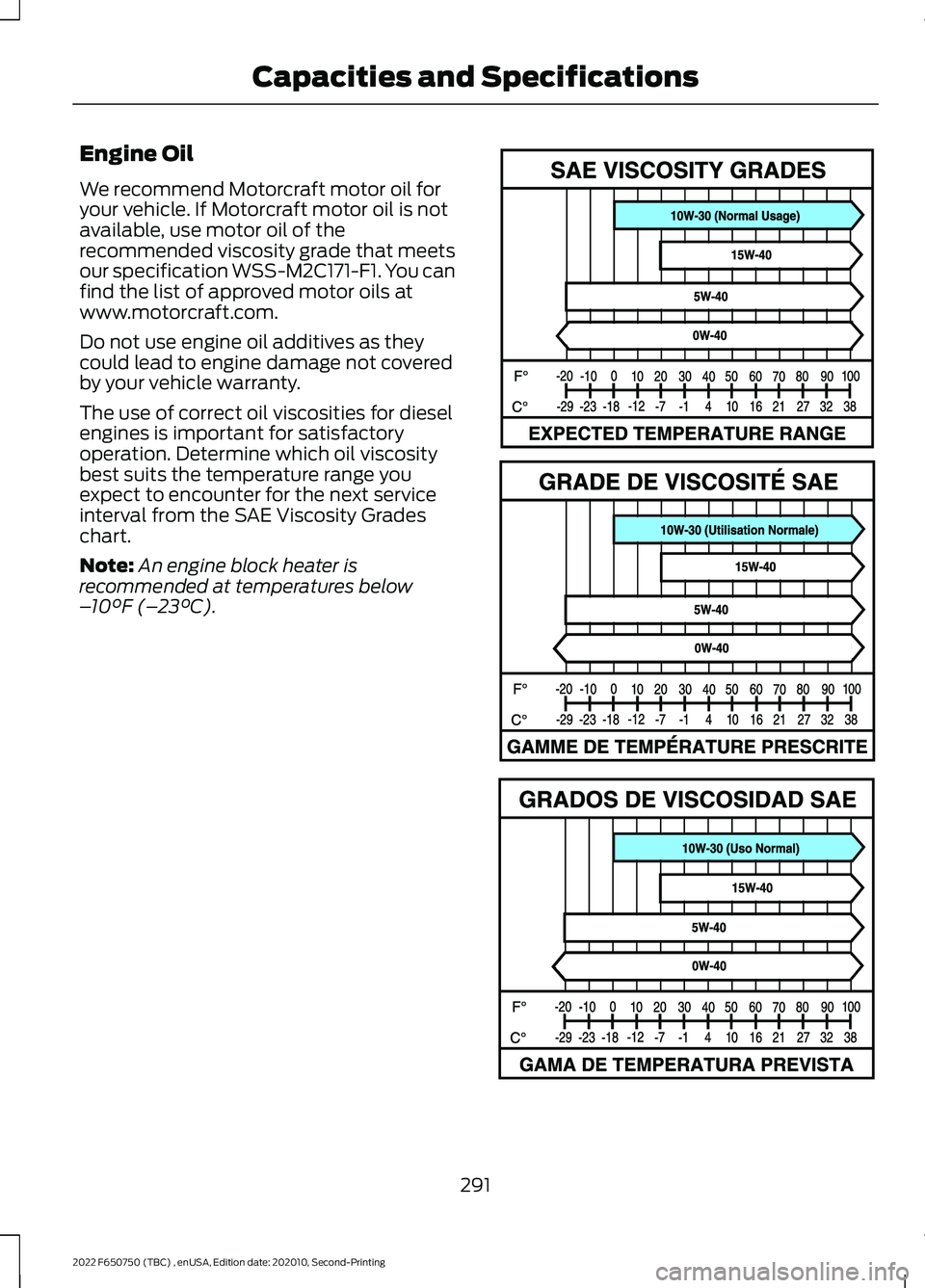
The use of correct oil viscosities for diesel
engines is important for satisfactory
operation. Determine which oil viscosity
best suits the temperature range you
expect to encounter for the next service
interval from the SAE Viscosity Grades
chart.
Note:
An engine block heater is
recommended at temperatures below
– 10°F (– 23°C). 291
2022 F650750 (TBC) , enUSA, Edition date: 202010, Second-Printing Capacities and SpecificationsE327351
Page 298 of 379
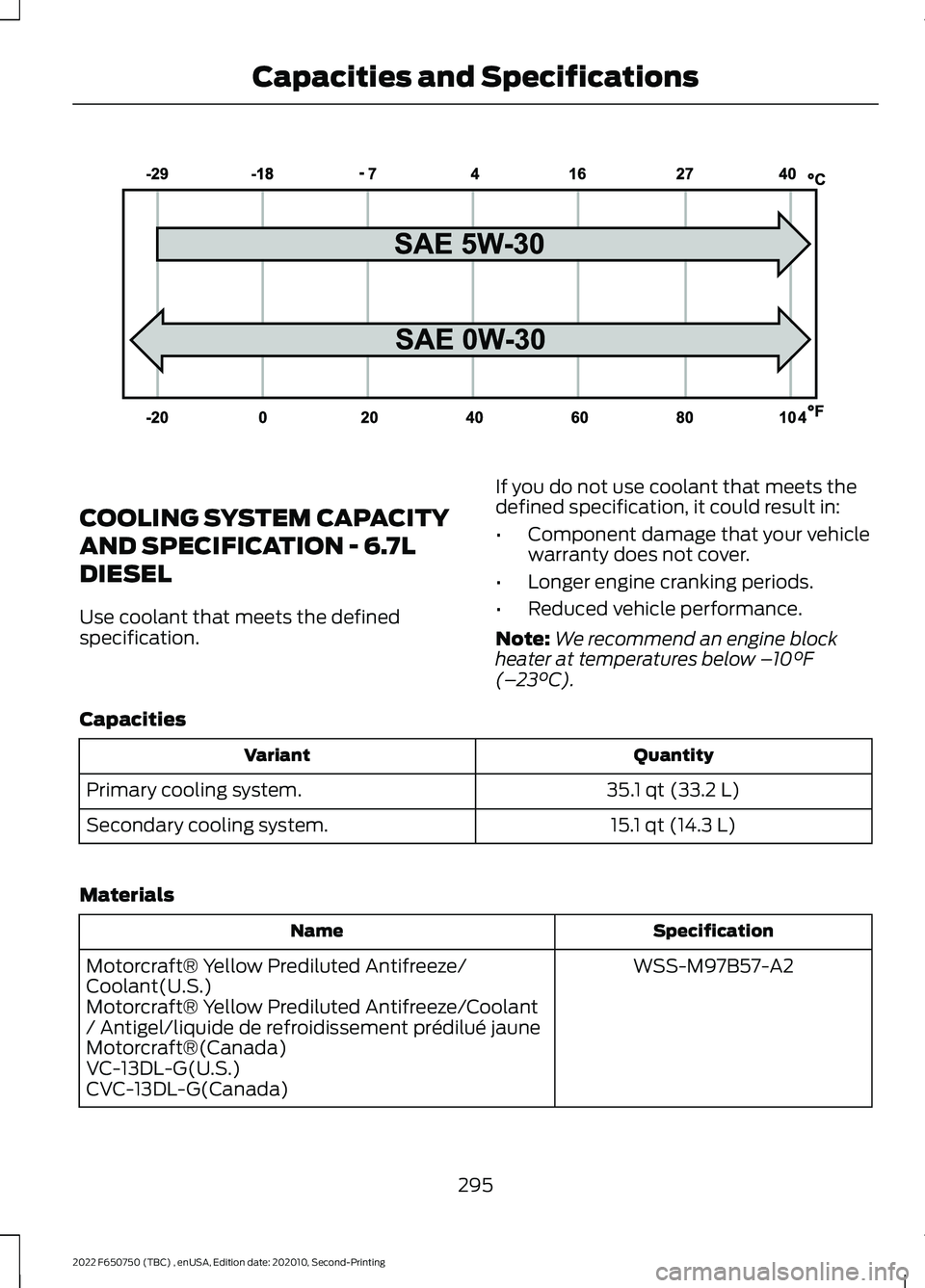
COOLING SYSTEM CAPACITY
AND SPECIFICATION - 6.7L
DIESEL
Use coolant that meets the defined
specification.
If you do not use coolant that meets the
defined specification, it could result in:
•
Component damage that your vehicle
warranty does not cover.
• Longer engine cranking periods.
• Reduced vehicle performance.
Note: We recommend an engine block
heater at temperatures below – 10°F
(– 23°C).
Capacities Quantity
Variant
35.1 qt (33.2 L)
Primary cooling system.
15.1 qt (14.3 L)
Secondary cooling system.
Materials Specification
Name
WSS-M97B57-A2
Motorcraft® Yellow Prediluted Antifreeze/
Coolant(U.S.)
Motorcraft® Yellow Prediluted Antifreeze/Coolant
/ Antigel/liquide de refroidissement prédilué jaune
Motorcraft®(Canada)
VC-13DL-G(U.S.)
CVC-13DL-G(Canada)
295
2022 F650750 (TBC) , enUSA, Edition date: 202010, Second-Printing Capacities and SpecificationsE240523
Page 328 of 379
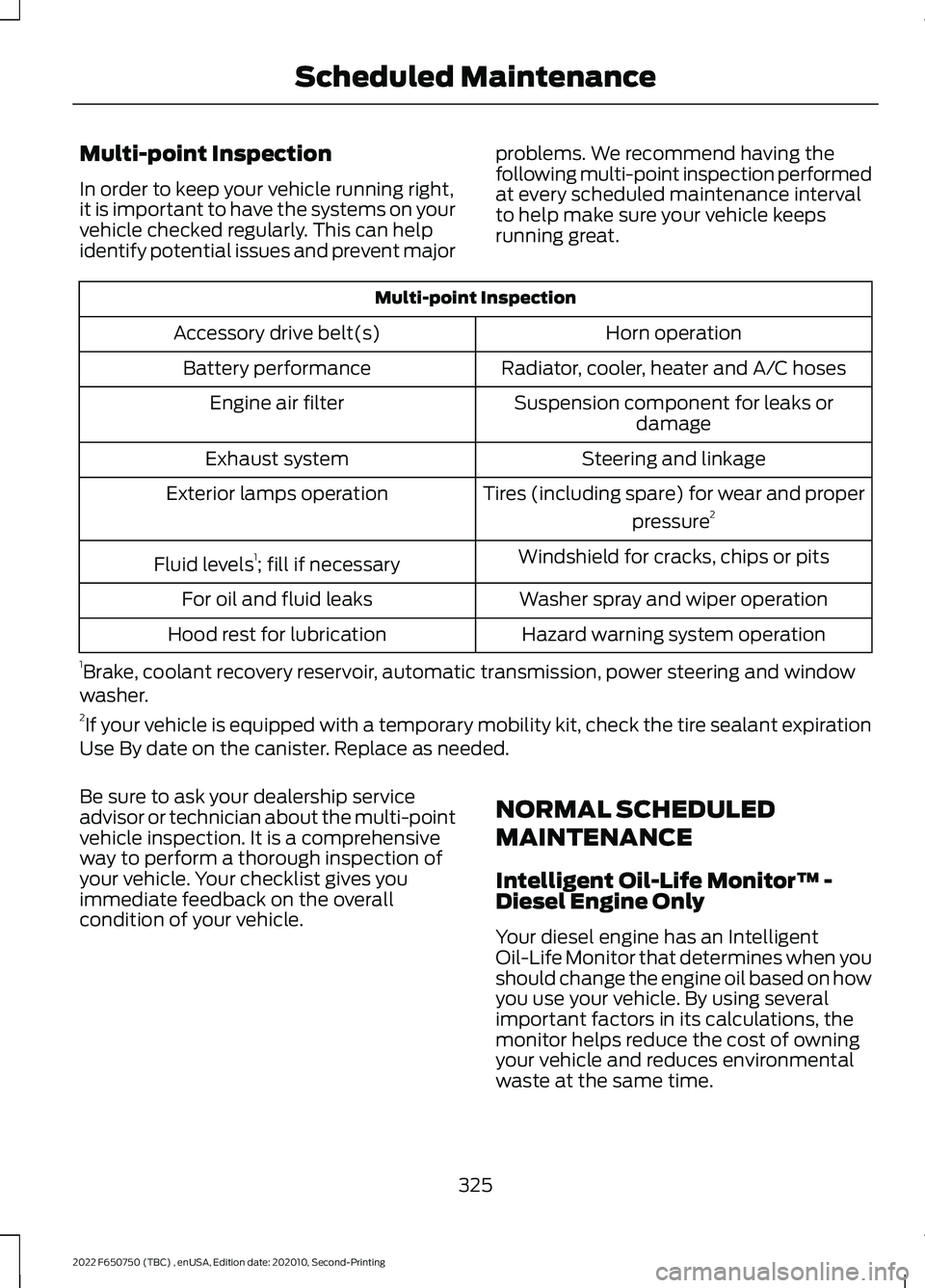
Multi-point Inspection
In order to keep your vehicle running right,
it is important to have the systems on your
vehicle checked regularly. This can help
identify potential issues and prevent major
problems. We recommend having the
following multi-point inspection performed
at every scheduled maintenance interval
to help make sure your vehicle keeps
running great.Multi-point Inspection
Horn operation
Accessory drive belt(s)
Radiator, cooler, heater and A/C hoses
Battery performance
Suspension component for leaks ordamage
Engine air filter
Steering and linkage
Exhaust system
Tires (including spare) for wear and properpressure2
Exterior lamps operation
Windshield for cracks, chips or pits
Fluid levels 1
; fill if necessary
Washer spray and wiper operation
For oil and fluid leaks
Hazard warning system operation
Hood rest for lubrication
1 Brake, coolant recovery reservoir, automatic transmission, power steering and window
washer.
2 If your vehicle is equipped with a temporary mobility kit, check the tire sealant expiration
Use By date on the canister. Replace as needed.
Be sure to ask your dealership service
advisor or technician about the multi-point
vehicle inspection. It is a comprehensive
way to perform a thorough inspection of
your vehicle. Your checklist gives you
immediate feedback on the overall
condition of your vehicle. NORMAL SCHEDULED
MAINTENANCE
Intelligent Oil-Life Monitor™ -
Diesel Engine Only
Your diesel engine has an Intelligent
Oil-Life Monitor that determines when you
should change the engine oil based on how
you use your vehicle. By using several
important factors in its calculations, the
monitor helps reduce the cost of owning
your vehicle and reduces environmental
waste at the same time.
325
2022 F650750 (TBC) , enUSA, Edition date: 202010, Second-Printing Scheduled Maintenance
Page 375 of 379
Child Safety......................................................24
General Information............................................ 24
Child Safety Locks
.........................................35
Cleaning Products........................................261
Cleaning the Engine....................................263
Cleaning the Exterior..................................262
Cleaning the Instrument Panel and Instrument Cluster Lens........................265
Cleaning the Interior...................................264
Cleaning the Wheels..................................265
Cleaning the Windows and Wiper Blades...........................................................264
Climate Control
..............................................85
Cold Weather Precautions........................183
Connected Vehicle.....................................306
Connected Vehicle –
Troubleshooting............................................ 307
Connecting the Vehicle to a Mobile Network - Vehicles With: Modem............................ 306
Connected Vehicle Limitations..............306
Connected Vehicle Requirements
........306
Connected Vehicle – Troubleshooting........................................307
Connected Vehicle – Frequently Asked Questions......................................................... 307
Connecting a Bluetooth® Device...........313
Connecting the Vehicle to a Mobile Network - Vehicles With:
Modem.........................................................306
Connecting FordPass to the Modem.........306
Enabling and Disabling the Modem..........306
What Is the Modem..........................................306
Coolant Check See: Engine Coolant Check - 6.7L
Diesel................................................................. 232
See: Engine Coolant Check - 7.3L.................237
Cooling System Capacity and Specification - 6.7L Diesel.....................295
Cooling System Capacity and Specification - 7.3L..................................296
Cruise Control
................................................154
Cruise Control Indicators............................161
Cruise Control - Vehicles With: Adaptive Cruise Control................................................51
Cruise Control - Vehicles With: Cruise Control..............................................................51
Customer Assistance
..................................193 Customer Information...............................340
Radio Frequency Certification
Labels............................................................... 340
D
Data Recording
.................................................13
Daytime Running Lamps - Vehicles With: Configurable Daytime Running
Lamps.............................................................56
Daytime Running Lamps - Vehicles With: Daytime Running Lamps (DRL)............56
Diesel Exhaust Fluid Capacity and Specification..............................................300
Diesel Particulate Filter...............................122
Digital Radio....................................................311
Direction Indicators........................................57
Doors and Locks.............................................48
Draining the Fuel Filter Water Trap - 6.7L Diesel..............................................................231
Driver Alert
......................................................162
Driving Aids.....................................................162
Driving Hints...................................................182
Driving Through Water...............................186
DRL See: Daytime Running Lamps - Vehicles With:
Configurable Daytime Running
Lamps.................................................................. 56
See: Daytime Running Lamps - Vehicles With: Daytime Running Lamps (DRL)................56
E
Economical Driving
......................................183
Electrical System Inspection...................253
Electromagnetic Compatibility..............345
Electronic Locking Differential................134
Emission Law..................................................115
End User License Agreement.................348
Engine Block Heater....................................104
Engine Coolant Check - 6.7L Diesel.............................................................232
Engine Coolant Check - 7.3L....................237
Engine Emission Control
.............................115
Engine Idle Shutdown................................103
Engine Immobilizer See: Passive Anti-Theft System.....................50
372
2022 F650750 (TBC) , enUSA, Edition date: 202010, Second-Printing Index