low oil pressure FORD F SERIES MOTORHOME AND COMMERCIAL CHASSIS 2001 10.G Owners Manual
[x] Cancel search | Manufacturer: FORD, Model Year: 2001, Model line: F SERIES MOTORHOME AND COMMERCIAL CHASSIS, Model: FORD F SERIES MOTORHOME AND COMMERCIAL CHASSIS 2001 10.GPages: 104, PDF Size: 1.32 MB
Page 6 of 104
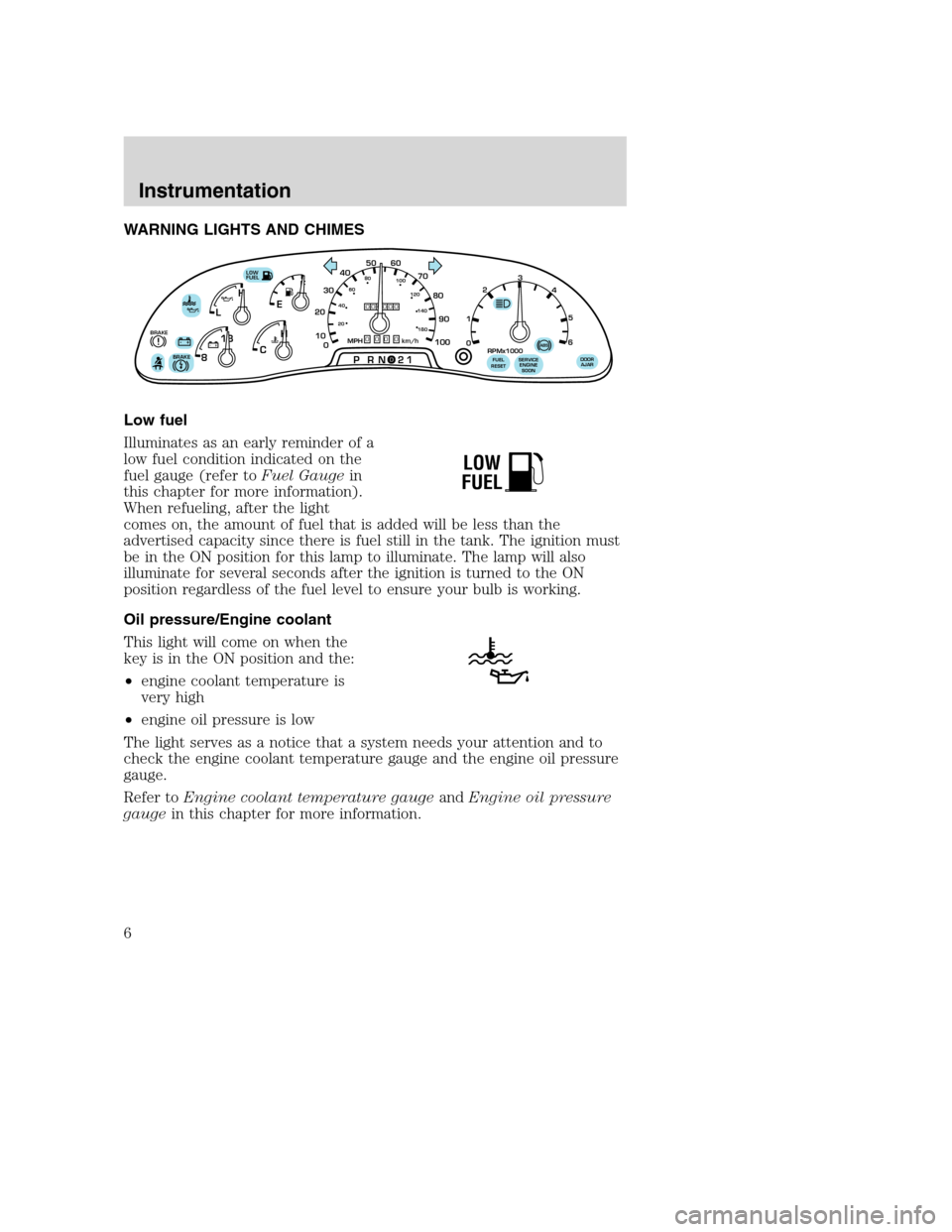
WARNING LIGHTS AND CHIMES
Low fuel
Illuminates as an early reminder of a
low fuel condition indicated on the
fuel gauge (refer toFuel Gaugein
this chapter for more information).
When refueling, after the light
comes on, the amount of fuel that is added will be less than the
advertised capacity since there is fuel still in the tank. The ignition must
be in the ON position for this lamp to illuminate. The lamp will also
illuminate for several seconds after the ignition is turned to the ON
position regardless of the fuel level to ensure your bulb is working.
Oil pressure/Engine coolant
This light will come on when the
key is in the ON position and the:
•engine coolant temperature is
very high
•engine oil pressure is low
The light serves as a notice that a system needs your attention and to
check the engine coolant temperature gauge and the engine oil pressure
gauge.
Refer toEngine coolant temperature gaugeandEngine oil pressure
gaugein this chapter for more information.
F
E
CH H
L
18
8
PRN 21LOW
FUEL
BRAKE!+ -+ -000000000
0
50
60
70
20
10
0 3040
80
90
100
20406080
100
120
140
180
MPH km/h
1
02
RPMx1000
3
4
5
6
SERVICE
ENGINE
SOONABSFUEL
RESETDOOR
AJARBRAKE
LOW
FUEL
Instrumentation
6
Page 11 of 104
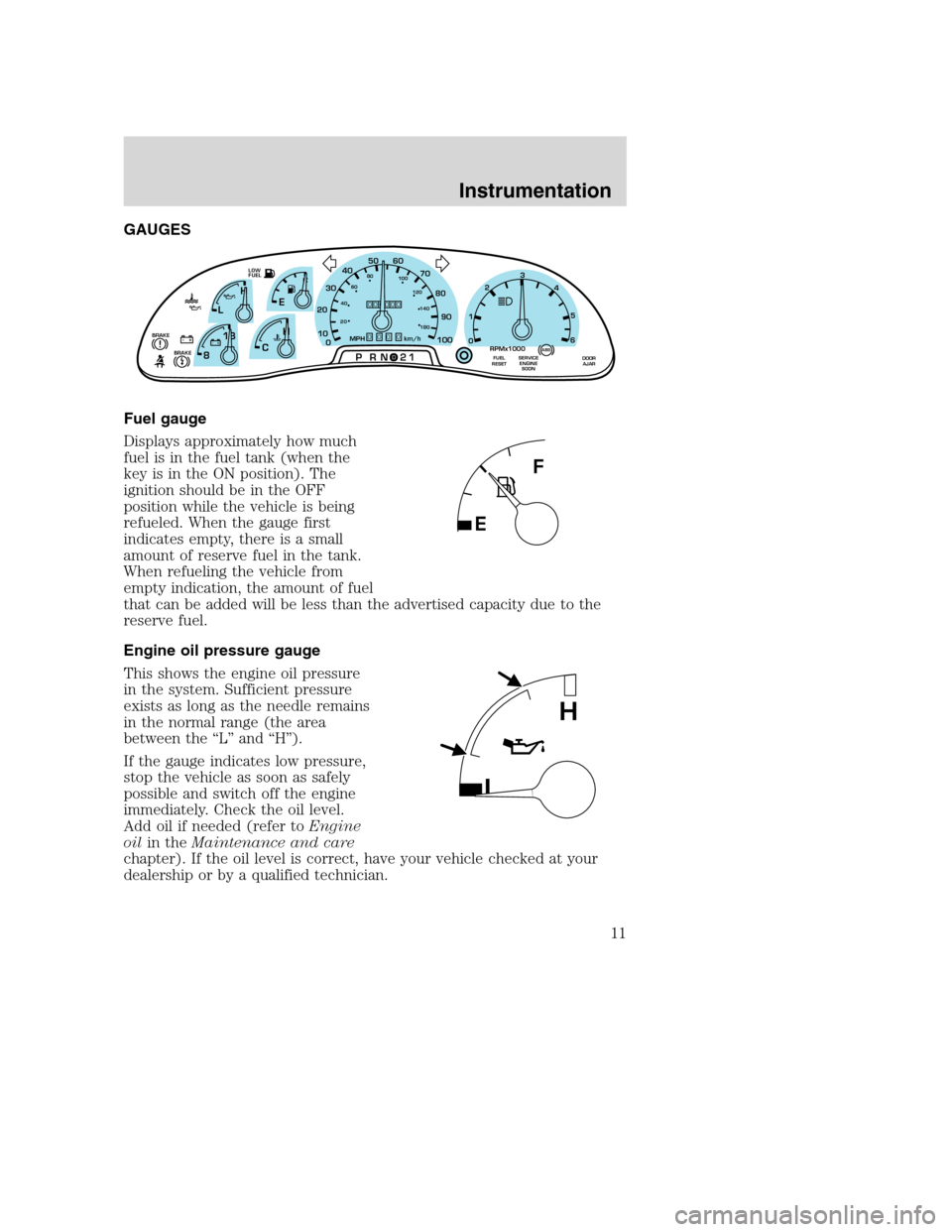
GAUGES
Fuel gauge
Displays approximately how much
fuel is in the fuel tank (when the
key is in the ON position). The
ignition should be in the OFF
position while the vehicle is being
refueled. When the gauge first
indicates empty, there is a small
amount of reserve fuel in the tank.
When refueling the vehicle from
empty indication, the amount of fuel
that can be added will be less than the advertised capacity due to the
reserve fuel.
Engine oil pressure gauge
This shows the engine oil pressure
in the system. Sufficient pressure
exists as long as the needle remains
in the normal range (the area
between the “L” and “H”).
If the gauge indicates low pressure,
stop the vehicle as soon as safely
possible and switch off the engine
immediately. Check the oil level.
Add oil if needed (refer toEngine
oilin theMaintenance and care
chapter). If the oil level is correct, have your vehicle checked at your
dealership or by a qualified technician.
F
E
CH H
L
18
8
PRN 21LOW
FUEL
+ -+ -000000000
0
50
60
70
20
10
0 3040
80
90
100
20406080
100
120
140
180
MPH km/hBRAKE!
1
02
RPMx1000
3
4
5
6
SERVICE
ENGINE
SOONABSFUEL
RESETDOOR
AJARBRAKE
L
H
Instrumentation
11
Page 46 of 104
Fuse/Relay
LocationFuse
Amp
RatingPower Distribution Box Description
5 15A* Powertrain Control Module Power, Fuel
Pump Relay Coil, Fuel Injectors, Mass Air
Flow Sensor with IAT, A/C System Relay
Coil
6 20A* Parklamp Feeds, Instrument Panel Fuse
#41, Warning Chime Module, Trailer Tow
Running Lamp Relay Coil, I/P Dimmer
Module
7 15A* Starter Relay Coil, BB Neutral Sense
8 10A* Stoplamp Switch (Logic): Brake Pressure
Switch, Power Brake Assist Module***,
Speed Control Module, Powertrain Control
Module, ABS module, Brake Shift Interlock
Actuator
9 5A* Alternator
10 20A* Daytime Running (DRL) Lamps
11 30A* Ignition Coils, Radio Capacitors #1 and #2,
Powertrain Control Module Relay
12 20A* Trailer Tow Running Lamps Feed, Trailer
Tow Backup Lamps Feed, IP-Backup Lamp
Feed
13 30A** Trailer Tow Electric Brake Controller Feed
14 60A** Instrument Panel Battery Feed (Fuse #9,
15, 21)
15 -- Not Used
16 60A** ABS Module
17 -- Not Used
18 20A** Horn Feed
19 -- Not Used
20 40A** Powertrain Control Module Relay
21 20A** Fuel Pump Motor
22 20A** Diagnostic Tool Connector, Cigar Lighter
Feed
Roadside emergencies
46
Page 86 of 104
•Combine errands and minimize stop-and-go driving.
Maintenance
•Keep tires properly inflated and use only recommended size.
•Operating a vehicle with the wheels out of alignment will reduce fuel
economy.
•Use recommended engine oil. Refer toLubricant Specifications.
•Perform all regularly scheduled maintenance items. Follow the
recommended maintenance schedule and owner maintenance checks
found in your vehicle scheduled maintenance guide.
Conditions
•Heavily loading a vehicle or towing a trailer may reduce fuel economy
at any speed.
•Carrying unnecessary weight may reduce fuel economy (approximately
0.4 km/L [1 mpg] is lost for every 180 kg [400 lb] of weight carried).
•Adding certain accessories to your vehicle (for example bug
deflectors, rollbars/light bars, running boards, ski/luggage racks) may
reduce fuel economy.
•Using fuel blended with alcohol may lower fuel economy.
•Fuel economy may decrease with lower temperatures during the first
12–16 km (8–10 miles) of driving.
•Driving on flat terrain offers improved fuel economy as compared to
driving on hilly terrain.
•Transmissions give their best fuel economy when operated in the top
cruise gear and with steady pressure on the gas pedal.
•Close windows for high speed driving.
EPA window sticker
Every new vehicle should have the EPA window sticker. Contact your
dealer if the window sticker is not supplied with your vehicle. The EPA
window sticker should be your guide for the fuel economy comparisons
with other vehicles.
It is important to note the box in the lower left corner of the window
sticker. These numbers represent the Range of L/100 km (MPG)
expected on the vehicle under optimum conditions. Your fuel economy
may vary depending upon the method of operation and conditions.
Maintenance and care
86
Page 101 of 104
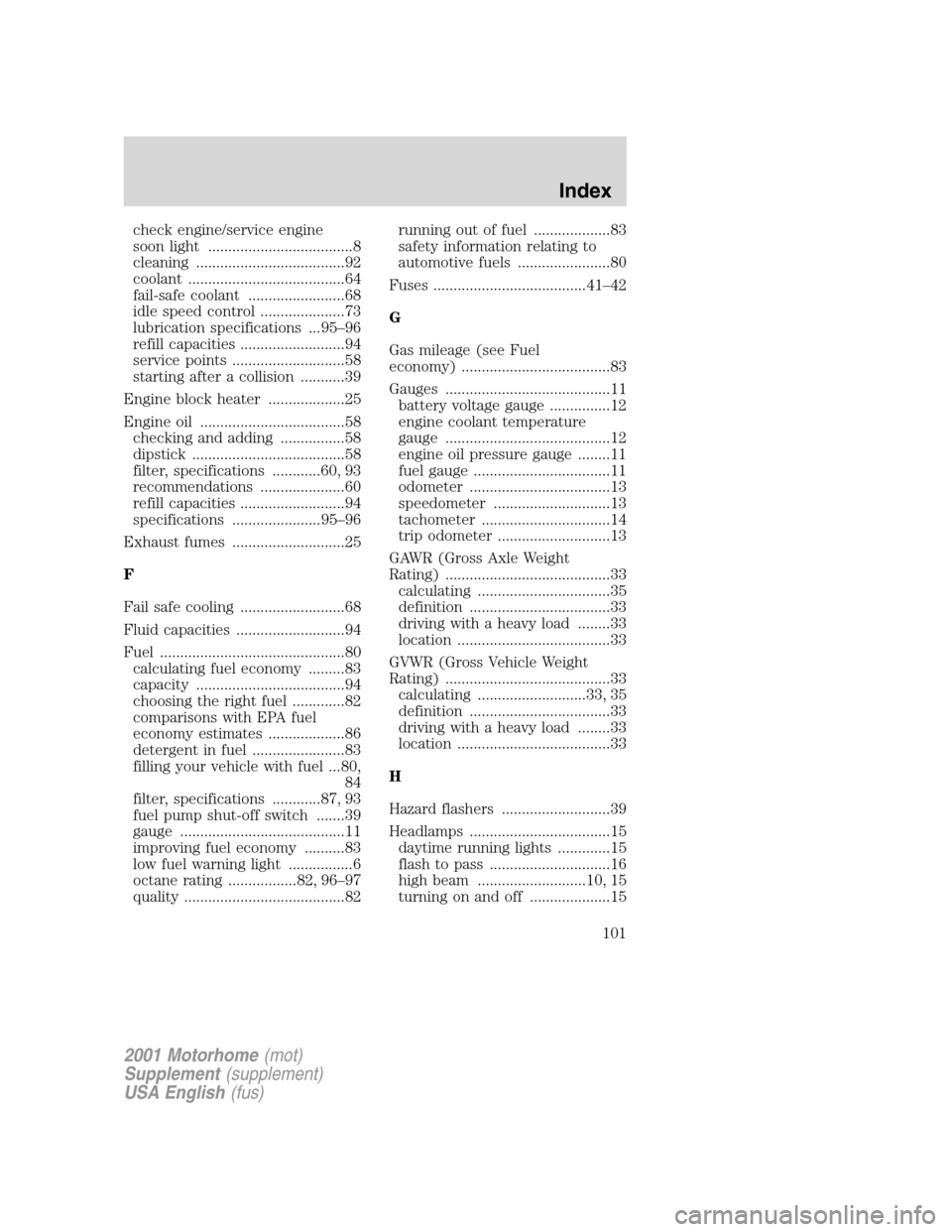
check engine/service engine
soon light ....................................8
cleaning .....................................92
coolant .......................................64
fail-safe coolant ........................68
idle speed control .....................73
lubrication specifications ...95–96
refill capacities ..........................94
service points ............................58
starting after a collision ...........39
Engine block heater ...................25
Engine oil ....................................58
checking and adding ................58
dipstick ......................................58
filter, specifications ............60, 93
recommendations .....................60
refill capacities ..........................94
specifications ......................95–96
Exhaust fumes ............................25
F
Fail safe cooling ..........................68
Fluid capacities ...........................94
Fuel ..............................................80
calculating fuel economy .........83
capacity .....................................94
choosing the right fuel .............82
comparisons with EPA fuel
economy estimates ...................86
detergent in fuel .......................83
filling your vehicle with fuel ...80,
84
filter, specifications ............87, 93
fuel pump shut-off switch .......39
gauge .........................................11
improving fuel economy ..........83
low fuel warning light ................6
octane rating .................82, 96–97
quality ........................................82running out of fuel ...................83
safety information relating to
automotive fuels .......................80
Fuses ......................................41–42
G
Gas mileage (see Fuel
economy) .....................................83
Gauges .........................................11
battery voltage gauge ...............12
engine coolant temperature
gauge .........................................12
engine oil pressure gauge ........11
fuel gauge ..................................11
odometer ...................................13
speedometer .............................13
tachometer ................................14
trip odometer ............................13
GAWR (Gross Axle Weight
Rating) .........................................33
calculating .................................35
definition ...................................33
driving with a heavy load ........33
location ......................................33
GVWR (Gross Vehicle Weight
Rating) .........................................33
calculating ...........................33, 35
definition ...................................33
driving with a heavy load ........33
location ......................................33
H
Hazard flashers ...........................39
Headlamps ...................................15
daytime running lights .............15
flash to pass ..............................16
high beam ...........................10, 15
turning on and off ....................15
2001 Motorhome(mot)
Supplement(supplement)
USA English(fus)
Index
101
Page 102 of 104
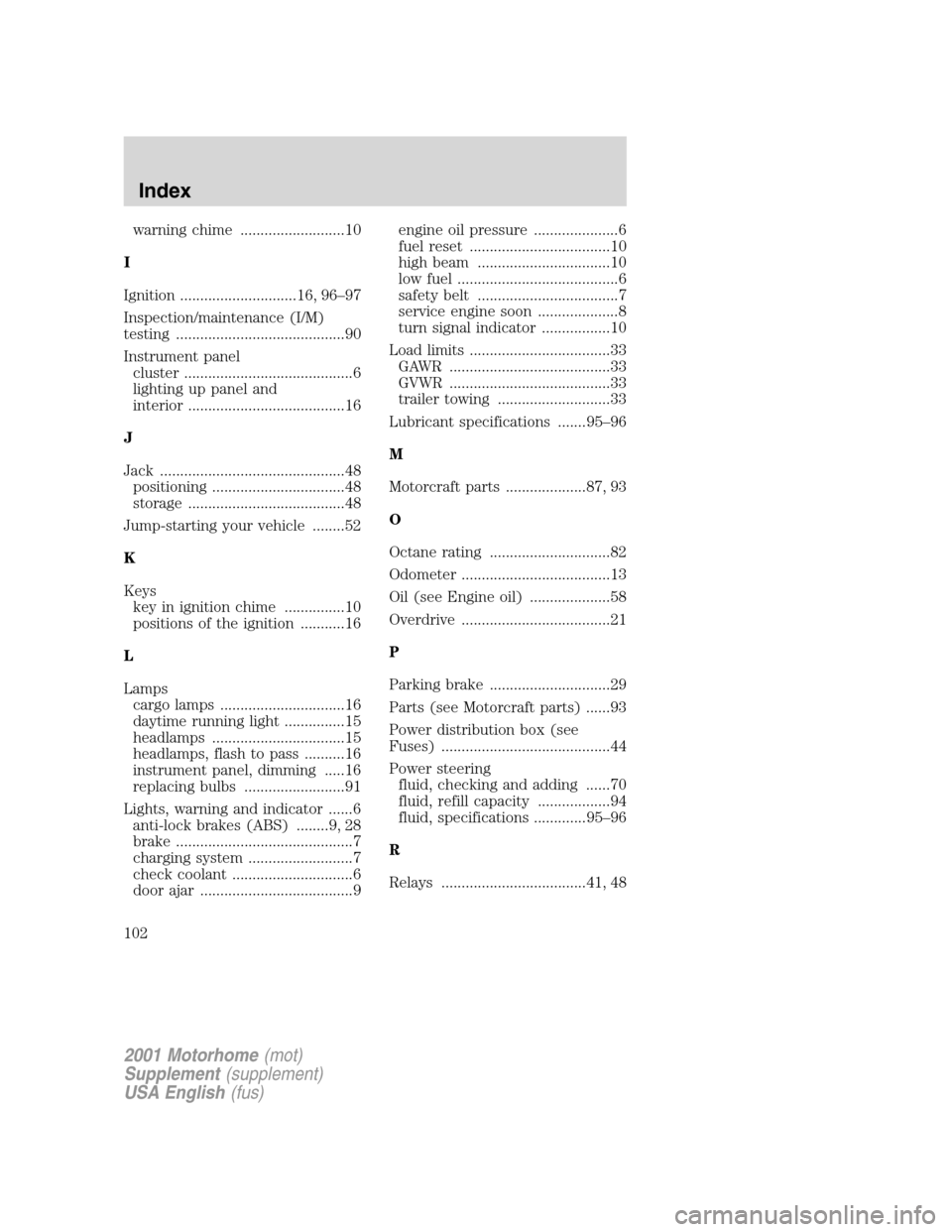
warning chime ..........................10
I
Ignition .............................16, 96–97
Inspection/maintenance (I/M)
testing ..........................................90
Instrument panel
cluster ..........................................6
lighting up panel and
interior .......................................16
J
Jack ..............................................48
positioning .................................48
storage .......................................48
Jump-starting your vehicle ........52
K
Keys
key in ignition chime ...............10
positions of the ignition ...........16
L
Lamps
cargo lamps ...............................16
daytime running light ...............15
headlamps .................................15
headlamps, flash to pass ..........16
instrument panel, dimming .....16
replacing bulbs .........................91
Lights, warning and indicator ......6
anti-lock brakes (ABS) ........9, 28
brake ............................................7
charging system ..........................7
check coolant ..............................6
door ajar ......................................9engine oil pressure .....................6
fuel reset ...................................10
high beam .................................10
low fuel ........................................6
safety belt ...................................7
service engine soon ....................8
turn signal indicator .................10
Load limits ...................................33
GAWR ........................................33
GVWR ........................................33
trailer towing ............................33
Lubricant specifications .......95–96
M
Motorcraft parts ....................87, 93
O
Octane rating ..............................82
Odometer .....................................13
Oil (see Engine oil) ....................58
Overdrive .....................................21
P
Parking brake ..............................29
Parts (see Motorcraft parts) ......93
Power distribution box (see
Fuses) ..........................................44
Power steering
fluid, checking and adding ......70
fluid, refill capacity ..................94
fluid, specifications .............95–96
R
Relays ....................................41, 48
2001 Motorhome(mot)
Supplement(supplement)
USA English(fus)
Index
102