coolant reservoir FORD F SERIES MOTORHOME AND COMMERCIAL CHASSIS 2014 12.G Owners Manual
[x] Cancel search | Manufacturer: FORD, Model Year: 2014, Model line: F SERIES MOTORHOME AND COMMERCIAL CHASSIS, Model: FORD F SERIES MOTORHOME AND COMMERCIAL CHASSIS 2014 12.GPages: 143, PDF Size: 3.21 MB
Page 16 of 143
Yellow area
The transmission fluid is higher thannormal operating temperature. This canbe caused by special operation conditions(i.e. snowplowing, towing or off-road use).Operating the transmission for extendedperiods of time with the gauge in theyellow area may cause internaltransmission damage. Altering the severityof the driving conditions is recommendedto lower the transmission temperature intothe normal range.
Red area
The transmission fluid is overheating. Stopthe vehicle to allow the temperature toreturn to normal range.
If the gauge is operating in the yellow orred area, stop the vehicle and verify theairflow is not restricted such as snow ordebris blocking airflow through the grill. Ifthe gauge continues to show hightemperatures, see your authorized dealer.
Engine Coolant TemperatureGauge
WARNING
Never remove the coolant reservoircap while the engine is running or hot.
At normal operating temperature, theneedle will remain in the center section.
Note:Do not restart the engine until thecause of overheating has been resolved.
If the needle enters the red section, theengine is overheating. Stop the engine,switch the ignition off and determine thecause once the engine has cooled down.
Fuel Gauge
Switch the ignition on. The fuel gauge willindicate approximately how much fuel isleft in the fuel tank. The fuel gauge mayvary slightly when your vehicle is movingor on a gradient. The arrow adjacent to thefuel pump symbol indicates on which sideof the vehicle the fuel filler door is located.
WARNING LAMPS AND
INDICATORS
The following warning lamps andindicators will alert you to a vehiclecondition that may become serious. Somelamps will illuminate when you start yourvehicle to make sure they work. If anylamps remain on after starting your vehicle,refer to the respective system warninglamp for further information.
Note:Some warning indicators appear inthe information display and function thesame as a warning lamp but do not displaywhen you start your vehicle.
Anti-Lock Braking System
If it illuminates when you aredriving, this indicates amalfunction. You will continueto have the normal braking system(without ABS) unless the brake systemwarning lamp is also illuminated. Have thesystem checked by your authorized dealer.
Battery
If it illuminates while driving, itindicates a malfunction. Switchoff all unnecessary electricalequipment and have the system checkedby your authorized dealer immediately.
13Motorhome (TY3) , enUSAInstrument Cluster
Page 21 of 143
Engine
ActionMessage
The engine is overheating. Stop your vehicle as soonas safely possible, turn off the engine. If the warningstays on followed by an indicator chime or continuesto come on, contact an authorized dealer as soon aspossible. Never remove the coolant reservoir cap whilethe engine is running or hot.
REDUCED ENGINE POWER
The engine is overheating. Stop your vehicle as soonas safely possible, turn off the engine. If the warningstays on followed by an indicator chime or continuesto come on, contact an authorized dealer as soon aspossible.
STOP ENGINE SAFELY
The engine coolant is overheating. Stop your vehicleas soon as safely possible, turn off the engine and letit cool. Check the coolant and coolant level. If thewarning stays on or continues to come on, contact anauthorized dealer as soon as possible.
CHECK ENGINE TEMPERATURE
A early reminder of a low fuel condition.FUEL LEVEL LOW
Maintenance
ActionMessage
The engine oil pressure is low. Check the level of theengine oil. If the oil level is OK and this warning persists,shut down the engine immediately and contact anauthorized dealer as soon as possible. See Engine OilCheck (page 75).
LOW OIL PRESSURE
The brake fluid level is low and the brake systemshould be inspected immediately. See Brake FluidCheck (page 80).
BRAKE FLUID LEVEL LOW
The fuel cap is loose, not seated properly or off. Stopyour vehicle when convenient, turn off the engine andcheck that you inserted the fuel cap is properly. Rotatethe cap until you hear a click. The warning messageswitch off after a proper drive cycle is completed. SeeEmission Control System (page 26). If the warningmessage remains on or continues to comes back on,see an authorized dealer as soon as possible.
CHECK FUEL CAP
18Motorhome (TY3) , enUSAInformation Displays
Page 76 of 143
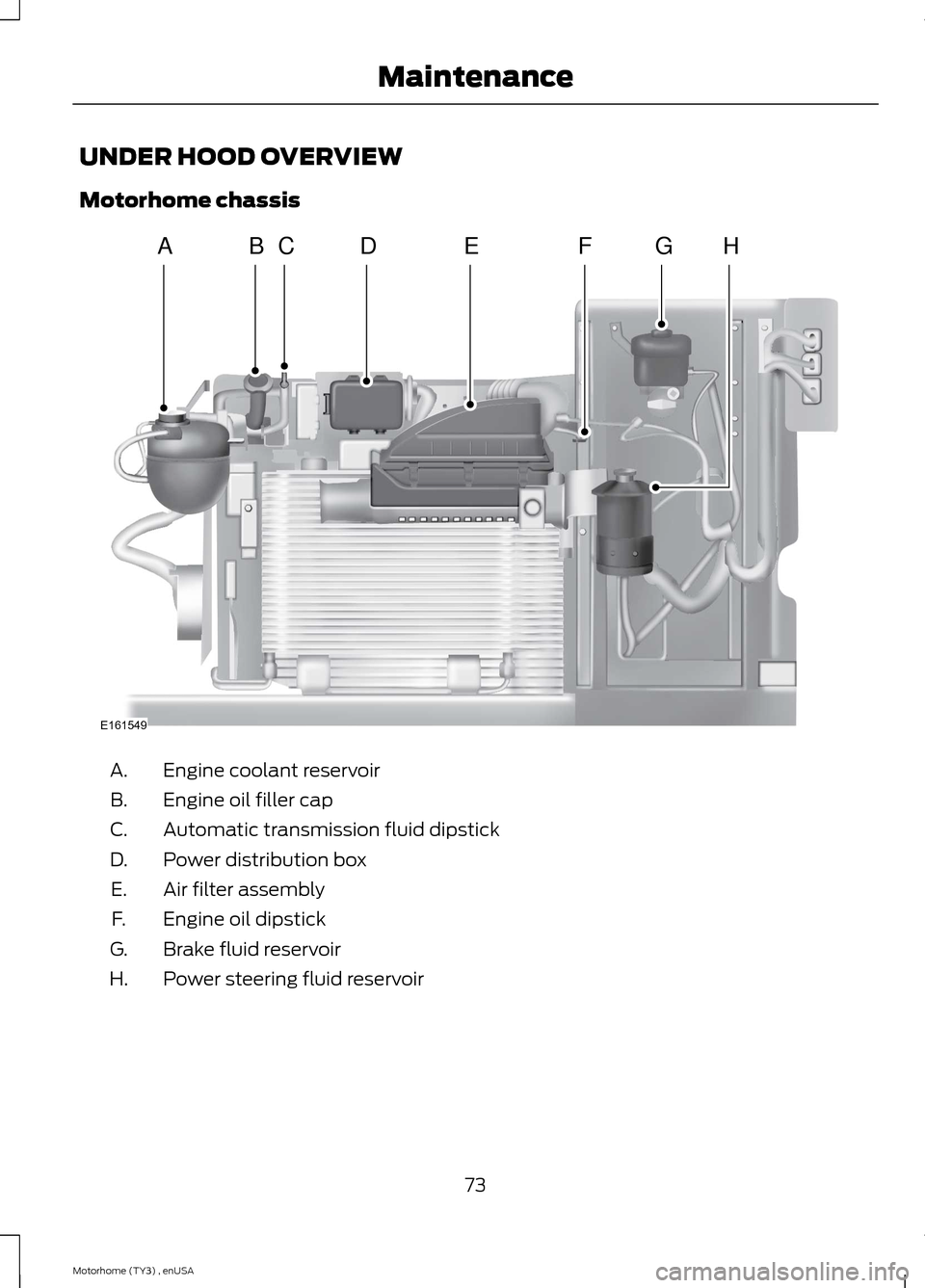
UNDER HOOD OVERVIEW
Motorhome chassis
Engine coolant reservoirA.
Engine oil filler capB.
Automatic transmission fluid dipstickC.
Power distribution boxD.
Air filter assemblyE.
Engine oil dipstickF.
Brake fluid reservoirG.
Power steering fluid reservoirH.
73Motorhome (TY3) , enUSAMaintenanceE161549ABCDEGFH
Page 77 of 143
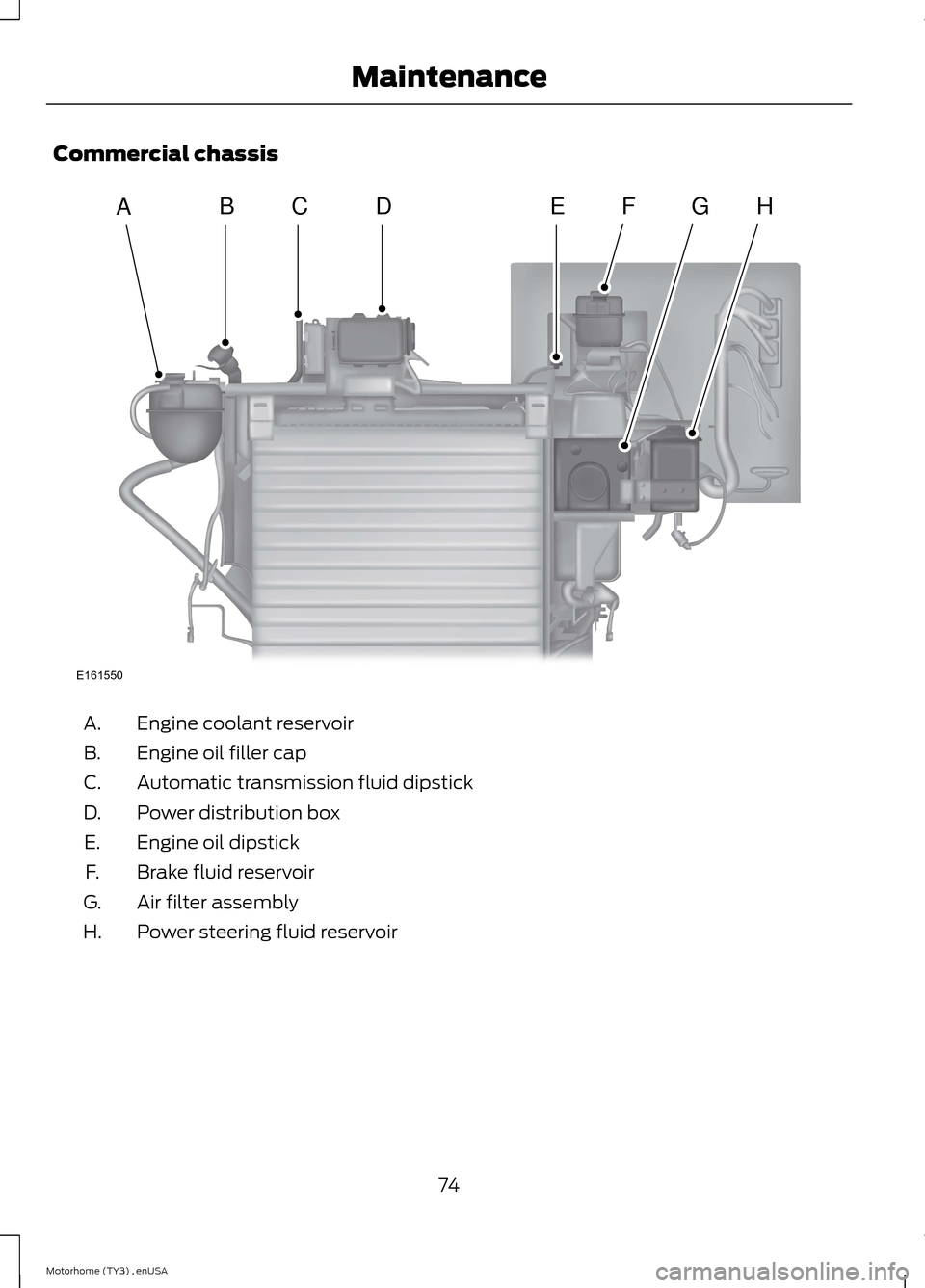
Commercial chassis
Engine coolant reservoirA.
Engine oil filler capB.
Automatic transmission fluid dipstickC.
Power distribution boxD.
Engine oil dipstickE.
Brake fluid reservoirF.
Air filter assemblyG.
Power steering fluid reservoirH.
74Motorhome (TY3) , enUSAMaintenanceE161550ABCDEFGH
Page 79 of 143
4.After three seconds, the Service: Oilreset in prog. message will bedisplayed.
5.After 25 seconds, the Service: Oil resetcomplete message will be displayed.
6.Release the accelerator and brakepedals, then rotate the key to the offposition.
Note:The Service: Oil reset completemessage will no longer be displayed.
ENGINE COOLANT CHECK
WARNINGS
Do not add engine coolant when theengine is hot. Steam and scaldingliquids released from a hot coolingsystem can burn you badly. Also, spillingcoolant on hot engine parts can burn you.
Do not put engine coolant in thewindshield washer fluid container. Ifsprayed on the windshield, enginecoolant could make it difficult to seethrough the windshield.
To reduce the risk of personal injury,make sure the engine is cool beforeunscrewing the coolant pressurerelief cap. The cooling system is underpressure; steam and hot liquid can comeout forcefully when you loosen the capslightly.
Do not add coolant further than theMAX mark.
When the engine is cold, check theconcentration and level of the enginecoolant at the intervals listed in thescheduled maintenance information. SeeScheduled Maintenance (page 121).
Note:Make sure that the level is betweenthe MIN and MAX marks on the coolantreservoir.
Note:Coolant expands when it is hot. Thelevel may extend beyond the MAX mark
Note:If the level is at the MIN mark, belowthe MIN mark, or empty, add coolantimmediately. See Adding Engine Coolantin this chapter.
The coolant concentration should bemaintained within 48% to 50%, whichequates to a freeze point between -30°F(-34°C) and -34°F (-37°C).
Note:For best results, coolantconcentration should be tested with arefractometer such as Robinair Coolant andBattery Refractometer 75240. We do notrecommend the use of hydrometers orcoolant test strips for measuring coolantconcentrations.
Note:Automotive fluids are notinterchangeable. Do not use engine coolant,antifreeze or windshield washer fluid outsideof its specified function and vehicle location.
Adding Engine Coolant
Note:Do not use stop leak pellets, coolingsystem sealants, or additives as they cancause damage to the engine cooling orheating systems. Your vehicle’s warrantydoes not cover this damage.
76Motorhome (TY3) , enUSAMaintenance
Page 80 of 143
•Do not mix different colors or types ofcoolant in your vehicle. Make sure thecorrect coolant is used. Mixing ofengine coolants may harm the engine’scooling system. The use of an impropercoolant may harm the engine andcooling system components and mayvoid the warranty. Use predilutedengine coolant meeting the Fordspecification. See Capacities andSpecifications (page 111).
•In case of emergency, you can add alarge amount of water without enginecoolant in order to reach a vehicleservice location. In this instance, youmust have the cooling system drained,chemically cleaned with MotorcraftPremium Cooling System Flush, andrefilled with engine coolant as soon aspossible. Water alone (without enginecoolant) can cause engine damagefrom corrosion, overheating or freezing.
•Do not use alcohol, methanol, brine orany engine coolants mixed with alcoholor methanol antifreeze (coolant).Alcohol and other liquids can causeengine damage from overheating orfreezing.
•Do not add extra inhibitors or additivesto the coolant. These can be harmfuland compromise the corrosionprotection of the engine coolant.
Unscrew the cap slowly. Any pressure willescape as you unscrew the cap.
Add prediluted engine coolant meeting theFord specification. See Capacities andSpecifications (page 111).
Whenever you add coolant, check thecoolant level in the coolant reservoir thenext few times you drive the vehicle. Ifnecessary, add enough prediluted enginecoolant to bring the coolant level to theproper level.
Recycled Engine Coolant
Ford Motor Company does not recommendthe use of recycled engine coolant since aFord-approved recycling process is not yetavailable.
Used engine coolant should be disposedof in an appropriate manner. Follow yourcommunity’s regulations and standardsfor recycling and disposing of automotivefluids.
Severe Climates
If you drive in extremely cold climates:
•It may be necessary to have a Fordauthorized dealer increase the coolantconcentration above 50%.
•A coolant concentration of 60% willprovide improved freeze pointprotection. Engine coolantconcentrations above 60% willdecrease the overheat protectioncharacteristics of the engine coolantand may cause engine damage
If you drive in extremely hot climates:
•It may be necessary to have a Fordauthorized dealer decrease the coolantconcentration to 40%.
•A coolant concentration of 40% willprovide improved overheat protection.Engine coolant concentrations below40% will decrease the freeze andcorrosion protection characteristics ofthe engine coolant and may causeengine damage.
Vehicles driven year-round in non-extremeclimates should use prediluted enginecoolant for optimum cooling system andengine protection.
77Motorhome (TY3) , enUSAMaintenance
Page 81 of 143
What you Should Know About Fail-Safe Cooling
If you deplete the engine coolant supply,this feature allows you to drive your vehicletemporarily before you incur incrementalcomponent damage. The fail-safe distancedepends on ambient temperatures, vehicleload and terrain.
How Fail-Safe Cooling Works
If the engine begins to overheat, the enginecoolant temperature gauge will move tothe red (hot) area and:
The coolant temperaturewarning indicator will light.
The service engine soonindicator will light.
If the engine reaches a presetover-temperature condition, the enginewill automatically switch to alternatingcylinder operation. Each disabled cylinderacts as an air pump and cools the engine.
When this occurs, the vehicle will stilloperate. However:
•The engine power will be limited.
•This will disable the air conditioningsystem.
Continued operation will increase theengine temperature and the engine willcompletely shut down, causing steeringand braking effort to increase.
Once the engine temperature cools, theengine can be re-started. Take your vehicleto an authorized dealer as soon as possibleto minimize engine damage.
When Fail-Safe Mode Is Activated
WARNINGS
Fail-safe mode is for use duringemergencies only. Operate thevehicle in fail-safe mode only as longas necessary to bring the vehicle to rest ina safe location and seek immediate repairs.When in fail-safe mode, the vehicle willhave limited power, will not be able tomaintain high-speed operation and maycompletely shut down without warning,potentially losing engine power, powersteering assist and power brake assist,which may increase the possibility of acrash resulting in serious injury.
Never remove the coolant reservoircap while the engine is running or hot.
You have limited engine power when in thefail-safe mode, so drive the vehicle withcaution. The vehicle will not be able tomaintain high-speed operation and theengine will run rough. Remember that theengine is capable of completely shuttingdown automatically to prevent enginedamage, therefore:
1.Pull off the road as soon as safelypossible and switch off the engine.
2.Have your vehicle towed to anauthorized dealer.
3.If this is not possible, wait a shortperiod for the engine to cool.
4.Check the coolant level and replenishif low.
5.Re-start the engine and take yourvehicle to an authorized dealer.
Note:Driving the vehicle without repairingthe engine problem increases the chance ofengine damage. Take your vehicle to anauthorized dealer as soon as possible.
78Motorhome (TY3) , enUSAMaintenance
Page 118 of 143
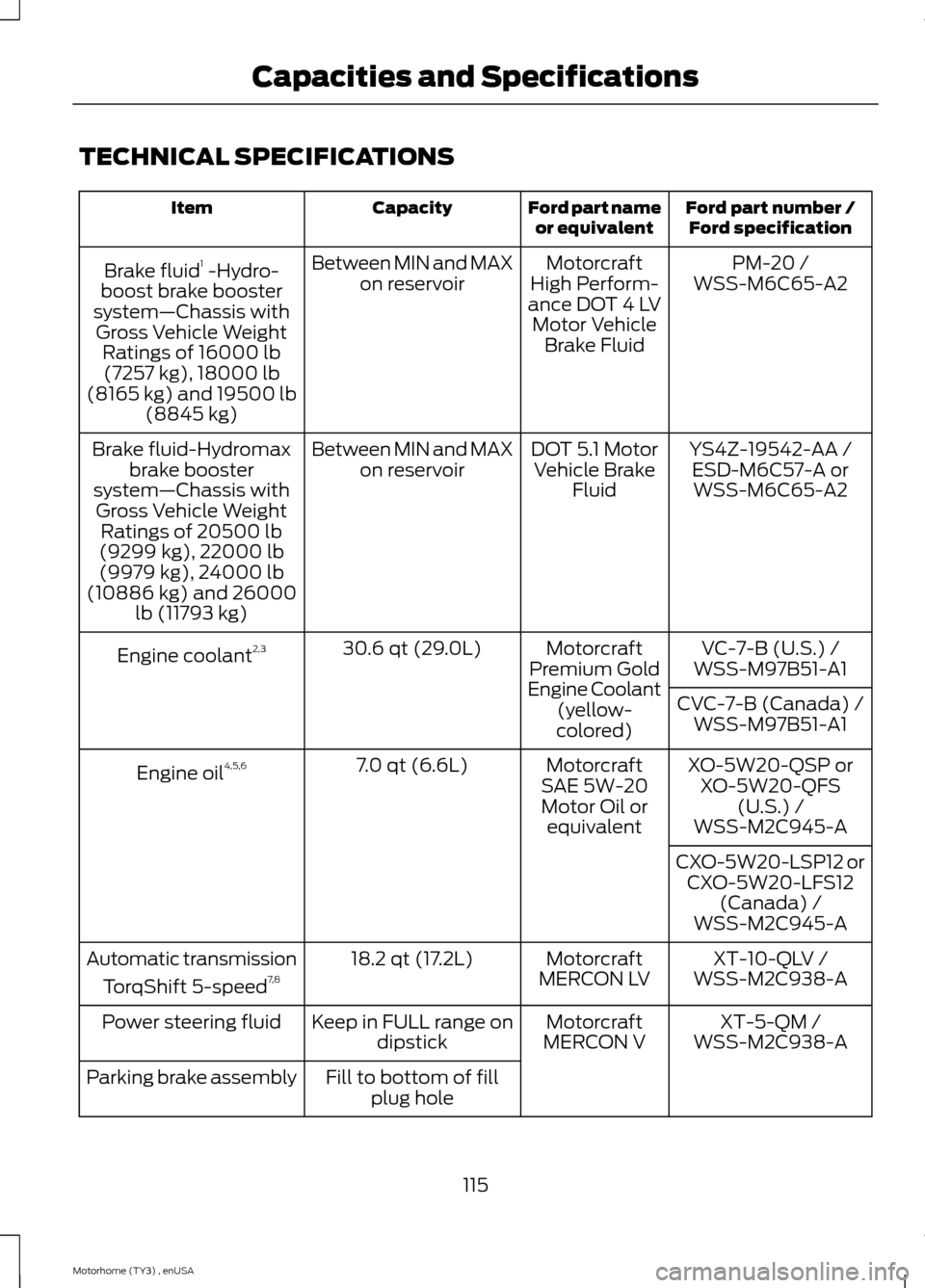
TECHNICAL SPECIFICATIONS
Ford part number /Ford specificationFord part nameor equivalentCapacityItem
PM-20 /MotorcraftHigh Perform-ance DOT 4 LVMotor VehicleBrake Fluid
Between MIN and MAXon reservoirBrake fluid1 -Hydro-boost brake boostersystem—Chassis withGross Vehicle WeightRatings of 16000 lb(7257 kg), 18000 lb(8165 kg) and 19500 lb(8845 kg)
WSS-M6C65-A2
YS4Z-19542-AA /DOT 5.1 MotorVehicle BrakeFluid
Between MIN and MAXon reservoirBrake fluid-Hydromaxbrake boostersystem—Chassis withGross Vehicle WeightRatings of 20500 lb(9299 kg), 22000 lb(9979 kg), 24000 lb(10886 kg) and 26000lb (11793 kg)
ESD-M6C57-A orWSS-M6C65-A2
VC-7-B (U.S.) /MotorcraftPremium GoldEngine Coolant(yellow-colored)
30.6 qt (29.0L)Engine coolant2,3WSS-M97B51-A1
CVC-7-B (Canada) /WSS-M97B51-A1
XO-5W20-QSP orXO-5W20-QFS(U.S.) /
MotorcraftSAE 5W-20Motor Oil orequivalent
7.0 qt (6.6L)Engine oil4,5,6
WSS-M2C945-A
CXO-5W20-LSP12 orCXO-5W20-LFS12(Canada) /WSS-M2C945-A
XT-10-QLV /MotorcraftMERCON LV18.2 qt (17.2L)Automatic transmission
TorqShift 5-speed7,8WSS-M2C938-A
XT-5-QM /MotorcraftMERCON VKeep in FULL range ondipstickPower steering fluidWSS-M2C938-A
Fill to bottom of fillplug holeParking brake assembly
115Motorhome (TY3) , enUSACapacities and Specifications
Page 120 of 143
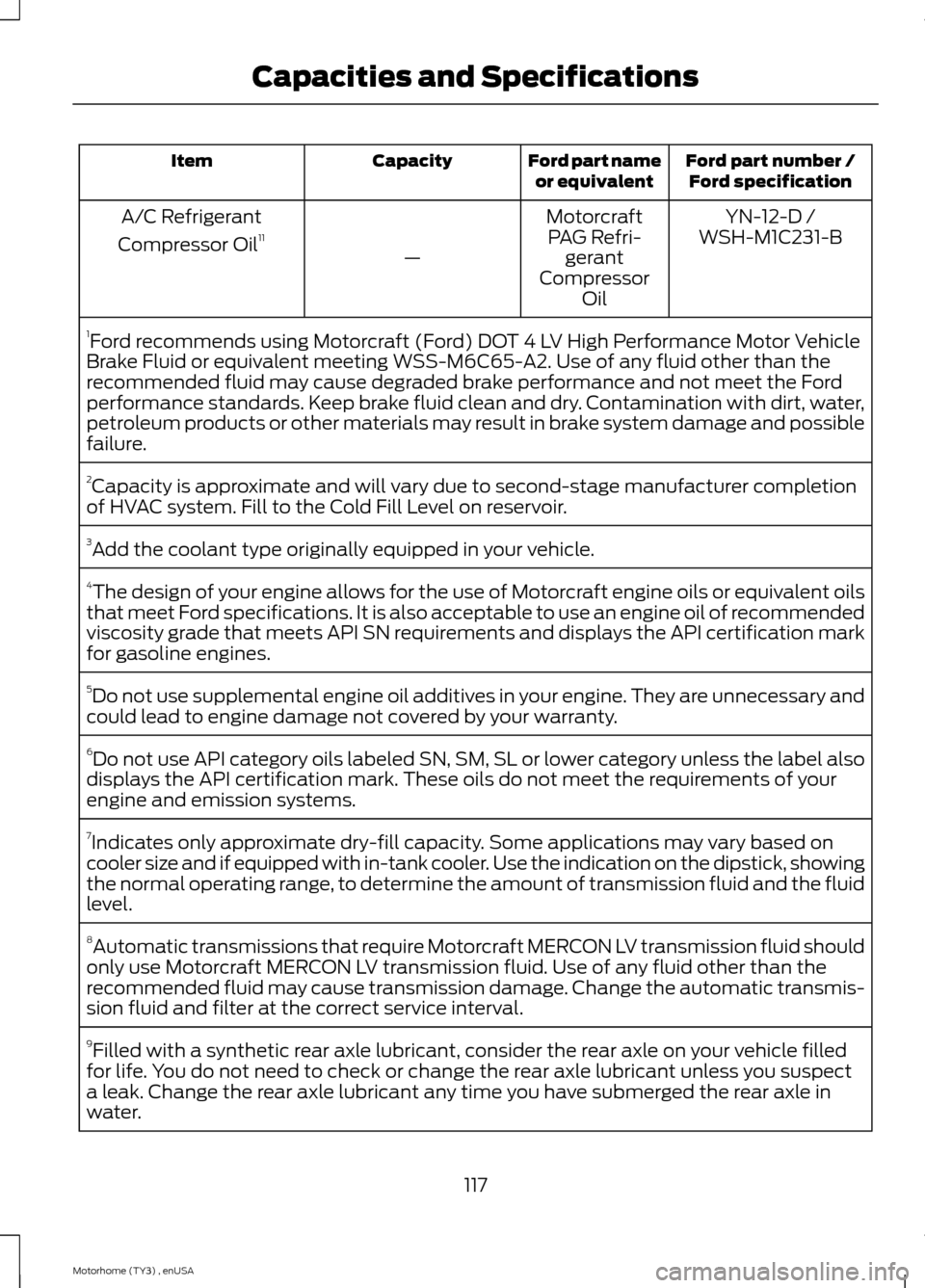
Ford part number /Ford specificationFord part nameor equivalentCapacityItem
YN-12-D /MotorcraftPAG Refri-gerantCompressorOil
—
A/C Refrigerant
Compressor Oil11WSH-M1C231-B
1Ford recommends using Motorcraft (Ford) DOT 4 LV High Performance Motor VehicleBrake Fluid or equivalent meeting WSS-M6C65-A2. Use of any fluid other than therecommended fluid may cause degraded brake performance and not meet the Fordperformance standards. Keep brake fluid clean and dry. Contamination with dirt, water,petroleum products or other materials may result in brake system damage and possiblefailure.
2Capacity is approximate and will vary due to second-stage manufacturer completionof HVAC system. Fill to the Cold Fill Level on reservoir.
3Add the coolant type originally equipped in your vehicle.
4The design of your engine allows for the use of Motorcraft engine oils or equivalent oilsthat meet Ford specifications. It is also acceptable to use an engine oil of recommendedviscosity grade that meets API SN requirements and displays the API certification markfor gasoline engines.
5Do not use supplemental engine oil additives in your engine. They are unnecessary andcould lead to engine damage not covered by your warranty.
6Do not use API category oils labeled SN, SM, SL or lower category unless the label alsodisplays the API certification mark. These oils do not meet the requirements of yourengine and emission systems.
7Indicates only approximate dry-fill capacity. Some applications may vary based oncooler size and if equipped with in-tank cooler. Use the indication on the dipstick, showingthe normal operating range, to determine the amount of transmission fluid and the fluidlevel.
8Automatic transmissions that require Motorcraft MERCON LV transmission fluid shouldonly use Motorcraft MERCON LV transmission fluid. Use of any fluid other than therecommended fluid may cause transmission damage. Change the automatic transmis-sion fluid and filter at the correct service interval.
9Filled with a synthetic rear axle lubricant, consider the rear axle on your vehicle filledfor life. You do not need to check or change the rear axle lubricant unless you suspecta leak. Change the rear axle lubricant any time you have submerged the rear axle inwater.
117Motorhome (TY3) , enUSACapacities and Specifications
Page 126 of 143
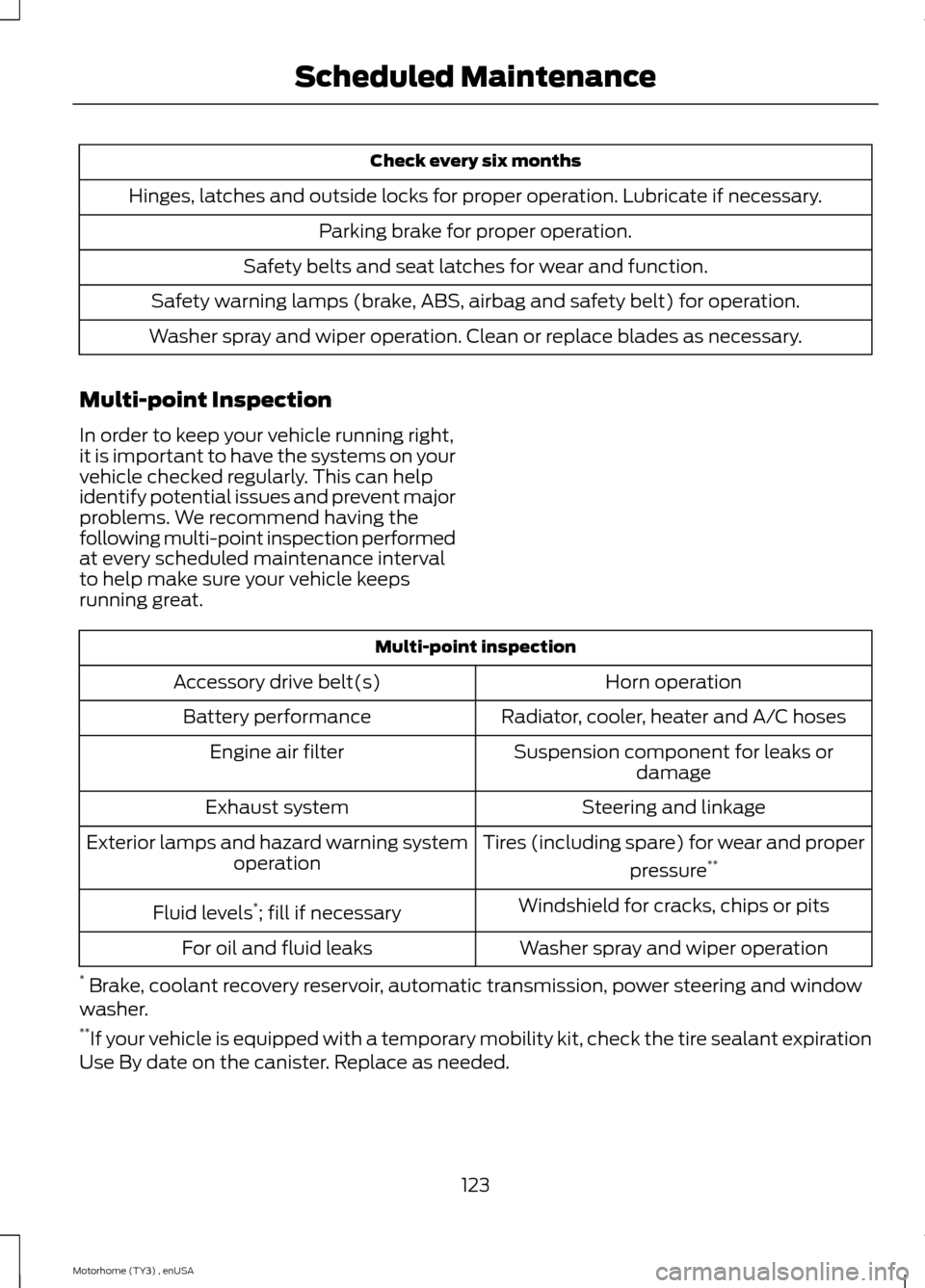
Check every six months
Hinges, latches and outside locks for proper operation. Lubricate if necessary.
Parking brake for proper operation.
Safety belts and seat latches for wear and function.
Safety warning lamps (brake, ABS, airbag and safety belt) for operation.
Washer spray and wiper operation. Clean or replace blades as necessary.
Multi-point Inspection
In order to keep your vehicle running right,it is important to have the systems on yourvehicle checked regularly. This can helpidentify potential issues and prevent majorproblems. We recommend having thefollowing multi-point inspection performedat every scheduled maintenance intervalto help make sure your vehicle keepsrunning great.
Multi-point inspection
Horn operationAccessory drive belt(s)
Radiator, cooler, heater and A/C hosesBattery performance
Suspension component for leaks ordamageEngine air filter
Steering and linkageExhaust system
Tires (including spare) for wear and proper
pressure**Exterior lamps and hazard warning systemoperation
Windshield for cracks, chips or pitsFluid levels*; fill if necessary
Washer spray and wiper operationFor oil and fluid leaks
* Brake, coolant recovery reservoir, automatic transmission, power steering and windowwasher.**If your vehicle is equipped with a temporary mobility kit, check the tire sealant expirationUse By date on the canister. Replace as needed.
123Motorhome (TY3) , enUSAScheduled Maintenance