engine FORD F150 1997 10.G Workshop Manual
[x] Cancel search | Manufacturer: FORD, Model Year: 1997, Model line: F150, Model: FORD F150 1997 10.GPages: 219, PDF Size: 2.21 MB
Page 159 of 219
11. Power steering fluid reservoir
12. Windshield washer fluid
reservoir
ENGINE OIL
Oil specifications
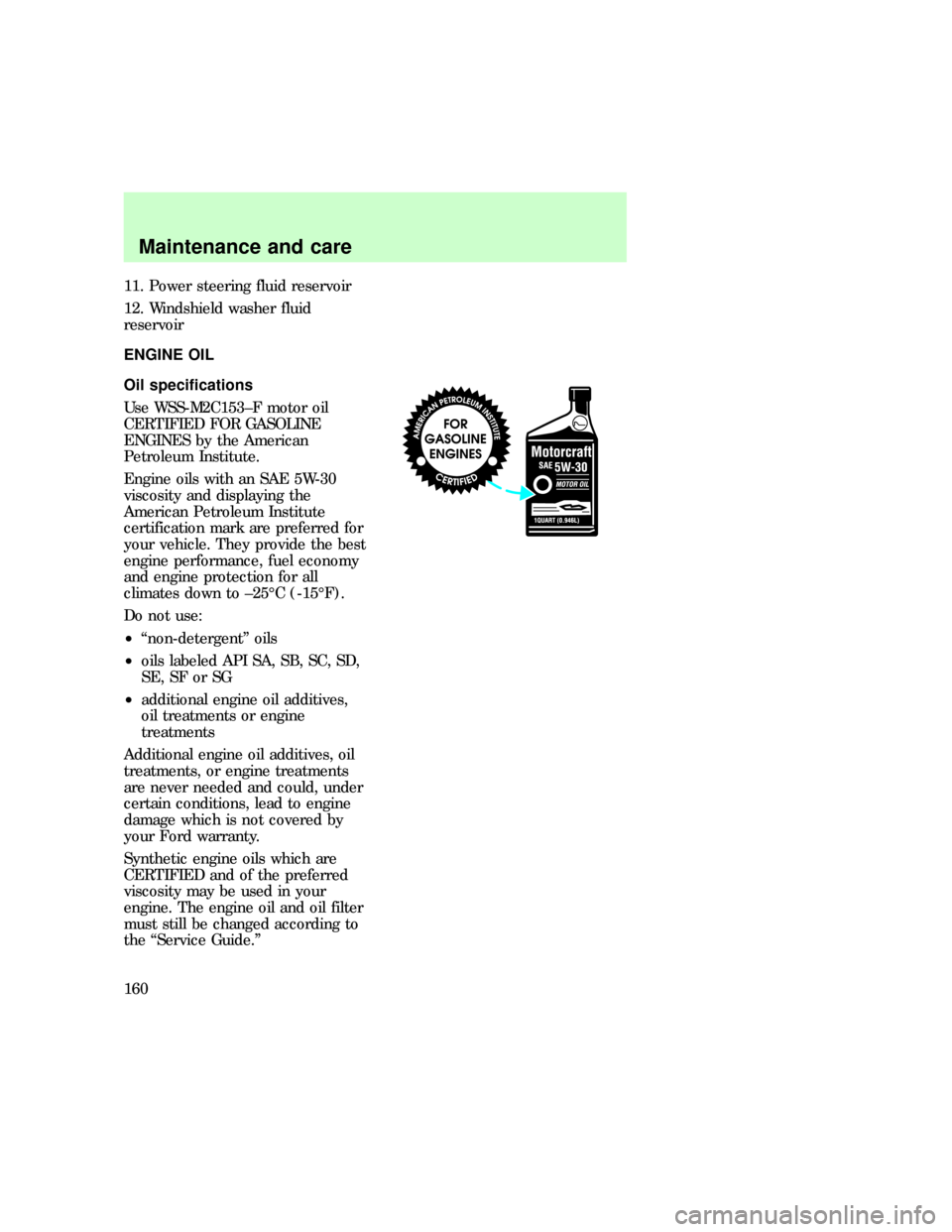
Use WSS-M2C153±F motor oil
CERTIFIED FOR GASOLINE
ENGINES by the American
Petroleum Institute.
Engine oils with an SAE 5W-30
viscosity and displaying the
American Petroleum Institute
certification mark are preferred for
your vehicle. They provide the best
engine performance, fuel economy
and engine protection for all
climates down to ±25ÉC (-15ÉF).
Do not use:
²ªnon-detergentº oils
²oils labeled API SA, SB, SC, SD,
SE, SF or SG
²additional engine oil additives,
oil treatments or engine
treatments
Additional engine oil additives, oil
treatments, or engine treatments
are never needed and could, under
certain conditions, lead to engine
damage which is not covered by
your Ford warranty.
Synthetic engine oils which are
CERTIFIED and of the preferred
viscosity may be used in your
engine. The engine oil and oil filter
must still be changed according to
the ªService Guide.º
f12_engine_oil
f12_oil_specs
Maintenance and care
160
Page 160 of 219

Oil filters
Ford production and aftermarket
(Motorcraft) oil filters are designed
for added engine protection and
long life. If a replacement oil filter
is used that does not meet Ford
material and design specifications,
startup engine noises or knock
may be experienced. It is
recommended that you use the
appropriate Motorcraft oil filter (or
another brand meeting Ford
specifications) for your engine
application.
Checking engine oil
Check the engine oil each time you
fuel your vehicle.
Check the engine oil level more
frequently if the vehicle is carrying
a heavy load, towing a trailer,
idling for extended periods (like
police, taxi or shuttle service
vehicles) or driven at high speeds
for extended periods of time.
To check the oil:
1. Make sure the vehicle is on level
ground. If the engine is warm, turn
the engine off and wait a few
minutes for the oil to drain into
the oil pan.
2. Set the parking brake and
ensure the gearshift is latched in P
(Park) (automatic transmission) or
1 (First) (manual transmission).
3. Open the hood. Protect yourself
from engine heat.
4. Locate and carefully remove the
f12_checking_oil
Maintenance and care
161
Page 161 of 219
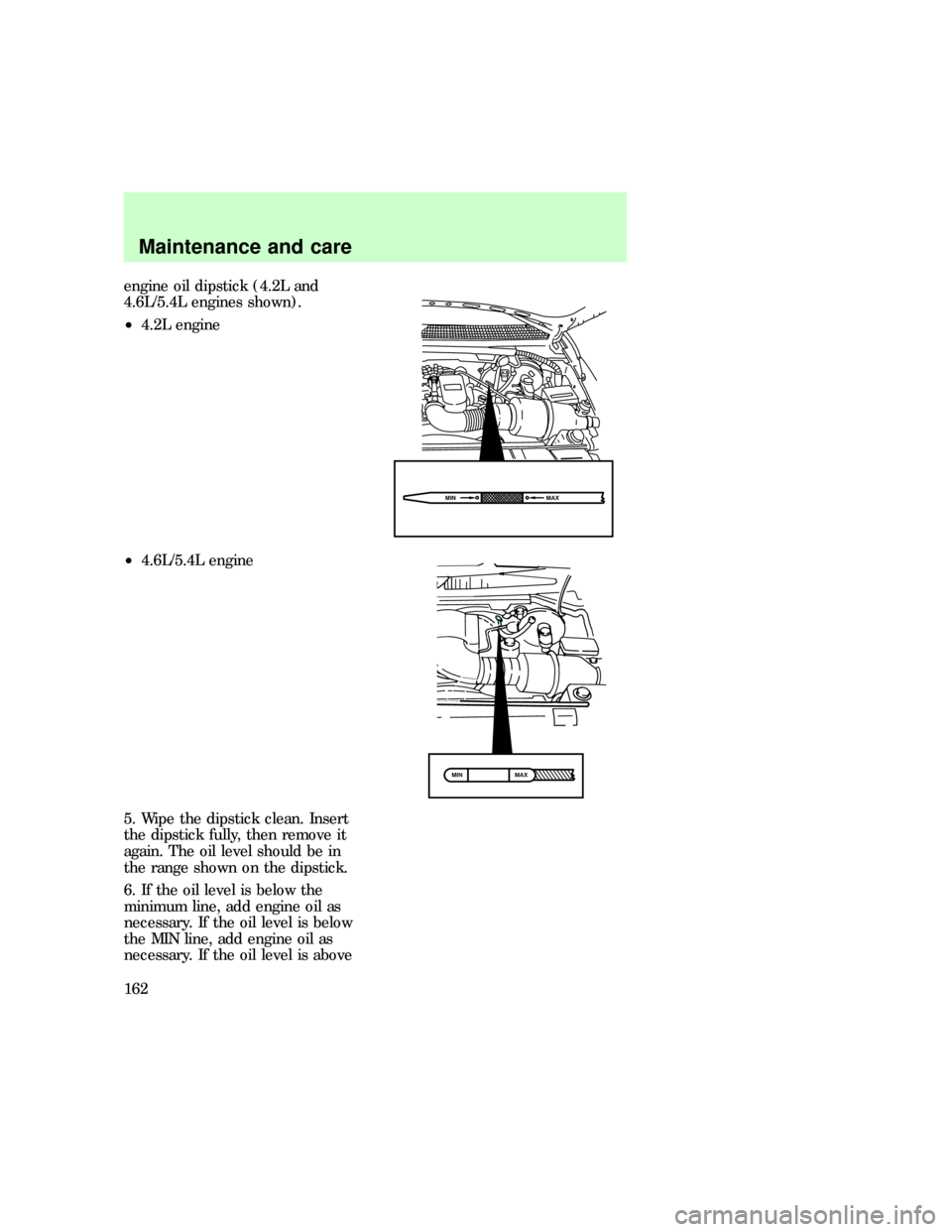
engine oil dipstick (4.2L and
4.6L/5.4L engines shown).
²4.2L engine
²4.6L/5.4L engine
5. Wipe the dipstick clean. Insert
the dipstick fully, then remove it
again. The oil level should be in
the range shown on the dipstick.
6. If the oil level is below the
minimum line, add engine oil as
necessary. If the oil level is below
the MIN line, add engine oil as
necessary. If the oil level is above
MAX MIN
MAX MIN
Maintenance and care
162
Page 162 of 219
the MAX line, engine damage or
high oil consumption may occur
and some oil must be removed
from the engine by a service
technician.
7. Put the dipstick back in and
ensure it is fully seated.
Adding engine oil
1. Check the engine oil.
2. If the oil level is below the MIN
line, then add engine oil.
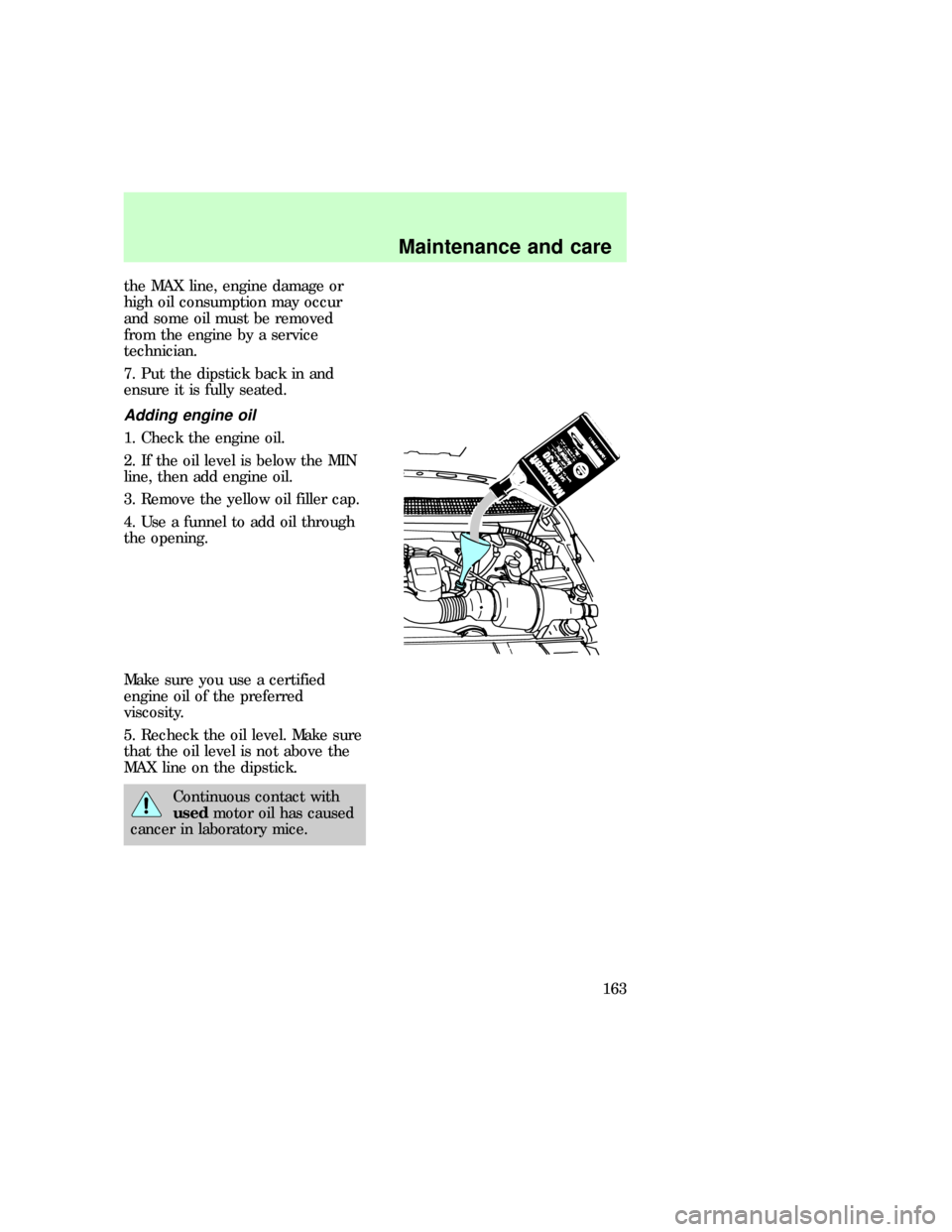
3. Remove the yellow oil filler cap.
4. Use a funnel to add oil through
the opening.
Make sure you use a certified
engine oil of the preferred
viscosity.
5. Recheck the oil level. Make sure
that the oil level is not above the
MAX line on the dipstick.
Continuous contact with
usedmotor oil has caused
cancer in laboratory mice.
f12_adding_oil
f12_brake_fluid
Maintenance and care
163
Page 166 of 219
CHECKING AND ADDING
ENGINE COOLANT
Adding engine coolant
Do not put engine coolant
in the container for the
windshield washer fluid.
If sprayed on the windshield,
engine coolant could make it
difficult to see through the
windshield.
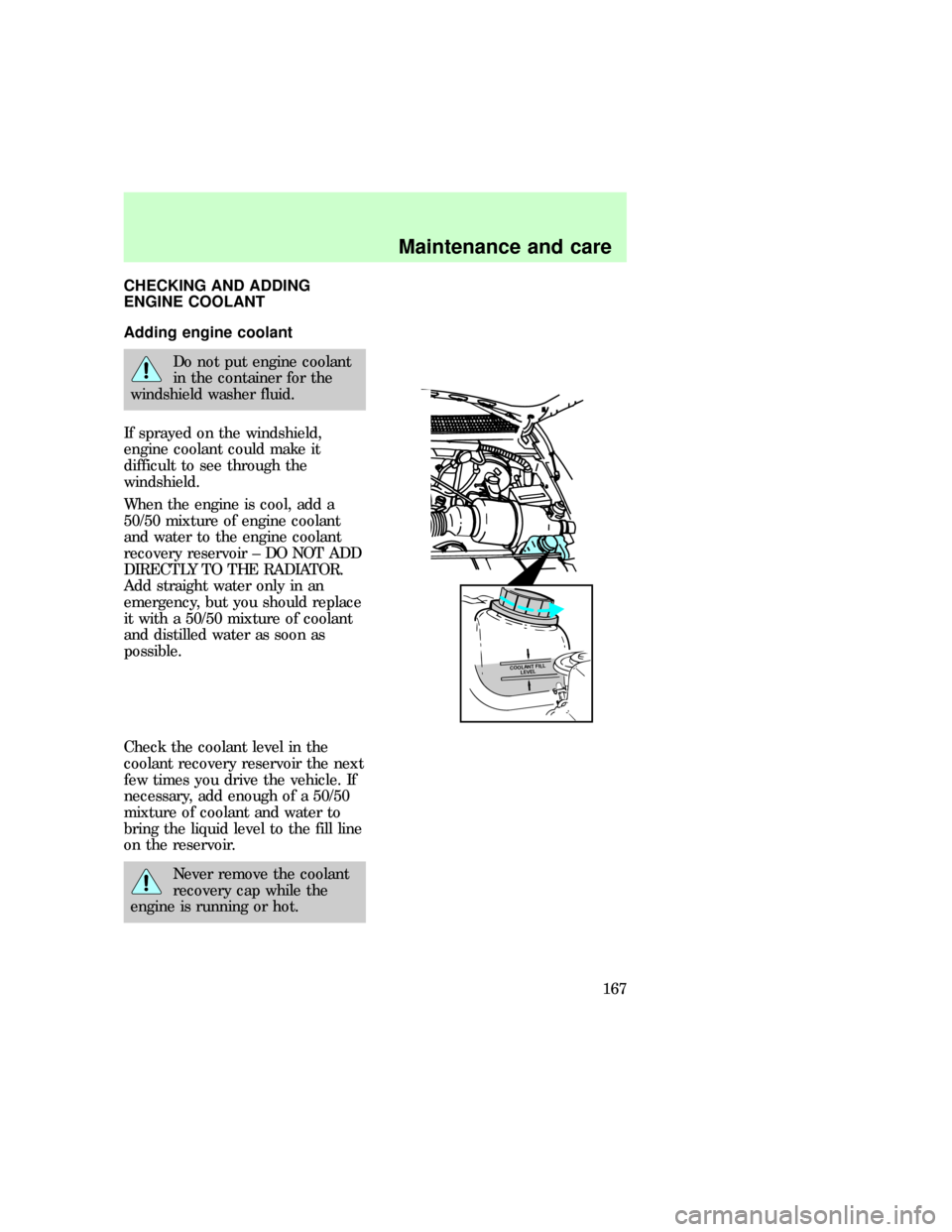
When the engine is cool, add a
50/50 mixture of engine coolant
and water to the engine coolant
recovery reservoir ± DO NOT ADD
DIRECTLY TO THE RADIATOR.
Add straight water only in an
emergency, but you should replace
it with a 50/50 mixture of coolant
and distilled water as soon as
possible.
Check the coolant level in the
coolant recovery reservoir the next
few times you drive the vehicle. If
necessary, add enough of a 50/50
mixture of coolant and water to
bring the liquid level to the fill line
on the reservoir.
Never remove the coolant
recovery cap while the
engine is running or hot.
COOLANT FILL
LEVEL
f12_adding_coolant
Maintenance and care
167
Page 167 of 219

If you must remove the coolant
recovery cap, follow these steps to
avoid personal injury:
1. Before you remove the cap, turn
the engine off and let it cool.
2. When the engine is cool, wrap a
thick cloth around the cap. Slowly
turn cap counterclockwise to the
first stop.
3. Step back while the pressure
releases.
4. When you are sure that all the
pressure has been released, use
the cloth to press the cap down,
turn it counterclockwise and
remove it.
Use Ford Premium Cooling System
Fluid E2FZ-19549±AA (in Canada,
Motorcraft CXC-8±B) or an
equivalent premium engine coolant
that meets Ford Specification
ESE-M97B44±A. Ford Premium
Engine Coolant is an optimized
formula that will protect all metals
and rubber elastomers used in
Ford cooling systems for 4 years or
80,000 km (50,000 miles).
Do not use alcohol or methanol
antifreeze or any engine coolants
mixed with alcohol or methanol
antifreeze. Do not use
supplemental coolant additives in
your vehicle. These additives may
harm your engine cooling system.
The use of an improper coolant
may void the warranty of your
vehicle's engine cooling system.
f12_recycled_coolant
Maintenance and care
168
Page 168 of 219

Recycled engine coolant
Ford Motor Company recommends
that Ford and Lincoln-Mercury
dealers use recycled engine
coolant produced by
Ford-approved processes. Not all
coolant recycling processes
produce coolant which meets Ford
specification ESE-M97B44±A, and
use of such coolant may harm
engine and cooling system
components.
Always dispose of used
automotive fluids in a responsible
manner. Follow your community's
regulations and standards for
recycling and disposing of
automotive fluids.
Coolant refill capacity
To find out how much fluid your
vehicle's cooling system can hold,
refer toRefill capacitiesin the
Capacities and specifications
chapter.
Have your dealer check the engine
cooling system for leaks if you
have to add more than a liter
(quart) of engine coolant per
month.
Severe winter climate
If you drive in extremely cold
climates [less than 36ÉC (34ÉF)], it
may be necessary to increase the
coolant concentration above 50%.
Refer to the chart on the coolant
container to ensure the coolant
concentration in your vehicle is
such that the coolant will not
f12_refill_capacity
f12_winter_climate
Maintenance and care
169
Page 169 of 219
freeze at the temperature level in
which you drive during winter
months. Never increase the engine
coolant concentration above 60%.
Leave a 50/50 mixture of engine
coolant and water in your vehicle
year-round in non-extreme
climates.
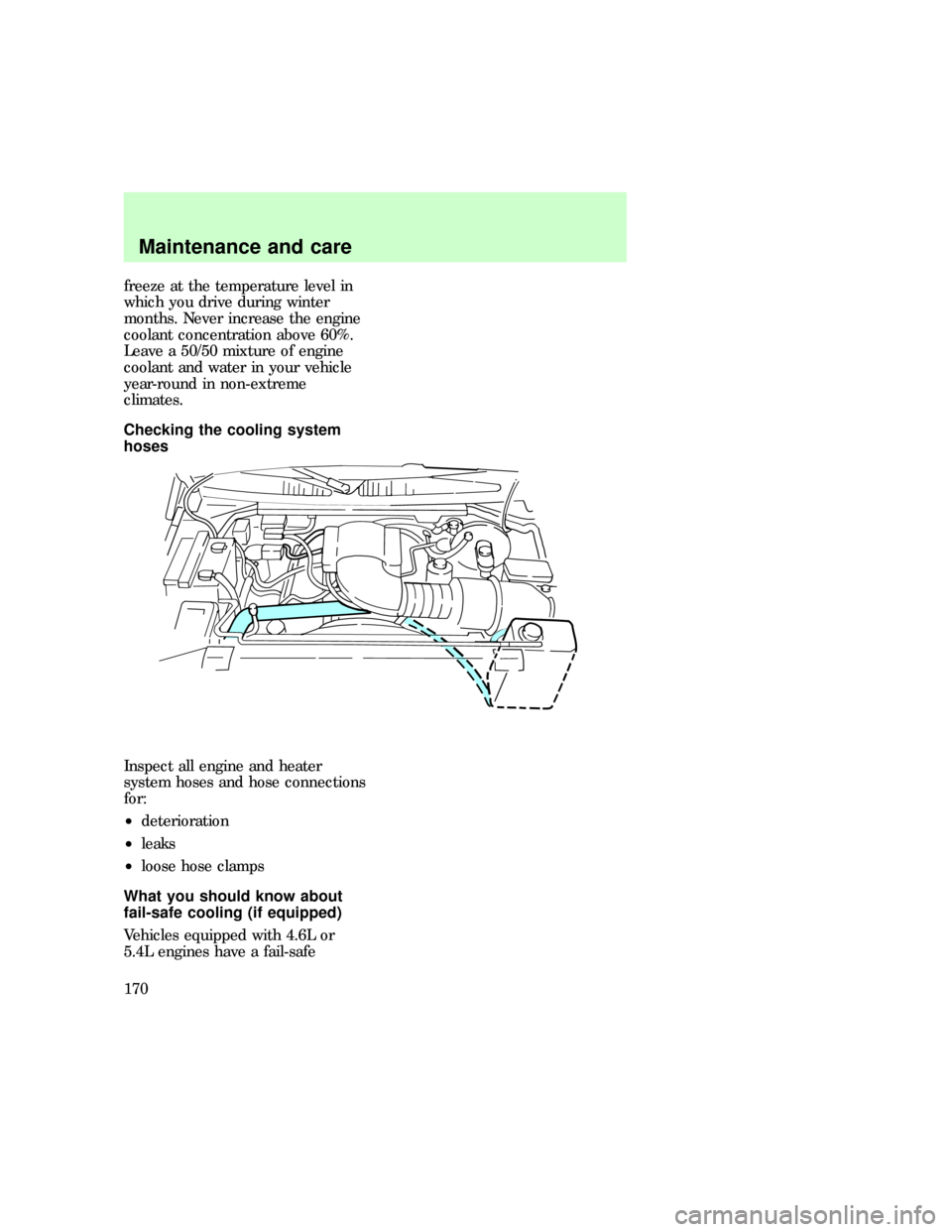
Checking the cooling system
hoses
Inspect all engine and heater
system hoses and hose connections
for:
²deterioration
²leaks
²loose hose clamps
What you should know about
fail-safe cooling (if equipped)
Vehicles equipped with 4.6L or
5.4L engines have a fail-safe
com_checking_hoses.01
f12_wysk_failsafe_cooling
Maintenance and care
170
Page 170 of 219
cooling mode. If the engine coolant
supply is depleted, this feature
allows the driver to drive the
vehicle (with limited power) for a
short distance in order to get the
vehicle to a service facility. Take
your vehicle to a service facility as
soon as possible to minimize
engine damage.
The actual distance your vehicle
can be driven depends on vehicle
load, road conditions and outside
temperature.
How fail-safe cooling works
If the engine overheats, the engine
will automatically switch from
eight to alternating four cylinder
operation. Each disabled cylinder
acts as an air pump and cools the
engine.
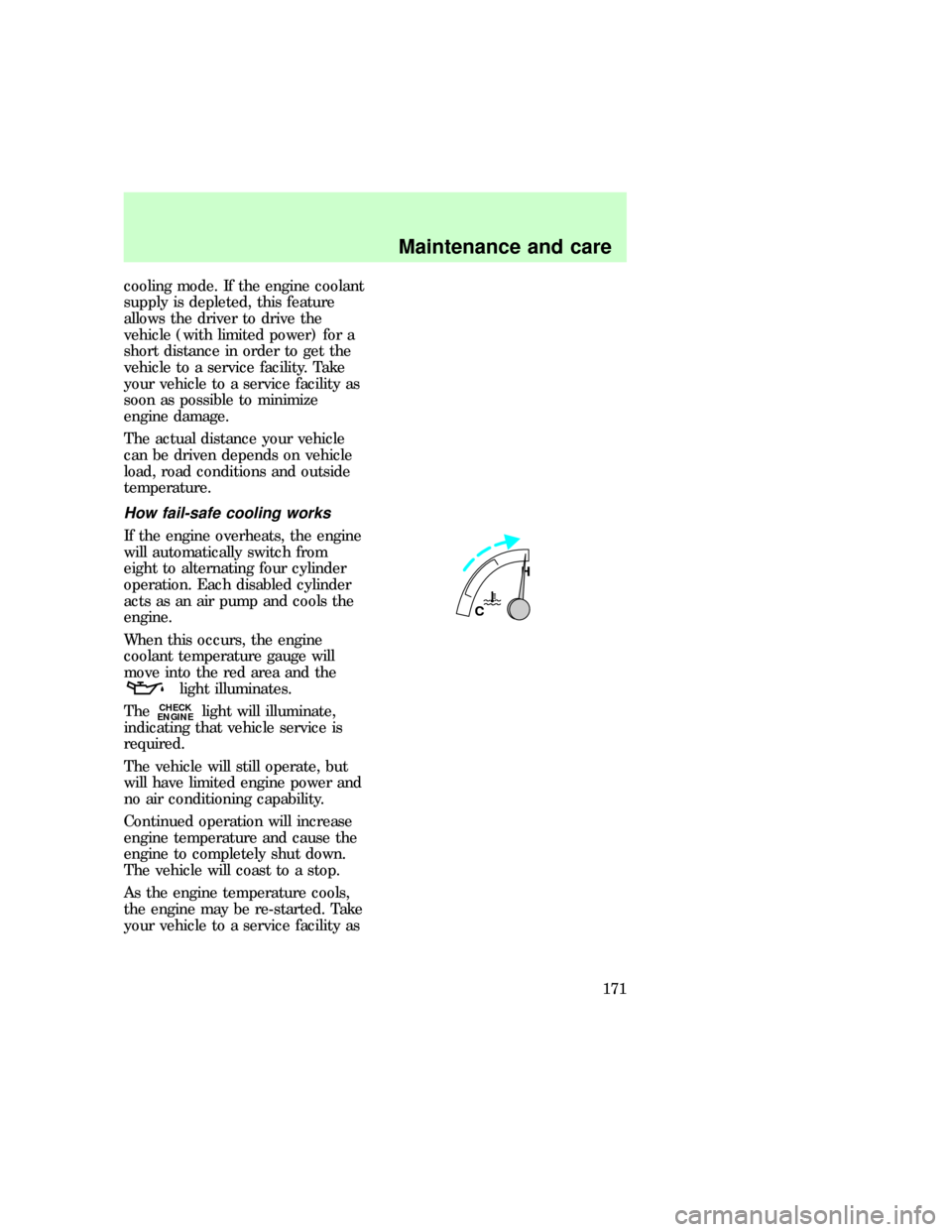
When this occurs, the engine
coolant temperature gauge will
move into the red area and the
light illuminates.
The
CHECK
ENGINElight will illuminate,
indicating that vehicle service is
required.
The vehicle will still operate, but
will have limited engine power and
no air conditioning capability.
Continued operation will increase
engine temperature and cause the
engine to completely shut down.
The vehicle will coast to a stop.
As the engine temperature cools,
the engine may be re-started. Take
your vehicle to a service facility as
CHCH
Maintenance and care
171
Page 171 of 219
soon as possible to minimize
engine damage.
When fail-safe mode is
activated
²Pull off the road as soon as
possible.
²Immediately turn the engine off
to prevent severe engine
damage.
²Wait for the engine to cool.
²Check the coolant level.
CHECKING AND ADDING
POWER STEERING FLUID
Check the power steering fluid
level at least twice a year.
1. Start the engine.
CHCH
f12_power_steering
Maintenance and care
172