child restraint FORD F150 1999 10.G User Guide
[x] Cancel search | Manufacturer: FORD, Model Year: 1999, Model line: F150, Model: FORD F150 1999 10.GPages: 232, PDF Size: 1.56 MB
Page 104 of 232
Follow all the important safety restraint and air bag precautions that
apply to adult passengers in your vehicle.
If the shoulder belt portion of a combination lap and shoulder belt can be
positioned so it does not cross or rest in front of the child's face or neck,
the child should wear the lap and shoulder belt. Moving the child closer to
the center of the vehicle may help provide a good shoulder belt fit.
Do not leave children, unreliable adults, or pets unattended in
your vehicle.
To improve the fit of lap and shoulder belts on children who have
outgrown child safety seats, Ford recommends use of a belt-positioning
booster seat that is labelled as conforming to all Federal motor vehicle
safety standards. Belt-positioning booster seats raise the child and
provide a shorter, firmer seating cushion that encourages safer seating
posture and better fit of lap and shoulder belts on the child.
A belt-positioning booster should be used if the shoulder belt rests in
front of the child's face or neck, or if the lap belt does not fit snugly on
both thighs, or if the thighs are too short to let the child sit all the way
back on the seat cushion when the lower legs hang over the edge of the
seat cushion. You may wish to discuss the special needs of your child
with your pediatrician.
SAFETY SEATS FOR CHILDREN
Child and infant or child safety seats
Use a safety seat that is recommended for the size and weight of the child.
Carefully follow all of the manufacturer's instructions with the safety seat
you put in your vehicle. If you do not install and use the safety seat properly,
the child may be injured in a sudden stop or collision.
Seating and safety restraints
104
Page 105 of 232
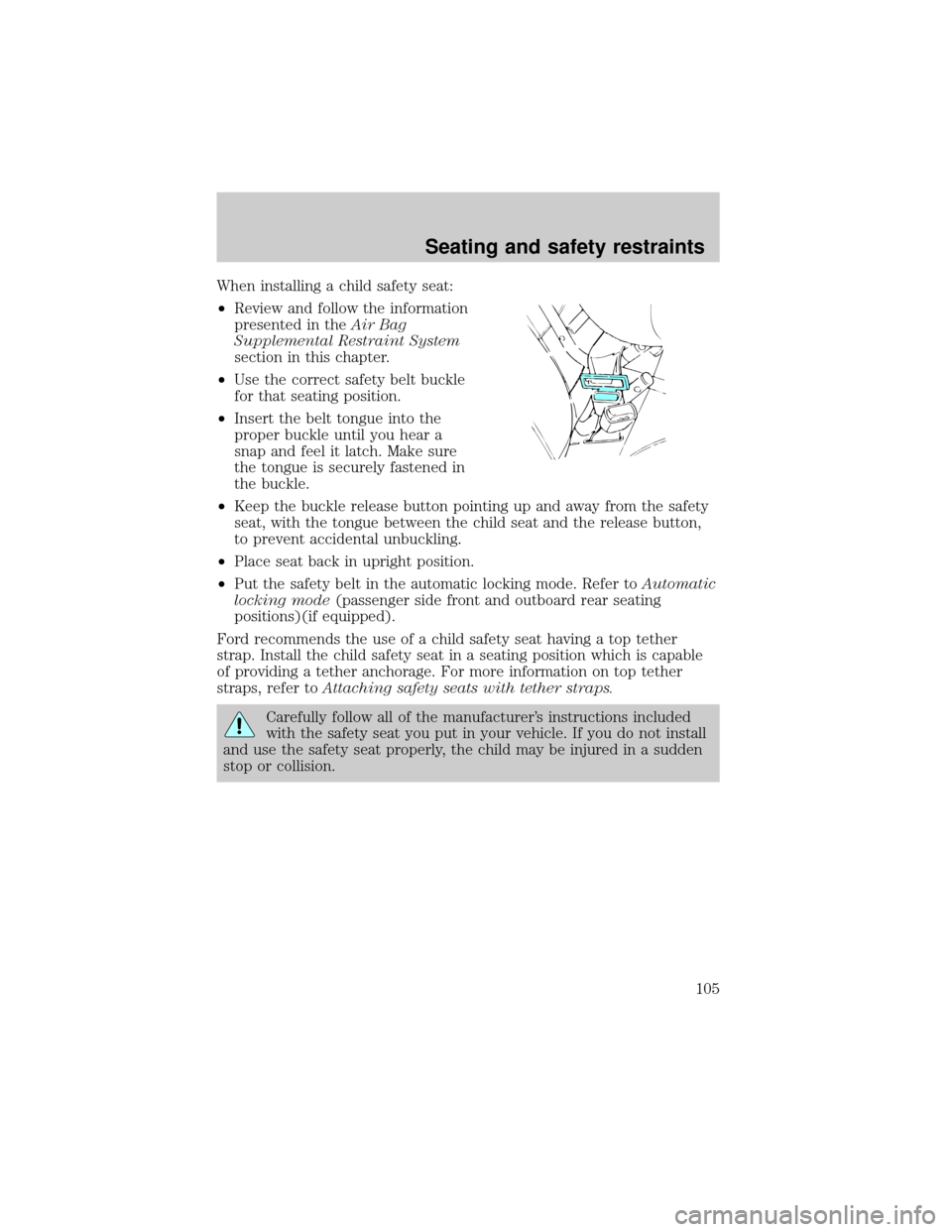
When installing a child safety seat:
²Review and follow the information
presented in theAir Bag
Supplemental Restraint System
section in this chapter.
²Use the correct safety belt buckle
for that seating position.
²Insert the belt tongue into the
proper buckle until you hear a
snap and feel it latch. Make sure
the tongue is securely fastened in
the buckle.
²Keep the buckle release button pointing up and away from the safety
seat, with the tongue between the child seat and the release button,
to prevent accidental unbuckling.
²Place seat back in upright position.
²Put the safety belt in the automatic locking mode. Refer toAutomatic
locking mode(passenger side front and outboard rear seating
positions)(if equipped).
Ford recommends the use of a child safety seat having a top tether
strap. Install the child safety seat in a seating position which is capable
of providing a tether anchorage. For more information on top tether
straps, refer toAttaching safety seats with tether straps.
Carefully follow all of the manufacturer's instructions included
with the safety seat you put in your vehicle. If you do not install
and use the safety seat properly, the child may be injured in a sudden
stop or collision.
Seating and safety restraints
105
Page 106 of 232
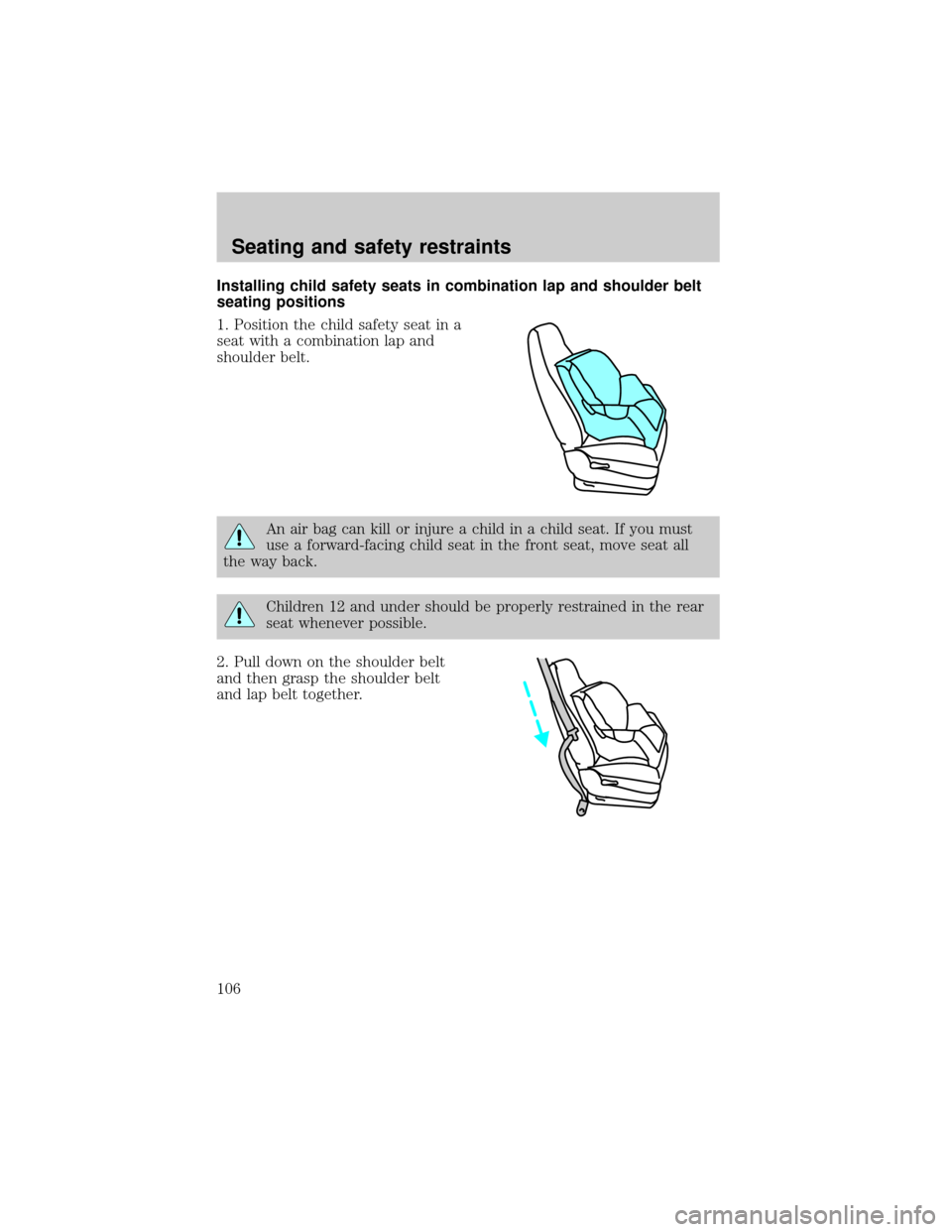
Installing child safety seats in combination lap and shoulder belt
seating positions
1. Position the child safety seat in a
seat with a combination lap and
shoulder belt.
An air bag can kill or injure a child in a child seat. If you must
use a forward-facing child seat in the front seat, move seat all
the way back.
Children 12 and under should be properly restrained in the rear
seat whenever possible.
2. Pull down on the shoulder belt
and then grasp the shoulder belt
and lap belt together.
Seating and safety restraints
106
Page 107 of 232
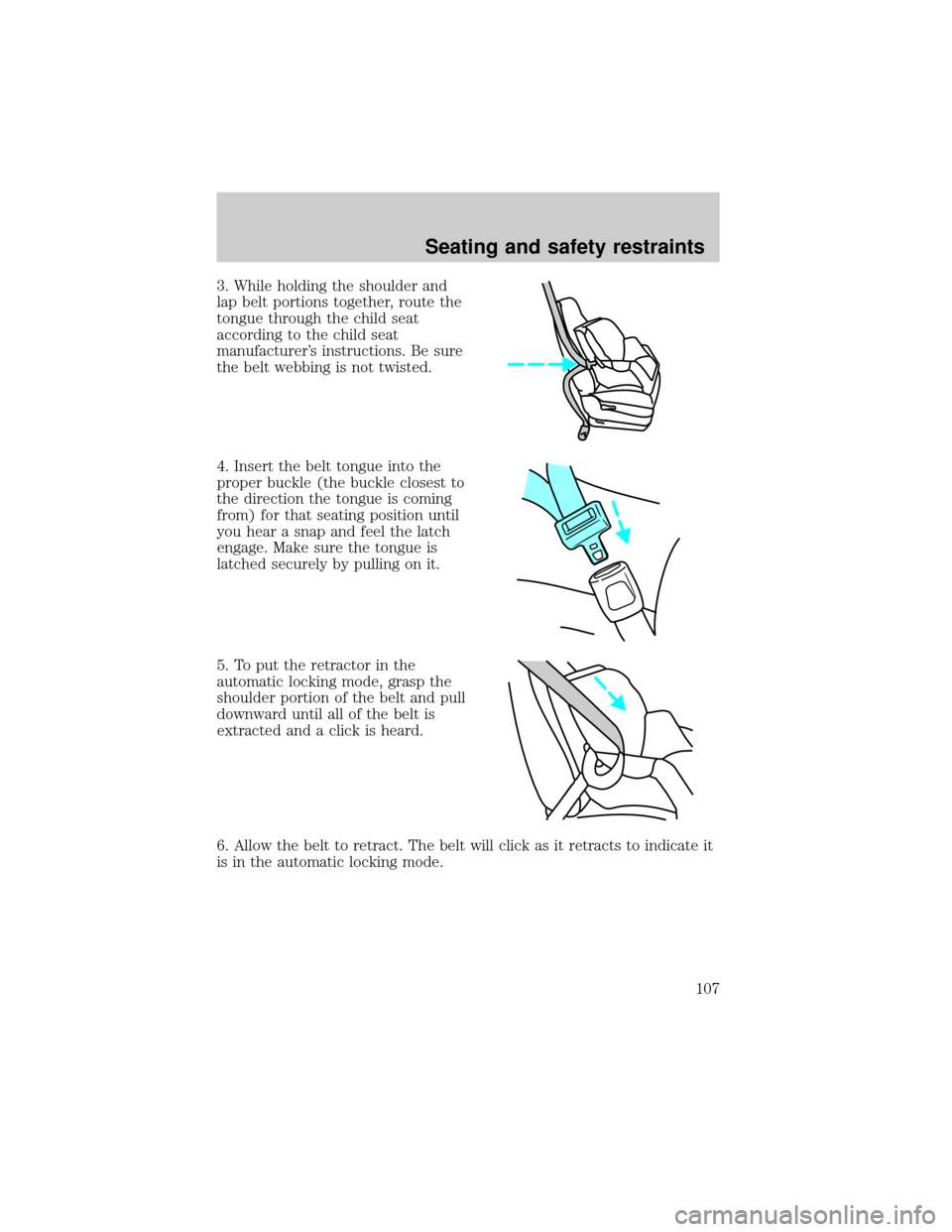
3. While holding the shoulder and
lap belt portions together, route the
tongue through the child seat
according to the child seat
manufacturer's instructions. Be sure
the belt webbing is not twisted.
4. Insert the belt tongue into the
proper buckle (the buckle closest to
the direction the tongue is coming
from) for that seating position until
you hear a snap and feel the latch
engage. Make sure the tongue is
latched securely by pulling on it.
5. To put the retractor in the
automatic locking mode, grasp the
shoulder portion of the belt and pull
downward until all of the belt is
extracted and a click is heard.
6. Allow the belt to retract. The belt will click as it retracts to indicate it
is in the automatic locking mode.
Seating and safety restraints
107
Page 108 of 232
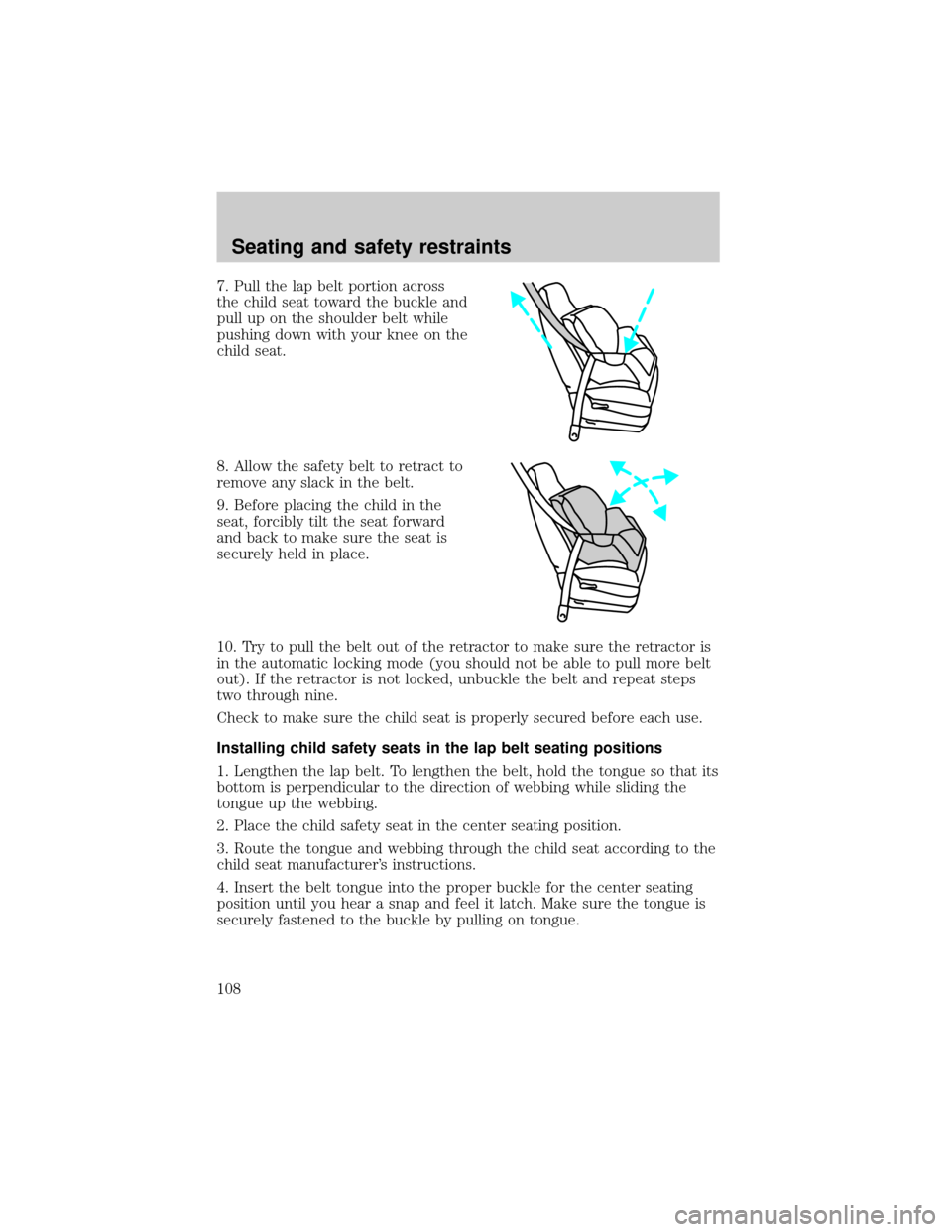
7. Pull the lap belt portion across
the child seat toward the buckle and
pull up on the shoulder belt while
pushing down with your knee on the
child seat.
8. Allow the safety belt to retract to
remove any slack in the belt.
9. Before placing the child in the
seat, forcibly tilt the seat forward
and back to make sure the seat is
securely held in place.
10. Try to pull the belt out of the retractor to make sure the retractor is
in the automatic locking mode (you should not be able to pull more belt
out). If the retractor is not locked, unbuckle the belt and repeat steps
two through nine.
Check to make sure the child seat is properly secured before each use.
Installing child safety seats in the lap belt seating positions
1. Lengthen the lap belt. To lengthen the belt, hold the tongue so that its
bottom is perpendicular to the direction of webbing while sliding the
tongue up the webbing.
2. Place the child safety seat in the center seating position.
3. Route the tongue and webbing through the child seat according to the
child seat manufacturer's instructions.
4. Insert the belt tongue into the proper buckle for the center seating
position until you hear a snap and feel it latch. Make sure the tongue is
securely fastened to the buckle by pulling on tongue.
Seating and safety restraints
108
Page 109 of 232
5. Push down on the child seat while pulling on the loose end of the lap
belt webbing to tighten the belt.
6. Before placing the child into the child seat, forcibly tilt the child seat
from side to side and in forward direction to make sure that the seat is
held securely in place. If the child seat moves excessively, repeat steps 5
through 6, or properly install the child seat in a different position.
Attaching safety seats with tether straps
Some manufacturers make safety seats that include a tether strap that
goes over the back of the vehicle seat and attaches to an anchoring
point. Other manufacturers offer the tether strap as an accessory.
Contact the manufacturer of your child safety seat for information about
ordering a tether strap.
Tether anchorage hardware
A tethered seat can be installed in the front passenger seat. Put the
tether strap over the seatback and attach it to an anchor bracket.
An anchor bracket can be installed on the rear edge of the front
passenger seat cushion.
The provision (attaching hole) is provided in the rear edge of the front
passenger seat cushion frame. The anchor bracket must be installed
using the instructions provided with the kit.
Tether anchorage hardware kits (part number 613D74) including
instructions, may be obtained at no charge from any Ford or
Lincoln-Mercury dealer.
If you have a SuperCab, attach the bracket to the inside of the back
panel of your vehicle. Carefully follow the instructions provided with the
kit.
If you have a SuperCab, Ford recommends you attach tether safety seats
in the rear seating position (if possible) with the tether strap attached to
the tether anchorage bracket as shown in the instructions provided with
the tether anchor kit.
Tighten the anchor according to specifications. Otherwise, the
safety seat may not be properly secured and the child may be
injured in a sudden stop or collision.
Seating and safety restraints
109
Page 225 of 232
Accessory delay ..........................70
Air bag supplemental restraint
system ..........................................95
and child safety seats ..............96
description ................................95
disposal ......................................98
indicator light ...........................98
passenger air bag .....................96
passenger deactivation
switch ..............61,99,100,101,102
Air cleaner filter ................188,189
Air suspension ...........................119
warning light .............................11
Anti-theft system ..............76,77,78
Armrests ......................................88
Automatic transmission
driving an automatic
overdrive ...................121,122,123
Axle
refill capacities ........................215
Battery
voltage gauge ............................14
Brakes ........................................115
anti-lock ............................115,116
anti-lock brake system
(ABS) warning light ...............116
fluid, checking and adding ....174
shift interlock ..........................120
Break-in period .............................2
CD player .....................52,54,55,56
Child safety seats
attaching with tether straps ..109
in rear seat .......................106,108
tether anchorage hardware ...109
Cleaning your vehicle ...............209
engine compartment ..............211
exterior .............................210,213
exterior lamps .........................211
interior .....................................212
plastic parts ............................211
washing ....................................209
waxing .....................................210wheels ......................................210
wiper blades ............................212
Clutch
fluid ..........................................175
operation while driving ..........123
recommended
shift speeds ......................125,126
Controls
power seat .................................86
Coolant ...............................178,179
checking and adding ..............177
refill capacities ........................179
Driveline universal joint and
slip yoke ....................................186
Driving under special
conditions ...........................132,133
sand .........................................132
snow and ice ...........................133
through water .........................132
Emission control system ..........202
Engine
coolant .....................................177
idle speed control ...................186
service points ...................170,171
starting after a collision .........149
Engine block heater .................113
Engine oil
checking and adding ..............173
dipstick ....................................172
specifications ...................172,174
Exhaust fumes ..........................113
Fail safe cooling .................179,180
Four-Wheel Drive vehicles ..10,128
description .......................130,131
driving off road .......................131
electronic shift ...................18,130
indicator light ....................10,128
lever operated shift ..128,129,130
Fuel
choosing the right fuel ...........196
comparisons with EPA fuel
economy estimates .................202
Index
225
Page 227 of 232
illuminated entry ......................83
locking/unlocking doors ...........79
replacement/additional
transmitters ...............................82
replacing the batteries .............81
Safety belts (see Safety
restraints) ....................................11
Safety Compliance
Certification Label ....................223
Safety defects, reporting ..........224
Safety restraints
cleaning the safety belts ...94,213
extension assembly ..................93
for children .............................103
lap belt ......................................92
warning light and chime .....93,94
Seat belts (see Safety
restraints) .....................89,90,91,92
Seats ..................................84,85,86
child safety seats ....................104
cleaning ...................................213
Servicing your vehicle .......168,169
Snowplowing ............3,145,146,147
Spark plugs, specifications .......214
Special notice ................................3
ambulance conversions ..............3
four-wheel drive
vehicles .............................147,148
utility-type vehicles ....................3
Specification chart,
lubricants ...................................217
Speed control ..............................62
Speedometer ...............................13
Starting your vehicle .........110,112
jump starting ............162,163,165
Steering wheel
tilting .........................................66
Tachometer .................................14
Tailgate ...................................72,73
Tires .............................190,191,192changing ...........................157,158
checking the pressure ............192
replacing ..................................193
rotating ....................................192
snow tires and chains ............194
tire grades ...............................191
treadwear ................................191
Towing
recreational towing ..........144,145
wrecker ....................................167
Traction-lok rear axle ...............118
Transfer case
fluid checking .........................185
Transmission
automatic operation ...............120
fluid, checking and adding
(automatic) ...............182,183,184
fluid, checking and adding
(manual) .................................184
manual operation ....................123
Transmission control
indictor light ................................10
Trip odometer .............................14
Vehicle dimensions ...................220
Vehicle Identification Number
(VIN) ..........................................223
Vehicle loading ..........................134
Ventilating your vehicle ...........114
Warning chimes ........................6,11
Washer fluid ..............................176
Water,
Driving through ....136,137,138,139
140,141,142,143
Windows .................................69,70
Windshield washer fluid
and wipers
checking and cleaning ............189
operation ...................................67
replacing wiper blades ...........190
Index
227