check transmission fluid FORD F150 2000 10.G Owners Manual
[x] Cancel search | Manufacturer: FORD, Model Year: 2000, Model line: F150, Model: FORD F150 2000 10.GPages: 280, PDF Size: 1.89 MB
Page 158 of 280
You should either know the terrain or examine maps of the area before
driving. Map out your route before driving in the area. For more
information on driving off-road, read the ªFour Wheelingº supplement in
your owner's portfolio.
If your vehicle gets stuck
If the vehicle is stuck it may be rocked out by shifting from forward and
reverse gears, stopping between shifts, in a steady pattern. Press lightly
on the accelerator in each gear.
Do not rock the vehicle if the engine is not at normal operating
temperature or damage to the transmission may occur.
Do not rock the vehicle for more than a few minutes or damage
to the transmission and tires may occur or the engine may
overheat.
Do not spin the wheels at over 56 km/h (35 mph). The tires may
fail and injure a passenger or bystander.
Sand
When driving over sand, try to keep all four wheels on the most solid
area of the trail. Do not reduce the tire pressures but shift to a lower
gear and drive steadily through the terrain. Apply the accelerator slowly
and avoid spinning the wheels.
Mud and water
If you must drive through high water, drive slowly. Traction or brake
capability may be limited.
When driving through water, determine the depth; avoid water higher
than the bottom of the hubs (if possible) and proceed slowly. If the
ignition system gets wet, the vehicle may stall.
Once through water, always try the brakes. Wet brakes do not stop the
vehicle as effectively as dry brakes. Drying can be improved by moving
your vehicle slowly while applying light pressure on the brake pedal.
After driving through mud, clean off residue stuck to the driveshafts and
tires. Excess mud stuck on tires and rotating driveshafts causes an
imbalance that could damage drive components.
If the transmission, transfer case or front axle are submerged in water,
their fluids should be checked and changed, if necessary.
Driving
158
Page 197 of 280
SERVICE RECOMMENDATIONS
To help you service your vehicle:
²We highlight do-it-yourself items in the engine compartment for easy
location.
²We provide a scheduled maintenance guide which makes tracking
routine service easy.
If your vehicle requires professional service, your dealership can provide
the necessary parts and service. Check your ªWarranty Guideº to find out
which parts and services are covered.
Use only recommended fuels, lubricants, fluids and service parts
conforming to specifications. Motorcraft parts are designed and built to
provide the best performance in your vehicle.
PRECAUTIONS WHEN SERVICING YOUR VEHICLE
Be especially careful when inspecting or servicing your vehicle.
²Do not work on a hot engine.
²When the engine is running, keep loose clothing, jewelry or long hair
away from moving parts.
²Do not work on a vehicle with the engine running in an enclosed
space, unless you are sure you have enough ventilation.
²Keep all lit cigarettes, open flames and other lit material away from
the battery and all fuel related parts.
If you disconnect the battery, the engine must ªrelearnº its idle
conditions before your vehicle will drive properly, as explained in the
Batterysection in this chapter.
Working with the engine off
²Automatic transmission:
1. Set the parking brake and ensure the gearshift is securely latched in P
(Park).
2. Turn off the engine and remove the key.
3. Block the wheels to prevent the vehicle from moving unexpectedly.
²Manual transmission:
1. Set the parking brake.
2. Depress the clutch and place the gearshift in 1 (First).
Maintenance and care
197
Page 200 of 280
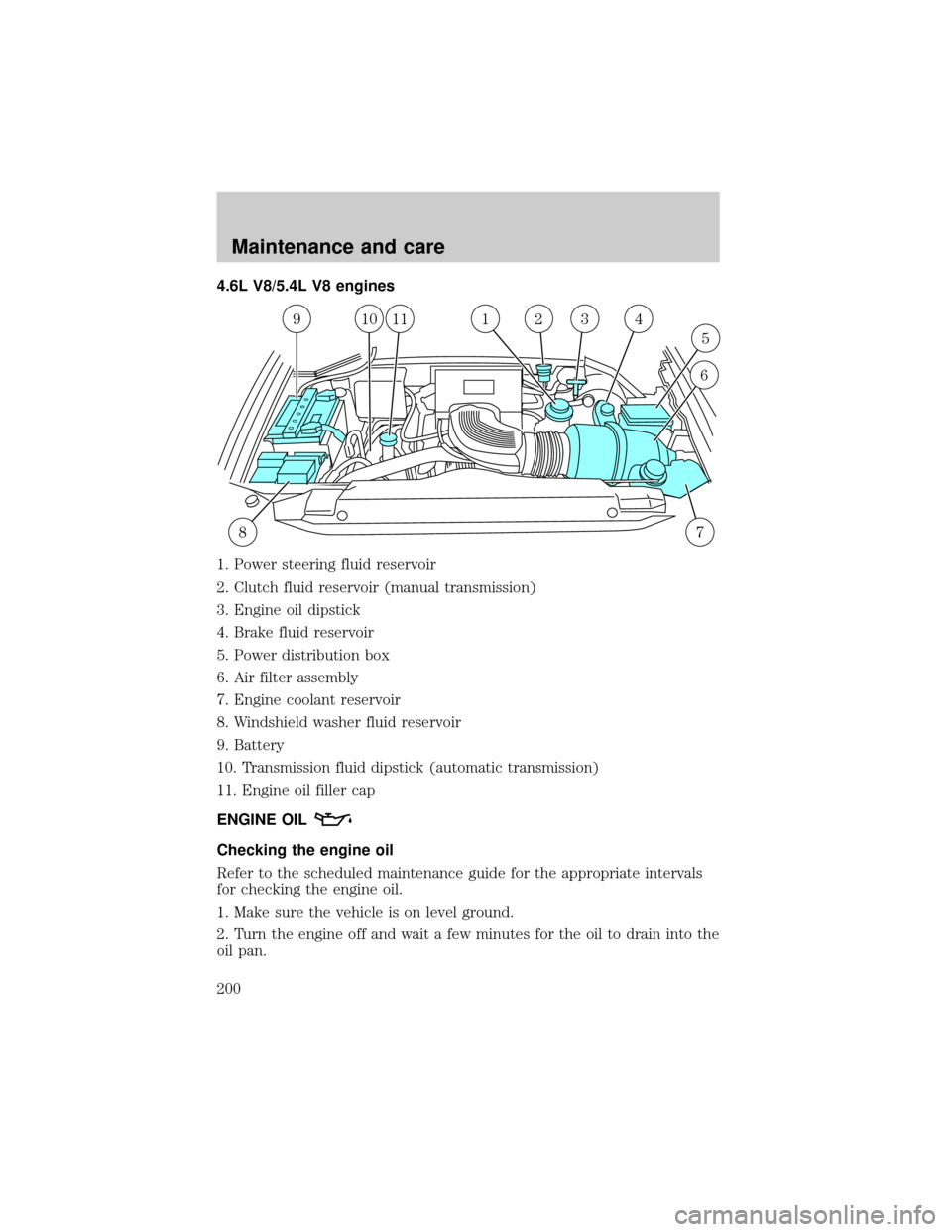
4.6L V8/5.4L V8 engines
1. Power steering fluid reservoir
2. Clutch fluid reservoir (manual transmission)
3. Engine oil dipstick
4. Brake fluid reservoir
5. Power distribution box
6. Air filter assembly
7. Engine coolant reservoir
8. Windshield washer fluid reservoir
9. Battery
10. Transmission fluid dipstick (automatic transmission)
11. Engine oil filler cap
ENGINE OIL
Checking the engine oil
Refer to the scheduled maintenance guide for the appropriate intervals
for checking the engine oil.
1. Make sure the vehicle is on level ground.
2. Turn the engine off and wait a few minutes for the oil to drain into the
oil pan.
87
910111324
6
5
Maintenance and care
200
Page 213 of 280
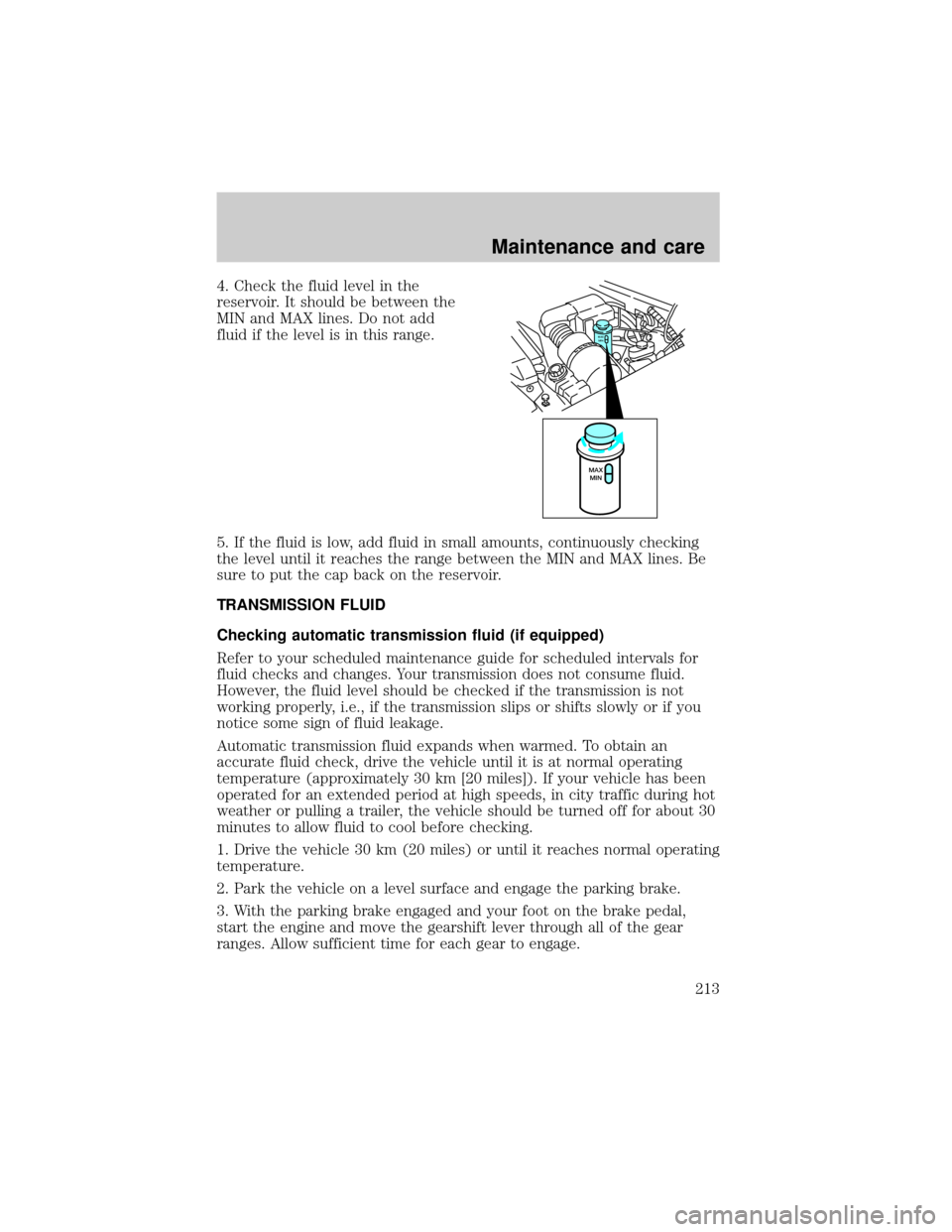
4. Check the fluid level in the
reservoir. It should be between the
MIN and MAX lines. Do not add
fluid if the level is in this range.
5. If the fluid is low, add fluid in small amounts, continuously checking
the level until it reaches the range between the MIN and MAX lines. Be
sure to put the cap back on the reservoir.
TRANSMISSION FLUID
Checking automatic transmission fluid (if equipped)
Refer to your scheduled maintenance guide for scheduled intervals for
fluid checks and changes. Your transmission does not consume fluid.
However, the fluid level should be checked if the transmission is not
working properly, i.e., if the transmission slips or shifts slowly or if you
notice some sign of fluid leakage.
Automatic transmission fluid expands when warmed. To obtain an
accurate fluid check, drive the vehicle until it is at normal operating
temperature (approximately 30 km [20 miles]). If your vehicle has been
operated for an extended period at high speeds, in city traffic during hot
weather or pulling a trailer, the vehicle should be turned off for about 30
minutes to allow fluid to cool before checking.
1. Drive the vehicle 30 km (20 miles) or until it reaches normal operating
temperature.
2. Park the vehicle on a level surface and engage the parking brake.
3. With the parking brake engaged and your foot on the brake pedal,
start the engine and move the gearshift lever through all of the gear
ranges. Allow sufficient time for each gear to engage.
MAX
MIN
MAX
MIN
Maintenance and care
213
Page 214 of 280
4. Latch the gearshift lever in P (Park) and leave the engine running.
5. Remove the dipstick, wiping it clean with a clean, dry lint free rag. If
necessary, refer toIdentifying components in the engine compartment
in this chapter for the location of the dipstick.
6. Install the dipstick making sure it is fully seated in the filler tube.
7. Remove the dipstick and inspect the fluid level. The fluid should be in
the designated area for normal operating temperature or ambient
temperature.
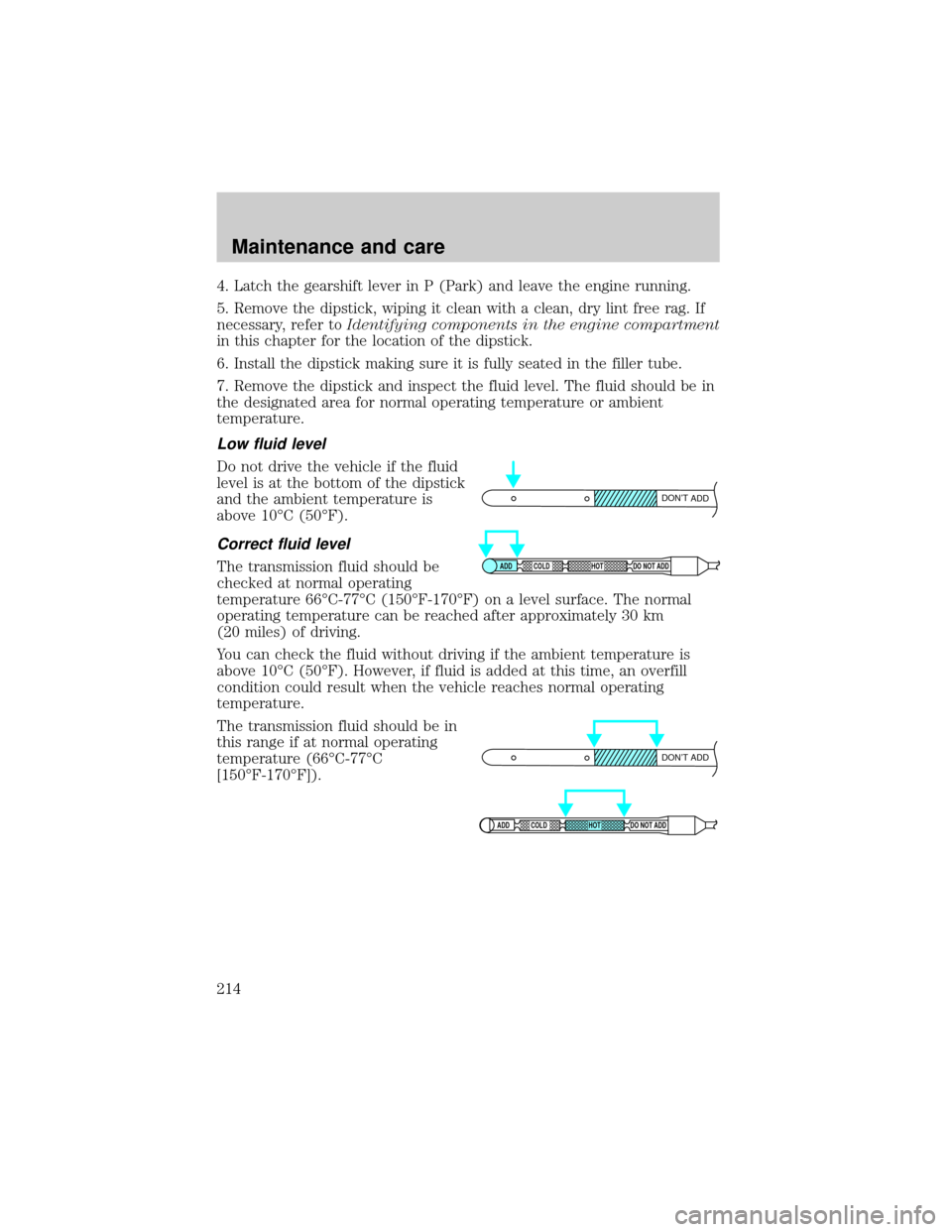
Low fluid level
Do not drive the vehicle if the fluid
level is at the bottom of the dipstick
and the ambient temperature is
above 10ÉC (50ÉF).
Correct fluid level
The transmission fluid should be
checked at normal operating
temperature 66ÉC-77ÉC (150ÉF-170ÉF) on a level surface. The normal
operating temperature can be reached after approximately 30 km
(20 miles) of driving.
You can check the fluid without driving if the ambient temperature is
above 10ÉC (50ÉF). However, if fluid is added at this time, an overfill
condition could result when the vehicle reaches normal operating
temperature.
The transmission fluid should be in
this range if at normal operating
temperature (66ÉC-77ÉC
[150ÉF-170ÉF]).
DON’T ADD
ADD COLD HOT DO NOT ADD
DON’T ADD
ADD COLD HOT DO NOT ADD
Maintenance and care
214
Page 216 of 280
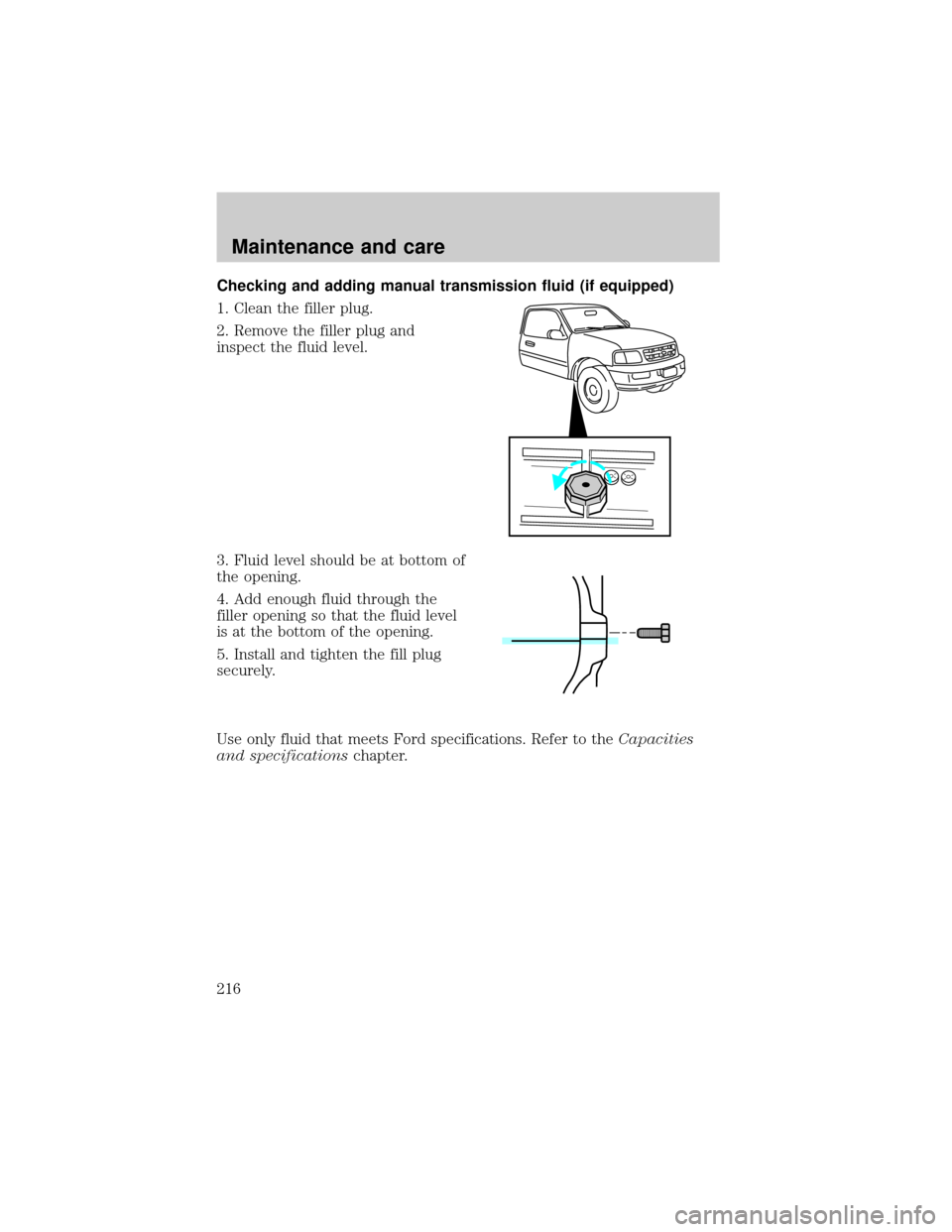
Checking and adding manual transmission fluid (if equipped)
1. Clean the filler plug.
2. Remove the filler plug and
inspect the fluid level.
3. Fluid level should be at bottom of
the opening.
4. Add enough fluid through the
filler opening so that the fluid level
is at the bottom of the opening.
5. Install and tighten the fill plug
securely.
Use only fluid that meets Ford specifications. Refer to theCapacities
and specificationschapter.
Maintenance and care
216
Page 250 of 280
2Service refill capacity is determined by filling the transfer case to the
bottom of the filler hole with the vehicle on a level surface.
3Ensure the correct automatic transmission fluid is used. Transmission
fluid requirements are indicated on the dipstick or on the dipstick
handle. Check the container to verify the fluid being added is of the
correct type. Refer to your scheduled maintenance guide to determine
the correct service interval.
Some transmission fluids may be labeled as dual usage, such as
MERCONtand MERCONtV. These dual usage fluids are not to be used
in an automatic transmission that requires use of the MERCONttype
fluid. However, these dual usage fluids may be used in transmissions that
require the MERCONtV type fluid.
MERCONtand MERCONtV type fluids are not interchangeable.
DO NOT mix MERCONtand MERCONtV. Use of a transmission
fluid that indicates dual usage (MERCONtand MERCONtV) in
an automatic transmission application requiring MERCONtmay
cause transmission damage. Use of any fluid other than the
recommended fluid may cause transmission damage.
4Indicates only approximate dry-fill capacity. Some applications may
vary based on cooler size and if equipped with an in-tank cooler. The
amount of transmission fluid and fluid level should be set by the
indication on the dipstick's normal operating range.
5Your vehicle's rear axle is filled with a synthetic rear axle lubricant and
is considered lubricated for life. These lubricants do not need to be
checked or changed unless a leak is suspected, service is required or the
axle assembly has been submerged in water. The axle lubricant should
be changed any time the rear axle has been submerged in water.
6Service refill capacity is determined by filling the axle to 6-14 mm
(1/4-9/16 inch) below the bottom of the filler hole with the vehicle on a
level surface.
Add 118 ml (4 oz.) of Additive Friction Modifier C8AZ-19B546-A or
equivalent meeting Ford specification EST-M2C118±A, for complete fill of
8.8 inch and 9.75 inch Traction-Lok axles.
7Service refill capacity is determined by filling the axle to the bottom of
the filler hole with the vehicle on a level surface.
For 10.25 inch Traction-Lok axles, use 3.1L (6.5 pints) of Motorcraft SAE
75W-140 Synthetic Rear Axle Lubricant and 236 ml (8 oz.) of Additive
Capacities and specifications
250
Page 252 of 280
ItemFord part name
or equivalentFord part
numberFord
specification
Transmission
/steering/parking
brake linkages
and pivots,
brake and
clutch pedal
shaft (if
equipped)Premium
Long-Life GreaseXG-1-C or
XG-1-KESA-M1C75-B
Power steering
fluid, transfer
case fluid
(4X4) and
transmission
fluid (manual)Motorcraft
MERCONtAT FXT-2-QDX MERCONt
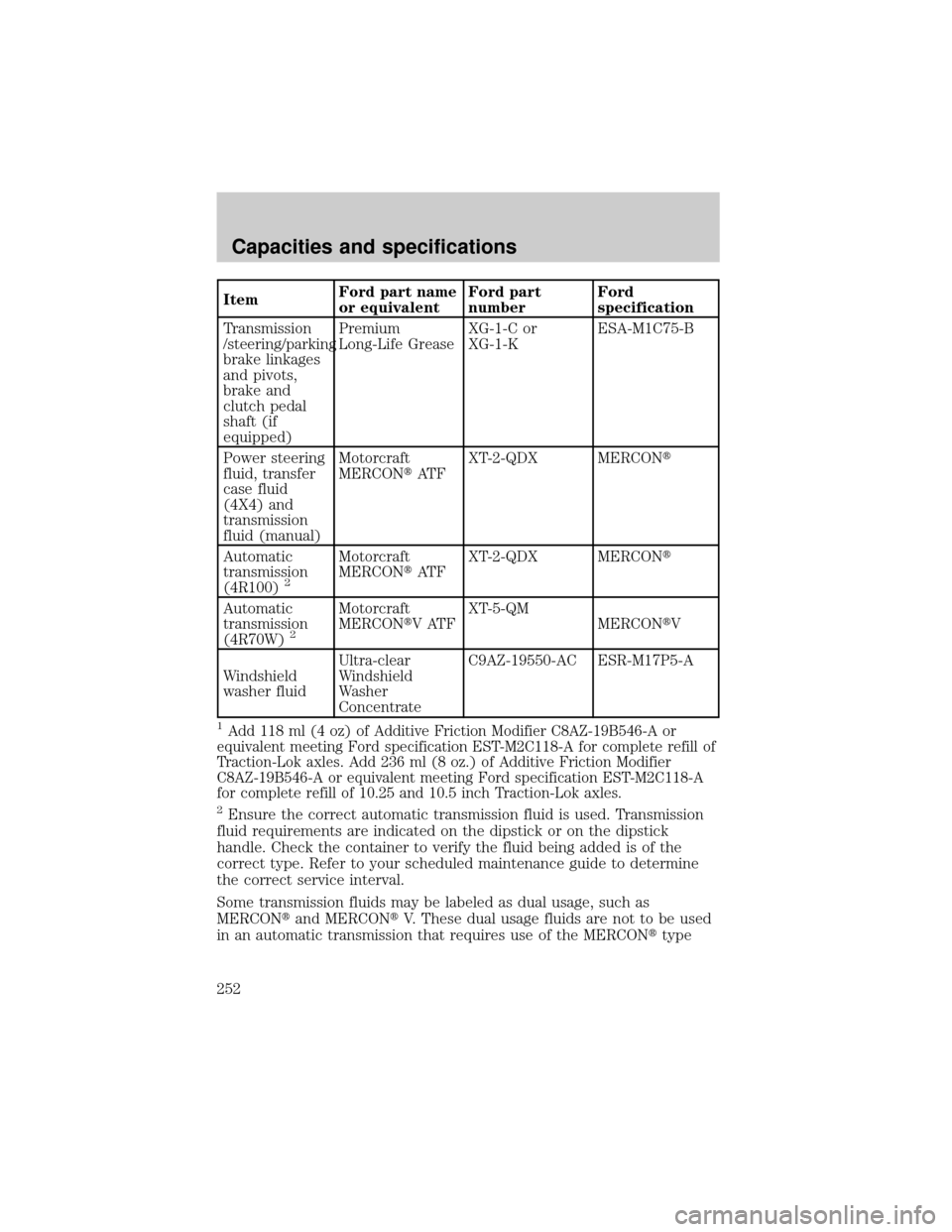
Automatic
transmission
(4R100)
2
Motorcraft
MERCONtAT FXT-2-QDX MERCONt
Automatic
transmission
(4R70W)
2
Motorcraft
MERCONtVATFXT-5-QM
MERCONtV
Windshield
washer fluidUltra-clear
Windshield
Washer
ConcentrateC9AZ-19550-AC ESR-M17P5-A
1Add 118 ml (4 oz) of Additive Friction Modifier C8AZ-19B546-A or
equivalent meeting Ford specification EST-M2C118-A for complete refill of
Traction-Lok axles. Add 236 ml (8 oz.) of Additive Friction Modifier
C8AZ-19B546-A or equivalent meeting Ford specification EST-M2C118-A
for complete refill of 10.25 and 10.5 inch Traction-Lok axles.
2Ensure the correct automatic transmission fluid is used. Transmission
fluid requirements are indicated on the dipstick or on the dipstick
handle. Check the container to verify the fluid being added is of the
correct type. Refer to your scheduled maintenance guide to determine
the correct service interval.
Some transmission fluids may be labeled as dual usage, such as
MERCONtand MERCONtV. These dual usage fluids are not to be used
in an automatic transmission that requires use of the MERCONttype
Capacities and specifications
252
Page 273 of 280

A
Accessory delay ..........................79
Air bag supplemental
restraint system ........................113
and child safety seats ............114
description ..............................113
disposal ....................................117
driver air bag ..........................115
indicator light ...................12, 116
operation .................................115
passenger air bag ...................115
passenger
deactivation switch ...........65, 117
Air cleaner filter .......220±221, 247
Air conditioning ..........................60
Ambulance packages ....................3
Antifreeze
(see Engine coolant) ................206
Anti-lock brake system
(see Brakes) ......................139±140
Anti-theft system
warning light .............................13
Armrests ....................................102
Audio system (see Radio) .........24
Automatic transmission ............144
driving an automatic
overdrive .................................145
fluid, adding ............................213
fluid, checking ........................213
fluid, refill capacities ..............248
fluid, specification ..................253
Auxiliary power point .................23
Axle
lubricant specifications ..251, 253
refill capacities ........................248
traction lok ..............................142B
Battery .......................................218
acid, treating emergencies .....218
charging system
warning light .............................13
jumping a disabled battery ....190
maintenance-free ....................218
replacement, specifications ...247
servicing ..................................218
voltage gauge ............................18
Belt minder ...............................108
Brakes ........................................138
anti-lock ...........................138±140
anti-lock brake system (ABS)
warning light .....................13, 140
brake warning light ..................12
fluid, checking and adding ....204
fluid, refill capacities ..............248
fluid, specifications .........251, 253
lubricant specifications ..251, 253
parking ....................................141
pedals (see Power
adjustable foot pedals) ............22
shift interlock ..........................144
Break-in period .............................3
C
Capacities for refilling fluids ....248
Cassette tape player ...................36
CD changer .................................54
Certification Label ....................257
Child safety restraints ..............122
child safety belts ....................122
Child safety seats ......................123
attaching with tether straps ..128
in front seat ............................125
in rear seat ......................125, 127
Index
273
Page 274 of 280

Cleaning your vehicle ...............242
engine compartment ..............243
exterior ............................243, 246
exterior lamps .........................244
instrument cluster lens ..........245
instrument panel ....................245
interior .....................................245
plastic parts ............................244
safety belts ..............................245
washing ....................................242
waxing .....................................242
wheels ......................................243
wiper blades ............................244
Climate control (see Air
conditioning or Heating) ............60
Clock ..........................28, 34, 45, 54
Clutch
fluid ..........................................204
operation while driving ..........147
recommended shift speeds ....149
Compass, electronic ....................75
calibration .................................77
set zone adjustment .................76
Console
overhead ....................................73
Controls
power seat .................................99
Coolant
checking and adding ..............206
refill capacities ................210, 248
specifications ..................251, 253
Cruise control
(see Speed control) ....................67
Customer Assistance ................175
Ford accessories for your
vehicle .....................................266
Ford Extended
Service Plan ............................259Getting assistance outside
the U.S. and Canada ..............265
Getting roadside assistance ...175
Getting the
service you need ....................259
Ordering additional
owner's literature ...................270
The Dispute
Settlement Board ...................262
Utilizing the Mediation/
Arbitration Program ...............265
D
Daytime running lamps
(see Lamps) ................................20
Dipstick
automatic
transmission fluid ...................213
engine oil .................................200
Doors
door ajar warning .....................15
lubricant specifications ..........251
Driveline universal joint
and slip yoke .............................218
Driving under special
conditions ..........................158±159
mud ..........................................158
sand .........................................158
snow and ice ...........................159
through water .................158, 162
E
Emergencies, roadside
jump-starting ..........................190
Emission control system ..........235
Engine ........................................253
Index
274