heating FORD F150 2001 10.G Owners Manual
[x] Cancel search | Manufacturer: FORD, Model Year: 2001, Model line: F150, Model: FORD F150 2001 10.GPages: 224, PDF Size: 1.45 MB
Page 14 of 224
vehicle from empty indication, the amount of fuel that can be added will
be less than the advertised capacity due to the reserve fuel.
A minimum of 22.2 L (six gallons) must be added or removed from the
fuel tank in order for the gauge to instantaneously update. If less than
six gallons is the change, the gauge will take between five to twenty
minutes to update.
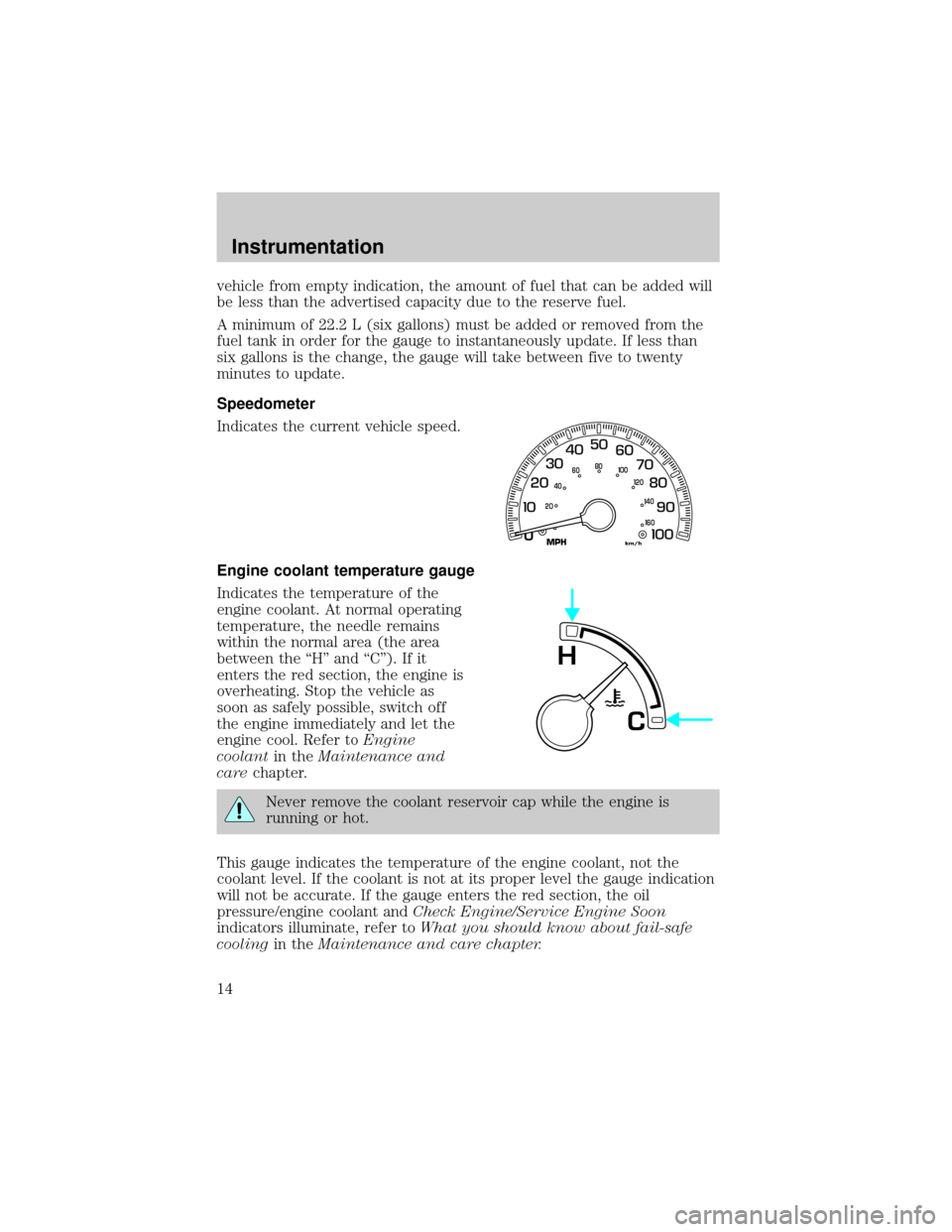
Speedometer
Indicates the current vehicle speed.
Engine coolant temperature gauge
Indicates the temperature of the
engine coolant. At normal operating
temperature, the needle remains
within the normal area (the area
between the ªHº and ªCº). If it
enters the red section, the engine is
overheating. Stop the vehicle as
soon as safely possible, switch off
the engine immediately and let the
engine cool. Refer toEngine
coolantin theMaintenance and
carechapter.
Never remove the coolant reservoir cap while the engine is
running or hot.
This gauge indicates the temperature of the engine coolant, not the
coolant level. If the coolant is not at its proper level the gauge indication
will not be accurate. If the gauge enters the red section, the oil
pressure/engine coolant andCheck Engine/Service Engine Soon
indicators illuminate, refer toWhat you should know about fail-safe
coolingin theMaintenance and care chapter.
0MPHkm/h
20406080
00
20
40
60
C
H
Instrumentation
14
Page 43 of 224
Radio reception factors
Three factors can affect radio reception:
²Distance/strength.The further an FM signal travels, the weaker it is.
The listenable range of the average FM station is approximately 40 km
(24 miles). This range can be affected by ªsignal modulation.º Signal
modulation is a process radio stations use to increase their
strength/volume relative to other stations.
²Terrain.Hills, mountains and tall buildings between your vehicle's
antenna and the radio station signal can cause FM reception problems.
Static can be caused on AM stations by power lines, electric fences,
traffic lights and thunderstorms. Moving away from an interfering
structure (out of its ªshadowº) returns your reception to normal.
²Station overload.Weak signals are sometimes captured by stronger
signals when you pass a broadcast tower. A stronger signal may
temporarily overtake a weaker signal and play while the weak station
frequency is displayed.
The audio system automatically switches to single channel reception if it
will improve the reception of a station normally received in stereo.
Audio system warranties and service
Refer to the ªWarranty Guideº for audio system warranty information.
If service is necessary, see your dealer or a qualified technician.
CLIMATE CONTROL SYSTEM
Manual heating and air conditioning system (if equipped)
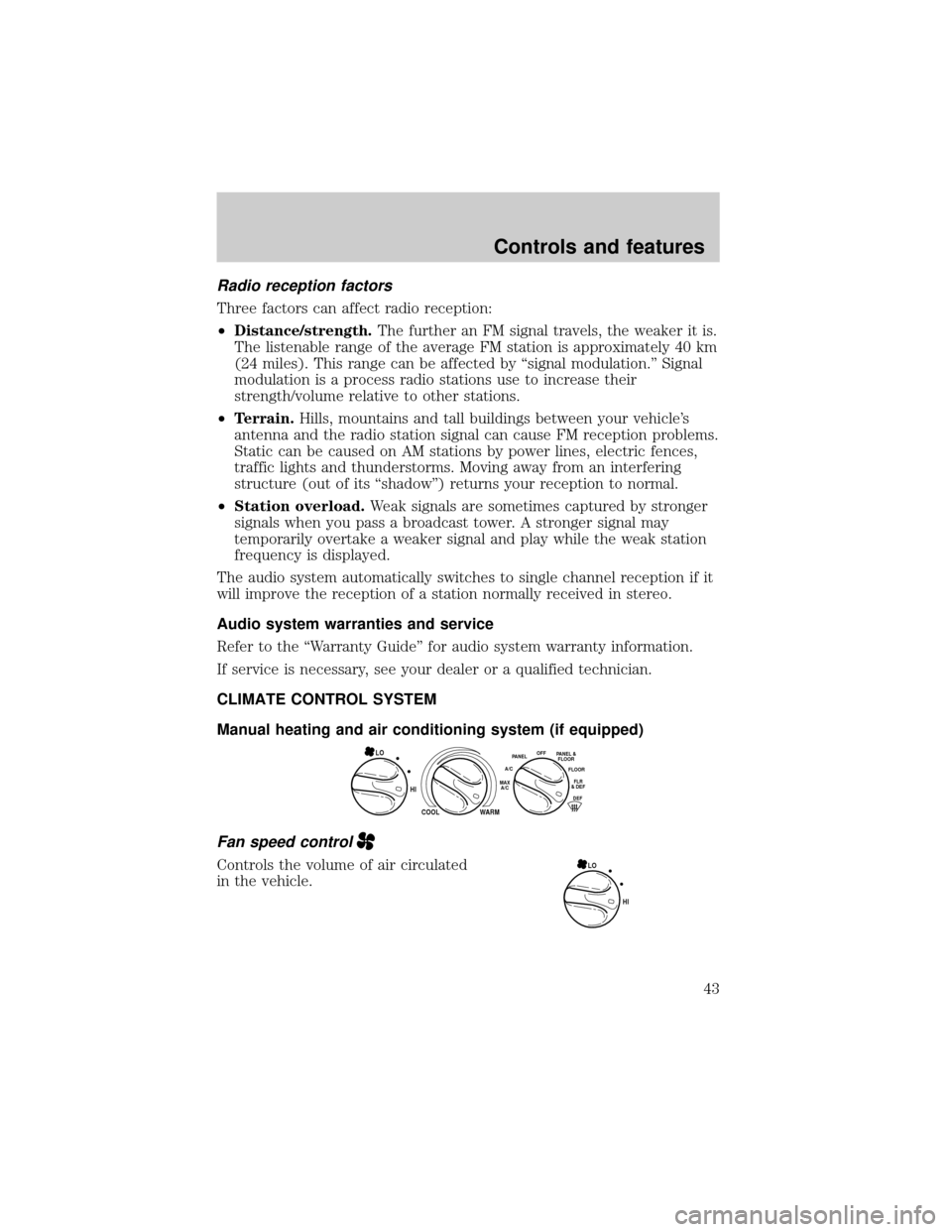
Fan speed control
Controls the volume of air circulated
in the vehicle.
HI
COOL WARM
OFFPANEL
A/CFLOOR
DEFFLR
& DEFMAX
A/C
PANEL &
FLOORLO
HI LO
Controls and features
43
Page 44 of 224
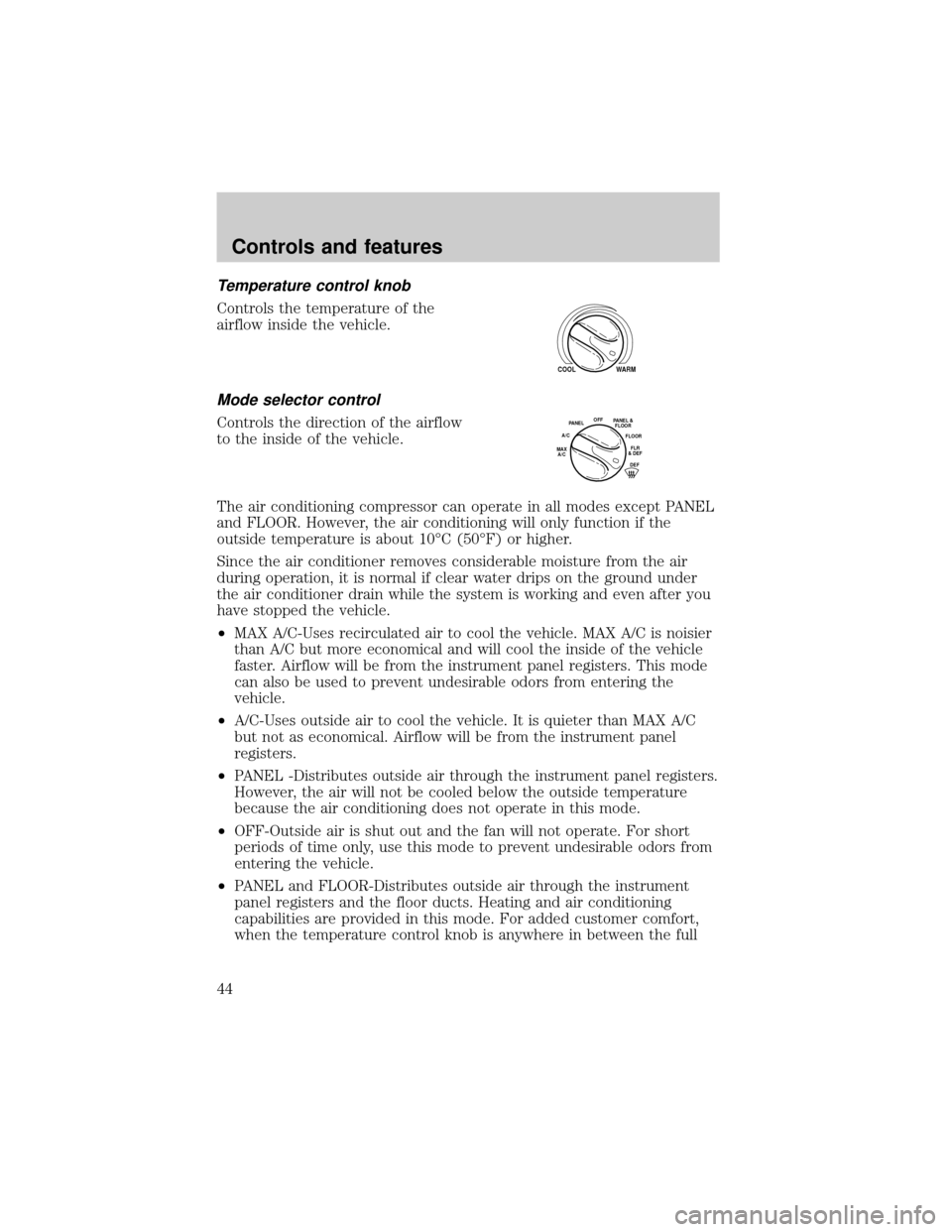
Temperature control knob
Controls the temperature of the
airflow inside the vehicle.
Mode selector control
Controls the direction of the airflow
to the inside of the vehicle.
The air conditioning compressor can operate in all modes except PANEL
and FLOOR. However, the air conditioning will only function if the
outside temperature is about 10ÉC (50ÉF) or higher.
Since the air conditioner removes considerable moisture from the air
during operation, it is normal if clear water drips on the ground under
the air conditioner drain while the system is working and even after you
have stopped the vehicle.
²MAX A/C-Uses recirculated air to cool the vehicle. MAX A/C is noisier
than A/C but more economical and will cool the inside of the vehicle
faster. Airflow will be from the instrument panel registers. This mode
can also be used to prevent undesirable odors from entering the
vehicle.
²A/C-Uses outside air to cool the vehicle. It is quieter than MAX A/C
but not as economical. Airflow will be from the instrument panel
registers.
²PANEL -Distributes outside air through the instrument panel registers.
However, the air will not be cooled below the outside temperature
because the air conditioning does not operate in this mode.
²OFF-Outside air is shut out and the fan will not operate. For short
periods of time only, use this mode to prevent undesirable odors from
entering the vehicle.
²PANEL and FLOOR-Distributes outside air through the instrument
panel registers and the floor ducts. Heating and air conditioning
capabilities are provided in this mode. For added customer comfort,
when the temperature control knob is anywhere in between the full
COOL WARM
OFFPANEL
A/CFLOOR
DEFFLR
& DEFMAX
A/C
PANEL &
FLOOR
Controls and features
44
Page 45 of 224
hot and full cold positions, the air distributed through the floor ducts
will be slightly warmer than the air sent to the instrument panel
registers.
²FLOOR -Allows for maximum heating by distributing outside air
through the floor ducts. However, the air will not be cooled below the
outside temperature because the air conditioning does not operate in
this mode.
²FLOOR & DEFROST ±Distributes outside air through the windshield
defroster ducts and the floor ducts. Heating and air conditioning
capabilities are provided in this mode. For added customer comfort,
the air distributed through the floor ducts will be slightly warmer than
the air sent to the windshield defroster ducts. If the temperature is
about 10ÉC (50ÉF) or higher, the air conditioner will automatically
dehumidify the air to reduce fogging.
²DEF
(Defrost)-Distributes outside air through the windshield
defroster ducts. It can be used to clear ice or fog from the windshield.
If the temperature is about 10ÉC (50ÉF) or higher, the air conditioner
will automatically dehumidify the air to reduce fogging.
Operating tips
²In humid weather, select DEFbefore driving. This will reduce
fogging on your windshield. After a few minutes, select any desired
position.
²To reduce humidity buildup inside the vehicle, do not drive with the
climate control system in the OFF or MAX A/C position.
²Do not put objects under the front seat that will interfere with the
airflow to the back seats (if equipped).
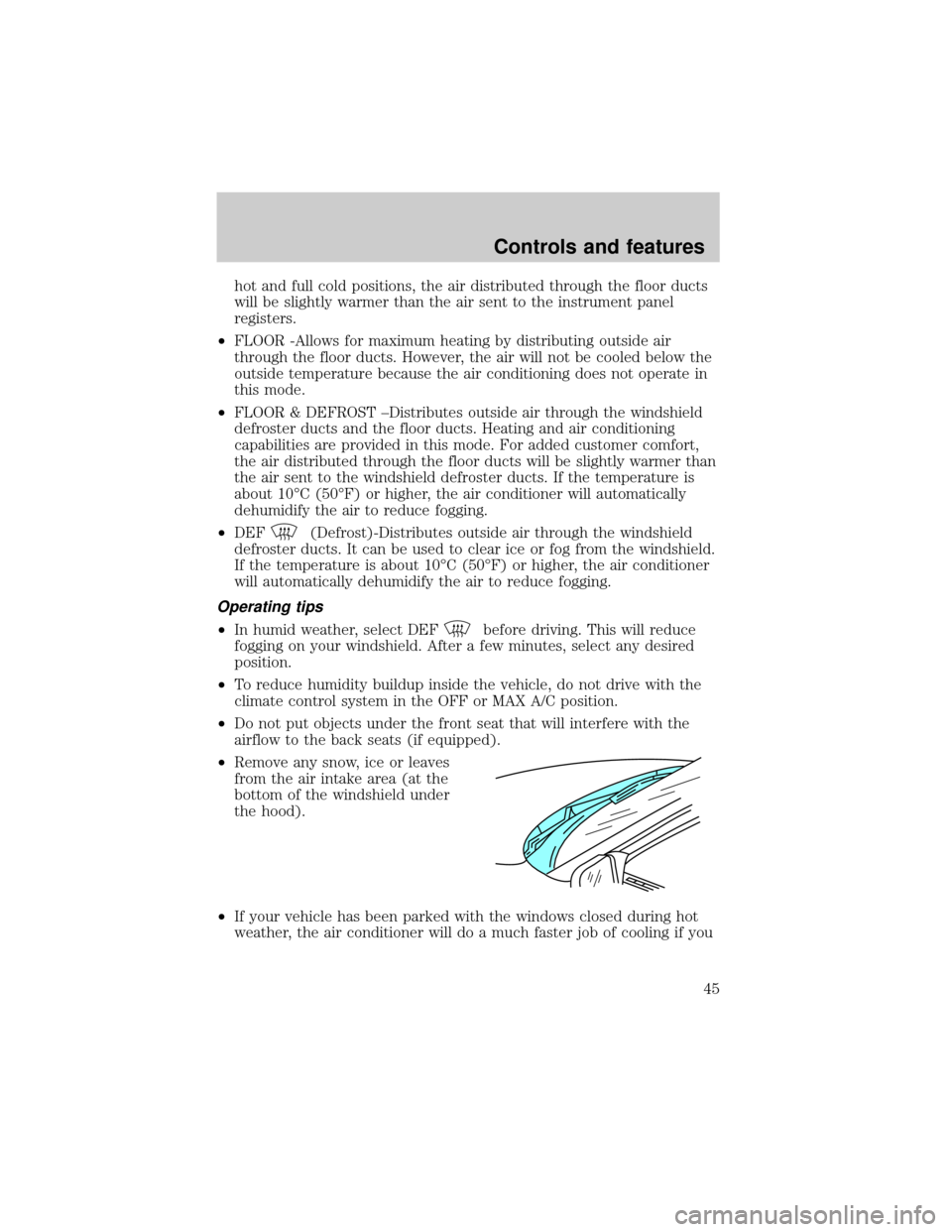
²Remove any snow, ice or leaves
from the air intake area (at the
bottom of the windshield under
the hood).
²If your vehicle has been parked with the windows closed during hot
weather, the air conditioner will do a much faster job of cooling if you
Controls and features
45
Page 106 of 224
Guarding against exhaust fumes
Although odorless and colorless, carbon monoxide is present in exhaust
fumes. Take precautions to avoid its dangerous effects.
If you ever smell exhaust fumes of any kind inside your vehicle,
have your dealer inspect and fix your vehicle immediately. Do
not drive if you smell exhaust fumes. These fumes are harmful and
could kill you.
Have the exhaust and body ventilation systems checked whenever:
²the vehicle is raised for service.
²the sound of the exhaust system changes.
²the vehicle has been damaged in a collision.
Engine exhaust, some of its constituents, and certain vehicle
components contain or emit chemicals known to the State of
California to cause cancer, and birth defects or other reproductive
harm.
Important ventilating information
If the engine is idling while the vehicle is stopped in an open area for
long periods of time, open the windows at least 2.5 cm (one inch).
Adjust the heating or air conditioning (if equipped) to bring in fresh air.
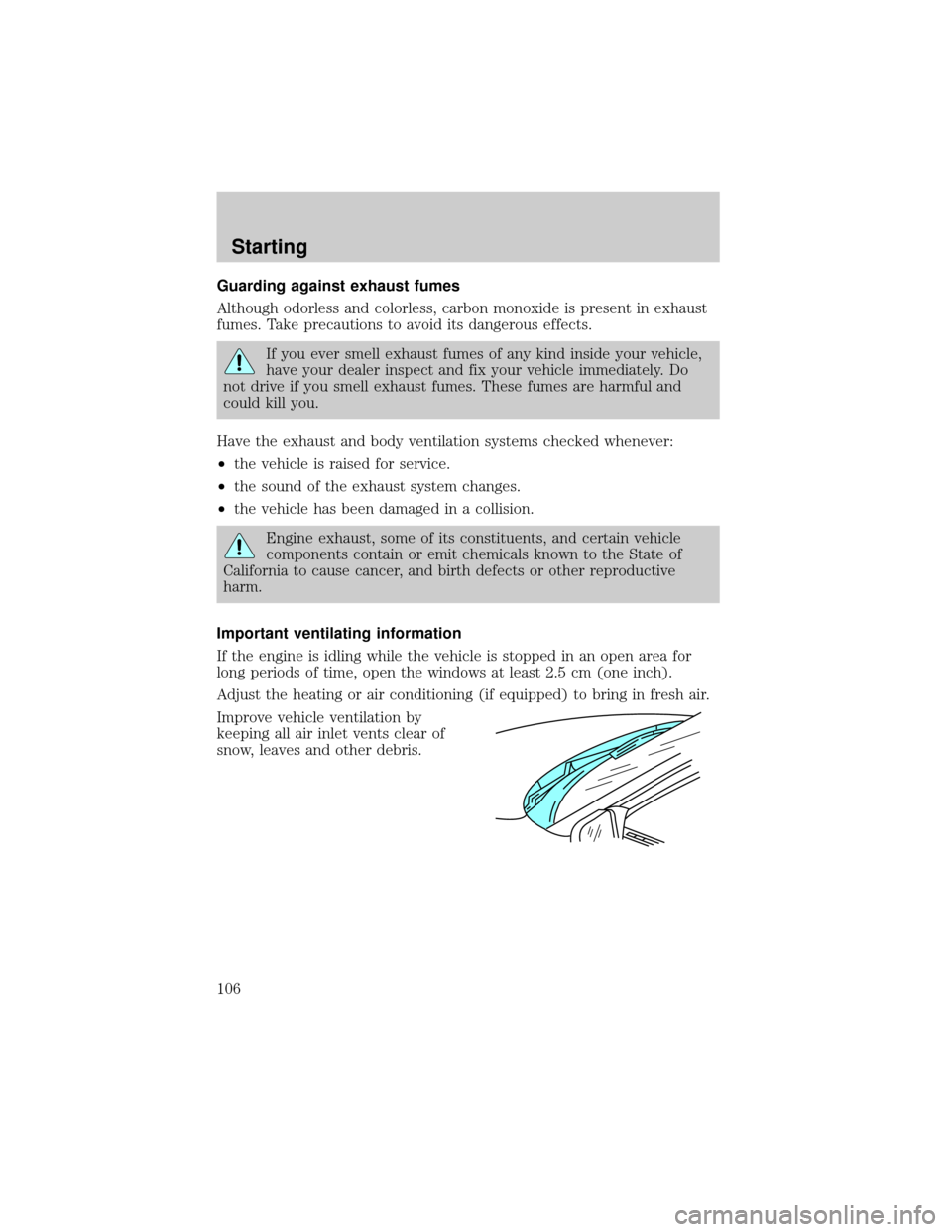
Improve vehicle ventilation by
keeping all air inlet vents clear of
snow, leaves and other debris.
Starting
106
Page 163 of 224
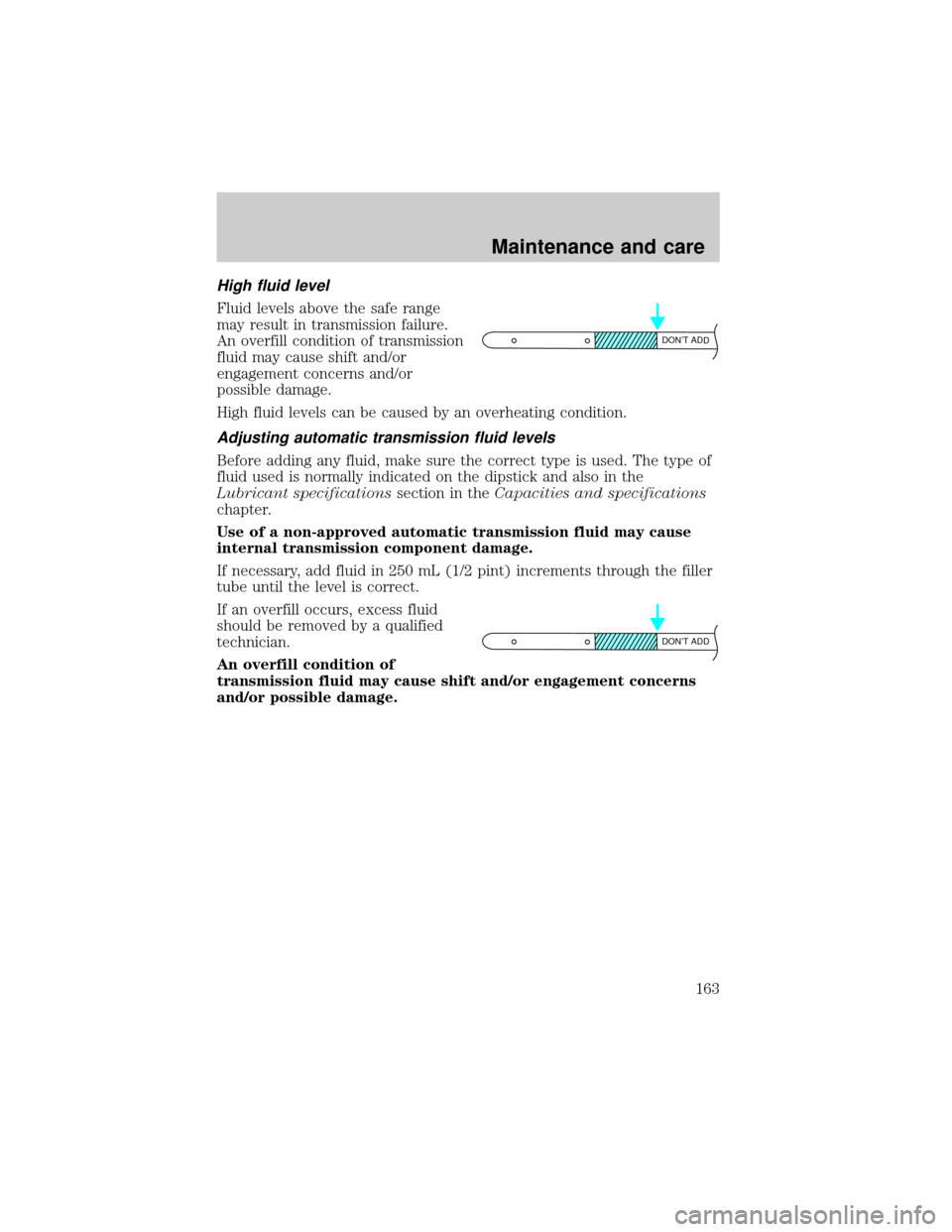
High fluid level
Fluid levels above the safe range
may result in transmission failure.
An overfill condition of transmission
fluid may cause shift and/or
engagement concerns and/or
possible damage.
High fluid levels can be caused by an overheating condition.
Adjusting automatic transmission fluid levels
Before adding any fluid, make sure the correct type is used. The type of
fluid used is normally indicated on the dipstick and also in the
Lubricant specificationssection in theCapacities and specifications
chapter.
Use of a non-approved automatic transmission fluid may cause
internal transmission component damage.
If necessary, add fluid in 250 mL (1/2 pint) increments through the filler
tube until the level is correct.
If an overfill occurs, excess fluid
should be removed by a qualified
technician.
An overfill condition of
transmission fluid may cause shift and/or engagement concerns
and/or possible damage.
DON’T ADD
DON’T ADD
Maintenance and care
163
Page 216 of 224

Accessory delay ..........................59
Air bag supplemental
restraint system ..........................90
and child safety seats ..............92
description ................................90
disposal ......................................94
driver air bag ............................92
indicator light ........................9,94
operation ...................................92
passenger air bag .....................92
Air cleaner filter ................167,194
Air conditioning ..........................43
Ambulance packages ....................3
Antifreeze
(see Engine coolant) ................154
Anti-lock brake system
(see Brakes) .......................107,108
Anti-theft system
warning light .............................11
Armrests ......................................79
Audio system (see Radio) .........21
Automatic transmission
driving an automatic
overdrive .................................113
fluid, adding ............................161
fluid, checking ........................161
fluid, refill capacities ..............194
fluid, specification ..................199
Auxiliary power point .................20
Axle
lubricant specifications ...197,199
refill capacities ........................194
traction lok ..............................110
Battery .......................................165
acid, treating emergencies .....165
charging system
warning light .............................11
jumping a disabled battery ....142
maintenance-free ....................165
replacement, specifications ...194
servicing ..................................165
voltage gauge ............................15Bed extender ..............................62
Belt minder .................................86
Brakes ........................................107
anti-lock ............................107,108
anti-lock brake system
(ABS) warning light ..........10,108
brake warning light ..................10
fluid, checking and adding ....153
fluid, refill capacities ..............194
fluid, specifications ..........197,199
lubricant specifications ...197,199
parking ....................................109
pedals (see Power
adjustable foot pedals) ............19
shift interlock ..........................112
Break-in period .............................3
Capacities for refilling fluids ....194
Cassette tape player ...................29
CD changer .................................39
Certification Label ....................201
Child safety restraints ................95
child safety belts ......................95
Child safety seats ........................96
attaching with tether straps ..101
in front seat ..............................97
in rear seat .........................97,100
Cleaning your vehicle ...............188
engine compartment ..............191
exterior .............................189,190
exterior lamps .........................191
instrument panel ....................192
instrument panel lens ............192
interior .....................................192
plastic parts ............................191
safety belts ..............................193
washing ....................................189
waxing .....................................190
wheels ......................................190
wiper blades ............................192
Climate control (see Air
conditioning or Heating) ............43
Clock .......................................29,38
Index
216
Page 218 of 224

cap ...........................................177
capacity ...................................194
choosing the right fuel ...........176
comparisons with EPA fuel
economy estimates .................181
detergent in fuel .....................177
filling your vehicle
with fuel ....................174,177,178
filter, specifications .........178,194
fuel pump shut-off switch .....129
gauge .........................................13
improving fuel economy ........178
low fuel warning light ................8
octane rating ....................176,199
quality ......................................176
running out of fuel .................177
safety information relating to
automotive fuels .....................174
Fuses ...................................130,131
Garage door opener ....................53
Gas cap (see Fuel cap) ............177
Gas mileage
(see Fuel economy) .................178
Gauges .........................................13
battery voltage gauge ...............15
engine coolant
temperature gauge ...................14
engine oil pressure gauge ........16
fuel gauge ..................................13
odometer ...................................15
speedometer .............................14
tachometer ................................15
trip odometer ............................15
GAWR
(Gross Axle Weight Rating) .....120
calculating ...............................122
definition .................................120
driving with a heavy load ......120
location ....................................120
GVWR (Gross
Vehicle Weight Rating) .............120
calculating ........................120,122definition .................................120
driving with a heavy load ......120
location ....................................120
Hazard flashers .........................129
Headlamps ...................................17
aiming ......................................188
autolamp system .......................18
bulb specifications ..................188
daytime running lights .............17
flash to pass ..............................17
high beam ............................11,17
replacing bulbs .......................184
turning on and off ....................17
warning chime ..........................13
Heating ........................................43
heating and air
conditioning system .................43
Hood ..........................................149
Ignition .......................................199
positions of the ignition ...........46
Infant seats (see Safety seats) ..96
Inspection/maintenance
(I/M) testing ..............................183
Instrument panel
cleaning ...................................192
cluster ...................................8,192
lighting up
panel and interior .....................18
location of components ..............8
Jump-starting your vehicle ......142
Keyless entry system
autolock .....................................70
locking and unlocking doors ....72
programming entry code .........71
Keys
key in ignition chime ...............13
positions of the ignition ...........46
Lamps
autolamp system .......................18
bulb replacement
specifications chart ................188
cargo lamps ...............................18
Index
218