engine coolant FORD F150 2002 10.G User Guide
[x] Cancel search | Manufacturer: FORD, Model Year: 2002, Model line: F150, Model: FORD F150 2002 10.GPages: 320, PDF Size: 2.95 MB
Page 267 of 320
Do not put engine coolant in the windshield washer fluid
container. If sprayed on the windshield, engine coolant could
make it difficult to see through the windshield.
The cooling system in your vehicle is filled with either green-colored
Motorcraft Premium Engine Coolant meeting Ford specification
ESE-M97B44±A or yellow-colored Motorcraft Premium Gold Engine
Coolant meeting Ford Specification WSS-M97B51±A1. To determine your
vehicle's coolant type (color), check your coolant reservoir.
²Add Motorcraft Premium Engine Coolant (green-colored),
VC-4±A (U.S.) or CXC-10 (Canada) or Motorcraft Premium
Gold Engine Coolant (yellow-colored), VC-7±A, depending on
the type of coolant originally equipped in your vehicle.If you
are unsure which type of coolant your vehicle requires, check your
coolant reservoir or contact your local dealer.
Note:Use of Motorcraft Cooling System Stop Leak Pellets, VC-6,
darkens the color of Motorcraft Premium Gold Engine Coolant from
yellow to golden tan.
²Do not add/mix an orange-colored, extended life coolant such
as Motorcraft Speciality Orange Engine Coolant, VC-2 (US) or
CXC-209 (Canada), meeting Ford specification WSS-M97B44±D
with the factory-filled coolant.Mixing Motorcraft Speciality Orange
Engine Coolant or any orange-colored extended life product with your
factory filled coolant can result in degraded corrosion protection.
²A large amount of water without engine coolant may be added, in case
of emergency, to reach a vehicle service location. In this instance, the
cooling system must be drained and refilled with a 50/50 mixture of
engine coolant and distilled water as soon as possible. Water alone
(without engine coolant) can cause engine damage from corrosion,
overheating or freezing.
²
Do not use alcohol, methanol or brine or any engine coolants
mixed with alcohol or methanol antifreeze (coolant).Alcohol and
other liquids can cause engine damage from overheating or freezing.
²Do not add extra inhibitors or additives to the coolant.These
can be harmful and compromise the corrosion protection of the engine
coolant.
²Do not mix with recycled coolant unless from a Ford-approved
recycling process (seeUse of Recycled Engine Coolantsection).
Maintenance and Specifications
267
Page 268 of 320
For vehicles with overflow coolant systems with a non-pressurized cap
on the coolant recovery system, add coolant to the coolant recovery
reservoir when the engine is cool. Add the proper mixture of coolant and
water to the ªcold fullº level. For all other vehicles, which have a coolant
degas system with a pressurized cap, or if it is necessary to remove the
coolant pressure relief cap on the radiator of a vehicle with an overflow
system, follow these steps to add engine coolant.
To avoid personal injury, make sure the engine is cool before
unscrewing the coolant pressure relief cap. The cooling system is
under pressure; steam and hot liquid can come out forcefully when the
cap is loosened slightly.
1. Before you begin, turn the engine off and let it cool.
2. When the engine is cool, wrap a thick cloth around the coolant
pressure relief cap on the coolant reservoir (an opaque plastic bottle).
Slowly turn cap counterclockwise (left) until pressure begins to release.
3. Step back while the pressure releases.
4. When you are sure that all the pressure has been released, use the
cloth to turn it counterclockwise and remove the cap.
5. Fill the coolant reservoir slowly with the proper coolant mixture (see
above), to within the ªcold fill rangeº or the ªcold fullº level on the
reservoir. If you removed the radiator cap in an overflow system, fill the
radiator until the coolant is visible and radiator is almost full.
6. Replace the cap. Turn until tightly installed. (Cap must be tightly
installed to prevent coolant loss.)
After any coolant has been added, check the coolant concentration see
Checking Engine Coolant section). If the concentration is not 50/50
(protection to ±34É F/±36É C), drain some coolant and adjust the
concentration. It may take several drains and additions to obtain a 50/50
coolant concentration.
Whenever coolant has been added, the coolant level in the coolant
reservoir should be checked the next few times you drive the vehicle. If
necessary, add enough 50/50 concentration of engine coolant and
distilled water to bring the liquid level to the proper level.
If you have to add more than 1.0 liter (1.0 quart) of engine coolant per
month, have your dealer check the engine cooling system. Your cooling
system may have a leak. Operating an engine with a low level of coolant
can result in engine overheating and possible engine damage.
Maintenance and Specifications
268
Page 269 of 320
Recycled engine coolant
Ford Motor Company recommends the use of a recycled engine coolant
produced by Ford-approved processes in vehicles originally equipped
with Motorcraft Premium Engine Coolant (green-colored). However, not
all coolant recycling processes produce coolant that meets Ford
specification ESE-M97B44±A. Use of such coolant may harm the engine
and cooling system components.
Ford Motor Company does NOT recommend the use of recycled engine
coolant in vehicles originally equipped with Motorcraft Premium Gold
Engine Coolant since a Ford-approved recycling process is not yet
available.
Used engine coolant should be disposed of in an appropriate
manner. Follow your community's regulations and standards for recycling
and disposing of automotive fluids.
Coolant refill capacity
To find out how much fluid your vehicle's cooling system can hold, refer
toRefill capacitiesin this chapter.
Fill your engine coolant reservoir as outlined inAdding engine coolant
in this chapter.
Severe climates
If you drive in extremely cold climates (less than ±36É C [±34É F]):
²It may be necessary to increase the coolant concentration
above 50%.
²NEVER increase the coolant concentration above 60%.
²Increased engine coolant concentrations above 60% will
decrease the overheat protection characteristics of the engine
coolant and may cause engine damage.
²Refer to the chart on the coolant container to ensure the
coolant concentration in your vehicle will provide adequate
freeze protection at the temperatures in which you drive in the
winter months.
If you drive in extremely hot climates:
²It is still necessary to maintain the coolant concentration
above 40%.
Maintenance and Specifications
269
Page 270 of 320
²NEVER decrease the coolant concentration below 40%.
²Decreased engine coolant concentrations below 40% will
decrease the corrosion protection characteristics of the engine
coolant and may cause engine damage.
²Decreased engine coolant concentrations below 40% will
decrease the freeze protection characteristics of the engine
coolant and may cause engine damage.
²Refer to the chart on the coolant container to ensure the
coolant concentration in your vehicle will provide adequate
protection at the temperatures in which you drive.
Vehicles driven year-round in non-extreme climates should use a 50/50
mixture of engine coolant and distilled water for optimum cooling system
and engine protection.
What you should know about fail-safe cooling (if equipped)
If the engine coolant supply is depleted, this feature allows the vehicle to
be driven temporarily before incremental component damage is incurred.
The ªfail-safeº distance depends on ambient temperatures, vehicle load
and terrain.
How fail-safe cooling works
If the engine begins to overheat:
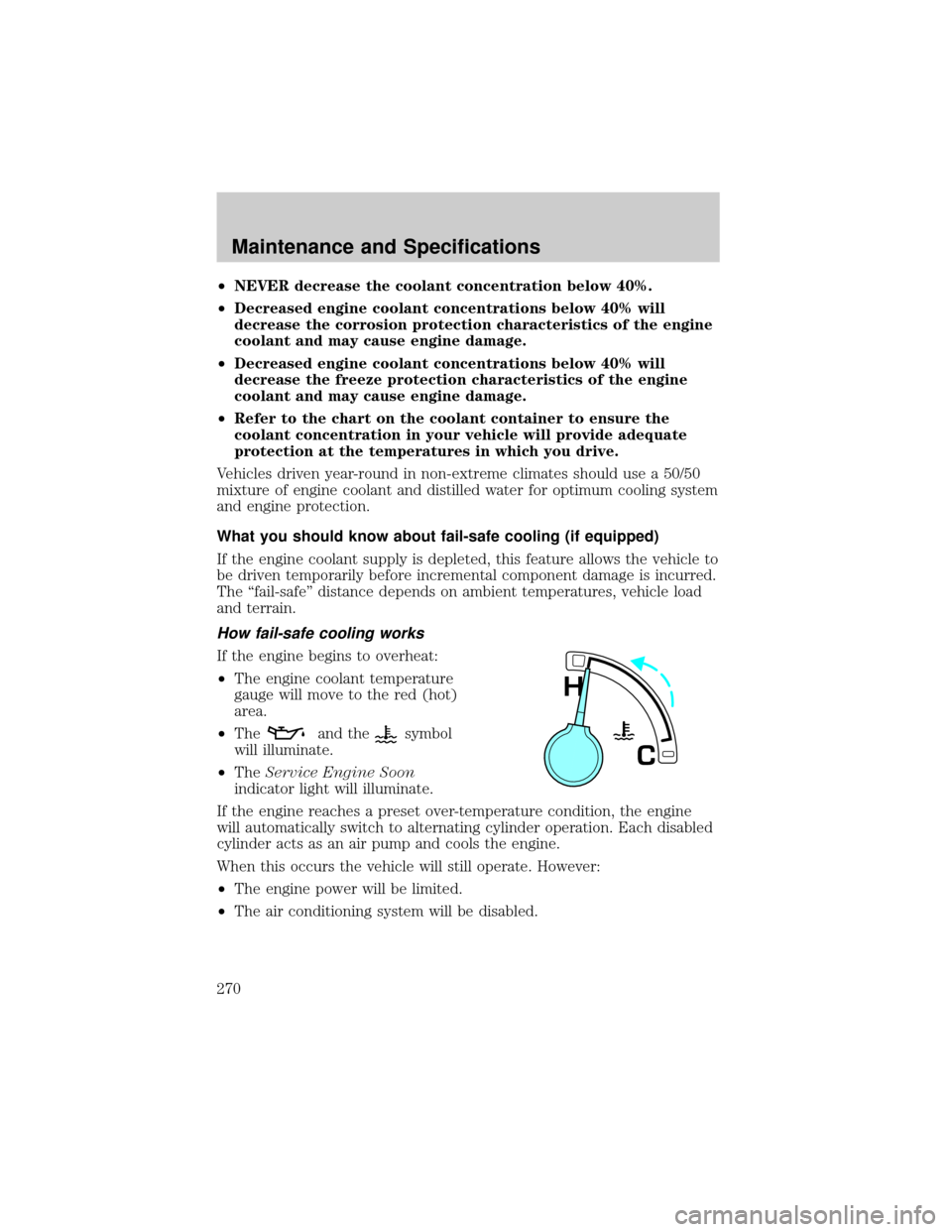
²The engine coolant temperature
gauge will move to the red (hot)
area.
²The
and thesymbol
will illuminate.
²TheService Engine Soon
indicator light will illuminate.
If the engine reaches a preset over-temperature condition, the engine
will automatically switch to alternating cylinder operation. Each disabled
cylinder acts as an air pump and cools the engine.
When this occurs the vehicle will still operate. However:
²The engine power will be limited.
²The air conditioning system will be disabled.
C
H
Maintenance and Specifications
270
Page 271 of 320
Continued operation will increase the engine temperature:
²The engine will completely shut down.
²Steering and braking effort will increase.
Once the engine temperature cools, the engine can be re-started. Take
your vehicle to a service facility as soon as possible to minimize engine
damage.
When fail-safe mode is activated
You have limited engine power when in the fail-safe mode, so drive the
vehicle with caution. The vehicle will not be able to maintain high speed
operation and the engine will run rough. Remember that the engine is
capable of completely shutting down automatically to prevent engine
damage, therefore:
1. Pull off the road as soon as safely possible and turn off the engine.
2. Arrange for the vehicle to be taken to a service facility.
3. If this is not possible, wait a short period for the engine to cool.
4. Check the coolant level and replenish if low.
Never remove the coolant reservoir cap while the engine is
running or hot.
5. Restart the engine and take your vehicle to a service facility.
Driving the vehicle without repairing the engine problem
increases the chance of engine damage. Take your vehicle to a
service facility as soon as possible.
WHAT YOU SHOULD KNOW ABOUT AUTOMOTIVE FUELS
Important safety precautions
Do not overfill the fuel tank. The pressure in an overfilled tank
may cause leakage and lead to fuel spray and fire.
The fuel system may be under pressure. If the fuel filler cap is
venting vapor or if you hear a hissing sound, wait until it stops
before completely removing the fuel filler cap. Otherwise, fuel may
spray out and injure you or others.
Maintenance and Specifications
271
Page 282 of 320
engine must warm up to its normal operating temperature. Once started,
do not turn off the engine until the above driving cycle is complete.
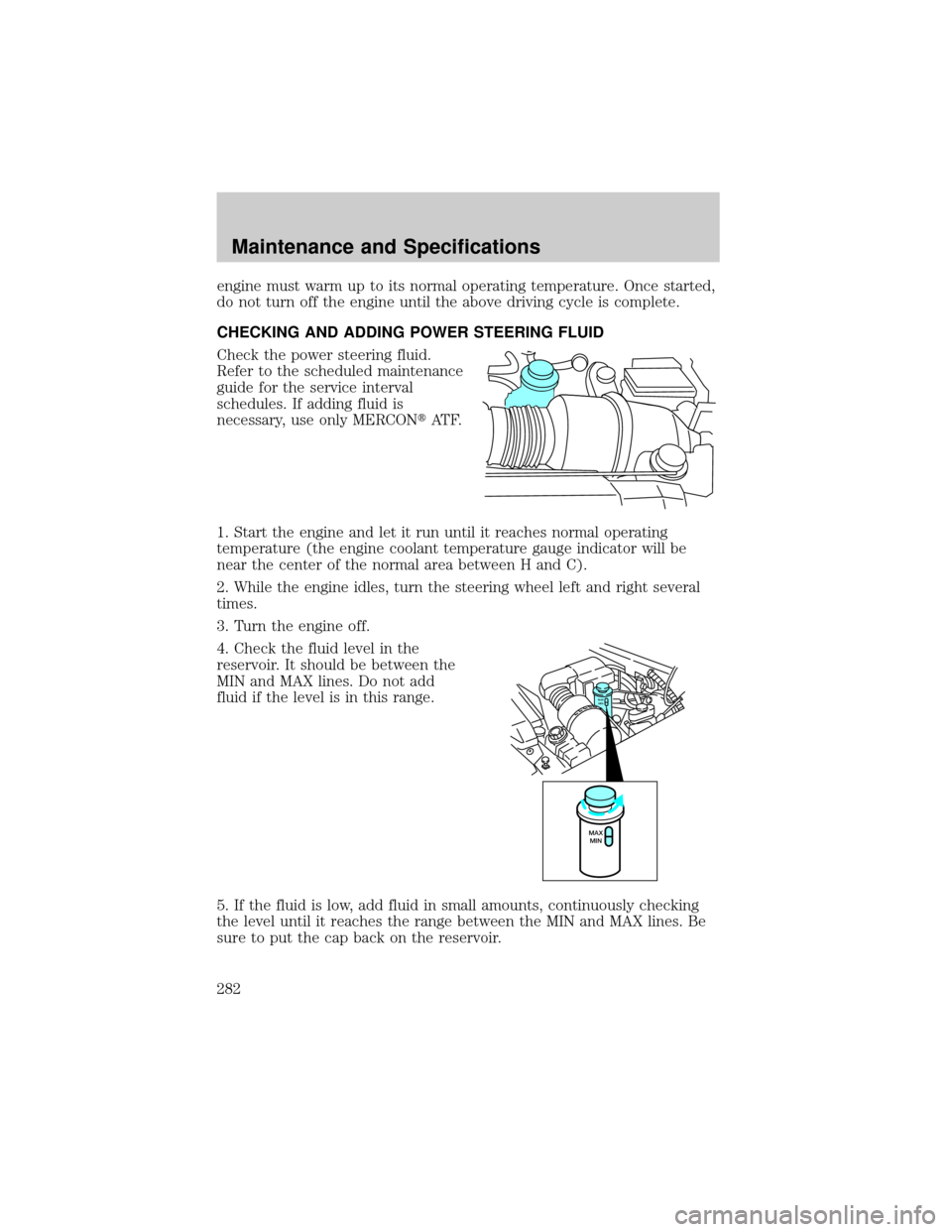
CHECKING AND ADDING POWER STEERING FLUID
Check the power steering fluid.
Refer to the scheduled maintenance
guide for the service interval
schedules. If adding fluid is
necessary, use only MERCONtAT F.
1. Start the engine and let it run until it reaches normal operating
temperature (the engine coolant temperature gauge indicator will be
near the center of the normal area between H and C).
2. While the engine idles, turn the steering wheel left and right several
times.
3. Turn the engine off.
4. Check the fluid level in the
reservoir. It should be between the
MIN and MAX lines. Do not add
fluid if the level is in this range.
5. If the fluid is low, add fluid in small amounts, continuously checking
the level until it reaches the range between the MIN and MAX lines. Be
sure to put the cap back on the reservoir.
MAX
MIN
MAX
MIN
Maintenance and Specifications
282
Page 295 of 320
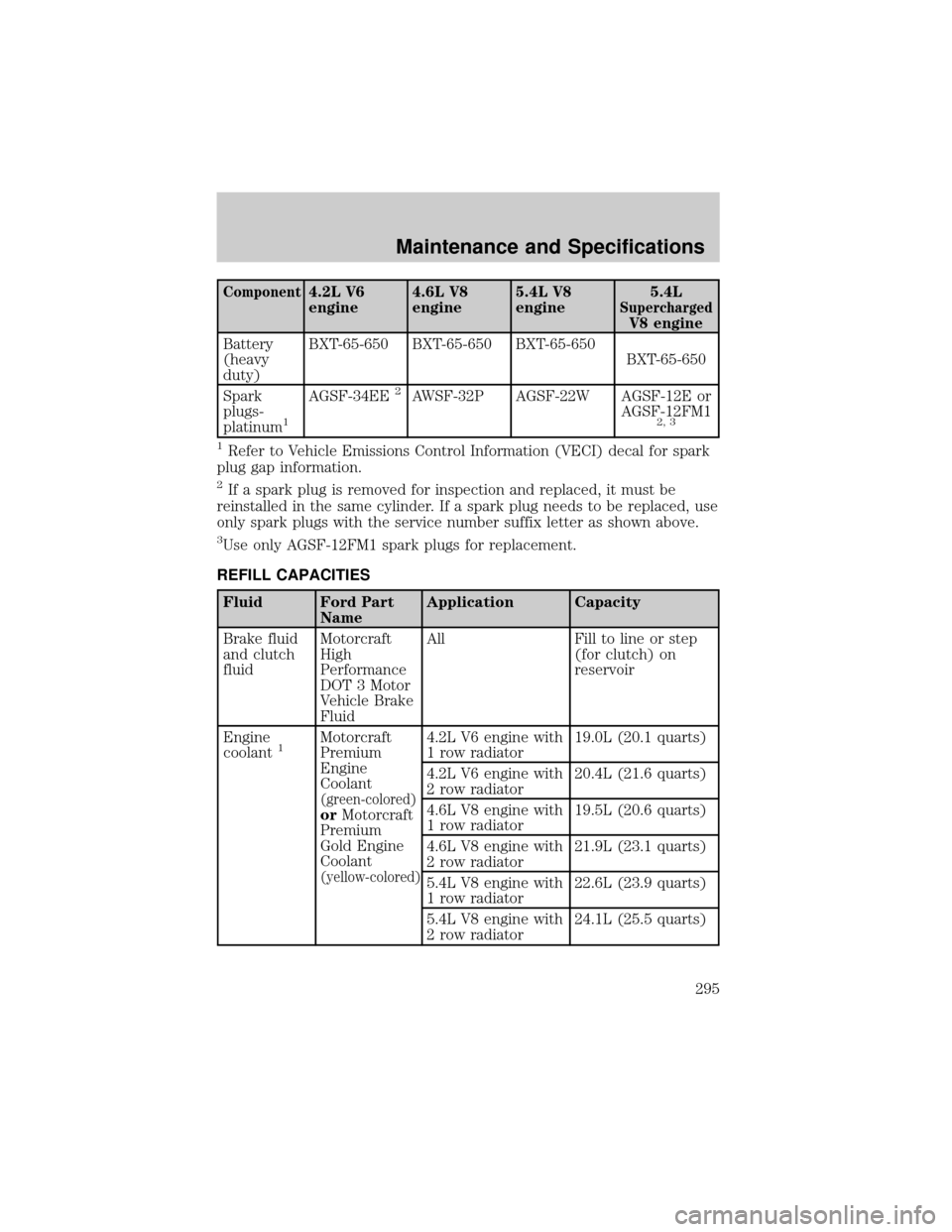
Component4.2L V6
engine4.6L V8
engine5.4L V8
engine5.4LSuperchargedV8 engine
Battery
(heavy
duty)BXT-65-650 BXT-65-650 BXT-65-650
BXT-65-650
Spark
plugs-
platinum
1
AGSF-34EE2AWSF-32P AGSF-22W AGSF-12E or
AGSF-12FM1
2, 3
1
Refer to Vehicle Emissions Control Information (VECI) decal for spark
plug gap information.
2If a spark plug is removed for inspection and replaced, it must be
reinstalled in the same cylinder. If a spark plug needs to be replaced, use
only spark plugs with the service number suffix letter as shown above.
3Use only AGSF-12FM1 spark plugs for replacement.
REFILL CAPACITIES
Fluid Ford Part
NameApplication Capacity
Brake fluid
and clutch
fluidMotorcraft
High
Performance
DOT 3 Motor
Vehicle Brake
FluidAll Fill to line or step
(for clutch) on
reservoir
Engine
coolant
1Motorcraft
Premium
Engine
Coolant
(green-colored)orMotorcraft
Premium
Gold Engine
Coolant
(yellow-colored)
4.2L V6 engine with
1 row radiator19.0L (20.1 quarts)
4.2L V6 engine with
2 row radiator20.4L (21.6 quarts)
4.6L V8 engine with
1 row radiator19.5L (20.6 quarts)
4.6L V8 engine with
2 row radiator21.9L (23.1 quarts)
5.4L V8 engine with
1 row radiator22.6L (23.9 quarts)
5.4L V8 engine with
2 row radiator24.1L (25.5 quarts)
Maintenance and Specifications
295
Page 296 of 320
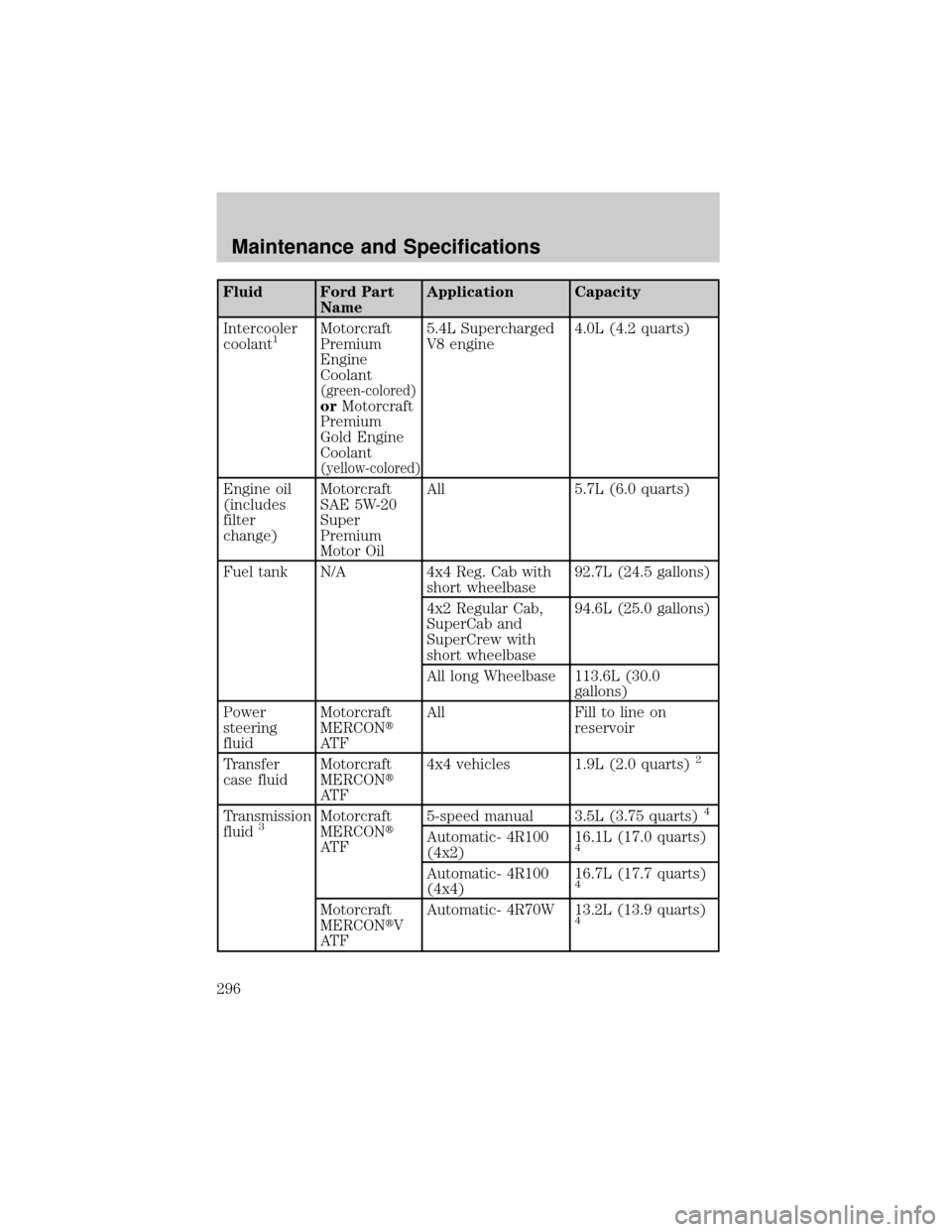
Fluid Ford Part
NameApplication Capacity
Intercooler
coolant
1Motorcraft
Premium
Engine
Coolant
(green-colored)orMotorcraft
Premium
Gold Engine
Coolant
(yellow-colored)
5.4L Supercharged
V8 engine4.0L (4.2 quarts)
Engine oil
(includes
filter
change)Motorcraft
SAE 5W-20
Super
Premium
Motor OilAll 5.7L (6.0 quarts)
Fuel tank N/A 4x4 Reg. Cab with
short wheelbase92.7L (24.5 gallons)
4x2 Regular Cab,
SuperCab and
SuperCrew with
short wheelbase94.6L (25.0 gallons)
All long Wheelbase 113.6L (30.0
gallons)
Power
steering
fluidMotorcraft
MERCONt
AT FAll Fill to line on
reservoir
Transfer
case fluidMotorcraft
MERCONt
AT F4x4 vehicles 1.9L (2.0 quarts)
2
Transmission
fluid3Motorcraft
MERCONt
AT F5-speed manual 3.5L (3.75 quarts)4
Automatic- 4R100
(4x2)16.1L (17.0 quarts)4
Automatic- 4R100
(4x4)16.7L (17.7 quarts)4
Motorcraft
MERCONtV
AT FAutomatic- 4R70W 13.2L (13.9 quarts)4
Maintenance and Specifications
296
Page 299 of 320
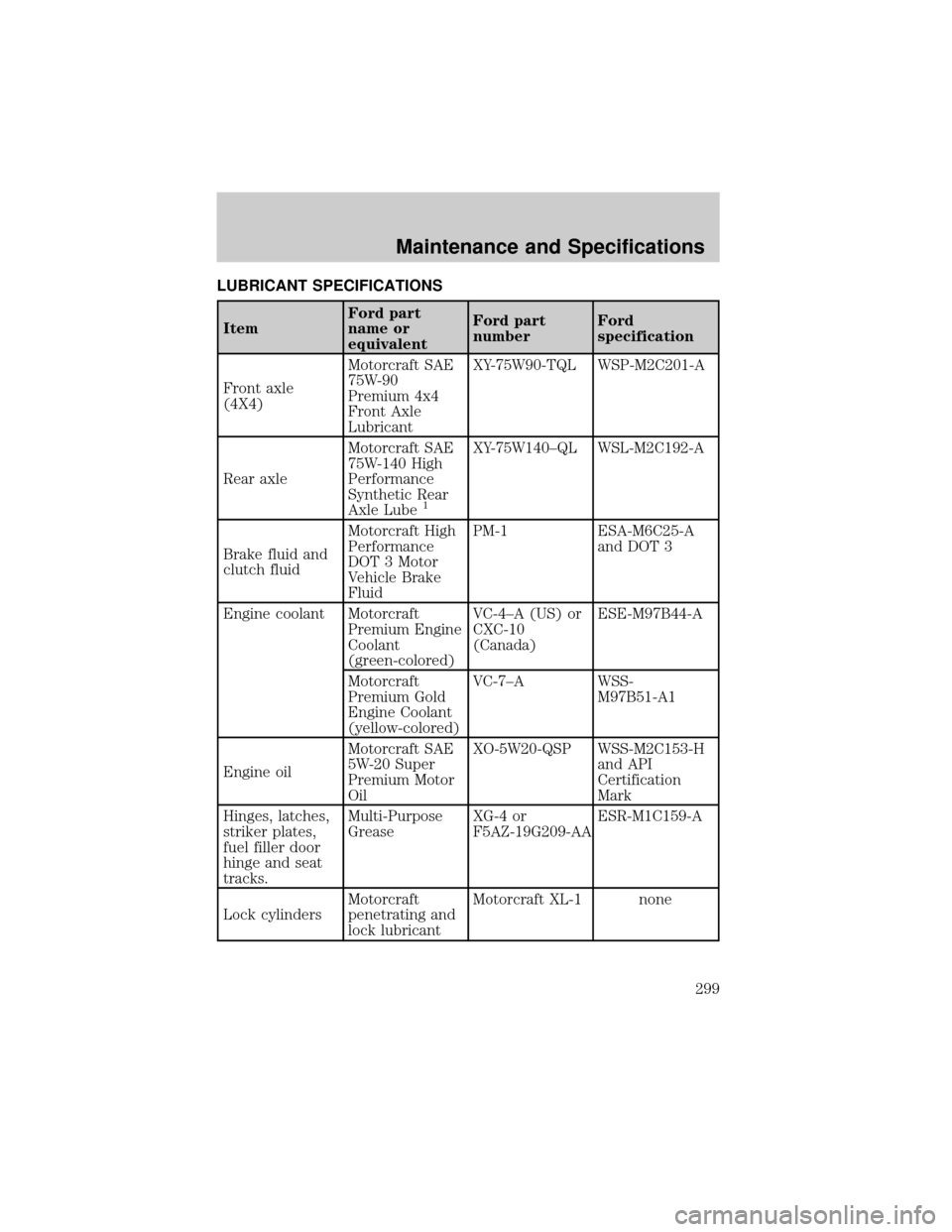
LUBRICANT SPECIFICATIONS
ItemFord part
name or
equivalentFord part
numberFord
specification
Front axle
(4X4)Motorcraft SAE
75W-90
Premium 4x4
Front Axle
LubricantXY-75W90-TQL WSP-M2C201-A
Rear axleMotorcraft SAE
75W-140 High
Performance
Synthetic Rear
Axle Lube
1
XY-75W140±QL WSL-M2C192-A
Brake fluid and
clutch fluidMotorcraft High
Performance
DOT 3 Motor
Vehicle Brake
FluidPM-1 ESA-M6C25-A
and DOT 3
Engine coolant Motorcraft
Premium Engine
Coolant
(green-colored)VC-4±A (US) or
CXC-10
(Canada)ESE-M97B44-A
Motorcraft
Premium Gold
Engine Coolant
(yellow-colored)VC-7±A WSS-
M97B51-A1
Engine oilMotorcraft SAE
5W-20 Super
Premium Motor
OilXO-5W20-QSP WSS-M2C153-H
and API
Certification
Mark
Hinges, latches,
striker plates,
fuel filler door
hinge and seat
tracks.Multi-Purpose
GreaseXG-4 or
F5AZ-19G209-AAESR-M1C159-A
Lock cylindersMotorcraft
penetrating and
lock lubricantMotorcraft XL-1 none
Maintenance and Specifications
299
Page 313 of 320

A
Accessory delay ..........................86
Air bag supplemental
restraint system ........................145
and child safety seats ............147
description ..............................145
disposal ....................................149
driver air bag ..........................147
indicator light ...................13, 149
operation .................................147
passenger air bag ...................147
passenger deactivation
switch ......................................150
Air cleaner filter ...............289, 294
Air conditioning ..........................59
manual heating and air
conditioning system .................55
Ambulance packages ....................7
Antifreeze
(see Engine coolant) ................265
Anti-lock brake system
(see Brakes) ......................170±171
Anti-theft system
warning light .............................15
Armrests ....................................130
Automatic transmission ............175
driving an automatic
overdrive .................................176
fluid, adding ............................284
fluid, checking ........................284
fluid, refill capacities ..............295
fluid, specification ..................301
Auxiliary power point ...........82, 84
Axle
lubricant
specifications ..................299, 301refill capacities ........................295
traction lok ..............................174
B
Battery .......................................263
acid, treating emergencies .....263
charging system
warning light .............................13
jumping a disabled battery ....226
maintenance-free ....................263
replacement,
specifications ..........................294
servicing ..................................263
voltage gauge ............................18
Bed extender ..............................99
Belt minder ...............................140
Brakes ........................................170
anti-lock ...........................170±171
anti-lock brake system
(ABS) warning light .........12, 171
brake warning light ..................12
fluid, checking and adding ....283
fluid, refill capacities ..............295
fluid, specifications .........299, 301
lubricant
specifications ..................299, 301
parking ....................................172
pedals (see Power
adjustable foot pedals) ............88
shift interlock ..........................175
Break-in period .............................5
C
Capacities for refilling fluids ....295
Cassette tape player ...................36
CD changer .................................49
Certification Label ....................307
Index
313