fuel FORD F150 2009 12.G User Guide
[x] Cancel search | Manufacturer: FORD, Model Year: 2009, Model line: F150, Model: FORD F150 2009 12.GPages: 405, PDF Size: 2.82 MB
Page 96 of 405
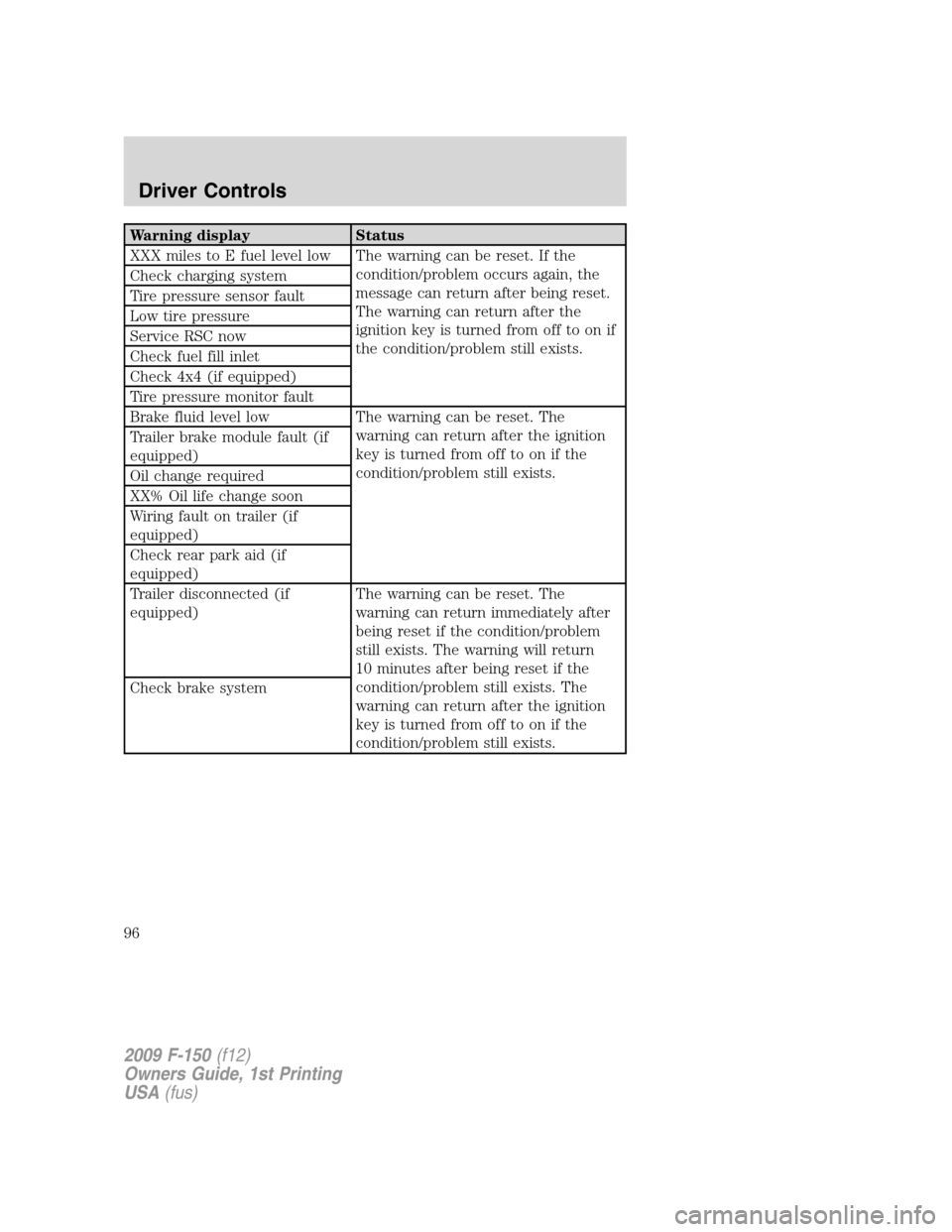
Warning display Status
XXX miles to E fuel level low The warning can be reset. If the
condition/problem occurs again, the
message can return after being reset.
The warning can return after the
ignition key is turned from off to on if
the condition/problem still exists. Check charging system
Tire pressure sensor fault
Low tire pressure
Service RSC now
Check fuel fill inlet
Check 4x4 (if equipped)
Tire pressure monitor fault
Brake fluid level low The warning can be reset. The
warning can return after the ignition
key is turned from off to on if the
condition/problem still exists. Trailer brake module fault (if
equipped)
Oil change required
XX% Oil life change soon
Wiring fault on trailer (if
equipped)
Check rear park aid (if
equipped)
Trailer disconnected (if
equipped)The warning can be reset. The
warning can return immediately after
being reset if the condition/problem
still exists. The warning will return
10 minutes after being reset if the
condition/problem still exists. The
warning can return after the ignition
key is turned from off to on if the
condition/problem still exists. Check brake system
2009 F-150(f12)
Owners Guide, 1st Printing
USA(fus)
Driver Controls
96
Page 98 of 405
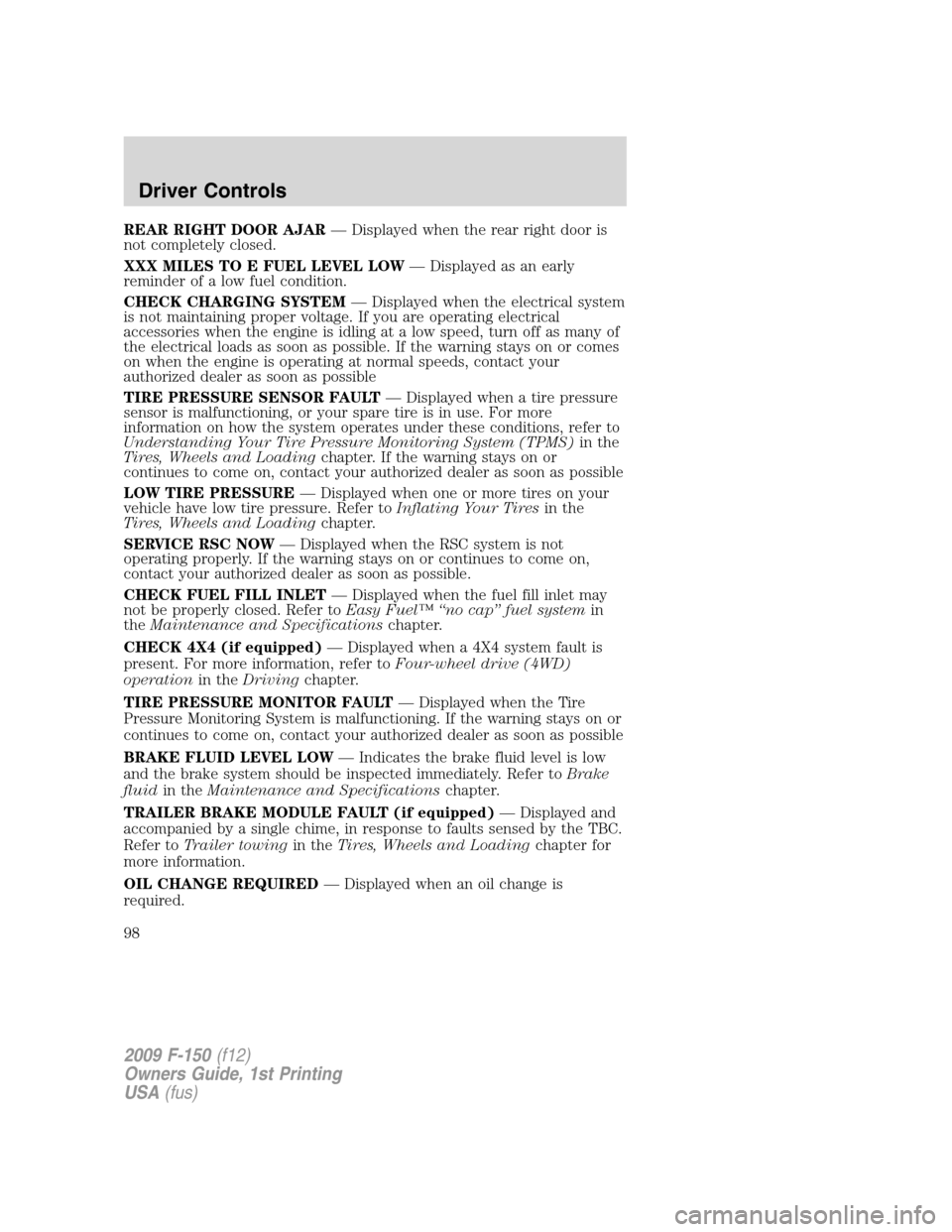
REAR RIGHT DOOR AJAR— Displayed when the rear right door is
not completely closed.
XXX MILES TO E FUEL LEVEL LOW— Displayed as an early
reminder of a low fuel condition.
CHECK CHARGING SYSTEM— Displayed when the electrical system
is not maintaining proper voltage. If you are operating electrical
accessories when the engine is idling at a low speed, turn off as many of
the electrical loads as soon as possible. If the warning stays on or comes
on when the engine is operating at normal speeds, contact your
authorized dealer as soon as possible
TIRE PRESSURE SENSOR FAULT— Displayed when a tire pressure
sensor is malfunctioning, or your spare tire is in use. For more
information on how the system operates under these conditions, refer to
Understanding Your Tire Pressure Monitoring System (TPMS)in the
Tires, Wheels and Loadingchapter. If the warning stays on or
continues to come on, contact your authorized dealer as soon as possible
LOW TIRE PRESSURE— Displayed when one or more tires on your
vehicle have low tire pressure. Refer toInflating Your Tiresin the
Tires, Wheels and Loadingchapter.
SERVICE RSC NOW— Displayed when the RSC system is not
operating properly. If the warning stays on or continues to come on,
contact your authorized dealer as soon as possible.
CHECK FUEL FILL INLET— Displayed when the fuel fill inlet may
not be properly closed. Refer toEasy Fuel™ “no cap” fuel systemin
theMaintenance and Specificationschapter.
CHECK 4X4 (if equipped)— Displayed when a 4X4 system fault is
present. For more information, refer toFour-wheel drive (4WD)
operationin theDrivingchapter.
TIRE PRESSURE MONITOR FAULT— Displayed when the Tire
Pressure Monitoring System is malfunctioning. If the warning stays on or
continues to come on, contact your authorized dealer as soon as possible
BRAKE FLUID LEVEL LOW— Indicates the brake fluid level is low
and the brake system should be inspected immediately. Refer toBrake
fluidin theMaintenance and Specificationschapter.
TRAILER BRAKE MODULE FAULT (if equipped)— Displayed and
accompanied by a single chime, in response to faults sensed by the TBC.
Refer toTrailer towingin theTires, Wheels and Loadingchapter for
more information.
OIL CHANGE REQUIRED— Displayed when an oil change is
required.
2009 F-150(f12)
Owners Guide, 1st Printing
USA(fus)
Driver Controls
98
Page 101 of 405

Info menu
This control displays the following
control displays:
•Trip odometer/Odometer
•Distance to Empty
•Average Fuel Economy
•Instantaneous Fuel Economy
•Trip Elapsed Drive Time
•Blank
Odometer/Trip odometer
Refer toGaugesin theInstrument Clusterchapter.
Distance to empty (DTE)
Selecting this function from the
INFO menu estimates approximately
how far you can drive with the fuel
remaining in your tank under
normal driving conditions.
Remember to turn the ignition off
when refueling to allow this feature to correctly detect the added fuel.
The DTE function will display XXX MILES TO E FUEL LEVEL LOW and
sound a tone for one second when you have approximately 50 miles
(80 km) to empty. If you RESET this warning message, this display and
tone will return within 10 minutes.
DTE is calculated using a running average fuel economy, which is based
on your recent driving history of 500 miles (800 km). This value is not
the same as the average fuel economy display. The running average fuel
economy is reinitialized to a factory default value if the battery is
disconnected.
Average fuel economy (AFE)
Select this function from the INFO
menu to display your average fuel
economy in miles/gallon or
liters/100 km.
2009 F-150(f12)
Owners Guide, 1st Printing
USA(fus)
Driver Controls
101
Page 102 of 405

If you calculate your average fuel economy by dividing 100 miles traveled
by gallons of fuel used (kilometers traveled by liters used), your figure
may be different than displayed for the following reasons:
•Your vehicle was not perfectly level during fill-up
•Differences in the automatic shut-off points on the fuel pumps at
service stations
•Variations in top-off procedure from one fill-up to another
•Rounding of the displayed values to the nearest 0.1 gallon (liter)
1. Drive the vehicle at least 5 miles (8 km) with the speed control
system engaged to display a stabilized average.
2. Record the highway fuel economy for future reference.
It is important to press the RESET control after setting the speed
control to get accurate highway fuel economy readings.
Instantaneous fuel economy
Select this function from the INFO
menu to display your instantaneous
fuel economy. This will display your
fuel economy as a bar graph ranging
from
poor economy to
excellent economy.
Your vehicle must be moving to calculate instantaneous fuel economy.
When your vehicle is not moving, this function shows
, one or no bars
illuminated. Instantaneous fuel economy cannot be reset.
Trip elapsed drive time
Select this function from the INFO
menu to display a timer.
To operate the Trip Elapsed Drive
Time perform the following:
1. Press and release RESET in order
to start the timer.
2. Press and release RESET to pause the timer.
3. Press and hold RESET for two seconds in order to reset the timer.
Blank screen
Press the RESET once to turn the message center display off.
2009 F-150(f12)
Owners Guide, 1st Printing
USA(fus)
Driver Controls
102
Page 103 of 405
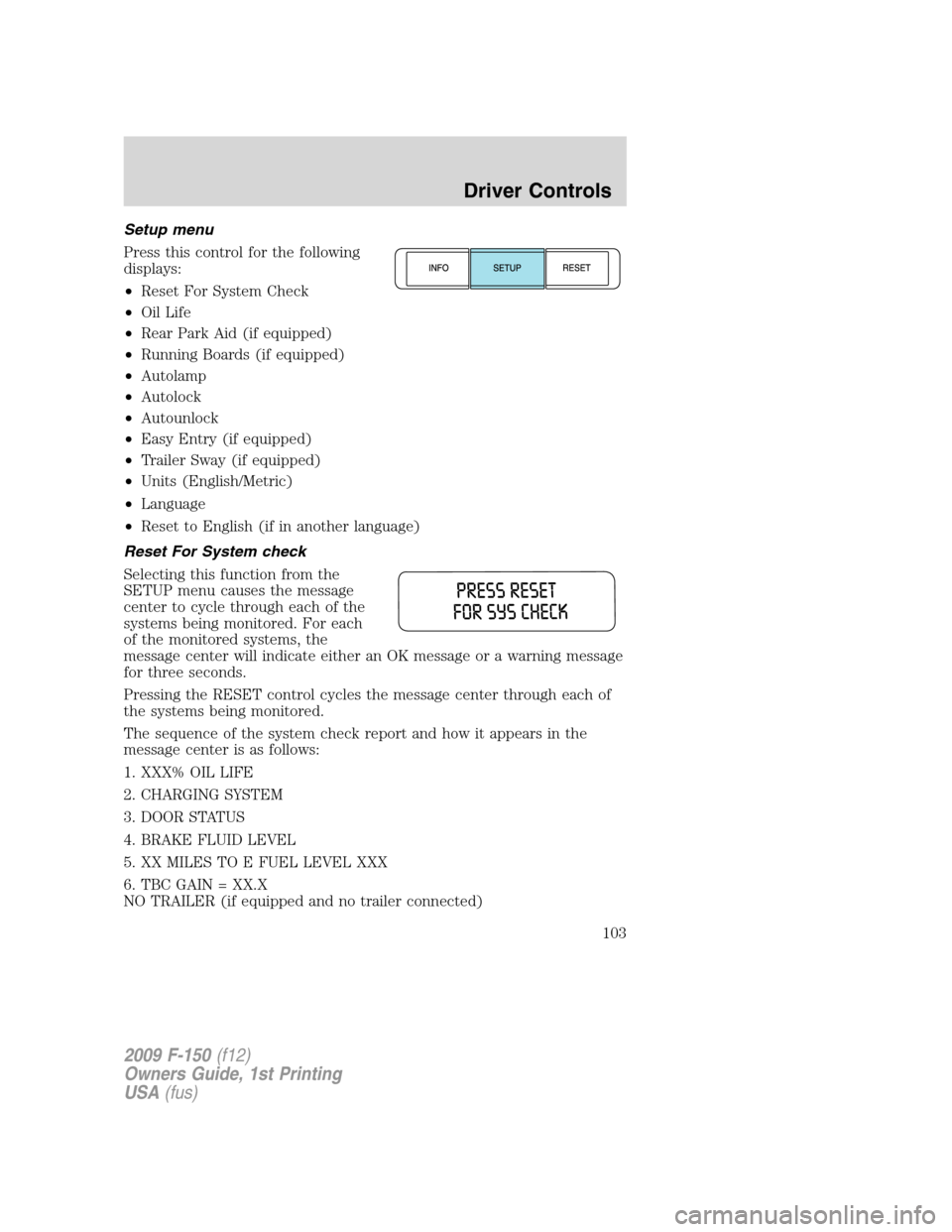
Setup menu
Press this control for the following
displays:
•Reset For System Check
•Oil Life
•Rear Park Aid (if equipped)
•Running Boards (if equipped)
•Autolamp
•Autolock
•Autounlock
•Easy Entry (if equipped)
•Trailer Sway (if equipped)
•Units (English/Metric)
•Language
•Reset to English (if in another language)
Reset For System check
Selecting this function from the
SETUP menu causes the message
center to cycle through each of the
systems being monitored. For each
of the monitored systems, the
message center will indicate either an OK message or a warning message
for three seconds.
Pressing the RESET control cycles the message center through each of
the systems being monitored.
The sequence of the system check report and how it appears in the
message center is as follows:
1. XXX% OIL LIFE
2. CHARGING SYSTEM
3. DOOR STATUS
4. BRAKE FLUID LEVEL
5. XX MILES TO E FUEL LEVEL XXX
6. TBC GAIN = XX.X
NO TRAILER (if equipped and no trailer connected)
2009 F-150(f12)
Owners Guide, 1st Printing
USA(fus)
Driver Controls
103
Page 108 of 405
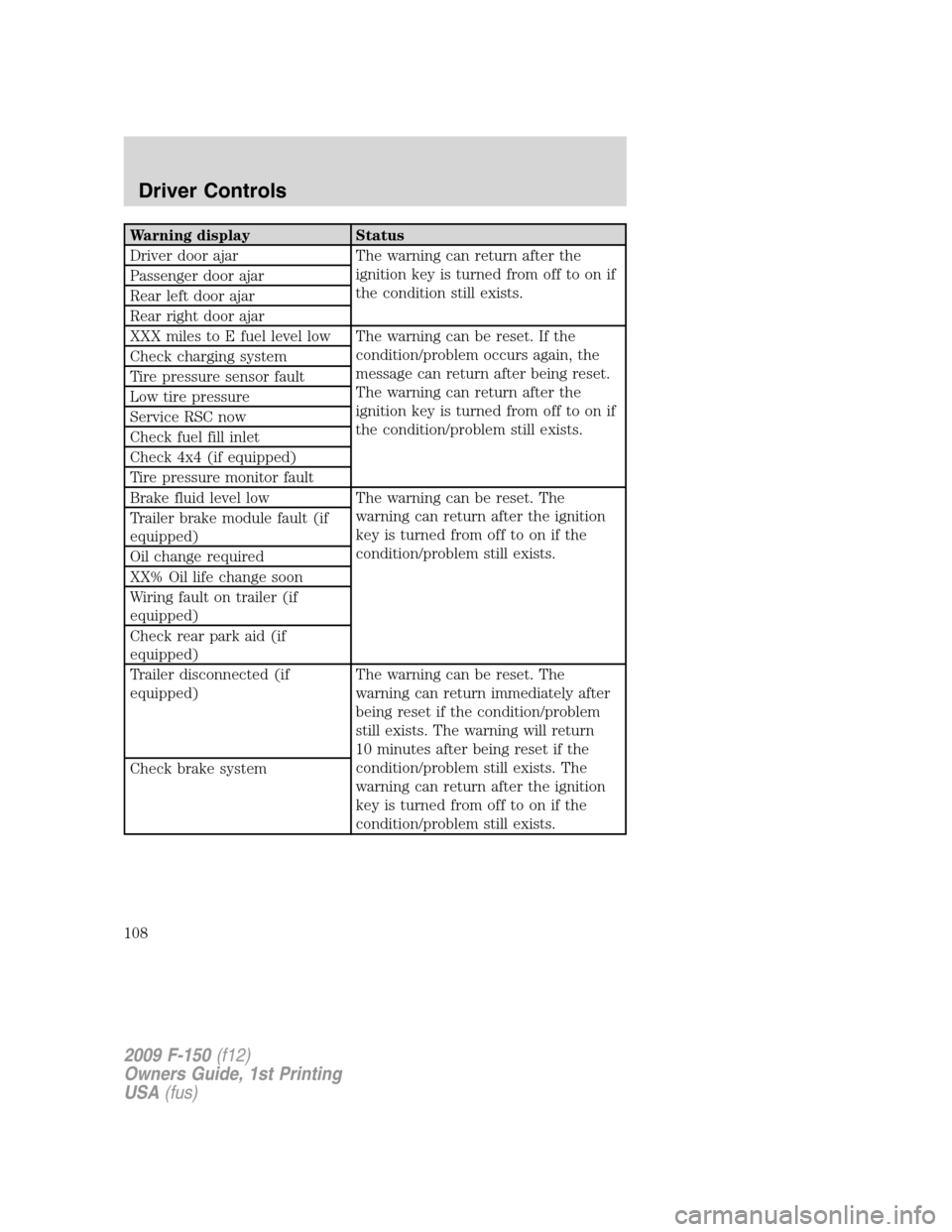
Warning display Status
Driver door ajar The warning can return after the
ignition key is turned from off to on if
the condition still exists. Passenger door ajar
Rear left door ajar
Rear right door ajar
XXX miles to E fuel level low The warning can be reset. If the
condition/problem occurs again, the
message can return after being reset.
The warning can return after the
ignition key is turned from off to on if
the condition/problem still exists. Check charging system
Tire pressure sensor fault
Low tire pressure
Service RSC now
Check fuel fill inlet
Check 4x4 (if equipped)
Tire pressure monitor fault
Brake fluid level low The warning can be reset. The
warning can return after the ignition
key is turned from off to on if the
condition/problem still exists. Trailer brake module fault (if
equipped)
Oil change required
XX% Oil life change soon
Wiring fault on trailer (if
equipped)
Check rear park aid (if
equipped)
Trailer disconnected (if
equipped)The warning can be reset. The
warning can return immediately after
being reset if the condition/problem
still exists. The warning will return
10 minutes after being reset if the
condition/problem still exists. The
warning can return after the ignition
key is turned from off to on if the
condition/problem still exists. Check brake system
2009 F-150(f12)
Owners Guide, 1st Printing
USA(fus)
Driver Controls
108
Page 110 of 405
XXX MILES TO E FUEL LEVEL LOW— Displayed as an early
reminder of a low fuel condition.
CHECK CHARGING SYSTEM— Displayed when the electrical system
is not maintaining proper voltage. If you are operating electrical
accessories when the engine is idling at a low speed, turn off as many of
the electrical loads as soon as possible. If the warning stays on or comes
on when the engine is operating at normal speeds, contact your
authorized dealer as soon as possible
TIRE PRESSURE SENSOR FAULT— Displayed when a tire pressure
sensor is malfunctioning, or your spare tire is in use. For more
information on how the system operates under these conditions, refer to
Understanding Your Tire Pressure Monitoring System (TPMS)in the
Tires, Wheels and Loadingchapter. If the warning stays on or
continues to come on, contact your authorized dealer as soon as
possible.
LOW TIRE PRESSURE— Displayed when one or more tires on your
vehicle have low tire pressure. Refer toInflating Your Tiresin the
Tires, Wheels and Loadingchapter.
SERVICE RSC NOW— Displayed when the RSC system is not
operating properly. If the warning stays on or continues to come on,
contact your authorized dealer as soon as possible.
CHECK FUEL FILL INLET— Displayed when the fuel fill inlet may
not be properly closed. Refer toEasy Fuel™ “no cap” fuel systemin
theMaintenance and Specificationschapter.
CHECK 4X4 (if equipped)— Displayed when a 4X4 system fault is
present. For more information, refer toFour-wheel drive (4WD)
operationin theDrivingchapter.
TIRE PRESSURE MONITOR FAULT— Displayed when the Tire
Pressure Monitoring System is malfunctioning. If the warning stays on or
continues to come on, contact your authorized dealer as soon as
possible.
BRAKE FLUID LEVEL LOW— Indicates the brake fluid level is low
and the brake system should be inspected immediately. Refer toBrake
fluidin theMaintenance and Specificationschapter.
TRAILER BRAKE MODULE FAULT (if equipped)— Displayed and
accompanied by a single chime, in response to faults sensed by the TBC.
Refer toTrailer towingin theTires, Wheels and Loadingchapter for
more information.
OIL CHANGE REQUIRED— Displayed when an oil change is
required.
2009 F-150(f12)
Owners Guide, 1st Printing
USA(fus)
Driver Controls
110
Page 231 of 405

TIRE PRESSURE MONITORING SYSTEM (TPMS) (IF EQUIPPED)
Each tire, including the spare (if
provided), should be checked
monthly when cold and inflated to
the inflation pressure recommended
by the vehicle manufacturer on the
vehicle placard or tire inflation pressure label. (If your vehicle has tires
of a different size than the size indicated on the vehicle placard or tire
inflation pressure label, you should determine the proper tire inflation
pressure for those tires.)
As an added safety feature, your vehicle has been equipped with a tire
pressure monitoring system (TPMS) that illuminates a low tire pressure
telltale when one or more of your tires is significantly under-inflated.
Accordingly, when the low tire pressure telltale illuminates, you should
stop and check your tires as soon as possible, and inflate them to the
proper pressure. Driving on a significantly under-inflated tire causes the
tire to overheat and can lead to tire failure. Under-inflation also reduces
fuel efficiency and tire tread life, and may affect the vehicle’s handling
and stopping ability.
Please note that the TPMS is not a substitute for proper tire
maintenance, and it is the driver’s responsibility to maintain correct tire
pressure, even if under-inflation has not reached the level to trigger
illumination of the TPMS low tire pressure telltale.
Your vehicle has also been equipped with a TPMS malfunction indicator
to indicate when the system is not operating properly. The TPMS
malfunction indicator is combined with the low tire pressure telltale.
When the system detects a malfunction, the telltale will flash for
approximately one minute and then remain continuously illuminated.
This sequence will continue upon subsequent vehicle start-ups as long as
the malfunction exists.
When the malfunction indicator is illuminated, the system may not be
able to detect or signal low tire pressure as intended. TPMS malfunctions
may occur for a variety of reasons, including the installation of
replacement or alternate tires or wheels on the vehicle that prevent the
TPMS from functioning properly. Always check the TPMS malfunction
telltale after replacing one or more tires or wheels on your vehicle to
ensure that the replacement or alternate tires and wheels allow the
TPMS to continue to function properly.
2009 F-150(f12)
Owners Guide, 1st Printing
USA(fus)
Tires, Wheels and Loading
231
Page 241 of 405

Note: Do not place chains on the following tires sizes: P265/60R18,
P275/65R18, LT275/70R17, LT275/65R18, P275/55R20, and P275/45R22.
Follow these guidelines when using snow tires and chains:
•Use only SAE Class S chains.
•Install chains securely, verifying that the chains do not touch any
wiring, brake lines or fuel lines.
•Drive cautiously. If you hear the chains rub or bang against your
vehicle, stop and re-tighten the chains. If this does not work, remove
the chains to prevent damage to your vehicle.
•If possible, avoid fully loading your vehicle.
•Remove the tire chains when they are no longer needed. Do not use
tire chains on dry roads.
•The suspension insulation and bumpers will help prevent vehicle
damage. Do not remove these components from your vehicle when
using snow tires and chains.
VEHICLE LOADING – WITH AND WITHOUT A TRAILER
This section will guide you in the proper loading of your vehicle and/or
trailer, to keep your loaded vehicle weight within its design rating
capability, with or without a trailer. Properly loading your vehicle will
provide maximum return of vehicle design performance. Before loading
your vehicle, familiarize yourself with the following terms for determining
your vehicle’s weight ratings, with or without a trailer, from the vehicle’s
Tire Label or Safety Compliance Certification Label:
Base Curb Weight– is the weight of the vehicle including a full tank of
fuel and all standard equipment. It does not include passengers, cargo, or
optional equipment.
Vehicle Curb Weight– is the weight of your new vehicle when you
picked it up from your authorized dealer plus any aftermarket
equipment.
2009 F-150(f12)
Owners Guide, 1st Printing
USA(fus)
Tires, Wheels and Loading
241
Page 262 of 405
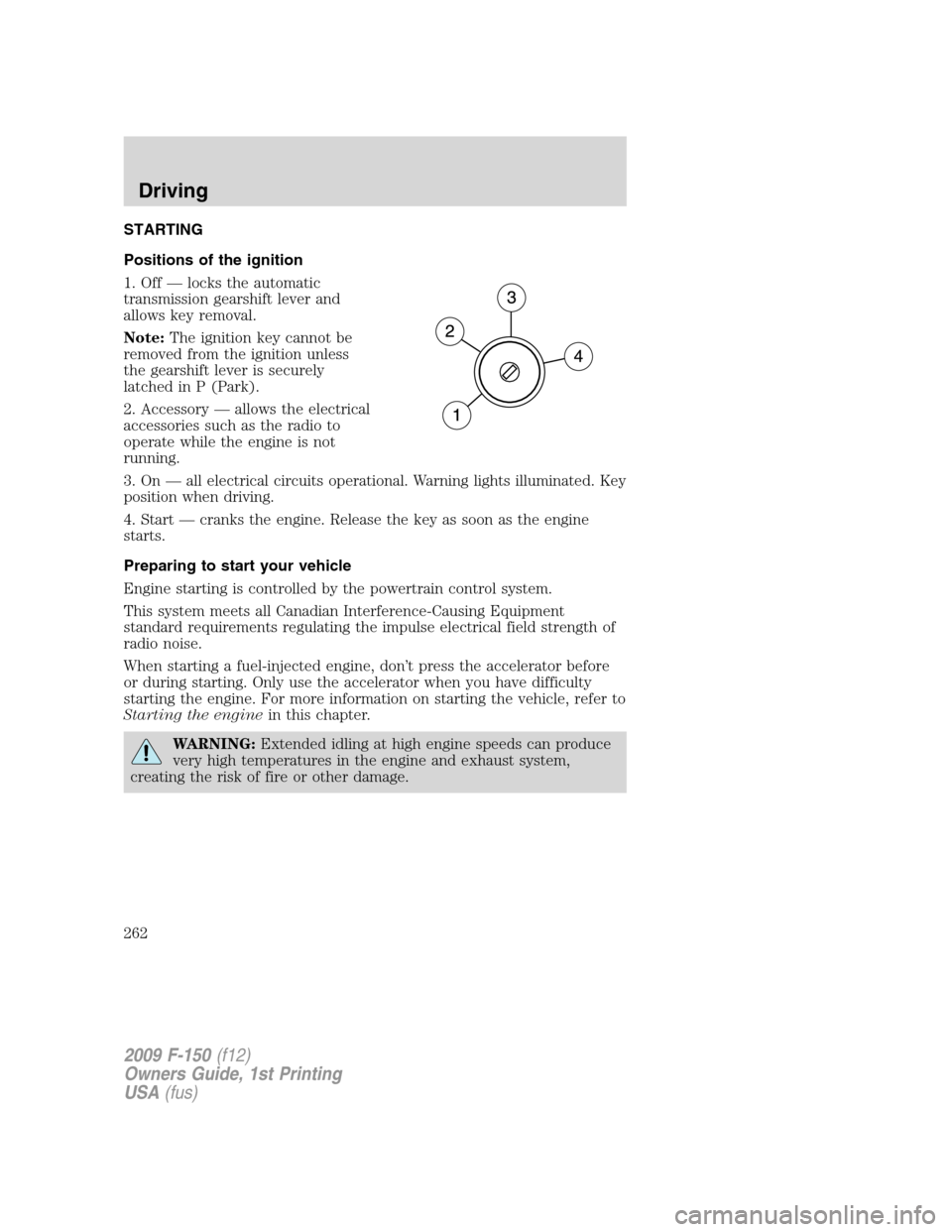
STARTING
Positions of the ignition
1. Off — locks the automatic
transmission gearshift lever and
allows key removal.
Note:The ignition key cannot be
removed from the ignition unless
the gearshift lever is securely
latched in P (Park).
2. Accessory — allows the electrical
accessories such as the radio to
operate while the engine is not
running.
3. On — all electrical circuits operational. Warning lights illuminated. Key
position when driving.
4. Start — cranks the engine. Release the key as soon as the engine
starts.
Preparing to start your vehicle
Engine starting is controlled by the powertrain control system.
This system meets all Canadian Interference-Causing Equipment
standard requirements regulating the impulse electrical field strength of
radio noise.
When starting a fuel-injected engine, don’t press the accelerator before
or during starting. Only use the accelerator when you have difficulty
starting the engine. For more information on starting the vehicle, refer to
Starting the enginein this chapter.
WARNING:Extended idling at high engine speeds can produce
very high temperatures in the engine and exhaust system,
creating the risk of fire or other damage.
2009 F-150(f12)
Owners Guide, 1st Printing
USA(fus)
Driving
262