engine FORD F150 2009 12.G Owner's Manual
[x] Cancel search | Manufacturer: FORD, Model Year: 2009, Model line: F150, Model: FORD F150 2009 12.GPages: 405, PDF Size: 2.82 MB
Page 238 of 405
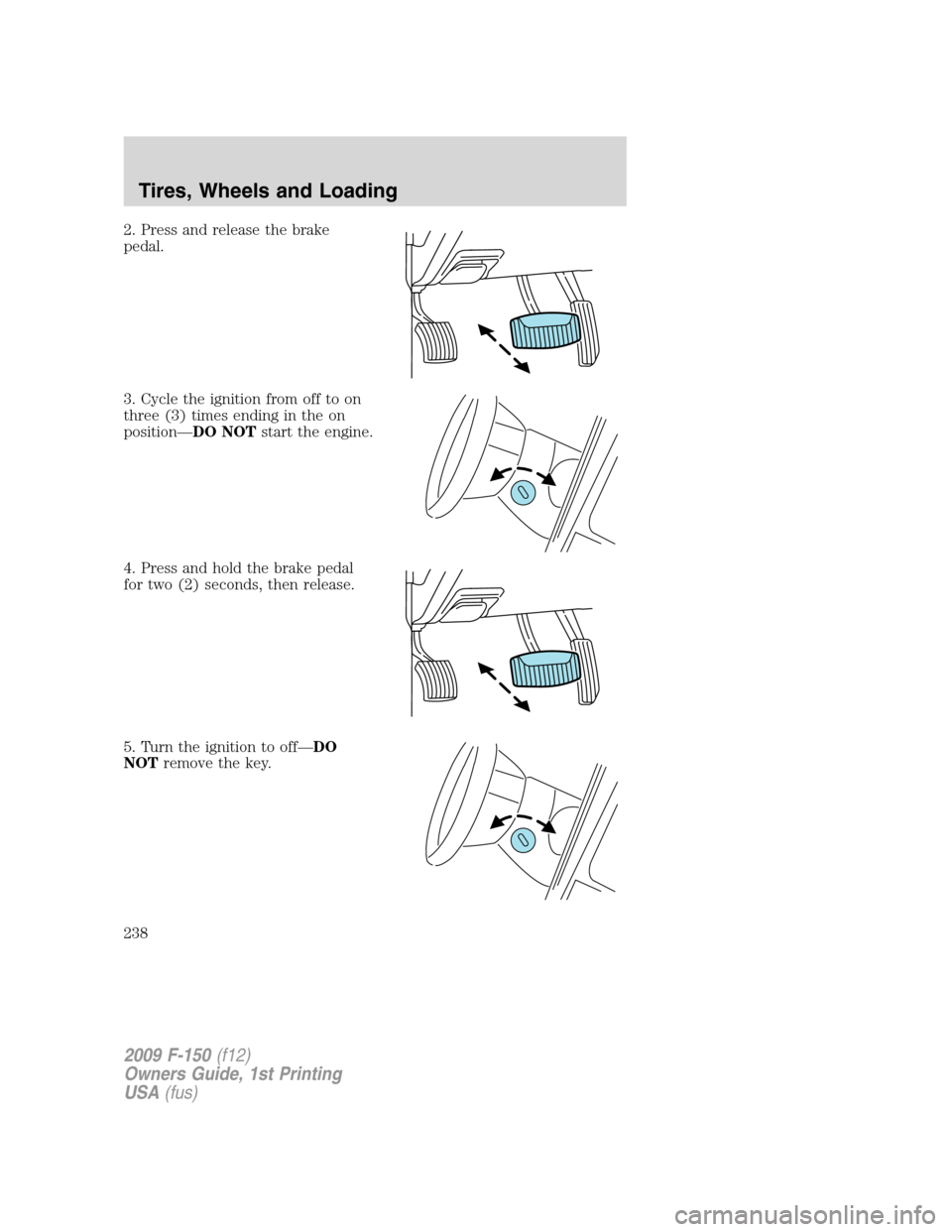
2. Press and release the brake
pedal.
3. Cycle the ignition from off to on
three (3) times ending in the on
position—DO NOTstart the engine.
4. Press and hold the brake pedal
for two (2) seconds, then release.
5. Turn the ignition to off—DO
NOTremove the key.
2009 F-150(f12)
Owners Guide, 1st Printing
USA(fus)
Tires, Wheels and Loading
238
Page 239 of 405
6. Cycle the ignition from off to on three (3) times ending in on—DO
NOTstart the engine.
If the reset mode has been entered successfully, the horn will sound
once, the TPMS indicator
will flash and the message center will
displayTRAIN LEFT FRONT TIRE.
If after repeated attempts to enter the reset mode, the horn does not
sound, the TPMS indicator
does not flash and the message center
does not displayTRAIN LEFT FRONT TIRE, seek service from your
authorized dealer.
7. Train the TPMS sensors in the tires using the following TPMS reset
sequence starting with theleft front tirein the following clockwise order:
1. Left front tire (Front driver’s side)
2. Right front tire (Front passenger’s side)
3. Right rear tire (Rear passenger’s side)
4. Left rear tire (Rear driver’s side)
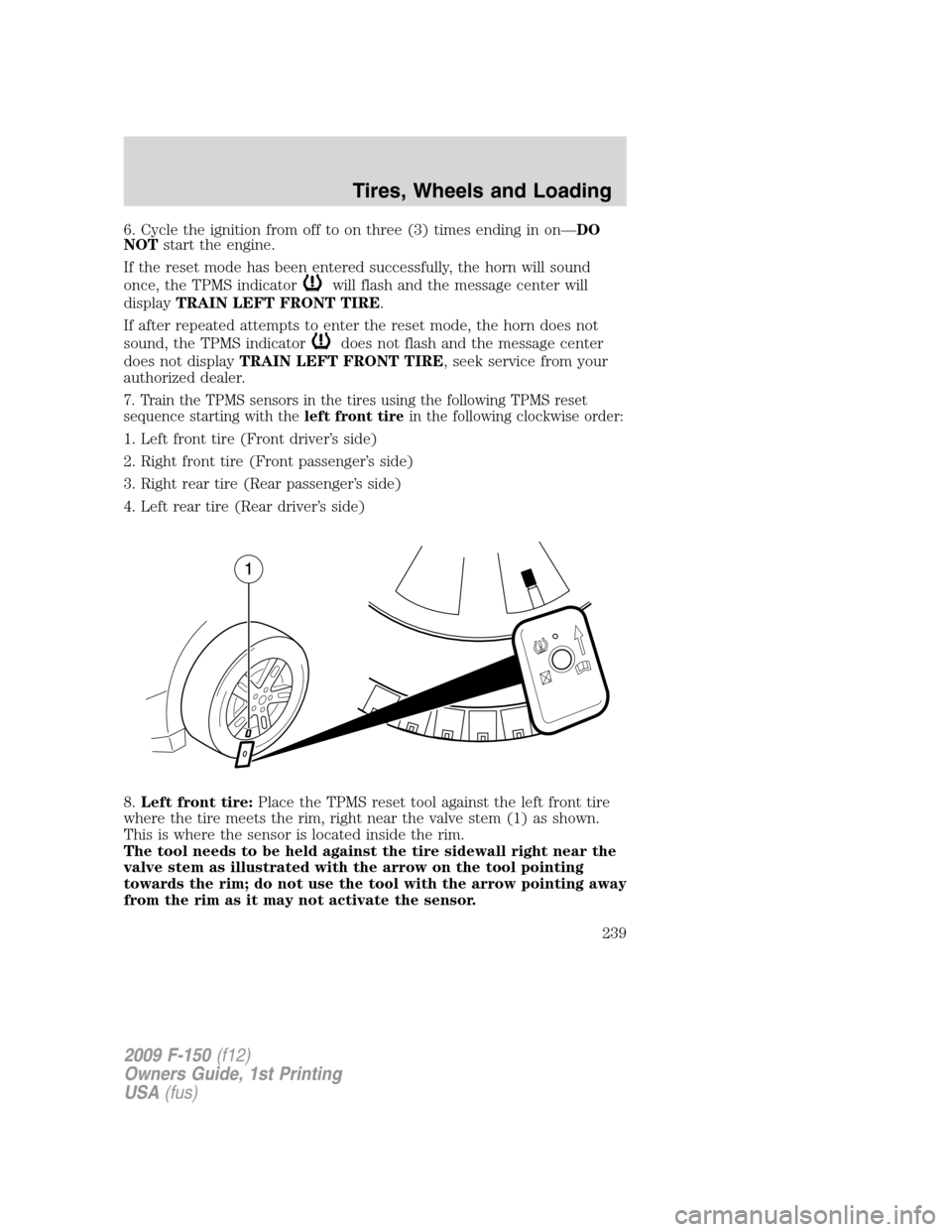
8.Left front tire:Place the TPMS reset tool against the left front tire
where the tire meets the rim, right near the valve stem (1) as shown.
This is where the sensor is located inside the rim.
The tool needs to be held against the tire sidewall right near the
valve stem as illustrated with the arrow on the tool pointing
towards the rim; do not use the tool with the arrow pointing away
from the rim as it may not activate the sensor.
2009 F-150(f12)
Owners Guide, 1st Printing
USA(fus)
Tires, Wheels and Loading
239
Page 245 of 405
WARNING:Exceeding the Safety Compliance Certification Label
vehicle weight rating limits could result in substandard vehicle
handling or performance, engine, transmission and/or structural
damage, serious damage to the vehicle, loss of control and personal
injury.
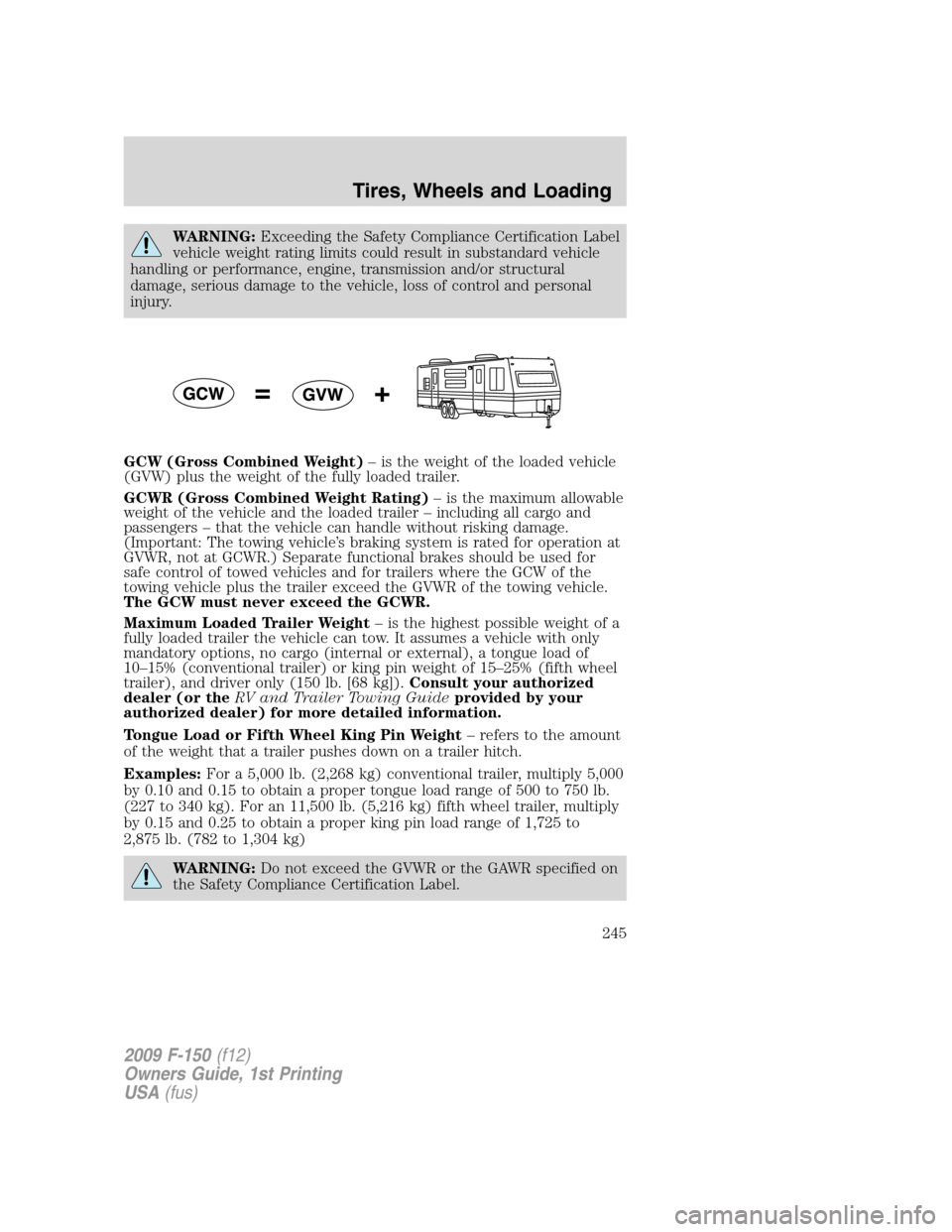
GCW (Gross Combined Weight)– is the weight of the loaded vehicle
(GVW) plus the weight of the fully loaded trailer.
GCWR (Gross Combined Weight Rating)– is the maximum allowable
weight of the vehicle and the loaded trailer – including all cargo and
passengers – that the vehicle can handle without risking damage.
(Important: The towing vehicle’s braking system is rated for operation at
GVWR, not at GCWR.) Separate functional brakes should be used for
safe control of towed vehicles and for trailers where the GCW of the
towing vehicle plus the trailer exceed the GVWR of the towing vehicle.
The GCW must never exceed the GCWR.
Maximum Loaded Trailer Weight– is the highest possible weight of a
fully loaded trailer the vehicle can tow. It assumes a vehicle with only
mandatory options, no cargo (internal or external), a tongue load of
10–15% (conventional trailer) or king pin weight of 15–25% (fifth wheel
trailer), and driver only (150 lb. [68 kg]).Consult your authorized
dealer (or theRV and Trailer Towing Guideprovided by your
authorized dealer) for more detailed information.
Tongue Load or Fifth Wheel King Pin Weight– refers to the amount
of the weight that a trailer pushes down on a trailer hitch.
Examples:For a 5,000 lb. (2,268 kg) conventional trailer, multiply 5,000
by 0.10 and 0.15 to obtain a proper tongue load range of 500 to 750 lb.
(227 to 340 kg). For an 11,500 lb. (5,216 kg) fifth wheel trailer, multiply
by 0.15 and 0.25 to obtain a proper king pin load range of 1,725 to
2,875 lb. (782 to 1,304 kg)
WARNING:Do not exceed the GVWR or the GAWR specified on
the Safety Compliance Certification Label.
2009 F-150(f12)
Owners Guide, 1st Printing
USA(fus)
Tires, Wheels and Loading
245
Page 248 of 405
TRAILER TOWING
Your vehicle may tow a class I, II, III or IV trailer provided the maximum
trailer weight is less than or equal to the maximum trailer weight listed
for your engine and rear axle ratio on the following charts.
If your vehicle is not equipped with a heavy-duty trailer towing package,
the maximum weight your vehicle can tow is limited to 5,000 lb.
(2,268 kg)
Your vehicle’s load capacity is designated by weight, not by volume, so
you cannot necessarily use all available space when loading a vehicle.
Towing a trailer places an additional load on your vehicle’s engine,
transmission, axle, brakes, tires and suspension. Inspect these
components carefully periodically during, and after any towing operation.
Exceeding the maximum GCWR could result in extensive damage
to your vehicle and personal injury.
WARNING:Do not exceed the GVWR or the GAWR specified on
the certification label.
WARNING:Towing trailers beyond the maximum recommended
gross trailer weight exceeds the limit of the vehicle and could
result in engine damage, transmission damage, structural damage, loss
of vehicle control, vehicle rollover and personal injury.
Regular Cab 4x2 (126” wheelbase)
Engine Rear axle ratio Maximum
GCWR-lb. (kg)Maximum
trailer
weight-lb. (kg)
4.6L 2V3.55 10400 (4717) 5400 (2449)
3.73 10900 (4944) 5900 (2676)
2009 F-150(f12)
Owners Guide, 1st Printing
USA(fus)
Tires, Wheels and Loading
248
Page 249 of 405
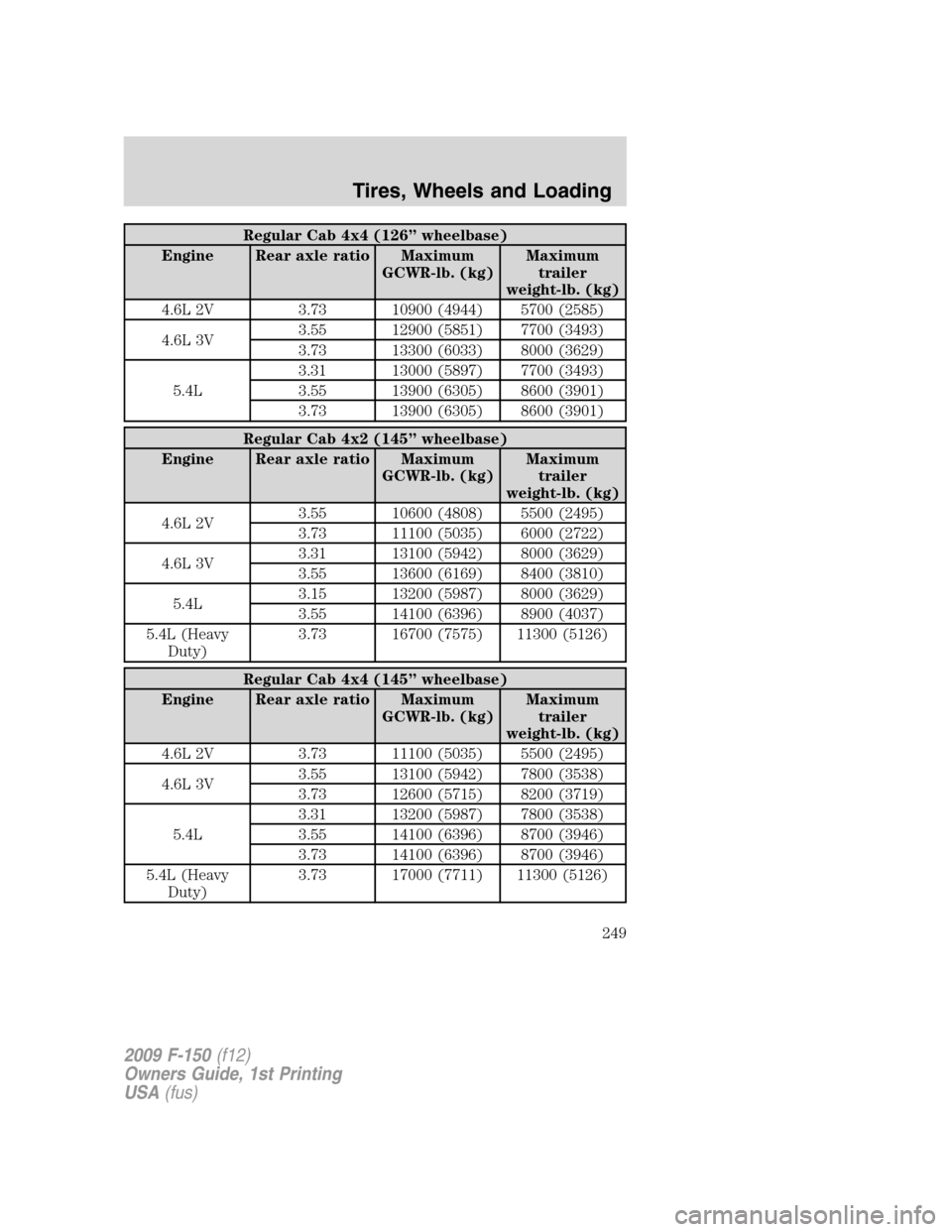
Regular Cab 4x4 (126” wheelbase)
Engine Rear axle ratio Maximum
GCWR-lb. (kg)Maximum
trailer
weight-lb. (kg)
4.6L 2V 3.73 10900 (4944) 5700 (2585)
4.6L 3V3.55 12900 (5851) 7700 (3493)
3.73 13300 (6033) 8000 (3629)
5.4L3.31 13000 (5897) 7700 (3493)
3.55 13900 (6305) 8600 (3901)
3.73 13900 (6305) 8600 (3901)
Regular Cab 4x2 (145” wheelbase)
Engine Rear axle ratio Maximum
GCWR-lb. (kg)Maximum
trailer
weight-lb. (kg)
4.6L 2V3.55 10600 (4808) 5500 (2495)
3.73 11100 (5035) 6000 (2722)
4.6L 3V3.31 13100 (5942) 8000 (3629)
3.55 13600 (6169) 8400 (3810)
5.4L3.15 13200 (5987) 8000 (3629)
3.55 14100 (6396) 8900 (4037)
5.4L (Heavy
Duty)3.73 16700 (7575) 11300 (5126)
Regular Cab 4x4 (145” wheelbase)
Engine Rear axle ratio Maximum
GCWR-lb. (kg)Maximum
trailer
weight-lb. (kg)
4.6L 2V 3.73 11100 (5035) 5500 (2495)
4.6L 3V3.55 13100 (5942) 7800 (3538)
3.73 12600 (5715) 8200 (3719)
5.4L3.31 13200 (5987) 7800 (3538)
3.55 14100 (6396) 8700 (3946)
3.73 14100 (6396) 8700 (3946)
5.4L (Heavy
Duty)3.73 17000 (7711) 11300 (5126)
2009 F-150(f12)
Owners Guide, 1st Printing
USA(fus)
Tires, Wheels and Loading
249
Page 250 of 405
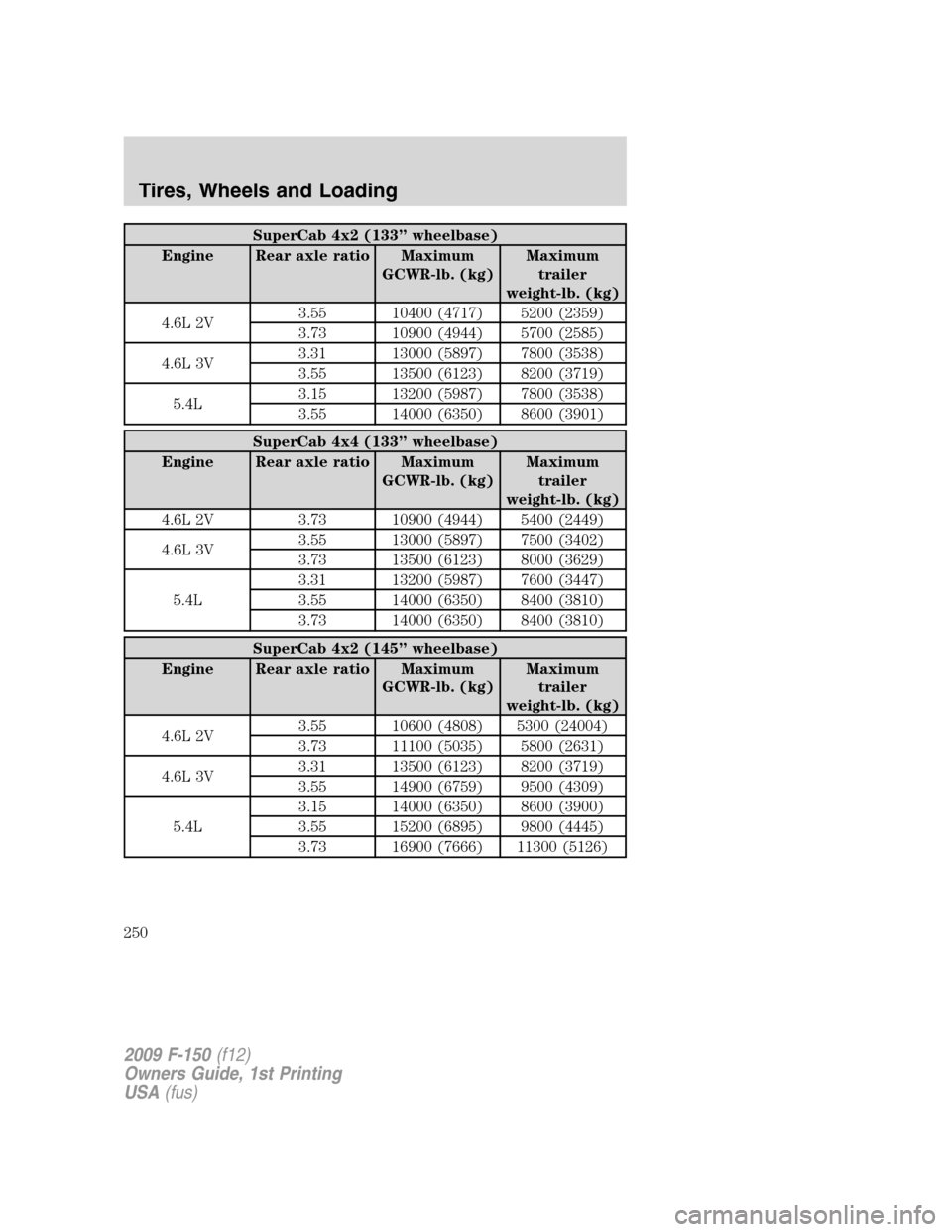
SuperCab 4x2 (133” wheelbase)
Engine Rear axle ratio Maximum
GCWR-lb. (kg)Maximum
trailer
weight-lb. (kg)
4.6L 2V3.55 10400 (4717) 5200 (2359)
3.73 10900 (4944) 5700 (2585)
4.6L 3V3.31 13000 (5897) 7800 (3538)
3.55 13500 (6123) 8200 (3719)
5.4L3.15 13200 (5987) 7800 (3538)
3.55 14000 (6350) 8600 (3901)
SuperCab 4x4 (133” wheelbase)
Engine Rear axle ratio Maximum
GCWR-lb. (kg)Maximum
trailer
weight-lb. (kg)
4.6L 2V 3.73 10900 (4944) 5400 (2449)
4.6L 3V3.55 13000 (5897) 7500 (3402)
3.73 13500 (6123) 8000 (3629)
5.4L3.31 13200 (5987) 7600 (3447)
3.55 14000 (6350) 8400 (3810)
3.73 14000 (6350) 8400 (3810)
SuperCab 4x2 (145” wheelbase)
Engine Rear axle ratio Maximum
GCWR-lb. (kg)Maximum
trailer
weight-lb. (kg)
4.6L 2V3.55 10600 (4808) 5300 (24004)
3.73 11100 (5035) 5800 (2631)
4.6L 3V3.31 13500 (6123) 8200 (3719)
3.55 14900 (6759) 9500 (4309)
5.4L3.15 14000 (6350) 8600 (3900)
3.55 15200 (6895) 9800 (4445)
3.73 16900 (7666) 11300 (5126)
2009 F-150(f12)
Owners Guide, 1st Printing
USA(fus)
Tires, Wheels and Loading
250
Page 251 of 405
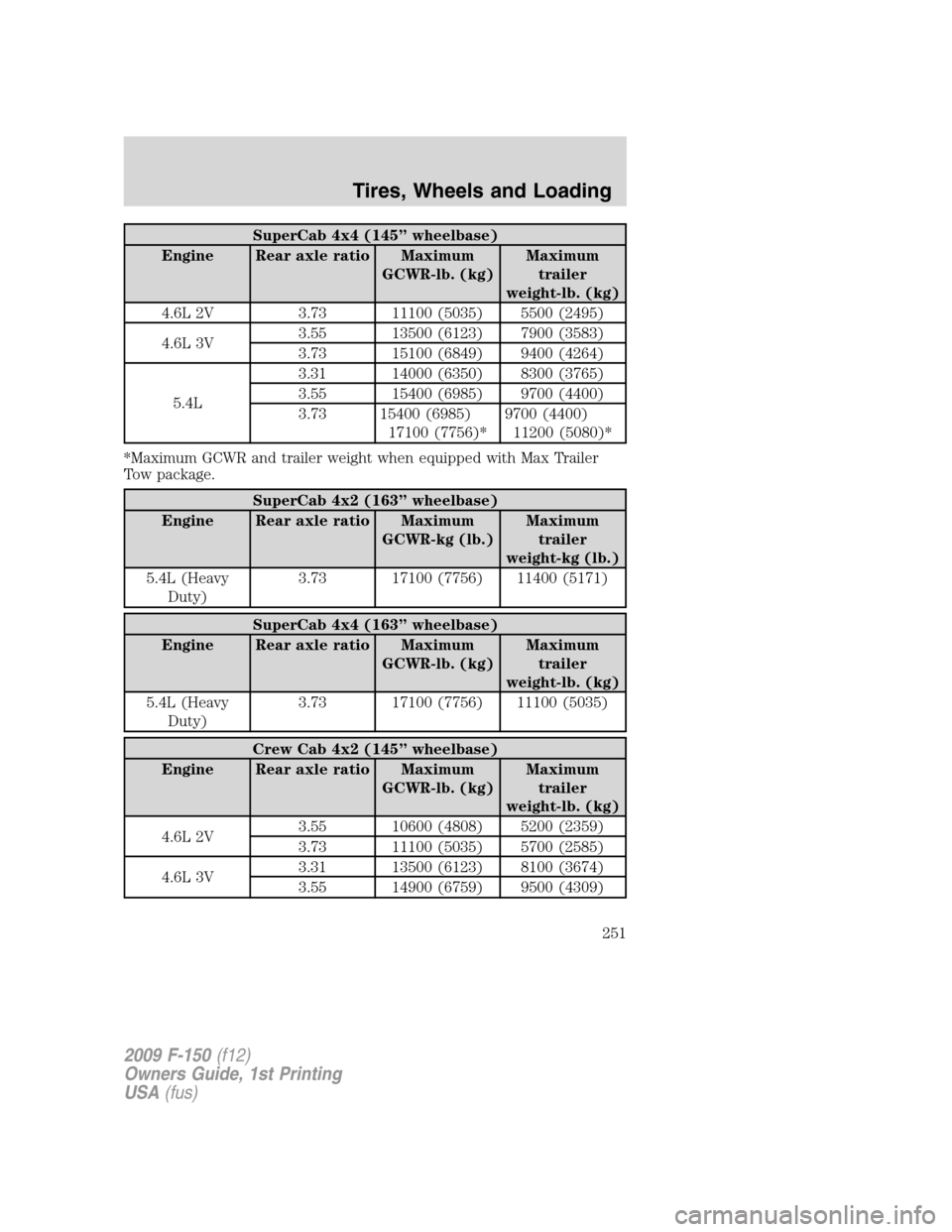
SuperCab 4x4 (145” wheelbase)
Engine Rear axle ratio Maximum
GCWR-lb. (kg)Maximum
trailer
weight-lb. (kg)
4.6L 2V 3.73 11100 (5035) 5500 (2495)
4.6L 3V3.55 13500 (6123) 7900 (3583)
3.73 15100 (6849) 9400 (4264)
5.4L3.31 14000 (6350) 8300 (3765)
3.55 15400 (6985) 9700 (4400)
3.73 15400 (6985)
17100 (7756)*9700 (4400)
11200 (5080)*
*Maximum GCWR and trailer weight when equipped with Max Trailer
Tow package.
SuperCab 4x2 (163” wheelbase)
Engine Rear axle ratio Maximum
GCWR-kg (lb.)Maximum
trailer
weight-kg (lb.)
5.4L (Heavy
Duty)3.73 17100 (7756) 11400 (5171)
SuperCab 4x4 (163” wheelbase)
Engine Rear axle ratio Maximum
GCWR-lb. (kg)Maximum
trailer
weight-lb. (kg)
5.4L (Heavy
Duty)3.73 17100 (7756) 11100 (5035)
Crew Cab 4x2 (145” wheelbase)
Engine Rear axle ratio Maximum
GCWR-lb. (kg)Maximum
trailer
weight-lb. (kg)
4.6L 2V3.55 10600 (4808) 5200 (2359)
3.73 11100 (5035) 5700 (2585)
4.6L 3V3.31 13500 (6123) 8100 (3674)
3.55 14900 (6759) 9500 (4309)
2009 F-150(f12)
Owners Guide, 1st Printing
USA(fus)
Tires, Wheels and Loading
251
Page 252 of 405
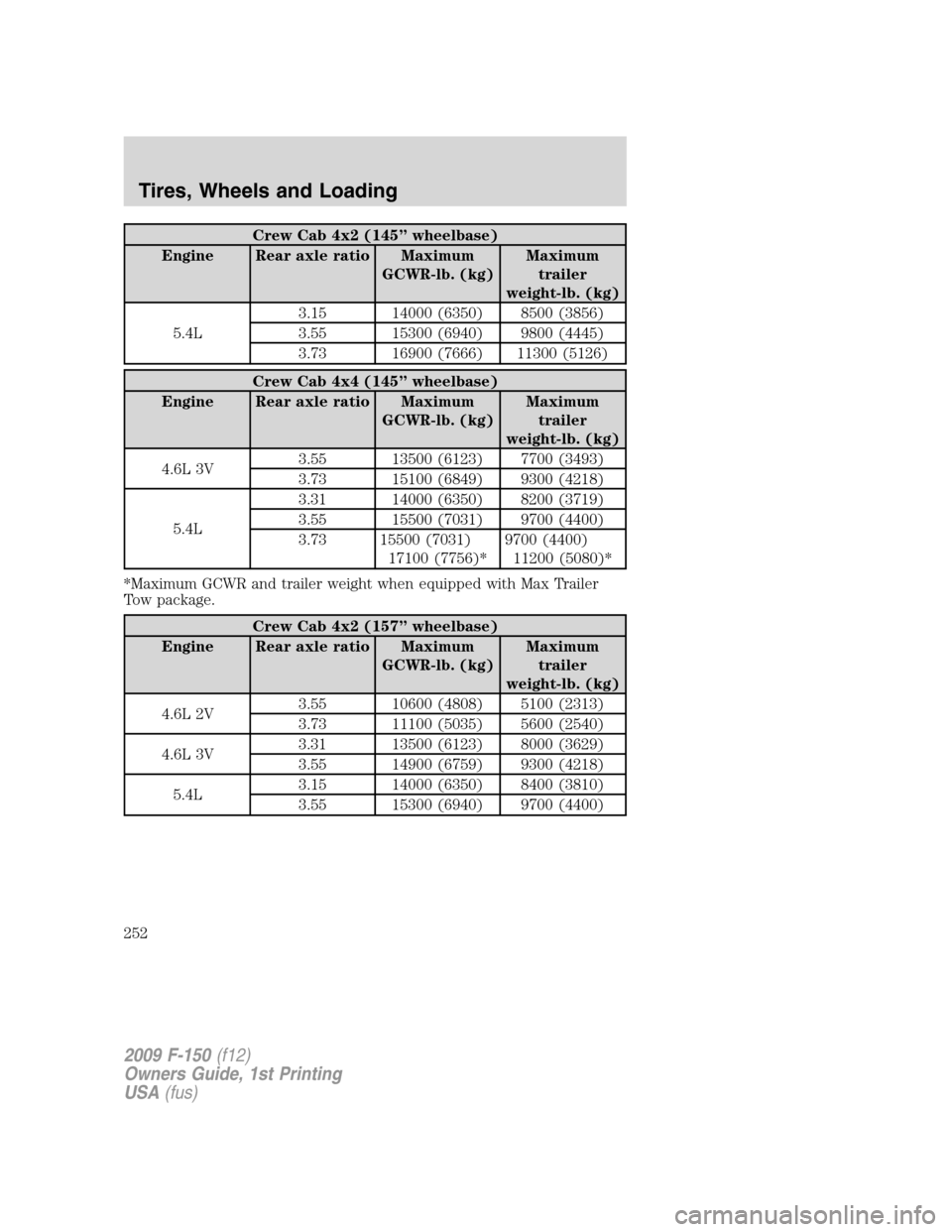
Crew Cab 4x2 (145” wheelbase)
Engine Rear axle ratio Maximum
GCWR-lb. (kg)Maximum
trailer
weight-lb. (kg)
5.4L3.15 14000 (6350) 8500 (3856)
3.55 15300 (6940) 9800 (4445)
3.73 16900 (7666) 11300 (5126)
Crew Cab 4x4 (145” wheelbase)
Engine Rear axle ratio Maximum
GCWR-lb. (kg)Maximum
trailer
weight-lb. (kg)
4.6L 3V3.55 13500 (6123) 7700 (3493)
3.73 15100 (6849) 9300 (4218)
5.4L3.31 14000 (6350) 8200 (3719)
3.55 15500 (7031) 9700 (4400)
3.73 15500 (7031)
17100 (7756)*9700 (4400)
11200 (5080)*
*Maximum GCWR and trailer weight when equipped with Max Trailer
Tow package.
Crew Cab 4x2 (157” wheelbase)
Engine Rear axle ratio Maximum
GCWR-lb. (kg)Maximum
trailer
weight-lb. (kg)
4.6L 2V3.55 10600 (4808) 5100 (2313)
3.73 11100 (5035) 5600 (2540)
4.6L 3V3.31 13500 (6123) 8000 (3629)
3.55 14900 (6759) 9300 (4218)
5.4L3.15 14000 (6350) 8400 (3810)
3.55 15300 (6940) 9700 (4400)
2009 F-150(f12)
Owners Guide, 1st Printing
USA(fus)
Tires, Wheels and Loading
252
Page 253 of 405
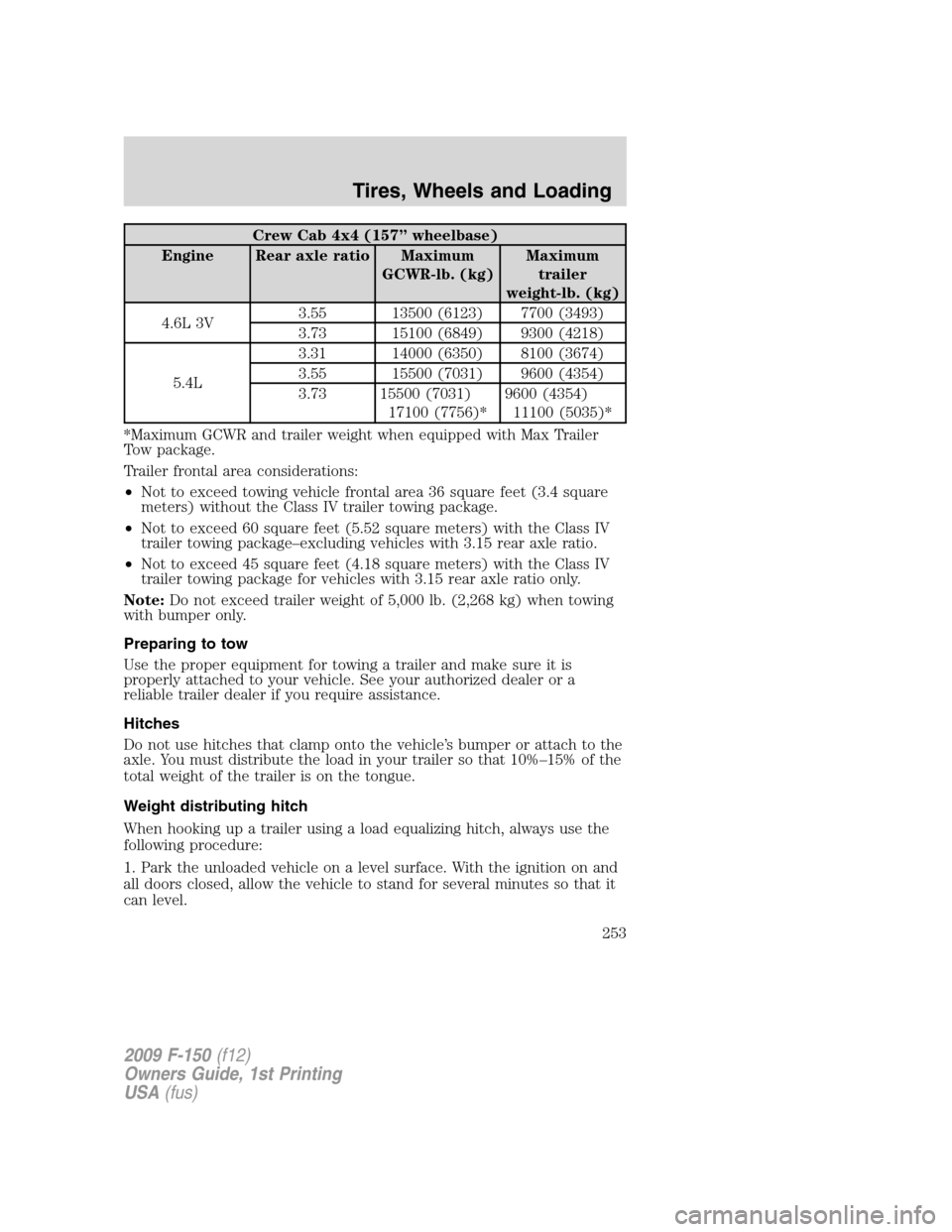
Crew Cab 4x4 (157” wheelbase)
Engine Rear axle ratio Maximum
GCWR-lb. (kg)Maximum
trailer
weight-lb. (kg)
4.6L 3V3.55 13500 (6123) 7700 (3493)
3.73 15100 (6849) 9300 (4218)
5.4L3.31 14000 (6350) 8100 (3674)
3.55 15500 (7031) 9600 (4354)
3.73 15500 (7031)
17100 (7756)*9600 (4354)
11100 (5035)*
*Maximum GCWR and trailer weight when equipped with Max Trailer
Tow package.
Trailer frontal area considerations:
•Not to exceed towing vehicle frontal area 36 square feet (3.4 square
meters) without the Class IV trailer towing package.
•Not to exceed 60 square feet (5.52 square meters) with the Class IV
trailer towing package–excluding vehicles with 3.15 rear axle ratio.
•Not to exceed 45 square feet (4.18 square meters) with the Class IV
trailer towing package for vehicles with 3.15 rear axle ratio only.
Note:Do not exceed trailer weight of 5,000 lb. (2,268 kg) when towing
with bumper only.
Preparing to tow
Use the proper equipment for towing a trailer and make sure it is
properly attached to your vehicle. See your authorized dealer or a
reliable trailer dealer if you require assistance.
Hitches
Do not use hitches that clamp onto the vehicle’s bumper or attach to the
axle. You must distribute the load in your trailer so that 10%–15% of the
total weight of the trailer is on the tongue.
Weight distributing hitch
When hooking up a trailer using a load equalizing hitch, always use the
following procedure:
1. Park the unloaded vehicle on a level surface. With the ignition on and
all doors closed, allow the vehicle to stand for several minutes so that it
can level.
2009 F-150(f12)
Owners Guide, 1st Printing
USA(fus)
Tires, Wheels and Loading
253
Page 260 of 405
•The trailer tongue weight should be 10–15% of the loaded trailer
weight.
•If you will be towing a trailer frequently in hot weather, hilly
conditions, at GCWR, or any combination of these factors, consider
refilling your rear axle with synthetic gear lube if not already so
equipped. Refer to theMaintenance and Specificationschapter for
the lubricant specification. Remember that regardless of the rear axle
lube used, do not tow a trailer for the first 1,000 miles (1,600 km) of a
new vehicle, and that the first 500 miles (800 km) of towing be done
at no faster than 70 mph (113 km/h) with no full throttle starts.
•After you have traveled 50 miles (80 km), thoroughly check your
hitch, electrical connections and trailer wheel lug nuts.
•To aid in engine/transmission cooling and A/C efficiency during hot
weather while stopped in traffic, place the gearshift lever in P (Park).
•Vehicles with trailers should not be parked on a grade. If you must
park on a grade, place wheel chocks under the trailer’s wheels.
Launching or retrieving a boat
Disconnect the wiring to the trailer before backing the trailer
into the water. Reconnect the wiring to the trailer after the
trailer is removed from the water.
When backing down a ramp during boat launching or retrieval:
•do not allow the static water level to rise above the bottom edge of
the rear bumper.
•do not allow waves to break higher than 6 inches (15 cm) above the
bottom edge of the rear bumper.
Exceeding these limits may allow water to enter vehicle components:
•causing internal damage to the components.
•affecting driveability, emissions and reliability.
Replace the rear axle lubricant any time the axle has been submerged in
water. Rear axle lubricant quantities are not to be checked or changed
unless a leak is suspected or repair required.
2009 F-150(f12)
Owners Guide, 1st Printing
USA(fus)
Tires, Wheels and Loading
260