tire pressure FORD F150 2009 12.G Owner's Guide
[x] Cancel search | Manufacturer: FORD, Model Year: 2009, Model line: F150, Model: FORD F150 2009 12.GPages: 405, PDF Size: 2.82 MB
Page 319 of 405
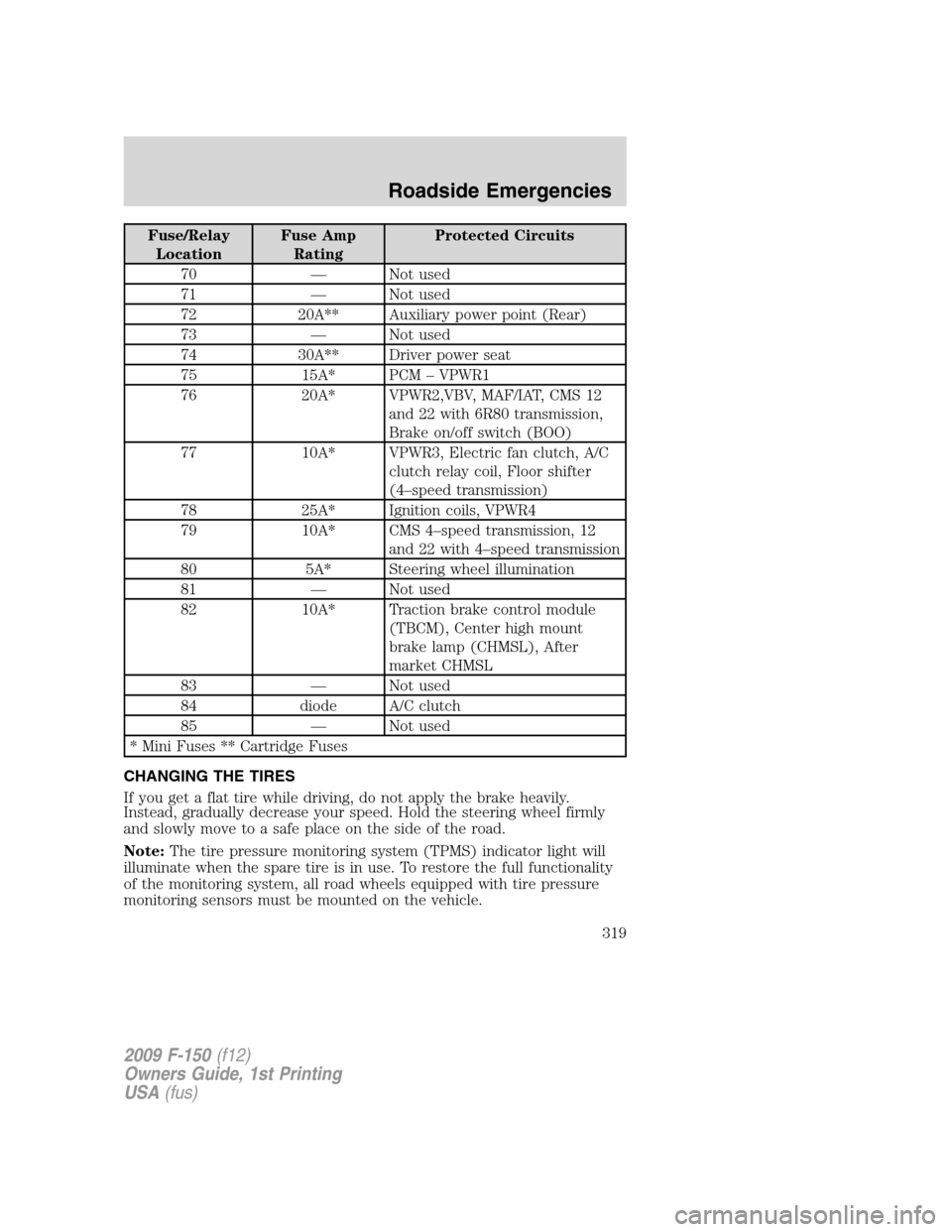
Fuse/Relay
LocationFuse Amp
RatingProtected Circuits
70 — Not used
71 — Not used
72 20A** Auxiliary power point (Rear)
73 — Not used
74 30A** Driver power seat
75 15A* PCM – VPWR1
76 20A* VPWR2,VBV, MAF/IAT, CMS 12
and 22 with 6R80 transmission,
Brake on/off switch (BOO)
77 10A* VPWR3, Electric fan clutch, A/C
clutch relay coil, Floor shifter
(4–speed transmission)
78 25A* Ignition coils, VPWR4
79 10A* CMS 4–speed transmission, 12
and 22 with 4–speed transmission
80 5A* Steering wheel illumination
81 — Not used
82 10A* Traction brake control module
(TBCM), Center high mount
brake lamp (CHMSL), After
market CHMSL
83 — Not used
84 diode A/C clutch
85 — Not used
* Mini Fuses ** Cartridge Fuses
CHANGING THE TIRES
If you get a flat tire while driving, do not apply the brake heavily.
Instead, gradually decrease your speed. Hold the steering wheel firmly
and slowly move to a safe place on the side of the road.
Note:The tire pressure monitoring system (TPMS) indicator light will
illuminate when the spare tire is in use. To restore the full functionality
of the monitoring system, all road wheels equipped with tire pressure
monitoring sensors must be mounted on the vehicle.
2009 F-150(f12)
Owners Guide, 1st Printing
USA(fus)
Roadside Emergencies
319
Page 320 of 405
Have a flat serviced by an authorized dealer in order to prevent damage
to the TPMS sensors, refer toTire pressure monitoring system
(TPMS)in theTires, Wheels and Loadingchapter. Replace the spare
tire with a road tire as soon as possible. During repairing or replacing of
the flat tire, have the authorized dealer inspect the TPMS sensor for
damage.
WARNING:The use of tire sealants may damage your Tire
Pressure Monitoring System and should not be used.
WARNING:Refer toTire pressure monitoring system (TPMS)
in theTires, Wheels and Loadingchapter for important
information. If the tire pressure monitor sensor becomes damaged, it
will no longer function.
Dissimilar spare tire/wheel information
WARNING:Failure to follow these guidelines could result in an
increased risk of loss of vehicle control, injury or death.
If you have a dissimilar spare tire/wheel, then it is intended for
temporary use only. This means that if you need to use it, you should
replace it as soon as possible with a road tire/wheel that is the same size
and type as the road tires and wheels that were originally provided by
Ford. If the dissimilar spare tire or wheel is damaged, it should be
replaced rather than repaired.
A dissimilar spare tire/wheel is defined as a spare tire and/or wheel that
is different in brand, size or appearance from the road tires and wheels
and can be one of three types:
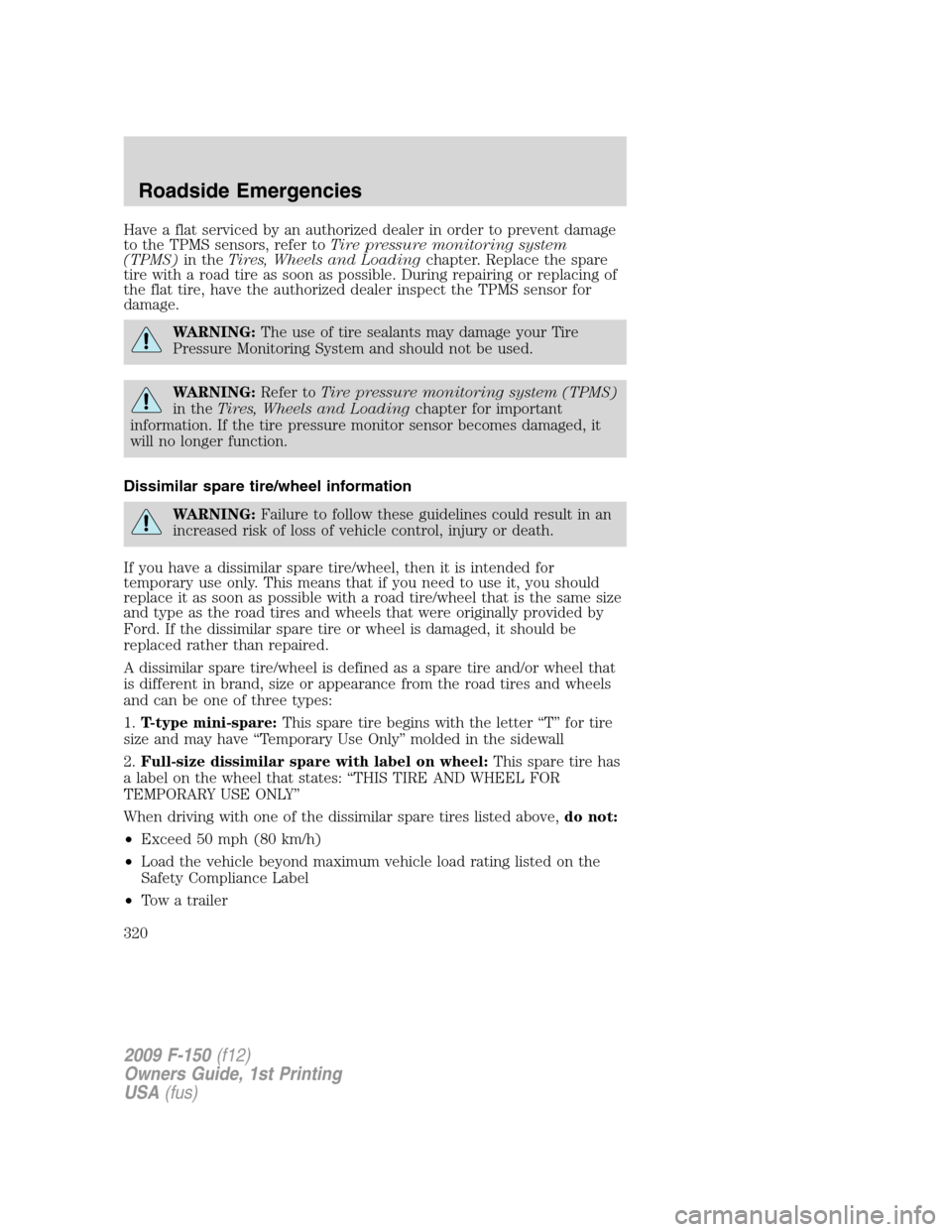
1.T-type mini-spare:This spare tire begins with the letter “T” for tire
size and may have “Temporary Use Only” molded in the sidewall
2.Full-size dissimilar spare with label on wheel:This spare tire has
a label on the wheel that states: “THIS TIRE AND WHEEL FOR
TEMPORARY USE ONLY”
When driving with one of the dissimilar spare tires listed above,do not:
•Exceed 50 mph (80 km/h)
•Load the vehicle beyond maximum vehicle load rating listed on the
Safety Compliance Label
•Tow a trailer
2009 F-150(f12)
Owners Guide, 1st Printing
USA(fus)
Roadside Emergencies
320
Page 322 of 405
When driving with the full-size dissimilar spare tire/wheel additional
caution should be given to:
•Towing a trailer
•Driving vehicles equipped with a camper body
•Driving vehicles with a load on the cargo rack
Drive cautiously when using a full-size dissimilar spare tire/wheel and
seek service as soon as possible.
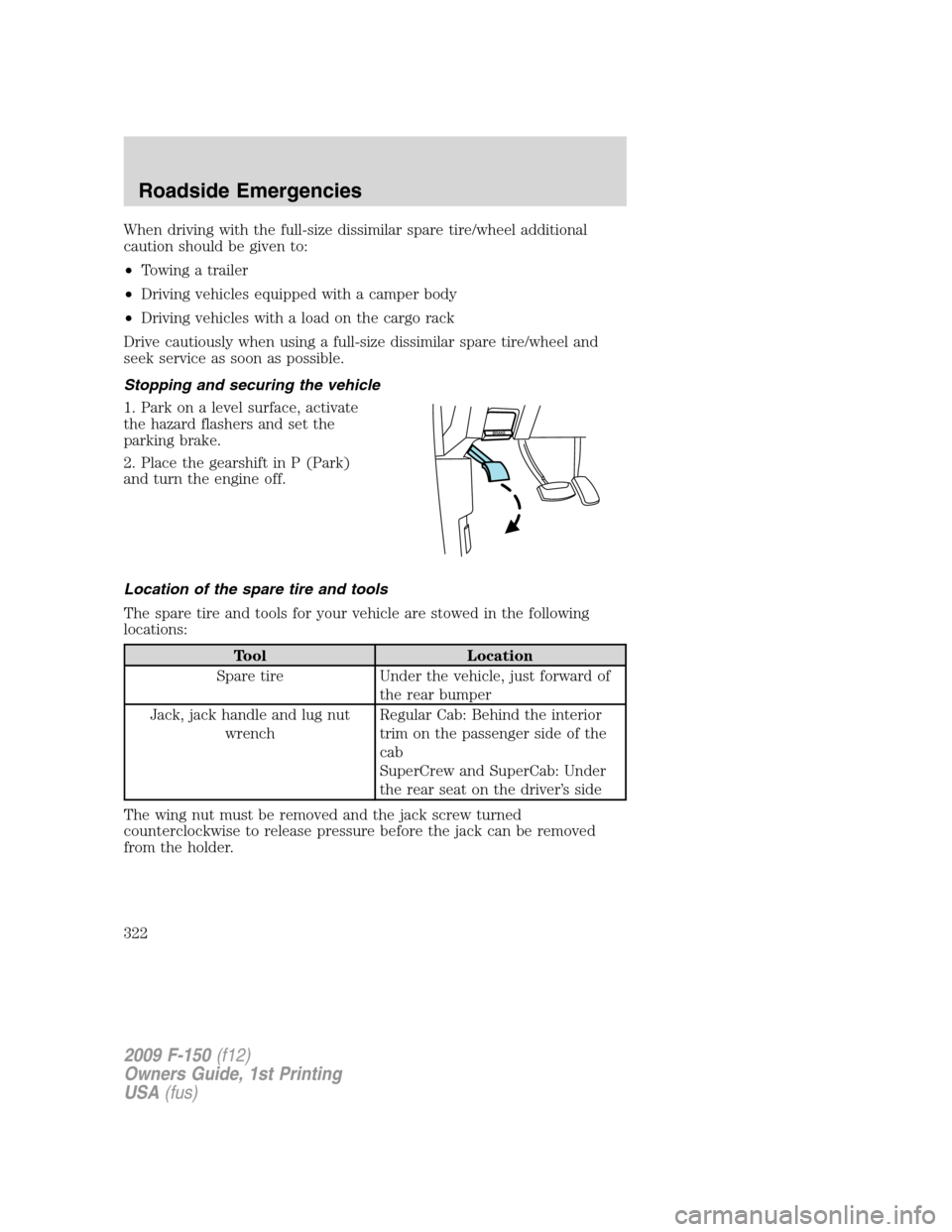
Stopping and securing the vehicle
1. Park on a level surface, activate
the hazard flashers and set the
parking brake.
2. Place the gearshift in P (Park)
and turn the engine off.
Location of the spare tire and tools
The spare tire and tools for your vehicle are stowed in the following
locations:
Tool Location
Spare tire Under the vehicle, just forward of
the rear bumper
Jack, jack handle and lug nut
wrenchRegular Cab: Behind the interior
trim on the passenger side of the
cab
SuperCrew and SuperCab: Under
the rear seat on the driver’s side
The wing nut must be removed and the jack screw turned
counterclockwise to release pressure before the jack can be removed
from the holder.
2009 F-150(f12)
Owners Guide, 1st Printing
USA(fus)
Roadside Emergencies
322
Page 326 of 405
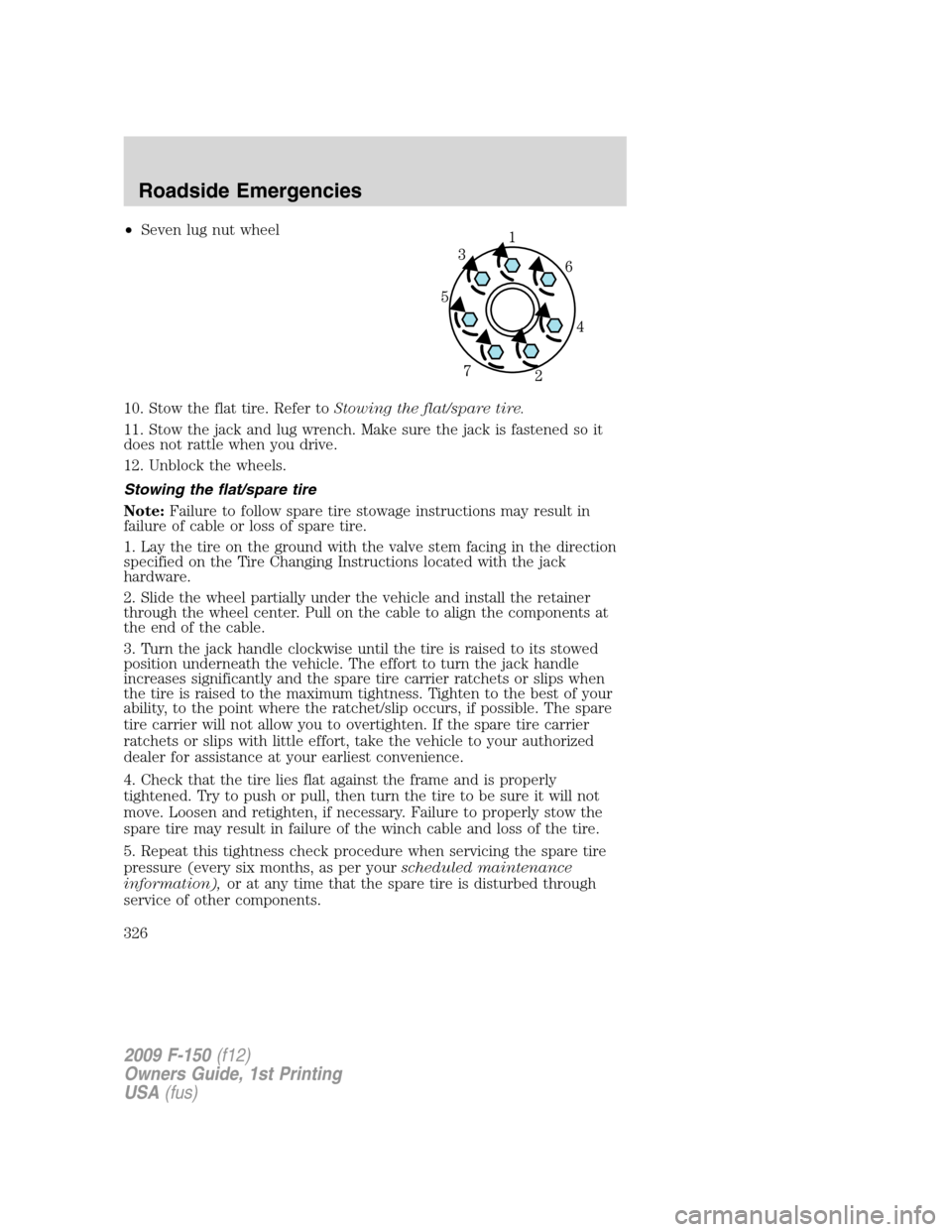
•Seven lug nut wheel
10. Stow the flat tire. Refer toStowing the flat/spare tire.
11. Stow the jack and lug wrench. Make sure the jack is fastened so it
does not rattle when you drive.
12. Unblock the wheels.
Stowing the flat/spare tire
Note:Failure to follow spare tire stowage instructions may result in
failure of cable or loss of spare tire.
1. Lay the tire on the ground with the valve stem facing in the direction
specified on the Tire Changing Instructions located with the jack
hardware.
2. Slide the wheel partially under the vehicle and install the retainer
through the wheel center. Pull on the cable to align the components at
the end of the cable.
3. Turn the jack handle clockwise until the tire is raised to its stowed
position underneath the vehicle. The effort to turn the jack handle
increases significantly and the spare tire carrier ratchets or slips when
the tire is raised to the maximum tightness. Tighten to the best of your
ability, to the point where the ratchet/slip occurs, if possible. The spare
tire carrier will not allow you to overtighten. If the spare tire carrier
ratchets or slips with little effort, take the vehicle to your authorized
dealer for assistance at your earliest convenience.
4. Check that the tire lies flat against the frame and is properly
tightened. Try to push or pull, then turn the tire to be sure it will not
move. Loosen and retighten, if necessary. Failure to properly stow the
spare tire may result in failure of the winch cable and loss of the tire.
5. Repeat this tightness check procedure when servicing the spare tire
pressure (every six months, as per yourscheduled maintenance
information),or at any time that the spare tire is disturbed through
service of other components.
2009 F-150(f12)
Owners Guide, 1st Printing
USA(fus)
Roadside Emergencies
326
Page 378 of 405
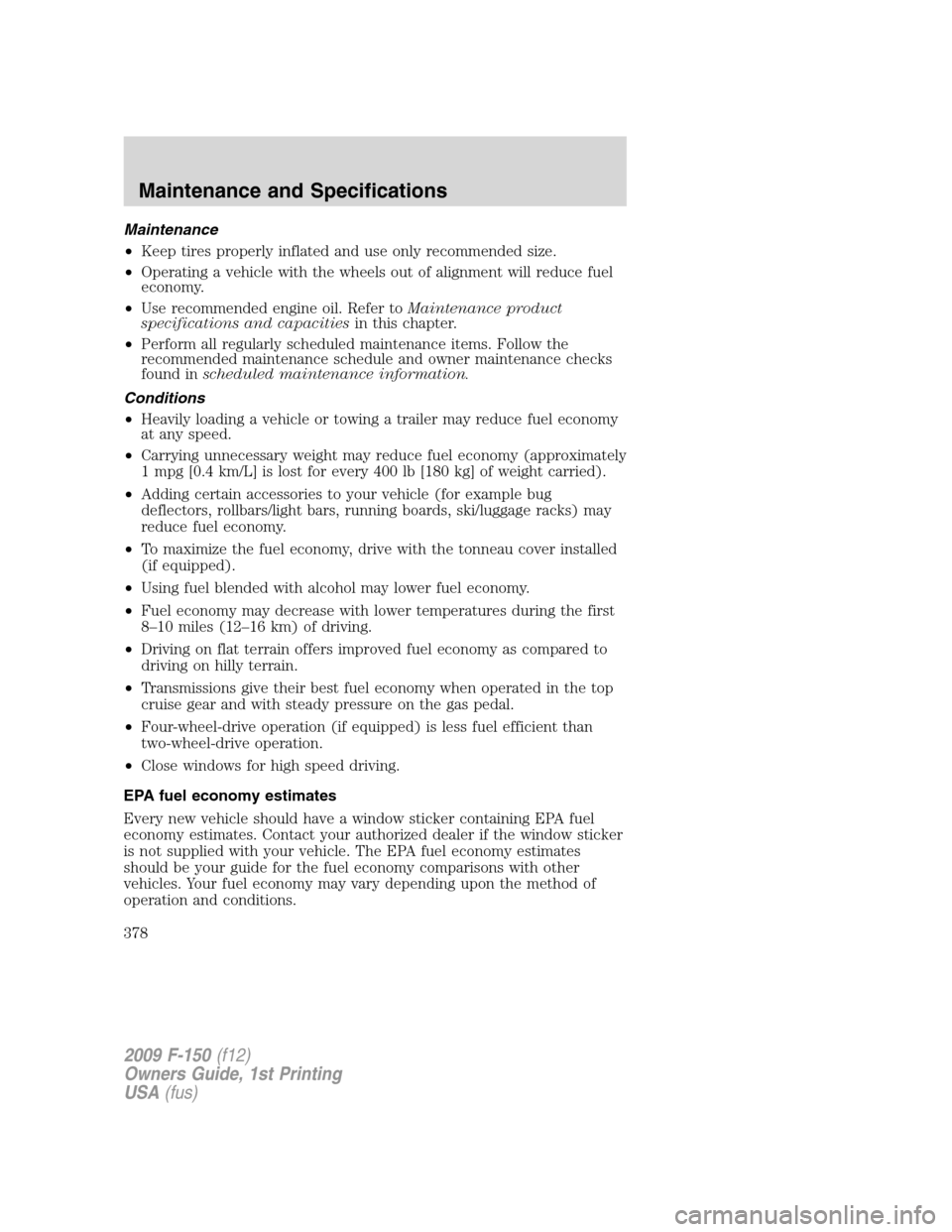
Maintenance
•Keep tires properly inflated and use only recommended size.
•Operating a vehicle with the wheels out of alignment will reduce fuel
economy.
•Use recommended engine oil. Refer toMaintenance product
specifications and capacitiesin this chapter.
•Perform all regularly scheduled maintenance items. Follow the
recommended maintenance schedule and owner maintenance checks
found inscheduled maintenance information.
Conditions
•Heavily loading a vehicle or towing a trailer may reduce fuel economy
at any speed.
•Carrying unnecessary weight may reduce fuel economy (approximately
1 mpg [0.4 km/L] is lost for every 400 lb [180 kg] of weight carried).
•Adding certain accessories to your vehicle (for example bug
deflectors, rollbars/light bars, running boards, ski/luggage racks) may
reduce fuel economy.
•To maximize the fuel economy, drive with the tonneau cover installed
(if equipped).
•Using fuel blended with alcohol may lower fuel economy.
•Fuel economy may decrease with lower temperatures during the first
8–10 miles (12–16 km) of driving.
•Driving on flat terrain offers improved fuel economy as compared to
driving on hilly terrain.
•Transmissions give their best fuel economy when operated in the top
cruise gear and with steady pressure on the gas pedal.
•Four-wheel-drive operation (if equipped) is less fuel efficient than
two-wheel-drive operation.
•Close windows for high speed driving.
EPA fuel economy estimates
Every new vehicle should have a window sticker containing EPA fuel
economy estimates. Contact your authorized dealer if the window sticker
is not supplied with your vehicle. The EPA fuel economy estimates
should be your guide for the fuel economy comparisons with other
vehicles. Your fuel economy may vary depending upon the method of
operation and conditions.
2009 F-150(f12)
Owners Guide, 1st Printing
USA(fus)
Maintenance and Specifications
378
Page 404 of 405
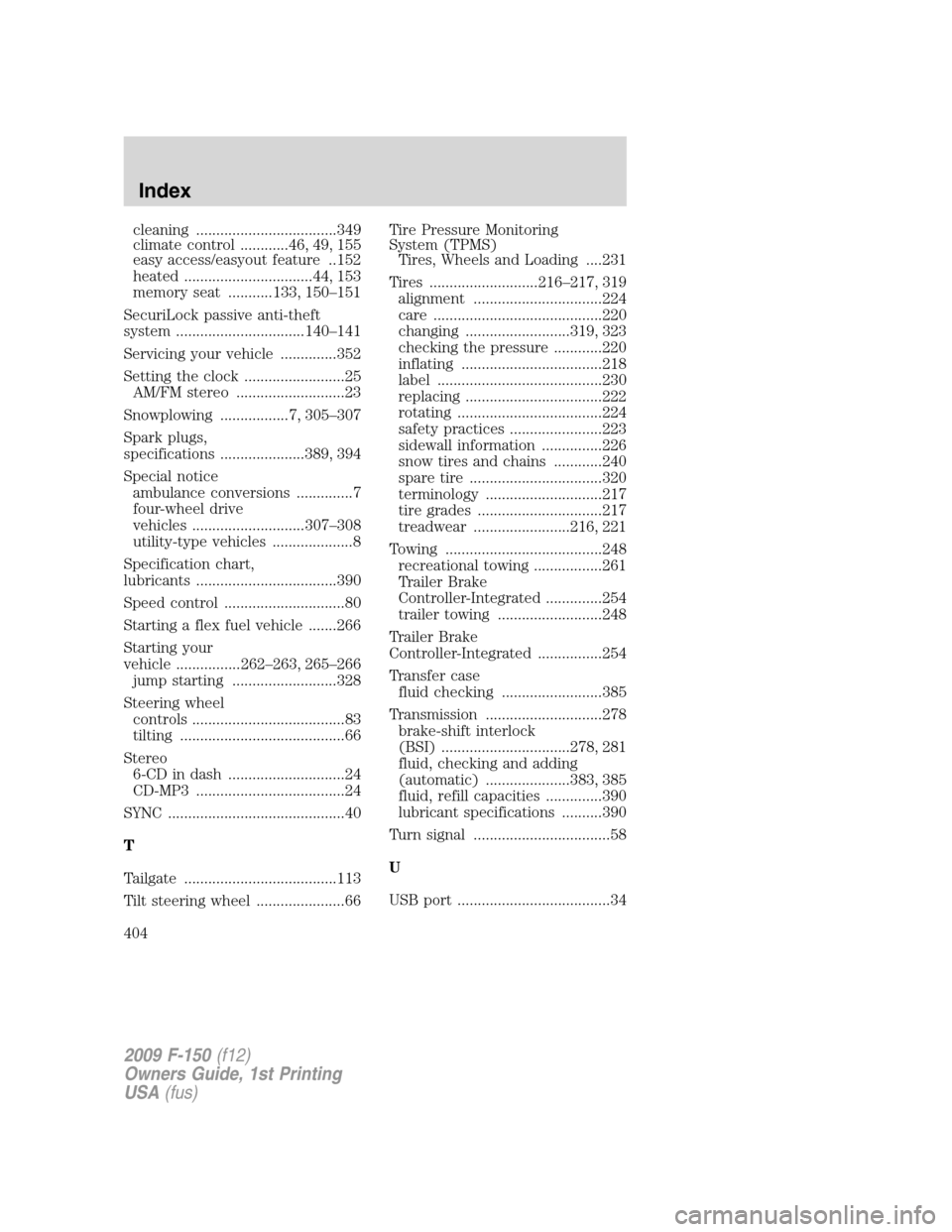
cleaning ...................................349
climate control ............46, 49, 155
easy access/easyout feature ..152
heated ................................44, 153
memory seat ...........133, 150–151
SecuriLock passive anti-theft
system ................................140–141
Servicing your vehicle ..............352
Setting the clock .........................25
AM/FM stereo ...........................23
Snowplowing .................7, 305–307
Spark plugs,
specifications .....................389, 394
Special notice
ambulance conversions ..............7
four-wheel drive
vehicles ............................307–308
utility-type vehicles ....................8
Specification chart,
lubricants ...................................390
Speed control ..............................80
Starting a flex fuel vehicle .......266
Starting your
vehicle ................262–263, 265–266
jump starting ..........................328
Steering wheel
controls ......................................83
tilting .........................................66
Stereo
6-CD in dash .............................24
CD-MP3 .....................................24
SYNC ............................................40
T
Tailgate ......................................113
Tilt steering wheel ......................66Tire Pressure Monitoring
System (TPMS)
Tires, Wheels and Loading ....231
Tires ...........................216–217, 319
alignment ................................224
care ..........................................220
changing ..........................319, 323
checking the pressure ............220
inflating ...................................218
label .........................................230
replacing ..................................222
rotating ....................................224
safety practices .......................223
sidewall information ...............226
snow tires and chains ............240
spare tire .................................320
terminology .............................217
tire grades ...............................217
treadwear ........................216, 221
Towing .......................................248
recreational towing .................261
Trailer Brake
Controller-Integrated ..............254
trailer towing ..........................248
Trailer Brake
Controller-Integrated ................254
Transfer case
fluid checking .........................385
Transmission .............................278
brake-shift interlock
(BSI) ................................278, 281
fluid, checking and adding
(automatic) .....................383, 385
fluid, refill capacities ..............390
lubricant specifications ..........390
Turn signal ..................................58
U
USB port ......................................34
2009 F-150(f12)
Owners Guide, 1st Printing
USA(fus)
Index
404