4WD FORD F150 2012 12.G Owner's Manual
[x] Cancel search | Manufacturer: FORD, Model Year: 2012, Model line: F150, Model: FORD F150 2012 12.GPages: 462, PDF Size: 3.26 MB
Page 319 of 462
Driving off-road with truck and utility vehicles
4WD vehicles are specially equipped for driving on sand, snow, mud and
rough terrain and have operating characteristics that are somewhat
different from conventional vehicles, both on and off the road.
Your vehicle may be equipped with a front air dam that can become
damaged (due to reduced ground clearance) when taking your vehicle
off-road. This air dam can be taken off by removing two bolts.
For vehicles equipped with a 3.5L Ecoboost™ engine:
Your vehicle is equipped with an underbody transmission shield and
brackets that may become damaged (due to reduced ground clearance)
when taking your vehicle off-road. Remove the shield by disengaging the
fasteners at each corner of the shield. Then, remove the shield rear
brackets by removing the bracket to frame bolts, or have your authorized
dealer perform the work for you
How your vehicle differs from other vehicles
Truck and utility vehicles can differ from some other vehicles. Your
vehicle may be higher to allow it to travel over rough terrain without
getting hung up or damaging underbody components.
The differences that make your vehicle so versatile also make it handle
differently than an ordinary passenger car.
Maintain steering wheel control at all times, especially in rough terrain.
Since sudden changes in terrain can result in abrupt steering wheel
motion, make sure you grip the steering wheel from the outside. Do not
grip the spokes.
Drive cautiously to avoid vehicle damage from concealed objects such as
rocks and stumps.
You should either know the terrain or examine maps of the area before
driving. Map out your route before driving in the area. To maintain
steering and braking control of your vehicle, you must have all four
wheels on the ground and they must be rolling, not sliding or spinning.
Basic operating principles
•
Do not use 4WD on dry, hard surfaced roads. Doing so will produce
excessive noise, increase tire wear and may damage drive components.
4WD modes are only intended for consistently slippery or loose surfaces.
•Drive slower in strong crosswinds which can affect the normal steering
characteristics of your vehicle.
•Be extremely careful when driving on pavement made slippery by
loose sand, water, gravel, snow or ice.
Driving
319
2012 F-150(f12)
Owners Guide, 1st Printing
USA(fus)
Page 321 of 462
Emergency maneuvers
•In an unavoidable emergency situation where a sudden sharp turn
must be made, remember to avoid “over-driving” your vehicle, i.e.,
turn the steering wheel only as rapidly and as far as required to avoid
the emergency. Excessive steering will result in less vehicle control,
not more. Additionally, smooth variations of the accelerator and/or
brake pedal pressure should be utilized if changes in vehicle speed are
called for. Avoid abrupt steering, acceleration or braking which could
result in an increased risk of loss of vehicle control, vehicle rollover
and/or personal injury. Use all available road surface to return the
vehicle to a safe direction of travel.
•In the event of an emergency stop, avoid skidding the tires and do not
attempt any sharp steering wheel movements.
•If the vehicle goes from one type of surface to another (i.e., from
concrete to gravel) there will be a change in the way the vehicle
responds to a maneuver (steering, acceleration or braking). Again,
avoid these abrupt inputs.
Parking
On some 4WD vehicles, when the transfer case is in the N (Neutral)
position, the engine and transmission are disconnected from the rest of
the driveline. Therefore, the vehicle is free to roll even if the automatic
transmission is in P (Park) or the manual transmission is in gear. Do not
leave the vehicle unattended with the transfer case in the N (Neutral)
position. Always set the parking brake fully and turn off the ignition
when leaving the vehicle.
WARNING:Always set the parking brake fully and make sure
the gearshift is latched in P (Park). Turn the ignition to the off
position and remove the key whenever you leave your vehicle.
WARNING:If the parking brake is fully released, but the brake
warning lamp remains illuminated, the brakes may not be
working properly. See your authorized dealer.
4WD systems
4WD (when you select a 4WD mode) uses all four wheels to power the
vehicle. This increases traction, enabling you to drive over terrain and
road conditions that a conventional two-wheel drive vehicle cannot.
Power is supplied to all four wheels through a transfer case. On 4WD
vehicles, the transfer case allows you to select 4WD when necessary.
Driving
321
2012 F-150(f12)
Owners Guide, 1st Printing
USA(fus)
Page 322 of 462
Information on transfer case operation and shifting procedures can be
found in this chapter. Information on transfer case maintenance can be
found in theMaintenance and Specificationschapter. You should
become thoroughly familiar with this information before you operate
your vehicle.
Normal characteristics
On some 4WD models, the initial shift from two-wheel drive to 4x4 while
the vehicle is moving can cause some momentary clunk and ratcheting
sounds. This is the front drivetrain coming up to speed and the
automatic locking hubs engaging and is not cause for concern.
Sand
When driving over sand, try to keep all four wheels on the most solid
area of the trail. Avoid reducing the tire pressures but shift to a lower
gear and drive steadily through the terrain. Apply the accelerator slowly
and avoid spinning the wheels.
Avoid excessive speed because vehicle momentum can work against you
and cause the vehicle to become stuck to the point that assistance may
be required from another vehicle. Remember, you may be able to back
out the way you came if you proceed with caution.
Mud and water
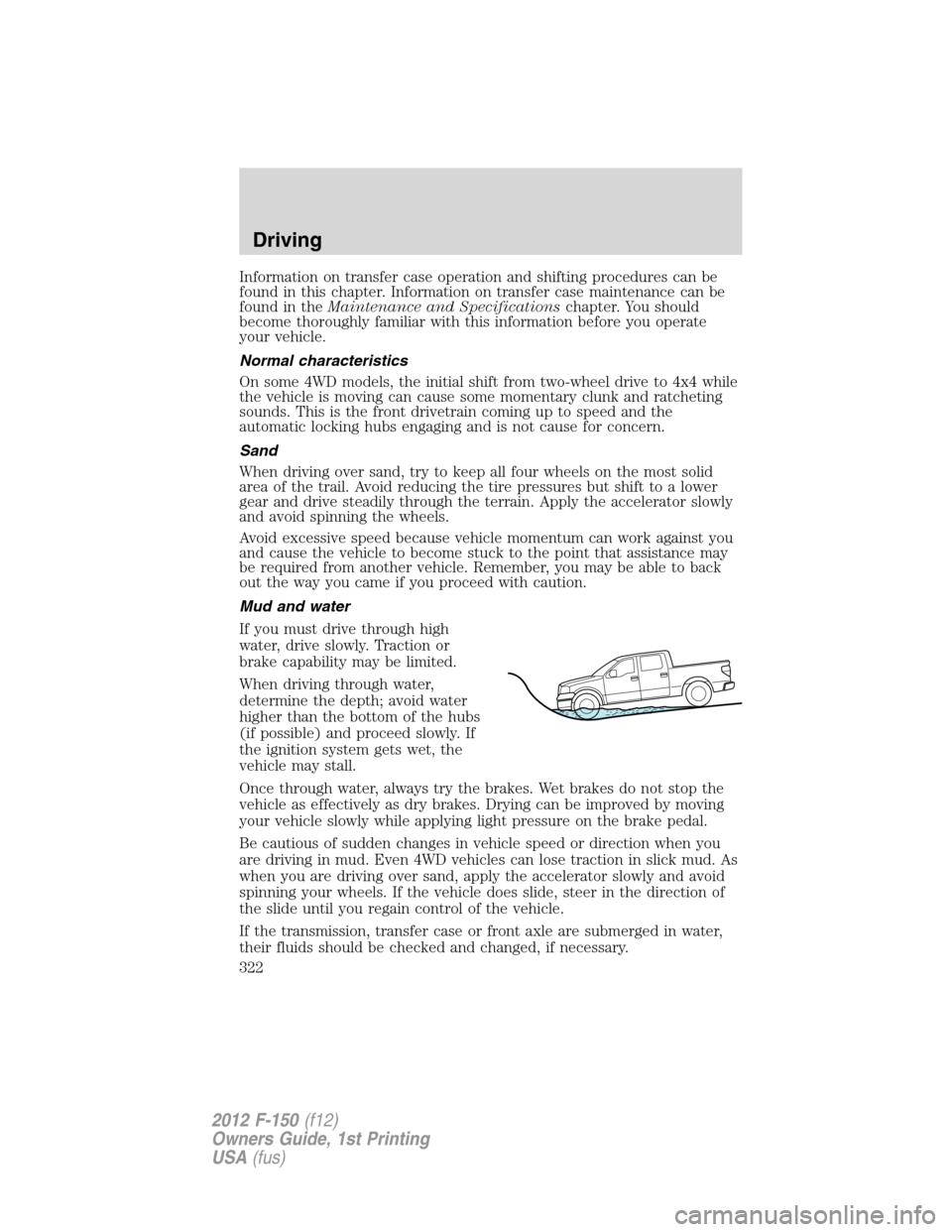
If you must drive through high
water, drive slowly. Traction or
brake capability may be limited.
When driving through water,
determine the depth; avoid water
higher than the bottom of the hubs
(if possible) and proceed slowly. If
the ignition system gets wet, the
vehicle may stall.
Once through water, always try the brakes. Wet brakes do not stop the
vehicle as effectively as dry brakes. Drying can be improved by moving
your vehicle slowly while applying light pressure on the brake pedal.
Be cautious of sudden changes in vehicle speed or direction when you
are driving in mud. Even 4WD vehicles can lose traction in slick mud. As
when you are driving over sand, apply the accelerator slowly and avoid
spinning your wheels. If the vehicle does slide, steer in the direction of
the slide until you regain control of the vehicle.
If the transmission, transfer case or front axle are submerged in water,
their fluids should be checked and changed, if necessary.
Driving
322
2012 F-150(f12)
Owners Guide, 1st Printing
USA(fus)
Page 324 of 462
Descend a hill in the same gear you
would use to climb up the hill to
avoid excessive brake application and
brake overheating. Do not descend in
neutral; instead, disengage overdrive
or manually shift to a lower gear.
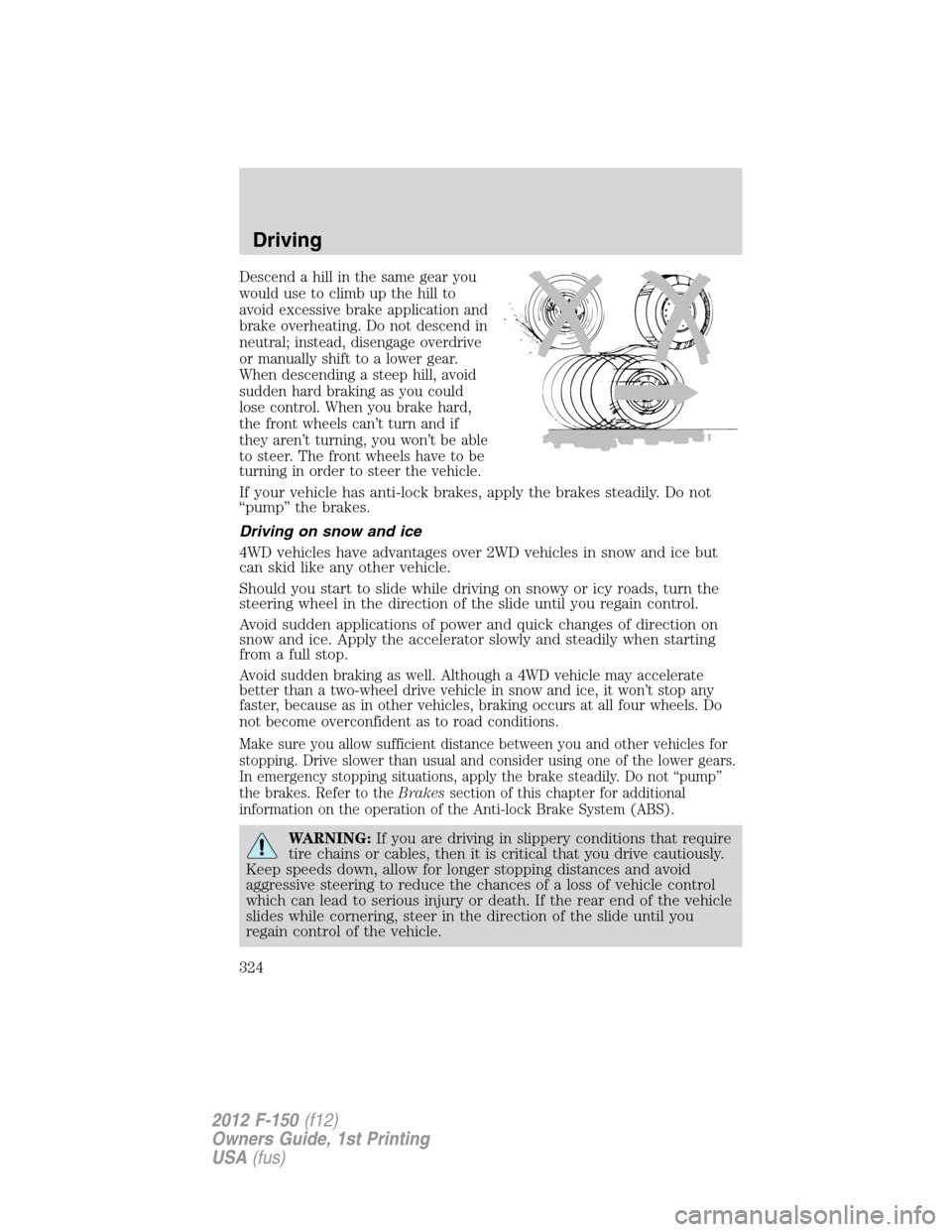
When descending a steep hill, avoid
sudden hard braking as you could
lose control. When you brake hard,
the front wheels can’t turn and if
they aren’t turning, you won’t be able
to steer. The front wheels have to be
turning in order to steer the vehicle.
If your vehicle has anti-lock brakes, apply the brakes steadily. Do not
“pump” the brakes.
Driving on snow and ice
4WD vehicles have advantages over 2WD vehicles in snow and ice but
can skid like any other vehicle.
Should you start to slide while driving on snowy or icy roads, turn the
steering wheel in the direction of the slide until you regain control.
Avoid sudden applications of power and quick changes of direction on
snow and ice. Apply the accelerator slowly and steadily when starting
from a full stop.
Avoid sudden braking as well. Although a 4WD vehicle may accelerate
better than a two-wheel drive vehicle in snow and ice, it won’t stop any
faster, because as in other vehicles, braking occurs at all four wheels. Do
not become overconfident as to road conditions.
Make sure you allow sufficient distance between you and other vehicles for
stopping. Drive slower than usual and consider using one of the lower gears.
In emergency stopping situations, apply the brake steadily. Do not “pump”
the brakes. Refer to theBrakessection of this chapter for additional
information on the operation of the Anti-lock Brake System (ABS).
WARNING:If you are driving in slippery conditions that require
tire chains or cables, then it is critical that you drive cautiously.
Keep speeds down, allow for longer stopping distances and avoid
aggressive steering to reduce the chances of a loss of vehicle control
which can lead to serious injury or death. If the rear end of the vehicle
slides while cornering, steer in the direction of the slide until you
regain control of the vehicle.
Driving
324
2012 F-150(f12)
Owners Guide, 1st Printing
USA(fus)
Page 438 of 462
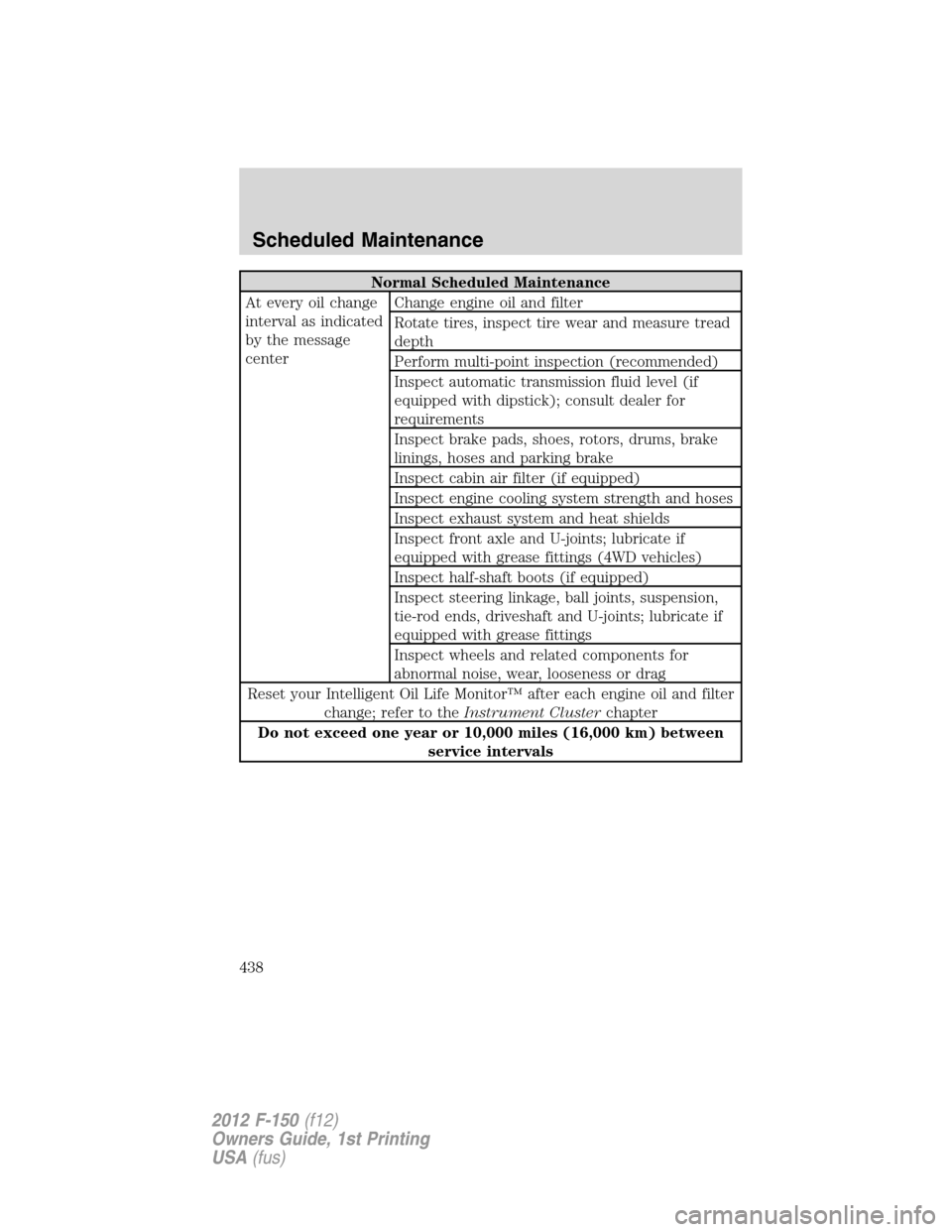
Normal Scheduled Maintenance
At every oil change
interval as indicated
by the message
centerChange engine oil and filter
Rotate tires, inspect tire wear and measure tread
depth
Perform multi-point inspection (recommended)
Inspect automatic transmission fluid level (if
equipped with dipstick); consult dealer for
requirements
Inspect brake pads, shoes, rotors, drums, brake
linings, hoses and parking brake
Inspect cabin air filter (if equipped)
Inspect engine cooling system strength and hoses
Inspect exhaust system and heat shields
Inspect front axle and U-joints; lubricate if
equipped with grease fittings (4WD vehicles)
Inspect half-shaft boots (if equipped)
Inspect steering linkage, ball joints, suspension,
tie-rod ends, driveshaft and U-joints; lubricate if
equipped with grease fittings
Inspect wheels and related components for
abnormal noise, wear, looseness or drag
Reset your Intelligent Oil Life Monitor™ after each engine oil and filter
change; refer to theInstrument Clusterchapter
Do not exceed one year or 10,000 miles (16,000 km) between
service intervals
Scheduled Maintenance
438
2012 F-150(f12)
Owners Guide, 1st Printing
USA(fus)
Page 439 of 462
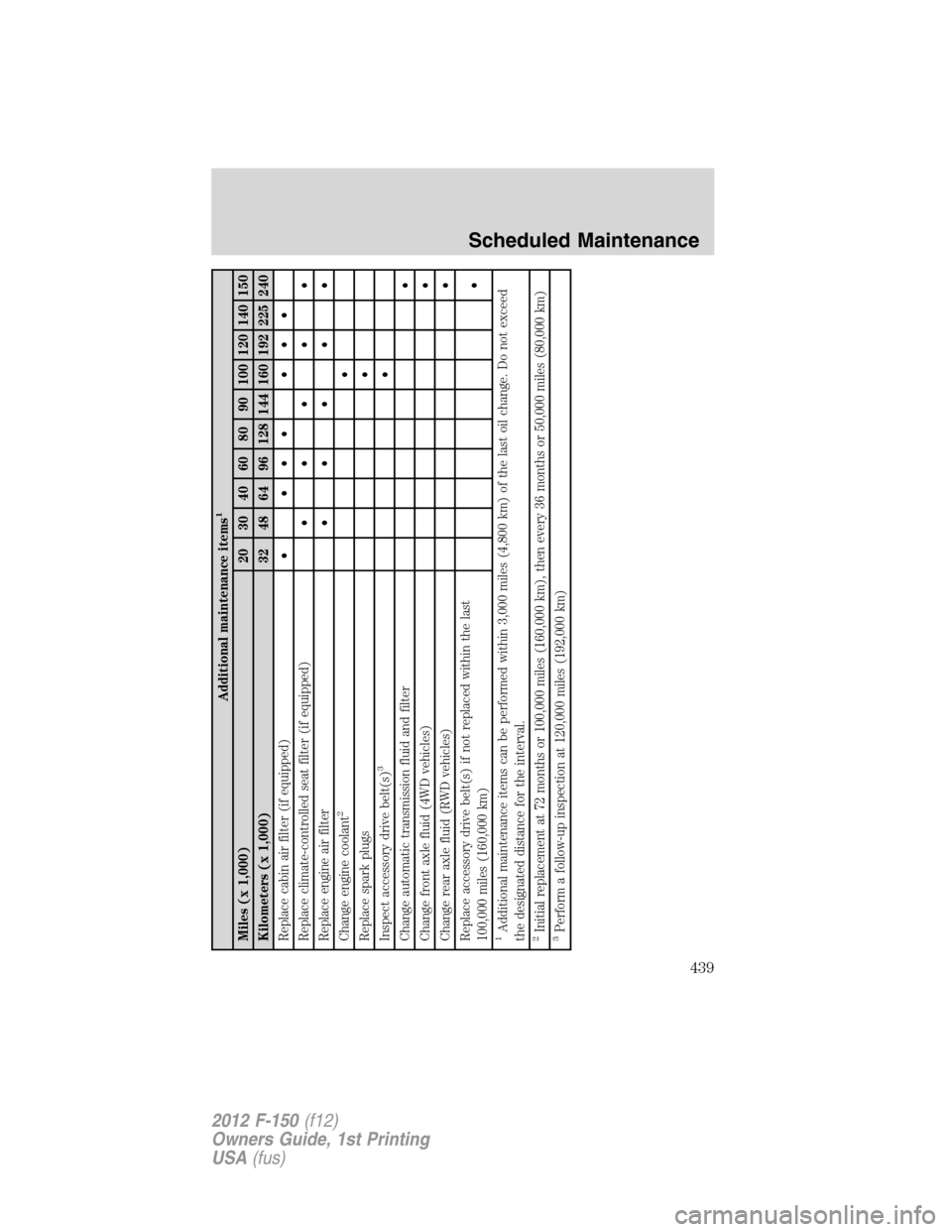
Additional maintenance items
1
Miles (x 1,000) 20 30 40 60 80 90 100 120 140 150
Kilometers (x 1,000) 32 48 64 96 128 144 160 192 225 240
Replace cabin air filter (if equipped)• ••• •••
Replace climate-controlled seat filter (if equipped)•••••
Replace engine air filter•••••
Change engine coolant
2
•
Replace spark plugs•
Inspect accessory drive belt(s)
3
•
Change automatic transmission fluid and filter•
Change front axle fluid (4WD vehicles)•
Change rear axle fluid (RWD vehicles)•
Replace accessory drive belt(s) if not replaced within the last
100,000 miles (160,000 km)•
1Additional maintenance items can be performed within 3,000 miles (4,800 km) of the last oil change. Do not exceed
the designated distance for the interval.2Initial replacement at 72 months or 100,000 miles (160,000 km), then every 36 months or 50,000 miles (80,000 km)3Perform a follow-up inspection at 120,000 miles (192,000 km)
Scheduled Maintenance
439
2012 F-150(f12)
Owners Guide, 1st Printing
USA(fus)
Page 441 of 462
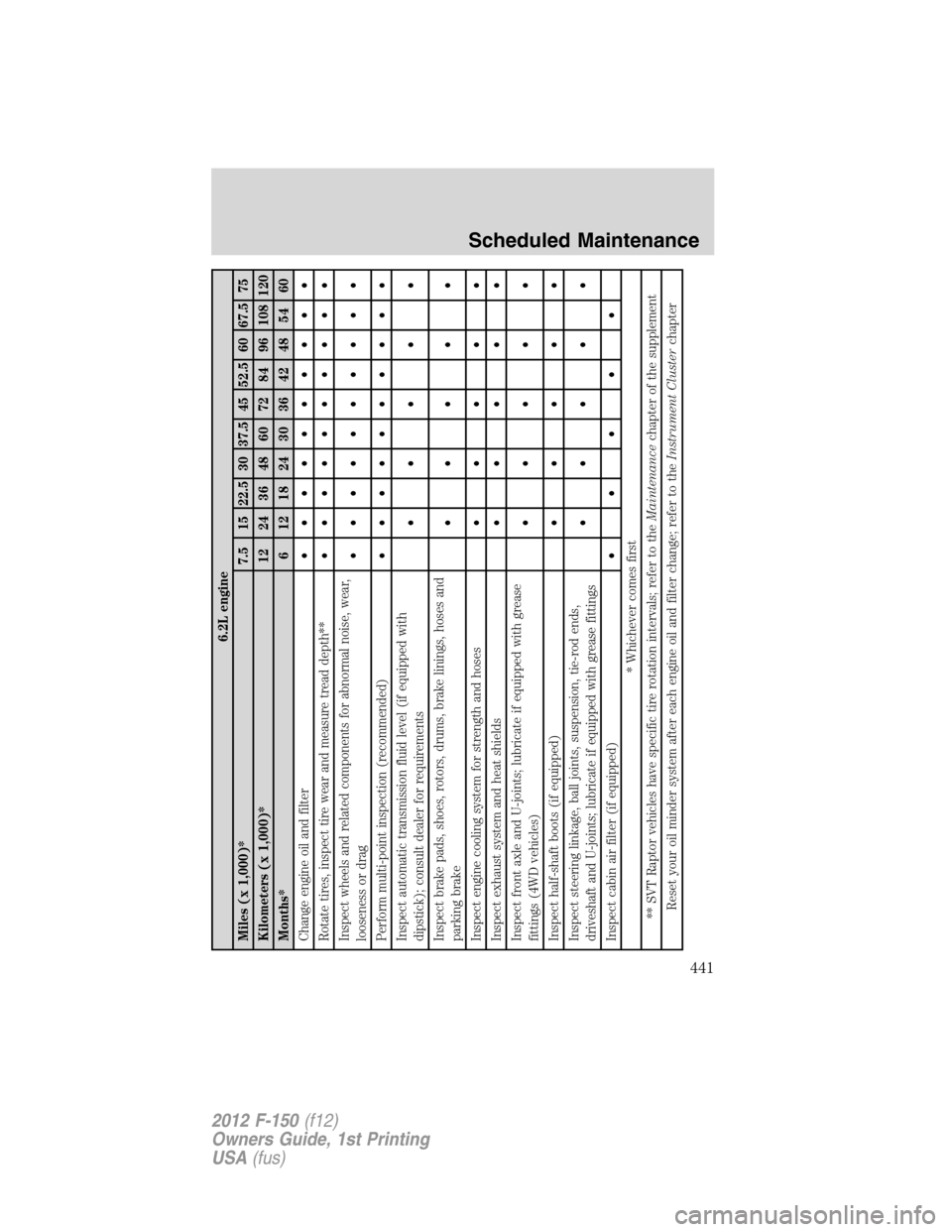
6.2L engine
Miles (x 1,000)* 7.5 15 22.5 30 37.5 45 52.5 60 67.5 75
Kilometers (x 1,000)* 12 24 36 48 60 72 84 96 108 120
Months* 6 12 18 24 30 36 42 48 54 60
Change engine oil and filter• •••••••••
Rotate tires, inspect tire wear and measure tread depth**• •••••••••
Inspect wheels and related components for abnormal noise, wear,
looseness or drag• •••••••••
Perform multi-point inspection (recommended)• •••••••••
Inspect automatic transmission fluid level (if equipped with
dipstick); consult dealer for requirements•••••
Inspect brake pads, shoes, rotors, drums, brake linings, hoses and
parking brake•••••
Inspect engine cooling system for strength and hoses•••••
Inspect exhaust system and heat shields•••••
Inspect front axle and U-joints; lubricate if equipped with grease
fittings (4WD vehicles)•••••
Inspect half-shaft boots (if equipped)•••••
Inspect steering linkage, ball joints, suspension, tie-rod ends,
driveshaft and U-joints; lubricate if equipped with grease fittings•••••
Inspect cabin air filter (if equipped)• ••••
* Whichever comes first
** SVT Raptor vehicles have specific tire rotation intervals; refer to theMaintenancechapter of the supplement
Reset your oil minder system after each engine oil and filter change; refer to theInstrument Clusterchapter
Scheduled Maintenance
441
2012 F-150(f12)
Owners Guide, 1st Printing
USA(fus)
Page 442 of 462
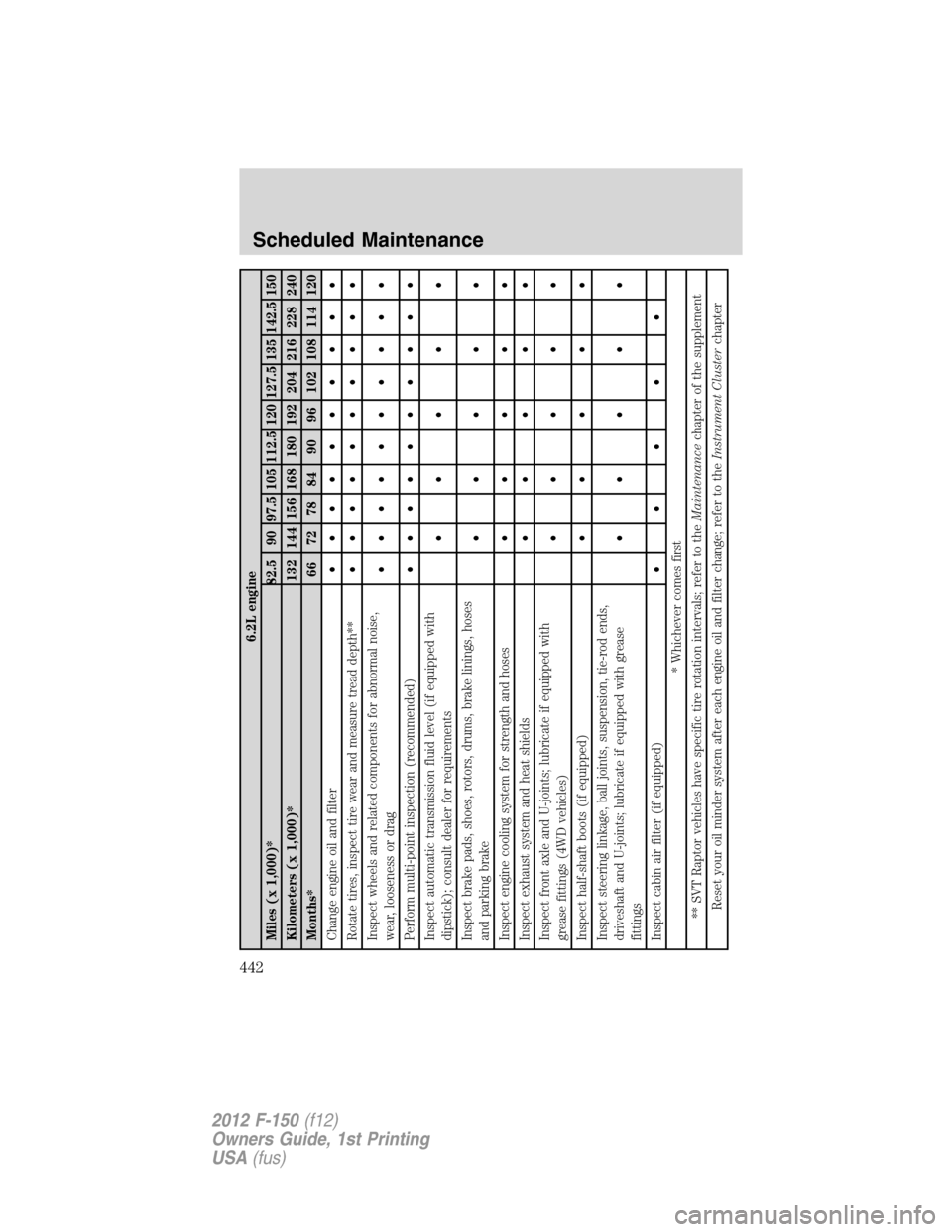
6.2L engine
Miles (x 1,000)* 82.5 90 97.5 105 112.5 120 127.5 135 142.5 150
Kilometers (x 1,000)* 132 144 156 168 180 192 204 216 228 240
Months* 66 72 78 84 90 96 102 108 114 120
Change engine oil and filter••••••••••
Rotate tires, inspect tire wear and measure tread depth**••••••••••
Inspect wheels and related components for abnormal noise,
wear, looseness or drag••••••••••
Perform multi-point inspection (recommended)••••••••••
Inspect automatic transmission fluid level (if equipped with
dipstick); consult dealer for requirements•••••
Inspect brake pads, shoes, rotors, drums, brake linings, hoses
and parking brake•••••
Inspect engine cooling system for strength and hoses•••••
Inspect exhaust system and heat shields•••••
Inspect front axle and U-joints; lubricate if equipped with
grease fittings (4WD vehicles)•••••
Inspect half-shaft boots (if equipped)•••••
Inspect steering linkage, ball joints, suspension, tie-rod ends,
driveshaft and U-joints; lubricate if equipped with grease
fittings•••••
Inspect cabin air filter (if equipped)••• • •
* Whichever comes first
** SVT Raptor vehicles have specific tire rotation intervals; refer to theMaintenancechapter of the supplement
Reset your oil minder system after each engine oil and filter change; refer to theInstrument Clusterchapter
Scheduled Maintenance
442
2012 F-150(f12)
Owners Guide, 1st Printing
USA(fus)
Page 443 of 462
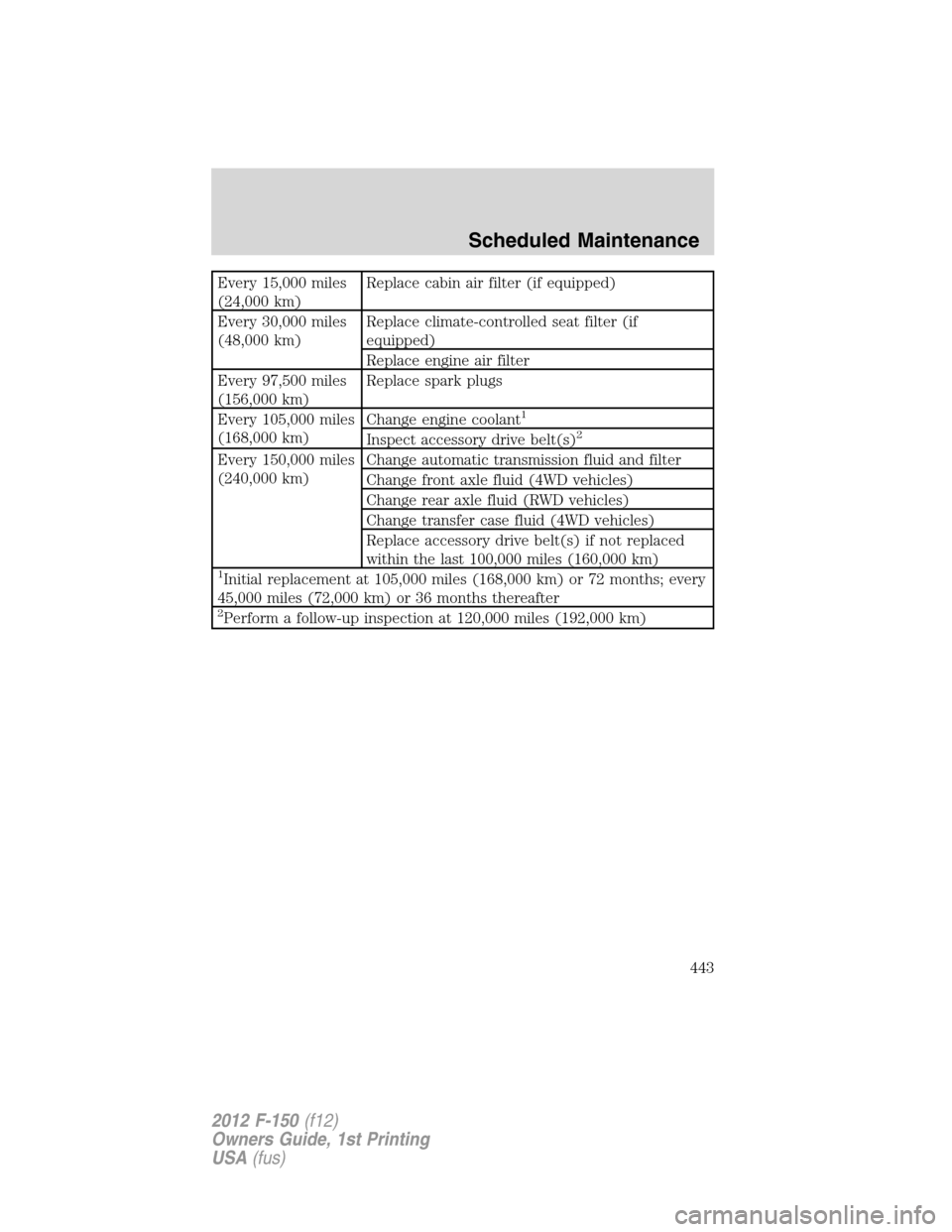
Every 15,000 miles
(24,000 km)Replace cabin air filter (if equipped)
Every 30,000 miles
(48,000 km)Replace climate-controlled seat filter (if
equipped)
Replace engine air filter
Every 97,500 miles
(156,000 km)Replace spark plugs
Every 105,000 miles
(168,000 km)Change engine coolant
1
Inspect accessory drive belt(s)2
Every 150,000 miles
(240,000 km)Change automatic transmission fluid and filter
Change front axle fluid (4WD vehicles)
Change rear axle fluid (RWD vehicles)
Change transfer case fluid (4WD vehicles)
Replace accessory drive belt(s) if not replaced
within the last 100,000 miles (160,000 km)
1Initial replacement at 105,000 miles (168,000 km) or 72 months; every
45,000 miles (72,000 km) or 36 months thereafter
2Perform a follow-up inspection at 120,000 miles (192,000 km)
Scheduled Maintenance
443
2012 F-150(f12)
Owners Guide, 1st Printing
USA(fus)
Page 447 of 462
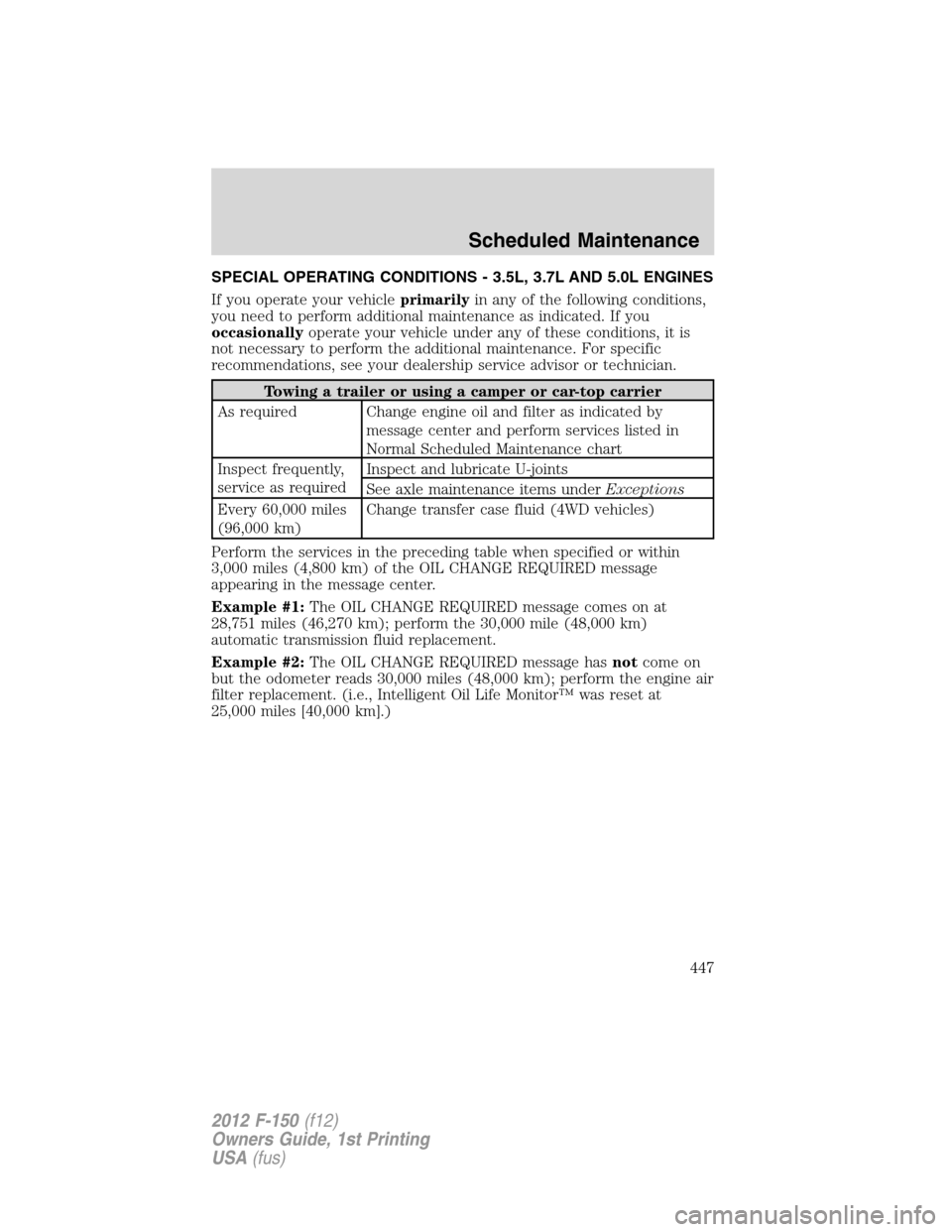
SPECIAL OPERATING CONDITIONS - 3.5L, 3.7L AND 5.0L ENGINES
If you operate your vehicleprimarilyin any of the following conditions,
you need to perform additional maintenance as indicated. If you
occasionallyoperate your vehicle under any of these conditions, it is
not necessary to perform the additional maintenance. For specific
recommendations, see your dealership service advisor or technician.
Towing a trailer or using a camper or car-top carrier
As required Change engine oil and filter as indicated by
message center and perform services listed in
Normal Scheduled Maintenance chart
Inspect frequently,
service as requiredInspect and lubricate U-joints
See axle maintenance items underExceptions
Every 60,000 miles
(96,000 km)Change transfer case fluid (4WD vehicles)
Perform the services in the preceding table when specified or within
3,000 miles (4,800 km) of the OIL CHANGE REQUIRED message
appearing in the message center.
Example #1:The OIL CHANGE REQUIRED message comes on at
28,751 miles (46,270 km); perform the 30,000 mile (48,000 km)
automatic transmission fluid replacement.
Example #2:The OIL CHANGE REQUIRED message hasnotcome on
but the odometer reads 30,000 miles (48,000 km); perform the engine air
filter replacement. (i.e., Intelligent Oil Life Monitor™ was reset at
25,000 miles [40,000 km].)
Scheduled Maintenance
447
2012 F-150(f12)
Owners Guide, 1st Printing
USA(fus)