engine FORD F150 2012 12.G Manual PDF
[x] Cancel search | Manufacturer: FORD, Model Year: 2012, Model line: F150, Model: FORD F150 2012 12.GPages: 462, PDF Size: 3.26 MB
Page 321 of 462
Emergency maneuvers
•In an unavoidable emergency situation where a sudden sharp turn
must be made, remember to avoid “over-driving” your vehicle, i.e.,
turn the steering wheel only as rapidly and as far as required to avoid
the emergency. Excessive steering will result in less vehicle control,
not more. Additionally, smooth variations of the accelerator and/or
brake pedal pressure should be utilized if changes in vehicle speed are
called for. Avoid abrupt steering, acceleration or braking which could
result in an increased risk of loss of vehicle control, vehicle rollover
and/or personal injury. Use all available road surface to return the
vehicle to a safe direction of travel.
•In the event of an emergency stop, avoid skidding the tires and do not
attempt any sharp steering wheel movements.
•If the vehicle goes from one type of surface to another (i.e., from
concrete to gravel) there will be a change in the way the vehicle
responds to a maneuver (steering, acceleration or braking). Again,
avoid these abrupt inputs.
Parking
On some 4WD vehicles, when the transfer case is in the N (Neutral)
position, the engine and transmission are disconnected from the rest of
the driveline. Therefore, the vehicle is free to roll even if the automatic
transmission is in P (Park) or the manual transmission is in gear. Do not
leave the vehicle unattended with the transfer case in the N (Neutral)
position. Always set the parking brake fully and turn off the ignition
when leaving the vehicle.
WARNING:Always set the parking brake fully and make sure
the gearshift is latched in P (Park). Turn the ignition to the off
position and remove the key whenever you leave your vehicle.
WARNING:If the parking brake is fully released, but the brake
warning lamp remains illuminated, the brakes may not be
working properly. See your authorized dealer.
4WD systems
4WD (when you select a 4WD mode) uses all four wheels to power the
vehicle. This increases traction, enabling you to drive over terrain and
road conditions that a conventional two-wheel drive vehicle cannot.
Power is supplied to all four wheels through a transfer case. On 4WD
vehicles, the transfer case allows you to select 4WD when necessary.
Driving
321
2012 F-150(f12)
Owners Guide, 1st Printing
USA(fus)
Page 323 of 462
Driving through deep water may damage the transmission.
If the front or rear axle is submerged in water, the axle lubricant should
be replaced.
After driving through mud, clean off residue stuck to rotating driveshafts
and tires. Excess mud stuck on tires and rotating driveshafts causes an
imbalance that could damage drive components.
“Tread Lightly” is an educational
program designed to increase public
awareness of land-use regulations
and responsibilities in our nations
wilderness areas. Ford Motor
Company joins the U.S. Forest
Service and the Bureau of Land Management in encouraging you to help
preserve our national forest and other public and private lands by
“treading lightly.”
Driving on hilly or sloping terrain
Although natural obstacles may make it necessary to travel diagonally up
or down a hill or steep incline, you should always try to drive straight up
or straight down.Avoid driving crosswise or turning on steep
slopes or hills. A danger lies in losing traction, slipping sideways and
possibly rolling over. Whenever driving on a hill, determine beforehand
the route you will use. Do not drive over the crest of a hill without
seeing what conditions are on the other side. Do not drive in reverse
over a hill without the aid of an observer.
When climbing a steep slope or hill,
start in a lower gear rather than
downshifting to a lower gear from a
higher gear once the ascent has
started. This reduces strain on the
engine and the possibility of stalling.
If you do stall out, do not try to
turn around because you might roll
over. It is better to back down to a safe location.
Apply just enough power to the wheels to climb the hill. Too much
power will cause the tires to slip, spin or lose traction, resulting in loss of
vehicle control.
Driving
323
2012 F-150(f12)
Owners Guide, 1st Printing
USA(fus)
Page 325 of 462
Maintenance and modifications
The suspension and steering systems on your vehicle have been designed
and tested to provide predictable performance whether loaded or empty
and durable load carrying capability. For this reason, Ford Motor
Company strongly recommends that you do not make modifications such
as adding or removing parts (such as lift kits or stabilizer bars) or by
using replacement parts not equivalent to the original factory equipment.
Snow plow restriction
WARNING:Ford does not recommend the use of any F-150
model to be upfitted and equipped with snow plow hardware for
use as a snow plow vehicle.
Any modifications to a vehicle that raise the center of gravity can make it
more likely the vehicle will roll over as a result of a loss of control. Ford
Motor Company recommends that caution be used with any vehicle equipped
with a high load or device (such as ladder racks or pickup box cover).
Failure to maintain your vehicle properly may void the warranty, increase
your repair cost, reduce vehicle performance and operational capabilities
and adversely affect driver and passenger safety. Frequent inspection of
vehicle chassis components is recommended if the vehicle is subjected to
heavy off-road usage.
DRIVING THROUGH WATER
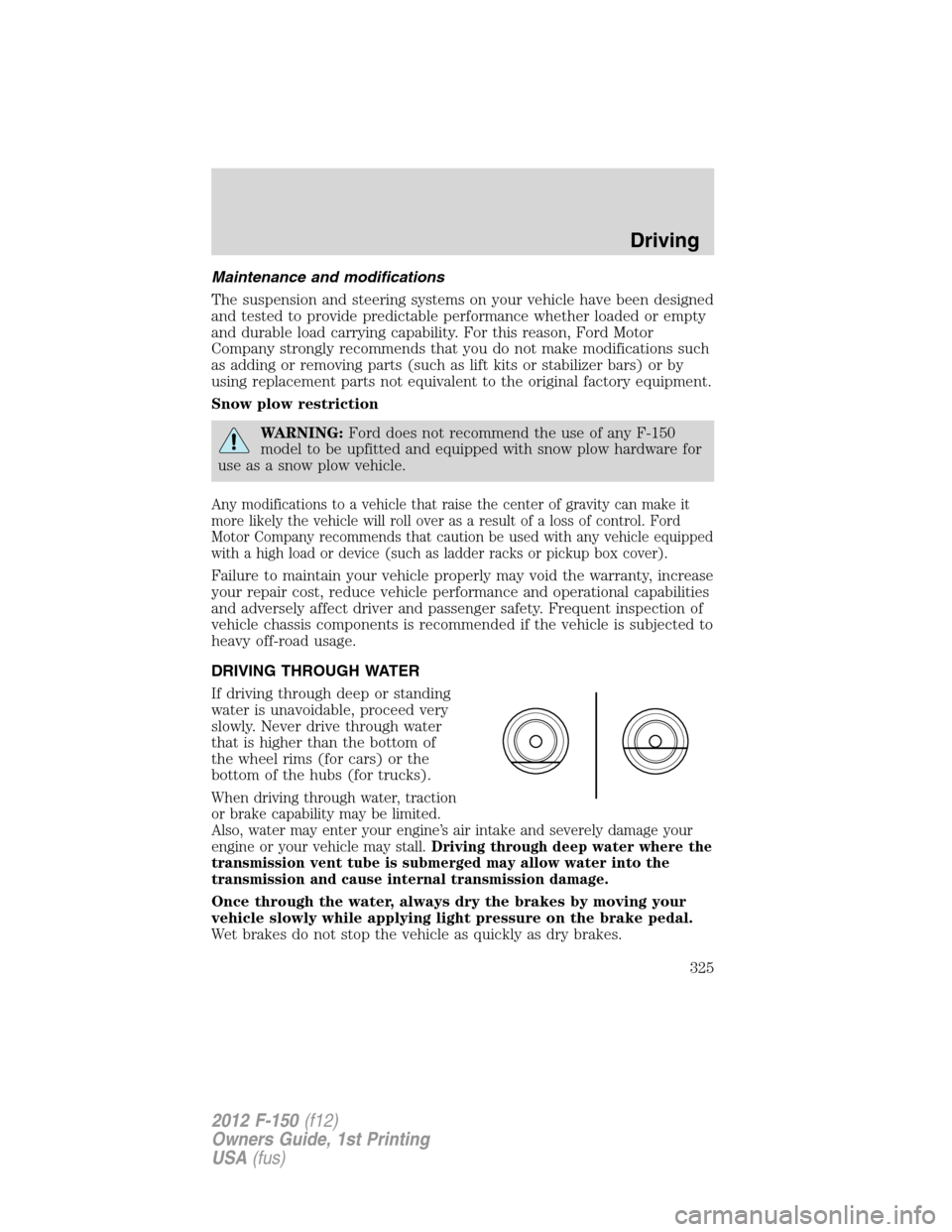
If driving through deep or standing
water is unavoidable, proceed very
slowly. Never drive through water
that is higher than the bottom of
the wheel rims (for cars) or the
bottom of the hubs (for trucks).
When driving through water, traction
or brake capability may be limited.
Also, water may enter your engine’s air intake and severely damage your
engine or your vehicle may stall.Driving through deep water where the
transmission vent tube is submerged may allow water into the
transmission and cause internal transmission damage.
Once through the water, always dry the brakes by moving your
vehicle slowly while applying light pressure on the brake pedal.
Wet brakes do not stop the vehicle as quickly as dry brakes.
Driving
325
2012 F-150(f12)
Owners Guide, 1st Printing
USA(fus)
Page 328 of 462
FUEL PUMP SHUT-OFF
In the event of a moderate to severe collision, this vehicle is equipped
with a fuel pump shut-off feature that stops the flow of fuel to the
engine. Not every impact will cause a shut-off.
Should your vehicle shut off after a collision due to this feature, you may
restart your vehicle by doing the following:
1. Turn the ignition switch to the off position.
2. Turn the ignition switch to the on position.
In some instances the vehicle may not restart the first time you try to
restart and may take one additional attempt.
WARNING:Failure to inspect and if necessary repair fuel leaks
after a collision may increase the risk of fire and serious injury.
Ford Motor Company recommends that the fuel system be inspected
by an authorized dealer after any collision.
FUSES AND RELAYS
Fuses
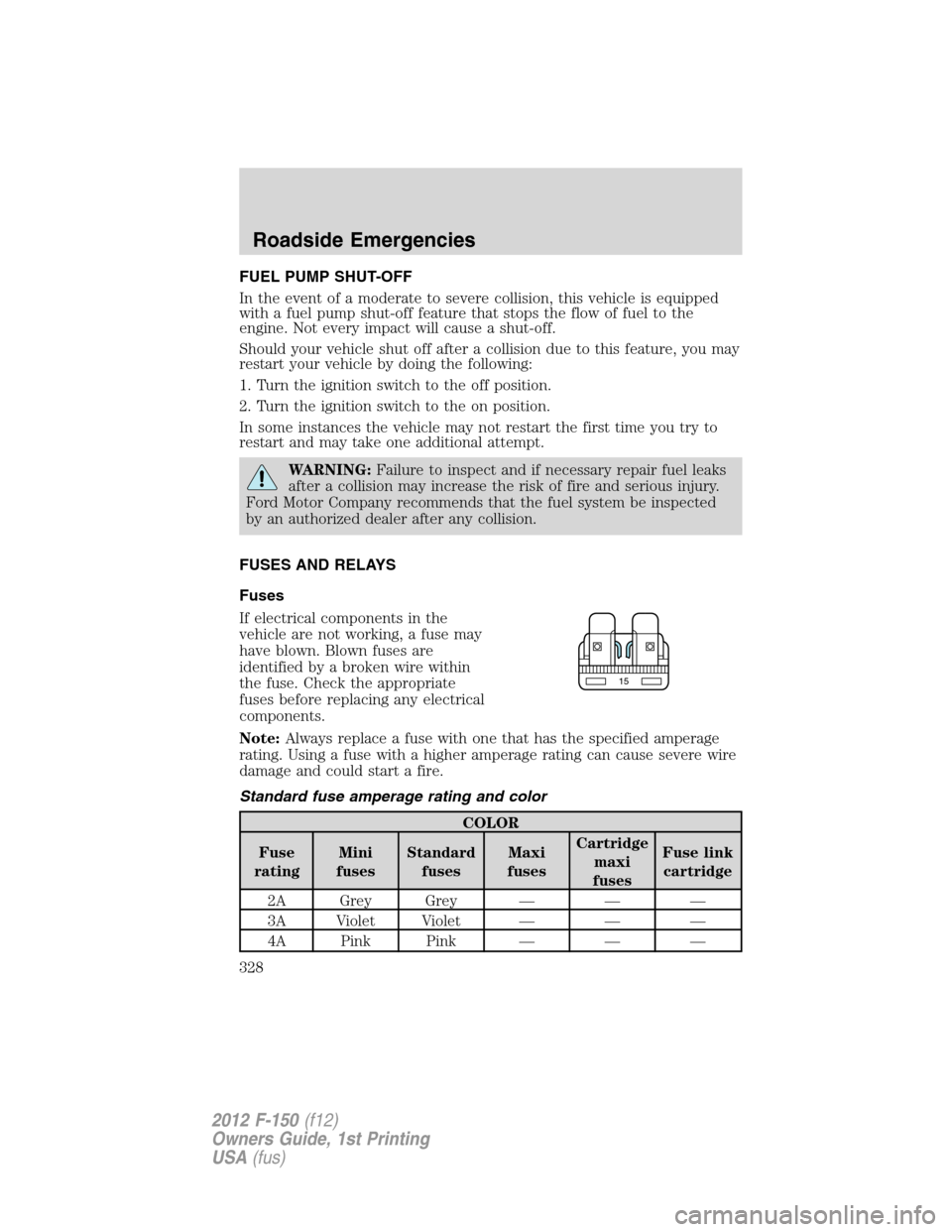
If electrical components in the
vehicle are not working, a fuse may
have blown. Blown fuses are
identified by a broken wire within
the fuse. Check the appropriate
fuses before replacing any electrical
components.
Note:Always replace a fuse with one that has the specified amperage
rating. Using a fuse with a higher amperage rating can cause severe wire
damage and could start a fire.
Standard fuse amperage rating and color
COLOR
Fuse
ratingMini
fusesStandard
fusesMaxi
fusesCartridge
maxi
fusesFuse link
cartridge
2A Grey Grey — — —
3A Violet Violet — — —
4A Pink Pink — — —
15
Roadside Emergencies
328
2012 F-150(f12)
Owners Guide, 1st Printing
USA(fus)
Page 331 of 462
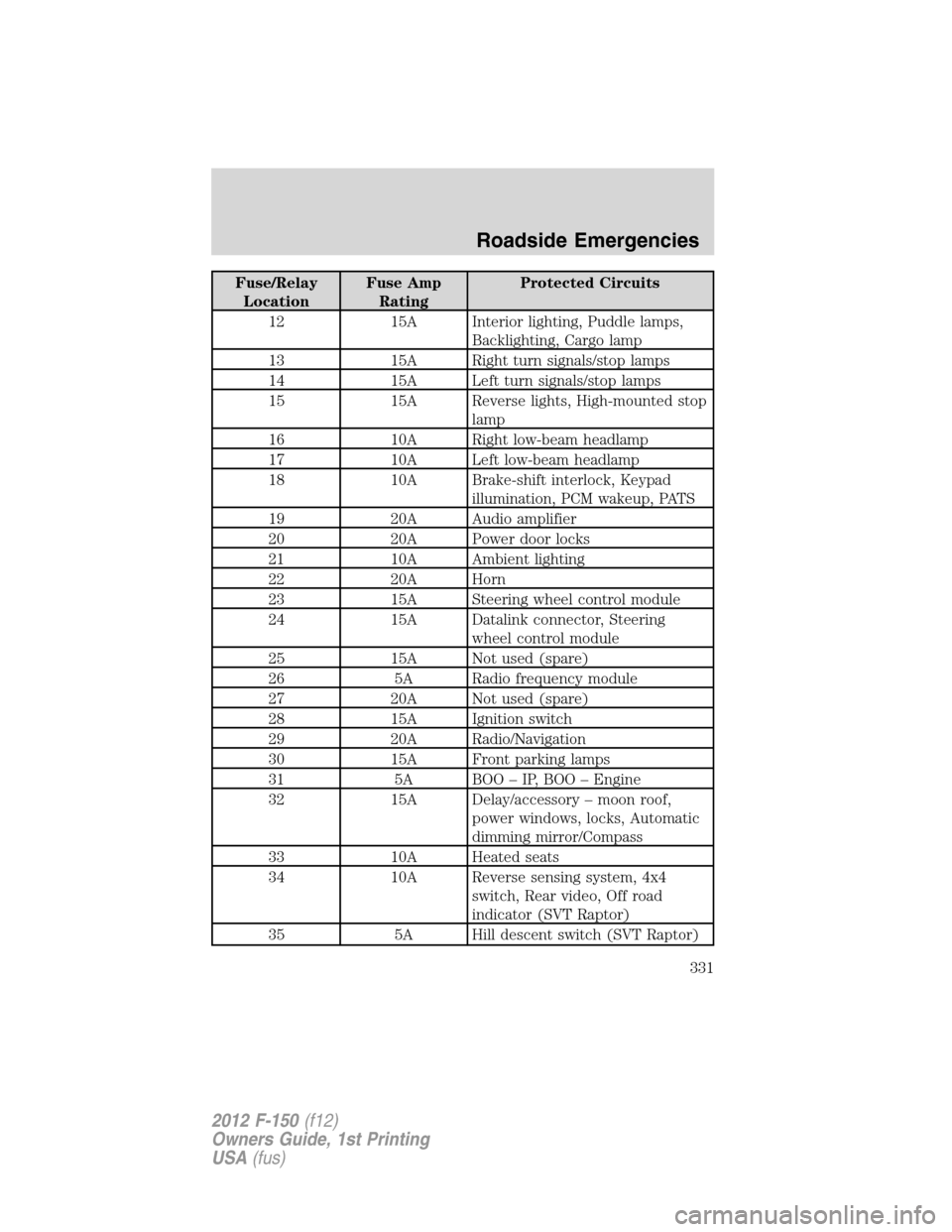
Fuse/Relay
LocationFuse Amp
RatingProtected Circuits
12 15A Interior lighting, Puddle lamps,
Backlighting, Cargo lamp
13 15A Right turn signals/stop lamps
14 15A Left turn signals/stop lamps
15 15A Reverse lights, High-mounted stop
lamp
16 10A Right low-beam headlamp
17 10A Left low-beam headlamp
18 10A Brake-shift interlock, Keypad
illumination, PCM wakeup, PATS
19 20A Audio amplifier
20 20A Power door locks
21 10A Ambient lighting
22 20A Horn
23 15A Steering wheel control module
24 15A Datalink connector, Steering
wheel control module
25 15A Not used (spare)
26 5A Radio frequency module
27 20A Not used (spare)
28 15A Ignition switch
29 20A Radio/Navigation
30 15A Front parking lamps
31 5A BOO – IP, BOO – Engine
32 15A Delay/accessory – moon roof,
power windows, locks, Automatic
dimming mirror/Compass
33 10A Heated seats
34 10A Reverse sensing system, 4x4
switch, Rear video, Off road
indicator (SVT Raptor)
35 5A Hill descent switch (SVT Raptor)
Roadside Emergencies
331
2012 F-150(f12)
Owners Guide, 1st Printing
USA(fus)
Page 332 of 462
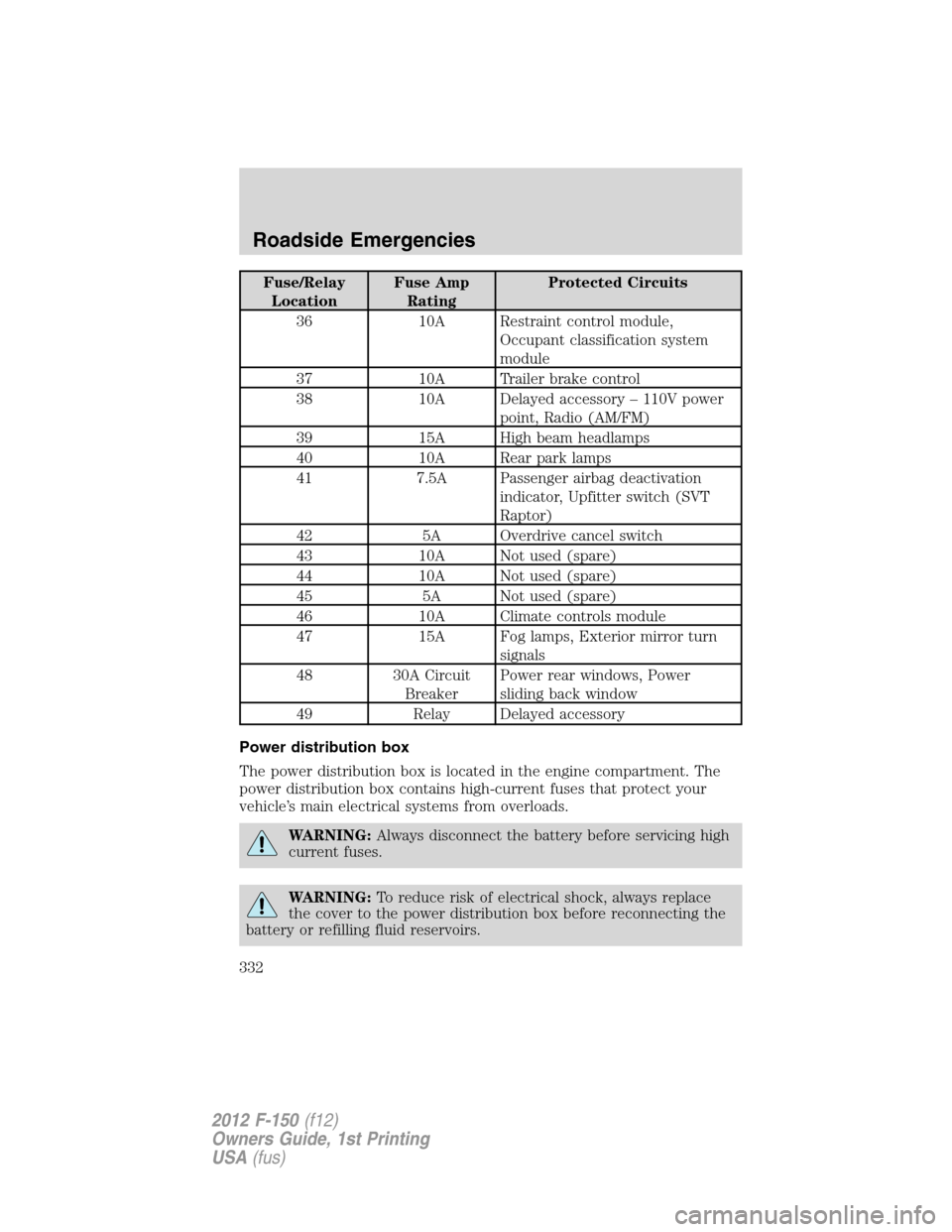
Fuse/Relay
LocationFuse Amp
RatingProtected Circuits
36 10A Restraint control module,
Occupant classification system
module
37 10A Trailer brake control
38 10A Delayed accessory – 110V power
point, Radio (AM/FM)
39 15A High beam headlamps
40 10A Rear park lamps
41 7.5A Passenger airbag deactivation
indicator, Upfitter switch (SVT
Raptor)
42 5A Overdrive cancel switch
43 10A Not used (spare)
44 10A Not used (spare)
45 5A Not used (spare)
46 10A Climate controls module
47 15A Fog lamps, Exterior mirror turn
signals
48 30A Circuit
BreakerPower rear windows, Power
sliding back window
49 Relay Delayed accessory
Power distribution box
The power distribution box is located in the engine compartment. The
power distribution box contains high-current fuses that protect your
vehicle’s main electrical systems from overloads.
WARNING:Always disconnect the battery before servicing high
current fuses.
WARNING:To reduce risk of electrical shock, always replace
the cover to the power distribution box before reconnecting the
battery or refilling fluid reservoirs.
Roadside Emergencies
332
2012 F-150(f12)
Owners Guide, 1st Printing
USA(fus)
Page 333 of 462
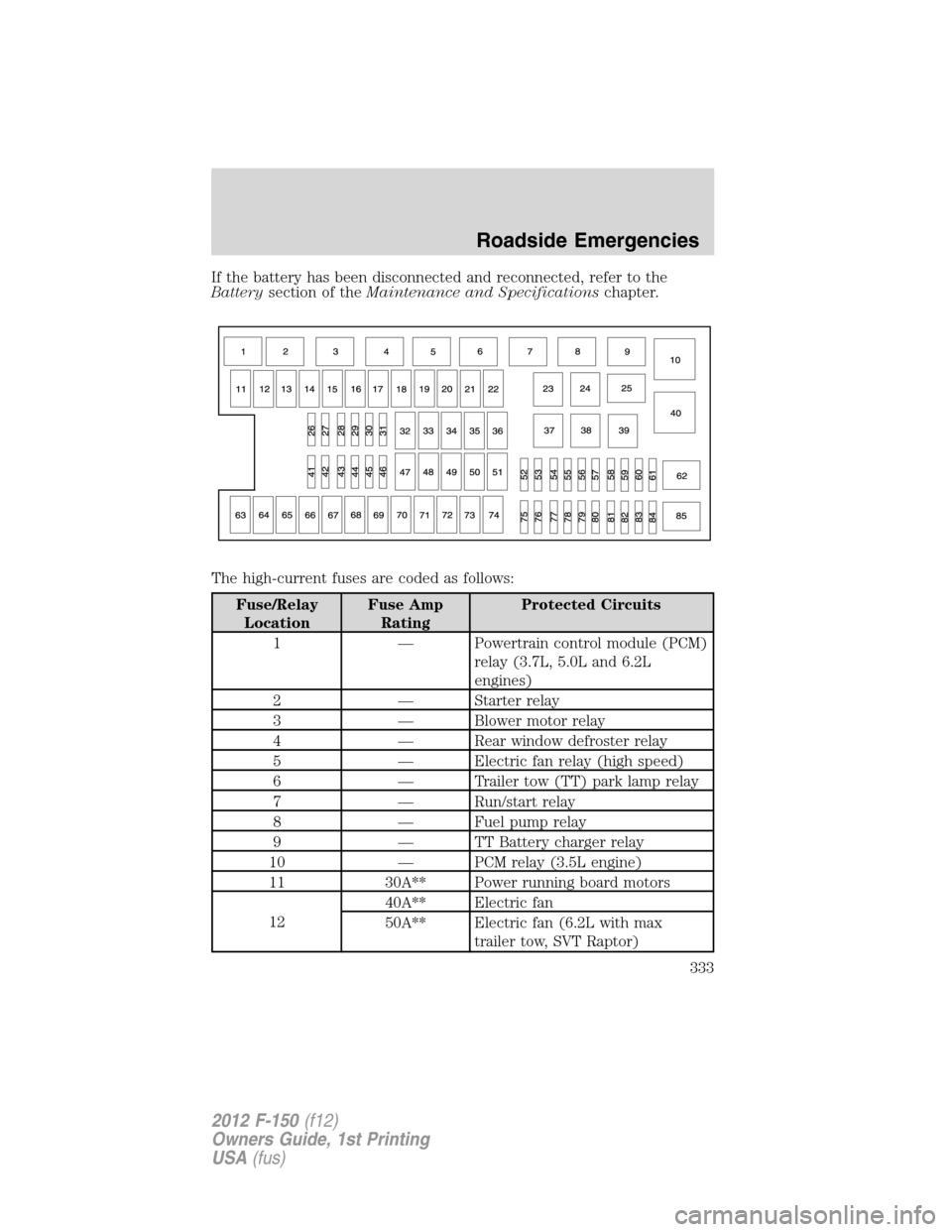
If the battery has been disconnected and reconnected, refer to the
Batterysection of theMaintenance and Specificationschapter.
The high-current fuses are coded as follows:
Fuse/Relay
LocationFuse Amp
RatingProtected Circuits
1 — Powertrain control module (PCM)
relay (3.7L, 5.0L and 6.2L
engines)
2 — Starter relay
3 — Blower motor relay
4 — Rear window defroster relay
5 — Electric fan relay (high speed)
6 — Trailer tow (TT) park lamp relay
7 — Run/start relay
8 — Fuel pump relay
9 — TT Battery charger relay
10 — PCM relay (3.5L engine)
11 30A** Power running board motors
1240A** Electric fan
50A** Electric fan (6.2L with max
trailer tow, SVT Raptor)
Roadside Emergencies
333
2012 F-150(f12)
Owners Guide, 1st Printing
USA(fus)
Page 334 of 462
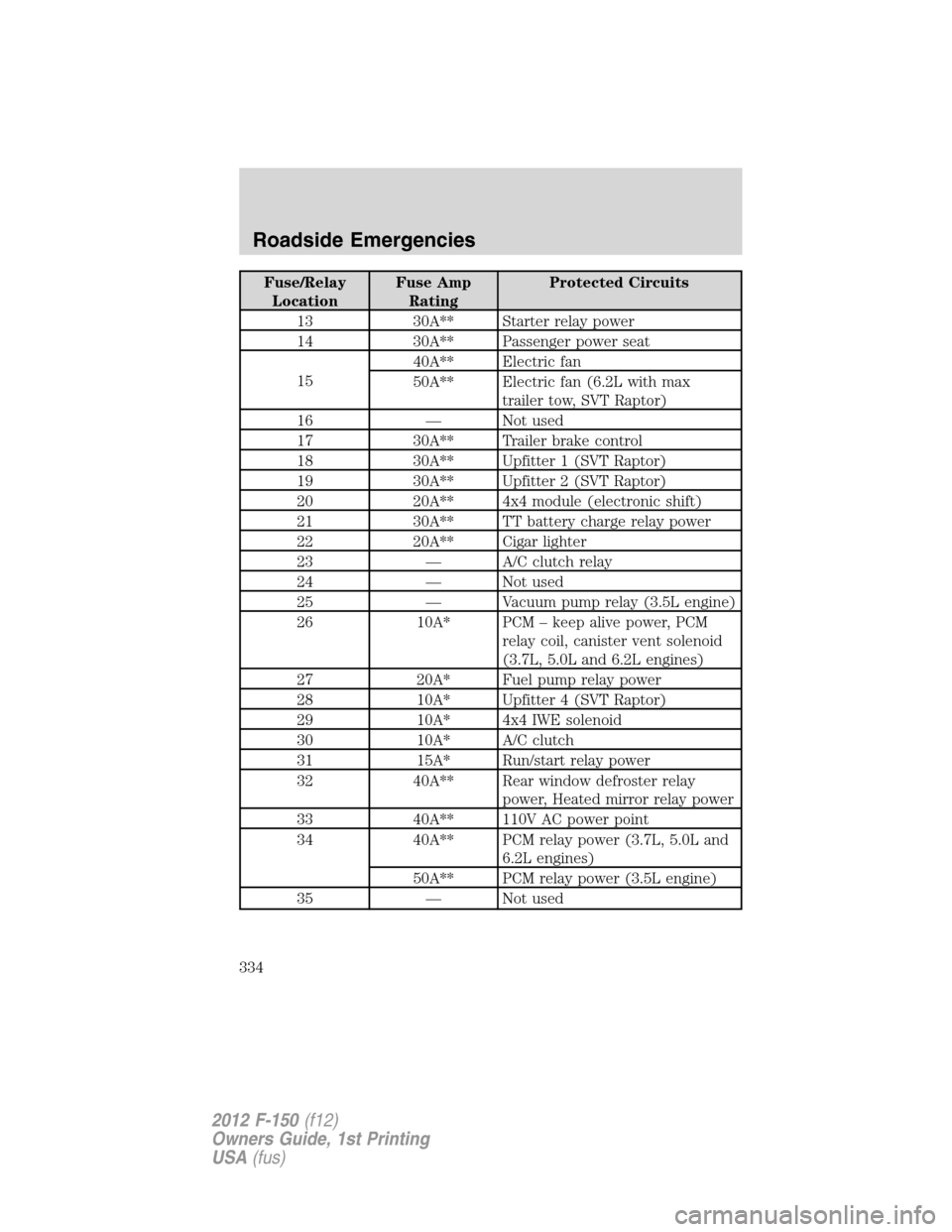
Fuse/Relay
LocationFuse Amp
RatingProtected Circuits
13 30A** Starter relay power
14 30A** Passenger power seat
1540A** Electric fan
50A** Electric fan (6.2L with max
trailer tow, SVT Raptor)
16 — Not used
17 30A** Trailer brake control
18 30A** Upfitter 1 (SVT Raptor)
19 30A** Upfitter 2 (SVT Raptor)
20 20A** 4x4 module (electronic shift)
21 30A** TT battery charge relay power
22 20A** Cigar lighter
23 — A/C clutch relay
24 — Not used
25 — Vacuum pump relay (3.5L engine)
26 10A* PCM – keep alive power, PCM
relay coil, canister vent solenoid
(3.7L, 5.0L and 6.2L engines)
27 20A* Fuel pump relay power
28 10A* Upfitter 4 (SVT Raptor)
29 10A* 4x4 IWE solenoid
30 10A* A/C clutch
31 15A* Run/start relay power
32 40A** Rear window defroster relay
power, Heated mirror relay power
33 40A** 110V AC power point
34 40A** PCM relay power (3.7L, 5.0L and
6.2L engines)
50A** PCM relay power (3.5L engine)
35 — Not used
Roadside Emergencies
334
2012 F-150(f12)
Owners Guide, 1st Printing
USA(fus)
Page 335 of 462
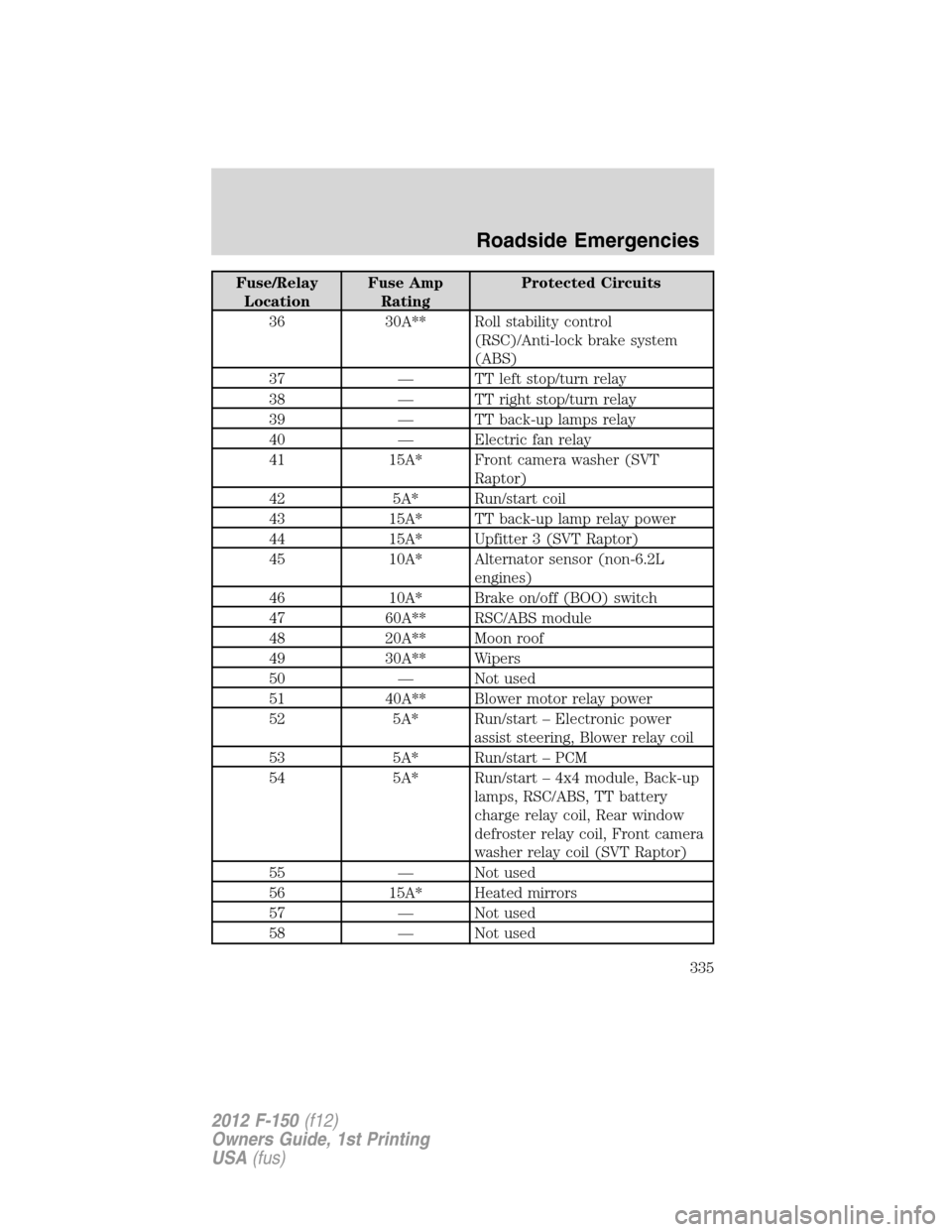
Fuse/Relay
LocationFuse Amp
RatingProtected Circuits
36 30A** Roll stability control
(RSC)/Anti-lock brake system
(ABS)
37 — TT left stop/turn relay
38 — TT right stop/turn relay
39 — TT back-up lamps relay
40 — Electric fan relay
41 15A* Front camera washer (SVT
Raptor)
42 5A* Run/start coil
43 15A* TT back-up lamp relay power
44 15A* Upfitter 3 (SVT Raptor)
45 10A* Alternator sensor (non-6.2L
engines)
46 10A* Brake on/off (BOO) switch
47 60A** RSC/ABS module
48 20A** Moon roof
49 30A** Wipers
50 — Not used
51 40A** Blower motor relay power
52 5A* Run/start – Electronic power
assist steering, Blower relay coil
53 5A* Run/start – PCM
54 5A* Run/start – 4x4 module, Back-up
lamps, RSC/ABS, TT battery
charge relay coil, Rear window
defroster relay coil, Front camera
washer relay coil (SVT Raptor)
55 — Not used
56 15A* Heated mirrors
57 — Not used
58 — Not used
Roadside Emergencies
335
2012 F-150(f12)
Owners Guide, 1st Printing
USA(fus)
Page 336 of 462
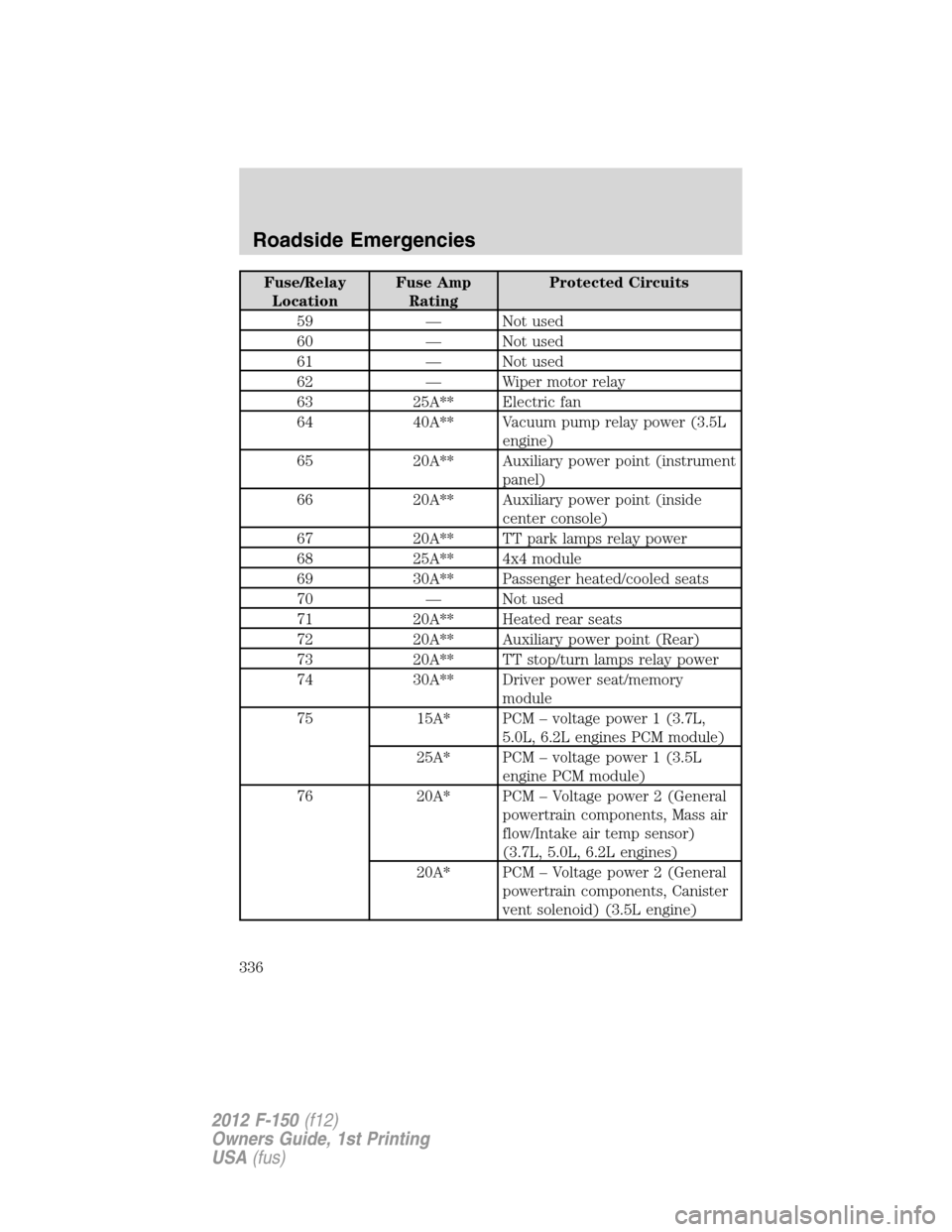
Fuse/Relay
LocationFuse Amp
RatingProtected Circuits
59 — Not used
60 — Not used
61 — Not used
62 — Wiper motor relay
63 25A** Electric fan
64 40A** Vacuum pump relay power (3.5L
engine)
65 20A** Auxiliary power point (instrument
panel)
66 20A** Auxiliary power point (inside
center console)
67 20A** TT park lamps relay power
68 25A** 4x4 module
69 30A** Passenger heated/cooled seats
70 — Not used
71 20A** Heated rear seats
72 20A** Auxiliary power point (Rear)
73 20A** TT stop/turn lamps relay power
74 30A** Driver power seat/memory
module
75 15A* PCM – voltage power 1 (3.7L,
5.0L, 6.2L engines PCM module)
25A* PCM – voltage power 1 (3.5L
engine PCM module)
76 20A* PCM – Voltage power 2 (General
powertrain components, Mass air
flow/Intake air temp sensor)
(3.7L, 5.0L, 6.2L engines)
20A* PCM – Voltage power 2 (General
powertrain components, Canister
vent solenoid) (3.5L engine)
Roadside Emergencies
336
2012 F-150(f12)
Owners Guide, 1st Printing
USA(fus)