wheel FORD F150 2014 12.G Raptor Supplement Manual
[x] Cancel search | Manufacturer: FORD, Model Year: 2014, Model line: F150, Model: FORD F150 2014 12.GPages: 41, PDF Size: 4.4 MB
Page 3 of 41
Introduction
About This Supplement.................................3
Product History..................................................3
At a Glance
At a Glance..........................................................4
Fuel and Refueling
Fuel Quality.........................................................7
Terrain Response
Principle of Operation.....................................8
Using Hill Descent Control............................8
Driving Aids
Front View Camera..........................................9
Towing
Towing a Trailer................................................12
Transporting the Vehicle...............................12
Towing the Vehicle on Four Wheels.........13
Driving Hints
Off-Road Driving.............................................15
Vehicle Care
Cleaning the Exterior.....................................25
Wheels and Tires
General Information......................................26
Tire Care............................................................26
Using Snow Chains........................................27
Wheels................................................................27
Capacities and Specific-ations
Engine Specifications...................................29
Motorcraft Parts.............................................30
Technical Specifications...............................31
Accessories
Auxiliary Switches..........................................33
Warranty Terms andConditions
Base Warranty.................................................35
1F150 (TF6)Table of Contents
Page 7 of 41
•Longer, cast aluminum lower controlarms
•Longer, forged steel upper control arms
•Front coil springs and rear leaf springs
•Fox Racing 1.8 inch piston internalbypass front shocks
•Fox Racing 1.8 inch, internal bypass,remote reservoir rear shocks
•Micro-cellular urethane jouncebumpers (front and rear)
•Raptor navigation welcome screen
•Full-size all-terrain spare tire
•Off-road specific calibrations forengine, transmission and AdvanceTracsystem
•Standard 17 inch Cast AluminumWheels
•Optional 17 inch forged aluminumbeadlock compatible wheels
•LT 315/70-17 BF Goodrich all-terraintires
Note:Your F-150 SVT Raptor is equippedwith unique front and rear high-performanceFox shock absorbers designed for severeoff-road use. Due to the hydraulic motionof the shock fluid in the unique internalbypass system, you can expect some noiseduring on-road driving, including boom,chirp, or clunk noises. This is a normalcharacteristic of the shock absorbers andyou should not attempt repair.
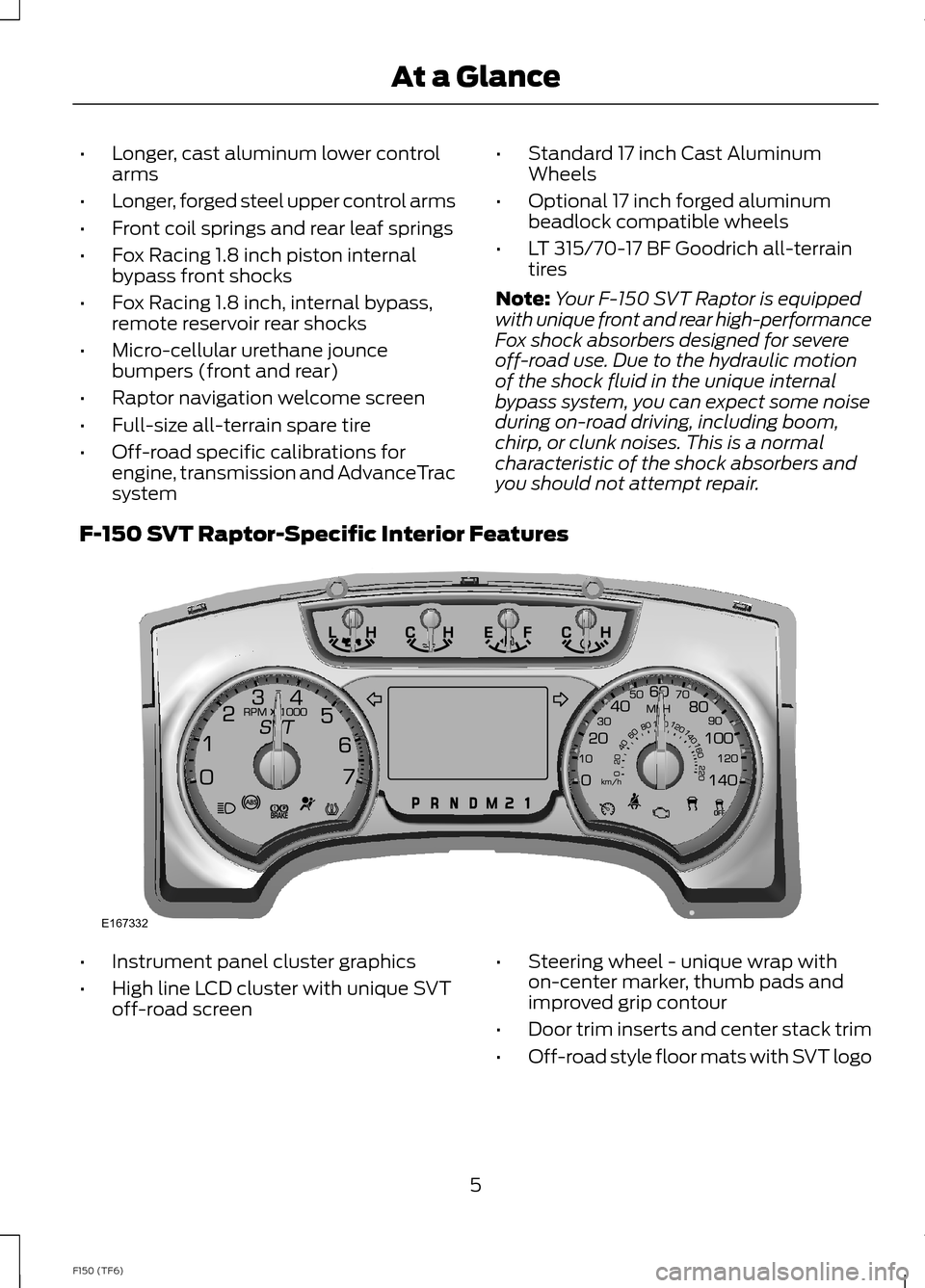
F-150 SVT Raptor-Specific Interior Features
•Instrument panel cluster graphics
•High line LCD cluster with unique SVToff-road screen
•Steering wheel - unique wrap withon-center marker, thumb pads andimproved grip contour
•Door trim inserts and center stack trim
•Off-road style floor mats with SVT logo
5F150 (TF6)At a GlanceE167332
Page 12 of 41
Turning on the Front Off-road CameraSystem
Your vehicle must meet the followingconditions to turn the system on:
•You must be in off-road mode withelectronic locking differential (ELD)activated, or in 4L.
See the Off-Road Mode section in theDriving Hints chapter of this supplement,and Electronic Locking Differential (ELD)in the Four-Wheel Drive chapter of yourOwner’s Manual for information on howto activate these systems.
1.Select the Truck Apps menu in yourinformation display screen.
2.Select the sub-menu Off-RoadCamera.
3.Press OK to enable and disable thecamera.
The area displayed on the screen may varyaccording to the vehicle orientation androad conditions.
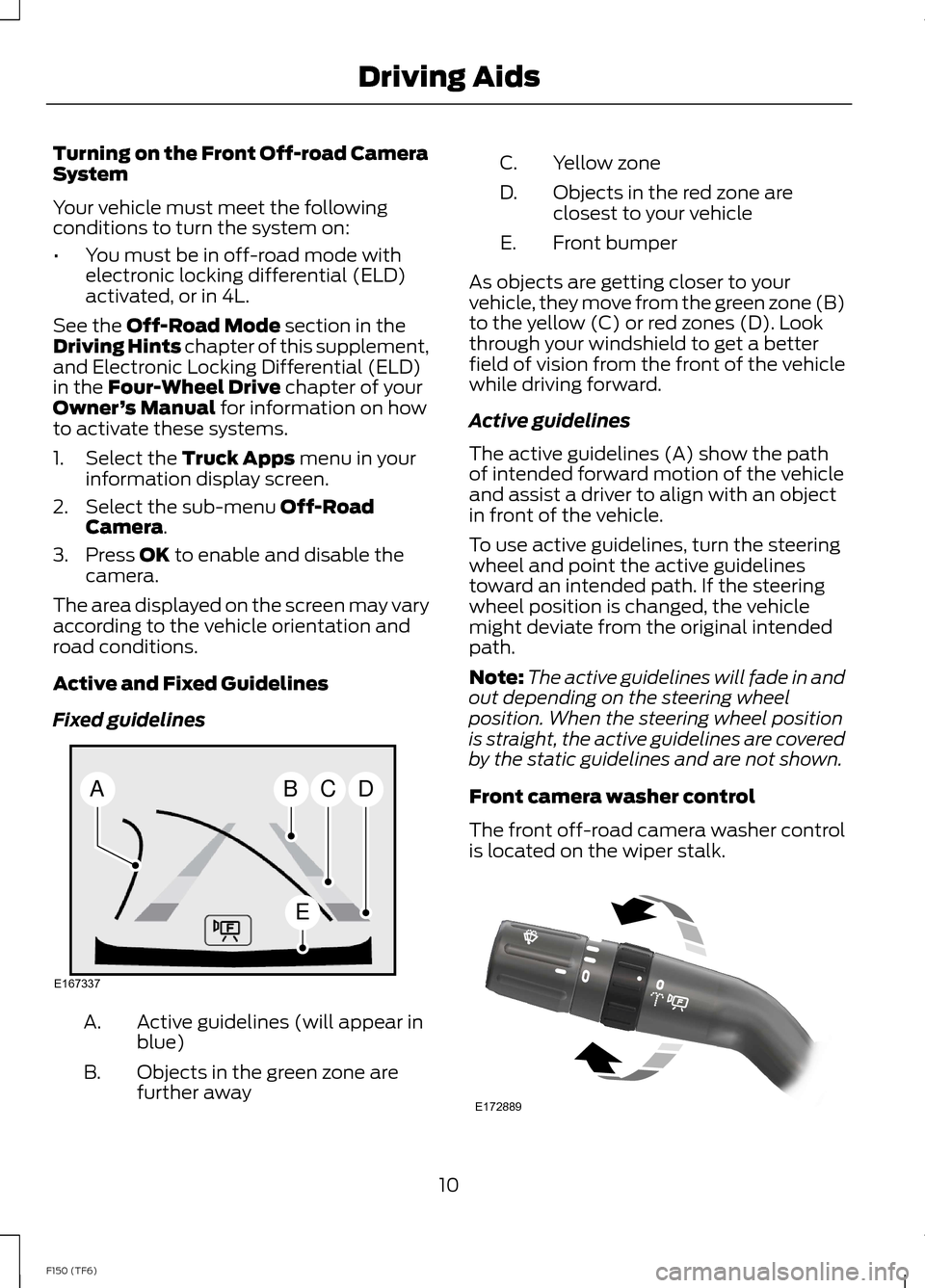
Active and Fixed Guidelines
Fixed guidelines
Active guidelines (will appear inblue)A.
Objects in the green zone arefurther awayB.
Yellow zoneC.
Objects in the red zone areclosest to your vehicleD.
Front bumperE.
As objects are getting closer to yourvehicle, they move from the green zone (B)to the yellow (C) or red zones (D). Lookthrough your windshield to get a betterfield of vision from the front of the vehiclewhile driving forward.
Active guidelines
The active guidelines (A) show the pathof intended forward motion of the vehicleand assist a driver to align with an objectin front of the vehicle.
To use active guidelines, turn the steeringwheel and point the active guidelinestoward an intended path. If the steeringwheel position is changed, the vehiclemight deviate from the original intendedpath.
Note:The active guidelines will fade in andout depending on the steering wheelposition. When the steering wheel positionis straight, the active guidelines are coveredby the static guidelines and are not shown.
Front camera washer control
The front off-road camera washer controlis located on the wiper stalk.
10F150 (TF6)Driving AidsBECDAE167337 E172889
Page 15 of 41
It is required that your vehicle be towedwith flatbed equipment. When towing witha flatbed, 4x4 blocks must be used whenloading and unloading your vehicle. Do nottow with a slingbelt. Ford Motor Companyhas not approved a slingbelt towingprocedure.
Note:If the vehicle is towed by other meansor incorrectly, vehicle damage may occur.
TOWING THE VEHICLE ON
FOUR WHEELS
Emergency Towing
If your vehicle becomes inoperable(without access to wheel dollies,car-hauling trailer, or flatbed transportvehicle), it can be flat-towed (all wheelson the ground, regardless of the powertrainand transmission configuration) under thefollowing conditions:
•Your vehicle is facing forward fortowing in a forward direction.
•Place the transmission in position N. Ifyou cannot move the transmission intoN, you may need to override it.
•Maximum speed is 35 mph (56 km/h).
•Maximum distance is 50 miles (80kilometers).
Recreational Towing
Note:Put your climate control system inrecirculated air mode to prevent exhaustfumes from entering your vehicle.
Follow these guidelines if you have a needfor recreational towing, such as towingyour vehicle behind a motorhome. Wedesigned these guidelines to preventdamage to your transmission.
Four-wheel-down Towing
You can only tow a four-wheel drivevehicle with all wheels on the ground byplacing the transfer case in its neutralposition and engaging thefour-wheel-down towing feature. Performthe steps outlined in the following sectionafter positioning your vehicle behind thetow vehicle and properly securing themtogether.
1.Turn the ignition to the on position. Donot start the engine.
2.Press and hold the brake pedal.
3.Rotate the four-wheel drive switch to2H.
4.Shift the transmission to position N.
5.Rotate the four-wheel drive switchfrom 2H to 4L and back to 2H fivetimes within seven seconds.
Note:If completed successfully, theinformation display shows NEUTRAL TOWLEAVE IN N or NEUTRAL TOW ENABLEDLEAVE TRANSMISSION IN NEUTRAL.This indicates that your vehicle is safe totow with all wheels on the ground
Note:If you do not see the message in thedisplay, you must perform the procedureagain from the beginning.
Note:You may hear an audible noise as thetransfer case shifts into its neutral position.This is normal.
6.Leave the transmission in position Nand turn the ignition as far as it will gotoward the off position (it will not turnfully off when the transmission is inposition N. You must leave the key inthe ignition while towing. To lock andunlock your vehicle, use the keylessentry keypad or extra set of keys.
7.Release the brake pedal.
13F150 (TF6)Towing
Page 16 of 41
WARNINGS
Do not disconnect the battery duringrecreational towing. Doing so willprevent the transfer case fromshifting properly and may cause the vehicleto roll even if the transmission is in P(Park).
Shifting the transfer case to itsneutral position for recreationaltowing may cause the vehicle to beable to roll even if the transmission is in P(Park). The driver or others could beinjured. Make sure the foot brake isdepressed and the vehicle is in a secureand safe position while the transfer caseis being shifted to its neutral position.
Failing to put the transfer case in itsneutral position will damage vehiclecomponents.
Note:You can check four-wheel-downtowing status at any time by opening thedriver's door or turning the ignition to theaccessory or on position and verifying theNEUTRAL TOW ENABLED messagedisplays in the cluster.
To exit four-wheel-down towing and returnthe transfer case to its 2H position:
1.With your vehicle still properly securedto the tow vehicle, press and hold thebrake pedal.
2.Turn the ignition to the on position. Donot start the engine.
3.Shift the transmission out of N and intoany gear.
4.Release the brake pedal.
Note:If completed successfully, theinstrument cluster displays 4X2, andNEUTRAL TOW DISABLED.
Note:If the indicator light and message donot display, you must perform the procedureagain from the beginning.
Note:You may hear an audible noise as thetransfer case shifts out of its neutralposition. This is normal.
5.Apply the parking brake, and thendisconnect the vehicle from the towvehicle.
6.Release the parking brake, start theengine, and shift the transmission toposition D to make sure the transfercase is out of position N.
7.If the transfer case does notsuccessfully shift out of position N, setthe parking brake until you can haveyour vehicle serviced.
14F150 (TF6)Towing
Page 21 of 41
Off-road Screen
The real-time status of your vehiclesoff-road systems can be continuouslymonitored using the first off-road screenfound under the Truck Apps menu in theinformation displays screen. See theInformation Displays chapter of yourOwner’s Manual for more information.
Basic Off-road Driving Techniques
•
•Grip the steering wheel with thumbson the outside of the rim. This willreduce the risk of injury due to abruptsteering wheel motions that occurwhen negotiating rough terrain. Do notgrip the steering wheel with thumbsinside the rim.
•Throttle, brake and steering inputsshould be made in a smooth andcontrolled manner. Sudden inputs tothe controls can cause loss of tractionor upset the vehicle, especially whileon sloped terrain or while crossingobstacles such as rocks or logs.
•Look ahead on your route notingupcoming obstacles, surface textureor color changes or any other factorswhich may indicate a change inavailable traction, and adjust thevehicle speed and route accordingly.During pre-run, mark obstacles withGPS markers to make sure appropriatespeeds are used to avoid potentialvehicle damage.
•When driving off-road, if the front orrear suspension is bottoming-outand/or excessive contact with theskid-plates is encountered, reducevehicle speed to avoid potentialdamage to the vehicle.
•When running with other vehicles, it isrecommended that communication isused, and the lead vehicle notify othervehicles of obstacles that could causepotential vehicle damage.
•Always keep available groundclearance in mind and pick a route thatminimizes the risk of catching theunderside of the vehicle on an obstacle.
•When negotiating low speed obstacles,applying light brake pressure inconjunction with the throttle will helpprevent the vehicle from jerking andwill allow you to negotiate the obstaclein a more controlled manner. Using 4Lwill also help with this.
•Use and equip supplemental safetyequipment as discussed later in thischapter.
•Please consult your local off-roadgroup for other helpful tips.
•Off-roading requires a high degree ofconcentration. Even if your local lawdoes not prohibit alcohol use whiledriving off-road, Ford stronglyrecommends against drinking if youplan to off-road.
Operating a Performance Vehicleat Higher than Normal Speeds
Your vehicle is capable of operating athigher than normal off-road speeds and isequipped with tires rated for the vehicles’maximum speed. However, it is importantto remember to always drive safely, obeyall traffic laws and only operate yourvehicle at higher than normal speeds atlocations and under conditions where suchcan be done safely.
19F150 (TF6)Driving Hints
Page 22 of 41
Before operating your vehicle at higherthan normal speeds:
•Make sure your tires are at the correcttire pressure. See Tire Care (page 26).
•Inspect wheels and tires for wear anddamage. Replace any damaged wheelsor tires.
•Never operate the vehicle at higherthan normal speeds when loaded withpassengers/cargo.
Driving in Mud
•Deep mud should be approached withcaution especially if you are driving inan unfamiliar area.
•If possible, test the depth of a mud holebefore entering with the vehicle.
•Keep in mind that obstacles and deepruts may be hidden beneath thesurface of the mud.
•Proceed in a steady, controlled mannerthrough deep mud while maintainingmomentum.
•If momentum is lost and you feel thevehicle becoming stuck, turning thesteering wheel back and forth (sawingthe wheel) quarter turn in eachdirection may give the traction youneed to clear the muddy area.
•In higher speed areas with shallowmud, directional control will be reducedin the muddy area much like on snowor ice. When approaching such an area,be sure to slow to a speed whichallows you to maneuver as required bythe conditions.
Driving in Sand
WARNING
Tires must be returned to normalrecommended tire pressures beforedriving on pavement or hardsurfaces. Failure to properly maintain yourtire pressure could increase the risk of tirefailure, loss of control, vehicle rollover andpersonal injury.
Soft sand and dunes present a very uniquedriving challenge. Before going on such adrive, some research is advised regardingproven techniques and pitfalls inherent indriving in deep sand.
Some general points to consider:
•It is very difficult and in many casesimpossible to navigate deep sand withtire pressures which are appropriate foron-road driving. If you decide to airdown your tires, be advised that the tirepressure monitoring light willilluminate. The tires must be returnedto normal recommended tire pressuresbefore driving on pavement or hardsurfaces.
•Lower tire pressures are more likely tocause a debeading of the tire duringcornering. Avoid sharp or abrupt turnswhen you have extremely low tirepressures.
•To help prevent becoming stuck indeep sand, avoid spinning the tires ormaking abrupt maneuvers. Proceed ina controlled manner while maintainingvehicle momentum.
•Avoid stopping or parking on inclinesas this makes it more difficult toresume driving.
20F150 (TF6)Driving Hints
Page 23 of 41
Driving in Deep Snow
•Maintain vehicle momentum.
•Apply the throttle very gently to avoidspinning the tires. Spinning the tires willpotentially dig the vehicle deeper intothe snow.
•Drive in a controlled manner, avoidingaggressive steering wheel movements,and keep braking to a minimum.
•Extremely deep snow may cause thevehicle to high center causing thevehicle to become stuck. Test thedepth of the snow before trying to drivethrough it.
Crossing Obstacles
•Review the path ahead beforeattempting to cross any obstacle. It isbest if the obstacle is reviewed fromoutside the vehicle so that there is agood understanding of terrain conditionboth in, front of, and behind theobstacle.
•Approach obstacles slowly and slowlyinch the vehicle over.
•If a large obstacle such as a rockcannot be avoided, choose a path thatplaces the rock directly under the tirerather than the undercarriage of thevehicle. This will help prevent damageto the vehicle.
•Ditches and washouts should becrossed at a 45 degree angle, allowingeach wheel to independently cross theobstacle.
Hill Climbing
WARNING
Extreme care should be used whensteering the vehicle in reverse downa slope so as not to cause the vehicleto swerve out of control.
•Always attempt to climb a steep hillalong the fall line of the slope and notdiagonally.
•If the vehicle is unable to make it upthe hill, DO NOT attempt to turn backdown the slope. Place the vehicle inlow range and slowly back down inreverse.
•When descending a steep slope, selectlow gear and engage hill descentcontrol. Use the throttle and brakepedals to control your descent speedas described earlier in this section usinghill descent control. Note that hilldescent control is functional in reverseand should be used in this situation.
Water Wading
Your vehicle is designed to operate in waterdepths up to 30 inches (760 millimeters).However, as the water depth increases,vehicle speed must be reduced to avoidpotential vehicle damage.
•Always determine the depth beforeattempting a water crossing.
•Proceed slowly and avoid splashingwater any more than is necessary.
•Be aware that obstacles and debrismay be beneath the water’s surface.
•Keep the doors fully closed during thewater crossing.
•Upon completion of the water crossing,slowly drive a short distance and checkthe brakes for full effectiveness.
Refer to chart below for the maximumallowable speeds when driving throughwater.
Note:Failure to follow the recommendedspeeds may result in vehicle damage.
21F150 (TF6)Driving Hints
Page 26 of 41
•
•It is highly encouraged that you switchto off-road mode and perform anAdvanceTrac single press to make sureimproved off-road brakingperformance under these conditions.Be sure to disengage the off-roadmode and switch back to AdvanceTrackey-on mode before performing anystreet driving. Please see the Off-RoadMode section of this supplement formore details.
After Off-Road Driving
It is important to complete a full vehicleinspection after off-road driving. Someitems to check include:
•Make sure that tires are inflated toproper tire pressure as indicated on thetire placard.
•Check the wheels and undercarriagefor built up mud or debris which cancause vehicle vibration.
•Make sure that the grille and radiatorare clear of any obstructions that mayaffect cooling.
•Make sure that the brakes are in properworking order and free of any mud,stones and debris, which can becometrapped around the brake rotor,backing plate and caliper.
•Check that the air filter is clean and dry.
•Inspect for torn or punctured boots onball joints, half shafts, steering gears.
•Inspect exhaust system for damage orlooseness.
•Inspect undercarriage fasteners. If anyare loose or damaged, tighten orreplace ensuring that the proper torquespecification is used.
•Inspect the tires for any cuts in thetread or sidewall area. Also inspect thesidewall for any bulge indicatingdamage to the tire.
•Inspect the wheels for dents, cracks,or other damage.
24F150 (TF6)Driving Hints
Page 28 of 41
GENERAL INFORMATION
Your vehicle is equipped with uniquewheels and tires designed to enhanceperformance and appearance. To continueproviding this performance, you must takeextra care when operating and maintainingyour vehicle.
LT315/70R17 BSWtiresTires
SVT-Signaturestyle, 17 in x 8.5 inaluminum 6-spokewheels
Wheels
LT315/70R17 BSWtireSpare tire
TIRE CARE
WARNINGS
Always re-inflate tires torecommended tire pressures beforethe vehicle is operated on-road. Therecommended pressure is located on thetire placard label or safety certificationlabel, located on the B-pillar, inside thedriver’s door.
Always check tires and wheels fordamage before returning to the road.Off-road use may cause damage toyour tires and wheels that could result intire failure.
Note:If you have reduced your tire pressurefor off-road use, the tire pressure monitoringsystem (TPMS) warning light will thenactivate in the instrument panel as areminder to re-inflate the tires beforereturning to the road.
Your vehicle is equipped with highperformance, all-terrain tires designed tooptimize handling, steering and braking toprovide the performance you expect in anSVT vehicle. These tires are optimized forboth on and off-road performance, andtheir ride, noise and wear characteristicsare different from other tires. Also, becauseof their aggressive tread profile, it isimportant that you maintain your tiresproperly.
•Always maintain your tire pressuresaccording to the tire informationplacard located on the driver’s doorB-pillar, using an accurate gauge.Remember to be prepared to re-inflateyour tires before returning to the road.If a tire filling station is not available,remember to prepare a supplementalmeans to inflate the tires, such as aportable compressor.
•In cold temperature, check the tirepressure after the vehicle has beenparked for more than three hours. Donot reduce pressure of warm tires.
•Check your tire pressure often tomaintain it properly. Tire pressure candiminish over time and fluctuate withtemperature.
•Do not overload your vehicle. Maximumvehicle and axle weights are listed onthe tire information placard.
•Extra caution should be taken whenoperating the vehicle near its maximumload, including assuring proper tirepressure and reducing speeds.
•In the event that you encounter anabnormally harsh impact, inspect yourtires for damage.
•Inspect your tires for damage on aregular basis. Replace a damaged tireimmediately.
26F150 (TF6)Wheels and Tires