seats FORD F150 2023 User Guide
[x] Cancel search | Manufacturer: FORD, Model Year: 2023, Model line: F150, Model: FORD F150 2023Pages: 786, PDF Size: 23.15 MB
Page 64 of 786
Note:For vehicles with adjustable headrestraints, route the tether strap under thehead restraint and between the headrestraint posts. Otherwise, route the tetherstrap over the top of the seat backrest.
2.Locate the correct anchor for theselected seating position. You mayneed to pull the seat backrest forwardto access the tether anchors. Make surethe seat is locked in the upright positionbefore installing the child restraint.
3.Clip the tether strap to the anchor.
4.Tighten the child restraint tether strapaccording to the manufacturer'sinstructions.
If you incorrectly clip the tether strap, thechild restraint may not be retained properlyin the event of a crash.
If you did not properly anchor the childrestraint, the risk of a child being injured ina crash greatly increases.
If your child restraint system has a tetherstrap, and the child restraint manufacturerrecommends its use, we also recommendits use.
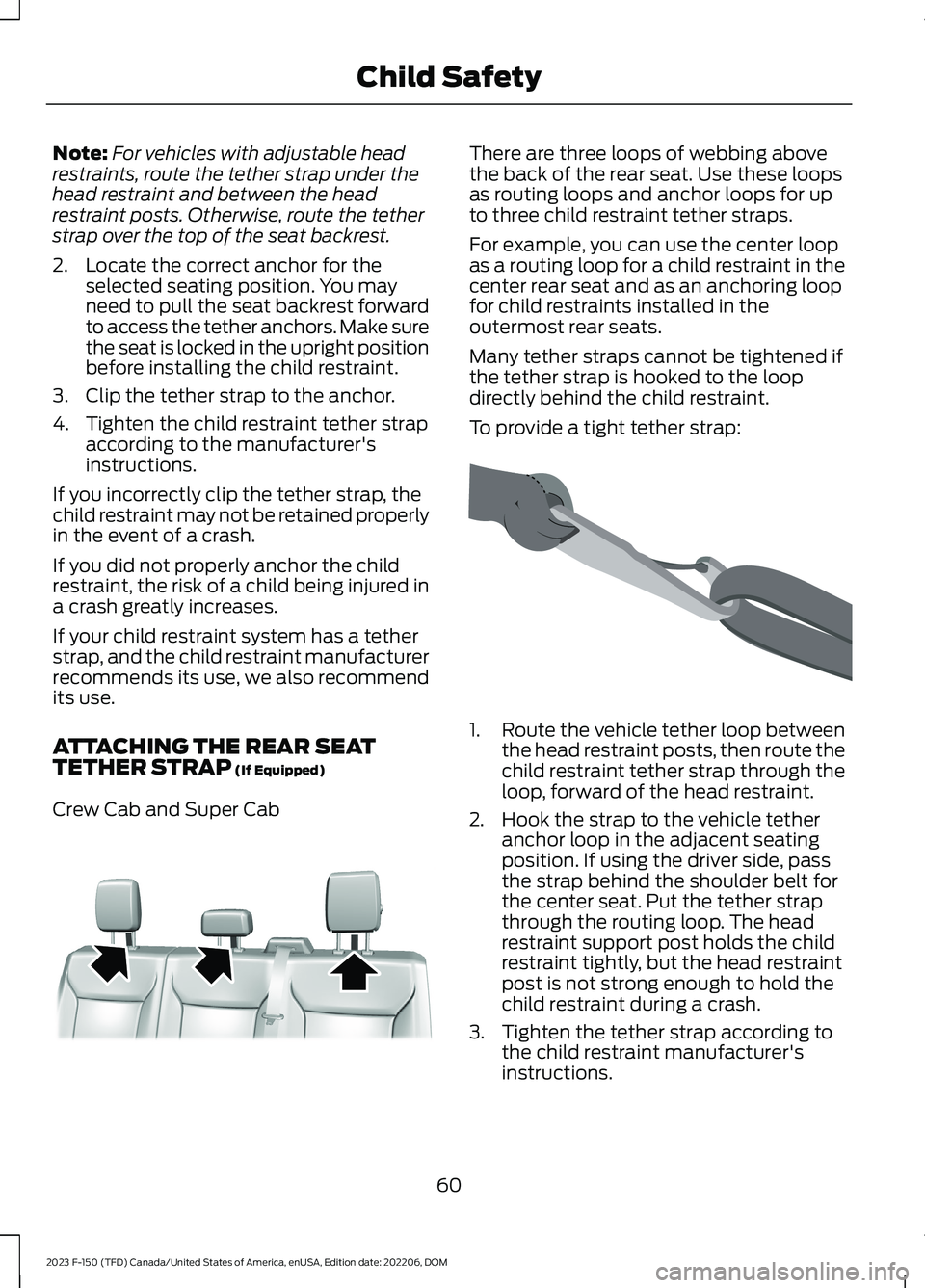
ATTACHING THE REAR SEATTETHER STRAP (If Equipped)
Crew Cab and Super Cab
There are three loops of webbing abovethe back of the rear seat. Use these loopsas routing loops and anchor loops for upto three child restraint tether straps.
For example, you can use the center loopas a routing loop for a child restraint in thecenter rear seat and as an anchoring loopfor child restraints installed in theoutermost rear seats.
Many tether straps cannot be tightened ifthe tether strap is hooked to the loopdirectly behind the child restraint.
To provide a tight tether strap:
1.Route the vehicle tether loop betweenthe head restraint posts, then route thechild restraint tether strap through theloop, forward of the head restraint.
2.Hook the strap to the vehicle tetheranchor loop in the adjacent seatingposition. If using the driver side, passthe strap behind the shoulder belt forthe center seat. Put the tether strapthrough the routing loop. The headrestraint support post holds the childrestraint tightly, but the head restraintpost is not strong enough to hold thechild restraint during a crash.
3.Tighten the tether strap according tothe child restraint manufacturer'sinstructions.
60
2023 F-150 (TFD) Canada/United States of America, enUSA, Edition date: 202206, DOMChild SafetyE309318 E309384
Page 65 of 786
If you did not properly anchor the childrestraint, the risk of a child being injured ina crash greatly increases.
If your child restraint system has a tetherstrap, and the child restraint manufacturerrecommends its use, we also recommendits use.
BOOSTER SEATS
Use a belt-positioning booster seat forchildren who have outgrown or no longerproperly fit in a child restraint and meetthe following criteria.
•Generally children who are less than57 in (1.45 m) tall.
•Are greater than age four (4) and lessthan age twelve (12).
•Are between 40 lb (18 kg) and 80 lb(36 kg) and upward to 100 lb (45 kg).
Many state and provincial laws require thatchildren use approved booster seats untilthey reach age eight, a height of 57 in(1.45 m) tall, or 80 lb (36 kg).
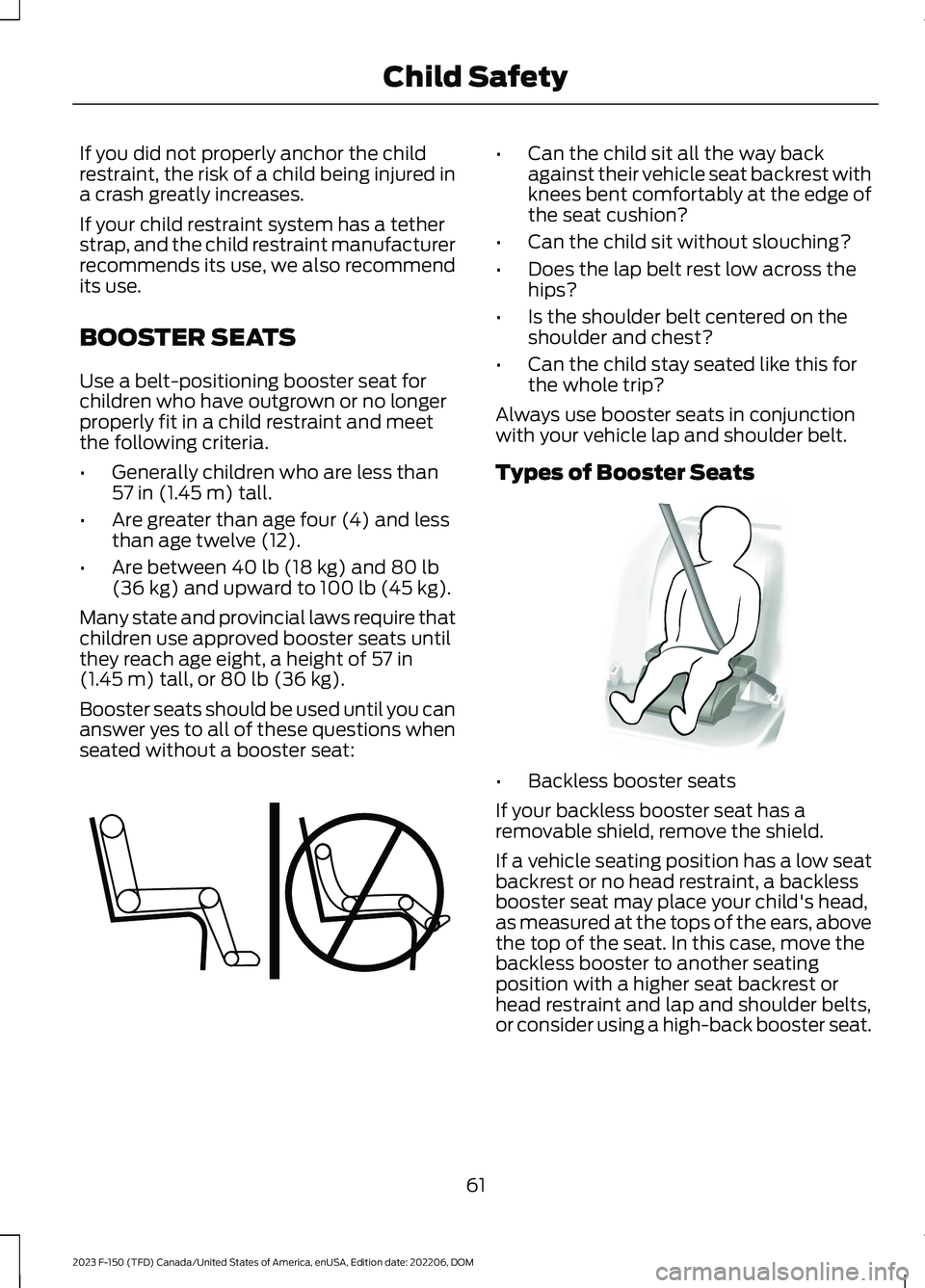
Booster seats should be used until you cananswer yes to all of these questions whenseated without a booster seat:
•Can the child sit all the way backagainst their vehicle seat backrest withknees bent comfortably at the edge ofthe seat cushion?
•Can the child sit without slouching?
•Does the lap belt rest low across thehips?
•Is the shoulder belt centered on theshoulder and chest?
•Can the child stay seated like this forthe whole trip?
Always use booster seats in conjunctionwith your vehicle lap and shoulder belt.
Types of Booster Seats
•Backless booster seats
If your backless booster seat has aremovable shield, remove the shield.
If a vehicle seating position has a low seatbackrest or no head restraint, a backlessbooster seat may place your child's head,as measured at the tops of the ears, abovethe top of the seat. In this case, move thebackless booster to another seatingposition with a higher seat backrest orhead restraint and lap and shoulder belts,or consider using a high-back booster seat.
61
2023 F-150 (TFD) Canada/United States of America, enUSA, Edition date: 202206, DOMChild SafetyE142595 E68924
Page 66 of 786
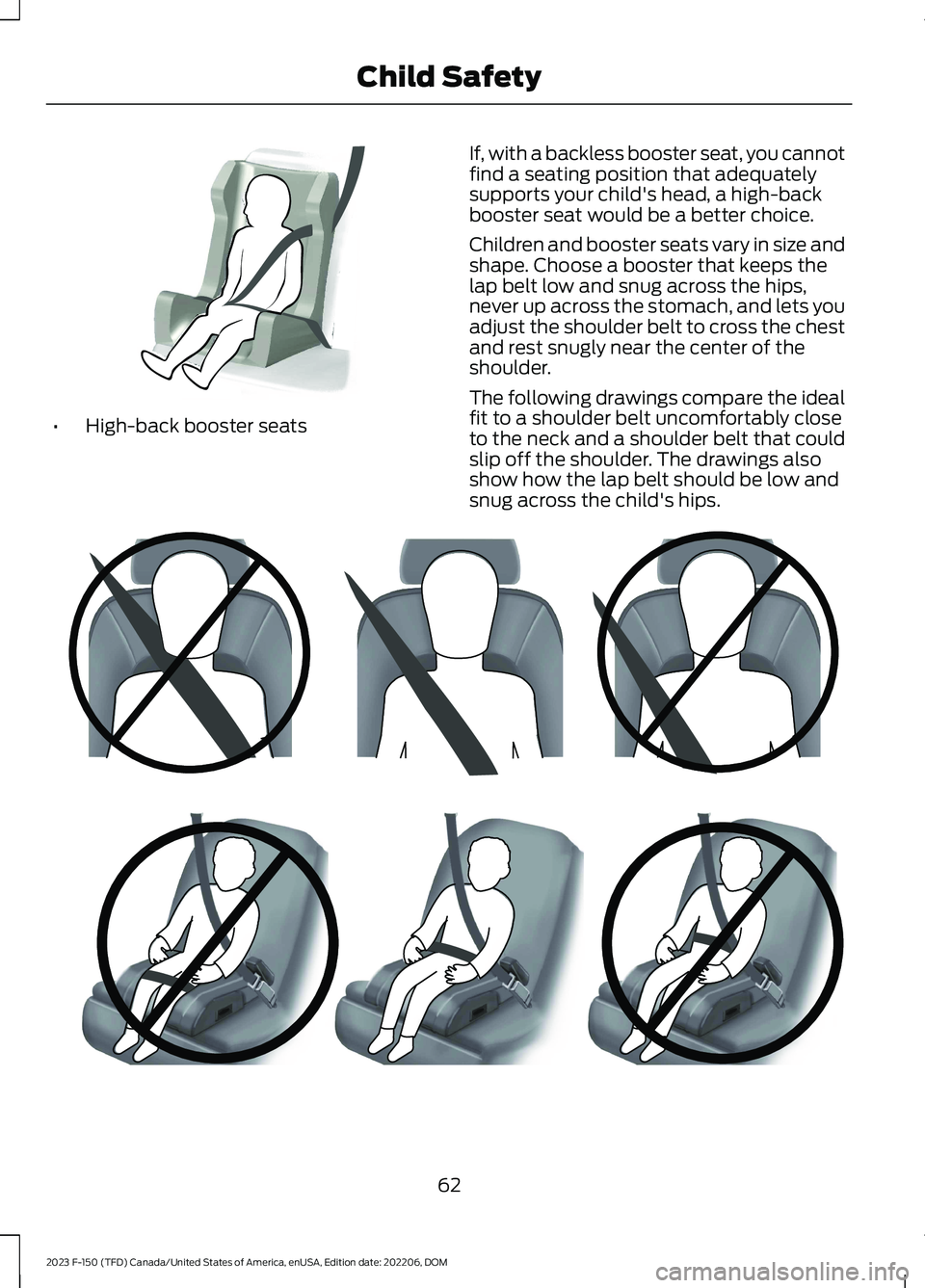
•High-back booster seats
If, with a backless booster seat, you cannotfind a seating position that adequatelysupports your child's head, a high-backbooster seat would be a better choice.
Children and booster seats vary in size andshape. Choose a booster that keeps thelap belt low and snug across the hips,never up across the stomach, and lets youadjust the shoulder belt to cross the chestand rest snugly near the center of theshoulder.
The following drawings compare the idealfit to a shoulder belt uncomfortably closeto the neck and a shoulder belt that couldslip off the shoulder. The drawings alsoshow how the lap belt should be low andsnug across the child's hips.
62
2023 F-150 (TFD) Canada/United States of America, enUSA, Edition date: 202206, DOMChild SafetyE70710 E142596 E142597
Page 68 of 786
SEATBELT PRECAUTIONS
WARNING: Always drive and ridewith your seatback upright and the lapbelt snug and low across the hips.
WARNING: Children must alwaysbe properly restrained.
WARNING: Do not allow apassenger to hold a child on their lapwhen your vehicle is moving. Failure tofollow this instruction could result inpersonal injury or death in the event of asudden stop or crash.
WARNING: All occupants of yourvehicle, including the driver, shouldalways properly wear their seatbelts,even when an airbag supplementalrestraint system is provided. Failure toproperly wear your seatbelt couldseriously increase the risk of injury ordeath.
WARNING: It is extremelydangerous to ride in a cargo area, insideor outside of a vehicle. In a crash, peopleriding in these areas are more likely to beseriously injured or killed. Do not allowpeople to ride in any area of your vehiclethat is not equipped with seats andseatbelts. Make sure everyone in yourvehicle is in a seat and properly using aseatbelt. Failure to follow this warningcould result in serious personal injury ordeath.
WARNING: In a rollover crash, anunbelted person is significantly morelikely to die than a person wearing aseatbelt.
WARNING: Each seating positionin your vehicle has a specific seatbeltassembly made up of one buckle andone tongue designed to be used as a pair.Use the shoulder belt on the outsideshoulder only. Never wear the shoulderbelt under the arm. Never use a singleseatbelt for more than one person.
WARNING: Even with advancedrestraints systems, properly restrainchildren 12 and under in a rear seatingposition. Failure to follow this couldseriously increase the risk of injury ordeath.
WARNING: Seatbelts and seatsmay be hot in a vehicle that is in thesunshine. The hot seatbelts or seats mayburn a small child. Check seat covers andbuckles before you place a childanywhere near them.
WARNING: If your vehicle isinvolved in a crash, have the seatbeltsand associated components inspectedas soon as possible. Failure to follow thisinstruction could result in personal injuryor death.
All seating positions in this vehicle haveseatbelts. All occupants of the vehicleshould properly wear their seatbelts, evenwhen an airbag supplemental restraintsystem is provided.
The seatbelt system consists of:
•Lap and shoulder seatbelts.
•A shoulder seatbelt with automaticlocking mode, except driver seatbelt.
•Height adjusters at the front outermostseating positions.
•Seatbelt pretensioners at the frontoutermost and rear outermost seatingpositions.
64
2023 F-150 (TFD) Canada/United States of America, enUSA, Edition date: 202206, DOMSeatbelts
Page 78 of 786
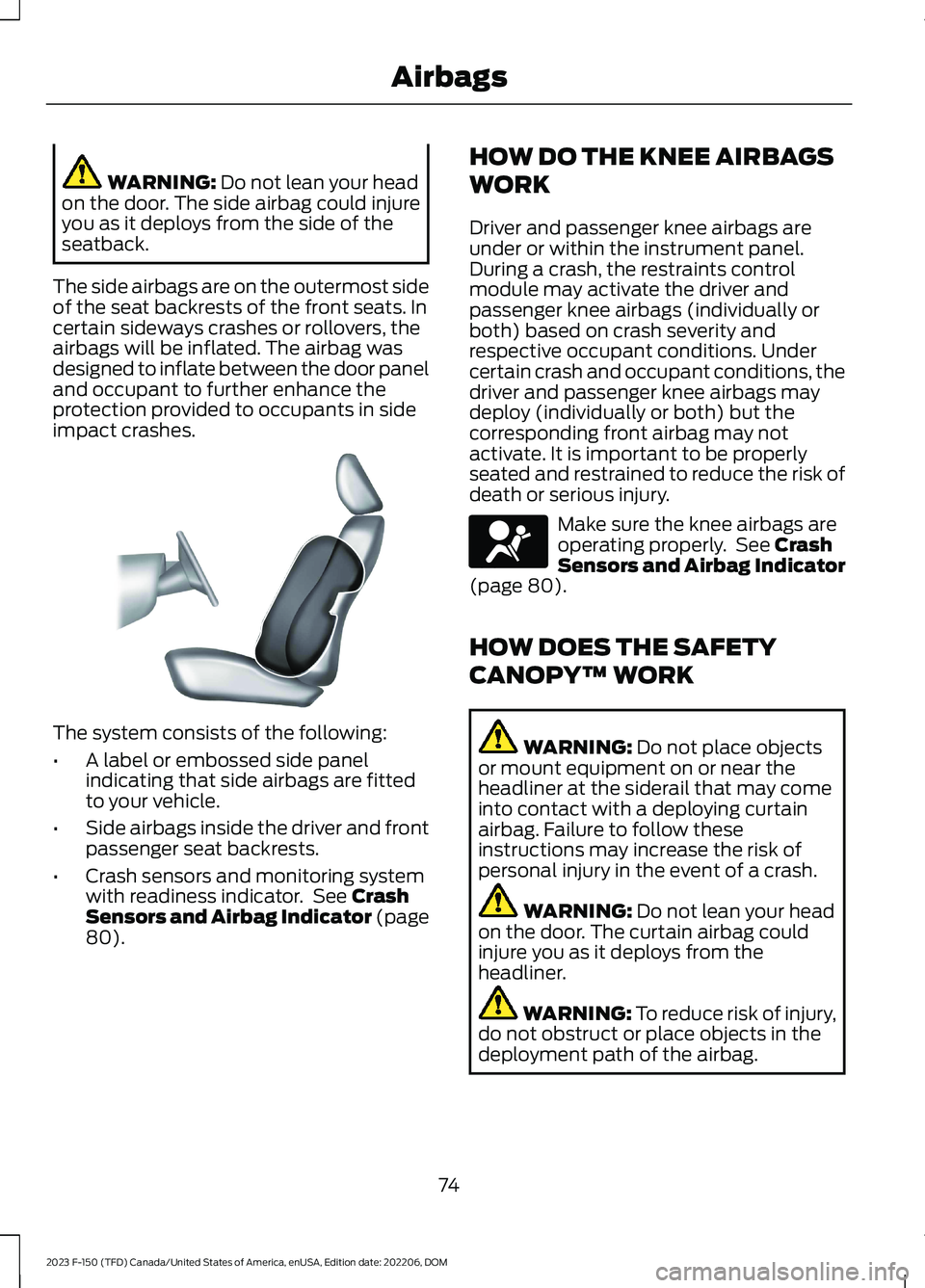
WARNING: Do not lean your headon the door. The side airbag could injureyou as it deploys from the side of theseatback.
The side airbags are on the outermost sideof the seat backrests of the front seats. Incertain sideways crashes or rollovers, theairbags will be inflated. The airbag wasdesigned to inflate between the door paneland occupant to further enhance theprotection provided to occupants in sideimpact crashes.
The system consists of the following:
•A label or embossed side panelindicating that side airbags are fittedto your vehicle.
•Side airbags inside the driver and frontpassenger seat backrests.
•Crash sensors and monitoring systemwith readiness indicator. See CrashSensors and Airbag Indicator (page80).
HOW DO THE KNEE AIRBAGS
WORK
Driver and passenger knee airbags areunder or within the instrument panel.During a crash, the restraints controlmodule may activate the driver andpassenger knee airbags (individually orboth) based on crash severity andrespective occupant conditions. Undercertain crash and occupant conditions, thedriver and passenger knee airbags maydeploy (individually or both) but thecorresponding front airbag may notactivate. It is important to be properlyseated and restrained to reduce the risk ofdeath or serious injury.
Make sure the knee airbags areoperating properly. See CrashSensors and Airbag Indicator(page 80).
HOW DOES THE SAFETY
CANOPY™ WORK
WARNING: Do not place objectsor mount equipment on or near theheadliner at the siderail that may comeinto contact with a deploying curtainairbag. Failure to follow theseinstructions may increase the risk ofpersonal injury in the event of a crash.
WARNING: Do not lean your headon the door. The curtain airbag couldinjure you as it deploys from theheadliner.
WARNING: To reduce risk of injury,do not obstruct or place objects in thedeployment path of the airbag.
74
2023 F-150 (TFD) Canada/United States of America, enUSA, Edition date: 202206, DOMAirbagsE152533 E67017
Page 79 of 786
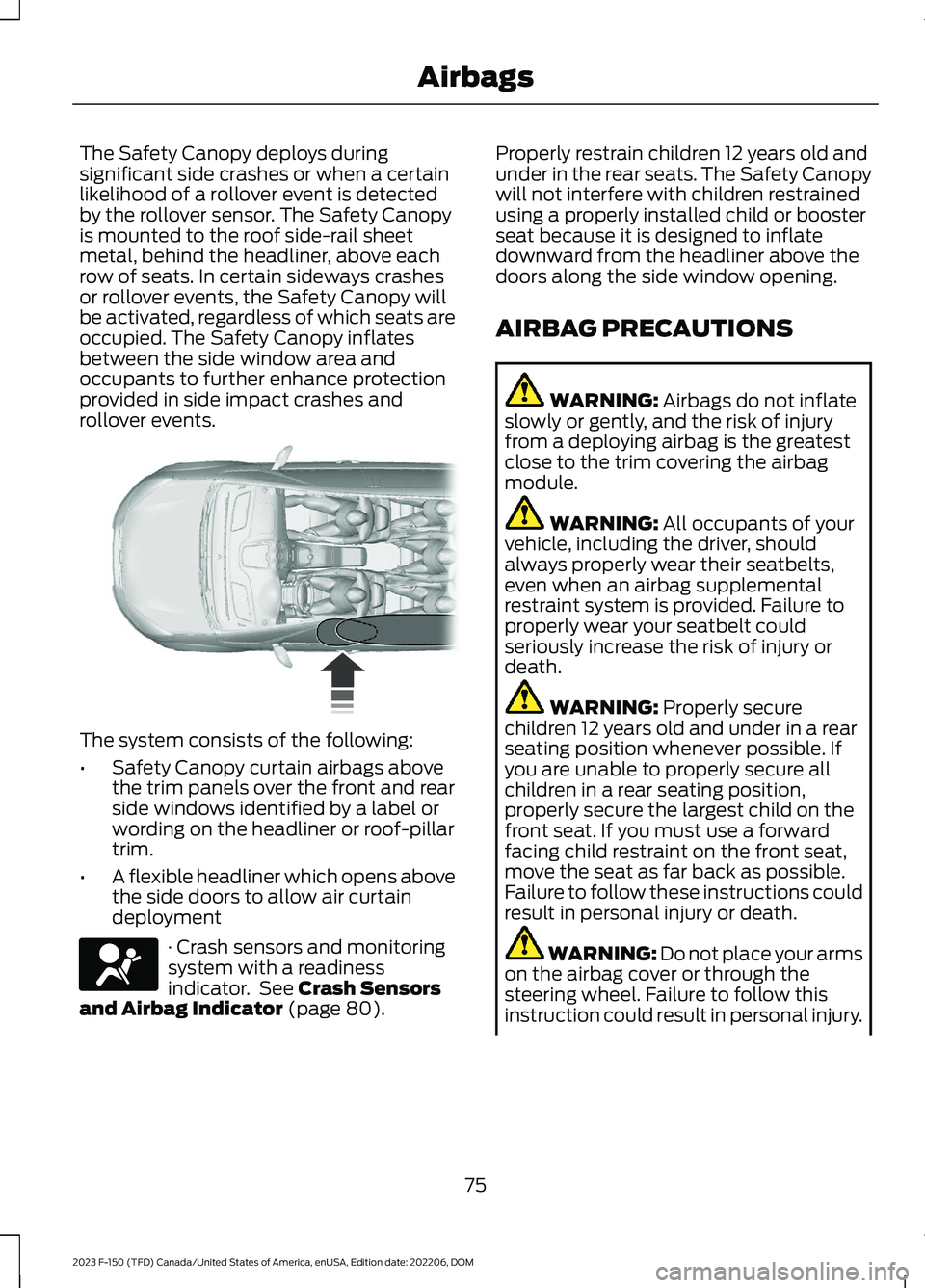
The Safety Canopy deploys duringsignificant side crashes or when a certainlikelihood of a rollover event is detectedby the rollover sensor. The Safety Canopyis mounted to the roof side-rail sheetmetal, behind the headliner, above eachrow of seats. In certain sideways crashesor rollover events, the Safety Canopy willbe activated, regardless of which seats areoccupied. The Safety Canopy inflatesbetween the side window area andoccupants to further enhance protectionprovided in side impact crashes androllover events.
The system consists of the following:
•Safety Canopy curtain airbags abovethe trim panels over the front and rearside windows identified by a label orwording on the headliner or roof-pillartrim.
•A flexible headliner which opens abovethe side doors to allow air curtaindeployment
· Crash sensors and monitoringsystem with a readinessindicator. See Crash Sensorsand Airbag Indicator (page 80).
Properly restrain children 12 years old andunder in the rear seats. The Safety Canopywill not interfere with children restrainedusing a properly installed child or boosterseat because it is designed to inflatedownward from the headliner above thedoors along the side window opening.
AIRBAG PRECAUTIONS
WARNING: Airbags do not inflateslowly or gently, and the risk of injuryfrom a deploying airbag is the greatestclose to the trim covering the airbagmodule.
WARNING: All occupants of yourvehicle, including the driver, shouldalways properly wear their seatbelts,even when an airbag supplementalrestraint system is provided. Failure toproperly wear your seatbelt couldseriously increase the risk of injury ordeath.
WARNING: Properly securechildren 12 years old and under in a rearseating position whenever possible. Ifyou are unable to properly secure allchildren in a rear seating position,properly secure the largest child on thefront seat. If you must use a forwardfacing child restraint on the front seat,move the seat as far back as possible.Failure to follow these instructions couldresult in personal injury or death.
WARNING: Do not place your armson the airbag cover or through thesteering wheel. Failure to follow thisinstruction could result in personal injury.
75
2023 F-150 (TFD) Canada/United States of America, enUSA, Edition date: 202206, DOMAirbags E75004 E67017
Page 80 of 786
WARNING: Keep the areas in frontof the airbags free from obstruction. Donot affix anything to or over the airbagcovers. Objects could become projectilesduring airbag deployment. Failure tofollow this instruction could result inpersonal injury or death.
WARNING: To reduce risk of injury,do not obstruct or place objects in thedeployment path of the airbag.
WARNING: Do not place arearward facing child restraint in front ofan active airbag. Failure to follow thisinstruction could result in personal injuryor death.
WARNING: Do not attempt toservice, repair, or modify thesupplementary restraint system orassociated components. Failure tofollow this instruction could result inpersonal injury or death.
WARNING: Several airbag systemcomponents get hot after inflation. Toreduce the risk of injury, do not touchthem after inflation.
WARNING: If a supplementaryrestraint system component hasdeployed, it will not function again. Havethe system and associated componentsinspected as soon as possible. Failure tofollow this instruction could result inpersonal injury or death.
PROPERLY ADJUSTING THE
DRIVER AND FRONT
PASSENGER SEATS
WARNING: National HighwayTraffic Safety Administration (NHTSA)recommends a minimum distance of atleast 10 in (25 cm) between anoccupant's chest and the driver airbagmodule.
To properly position yourself away fromthe airbag:
•Move your seat to the rear as far as youcan while still reaching the pedalscomfortably.
•Recline the seat slightly one or twodegrees from the upright position.
After all occupants have adjusted theirseats and put on seatbelts, it is veryimportant that they continue to sitproperly. Properly seated occupants situpright, lean against the seat backrest, andcenter themselves on the seat cushion,with their feet comfortably extended onthe floor. Sitting improperly can increasethe chance of injury in a crash event. Forexample, if an occupant slouches, liesdown, turns sideways, sits forward, leansforward or sideways, or puts one or bothfeet up, the chance of injury during a crashgreatly increases.
CHILDREN AND AIRBAGS
WARNING: Do not place arearward facing child restraint in front ofan active airbag. Failure to follow thisinstruction could result in personal injuryor death.
76
2023 F-150 (TFD) Canada/United States of America, enUSA, Edition date: 202206, DOMAirbags
Page 81 of 786
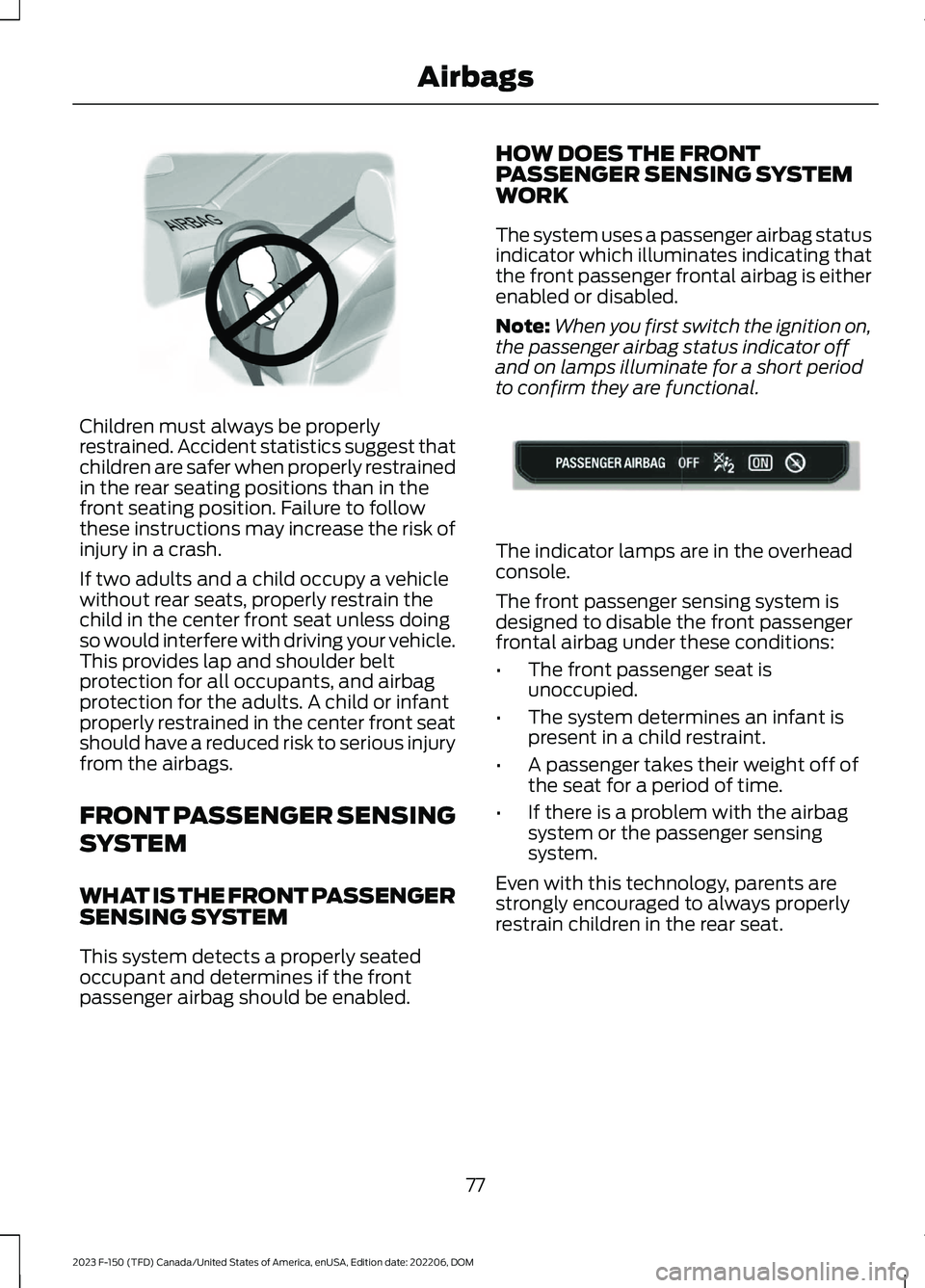
Children must always be properlyrestrained. Accident statistics suggest thatchildren are safer when properly restrainedin the rear seating positions than in thefront seating position. Failure to followthese instructions may increase the risk ofinjury in a crash.
If two adults and a child occupy a vehiclewithout rear seats, properly restrain thechild in the center front seat unless doingso would interfere with driving your vehicle.This provides lap and shoulder beltprotection for all occupants, and airbagprotection for the adults. A child or infantproperly restrained in the center front seatshould have a reduced risk to serious injuryfrom the airbags.
FRONT PASSENGER SENSING
SYSTEM
WHAT IS THE FRONT PASSENGERSENSING SYSTEM
This system detects a properly seatedoccupant and determines if the frontpassenger airbag should be enabled.
HOW DOES THE FRONTPASSENGER SENSING SYSTEMWORK
The system uses a passenger airbag statusindicator which illuminates indicating thatthe front passenger frontal airbag is eitherenabled or disabled.
Note:When you first switch the ignition on,the passenger airbag status indicator offand on lamps illuminate for a short periodto confirm they are functional.
The indicator lamps are in the overheadconsole.
The front passenger sensing system isdesigned to disable the front passengerfrontal airbag under these conditions:
•The front passenger seat isunoccupied.
•The system determines an infant ispresent in a child restraint.
•A passenger takes their weight off ofthe seat for a period of time.
•If there is a problem with the airbagsystem or the passenger sensingsystem.
Even with this technology, parents arestrongly encouraged to always properlyrestrain children in the rear seat.
77
2023 F-150 (TFD) Canada/United States of America, enUSA, Edition date: 202206, DOMAirbagsE142846 E181984
Page 82 of 786
•When the front passenger sensingsystem disables the front passengerfrontal airbag, the passenger airbagstatus indicator illuminates the offlamp.
•If you have installed the child restraintand the passenger airbag statusindicator illuminates the on lamp,switch your vehicle off, remove thechild restraint from your vehicle andreinstall the restraint following thechild restraint manufacturer'sinstructions.
The front passenger sensing system workswith sensors that are part of the frontpassenger seat and seatbelt. The sensorsare designed to detect the presence of aproperly seated occupant and determineif the front passenger frontal airbag shouldbe enabled.
•When the front passenger sensingsystem enables the front passengerfrontal airbag, the passenger airbagstatus indicator illuminates the onlamp.
If a person of adult size is sitting in the frontpassenger seat, but the passenger airbagstatus indicator off lamp is illuminated, itis possible that the person is not sittingproperly in the seat. If this happens:
•Switch your vehicle off and ask theperson to place the seat backrest in anupright position.
•Have the person sit upright in the seat,centered on the seat cushion, with theperson's legs comfortably extended.
•Restart your vehicle and have theperson remain in this position for abouttwo minutes. This allows the systemto detect that person and enable thepassenger frontal airbag.
•If the indicator off lamp remainsilluminated even after this, you shouldadvise the person to ride in the rearseat.
After all occupants have adjusted theirseats and put on seatbelts, it is veryimportant that they continue to sit upright,leaning against the seat backrest, andcentered on the seat cushion, with theirfeet comfortably extended on the floor.
Sitting improperly can increase the chanceof injury in a crash event. For example, ifan occupant slouches, lies down, turnssideways, sits forward, leans forward orsideways, or puts one or both feet up, thechance of injury during a crash greatlyincreases.
If you think that the state of the passengerairbag status indicator lamp is incorrect,check for the following:
•Objects lodged underneath the seat.
•Objects between the seat cushion andthe center console.
•Objects hanging off the seat backrest.
•Objects stowed in the seat backrestmap pocket.
•Objects placed on the occupant's lap.
•Cargo interference with the seat
•Other passengers pushing or pulling onthe seat.
•Rear passenger feet and knees restingor pushing on the seat.
The listed conditions could cause theweight of a properly seated occupant tobe incorrectly interpreted by the frontpassenger sensing system. The person inthe front passenger seat could appearheavier or lighter due to the conditionslisted.
Make sure the front passengersensing system is operatingproperly. See Crash Sensorsand Airbag Indicator (page 80).
If the airbag readiness light is on, do thefollowing:
78
2023 F-150 (TFD) Canada/United States of America, enUSA, Edition date: 202206, DOMAirbagsE67017
Page 86 of 786
•The knee airbag(s) may deploy basedon crash severity and occupantconditions.
•The Safety Canopy inflates in certainside impact crashes or rollover events.The Safety Canopy may activate inother types of crashes if the vehicleexperiences sufficient sideways motionor deformation, or a certain likelihoodof rollover.
Airbags and Police Equipment
WARNING: Do not place objectsor mount equipment on or near theairbag cover, on the side of the front orrear seatbacks, or in areas that maycome into contact with a deployingairbag. Failure to follow theseinstructions may increase the risk ofpersonal injury in the event of a crash.
WARNING: Keep the areas in frontof the airbags free from obstruction. Donot affix anything to or over the airbagcovers. Objects could become projectilesduring airbag deployment. Failure tofollow this instruction could result inpersonal injury or death.
Dual driver and passenger airbags, sideairbags and knee airbags affect the waypolice equipment can be mounted in policevehicles.
Any surfaces that could come into contactwith an airbag, once it has deployed, mustnot damage the airbag or alter itsdeployment path.
Once the airbag has fully deployed, anyperipheral equipment surfaces that couldcome into contact with the airbag, such aswhen the airbag deflates with the loadingof an occupant, must not damage theairbag or alter its deployment path. Sharpedges, corners or protrusions coulddamage the nylon airbag material andreduce the effectiveness of the airbag.
Some approximate dimensions for airbags,at full inflation, are provided. Thesedimensions are somewhat flexible andrepresent free form deployments withoutthe loading of occupants. The shadedareas in Figures 8 through 10 representavailable police equipment mountingzones. These zones are shown for policevehicles with standard bucket seats. Thezone dimensions provided in Figures 8through 10 are approximate and will varywith the loading of occupants in the seats.
All airbag and equipment mounting zonedimensions are approximate due todifferent airbag deploymentcharacteristics.
Do not mount equipment between the sideof the front seat and the door trim that willblock deployment of the side airbag.
Do not mount equipment between theseats and the body side as shown in Figure7 that would prevent the side curtain airbagfrom achieving occupant coverage.
82
2023 F-150 (TFD) Canada/United States of America, enUSA, Edition date: 202206, DOMAirbags