warning FORD F150 2023 Owners Manual
[x] Cancel search | Manufacturer: FORD, Model Year: 2023, Model line: F150, Model: FORD F150 2023Pages: 786, PDF Size: 23.15 MB
Page 549 of 786
WARNING: Only usereplacement tires and wheelsthat are the same size, loadindex, speed rating, and type asthose originally provided for yourvehicle. The recommended tireand wheel sizes can be found onthe Tire Label on the driver sidedoor frame or the edge of thedriver door. If this information isnot found in those locations, orfor additional options, contactyour authorized dealer. Use ofany tire or wheel notrecommended, could affect thesafety and performance of yourvehicle, which could result in anincreased risk of loss of vehiclecontrol, vehicle rollover, personalinjury and death.
WARNING: To reduce therisk of serious injury, whenmounting replacement tires andwheels, you should not exceedthe maximum pressure indicatedon the sidewall of the tire to setthe beads without additionalprecautions listed below. If thebeads do not seat at themaximum pressure indicated,re-lubricate and try again.
WARNING: For a mountingpressure more than 20 psi(1.38 bar) greater than themaximum pressure, a Forddealer or other tire serviceprofessional should do themounting.
WARNING: Always inflatesteel carcass tires with a remoteair fill with the person inflatingstanding at a minimum of 12 ft(3.66 m) away from the wheeland tire assembly.
WARNING: When inflatingthe tire for mounting pressuresup to 20 psi (1.38 bar) greaterthan the maximum pressure onthe tire sidewall, the followingprecautions must be taken toprotect the person mounting thetire:
•Make sure that you have thecorrect tire and wheel size.
•Lubricate the tire bead and
wheel bead seat area again.
•Stand at a minimum of 12 ft(3.66 m) away from the wheeland tire assembly.
•Use both eye and earprotection.
Important: Remember to replacethe wheel valve stems when theroad tires are replaced on yourvehicle.
It is recommended that the two
front tires or two rear tiresgenerally be replaced as a pair ifthe worn tires still have usabledepth.
545
2023 F-150 (TFD) Canada/United States of America, enUSA, Edition date: 202206, DOMWheel and Tire Information
Page 550 of 786
To avoid potential Four-WheelDrive (4WD) malfunction or(4WD) system damage, it isrecommended to replace all fourtires rather than mixingsignificantly worn tires with newtires.
The tire pressure sensors mountedin the wheels (originally installedon your vehicle) are not designedto be used in aftermarket wheels.
The use of wheels or tires notrecommended may affect theoperation of your tire pressuremonitoring system.
If the tire pressure monitoringsystem indicator is flashing, yoursystem is malfunctioning. Yourreplacement tire might beincompatible with your tirepressure monitoring system, orsome component of the systemmay be damaged.
USING SNOW CHAINS
WARNING: Do not exceed 30 mph(50 km/h). Failure to follow thisinstruction could result in the loss ofcontrol of your vehicle, personal injury ordeath.
WARNING: Do not use snow chainson snow-free roads.
WARNING: Only fit snow chains tospecified tires.
WARNING: If your vehicle is fittedwith wheel trims, remove them beforefitting snow chains.
WARNING: If you choose to installsnow tires on your vehicle, they must bethe same size, construction, and loadrange as the original tires listed on thetire placard, and they must be installedon all four wheels. Mixing tires ofdifferent size or construction on yourvehicle can adversely affect yourvehicle's handling and braking, and maylead to loss of vehicle control.
WARNING: Wheels and tires mustbe the same size, load index and speedrating as those originally fitted on thevehicle. Use of any other tire or wheelcan affect the safety and performanceof your vehicle. Additionally, the use ofnon-recommended tires and wheels cancause steering, suspension, axle, transfercase or power transfer unit failure.Follow the recommended tire inflationpressures found on the SafetyCompliance Certification label, or theTire Label on the B-Pillar or the edge ofthe driver door. Failure to follow thisinstruction could result in loss of vehiclecontrol, vehicle rollover, or personal injuryor death.
Only use snow chains on rear wheels.Install snow chains in pairs. Do not useself-tensioning snow chains.
Only use snow chains on the followingspecified tire sizes. Only install chains thatare 15mm or less (SAE Class S chains).
•245/70R17
•265/70R17
•LT265/70R17
•265/60R18
•LT265/70R18
We recommend you use steel wheels ofthe same size and specification if snowchains are required because chains maychip aluminum wheels.
546
2023 F-150 (TFD) Canada/United States of America, enUSA, Edition date: 202206, DOMWheel and Tire Information
Page 552 of 786
•When installing wheels, always torquelug nuts to specification with a torquewrench.
•Inspect your wheels for damage on aregular basis. If you have a damagedwheel, replace it immediately.
•If you encounter an abnormally harshimpact, inspect the outside tire wall ofyour wheels, both inside and out, fordamage.
Note:Ford Performance only recommendsusing bead-lock rings from FordPerformance Parts, in conjunction with theoriginal equipment manufacturer (OEM)tire. Any other combination using this wheelcould result in air loss or tire failure.
Note:Converting the bead-lock compatiblewheel to true bead-locks is for off-road useonly. We do not approve of the use of truebead-locks for on-road driving.
If your vehicles equipped with the optionalbead lock compatible wheel, you canconvert this wheel to use a true bead-lockring, which allows operation at low tirepressures when off-road to minimize therisk of de-beading the tire. See your localFord Performance Parts Dealer for moreinformation.
Tire Care
WARNING: Always re-inflate tiresto recommended tire pressures beforethe vehicle is operated on-road. Therecommended pressure is located on thetire label or safety certification label,located on the B-pillar, inside the driver'sdoor.
WARNING: After off-road use,before returning to the road, check thewheels and tires for damage. Off-roaduse may cause damage to your wheelsand tires that can lead to tire failure, lossof vehicle control, serious injury or death.
WARNING: Replace the wheelsand tires with the exact original brand,size and construction that cameoriginally on your vehicle. Use of anyother wheel or tire combinations, evenwith identical size ratings, may result ininsufficient running clearances, tirerubbing and eventual puncture. Failureto follow tire replacementrecommendations can lead to tire failure,loss of vehicle control, serious injury ordeath.
Note:If you have reduced your tire pressurefor off-road use, the tire pressure monitoringsystem (TPMS) warning light then activatesin the instrument panel as a reminder tore-inflate the tires before returning to theroad.
Your vehicle comes with high performance,all-terrain tires designed to optimizehandling, steering and braking to providethe performance you expect in a FordPerformance vehicle. These tires areoptimized for both on and off-roadperformance, and their ride, noise and wearcharacteristics are different from othertires. Also, because of their aggressivetread profile, it is important that youmaintain your tires properly.
548
2023 F-150 (TFD) Canada/United States of America, enUSA, Edition date: 202206, DOMWheel and Tire Information
Page 554 of 786
CHECKING THE TIRE
PRESSURES
Safe operation of your vehiclerequires that your tires areproperly inflated. Every day beforeyou drive, check your tires.
At least once a month and beforelong trips, inspect each tire andcheck the tire pressure with a tiregauge. Inflate all tires to therecommended inflation pressure.See Inflating the Tires (page550).
INFLATING THE TIRES
WARNING: Under-inflationis the most common cause oftire failures and may result insevere tire cracking, treadseparation or blowout, withunexpected loss of vehiclecontrol and increased risk ofinjury. Under-inflation increasessidewall flexing and rollingresistance, resulting in heatbuildup and internal damage tothe tire. It also may result inunnecessary tire stress, irregularwear, loss of vehicle control andaccidents. A tire can lose up tohalf of its air pressure and notappear to be flat!
WARNING: Do not use thetire pressure displayed in theinformation display as a tirepressure gauge. Failure to followthis instruction could result inpersonal injury or death.
Use the recommended coldinflation pressure for optimum tireperformance and wear.Under-inflation or over-inflationmay cause uneven treadwearpatterns.
Inflate your tires to therecommended inflation pressureeven if it is less than the maximuminflation pressure informationfound on the tire. You can find thetire label with the recommendedtire inflation pressure next to thetire size on the B-Pillar or the edgeof the driver door.
The recommended tire inflationpressure is also found on theSafety Compliance CertificationLabel, affixed to either the doorhinge pillar, door-latch post, or thedoor edge that meets thedoor-latch on the B-pillar, or onthe edge of the driver door.
Failure to follow the tire pressurerecommendations can causeuneven treadwear patterns andadversely affect the way yourvehicle handles.
550
2023 F-150 (TFD) Canada/United States of America, enUSA, Edition date: 202206, DOMTire Care
Page 555 of 786
INSPECTING THE TIRE FOR
WEAR
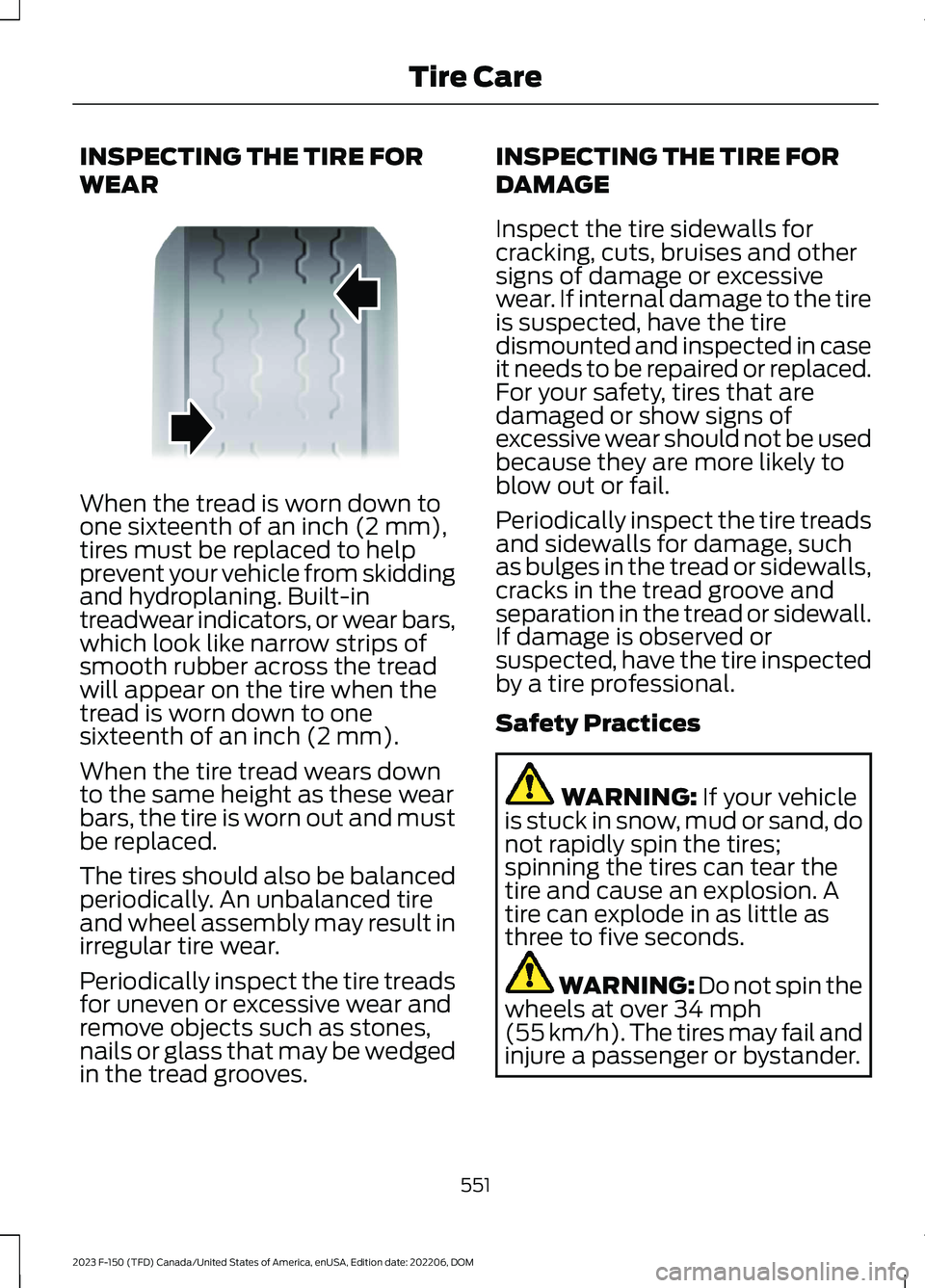
When the tread is worn down toone sixteenth of an inch (2 mm),tires must be replaced to helpprevent your vehicle from skiddingand hydroplaning. Built-intreadwear indicators, or wear bars,which look like narrow strips ofsmooth rubber across the treadwill appear on the tire when thetread is worn down to onesixteenth of an inch (2 mm).
When the tire tread wears downto the same height as these wearbars, the tire is worn out and mustbe replaced.
The tires should also be balancedperiodically. An unbalanced tireand wheel assembly may result inirregular tire wear.
Periodically inspect the tire treadsfor uneven or excessive wear andremove objects such as stones,nails or glass that may be wedgedin the tread grooves.
INSPECTING THE TIRE FOR
DAMAGE
Inspect the tire sidewalls forcracking, cuts, bruises and othersigns of damage or excessivewear. If internal damage to the tireis suspected, have the tiredismounted and inspected in caseit needs to be repaired or replaced.For your safety, tires that aredamaged or show signs ofexcessive wear should not be usedbecause they are more likely toblow out or fail.
Periodically inspect the tire treadsand sidewalls for damage, suchas bulges in the tread or sidewalls,cracks in the tread groove andseparation in the tread or sidewall.If damage is observed orsuspected, have the tire inspectedby a tire professional.
Safety Practices
WARNING: If your vehicleis stuck in snow, mud or sand, donot rapidly spin the tires;spinning the tires can tear thetire and cause an explosion. Atire can explode in as little as
three to five seconds.
WARNING: Do not spin thewheels at over 34 mph(55 km/h). The tires may fail andinjure a passenger or bystander.
551
2023 F-150 (TFD) Canada/United States of America, enUSA, Edition date: 202206, DOMTire CareE142546
Page 556 of 786
Highway Hazards
No matter how carefully you drive,there is always the possibility thatyou could eventually have a flattire on the highway. Drive slowlyto the closest safe area out oftraffic. This could further damagethe flat tire, but your safety ismore important.
If you feel a sudden vibration orride disturbance while driving, oryou suspect your tire or vehiclehas been damaged, immediatelyreduce your speed. Drive withcaution until you can safely pulloff the road. Stop and inspect thetires for damage. If a tire isunder-inflated or damaged,deflate it, remove the wheel andreplace it with your spare tire andwheel. If you cannot detect acause, have the vehicle towed tothe nearest repair facility or tiredealer to have the vehicleinspected.
Tire and Wheel Alignment
A bad jolt from hitting a curb orpothole can cause the front endof your vehicle to becomemisaligned or cause damage toyour tires. If your vehicle seems topull to one side when you aredriving, the wheels could be out ofalignment. Have an authorizeddealer check the wheel alignmentperiodically.
Wheel misalignment in the frontor the rear can cause uneven andrapid treadwear of your tires andshould be corrected by anauthorized dealer.
INSPECTING THE WHEEL
VALVE STEMS
Check the valve stems for holes,cracks, or cuts that could permitair leakage.
TIRE ROTATION
WARNING: If the tire labelshows different tire pressures forthe front and rear tires and thevehicle has a tire pressuremonitoring system, then youneed to update the settings forthe system sensors. Alwaysperform the system resetprocedure after tire rotation. Ifyou do not reset the system, itmay not provide a low tirepressure warning whennecessary.
Rotating your tires at therecommended interval will helpyour tires wear more evenly,providing better tire performanceand longer tire life.
Note:If your tires show any unevenwear have the alignment checkedby an authorized dealer beforerotating tires.
552
2023 F-150 (TFD) Canada/United States of America, enUSA, Edition date: 202206, DOMTire Care
Page 558 of 786
WHAT IS THE TIRE PRESSURE
MONITORING SYSTEM
The tire pressure monitoringsystem measures the vehicle'stire pressures. A warning lampilluminates if one or more tires aresignificantly underinflated or if there is asystem malfunction.
TIRE PRESSURE MONITORING
SYSTEM OVERVIEW
WARNING: Under-inflation is themost common cause of tire failures andmay result in severe tire cracking, treadseparation or blowout, with unexpectedloss of vehicle control and increased riskof injury. Under-inflation increasessidewall flexing and rolling resistance,resulting in heat buildup and internaldamage to the tire. It also may result inunnecessary tire stress, irregular wear,loss of vehicle control and accidents. Atire can lose up to half of its air pressureand not appear to be flat!
WARNING: To determine therequired pressure(s) for your vehicle, seethe Safety Compliance CertificationLabel (on the door hinge pillar,door-latch post or the door edge thatmeets the door-latch post, next to thedriver seat) or the Tire Label on theB-Pillar or the edge of the driver door.
Each tire, including the spare (if provided),should be checked monthly when cold andinflated to the inflation pressurerecommended by the vehicle manufactureron the vehicle placard or tire inflationpressure label. (If your vehicle has tires ofa different size than the size indicated onthe vehicle placard or tire inflation pressurelabel, you should determine the proper tireinflation pressure for those tires).
As an added safety feature, your vehiclehas been equipped with a Tire PressureMonitoring System (TPMS) thatilluminates a low tire pressure telltalewhen one or more of your tires issignificantly under-inflated. Accordingly,when the low tire pressure telltaleilluminates, you should stop and checkyour tires as soon as possible, and inflatethem to the proper pressure. Driving on asignificantly under-inflated tire causes thetire to overheat and can lead to tire failure.Under-inflation also reduces fuel efficiencyand tire tread life, and may affect thevehicle’s handling and stopping ability.
Please note that the TPMS is not asubstitute for proper tire maintenance, andit is the driver’s responsibility to maintaincorrect tire pressure, even if under-inflationhas not reached the level to triggerillumination of the TPMS low tire pressuretelltale.
Your vehicle has also been equipped witha TPMS malfunction indicator to indicatewhen the system is not operating properly.The TPMS malfunction indicator iscombined with the low tire pressuretelltale. When the system detects amalfunction, the telltale will flash forapproximately one minute and then remaincontinuously illuminated. This sequencewill continue upon subsequent vehiclestart-ups as long as the malfunction exists.
554
2023 F-150 (TFD) Canada/United States of America, enUSA, Edition date: 202206, DOMTire Pressure Monitoring SystemE139232
Page 559 of 786
When the malfunction indicator isilluminated, the system may not be ableto detect or signal low tire pressure asintended. TPMS malfunctions may occurfor a variety of reasons, including theinstallation of replacement or alternatetires or wheels on the vehicle that preventthe TPMS from functioning properly.Always check the TPMS malfunctiontelltale after replacing one or more tires orwheels on your vehicle to ensure that thereplacement or alternate tires and wheelsallow the TPMS to continue to functionproperly.
WARNING: Changes ormodifications not expressively approvedby the party responsible for compliancecould void the user's authority to operatethe equipment. The term "IC:" before theradio certification number only signifiesthat Industry Canada technicalspecifications were met.
This device complies with Part 15 of theFCC Rules and with License exempt RSSStandards of Industry Canada. Operationis subject to the following two conditions:
1.This device may not cause harmfulinterference, and
2.This device must accept anyinterference received, includinginterference that may cause undesiredoperation.
TIRE PRESSURE MONITORING
SYSTEM PRECAUTIONS
WARNING: The tire pressuremonitoring system is not a substitute formanually checking tire pressures. Youshould periodically check tire pressuresusing a pressure gauge. Failure tocorrectly maintain tire pressures couldincrease the risk of tire failure, loss ofcontrol, vehicle rollover and personalinjury.
WARNING: Do not use the tirepressure displayed in the informationdisplay as a tire pressure gauge. Failureto follow this instruction could result inpersonal injury or death.
Note:The use of tire sealants can damagethe tire pressure monitoring system.
Note:If the tire pressure monitor sensorbecomes damaged it may not function.
TIRE PRESSURE MONITORING
SYSTEM LIMITATIONS
When the outside temperature dropssignificantly, the tire pressure coulddecrease and activate the low tire pressurewarning lamp.
The warning lamp could also illuminatewhen you use a spare wheel, or tire sealantfrom the inflator kit.
Note:Regularly checking the vehicle tirepressures can reduce the possibility for thewarning lamp to illuminate due to outsideair temperature changes.
Note:After you inflate the tires to therecommended pressure it could take up totwo minutes of driving over 20 mph(32 km/h) for the warning indicator to turnoff.
555
2023 F-150 (TFD) Canada/United States of America, enUSA, Edition date: 202206, DOMTire Pressure Monitoring System
Page 560 of 786
VIEWING THE TIRE
PRESSURES
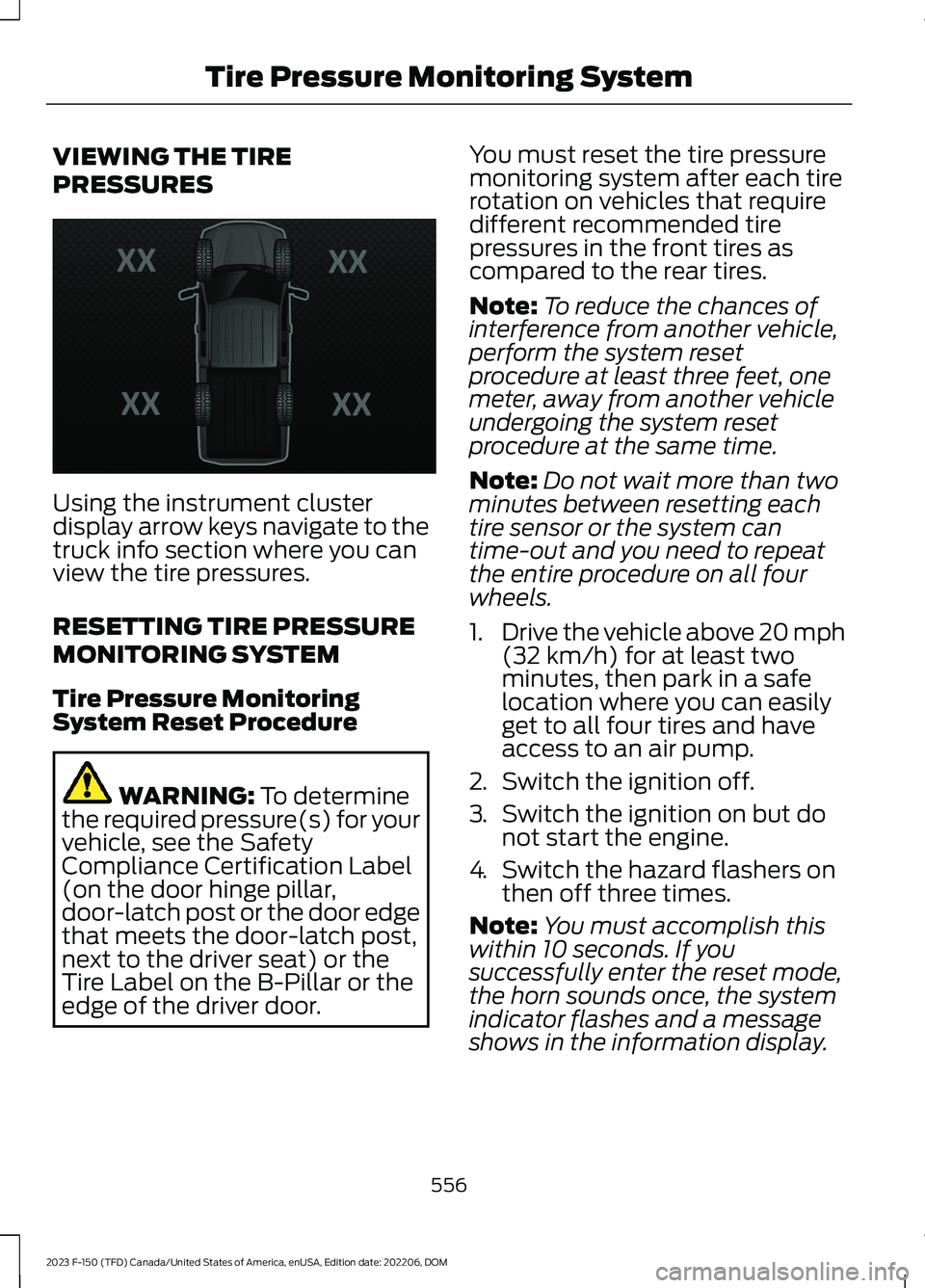
Using the instrument clusterdisplay arrow keys navigate to thetruck info section where you canview the tire pressures.
RESETTING TIRE PRESSURE
MONITORING SYSTEM
Tire Pressure MonitoringSystem Reset Procedure
WARNING: To determinethe required pressure(s) for yourvehicle, see the SafetyCompliance Certification Label(on the door hinge pillar,door-latch post or the door edge
that meets the door-latch post,next to the driver seat) or theTire Label on the B-Pillar or theedge of the driver door.
You must reset the tire pressuremonitoring system after each tirerotation on vehicles that requiredifferent recommended tirepressures in the front tires ascompared to the rear tires.
Note:To reduce the chances ofinterference from another vehicle,perform the system resetprocedure at least three feet, onemeter, away from another vehicleundergoing the system resetprocedure at the same time.
Note:Do not wait more than twominutes between resetting eachtire sensor or the system cantime-out and you need to repeatthe entire procedure on all fourwheels.
1.Drive the vehicle above 20 mph(32 km/h) for at least twominutes, then park in a safelocation where you can easilyget to all four tires and haveaccess to an air pump.
2.Switch the ignition off.
3.Switch the ignition on but donot start the engine.
4.Switch the hazard flashers onthen off three times.
Note:You must accomplish thiswithin 10 seconds. If yousuccessfully enter the reset mode,the horn sounds once, the systemindicator flashes and a messageshows in the information display.
556
2023 F-150 (TFD) Canada/United States of America, enUSA, Edition date: 202206, DOMTire Pressure Monitoring SystemE224333
Page 562 of 786
pressure sensors are mounted intoeach tire on your trailer. Thesensors send a message to yourvehicle indicating the currenttrailer tire pressure andtemperature.
If the trailer tire pressuremonitoring system detects that atire is low, a warning messageappears in the information display.The trailer tire information screenin the information displayhighlights the tire with a lowpressure.
If the trailer tire pressuremonitoring system detects that atire temperature is over temp, awarning message appears in theInformation display. The trailer tireinformation screen in theinformation display highlights thetire with a high temperature.
The main function of the trailer tirepressure monitoring system is towarn you when your trailer tiresneed air or if the tires areexperiencing high temperatures.It can also warn you in the eventthe system is no longer capableof functioning as intended. SeeTire Pressure MonitoringSystem – InformationMessages (page 560).
When a Temporary Spare orNew Tire is Installed
If you have replaced a trailer tirewith a new or spare tire, a warningmessage appears and pressurereadings are no longer displayedfor that tire.
To restore the full function of thetrailer tire pressure monitoringsystem:
•Have the damaged wheel andtire assembly repaired andremounted to your trailer.
•Install the trailer tire pressuremonitoring sensor into the newwheel and tire assembly.
•Perform the trailer tire pressuremonitoring system resetprocedure.
Trailer Tire PressureMonitoring System ResetProcedure
Note:You need to perform the tirepressure monitoring system resetprocedure after each tire rotation,or when a new trailer tire pressuresensor is installed into a trailer tire.
The trailer tire pressure monitoringsystem can be reset through themenu in the information display.See Tire Pressure MonitoringSystem – InformationMessages (page 560). Performingthe trailer setup process alsoresets the trailer tire pressuremonitoring system.
558
2023 F-150 (TFD) Canada/United States of America, enUSA, Edition date: 202206, DOMTire Pressure Monitoring System