tow FORD F250 1998 Owner's Manual
[x] Cancel search | Manufacturer: FORD, Model Year: 1998, Model line: F250, Model: FORD F250 1998Pages: 219, PDF Size: 1.65 MB
Page 120 of 219
must meet local and Federal
regulations.
Do not connect a trailer's
hydraulic brake system
directly to your vehicle's brake
system. Your vehicle may not
have enough braking power and
your chances of having a
collision greatly increase.
Trailer lamps
Trailer lamps are required on most
towed vehicles. Make sure your
trailer lamps conform to local and
Federal regulations. See your
dealer or trailer rental agency for
proper instructions and equipment
for hooking up trailer lamps.
Using a step bumper
The rear bumper is equipped with
an integral hitch and requires only
a ball with a 25.4 mm (one inch)
shank diameter. The bumper has a
2 270 kg (5 000 lb.) trailer weight
and 227 kg (500 lb.) tongue weight
capability.
If it is necessary to relocate the
trailer hitch ball position, a
frame-mounted trailer hitch must
be installed.
Driving while you tow
Do not drive faster than 88 km/h
(55 mph) when towing a trailer.
Speed control may shut off if you
are towing on long, steep grades.
When towing a trailer:
Driving
120
ProCarManuals.com
Page 121 of 219

²Use D (Drive) or a lower gear
when towing up or down steep
hills. This will eliminate
excessive downshifting and
upshifting for optimum fuel
economy and transmission
cooling.
²Anticipate stops and brake
gradually.
Servicing after towing
If you tow a trailer for long
distances, your vehicle will require
more frequent service intervals.
Refer to the Severe Duty Schedule
in your ªService Guideº for more
information.
Trailer towing tips
²Practice turning, stopping and
backing up in an area before
starting on a trip to get the feel
of the vehicle trailer
combination. When turning,
make wider turns so the trailer
wheels will clear curbs and
other obstacles.
²Allow more distance for
stopping with a trailer attached.
²The trailer tongue weight should
be 10±15% of the loaded trailer
weight.
²After you have traveled 80 km
(50 miles), thoroughly check
your hitch, electrical
connections and trailer wheel
lug nuts.
²When stopped in traffic for long
periods of time in hot weather,
place the gearshift in P (Park)
Driving
121
ProCarManuals.com
Page 123 of 219

Recreational towing (all wheels
on the ground)
Follow these guidelines for your
specific powertrain combination to
tow your vehicle with all four
wheels on the ground (such as
behind a recreational vehicle).
These guidelines are designed to
ensure that your transmission is
not damaged due to insufficient
lubrication.
2WD (manual and automatic
transmissions)
1. Place transmission in N
(Neutral).
2. Maximum speed is 56 km/h
(35 mph).
3. Maximum distance is 80 km
(50 miles).
If a distance of 80 km (50 miles)
or a speed of 56 km/h (35 mph)
must be exceeded, you must
disconnect the rear driveshaft.
With the rear driveshaft
disconnected, the maximum speed
is 88 km/h (55 mph) and there are
no mileage restrictions.
See your dealer for help with
disconnecting the driveshaft.
4WD ± Lever operated transfer
case (manual and automatic
transmissions)
1. Place transmission in P (Park).
2. Shift the transfer case to N
(Neutral).
Driving
123
ProCarManuals.com
Page 126 of 219

must not exceed the front
accessory reserve capacity.
²The total weight of the
snowplow and aftermarket
equipment must not exceed the
Total Accessory Reserve
Capacity.
²The weight of the installed
snowplow and aftermarket
equipment must not load the
vehicle beyond the GAWR
(front/rear) and GVWR listed on
the Safety Compliance
Certification Label.
²The total weight of the
snowplow and aftermarket
equipment must be considered
part of the payload and must
not exceed the Gross Combined
Weight Rating (GCWR) for
towing.
²Federal and most local
regulations require additional
exterior lamps for
snowplow-equipped vehicles.
Consult your dealer for
additional information.
²After installing a snowplow to
the vehicle, ensure the vehicle's
front toe alignment and front
ride height are within
specification (reset if required).
These specifications are located
in the vehicle's Workshop
Manual. Adherence to the toe,
tire pressures and ride height
specification is important for
proper tire wear, ride, handling
and headlight aim. Also,
Driving
126
ProCarManuals.com
Page 136 of 219

Fuse/Relay Location Fuse Amp Rating Description
14 15A Battery Saver Relay,
Interior Lamp Relay
15 5A Generic Electronic
Module (GEM)
16 20A Instrument Cluster
(W/O DRL), Daytime
Running Lamps (DRL)
Module, Hi-Beam
Headlamps (Power
supplied through
Multi-Function
Switch)
17 Ð Not Used
18 5A Park Lamp Relay,
Trailer Electronic
Brake Controller, Main
Light Switch, Trailer
Tow Run Relay, Front
Park/Turn Lamps,
License Lamps,
Stop/Park/Turn Lamps,
Tail/Side Marker
Lamps (Power
supplied through Main
Light Switch)
19 10A Instrument Cluster,
Air Bag Diagnostic
Monitor
20 5A Powertrain Control
Module (PCM),
Generic Electronic
Module (GEM)/Central
Timer Module (CTM)
Roadside emergencies
136
ProCarManuals.com
Page 137 of 219

Fuse/Relay Location Fuse Amp Rating Description
21 15A Clutch Pedal Position
(CPP) Switch (W/O
RAP), Starter
Interrupt Relay
(W/RAP)
22 10A Air Bag Diagnostic
Monitor, Passive
De-Activation (PAD)
Module
23 10A Trailer tow Battery
Charge Relay, 4X4
Hub Solenoid, 4X2
Hub Solenoid, Flasher
Relay, Shift on the Fly
Relay
24 10A Blower Relay
25 5A 4 Wheel Anti-Lock
Brake System
(4WABS) Module,
4WABS Relay
26 10A Daytime Running
Lamps (DRL) Module,
Right Headlamp
27 5A Main Light Switch,
Fog Lamp Relay
28 10A Left Headlamp
29 5A Autolamp Module,
Instrument Cluster,
Transmission Control
Switch (TCS), Brake
Warning
Resistor/Diode
Assembly (W/RABS)
Roadside emergencies
137
ProCarManuals.com
Page 139 of 219
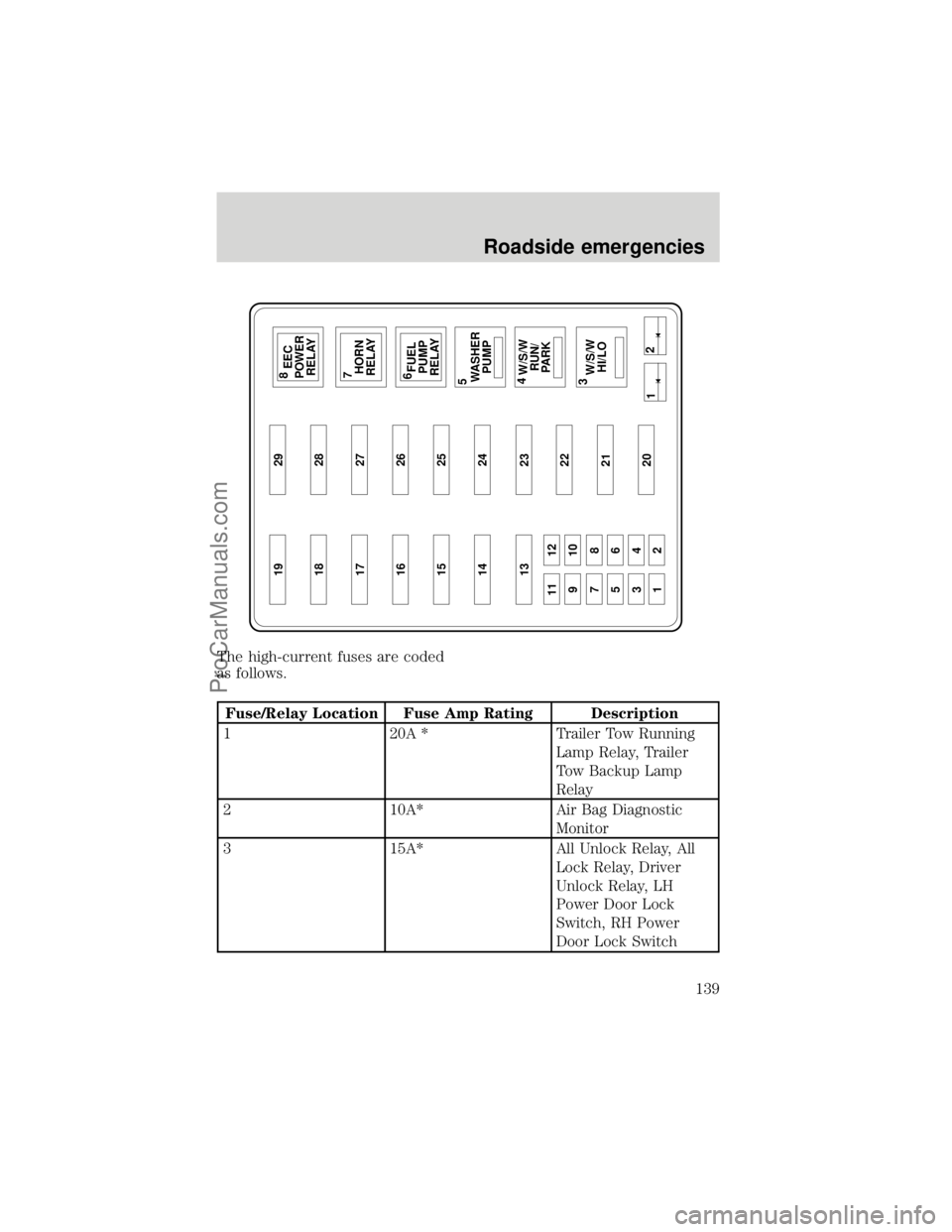
The high-current fuses are coded
as follows.
Fuse/Relay Location Fuse Amp Rating Description
1 20A * Trailer Tow Running
Lamp Relay, Trailer
Tow Backup Lamp
Relay
2 10A* Air Bag Diagnostic
Monitor
3 15A* All Unlock Relay, All
Lock Relay, Driver
Unlock Relay, LH
Power Door Lock
Switch, RH Power
Door Lock Switch
19 29
18 28EEC
POWER
RELAY
FUEL
PUMP
RELAY
WASHER
PUMP HORN
RELAY 17 27
16 26
15 25
14 24
13
11 12
910
77
88
55
66
33
44
11
22 23
22
21
20
W/S/W
RUN/
PARKW/S/W
HI/LO
Roadside emergencies
139
ProCarManuals.com
Page 140 of 219

Fuse/Relay Location Fuse Amp Rating Description
4 15A* Rear Air Suspension
(RAS)
5 20A* Horn Relay
6 15A* Radio, Premium Sound
Amplifier, CD Changer
7 15A* Main Light Switch,
Park Lamp Relay
8 30A* Main Light Switch,
Headlamp Relay,
Multi-Function Switch
9 15A* Daytime Running
Lamps (DRL) Module,
Fog Lamp Relay
10 25A* Auxiliary Power
Socket
11 Ð Not Used
12 Ð Not Used
13 Ð Not Used
14 60A**/20A** 4 Wheel Anti-Lock
Brake System
(4WABS)
Module/Ignition Switch
(W/RABS Only)
15 50A** Rear Air Suspension
Compressor
16 40A** Trailer Tow Battery
Charge Relay, Engine
Fuse Module (Fuse 2)
17 30A** Shift on the Fly Relay,
Transfer Case Shift
Relay
18 30A** Power Seat Control
Switch
19 20A** Fuel Pump Relay
Roadside emergencies
140
ProCarManuals.com
Page 142 of 219
If your vehicle is equipped with
4WD or AWD, a spare tire of a
different size than the road
tires should not be used. Such
a tire could result in damage to
driveline components and make
the vehicle difficult to control.
Location of the spare tire and
tools
The spare tire and tools for your
vehicle are stowed in the following
locations:
Tool Location
Spare tire Under the vehicle, just forward of the
rear bumper
Jack, lug nut wrench Under the seat
Jack handle On top of the radiator support at the
front of the engine compartment
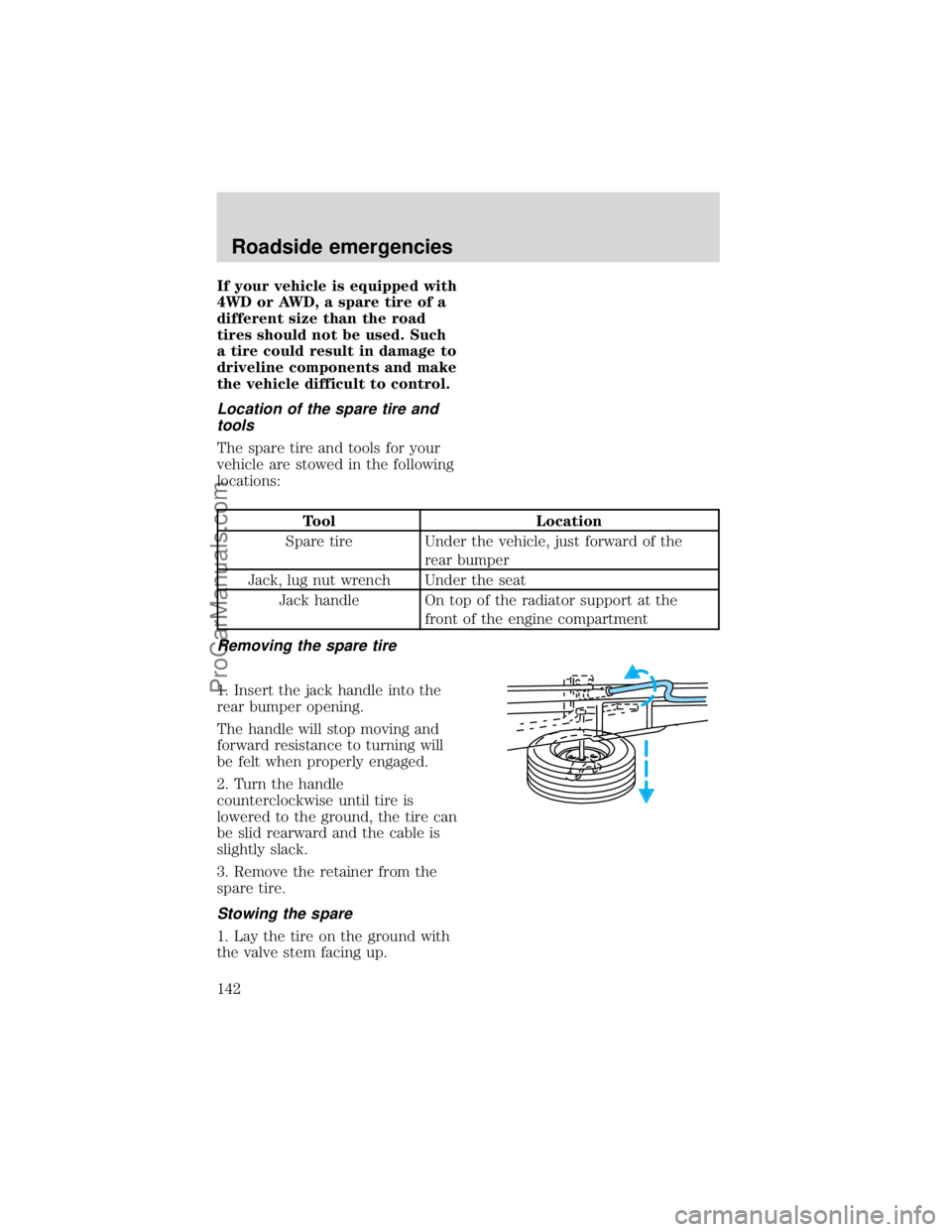
Removing the spare tire
1. Insert the jack handle into the
rear bumper opening.
The handle will stop moving and
forward resistance to turning will
be felt when properly engaged.
2. Turn the handle
counterclockwise until tire is
lowered to the ground, the tire can
be slid rearward and the cable is
slightly slack.
3. Remove the retainer from the
spare tire.
Stowing the spare
1. Lay the tire on the ground with
the valve stem facing up.
Roadside emergencies
142
ProCarManuals.com
Page 143 of 219
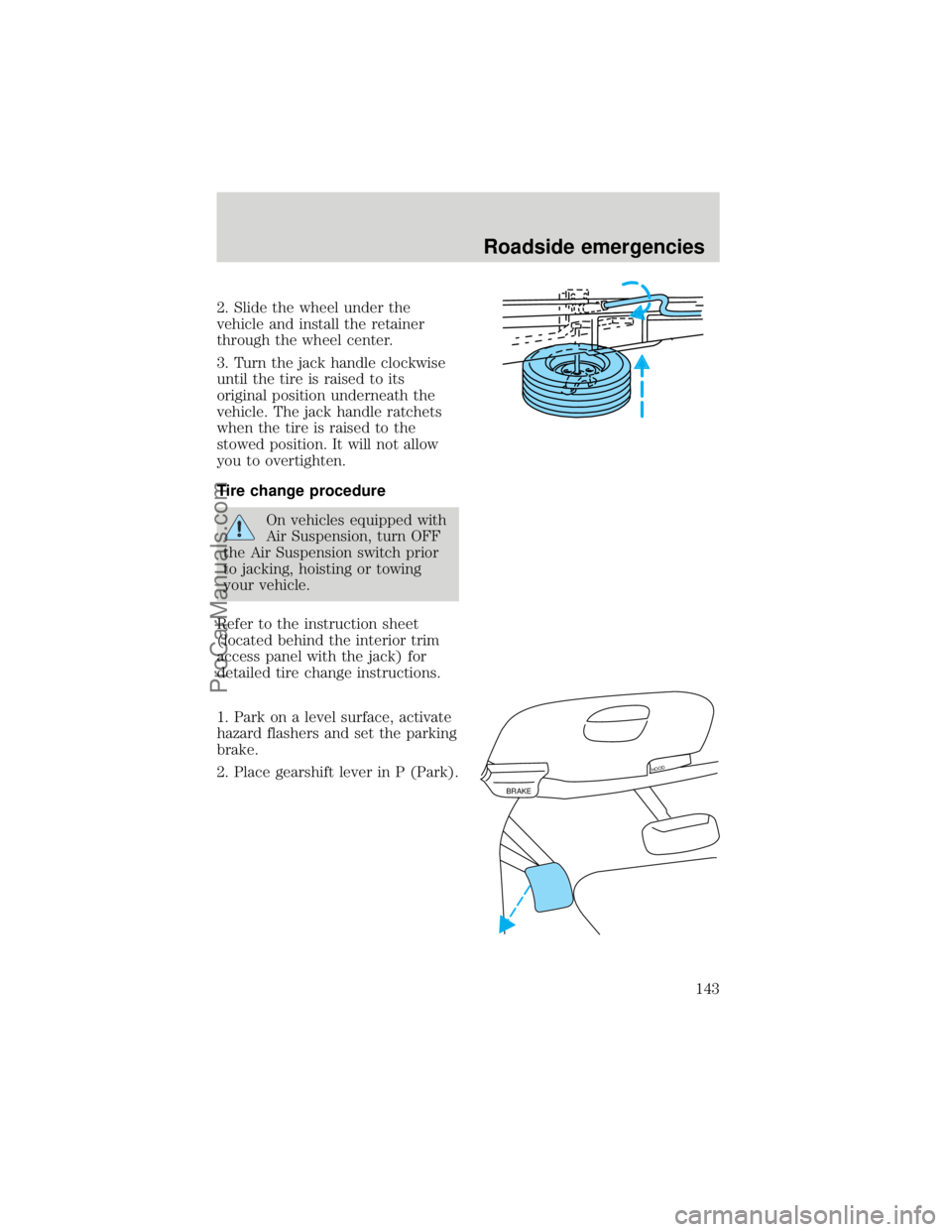
2. Slide the wheel under the
vehicle and install the retainer
through the wheel center.
3. Turn the jack handle clockwise
until the tire is raised to its
original position underneath the
vehicle. The jack handle ratchets
when the tire is raised to the
stowed position. It will not allow
you to overtighten.
Tire change procedure
On vehicles equipped with
Air Suspension, turn OFF
the Air Suspension switch prior
to jacking, hoisting or towing
your vehicle.
Refer to the instruction sheet
(located behind the interior trim
access panel with the jack) for
detailed tire change instructions.
1. Park on a level surface, activate
hazard flashers and set the parking
brake.
2. Place gearshift lever in P (Park).
BRAKE
HOOD
Roadside emergencies
143
ProCarManuals.com