reset FORD F250 1998 Owners Manual
[x] Cancel search | Manufacturer: FORD, Model Year: 1998, Model line: F250, Model: FORD F250 1998Pages: 219, PDF Size: 1.65 MB
Page 6 of 219
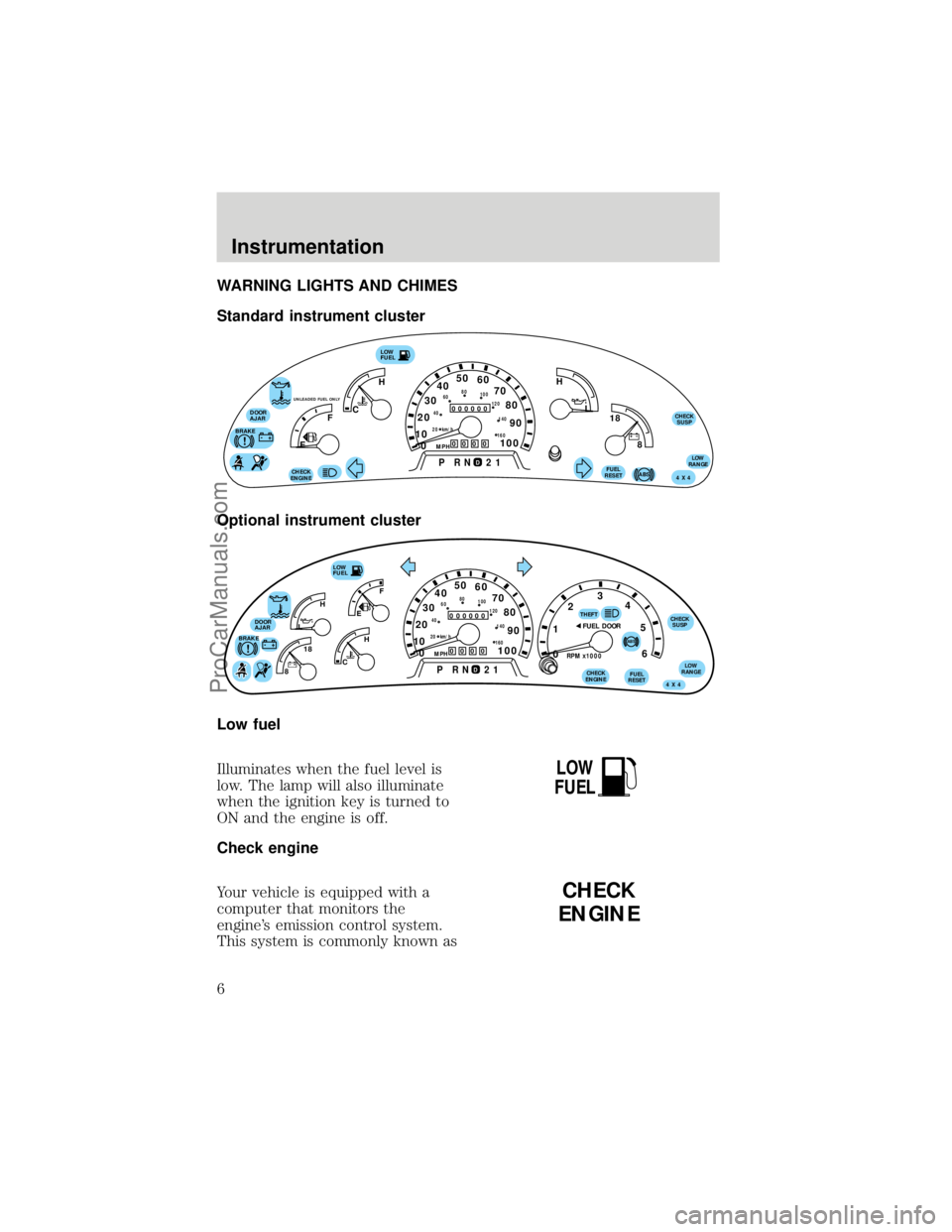
WARNING LIGHTS AND CHIMES
Standard instrument cluster
Optional instrument cluster
Low fuel
Illuminates when the fuel level is
low. The lamp will also illuminate
when the ignition key is turned to
ON and the engine is off.
Check engine
Your vehicle is equipped with a
computer that monitors the
engine's emission control system.
This system is commonly known as
DOOR
AJAR
BRAKE
FUEL
RESETCHECK
SUSP
LOW
RANGE
4 X 4
!+ -
LOW
FUEL
ABS CHECK
ENGINE
UNLEADED FUEL ONLY
EF
H
C
L
H
8 18
0
000000000
MPH
20km/h 406080
100
120
140
160
0
PRN 21
1020304050
60
70
80
90
100
D
LOW
FUEL
DOOR
AJAR
BRAKE
FUEL
RESET CHECK
ENGINELOW
RANGE
4 X 4
!ABS+ -
THEFTLEF
H0
0000
RPM1000X
00000
MPH
20km/h 406080
100
120
140
160
0
0 123
5
6 4
PRN 21
1020304050
60
70
80
90
100
8C 18
H
D
CHECK
SUSPFUEL DOOR
LOW
FUEL
CHECK
ENGINE
Instrumentation
6
ProCarManuals.com
Page 12 of 219

Fuel reset
Illuminates when the ignition key
is turned to the ON position and
the fuel pump shut-off switch has
been triggered. For more
information, refer toFuel pump
shut-off switchin theRoadside
emergencieschapter.
Safety belt warning chime
Chimes to remind you to fasten
your safety belts.
For information on the safety belt
warning chime, refer to the
Seating and safety restraints
chapter.
Supplemental restraint system
(SRS) warning chime
For information on the SRS
warning chime, refer to the
Seating and safety restraints
chapter.
Key-in-ignition warning chime
Sounds when the key is left in the
ignition in the OFF/LOCK or ACC
position and either front door is
opened.
Headlamps on warning chime
Sounds when the headlamps or
parking lamps are on, the ignition
is off (and the key is not in the
ignition) and either front door is
opened.
FUEL
RESET
Instrumentation
12
ProCarManuals.com
Page 13 of 219
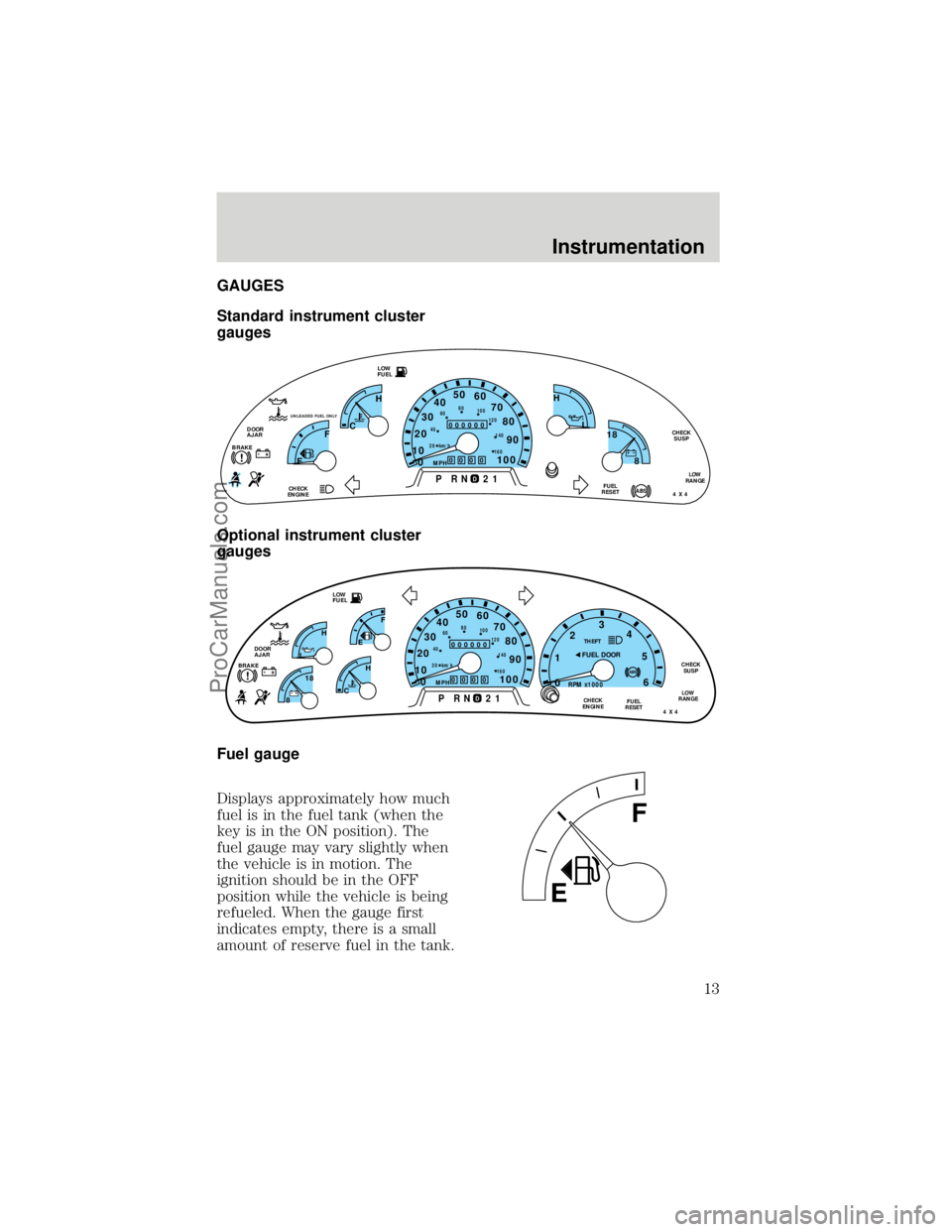
GAUGES
Standard instrument cluster
gauges
Optional instrument cluster
gauges
Fuel gauge
Displays approximately how much
fuel is in the fuel tank (when the
key is in the ON position). The
fuel gauge may vary slightly when
the vehicle is in motion. The
ignition should be in the OFF
position while the vehicle is being
refueled. When the gauge first
indicates empty, there is a small
amount of reserve fuel in the tank.
DOOR
AJAR
BRAKE
FUEL
RESETCHECK
SUSP
LOW
RANGE
4 X 4
!+ -
LOW
FUEL
ABS CHECK
ENGINE
UNLEADED FUEL ONLY
EF
H
C
L
H
8 18
0
000000000
MPH
20km/h 406080
100
120
140
160
0
PRN 21
1020304050
60
70
80
90
100
D
FUEL
RESET CHECK
ENGINELOW
RANGE
4 X 4
ABSBRAKE!+ -
THEFT
LOW
FUEL
DOOR
AJARLEF
H0
0000
RPM1000X
00000
MPH
20km/h 406080
100
120
140
160
0
0 123
5
6 4
PRN 21
1020304050
60
70
80
90
100
8C 18
H
D
CHECK
SUSPFUEL DOOR
EF
Instrumentation
13
ProCarManuals.com
Page 15 of 219
is not at its proper level or
mixture, the gauge indication will
not be accurate.
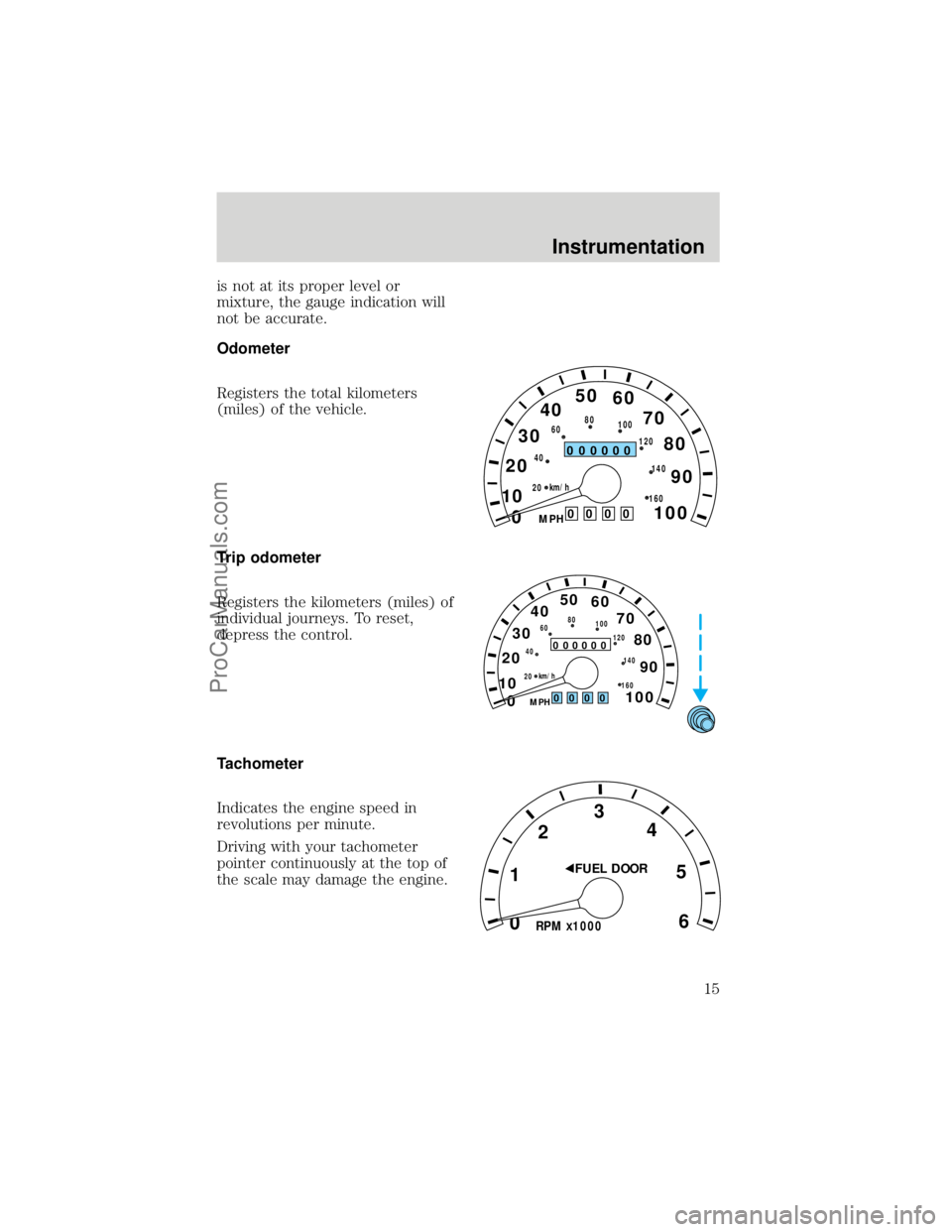
Odometer
Registers the total kilometers
(miles) of the vehicle.
Trip odometer
Registers the kilometers (miles) of
individual journeys. To reset,
depress the control.
Tachometer
Indicates the engine speed in
revolutions per minute.
Driving with your tachometer
pointer continuously at the top of
the scale may damage the engine.
0
000000000
MPH
20km/h 406080
100
120
140
160
0 1020304050
60
70
80
90
100
0
000000000
MPH
20km/h 406080
100
120
140
160
0 1020304050
60
70
80
90
100
RPM1000X0 123
5
6 4
FUEL DOOR
Instrumentation
15
ProCarManuals.com
Page 79 of 219
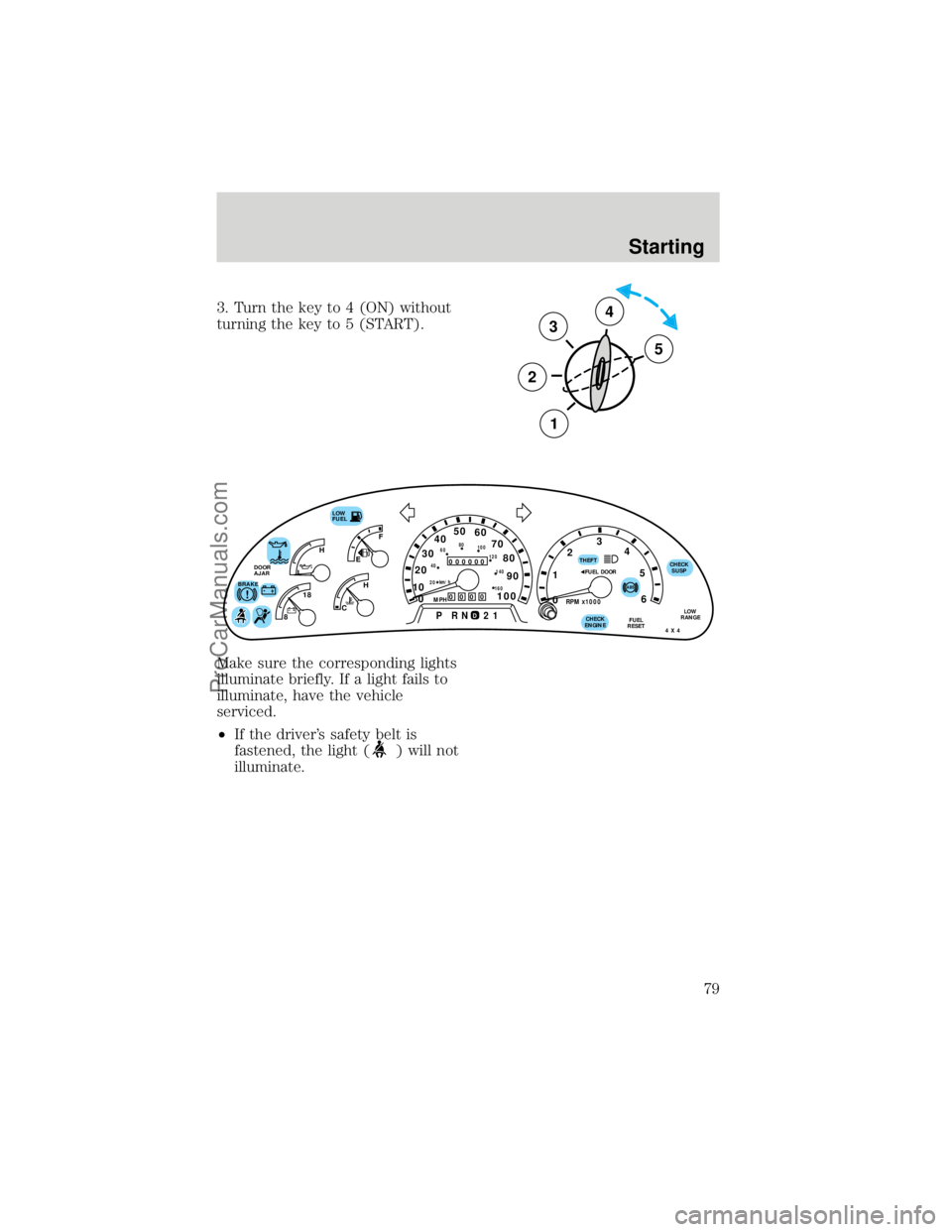
3. Turn the key to 4 (ON) without
turning the key to 5 (START).
Make sure the corresponding lights
illuminate briefly. If a light fails to
illuminate, have the vehicle
serviced.
²If the driver's safety belt is
fastened, the light (
) will not
illuminate.
3
2
1
5
4
LOW
FUEL
DOOR
AJAR
BRAKE
FUEL
RESET CHECK
ENGINELOW
RANGE
4 X 4
!ABS+ -
THEFTLEF
H0
0000
RPM1000X
00000
MPH
20km/h 406080
100
120
140
160
0
0 123
5
6 4
PRN 21
1020304050
60
70
80
90
100
8C 18
H
D
CHECK
SUSPFUEL DOOR
Starting
79
ProCarManuals.com
Page 107 of 219

hill before driving over the crest.
When climbing a steep hill, start in
a lower gear rather than
downshifting to a lower gear from
a higher gear once the ascent has
started. This reduces strain on the
engine and the possibility of
stalling.
When descending a steep hill,
avoid sudden braking. Rapid
pumping of the brake pedal will
help slow the vehicle and still
maintain steering control.
When speed control is on and you
are driving uphill, your vehicle
speed may drop considerably,
especially if you are carrying a
heavy load.
If vehicle speed drops more than
15±25 km/h (8±14 mph), the speed
control will cancel automatically.
Resume speed with accelerator
pedal.
If speed control cancels after
climbing the hill, reset speed by
pressing and holding the SET
ACCEL button (to resume speeds
over 50 km/h (30 mph).
Automatic transmission may shift
frequently while driving up steep
grades. Eliminate frequent shifting
by shifting out of
D(Overdrive)
into D (Drive).
Driving on snow and ice
A 4WD vehicle has advantages
over 2WD vehicles in snow and ice
but can skid like any other vehicle.
Driving
107
ProCarManuals.com
Page 126 of 219

must not exceed the front
accessory reserve capacity.
²The total weight of the
snowplow and aftermarket
equipment must not exceed the
Total Accessory Reserve
Capacity.
²The weight of the installed
snowplow and aftermarket
equipment must not load the
vehicle beyond the GAWR
(front/rear) and GVWR listed on
the Safety Compliance
Certification Label.
²The total weight of the
snowplow and aftermarket
equipment must be considered
part of the payload and must
not exceed the Gross Combined
Weight Rating (GCWR) for
towing.
²Federal and most local
regulations require additional
exterior lamps for
snowplow-equipped vehicles.
Consult your dealer for
additional information.
²After installing a snowplow to
the vehicle, ensure the vehicle's
front toe alignment and front
ride height are within
specification (reset if required).
These specifications are located
in the vehicle's Workshop
Manual. Adherence to the toe,
tire pressures and ride height
specification is important for
proper tire wear, ride, handling
and headlight aim. Also,
Driving
126
ProCarManuals.com
Page 127 of 219
maintain the engine oil and
transmission fluid change
intervals.
Do not exceed the GVWR
or the GAWR specified on
the Safety Compliance
Certification Label.
Removing snowplow
Read the following instructions
before removing a snowplow:
²After removing a snowplow from
the vehicle, ensure the vehicle's
front toe alignment and front
ride height are within
specification (reset if required).
These specifications are located
in the vehicle's Workshop
Manual. Adherence to the toe
and ride height specification is
important for proper tire wear,
ride, handling and headlight aim.
Snowplowing with your air bag
equipped vehicle
Your vehicle is equipped with
driver and passenger air bags. The
air bags are designed to deploy in
a collision with a solid barrier at a
range of 13 to 23 km/h (8 to 14
mph) or a parked car at a range of
25 to 45 km/h (16 to 28 mph).
Careless or high speed driving
while plowing snow which results
in vehicle decelerations equivalent
Driving
127
ProCarManuals.com
Page 131 of 219

HAZARD LIGHTS CONTROL
Use only in an emergency to warn
traffic of vehicle breakdown,
approaching danger, etc. The
hazard flashers can be operated
when the ignition is off.
²The hazard lights control is
located on top of the steering
column.
²Depress hazard lights control to
activate all hazard flashers
simultaneously.
²Depress control again to turn
the flashers off.
FUEL PUMP SHUT-OFF SWITCH
If the engine cranks but does not
start after a collision, the fuel
pump shut-off switch may have
been activated. The shut-off switch
is a device intended to stop the
electric fuel pump when your
vehicle has been involved in a
substantial jolt.
1. Turn the ignition switch to the
OFF position.
2. Check the fuel system for leaks.
3. If no fuel leak is apparent, reset
the fuel pump shut-off switch by
pushing in the button on the
switch.
4. Turn the ignition switch to the
ON position. Pause for a few
seconds and return the key to the
OFF position.
Roadside emergencies
131
ProCarManuals.com
Page 177 of 219

its idle conditions before your
vehicle will drive properly. To
begin this process:
1. Put the gearshift in P (Park)
(automatic transmissions) or the
neutral position (manual
transmissions), turn off all
accessories and start the vehicle.
2. Let the engine idle for at least
one minute.
3. The relearning process will
automatically complete as you
drive the vehicle.
²If you do not allow the engine to
relearn its idle, the idle quality
of your vehicle may be adversely
affected until the idle is
eventually relearned.
²If the battery has been
disconnected or a new battery
has been installed, the clock and
the preset radio stations must
be reset once the battery is
reconnected.
²Always dispose of automotive
batteries in a responsible
manner. Follow your
communities standards for
disposal. Call your local
recycling center to find out
more about recycling automotive
batteries.
WINDSHIELD WIPER BLADES
Check the wiper blades at least
twice a year or when they seem
less effective. Substances such as
tree sap and some hot wax
Maintenance and care
177
ProCarManuals.com