reset FORD F250 SUPER DUTY 2017 Owner's Manual
[x] Cancel search | Manufacturer: FORD, Model Year: 2017, Model line: F250 SUPER DUTY, Model: FORD F250 SUPER DUTY 2017Pages: 642, PDF Size: 12.35 MB
Page 182 of 642
We recommend the following coldweather idling guidelines:
•You can use Motorcraft® cetaneimprovers or non-alcohol-basedcetane improvers from a reputablemanufacturer as needed.
•Maintain the engine cooling systemproperly.
•Avoid shutting the engine down afteran extensive idling period. Drive yourvehicle for several miles with theengine at normal operatingtemperatures under a moderate load.
•Consider using an engine block heater.
•For extended idle times use anapproved idle speed increase device.
Winter Operating Tips for ArcticOperation -20°F (-29°C) and Below
The following information is a guidelineonly and is not to be the only source ofpossible solutions in resolving extremecold temperature issues.
Starting Aids
WARNING
Do not use starting fluid, for exampleether, in the air intake system. Suchfluid could cause immediateexplosive damage to the engine andpossible personal injury.
The use of the factory engine block heaterassists in engine starting in extreme coldambient temperatures See Engine BlockHeater (page 181).
Idle Control
Your vehicle may have a factory option fora stationary elevated idle control throughthe upfitter switches in the overheadconsole. This allows the operator toelevate the idle RPM for extended idleperiods, as well as aftermarket equipmentsuch as PTO operation. You must configurethis feature even if ordered from thefactory. See your authorized dealer forrequired upfitting.
Operation in Snow and Rain
Vehicle operation in heavy snowfall orextreme rain conditions may feedexcessive amounts of snow or water intothe air intake system. This could plug theair filter with snow and may cause theengine to lose power and possibly shutdown.
We recommend the following actions afteroperating your vehicle up to 200 mi(320 km) in snowfall or extreme rain:
•Snow: At the earliest opportunity, openthe hood and clear all the snow and icefrom the air filter housing inlet (do notremove the foam filter) and reset theair filter restriction gauge.
Note:Removal of the foam filter degradesyour vehicle performance during snow andhot weather conditions.
•Extreme rain: The air filter dries afterabout 15–30 minutes at highwayspeeds. At the earliest opportunity,open the hood and reset the air filterrestriction gauge.
Refer to Air filter and restriction gauge inthe Maintenance chapter for moreinformation. See Changing the EngineAir Filter (page 357).
179
Super Duty (TFE) Canada/United States of America, enUSA, Edition date: 201710, Second Printing
Starting and Stopping the Engine
Page 184 of 642
To help prolong engine life, werecommended you allow the engine to idlefor three to five minutes, especially afterany of the following:
•Continuous engine speed.
•High ambient temperature.
•High GVW or GCW operation, forexample heavy loads or trailers.
This allows the turbo charged engine tocool down.
ENGINE IDLE SHUTDOWN (If
Equipped)
Your vehicle may be equipped with anengine idle shutdown system. This systemautomatically shuts down your enginewhen it has been idling in P (Park) or N(Neutral) for five minutes (parking brakeset) or 15 minutes (parking brake not set).When the engine idle shutdown processhas started:
•A chime sounds and the informationdisplay will show ENGINE TURNS OFFIN 30 (seconds) and start countingdown
•You can restart the five or 15-minutetimer by changing the position of theaccelerator pedal, brake pedal or thepark brake within the final 30 seconds
•When the timer reaches zero, theengine shuts down and this messagewill appear in your information displayENGINE TURNED OFF
•One minute after the engine has shutdown, the electrical system simulateskey off, even though the ignition is stillin the on position, initiating normalaccessory delay period
•You must move the ignition to the offposition to reset the system beforerestarting your vehicle.
The engine idle shutdown idle timer doesnot start if:
•The engine is operating in powertake-off mode.
•The engine coolant temperature isbelow 60°F (16°C).
•The exhaust emission control device isregenerating.
ENGINE BLOCK HEATER (If
Equipped)
WARNINGS
Failure to follow engine block heaterinstructions could result in propertydamage or serious personal injury.
Do not use your heater withungrounded electrical systems ortwo-pronged adapters. There is a riskof electrical shock.
Note:The heater is most effective whenoutdoor temperatures are below 0°F(-18°C).
The heater acts as a starting aid bywarming the engine coolant. This allowsthe climate control system to respondquickly. The equipment includes a heaterelement (installed in the engine block) anda wire harness. You can connect thesystem to a grounded 120-volt ACelectrical source.
181
Super Duty (TFE) Canada/United States of America, enUSA, Edition date: 201710, Second Printing
Starting and Stopping the Engine
Page 194 of 642
Continued driving without refilling resultsin the following actions as required by theCalifornia Air Resources Board (CARB) andthe U.S. Environmental Protection Agency(EPA):
•Within a preset distance to empty,speed is limited upon vehicle restart.Prior to this occurring a messageappears in the information display.
•Further vehicle operation withoutrefilling the diesel exhaust fluid tankcauses the engine to enter an idle-onlycondition. This only occurs upon vehiclerefueling or at an extended idle. Amessage indicates the required actionsto resume normal operation. It isrequired to add a minimum of 1.0 gal(3.8 L) of diesel exhaust fluid to thetank to exit the idle-only condition, butyour vehicle is still in the speed-limitingmode until you refill the tankcompletely.
Note:For either vehicle speed limiting oridle-only condition, normal vehicle operationresumes when you refill the diesel exhaustfluid tank.
Note:When filling the diesel exhaust fluidtank from empty, there may be a short delaybefore detecting the increased level of fluid.The increased level detection must occurbefore your vehicle returns to full power.
Diesel Exhaust Fluid Guidelinesand Information
•Use only diesel exhaust fluid thatcarries the American PetroleumInstitute (API) certified diesel exhaustfluid trademark or ISO 22241.
•Do not put diesel exhaust fluid in thediesel fuel tank.
•Do not overfill the diesel exhaust fluidtank.
•Diesel exhaust fluid is corrosive.
•Do not re-use the diesel exhaust fluidcontainer once it is emptied.
•Avoid spilling diesel exhaust fluid onpainted surfaces, carpeting or plasticcomponents. Immediately wipe awayany diesel exhaust fluid that has spilledwith a damp cloth and water. If it hasalready crystallized, use warm waterand a sponge.
•Store diesel exhaust fluid out of directsunlight and in temperatures between23°F (-5°C) and 68°F (20°C).
•Diesel exhaust fluid freezes below 12°F(-11°C).
•Do not store the diesel exhaust fluidbottle in your vehicle. If it leaks it couldcause damage to interior componentsor release an ammonia odor inside yourvehicle.
•Diesel exhaust fluid is non-flammable,non-toxic, colorless and water-solubleliquid.
•The system has a diesel exhaust fluidquality sensor. Dilution of dieselexhaust fluid or use of any other liquidin the SCR system leads to a dieselexhaust fluid system fault, eventuallyleading to the vehicle only operating inidle-only mode.
•Do not dilute diesel exhaust fluid withwater or any other liquid.
•An ammonia odor may be smelledwhen the cap is removed or duringrefill. Refill diesel exhaust fluid in a wellventilated area.
191
Super Duty (TFE) Canada/United States of America, enUSA, Edition date: 201710, Second Printing
Fuel and Refueling
Page 195 of 642
Typical Diesel Exhaust Fluid UsageWhen Using the Power Take Off (PTO)
Continuous PTO use—Minimal PTO use
0–7,800 mi (0–12,550 km)
Contaminated Diesel ExhaustFluid or Inoperative SelectiveCatalytic Reduction System
Selective catalytic reduction systems aresensitive to contamination of the dieselexhaust fluid. Maintaining the purity of thefluid is important to avoid systemmalfunctions. If you remove or drain thediesel exhaust fluid tank, do not use thesame fluid to refill the tank. The systemhas a sensor to monitor fluid quality.
A warning lamp illuminates anda message appears in theinformation display if the systembecomes contaminated or inoperative.
Continued driving without replacing dieselexhaust fluid or having the selectivecatalytic reduction system repaired resultsin the following actions as required by theCalifornia Air Resources Board (CARB) andU.S. Environmental Protection Agency(EPA):
•Within a preset distance to empty,speed is limited upon vehicle restart.Prior to this occurring a messageappears in the information display.
•Further vehicle operation withoutreplacing contaminated diesel exhaustfluid causes the engine to enter anidle-only condition. This only occursupon vehicle refueling, vehicle idling inpark for 1 hour, or engine shutdown for10 minutes or more and is indicated bya message in the information displayindicating required actions to resumenormal operation.
Note:For vehicle speed limiting or idle-onlycondition, normal vehicle operation resumeswhen you repair the contaminated system.To service a contaminated or inoperativesystem, see an authorized dealer.
REFUELING - GASOLINE
WARNINGS
Fuel vapor burns violently and a fuelfire can cause severe injuries.
Read and follow all the instructionson the pump island.
Turn off your engine when you arerefueling.
Do not smoke if you are near fuel orrefueling your vehicle.
Keep sparks, flames and smokingmaterials away from fuel.
Stay outside your vehicle and do notleave the fuel pump unattendedwhen refueling your vehicle. This isagainst the law in some places.
Keep children away from the fuelpump; never let children pump fuel.
Do not use personal electronicdevices while refueling.
Wait at least 10 seconds beforeremoving the fuel pump nozzle toallow any residual fuel to drain intothe fuel tank.
Stop refueling after the fuel pumpnozzle automatically shuts off for thesecond time. Failure to follow thiswill fill the expansion space in the fuel tankand could lead to fuel overflowing.
Do not remove the fuel pump nozzlefrom its fully inserted position whenrefueling.
192
Super Duty (TFE) Canada/United States of America, enUSA, Edition date: 201710, Second Printing
Fuel and RefuelingE163176
Page 196 of 642
Use the following guidelines to avoidelectrostatic charge build-up when fillingan ungrounded fuel container:
•Place approved fuel container on theground.
•Do not fill a fuel container while it is inthe vehicle (including the cargo area).
•Keep the fuel pump nozzle in contactwith the fuel container while filling.
•Do not use a device that would holdthe fuel pump handle in the fill position.
Fuel Filler Cap
WARNINGS
The fuel system may be underpressure. If you hear a hissing soundnear the fuel filler door, do not refueluntil the sound stops. Otherwise, fuel mayspray out, which could cause seriouspersonal injury.
If you do not use the proper fuel fillercap, excessive pressure or vacuumin the fuel tank may damage the fuelsystem or cause the fuel cap to disengagein a collision, which may result in possiblepersonal injury.
Note:If you must replace the fuel filler cap,replace it with a fuel filler cap that isdesigned for your vehicle. The customerwarranty may be void for any damage to thefuel tank or fuel system if the correctgenuine Ford, Motorcraft or other certifiedfuel filler cap is not used.
Your fuel tank filler cap has an indexeddesign with a 1/4th turn on and off feature.When fueling your vehicle:
1. Put your vehicle in park (P).
2. Switch the engine off.
3. Carefully turn the filler capcounterclockwise until it spins off.
4. Pull to remove the cap from the fuelfiller pipe.
5.To install the cap, align the tabs on thecap with the notches on the filler pipe.
6. Turn the filler cap clockwise 1/4 of aturn clockwise until it clicks at leastonce.
If the Check Fuel Cap light or a Check FuelCap message appears in the instrumentcluster and stays on after you start theengine, you may not have installed the fuelfiller properly.
If the fuel cap light remains on, at the nextopportunity, safely pull off of the road,remove the fuel filler cap, align the capproperly and reinstall it. The check fuel caplight or Check fuel cap message may notreset immediately. It may take severaldriving cycles for the indicators to turn off.A driving cycle consists of an enginestart-up (after four or more hours with theengine off) followed by normal city andhighway driving.
REFUELING - DIESEL
WARNINGS
Read and follow all the instructionson the pump island.
Stay outside your vehicle and do notleave the fuel pump unattendedwhen refueling your vehicle.
Keep children away from the fuelpump. Never let children pump fuel.
Wait at least 10 seconds beforeremoving the fuel pump nozzle toallow any residual fuel to drain intothe fuel tank.
Do not remove the fuel pump nozzlefrom its fully inserted position whenrefueling.
193
Super Duty (TFE) Canada/United States of America, enUSA, Edition date: 201710, Second Printing
Fuel and Refueling
Page 245 of 642
When a vehicle ahead of you enters thesame lane or a slower vehicle is ahead inthe same lane, the vehicle speed adjuststo maintain a preset gap distance. Thedistance setting is adjustable.
The lead vehicle graphic illuminates.
The vehicle maintains a constant distancefrom the vehicle ahead until:
•The vehicle in front of you acceleratesto a speed above the set speed.
•The vehicle in front of you moves outof your lane or out of view.
•The vehicle speed falls below 12 mph(20 km/h).
•You set a new gap distance.
The system applies the brakes to slow thevehicle to maintain a safe distance fromthe vehicle in front. The system appliesonly limited maximum braking. Press thebrake pedal to override the system.
If the system predicts that its maximumbraking level is insufficient, an audiblewarning sounds while the systemcontinues to brake. A red warning barappears on the windshield heads-updisplay. Take immediate action to slow orstop the vehicle.
The system may provide slight temporaryacceleration when you use your driver sidedirectional indicator while following a leadvehicle, to aid in passing the vehicle.
Setting the Gap Distance
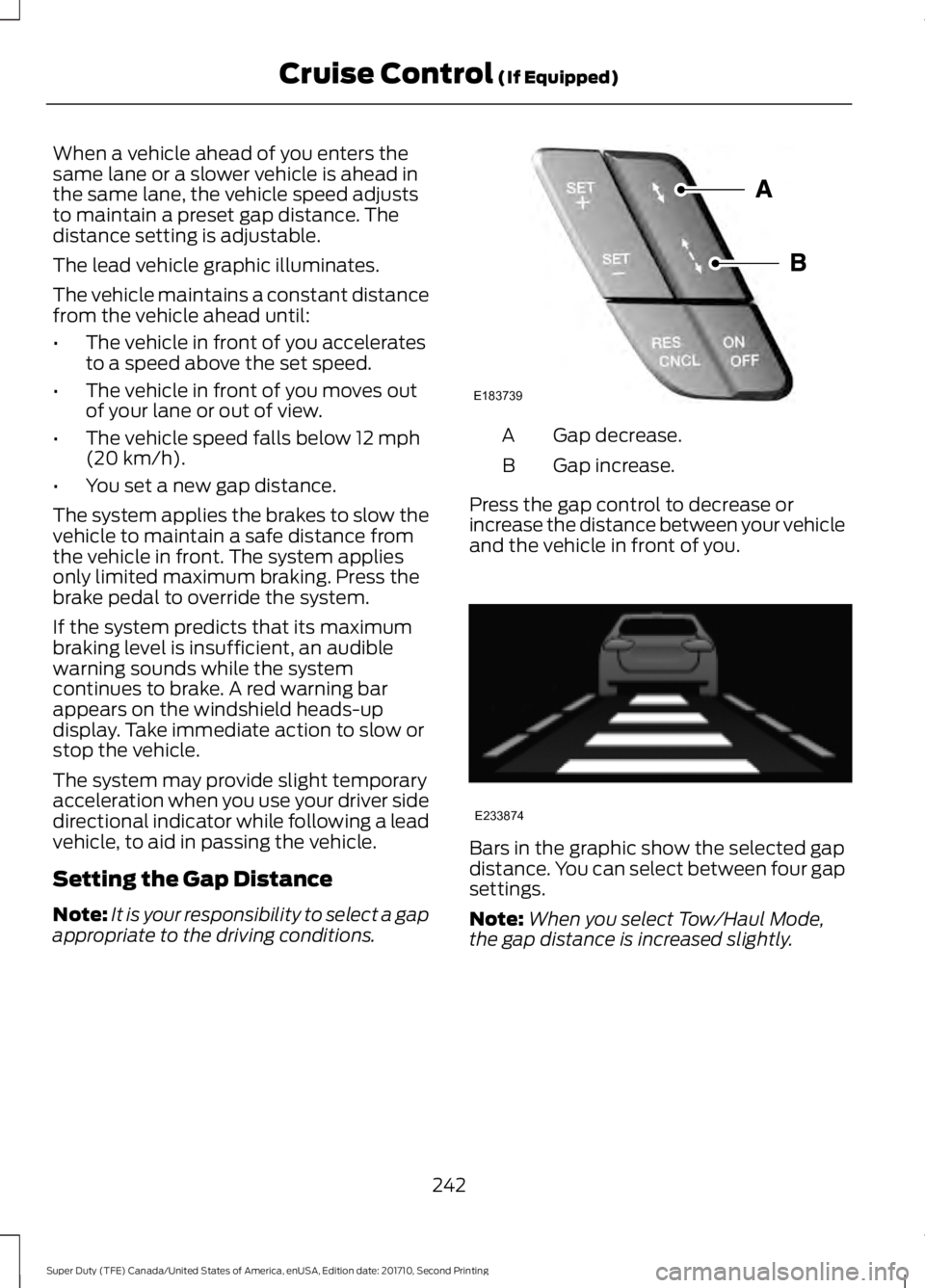
Note:It is your responsibility to select a gapappropriate to the driving conditions.
Gap decrease.A
Gap increase.B
Press the gap control to decrease orincrease the distance between your vehicleand the vehicle in front of you.
Bars in the graphic show the selected gapdistance. You can select between four gapsettings.
Note:When you select Tow/Haul Mode,the gap distance is increased slightly.
242
Super Duty (TFE) Canada/United States of America, enUSA, Edition date: 201710, Second Printing
Cruise Control (If Equipped)E183739 E233874
Page 262 of 642
Note:It is recommended that you turn thecollision warning system off if a snow plowor similar object is installed in such a waythat it may block the radar sensor. Yourvehicle will remember the selected settingacross key cycles.
Note:When possible, the manufacturerrecommends using the highest sensitivitysetting. If warnings are too frequent, you canreduce your system's sensitivity. Reducedsensitivity causes fewer and later systemwarnings. See General Information (page111).
Blocked Sensors
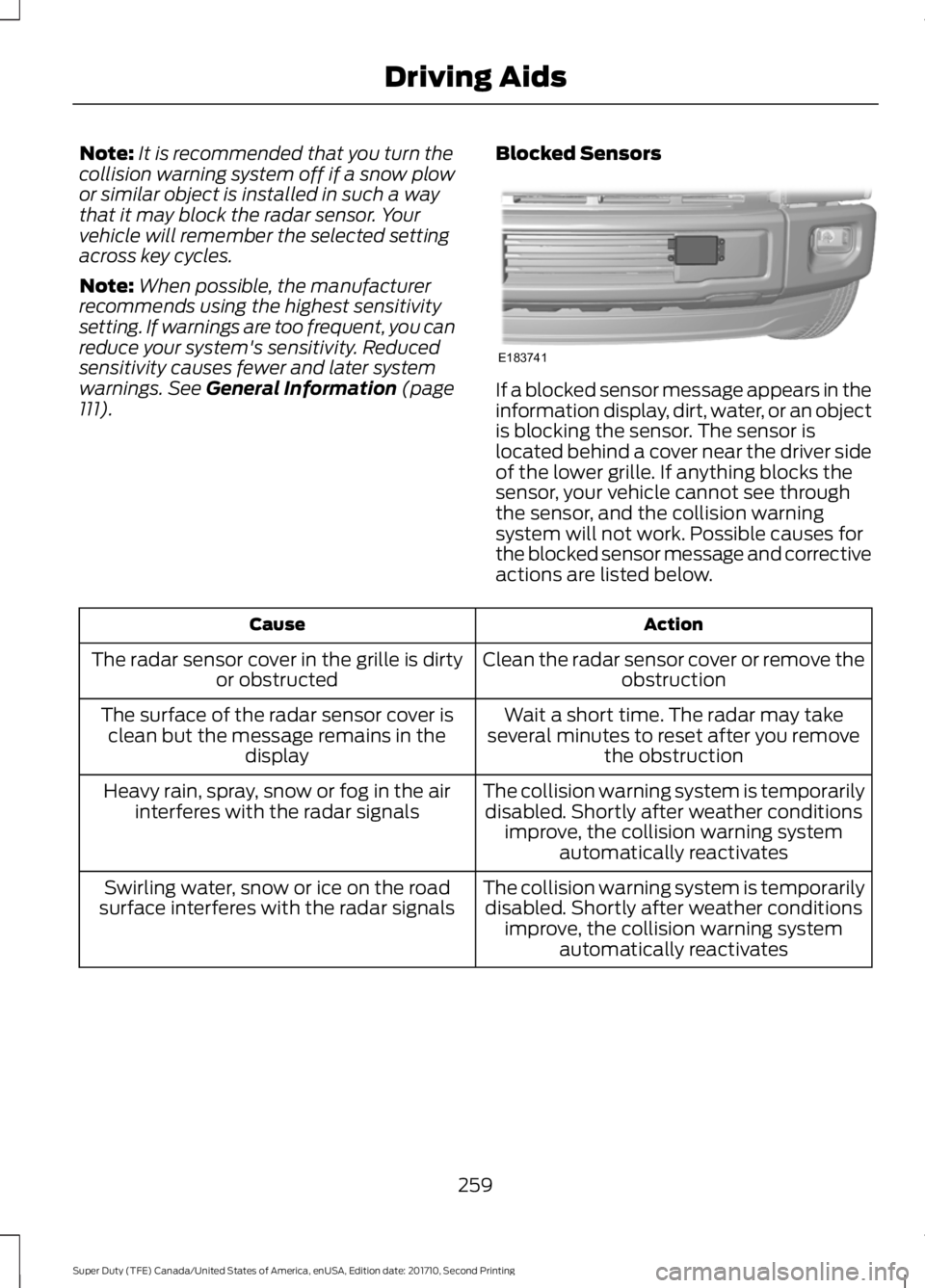
If a blocked sensor message appears in theinformation display, dirt, water, or an objectis blocking the sensor. The sensor islocated behind a cover near the driver sideof the lower grille. If anything blocks thesensor, your vehicle cannot see throughthe sensor, and the collision warningsystem will not work. Possible causes forthe blocked sensor message and correctiveactions are listed below.
ActionCause
Clean the radar sensor cover or remove theobstructionThe radar sensor cover in the grille is dirtyor obstructed
Wait a short time. The radar may takeseveral minutes to reset after you removethe obstruction
The surface of the radar sensor cover isclean but the message remains in thedisplay
The collision warning system is temporarilydisabled. Shortly after weather conditionsimprove, the collision warning systemautomatically reactivates
Heavy rain, spray, snow or fog in the airinterferes with the radar signals
The collision warning system is temporarilydisabled. Shortly after weather conditionsimprove, the collision warning systemautomatically reactivates
Swirling water, snow or ice on the roadsurface interferes with the radar signals
259
Super Duty (TFE) Canada/United States of America, enUSA, Edition date: 201710, Second Printing
Driving AidsE183741
Page 302 of 642
Note:When you try to restart your vehicleafter a fuel shutoff, your vehicle makes surethat various systems are safe to restart.Once your vehicle determines that thesystems are safe, then your vehicle willallow you to restart.
In the event of a moderate to severecollision, your vehicle is equipped with afuel pump shut-off feature that stops theflow of fuel to the engine. Not every impactwill cause a shutoff.
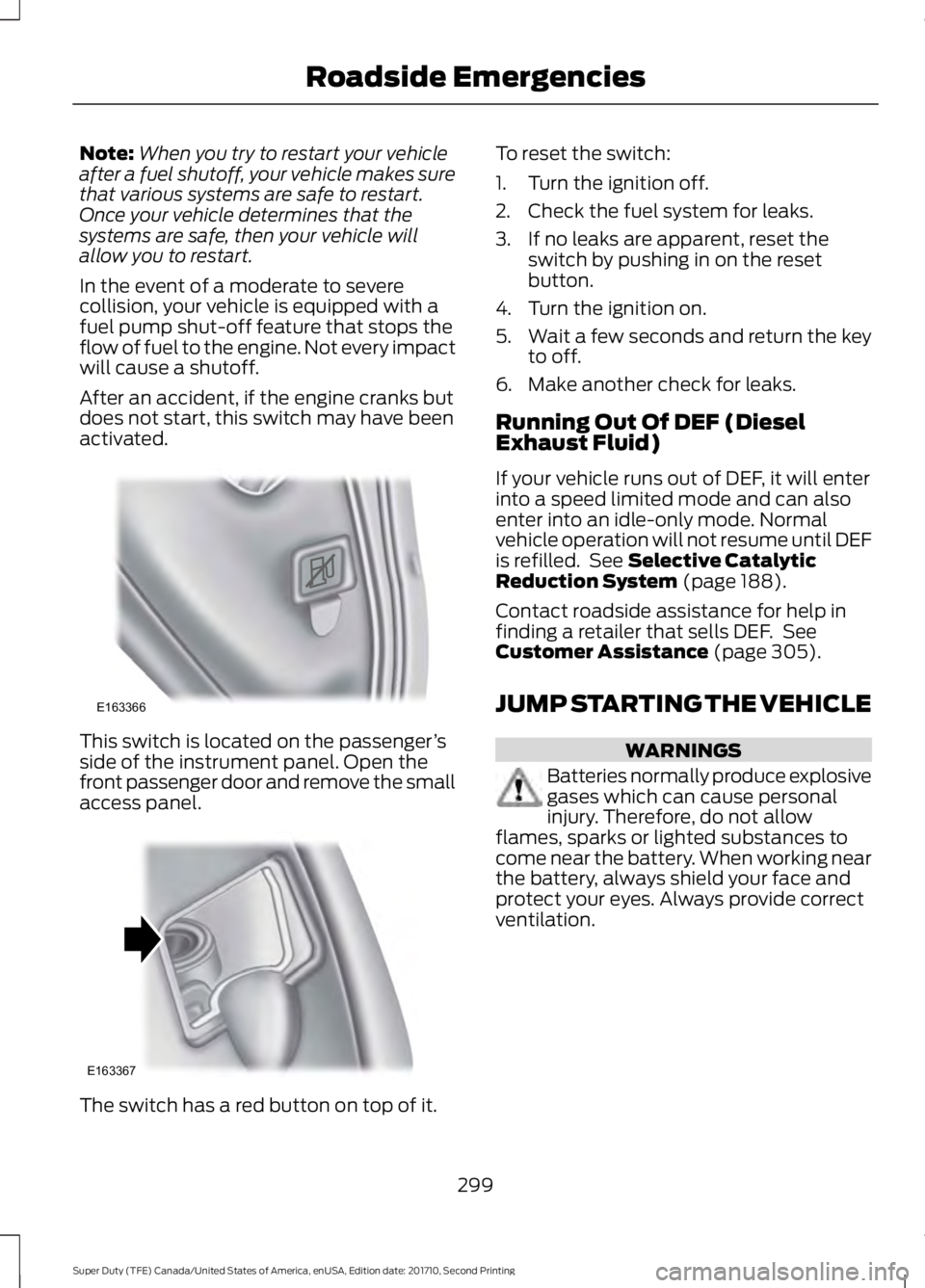
After an accident, if the engine cranks butdoes not start, this switch may have beenactivated.
This switch is located on the passenger’sside of the instrument panel. Open thefront passenger door and remove the smallaccess panel.
The switch has a red button on top of it.
To reset the switch:
1. Turn the ignition off.
2. Check the fuel system for leaks.
3. If no leaks are apparent, reset theswitch by pushing in on the resetbutton.
4. Turn the ignition on.
5.Wait a few seconds and return the keyto off.
6. Make another check for leaks.
Running Out Of DEF (DieselExhaust Fluid)
If your vehicle runs out of DEF, it will enterinto a speed limited mode and can alsoenter into an idle-only mode. Normalvehicle operation will not resume until DEFis refilled. See Selective CatalyticReduction System (page 188).
Contact roadside assistance for help infinding a retailer that sells DEF. SeeCustomer Assistance (page 305).
JUMP STARTING THE VEHICLE
WARNINGS
Batteries normally produce explosivegases which can cause personalinjury. Therefore, do not allowflames, sparks or lighted substances tocome near the battery. When working nearthe battery, always shield your face andprotect your eyes. Always provide correctventilation.
299
Super Duty (TFE) Canada/United States of America, enUSA, Edition date: 201710, Second Printing
Roadside EmergenciesE163366 E163367
Page 315 of 642
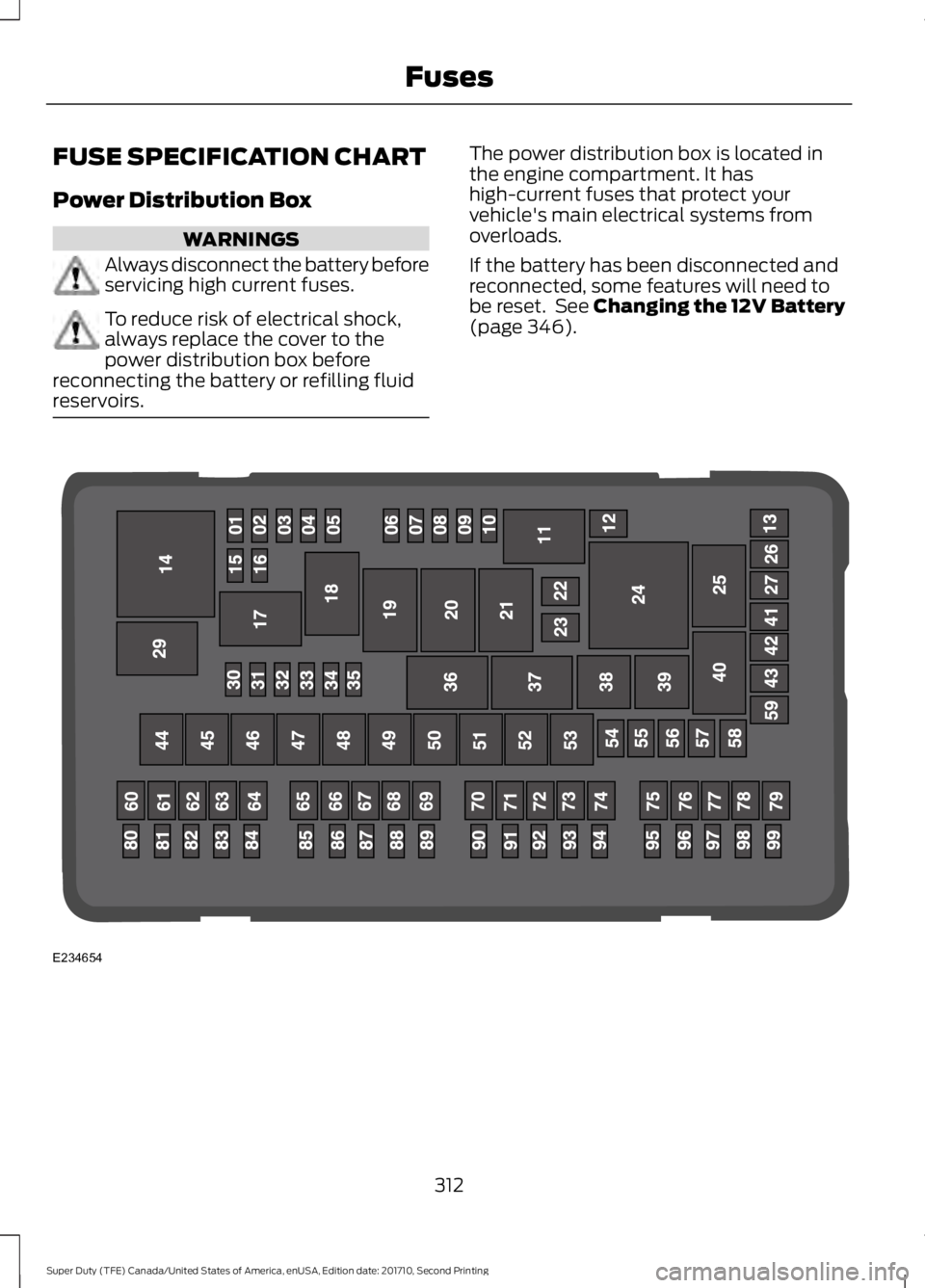
FUSE SPECIFICATION CHART
Power Distribution Box
WARNINGS
Always disconnect the battery beforeservicing high current fuses.
To reduce risk of electrical shock,always replace the cover to thepower distribution box beforereconnecting the battery or refilling fluidreservoirs.
The power distribution box is located inthe engine compartment. It hashigh-current fuses that protect yourvehicle's main electrical systems fromoverloads.
If the battery has been disconnected andreconnected, some features will need tobe reset. See Changing the 12V Battery(page 346).
312
Super Duty (TFE) Canada/United States of America, enUSA, Edition date: 201710, Second Printing
FusesE234654
Page 333 of 642
If your vehicle is equipped with a dieselengine, an Intelligent Oil Life Monitor™calculates the proper oil change serviceinterval. When the information displayindicates: OIL CHANGE REQUIRED, changethe engine oil and oil filter. SeeInformation Displays (page 111).
The engine oil filter protects your engineby filtering harmful, abrasive or sludgeparticles and particles significantly smallerthan most available will-fit filters. SeeMotorcraft Parts (page 419).
1. Unscrew the oil filter and oil pan drainplug and wait for the oil to drain.
2. Replace the filter.
3. Reinstall the oil pan drain plug.
4. Refill the engine with new oil. SeeCapacities and Specifications (page427).
5. For diesel engines, you need to resetthe Intelligent Oil Life Monitor™. SeeInformation Displays (page 111).
Engine lubrication for severeservice operation
The following conditions define severeoperation for which engine operation withSAE 5W-40 API CJ-4 is recommended. Oiland oil filter change intervals will bedetermined by the Intelligent Oil LifeMonitor™ as noted previously.
•Frequent or extended idling (over 10minutes per hour of normal driving).
•Low-speed operation/stationary use.
•If vehicle is operated in sustainedambient temperatures below -9°F(-23°C) or above 100°F (38°C).
•Frequent low-speed operation,consistent heavy traffic less than25 mph (40 km/h).
•Operating in severe dust conditions.
•Operating the vehicle off road.
•Towing a trailer over 1,000 mi(1,600 km).
•Sustained, high-speed driving at GrossVehicle Weight Rating (maximumloaded weight for vehicle operation).
•Use of fuels with sulfur content otherthan ultra-low sulfur diesel (ULSD).
•Use of high-sulfur diesel fuel.
CHANGING THE COALESCER
FILTER ELEMENT
WARNING
Do not dispose of engine oil or oilfilters in the household refuse or thepublic sewage system. Use anauthorized waste disposal facility.
Do not clean or recondition the filterelement.
We recommend that you demand the useof genuine Ford and Motorcraft® partswhenever your vehicle requires scheduledmaintenance or repair. Use the correctspecification filter element. SeeMotorcraft Parts (page 418).
Note:Operating your vehicle without a filterelement or with an unapproved filterelement may result in damage to the turbocharger or exchanger and could lead toengine damage that may not be covered bythe vehicle Warranty.
330
Super Duty (TFE) Canada/United States of America, enUSA, Edition date: 201710, Second Printing
Maintenance