light FORD F250 SUPER DUTY 2017 Workshop Manual
[x] Cancel search | Manufacturer: FORD, Model Year: 2017, Model line: F250 SUPER DUTY, Model: FORD F250 SUPER DUTY 2017Pages: 642, PDF Size: 12.35 MB
Page 168 of 642
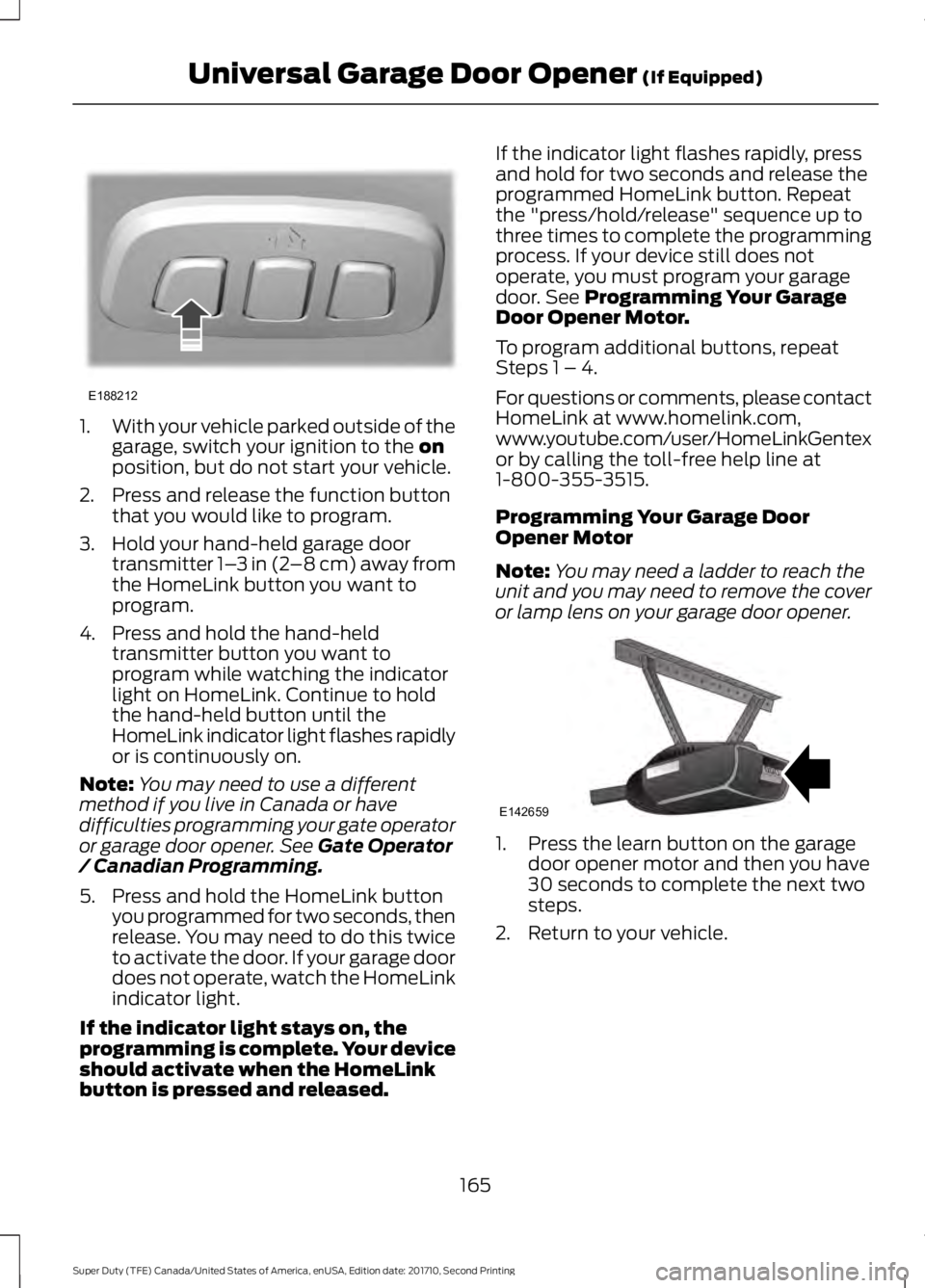
1.With your vehicle parked outside of thegarage, switch your ignition to the onposition, but do not start your vehicle.
2. Press and release the function buttonthat you would like to program.
3. Hold your hand-held garage doortransmitter 1–3 in (2–8 cm) away fromthe HomeLink button you want toprogram.
4. Press and hold the hand-heldtransmitter button you want toprogram while watching the indicatorlight on HomeLink. Continue to holdthe hand-held button until theHomeLink indicator light flashes rapidlyor is continuously on.
Note:You may need to use a differentmethod if you live in Canada or havedifficulties programming your gate operatoror garage door opener. See Gate Operator/ Canadian Programming.
5. Press and hold the HomeLink buttonyou programmed for two seconds, thenrelease. You may need to do this twiceto activate the door. If your garage doordoes not operate, watch the HomeLinkindicator light.
If the indicator light stays on, theprogramming is complete. Your deviceshould activate when the HomeLinkbutton is pressed and released.
If the indicator light flashes rapidly, pressand hold for two seconds and release theprogrammed HomeLink button. Repeatthe "press/hold/release" sequence up tothree times to complete the programmingprocess. If your device still does notoperate, you must program your garagedoor. See Programming Your GarageDoor Opener Motor.
To program additional buttons, repeatSteps 1 – 4.
For questions or comments, please contactHomeLink at www.homelink.com,www.youtube.com/user/HomeLinkGentexor by calling the toll-free help line at1-800-355-3515.
Programming Your Garage DoorOpener Motor
Note:You may need a ladder to reach theunit and you may need to remove the coveror lamp lens on your garage door opener.
1. Press the learn button on the garagedoor opener motor and then you have30 seconds to complete the next twosteps.
2. Return to your vehicle.
165
Super Duty (TFE) Canada/United States of America, enUSA, Edition date: 201710, Second Printing
Universal Garage Door Opener (If Equipped)E188212 E142659
Page 169 of 642
3.Press and hold the function button youwant to program for 2 seconds, thenrelease. Repeat this step. Dependingon your brand of garage door opener,you may need to repeat this sequencea third time.
Gate Operator / CanadianProgramming
Canadian radio-frequency laws requiretransmitter signals to “time-out” (or quit)after several seconds of transmission –which may not be long enough forHomeLink to pick up the signal duringprogramming. Similar to this Canadian law,some U.S. gate operators are designed to“time-out” in the same manner.
Note:If programming a garage door openeror gate operator, it is advised to unplug thedevice during the “cycling” process toprevent possible overheating.
1.Press and release,every two seconds,your hand-held transmitter until theHomeLink indicator light changes to arapidly blinking or continuously on light.
2. Release the hand-held transmitterbutton.
3. Continue programing HomeLink. SeeIn-Vehicle Programming, Step 4.
Erasing the Function Button Codes
Note:You cannot erase individual buttons.
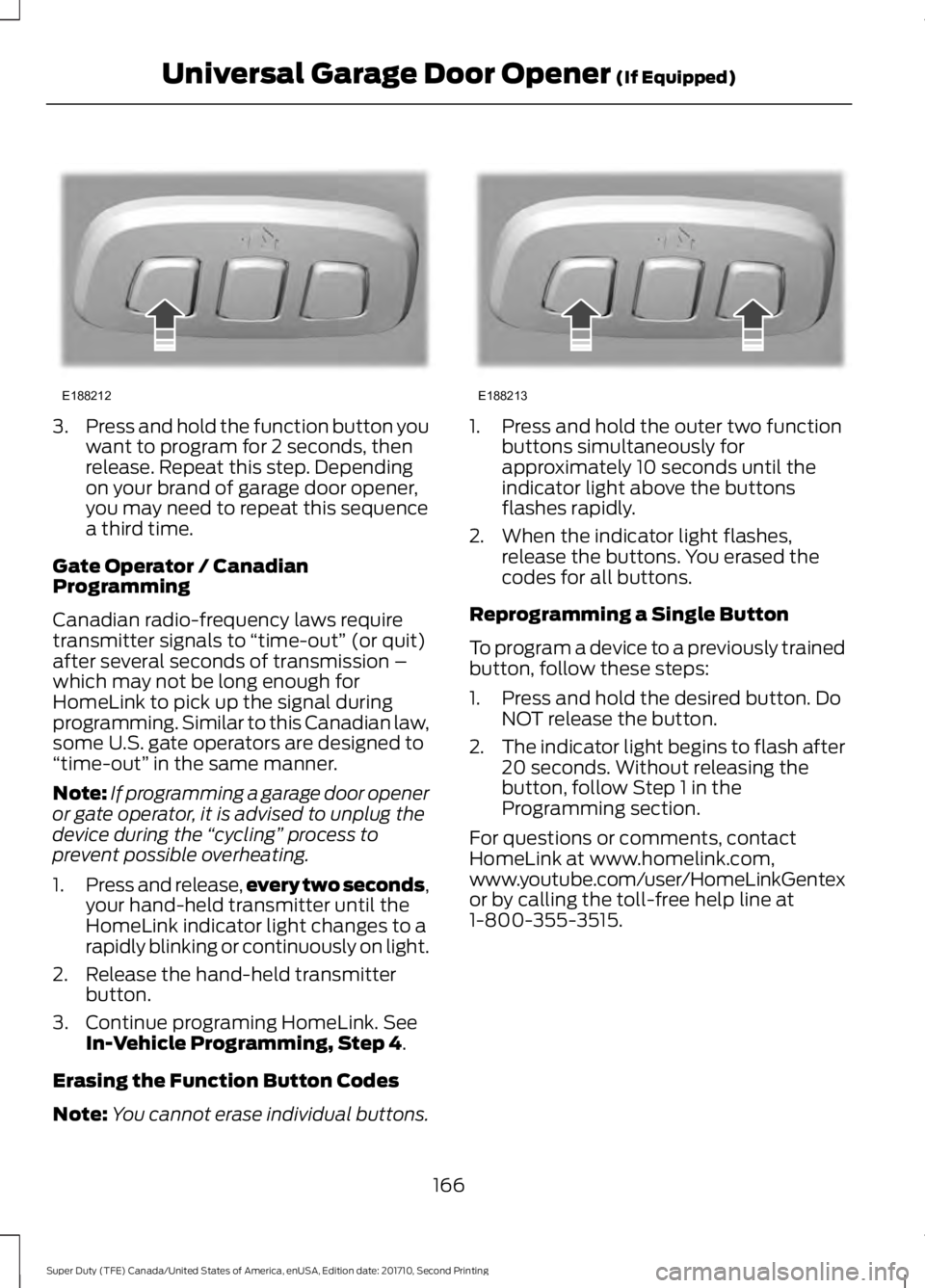
1. Press and hold the outer two functionbuttons simultaneously forapproximately 10 seconds until theindicator light above the buttonsflashes rapidly.
2. When the indicator light flashes,release the buttons. You erased thecodes for all buttons.
Reprogramming a Single Button
To program a device to a previously trainedbutton, follow these steps:
1. Press and hold the desired button. DoNOT release the button.
2.The indicator light begins to flash after20 seconds. Without releasing thebutton, follow Step 1 in theProgramming section.
For questions or comments, contactHomeLink at www.homelink.com,www.youtube.com/user/HomeLinkGentexor by calling the toll-free help line at1-800-355-3515.
166
Super Duty (TFE) Canada/United States of America, enUSA, Edition date: 201710, Second Printing
Universal Garage Door Opener (If Equipped)E188212 E188213
Page 171 of 642
12 Volt DC Power Point
WARNINGS
Do not plug optional electricalaccessories into the cigar lightersocket. Incorrect use of the cigarlighter can cause damage not covered bythe vehicle warranty, and can result in fireor serious injury.
Do not use a power point foroperating a cigar lighter. Incorrectuse of the power points can causedamage not covered by the vehiclewarranty, and can result in fire or seriousinjury.
Note:When you switch the ignition on, youcan use the socket to power 12 voltappliances with a maximum current ratingof 20 amps.
Note:Do not plug in any device thatsupplies power to the vehicle through thepower points, this may result in damage tovehicle systems.
Note:Do not hang any accessory from theaccessory plug.
Note:Do not use the power point over thevehicle capacity of 12 volt DC 240 watts ora fuse may blow.
Note:Always keep the power point capsclosed when not in use.
Do not insert objects other than anaccessory plug into the power point. Thiswill damage the power point and blow thefuse.
Run the vehicle for full capacity use of thepower point.
To prevent the battery from running out ofcharge:
•Do not use the power point longer thannecessary when the vehicle is notrunning.
•Do not leave devices plugged inovernight or when you park your vehiclefor extended periods.
Locations
Power points may be in the followinglocations:
•On the instrument panel.
•Inside the center console.
•On the rear of the center console.
•Inside the front under-seat storagecompartment.
Note:Timed power points remain on for 30minutes if the vehicle is in accessory mode.If you switch the vehicle off, the timedpower points remain on for 75 minutes.
110 Volt - 400 Watt Capacity ACPower Outlet
WARNING
Do not keep electrical devicesplugged in the power point wheneverthe device is not in use. Do not useany extension cord with the 110 volt ACpower point, since it will defeat the safetyprotection design. Doing so may cause thepower point to overload due to poweringmultiple devices that can reach beyondthe 400 watt load limit and could result infire or serious injury.
168
Super Duty (TFE) Canada/United States of America, enUSA, Edition date: 201710, Second Printing
Auxiliary Power Points
Page 172 of 642
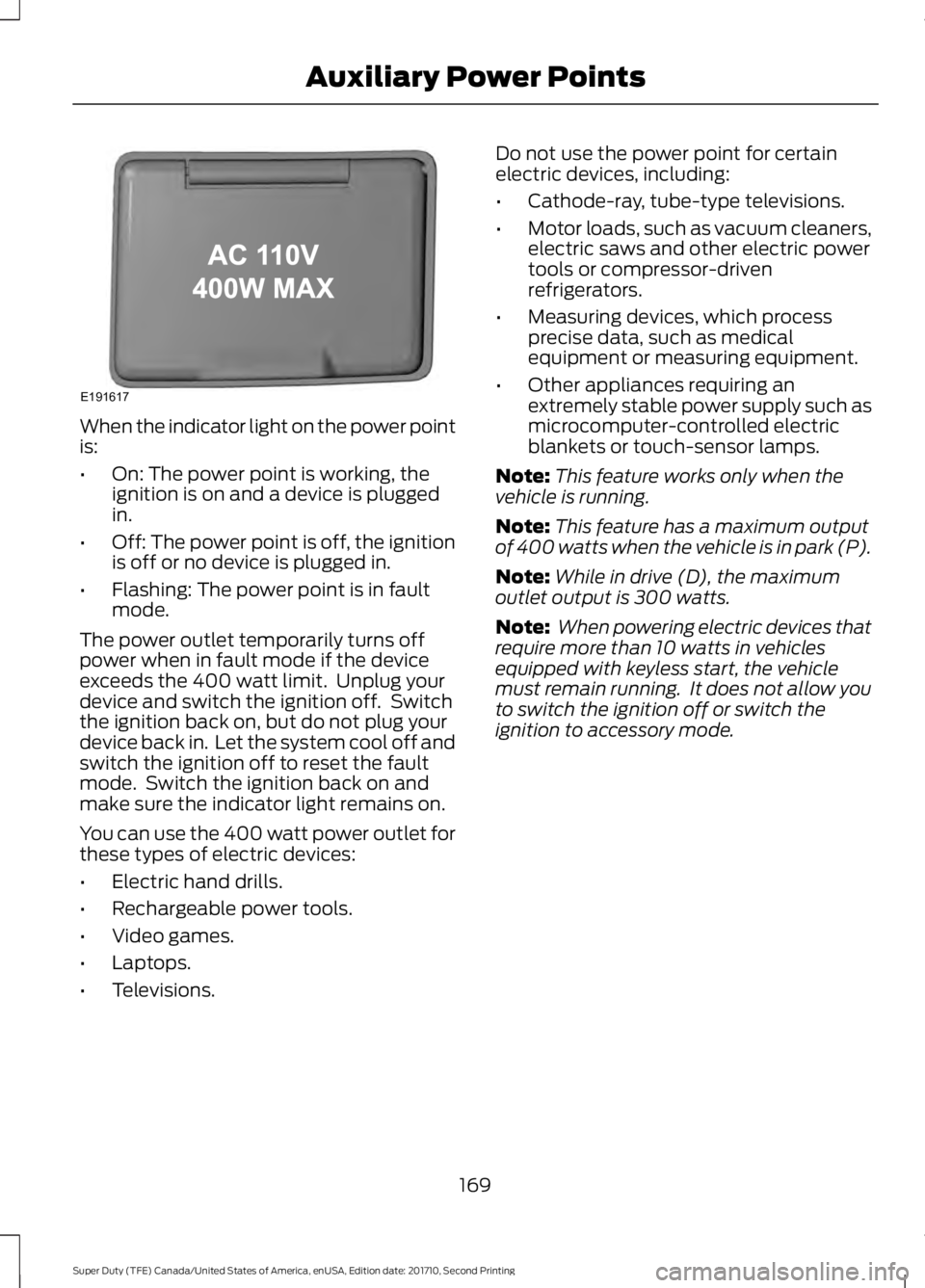
When the indicator light on the power pointis:
•On: The power point is working, theignition is on and a device is pluggedin.
•Off: The power point is off, the ignitionis off or no device is plugged in.
•Flashing: The power point is in faultmode.
The power outlet temporarily turns offpower when in fault mode if the deviceexceeds the 400 watt limit. Unplug yourdevice and switch the ignition off. Switchthe ignition back on, but do not plug yourdevice back in. Let the system cool off andswitch the ignition off to reset the faultmode. Switch the ignition back on andmake sure the indicator light remains on.
You can use the 400 watt power outlet forthese types of electric devices:
•Electric hand drills.
•Rechargeable power tools.
•Video games.
•Laptops.
•Televisions.
Do not use the power point for certainelectric devices, including:
•Cathode-ray, tube-type televisions.
•Motor loads, such as vacuum cleaners,electric saws and other electric powertools or compressor-drivenrefrigerators.
•Measuring devices, which processprecise data, such as medicalequipment or measuring equipment.
•Other appliances requiring anextremely stable power supply such asmicrocomputer-controlled electricblankets or touch-sensor lamps.
Note:This feature works only when thevehicle is running.
Note:This feature has a maximum outputof 400 watts when the vehicle is in park (P).
Note:While in drive (D), the maximumoutlet output is 300 watts.
Note: When powering electric devices thatrequire more than 10 watts in vehiclesequipped with keyless start, the vehiclemust remain running. It does not allow youto switch the ignition off or switch theignition to accessory mode.
169
Super Duty (TFE) Canada/United States of America, enUSA, Edition date: 201710, Second Printing
Auxiliary Power PointsE191617
Page 177 of 642
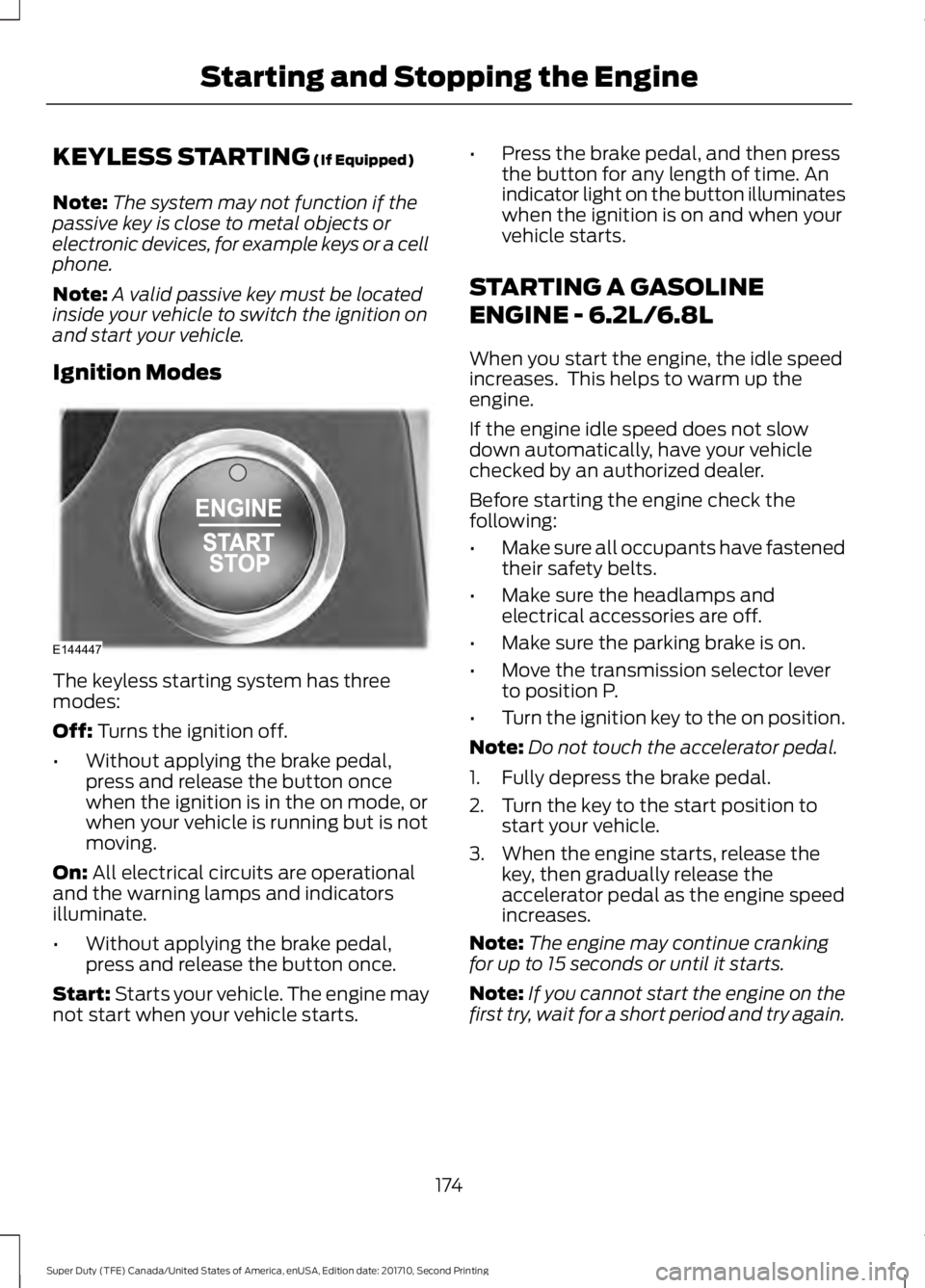
KEYLESS STARTING (If Equipped)
Note:The system may not function if thepassive key is close to metal objects orelectronic devices, for example keys or a cellphone.
Note:A valid passive key must be locatedinside your vehicle to switch the ignition onand start your vehicle.
Ignition Modes
The keyless starting system has threemodes:
Off: Turns the ignition off.
•Without applying the brake pedal,press and release the button oncewhen the ignition is in the on mode, orwhen your vehicle is running but is notmoving.
On: All electrical circuits are operationaland the warning lamps and indicatorsilluminate.
•Without applying the brake pedal,press and release the button once.
Start: Starts your vehicle. The engine maynot start when your vehicle starts.
•Press the brake pedal, and then pressthe button for any length of time. Anindicator light on the button illuminateswhen the ignition is on and when yourvehicle starts.
STARTING A GASOLINE
ENGINE - 6.2L/6.8L
When you start the engine, the idle speedincreases. This helps to warm up theengine.
If the engine idle speed does not slowdown automatically, have your vehiclechecked by an authorized dealer.
Before starting the engine check thefollowing:
•Make sure all occupants have fastenedtheir safety belts.
•Make sure the headlamps andelectrical accessories are off.
•Make sure the parking brake is on.
•Move the transmission selector leverto position P.
•Turn the ignition key to the on position.
Note:Do not touch the accelerator pedal.
1. Fully depress the brake pedal.
2. Turn the key to the start position tostart your vehicle.
3. When the engine starts, release thekey, then gradually release theaccelerator pedal as the engine speedincreases.
Note:The engine may continue crankingfor up to 15 seconds or until it starts.
Note:If you cannot start the engine on thefirst try, wait for a short period and try again.
174
Super Duty (TFE) Canada/United States of America, enUSA, Edition date: 201710, Second Printing
Starting and Stopping the EngineE144447
Page 180 of 642
sensor to determine how long the glowplugs stay energized. The required time forthe glow plugs to be energized decreasesas the coolant temperature, barometricpressure and environmental temperatureincrease.
Cold Weather Starting
WARNINGS
Do not use starting fluid, for exampleether, in the air intake system. Suchfluid could cause immediateexplosive damage to the engine andpossible personal injury.
Do not add gasoline, gasohol, alcoholor kerosene to diesel fuel. Thiscreates a serious fire hazard andcauses engine performance problems.
We recommend that the engine blockheater be used for starting when thetemperature is -9°F (-23°C) or colder. SeeEngine Block Heater (page 181).
When operating in cold weather, you mayuse Motorcraft® cetane improvers ornon-alcohol-based cetane improvers froma reputable manufacturer as needed.
Do not crank the engine for more than 10seconds as starter damage may occur. Ifthe engine does not start, switch theignition off and wait 30 seconds beforetrying again.
Switch the ignition on. Do notstart the engine until theglow-plug indicator turns off.
When the glow plug pre-heat indicatorturns off, turn the key to start. After youstart the engine, the glow plugs mayremain on for a period. If you do not startthe engine before the glow plug activationtime ends, you will need to reset the glowplugs by switching the ignition off. Afterthe engine starts, allow it to idle for about15 seconds. This protects the engine. Donot increase engine speed until the oilpressure gauge indicates normal pressure.
Cold Weather Operation
Note:Idling in cold weather does not heatthe engine to its normal operatingtemperature. Long periods of idling,especially in cold weather, can cause abuildup of deposits which can cause enginedamage.
Change to a lighter grade engine oil tomake starting easier under theseconditions. Refer to engine oilspecifications. See Capacities andSpecifications (page 427).
Diesel fuel is adjusted seasonally for coldtemperatures. Diesel fuel which has notbeen properly formulated for the ambientconditions may gel which can clog the fuelfilters. One indication that the fuel filter(s)may be clogged is if the engine starts, stallsafter a short time, and then does notrestart. If you have been using biodiesel,you may need to use a fuel with lowerbiodiesel content, try another brand, ordiscontinue using biodiesel. Do not usealcohol based additives to correct fuelgelling. This may result in damage to thefuel injectors and system. Use the properanti-gel and performance improvementproduct. See Capacities andSpecifications (page 427).
177
Super Duty (TFE) Canada/United States of America, enUSA, Edition date: 201710, Second Printing
Starting and Stopping the Engine
Page 187 of 642
FUEL QUALITY - E85
Choosing the Right Fuel - Flex FuelVehicles
Flex fuel vehicles have one of the followingidentifiers:
•Yellow fuel filler cap.
•Yellow bezel around the fuel filler inlet.
•Yellow fuel filler housing.
•Yellow E85 label on the fuel tank fillerdoor.
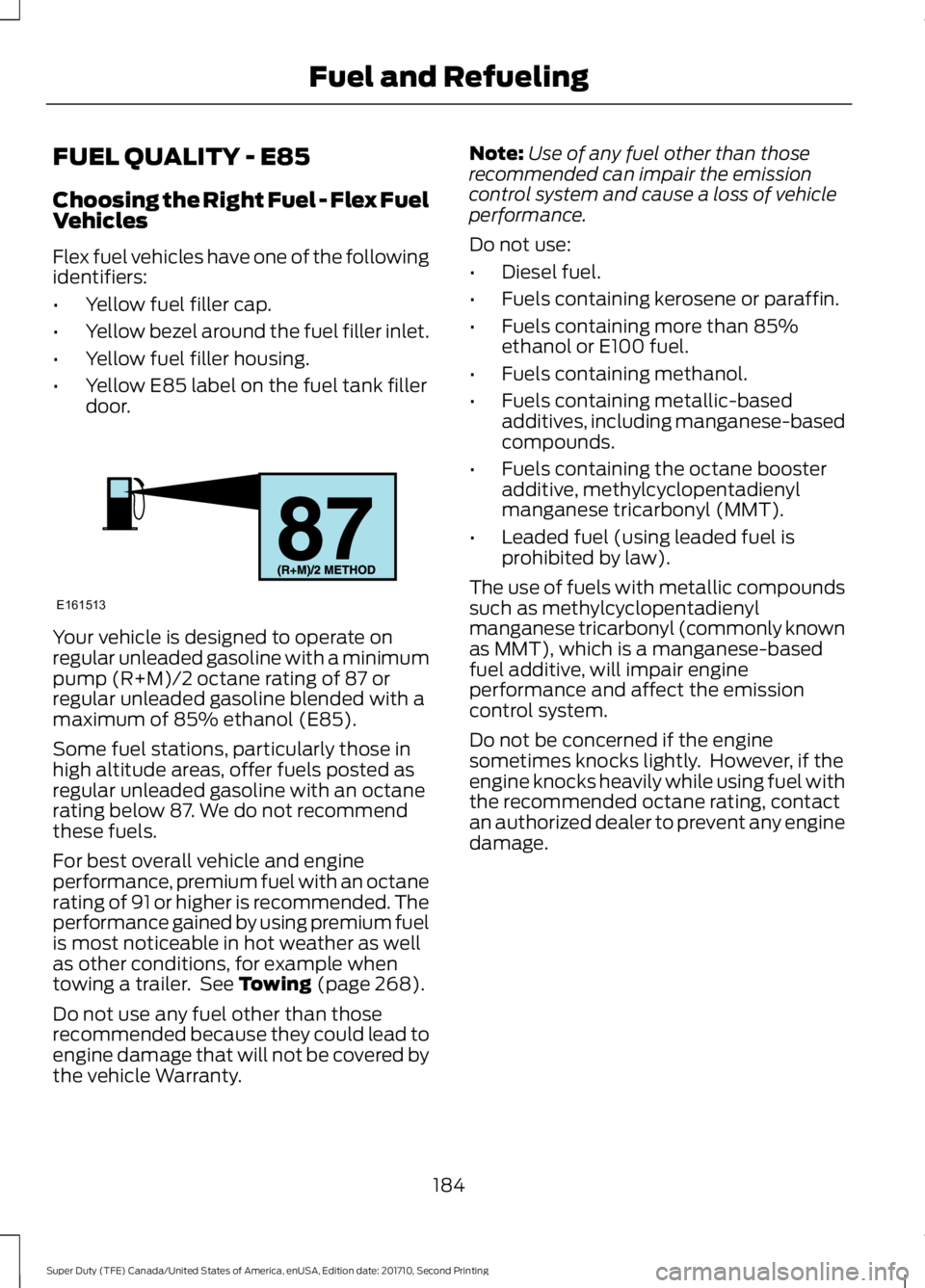
Your vehicle is designed to operate onregular unleaded gasoline with a minimumpump (R+M)/2 octane rating of 87 orregular unleaded gasoline blended with amaximum of 85% ethanol (E85).
Some fuel stations, particularly those inhigh altitude areas, offer fuels posted asregular unleaded gasoline with an octanerating below 87. We do not recommendthese fuels.
For best overall vehicle and engineperformance, premium fuel with an octanerating of 91 or higher is recommended. Theperformance gained by using premium fuelis most noticeable in hot weather as wellas other conditions, for example whentowing a trailer. See Towing (page 268).
Do not use any fuel other than thoserecommended because they could lead toengine damage that will not be covered bythe vehicle Warranty.
Note:Use of any fuel other than thoserecommended can impair the emissioncontrol system and cause a loss of vehicleperformance.
Do not use:
•Diesel fuel.
•Fuels containing kerosene or paraffin.
•Fuels containing more than 85%ethanol or E100 fuel.
•Fuels containing methanol.
•Fuels containing metallic-basedadditives, including manganese-basedcompounds.
•Fuels containing the octane boosteradditive, methylcyclopentadienylmanganese tricarbonyl (MMT).
•Leaded fuel (using leaded fuel isprohibited by law).
The use of fuels with metallic compoundssuch as methylcyclopentadienylmanganese tricarbonyl (commonly knownas MMT), which is a manganese-basedfuel additive, will impair engineperformance and affect the emissioncontrol system.
Do not be concerned if the enginesometimes knocks lightly. However, if theengine knocks heavily while using fuel withthe recommended octane rating, contactan authorized dealer to prevent any enginedamage.
184
Super Duty (TFE) Canada/United States of America, enUSA, Edition date: 201710, Second Printing
Fuel and RefuelingE161513
Page 188 of 642
Switching Between E85 andGasoline
We do not recommend repeatedlyalternating between E85 and gasoline. Ifyou switch from using E85 to gasoline, orfrom gasoline to E85, add as much fuel aspossible, at least half a tank. Drive yourvehicle immediately for a minimum of 5 mi(8 km) to allow it to adapt to the changein ethanol concentration. If you use E85exclusively, we recommend that you fillthe fuel tank with regular unleadedgasoline at each scheduled oil change.
FUEL QUALITY - DIESEL
Fuel Requirements - Choosing TheRight Fuel: Vehicles OperatedWhere Ultra Low Sulfur Diesel FuelIs Required (UnitedStates/Canada/Puerto Rico/U.S.Virgin Islands And Other Locales)
You should use Ultra-Low Sulfur Dieselfuel (also known as ULSD) designated asnumber 1-D or 2-D with a maximum of15-ppm sulfur in your diesel vehicle. Youmay operate your vehicle on diesel fuelscontaining up to 20% biodiesel, alsoknown as B20. These fuels should meetthe ASTM D975 diesel or the ASTM D7467B6-B20 biodiesel industry specifications.Outside of North America, use fuelsmeeting EN590 or equivalent local marketstandard.
Note:The vehicle Warranty does not coverdamage caused by using an improper typeof fuel or fuel additive.
Note:Do not blend used engine oil withdiesel fuel under any circumstances.Blending used oil with the fuel willsignificantly increase your vehicle’s exhaustemissions and reduce engine life due toincreased internal wear.
Using low sulfur diesel fuel(16-500 ppm) or high sulfurdiesel fuel (greater than 500ppm) in your diesel engine will causecertain emission components tomalfunction which may also cause theservice engine soon light to illuminateindicating an emissions-related concern.
Diesel fuel is adjusted seasonally for coldtemperature. For best results attemperatures below 19°F (-7°C), it isrecommended to use a diesel fuel whichhas been seasonally adjusted for theambient conditions.
Fuel Requirements - Choosing TheRight Fuel: Vehicles OperatedWhere Ultra Low Sulfur Diesel FuelIs Not Required
For the engine to operate reliably onlow-sulfur or high-sulfur diesel fuel, theengine must be a factory built high-sulfurengine (available as a dealer order optionfor select markets) or an ultra low sulfurdiesel fuel configured engine that has beenretrofitted for high-sulfur diesel fuel usingFord Motor Company dealer service parts.Failure to use retrofit components otherthan those available through yourauthorized dealer will result in coolantsystem damage, engine overheating,selective catalyst reduction system ordiesel particulate filter damage andpossible base engine damage.
Use only a diesel engine configured for usewith high sulfur diesel fuel in markets withdiesel fuel that has sulfur content greaterthan 15 ppm. Using low sulfur diesel fuel(16–500 ppm) or high sulfur diesel fuel(greater than 500 ppm) in a diesel enginedesigned to use only Ultra Low SulfurDiesel fuel may result in damage to engineemission control devices and theaftertreatment system, potentiallyrendering the vehicle inoperable.
185
Super Duty (TFE) Canada/United States of America, enUSA, Edition date: 201710, Second Printing
Fuel and Refueling
Page 191 of 642
•Fuels containing methanol.
•Fuels containing metallic-basedadditives, including manganese-basedcompounds.
•Fuels containing the octane boosteradditive, methylcyclopentadienylmanganese tricarbonyl (MMT).
•Leaded fuel (using leaded fuel isprohibited by law).
The use of fuels with metallic compoundssuch as methylcyclopentadienylmanganese tricarbonyl (commonly knownas MMT), which is a manganese-basedfuel additive, will impair engineperformance and affect the emissioncontrol system.
Do not be concerned if the enginesometimes knocks lightly. However, if theengine knocks heavily while using fuel withthe recommended octane rating, contactan authorized dealer to prevent any enginedamage.
RUNNING OUT OF FUEL
Avoid running out of fuel because thissituation may have an adverse effect onengine components.
If you have run out of fuel:
•You may need to cycle the ignition fromoff to on several times after refuelingto allow the fuel system to pump thefuel from the tank to the engine. Onrestarting, cranking time will take a fewseconds longer than normal. Withkeyless ignition, just start the engine.Crank time will be longer than usual.
•Normally, adding 1.06 gal (4 L) of fuelis enough to restart the engine. If thevehicle is out of fuel and on a steepgrade, more than 1.06 gal (4 L) may berequired.
SELECTIVE CATALYTIC
REDUCTION SYSTEM - DIESEL
Your vehicle may have a selective catalyticreduction system. The system helps reduceemission levels of oxides of nitrogen fromthe exhaust system. The systemautomatically injects diesel exhaust fluidinto the exhaust system to enable correctselective catalytic reduction systemfunction.
Note:Selective catalytic reduction systemsare not fitted to vehicles in markets whereonly high-sulfur diesel fuel is available.
Diesel Exhaust Fluid Level
In order for the system to operate correctlyyou must maintain the diesel exhaust fluidlevel.
A warning message appears in theinformation display when the dieselexhaust fluid level is low. If a warningmessage appears, refill the diesel exhaustfluid tank as soon as possible. SeeInformation Messages (page 128).
Filling the Diesel Exhaust FluidTank
WARNINGS
Keep diesel exhaust fluid out ofreach of children. Avoid contact withskin, eyes or clothing. In case ofcontact with your eyes, flush immediatelywith water and get prompt medicalattention. In case of contact with your skin,clean immediately with soap and water. Ifyou swallow any diesel exhaust fluid, drinkplenty of water, call a physicianimmediately.
188
Super Duty (TFE) Canada/United States of America, enUSA, Edition date: 201710, Second Printing
Fuel and Refueling
Page 193 of 642
2. Remove the diesel exhaust fluid tankfiller cap.
3.Insert the spout in to the filler neck untilthe seal on the spout seats on to thefiller neck. Pour the fluid in to the tank.When the tank is full the fluid will stopflowing automatically.
4. Return the container to the verticalposition slightly below the dieselexhaust fluid filler neck. Allow any fluidremaining in the spout to drain back into the container.
5. Remove the spout from the dieselexhaust fluid filler neck. Replace thediesel exhaust fluid tank cap.
6. Remove the spout from the dieselexhaust fluid container and replace thecap.
Note:If there is diesel exhaust fluid left inthe container retain it for later use. Thespout is re-useable. Wash the spout withclean water prior to storage. Do not use thediesel exhaust fluid spout with any otherfluid.
Filling the Diesel Exhaust Fluid Tank inCold Climates
Diesel exhaust fluid may freeze if theambient temperature is below 12°F (-11°C).Your vehicle has a preheating systemwhich allows diesel exhaust fluid tooperate below 12°F (-11°C). If you do notuse your vehicle for an extended periodwhen the ambient temperature is below12°F (-11°C), the fluid in the tank mayfreeze. If the tank is overfilled and the fluidfreezes it may damage the tank. This is notcovered by the vehicle warranty.
Diesel Exhaust Fluid WarningMessages and Vehicle Operations
WARNINGS
Diesel exhaust fluid must be refilledwhen low or replaced whencontaminated or your vehicle speedbecomes limited to 50 mph (80 km/h). Inthese conditions, drive with caution andrefill diesel exhaust fluid immediately. Ifthe diesel exhaust fluid becomes emptyor contaminated and fluid is not replaced,your vehicle becomes limited to engine idleonly once stopped. In these conditions, becautious where you stop your vehiclebecause you may not be able to drive longdistances or maintain highway speeds untilyou refill or replace the diesel exhaust fluid.
Tampering with or disabling selectivecatalytic reduction system results insevere vehicle performancelimitation including eventual speed limitingto 5 mph (5 km/h).
The information display shows a series ofmessages about the amount of dieselexhaust fluid available. A systems checkdisplays messages indicating the amountof diesel exhaust fluid available or displaysa warning message indicating theapproximate distance remaining as thefluid in the diesel exhaust fluid tank nearsempty. See Information Messages(page 128).
As the diesel exhaust fluid levelnears empty, the warningsymbol displays and a series oftones and messages starting at 500 mi(800 km) remaining before diesel exhaustfluid is depleted. The warning symbol andmessages continue until you refill thediesel exhaust fluid tank.
190
Super Duty (TFE) Canada/United States of America, enUSA, Edition date: 201710, Second Printing
Fuel and RefuelingE163176