warning FORD F250 SUPER DUTY 2017 Manual Online
[x] Cancel search | Manufacturer: FORD, Model Year: 2017, Model line: F250 SUPER DUTY, Model: FORD F250 SUPER DUTY 2017Pages: 642, PDF Size: 12.35 MB
Page 179 of 642
Guarding Against Exhaust Fumes
WARNING
Exhaust leaks may result in entry ofharmful and potentially lethal fumesinto the passenger compartment. Ifyou smell exhaust fumes inside yourvehicle, have your vehicle inspectedimmediately. Do not drive if you smellexhaust fumes.
Important Ventilating Information
If you stop your vehicle and then leave theengine idling for long periods of time, werecommend that you do one of thefollowing:
•Open the windows at least 1 inch (2.5centimeters).
•Set your climate control to outside air.
STARTING A DIESEL ENGINE -
6.7L DIESEL
Read all starting instructions carefullybefore you start your vehicle.
For temperatures below 32°F (0°C), theuse of the correct grade engine oil isessential for proper operation. Refer toengine oil specifications for moreinformation. See Capacities andSpecifications (page 427).
Your vehicle may have a cold weatherstarting strategy that prevents severeengine damage by assisting in enginelubrication warm-up. In extremely coldambient temperatures, this strategyactivates and prevents the acceleratorpedal from being used for 30 seconds afteryou start your vehicle. A message appearsin the information display as your vehiclewarms up. By not allowing the acceleratorpedal to be used, the engine oil is allowedto properly lubricate the bearings
preventing engine damage due to lack ofproper lubrication. After the 30 secondwarm-up period, the accelerator pedal willbe operational again and a messageappears informing you the vehicle is ok todrive.
When you start the engine in extremelycold temperatures -15°F (-26°C), werecommend that you allow the engine toidle for several minutes before you drivethe vehicle.
Before starting the engine check thefollowing:
•Make sure all occupants have fastenedtheir seatbelts.
•Make sure the headlamps andelectrical accessories are off.
•Make sure the parking brake is on.
•Make sure the transmission is in park(P).
Note:Do not press the accelerator duringstarting.
Diesel Engine Fast Start Glow PlugSystem
The diesel engine glow system consists of:
•Eight glow plugs (one per cylinder)
•Glow Plug Control Module
•Engine Coolant Temperature sensor
•Barometric pressure sensor
•Environmental temperature sensor
The powertrain and glow plug controlmodules electronically control the glowplug system. After you switch the ignitionon, the glow plug control moduleimmediately energizes the glow plugs. Theglow plug control module uses the enginecoolant temperature, barometric pressuresensor and environmental temperature
176
Super Duty (TFE) Canada/United States of America, enUSA, Edition date: 201710, Second Printing
Starting and Stopping the Engine
Page 180 of 642
sensor to determine how long the glowplugs stay energized. The required time forthe glow plugs to be energized decreasesas the coolant temperature, barometricpressure and environmental temperatureincrease.
Cold Weather Starting
WARNINGS
Do not use starting fluid, for exampleether, in the air intake system. Suchfluid could cause immediateexplosive damage to the engine andpossible personal injury.
Do not add gasoline, gasohol, alcoholor kerosene to diesel fuel. Thiscreates a serious fire hazard andcauses engine performance problems.
We recommend that the engine blockheater be used for starting when thetemperature is -9°F (-23°C) or colder. SeeEngine Block Heater (page 181).
When operating in cold weather, you mayuse Motorcraft® cetane improvers ornon-alcohol-based cetane improvers froma reputable manufacturer as needed.
Do not crank the engine for more than 10seconds as starter damage may occur. Ifthe engine does not start, switch theignition off and wait 30 seconds beforetrying again.
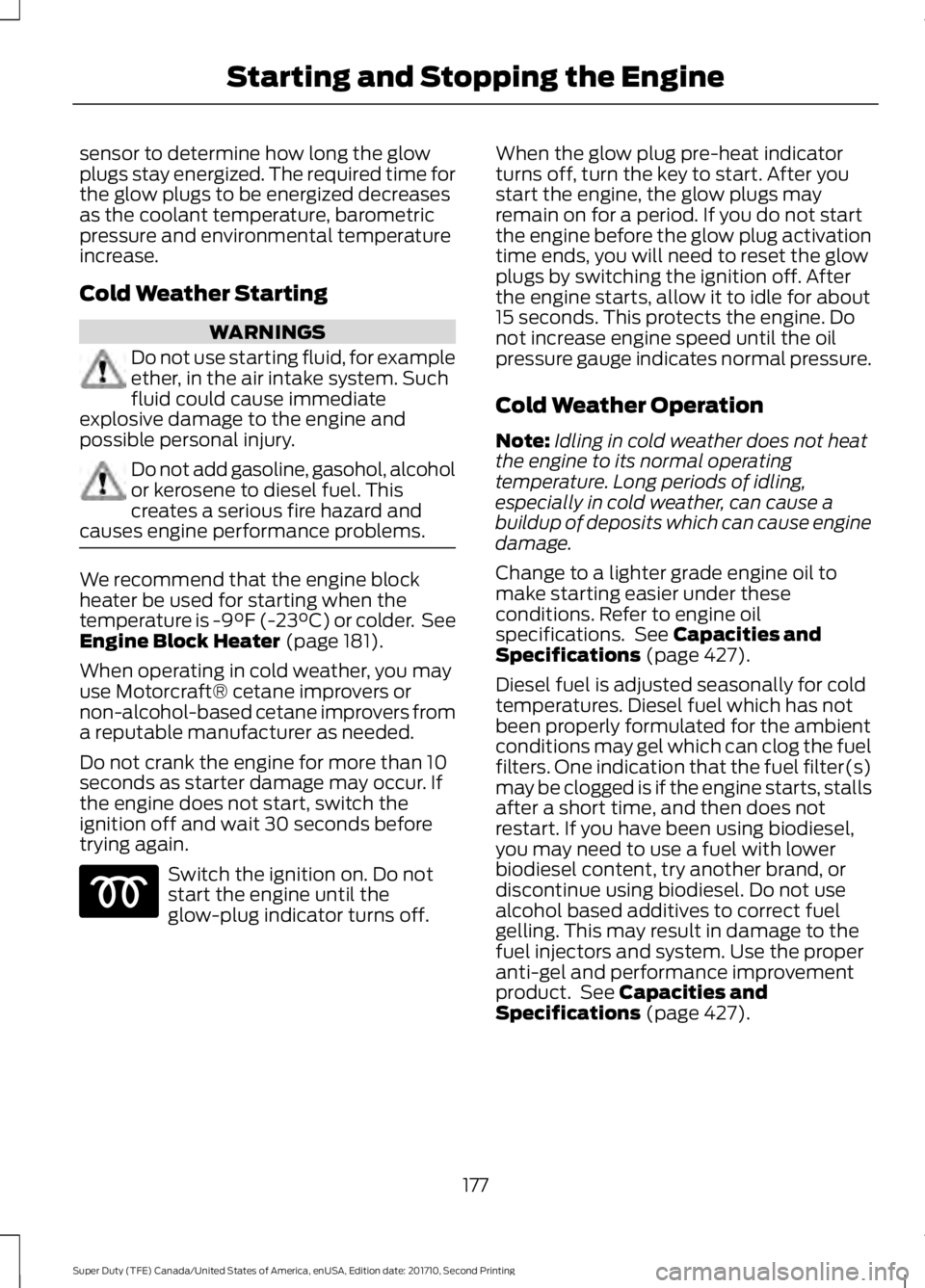
Switch the ignition on. Do notstart the engine until theglow-plug indicator turns off.
When the glow plug pre-heat indicatorturns off, turn the key to start. After youstart the engine, the glow plugs mayremain on for a period. If you do not startthe engine before the glow plug activationtime ends, you will need to reset the glowplugs by switching the ignition off. Afterthe engine starts, allow it to idle for about15 seconds. This protects the engine. Donot increase engine speed until the oilpressure gauge indicates normal pressure.
Cold Weather Operation
Note:Idling in cold weather does not heatthe engine to its normal operatingtemperature. Long periods of idling,especially in cold weather, can cause abuildup of deposits which can cause enginedamage.
Change to a lighter grade engine oil tomake starting easier under theseconditions. Refer to engine oilspecifications. See Capacities andSpecifications (page 427).
Diesel fuel is adjusted seasonally for coldtemperatures. Diesel fuel which has notbeen properly formulated for the ambientconditions may gel which can clog the fuelfilters. One indication that the fuel filter(s)may be clogged is if the engine starts, stallsafter a short time, and then does notrestart. If you have been using biodiesel,you may need to use a fuel with lowerbiodiesel content, try another brand, ordiscontinue using biodiesel. Do not usealcohol based additives to correct fuelgelling. This may result in damage to thefuel injectors and system. Use the properanti-gel and performance improvementproduct. See Capacities andSpecifications (page 427).
177
Super Duty (TFE) Canada/United States of America, enUSA, Edition date: 201710, Second Printing
Starting and Stopping the Engine
Page 181 of 642
Your vehicle has a fuel and water separatorthat recirculates fuel from the engine tohelp prevent fuel filter clogging. To avoidengine fuel starvation during cold weatheroperation of 32°F (0°C) or below, werecommend that the fuel level in your tankshould not drop below ¼ full. This helpsprevent air from entering the fuel systemand stalling the engine.
Your vehicle has a selective catalyticreduction system that uses Diesel ExhaustFluid (DEF) to operate properly. You needto replenish your vehicle’s DEF at certainintervals. When filling your vehicle’s DEFtank in cold weather, take special care toprevent damage to the tank. SeeSelective Catalytic Reduction System(page 188).
In cold weather below 32°F (0°C), theengine may slowly increase to a higher idlespeed if you leave it idling in park (P). Asthe engine warms-up, the engine soundlevel decreases due to the activation ofPCM-controlled sound reduction features.
If you operate your vehicle in a heavysnowstorm or blowing snow conditions,snow and ice can clog the engine airinduction. If this occurs, the engine mayexperience a significant reduction in poweroutput. At the earliest opportunity, clearall the snow and ice away from inside theair filter assembly. Remove the air cleanercover and the air filter and remove anysnow or ice. Remove any debris, snow orice, on the foam filter by brushing thesurface with a soft brush. Once you havecleared all of the debris, reinstall the airfilter and cover.
Do not use water, solvents, or a hard brushfor cleaning the foam filter.
WARNING
To reduce the risk of vehicle damageand personal burn injuries, do notstart your engine with the air cleanerremoved and do not remove it while theengine is running.
In order to operate the engine intemperatures of 32°F (0°C) or lower, readthe following instructions:
•Make sure that the batteries are ofsufficient size and are fully charged.Check other electrical components tomake sure they are in optimumcondition.
•Use the proper coolant solution at theconcentration recommendedprotecting the engine against damagefrom freezing.
•Try to keep the fuel tank full as muchas possible at the end of operation toprevent condensation in the fuelsystem.
•Make sure you use proper cold weatherengine oil and that it is at its properlevel. Also, if necessary, make sure tofollow the engine oil and filter changeschedule found under the Specialoperating conditions section listed inthe scheduled maintenanceinformation.
•At temperatures of -9°F (-23°C) orbelow, it is recommended that you usean engine block heater to improve coldengine starting.
•If operating in arctic temperatures of-20°F (-29°C) or lower, consult yourtruck dealer for information aboutspecial cold weather equipment andprecautions.
178
Super Duty (TFE) Canada/United States of America, enUSA, Edition date: 201710, Second Printing
Starting and Stopping the Engine
Page 182 of 642
We recommend the following coldweather idling guidelines:
•You can use Motorcraft® cetaneimprovers or non-alcohol-basedcetane improvers from a reputablemanufacturer as needed.
•Maintain the engine cooling systemproperly.
•Avoid shutting the engine down afteran extensive idling period. Drive yourvehicle for several miles with theengine at normal operatingtemperatures under a moderate load.
•Consider using an engine block heater.
•For extended idle times use anapproved idle speed increase device.
Winter Operating Tips for ArcticOperation -20°F (-29°C) and Below
The following information is a guidelineonly and is not to be the only source ofpossible solutions in resolving extremecold temperature issues.
Starting Aids
WARNING
Do not use starting fluid, for exampleether, in the air intake system. Suchfluid could cause immediateexplosive damage to the engine andpossible personal injury.
The use of the factory engine block heaterassists in engine starting in extreme coldambient temperatures See Engine BlockHeater (page 181).
Idle Control
Your vehicle may have a factory option fora stationary elevated idle control throughthe upfitter switches in the overheadconsole. This allows the operator toelevate the idle RPM for extended idleperiods, as well as aftermarket equipmentsuch as PTO operation. You must configurethis feature even if ordered from thefactory. See your authorized dealer forrequired upfitting.
Operation in Snow and Rain
Vehicle operation in heavy snowfall orextreme rain conditions may feedexcessive amounts of snow or water intothe air intake system. This could plug theair filter with snow and may cause theengine to lose power and possibly shutdown.
We recommend the following actions afteroperating your vehicle up to 200 mi(320 km) in snowfall or extreme rain:
•Snow: At the earliest opportunity, openthe hood and clear all the snow and icefrom the air filter housing inlet (do notremove the foam filter) and reset theair filter restriction gauge.
Note:Removal of the foam filter degradesyour vehicle performance during snow andhot weather conditions.
•Extreme rain: The air filter dries afterabout 15–30 minutes at highwayspeeds. At the earliest opportunity,open the hood and reset the air filterrestriction gauge.
Refer to Air filter and restriction gauge inthe Maintenance chapter for moreinformation. See Changing the EngineAir Filter (page 357).
179
Super Duty (TFE) Canada/United States of America, enUSA, Edition date: 201710, Second Printing
Starting and Stopping the Engine
Page 183 of 642
Operation in Standing Water
Ingestion of water into the diesel enginecan result in immediate and severedamage to the engine. If driving throughwater, slow down to avoid splashing waterinto the intake. If the engine stalls, and yoususpect ingestion of water into the engine,do not try to restart the engine. Consultyour dealer for service immediately.
Your fuel tank vents to the atmosphere byvalves on top of the tank and through thefuel cap. If water reaches the top of thetank, the valves may pull water into thefuel tank. Water in the fuel can causeperformance issues and damage the fuelinjection system.
DIESEL PARTICULATE FILTER
The filter forms part of the emissionsreduction system on your vehicle. It filtersharmful diesel particulates (soot) from theexhaust gas.
Regeneration
WARNING
Do not park or idle your vehicle overdry leaves, dry grass or othercombustible materials. Theregeneration process creates very highexhaust gas temperatures and the exhaustwill radiate a considerable amount of heatduring and after regeneration and after youhave switched the engine off. This is apotential fire hazard.
Note:Avoid running out of fuel.
Note:During regeneration at low speed orengine idle, you may smell a hot metallicodor and could notice a clicking metallicsound. This is due to the high temperaturesreached during regeneration and is normal.
Note:Changes in the engine or exhaustsound may be heard during the regenerationprocess.
The diesel particulate filter on your vehiclerequires periodic regeneration to maintainits correct function. Your vehicle will carryout this process automatically.
If your journeys meet one of the followingconditions:
•You drive only short distances.
•You frequently switch the ignition onand off.
•Your journeys contain a high level ofacceleration and deceleration.
You must carry out occasional trips withthe following conditions to assist theregeneration process:
•Drive your vehicle in more favorableconditions, which you will find at highervehicle speeds in normal driving, on amain road or freeway for a minimumof 20 minutes. This drive may includeshort stops that will not affect theregeneration process.
•Avoid prolonged idling and alwaysobserve speed limits and roadconditions.
•Do not switch the ignition off.
•Select a suitable gear to ideallymaintain engine speed between 1500and 3000 RPM.
SWITCHING OFF THE ENGINE
- 6.7L DIESEL
Switch the ignition off.
180
Super Duty (TFE) Canada/United States of America, enUSA, Edition date: 201710, Second Printing
Starting and Stopping the Engine
Page 184 of 642
To help prolong engine life, werecommended you allow the engine to idlefor three to five minutes, especially afterany of the following:
•Continuous engine speed.
•High ambient temperature.
•High GVW or GCW operation, forexample heavy loads or trailers.
This allows the turbo charged engine tocool down.
ENGINE IDLE SHUTDOWN (If
Equipped)
Your vehicle may be equipped with anengine idle shutdown system. This systemautomatically shuts down your enginewhen it has been idling in P (Park) or N(Neutral) for five minutes (parking brakeset) or 15 minutes (parking brake not set).When the engine idle shutdown processhas started:
•A chime sounds and the informationdisplay will show ENGINE TURNS OFFIN 30 (seconds) and start countingdown
•You can restart the five or 15-minutetimer by changing the position of theaccelerator pedal, brake pedal or thepark brake within the final 30 seconds
•When the timer reaches zero, theengine shuts down and this messagewill appear in your information displayENGINE TURNED OFF
•One minute after the engine has shutdown, the electrical system simulateskey off, even though the ignition is stillin the on position, initiating normalaccessory delay period
•You must move the ignition to the offposition to reset the system beforerestarting your vehicle.
The engine idle shutdown idle timer doesnot start if:
•The engine is operating in powertake-off mode.
•The engine coolant temperature isbelow 60°F (16°C).
•The exhaust emission control device isregenerating.
ENGINE BLOCK HEATER (If
Equipped)
WARNINGS
Failure to follow engine block heaterinstructions could result in propertydamage or serious personal injury.
Do not use your heater withungrounded electrical systems ortwo-pronged adapters. There is a riskof electrical shock.
Note:The heater is most effective whenoutdoor temperatures are below 0°F(-18°C).
The heater acts as a starting aid bywarming the engine coolant. This allowsthe climate control system to respondquickly. The equipment includes a heaterelement (installed in the engine block) anda wire harness. You can connect thesystem to a grounded 120-volt ACelectrical source.
181
Super Duty (TFE) Canada/United States of America, enUSA, Edition date: 201710, Second Printing
Starting and Stopping the Engine
Page 186 of 642
SAFETY PRECAUTIONS
WARNINGS
Do not overfill the fuel tank. Thepressure in an overfilled tank maycause leakage and lead to fuel sprayand fire.
The fuel system may be underpressure. If you hear a hissing soundnear the fuel filler inlet, do not refueluntil the sound stops. Otherwise, fuel mayspray out, which could cause seriouspersonal injury.
Automotive fuels can cause seriousinjury or death if misused ormishandled.
Flow of fuel through a fuel pumpnozzle can produce static electricity.This can cause a fire if you are fillingan ungrounded fuel container.
Fuel may contain benzene, which isa cancer-causing agent.
When refueling always shut theengine off and never allow sparks oropen flames near the fuel tank fillervalve. Never smoke or use a cell phonewhile refueling. Fuel vapor is extremelyhazardous under certain conditions. Avoidinhaling excess fumes.
Observe the following guidelines whenhandling automotive fuel:
•Extinguish all smoking materials andany open flames before refueling yourvehicle.
•Always turn off the vehicle beforerefueling.
•Automotive fuels can be harmful orfatal if swallowed. Fuel such asgasoline is highly toxic and ifswallowed can cause death orpermanent injury. If fuel is swallowed,call a physician immediately, even if nosymptoms are immediately apparent.The toxic effects of fuel may not bevisible for hours.
•Avoid inhaling fuel vapors. Inhaling toomuch fuel vapor of any kind can leadto eye and respiratory tract irritation.In severe cases, excessive or prolongedbreathing of fuel vapor can causeserious illness and permanent injury.
•Avoid getting fuel liquid in your eyes. Iffuel is splashed in the eyes, removecontact lenses (if worn), flush withwater for 15 minutes and seek medicalattention. Failure to seek propermedical attention could lead topermanent injury.
•Fuels can also be harmful if absorbedthrough the skin. If fuel is splashed onthe skin, clothing or both, promptlyremove contaminated clothing andwash skin thoroughly with soap andwater. Repeated or prolonged skincontact with fuel liquid or vapor causesskin irritation.
•Be particularly careful if you are takingAntabuse or other forms of Disulfiramfor the treatment of alcoholism.Breathing gasoline vapors could causean adverse reaction, serious personalinjury or sickness. If fuel is splashed onthe skin, wash the affected areasimmediately with plenty of soap andwater. Consult a physician immediatelyif you experience any adverse reactions.
183
Super Duty (TFE) Canada/United States of America, enUSA, Edition date: 201710, Second Printing
Fuel and Refueling
Page 189 of 642
Vehicles with engines configured for usewith high sulfur diesel fuel are onlyavailable for sale in countries where ultralow sulfur diesel fuel is generally notavailable or mandated by the government.Vehicles originally sold in a ultra low sulfurdiesel fuel market that are subsequentlyexported to non- ultra low sulfur diesel fuelmarkets will need to be retrofitted (at thecustomer’s expense using Ford authorizeddealer service parts) in order to be reliablyoperated on non- ultra low sulfur dieselfuel.
Biodiesel
WARNINGS
Do not use home heating oil,agricultural fuel, raw fats and oils,waste cooking greases, biodieselfuels greater than 20% or any diesel fuelnot intended for highway use. Damage tothe fuel injection system, engine andexhaust catalyst can occur if an improperfuel is used. Do not add gasoline, gasoholor alcohol to diesel fuel. This practicecreates a serious fire hazard and engineperformance problems.
Do not mix diesel fuel with gasoline,gasohol or alcohol. This could causean explosion resulting in personalinjury.
Do not add gasoline, gasohol oralcohol to diesel fuel. This practicecreates a serious fire hazard resultingin personal injury and engine performanceproblems.
Do not use home heating oil or anydiesel fuel not intended for highwayuse. Damage to the fuel injectionsystem, engine, exhaust catalyst and dieselparticulate filter can occur if an improperfuel is used. Red dye is used to identifyfuels intended for agricultural andnon-highway use.
You may operate your vehicle on dieselfuels containing up to 20% biodiesel, alsoknown as B20.
Biodiesel fuel is a chemically convertedproduct from renewable fuel sources, suchas vegetable oils, animal fats and wastecooking greases.
To help achieve acceptable engineperformance and durability when usingbiodiesel in your vehicle:
•Confirm the biodiesel content of thefuel to be B20 (20% biodiesel) or less
•Only use biodiesel fuel of good qualitythat complies with industry standards
•Follow the recommended servicemaintenance intervals. SeeScheduled Maintenance (page 573).
•Do not store biodiesel fuel in the fueltank for more than 1 month
•Consider changing brands or reducingbiodiesel content if you have coldtemperature fuel gelling issues or afrequent LOW FUEL PRESSUREmessage appearing
•Do NOT use raw oils, fats or wastecooking greases
Use of biodiesel in concentrations greaterthan 20% may cause damage to yourvehicle, including engine and/or exhaustafter-treatment hardware (exhaustcatalyst and particulate filter) failures.Concentrations greater than 20% can alsocause fuel filter restrictions that may resultin a lack of power or damage to fuelsystem components, including fuel pumpand fuel injector failures.
SAE 5W-40 or SAE 15W-40 oil isrecommended for fuels with greater than5% biodiesel (B5). Refer to the Specialoperating conditions section under theSchedule Maintenance chapter for moreinformation about oil change intervals andother maintenance when operating onbiodiesel.
186
Super Duty (TFE) Canada/United States of America, enUSA, Edition date: 201710, Second Printing
Fuel and Refueling
Page 191 of 642
•Fuels containing methanol.
•Fuels containing metallic-basedadditives, including manganese-basedcompounds.
•Fuels containing the octane boosteradditive, methylcyclopentadienylmanganese tricarbonyl (MMT).
•Leaded fuel (using leaded fuel isprohibited by law).
The use of fuels with metallic compoundssuch as methylcyclopentadienylmanganese tricarbonyl (commonly knownas MMT), which is a manganese-basedfuel additive, will impair engineperformance and affect the emissioncontrol system.
Do not be concerned if the enginesometimes knocks lightly. However, if theengine knocks heavily while using fuel withthe recommended octane rating, contactan authorized dealer to prevent any enginedamage.
RUNNING OUT OF FUEL
Avoid running out of fuel because thissituation may have an adverse effect onengine components.
If you have run out of fuel:
•You may need to cycle the ignition fromoff to on several times after refuelingto allow the fuel system to pump thefuel from the tank to the engine. Onrestarting, cranking time will take a fewseconds longer than normal. Withkeyless ignition, just start the engine.Crank time will be longer than usual.
•Normally, adding 1.06 gal (4 L) of fuelis enough to restart the engine. If thevehicle is out of fuel and on a steepgrade, more than 1.06 gal (4 L) may berequired.
SELECTIVE CATALYTIC
REDUCTION SYSTEM - DIESEL
Your vehicle may have a selective catalyticreduction system. The system helps reduceemission levels of oxides of nitrogen fromthe exhaust system. The systemautomatically injects diesel exhaust fluidinto the exhaust system to enable correctselective catalytic reduction systemfunction.
Note:Selective catalytic reduction systemsare not fitted to vehicles in markets whereonly high-sulfur diesel fuel is available.
Diesel Exhaust Fluid Level
In order for the system to operate correctlyyou must maintain the diesel exhaust fluidlevel.
A warning message appears in theinformation display when the dieselexhaust fluid level is low. If a warningmessage appears, refill the diesel exhaustfluid tank as soon as possible. SeeInformation Messages (page 128).
Filling the Diesel Exhaust FluidTank
WARNINGS
Keep diesel exhaust fluid out ofreach of children. Avoid contact withskin, eyes or clothing. In case ofcontact with your eyes, flush immediatelywith water and get prompt medicalattention. In case of contact with your skin,clean immediately with soap and water. Ifyou swallow any diesel exhaust fluid, drinkplenty of water, call a physicianimmediately.
188
Super Duty (TFE) Canada/United States of America, enUSA, Edition date: 201710, Second Printing
Fuel and Refueling
Page 192 of 642
WARNINGS
Only refill the diesel exhaust fluidtank in a well ventilated area. Whenyou remove the diesel exhaust fluidtank filler cap or a diesel exhaust fluidcontainer cap, ammonia vapors mayescape. Ammonia vapors can be irritatingto skin, eyes and mucous membranes.Inhaling ammonia vapors can causeburning to the eyes, throat and nose andcause coughing and watery eyes.
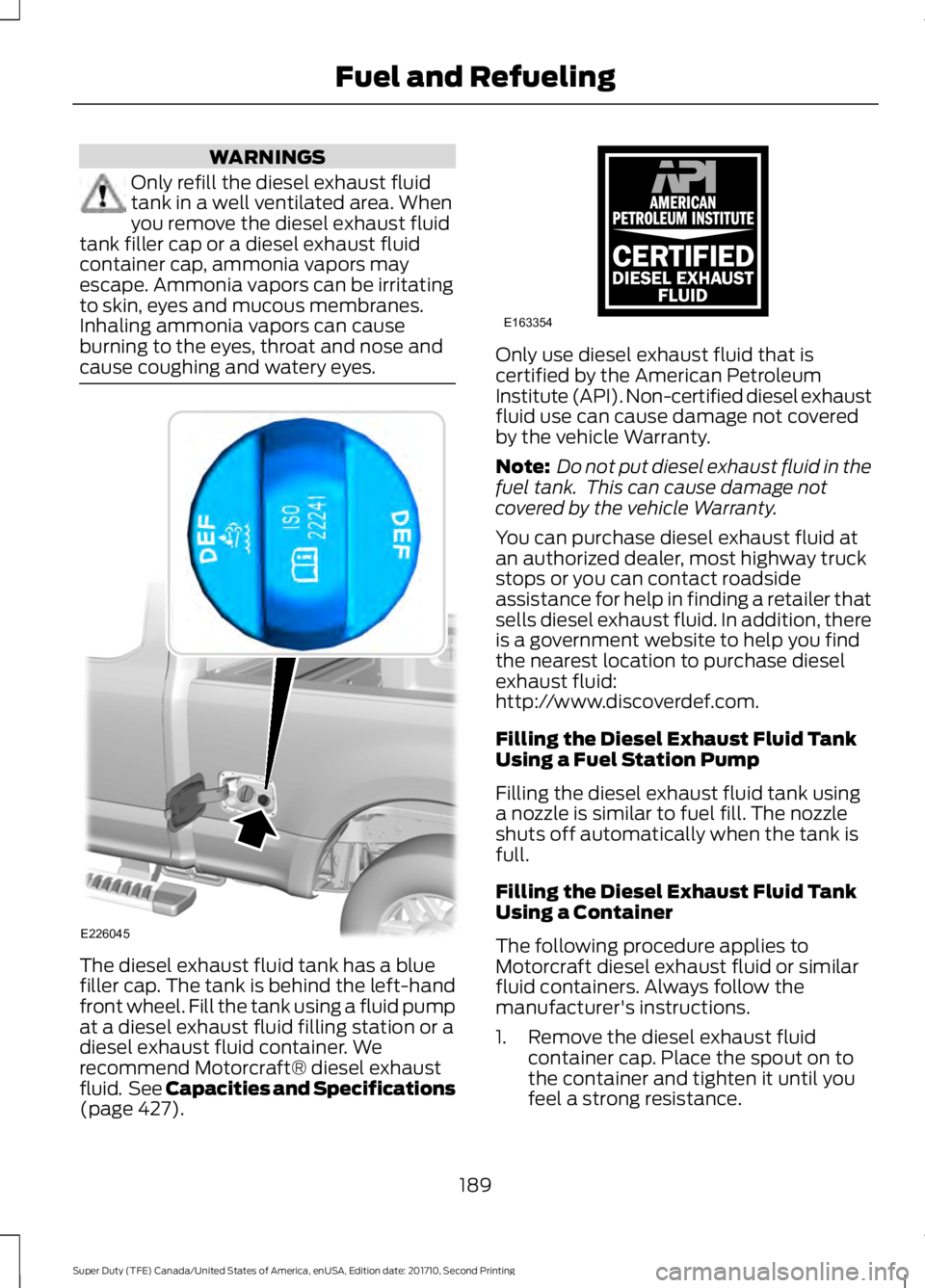
The diesel exhaust fluid tank has a bluefiller cap. The tank is behind the left-handfront wheel. Fill the tank using a fluid pumpat a diesel exhaust fluid filling station or adiesel exhaust fluid container. Werecommend Motorcraft® diesel exhaustfluid. See Capacities and Specifications(page 427).
Only use diesel exhaust fluid that iscertified by the American PetroleumInstitute (API). Non-certified diesel exhaustfluid use can cause damage not coveredby the vehicle Warranty.
Note: Do not put diesel exhaust fluid in thefuel tank. This can cause damage notcovered by the vehicle Warranty.
You can purchase diesel exhaust fluid atan authorized dealer, most highway truckstops or you can contact roadsideassistance for help in finding a retailer thatsells diesel exhaust fluid. In addition, thereis a government website to help you findthe nearest location to purchase dieselexhaust fluid:http://www.discoverdef.com.
Filling the Diesel Exhaust Fluid TankUsing a Fuel Station Pump
Filling the diesel exhaust fluid tank usinga nozzle is similar to fuel fill. The nozzleshuts off automatically when the tank isfull.
Filling the Diesel Exhaust Fluid TankUsing a Container
The following procedure applies toMotorcraft diesel exhaust fluid or similarfluid containers. Always follow themanufacturer's instructions.
1. Remove the diesel exhaust fluidcontainer cap. Place the spout on tothe container and tighten it until youfeel a strong resistance.
189
Super Duty (TFE) Canada/United States of America, enUSA, Edition date: 201710, Second Printing
Fuel and RefuelingE226045 E163354)E163354