coolant temperature FORD F450 2011 Owners Manual
[x] Cancel search | Manufacturer: FORD, Model Year: 2011, Model line: F450, Model: FORD F450 2011Pages: 449, PDF Size: 5.83 MB
Page 13 of 449
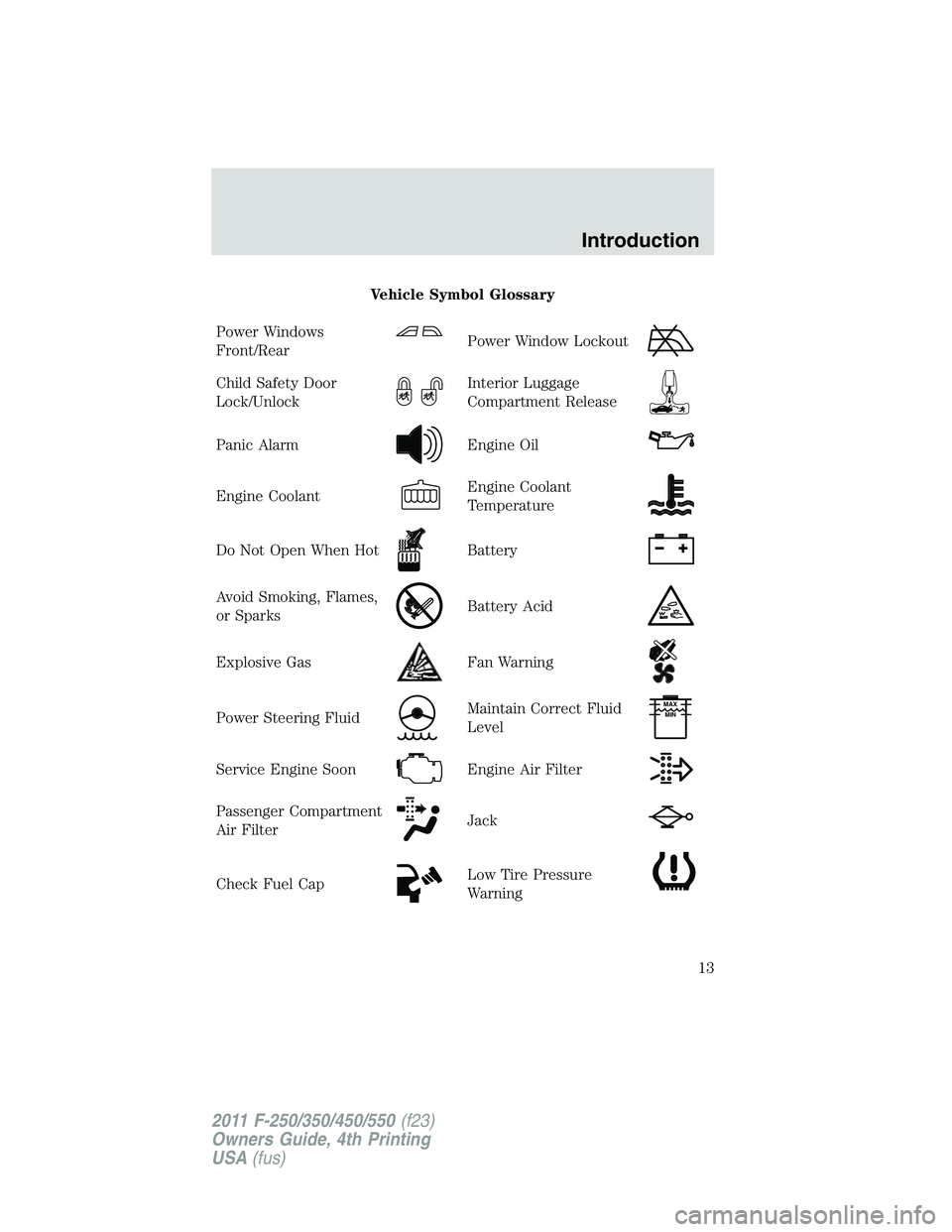
Vehicle Symbol Glossary
Power Windows
Front/Rear Power Window Lockout
Child Safety Door
Lock/Unlock Interior Luggage
Compartment Release
Panic Alarm Engine Oil
Engine Coolant Engine Coolant
Temperature
Do Not Open When Hot Battery
Avoid Smoking, Flames,
or Sparks Battery Acid
Explosive Gas Fan Warning
Power Steering Fluid Maintain Correct Fluid
Level MAX
MIN
Service Engine Soon Engine Air Filter
Passenger Compartment
Air Filter Jack
Check Fuel Cap Low Tire Pressure
WarningIntroduction
13
2011 F-250/350/450/550 (f23)
Owners Guide, 4th Printing
USA (fus)
Page 18 of 449
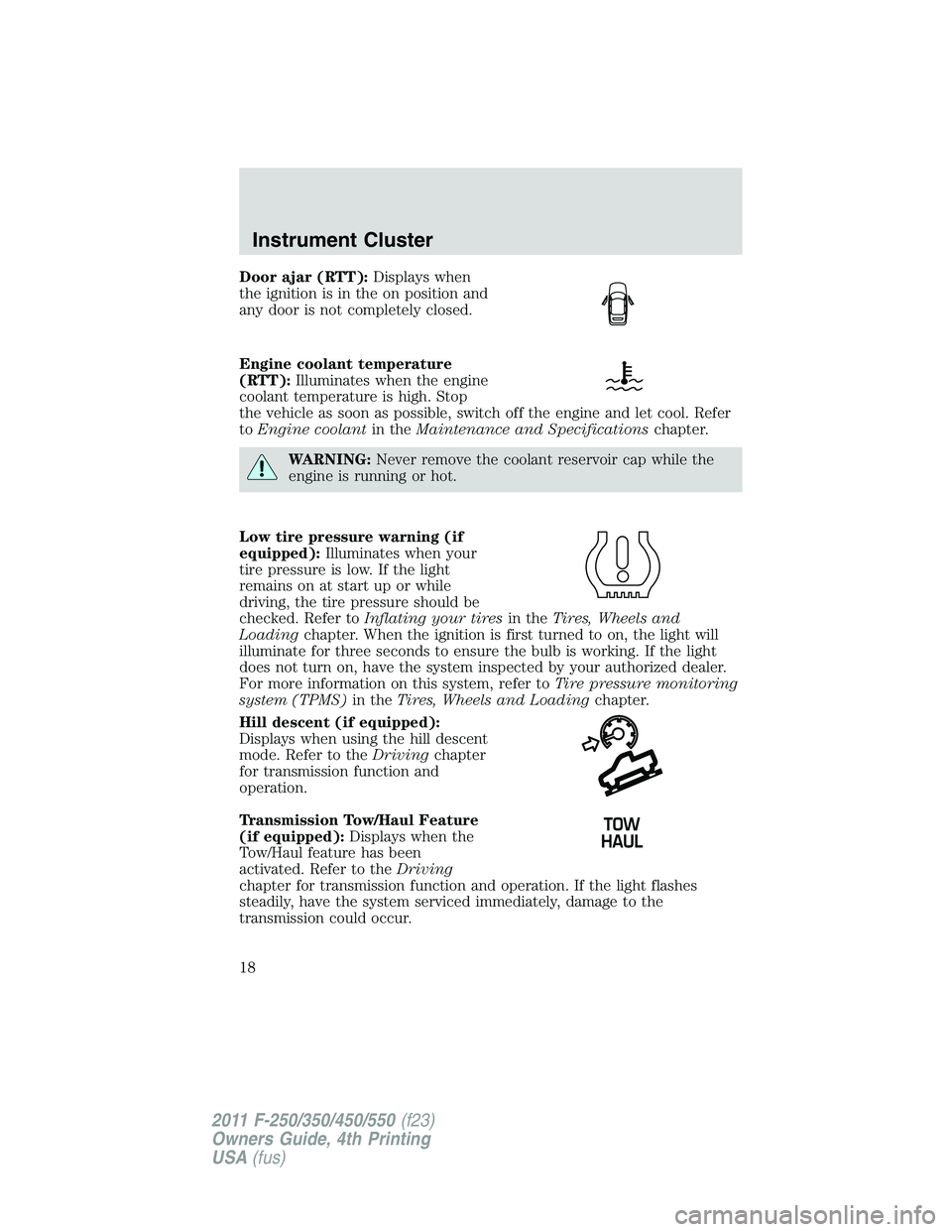
Door ajar (RTT): Displays when
the ignition is in the on position and
any door is not completely closed.
Engine coolant temperature
(RTT): Illuminates when the engine
coolant temperature is high. Stop
the vehicle as soon as possible, switch off the engine and let cool. Refer
to Engine coolant in the Maintenance and Specifications chapter.
WARNING: Never remove the coolant reservoir cap while the
engine is running or hot.
Low tire pressure warning (if
equipped): Illuminates when your
tire pressure is low. If the light
remains on at start up or while
driving, the tire pressure should be
checked. Refer to Inflating your tires in the Tires, Wheels and
Loading chapter. When the ignition is first turned to on, the light will
illuminate for three seconds to ensure the bulb is working. If the light
does not turn on, have the system inspected by your authorized dealer.
For more information on this system, refer to Tire pressure monitoring
system (TPMS) in the Tires, Wheels and Loading chapter.
Hill descent (if equipped):
Displays when using the hill descent
mode. Refer to the Driving chapter
for transmission function and
operation.
Transmission Tow/Haul Feature
(if equipped): Displays when the
Tow/Haul feature has been
activated. Refer to the Driving
chapter for transmission function and operation. If the light flashes
steadily, have the system serviced immediately, damage to the
transmission could occur.Instrument Cluster
18
2011 F-250/350/450/550 (f23)
Owners Guide, 4th Printing
USA (fus)
Page 21 of 449
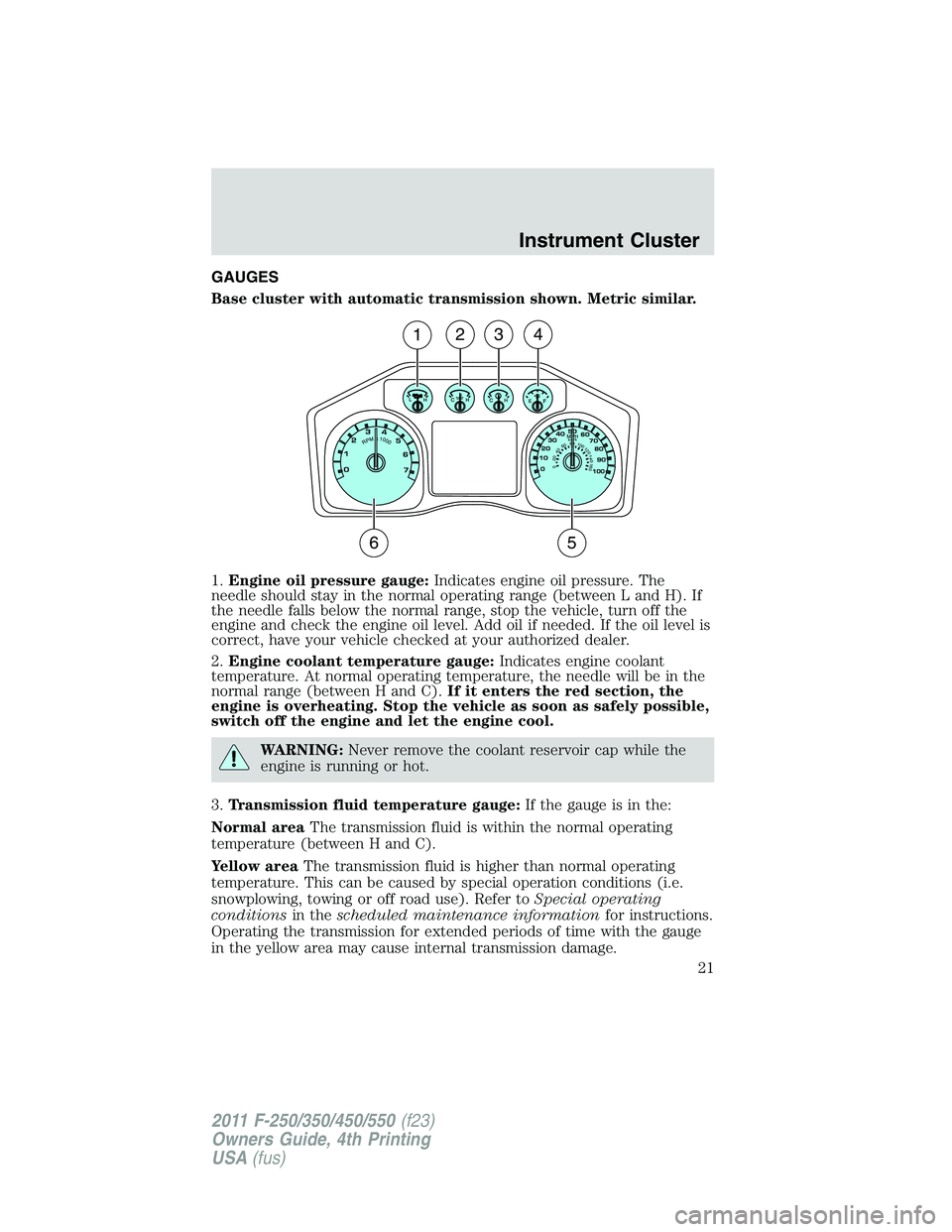
GAUGES
Base cluster with automatic transmission shown. Metric similar.
1. Engine oil pressure gauge: Indicates engine oil pressure. The
needle should stay in the normal operating range (between L and H). If
the needle falls below the normal range, stop the vehicle, turn off the
engine and check the engine oil level. Add oil if needed. If the oil level is
correct, have your vehicle checked at your authorized dealer.
2. Engine coolant temperature gauge: Indicates engine coolant
temperature. At normal operating temperature, the needle will be in the
normal range (between H and C). If it enters the red section, the
engine is overheating. Stop the vehicle as soon as safely possible,
switch off the engine and let the engine cool.
WARNING: Never remove the coolant reservoir cap while the
engine is running or hot.
3. Transmission fluid temperature gauge: If the gauge is in the:
Normal area The transmission fluid is within the normal operating
temperature (between H and C).
Yellow area The transmission fluid is higher than normal operating
temperature. This can be caused by special operation conditions (i.e.
snowplowing, towing or off road use). Refer to Special operating
conditions in the scheduled maintenance information for instructions.
Operating the transmission for extended periods of time with the gauge
in the yellow area may cause internal transmission damage. km/h
RPMx100
0
0 2 0 4 060801 0 0
1
2
0
1
4
0
16
0 MPH
1 2 3 4
6 5Instrument Cluster
21
2011 F-250/350/450/550 (f23)
Owners Guide, 4th Printing
USA (fus)
Page 49 of 449
is used to disable certain vehicle functions to prevent battery discharge
when the vehicle is in the transport/inventory phase and is not driven
long enough to maintain the battery’s charge. This mode can be disabled
by doing the following: Turn the ignition on, without starting the engine.
Press and release the brake pedal fully five times and press the hazard
button four times (on, off, on, off) within 10 seconds.
CHECK COOLANT ADDITIVE (diesel engine only) — Displayed
when the coolant additive needs to be checked. Refer to your diesel
supplement for more information.
POWER REDUCED TO LOWER ENGINE TEMP — Displayed when
the engine temperature gauge needle moves to H. You may notice
reduced engine power. Refer to Engine coolant in the Maintenance
and Specifications chapter for more information.
CLEANING EXHAUST FILTER (diesel engine only) — Displayed
when the vehicle has entered the cleaning mode. Various engine actions
will raise the exhaust temperature in the Diesel Particulate Filter (DPF)
system to burn off the particles (exhaust soot). After the particles are
burned off, the exhaust temperature will fall back to normal levels. This
message is NORMAL. Refer to your diesel supplement for more
information.
WARNING: When the CLEANING EXHAUST FILTER message
appears in the message center, do not park near flammable
materials, vapors or structures until filter cleaning is complete.
DRIVE TO CLEAN EXHAUST SYSTEM (diesel engine only) —
Displayed when the Diesel Particulate Filter (DPF) is full of particles
(exhaust soot) and the vehicle is not being operated in a manner to
allow normal cleaning. This message will stay on until the exhaust filter
cleaning has begun, at which time the CLEANING EXHAUST FILTER
message will be displayed. It is recommended the vehicle operator drive
the vehicle above 30 mph (48 km/h) until the CLEANING EXHAUST
FILTER message turns off. This message is NORMAL. Refer to your
diesel supplement for more information.
Note: If this message is ignored, your vehicle will continue to fill the
Diesel Particulate Filter (DPF) with particles (exhaust soot). If cleaning
is not permitted, the light will illuminate and engine power may be
limited. If the vehicle is still not operated in a manner to allow cleaning,
the service engine soon light will illuminate and engine power will
be further limited. Dealer service will then be required to restore your
vehicle to full-power operation. Instrument Cluster
49
2011 F-250/350/450/550 (f23)
Owners Guide, 4th Printing
USA (fus)
Page 266 of 449
WARNING: If you smell exhaust fumes inside your vehicle, have
your dealer inspect your vehicle immediately. Do not drive if you
smell exhaust fumes.
Important ventilating information
If the engine is idling while the vehicle is stopped for a long period of
time, open the windows at least 1 inch (2.5 cm) or adjust the heating or
air conditioning to bring in fresh air.
ENGINE BLOCK HEATER (IF EQUIPPED)
An engine block heater warms the engine coolant which aids in starting
and allows the heater/defroster system to respond quickly. If your vehicle
is equipped with this system, your equipment includes a heater element
which is installed in your engine block and a wire harness which allows
the user to connect the system to a grounded 120 volt A/C electrical
source. The block heater system is most effective when outdoor
temperatures reach below 0°F (-18°C).
For flexible fuel vehicles, if operating with E85 ethanol, an engine block
heater must be used if ambient temperature is below 0°F (-18°C).
See Cold weather starting earlier in this chapter for more information
on starting with ethanol.
WARNING: Failure to follow engine block heater instructions
could result in property damage or physical injury.
WARNING: To reduce the risk of electrical shock, do not use
your heater with ungrounded electrical systems or two-pronged
(cheater) adapters.
Prior to using the engine block heater, follow these recommendations for
proper and safe operation:
• For your safety, use an outdoor extension cord that is product
certified by Underwriter’s Laboratory (UL) or Canadian Standards
Association (CSA). Use only an extension cord that can be used
outdoors, in cold temperatures, and is clearly marked “Suitable for Use
with Outdoor Appliances.” Never use an indoor extension cord
outdoors; it could result in an electric shock or fire hazard.
• Use a 16 gauge outdoor extension cord, minimum.Driving
266
2011 F-250/350/450/550 (f23)
Owners Guide, 4th Printing
USA (fus)
Page 375 of 449
3. Run the engine until it reaches normal operating temperature.
4. Allow the engine to idle for at least one minute.
5. Turn the A/C on and allow the engine to idle for at least one minute.
6. Release the parking brake. With your foot on the brake pedal and with
the A/C on, put the vehicle in D (Drive) and allow the engine to idle for
at least one minute.
7. Drive the vehicle to complete the relearning process.
• The vehicle may need to be driven 10 miles (16 km) or more to
relearn the idle and fuel trim strategy.
• If you do not allow the engine to relearn its idle trim, the idle
quality of your vehicle may be adversely affected until the idle
trim is eventually relearned.
If the battery has been disconnected or a new battery has been installed,
the clock and radio settings must be reset once the battery is
reconnected.
• Always dispose of automotive
batteries in a responsible manner.
Follow your local authorized
standards for disposal. Call your
local authorized recycling center
to find out more about recycling
automotive batteries.
ENGINE COOLANT
Checking engine coolant
The concentration and level of engine coolant should be checked at the
intervals listed in scheduled maintenance information. The coolant
concentration should be maintained at 50/50 coolant and distilled water.
For best results, coolant concentration should be tested with a
refractometer such as Rotunda tool 300–ROB75240E available from your
dealer. The level of coolant should be maintained at the FULL COLD
level or within the COLD FILL RANGE in the coolant reservoir. If the
level falls below, add coolant per the instructions in the Adding engine
coolant section.
Your vehicle was factory-filled with a 50/50 engine coolant and water
concentration. If the concentration of coolant falls below 40% or above
L E A D
RETURN
RECYCLEMaintenance and Specifications
375
2011 F-250/350/450/550 (f23)
Owners Guide, 4th Printing
USA (fus)
Page 379 of 449
If your vehicle is equipped with a diesel engine, refer to the
Maintenance product specifications and capacities section of your
diesel supplement.
Fill your engine coolant reservoir as outlined previously in the Adding
engine coolant section.
Severe climates
If you drive in extremely cold climates:
• It may be necessary to increase the coolant concentration
above 50%.
• NEVER increase the coolant concentration above 60%.
• A coolant concentration of 60% will provide improved freeze
point protection. Increased engine coolant concentrations
above 60% will decrease the overheat protection
characteristics of the engine coolant and may cause engine
damage.
• If available, refer to the chart on the coolant container to
ensure the coolant concentration in your vehicle will provide
adequate freeze protection at the temperatures in which you
drive in the winter months.
If you drive in extremely hot climates:
• It is still necessary to maintain the coolant concentration
above 40%.
• NEVER decrease the coolant concentration below 40%.
• Decreased engine coolant concentrations below 40% will
decrease the corrosion/freeze protection characteristics of the
engine coolant and may cause engine damage.
• If available, refer to the chart on the coolant container to
ensure the coolant concentration in your vehicle will provide
adequate protection at the temperatures in which you drive.
Vehicles driven year-round in non-extreme climates should use a 50/50
mixture of engine coolant and distilled water for optimum cooling system
and engine protection.
What you should know about fail-safe cooling (if equipped)
If the engine coolant supply is depleted, this feature allows the vehicle to
be driven temporarily before incremental component damage is incurred.
The “fail-safe” distance depends on ambient temperatures, vehicle load
and terrain. Maintenance and Specifications
379
2011 F-250/350/450/550 (f23)
Owners Guide, 4th Printing
USA (fus)
Page 380 of 449
How fail-safe cooling works
If the engine begins to overheat:
• The engine coolant temperature gauge will move to the red (hot)
area.
• The message center will indicate the engine is overheating.
• The service engine soon indicator will illuminate.
If the engine reaches a preset over-temperature condition, the engine
will automatically switch to alternating cylinder operation. Each disabled
cylinder acts as an air pump and cools the engine.
When this occurs the vehicle will still operate. However:
• The engine power will be limited.
• The air conditioning system will be disabled.
Continued operation will increase the engine temperature and the engine
will completely shut down, causing steering and braking effort to
increase.
Once the engine temperature cools, the engine can be re-started. Take
your vehicle to an authorized dealer as soon as possible to minimize
engine damage.
When fail-safe mode is activated
You have limited engine power when in the fail-safe mode, so drive the
vehicle with caution. The vehicle will not be able to maintain high-speed
operation and the engine will run rough. Remember that the engine is
capable of completely shutting down automatically to prevent engine
damage; therefore:
1. Pull off the road as soon as safely possible and turn off the engine.
2. Arrange for the vehicle to be taken to an authorized dealer.
3. If this is not possible, wait a short period for the engine to cool.
4. Check the coolant level and replenish if low.
WARNING: Never remove the coolant reservoir cap while the
engine is running or hot.
5. Re-start the engine and take your vehicle to an authorized dealer.
Driving the vehicle without repairing the engine problem
increases the chance of engine damage. Take your vehicle to an
authorized dealer as soon as possible.Maintenance and Specifications
380
2011 F-250/350/450/550 (f23)
Owners Guide, 4th Printing
USA (fus)
Page 381 of 449
Engine fluid temperature management (except 6.8L V10)
Your vehicle has been designed to pull a trailer, but because of the added
load, the vehicle’s engine may temporarily reach higher temperatures
during severe operating conditions such as ascending a long or steep
grade while pulling a trailer in hot ambient temperatures.
At this time, you may notice your engine coolant temperature gauge
needle move toward the H and the POWER REDUCED TO LOWER
TEMP message may appear on the message center.
You may notice a reduction in the vehicle’s speed caused by reduced
engine power. Your vehicle has been designed to enter this mode if
certain high temperature/high load conditions take place in order to
manage the engine’s fluid temperatures. The amount of speed reduction
will depend on the vehicle loading, towing, grade, ambient temperature,
and other factors. If this occurs, there is no need to pull off the road.
The vehicle can continue to be driven while this message is active.
WARNING: To reduce the risk of collision and injury, be
prepared that the vehicle speed may reduce and the vehicle may
not be able to accelerate with full power until the fluid temperatures
reduce.
The air conditioning may also cycle on and off during severe operating
conditions to protect overheating of the engine. When the engine coolant
temperature decreases to a more normal operating temperature, the air
conditioning will turn on once again.
If you notice any of the following:
• the engine coolant temperature gauge moves fully into the red (hot)
area
• the coolant temperature warning light illuminates
• the service engine soon indicator illuminates
1. Pull off the road as soon as safely possible and place the vehicle in P
(Park).
2. Leave the engine running until the coolant temperature gauge needle
moves away from the H range. After several minutes, if this does not
happen, follow the remaining steps.
3. Turn the engine off and wait for it to cool before checking the coolant
level. Maintenance and Specifications
381
2011 F-250/350/450/550 (f23)
Owners Guide, 4th Printing
USA (fus)
Page 404 of 449
• Cover interior trim to prevent fading.
• Keep all rubber parts free from oil and solvents.
Engine
• The engine oil and filter should be changed prior to storage, as used
engine oil contain contaminates that may cause engine damage.
• Start the engine every 15 days. Run at fast idle until it reaches normal
operating temperature.
• With your foot on the brake, shift through all the gears while the
engine is running.
Fuel system
• Fill the fuel tank with high-quality fuel until the first automatic shutoff
of the fuel pump nozzle.
Note: During extended periods of vehicle storage (30 days or more),
fuel may deteriorate due to oxidation. Add a quality gas stabilizer
product to the vehicle fuel system whenever actual or expected storage
periods exceed 30 days. Follow the instructions on the additive label.
The vehicle should then be operated at idle speed to circulate the
additive throughout the fuel system.
Cooling system
• Protect against freezing temperatures.
• When removing vehicle from storage, check coolant fluid level.
Confirm there are no cooling system leaks, and fluid is at the
recommended level.
Battery
• Check and recharge as necessary. Keep connections clean.
• If storing your vehicle for more than 30 days without recharging the
battery, it may be advisable to disconnect the battery cables to ensure
battery charge is maintained for quick starting.
Note: If battery cables are disconnected, it will be necessary to reset
memory features.
Brakes
• Make sure brakes and parking brake are fully released.
Tires
• Maintain recommended air pressure.Maintenance and Specifications
404
2011 F-250/350/450/550 (f23)
Owners Guide, 4th Printing
USA (fus)