wheel FORD F450 2012 Manual PDF
[x] Cancel search | Manufacturer: FORD, Model Year: 2012, Model line: F450, Model: FORD F450 2012Pages: 448, PDF Size: 6.01 MB
Page 260 of 448
• The TBC interacts with the brake system of the vehicle, including
ABS, in order to reduce the likelihood of trailer wheel lock-up;
therefore, if these systems are not functioning properly, the TBC may
not function at full performance.
• Your vehicle’s brake system and the trailer brake system work
independently of each other; changing the GAIN setting on the TBC
does not affect the operation of your vehicle’s brakes whether a trailer
is attached or not.
• When the vehicle is turned off, the TBC output is disabled and the
display is shut down; turning the ignition from off to on awakens the
TBC module.
• The TBC is only a factory- or dealer-installed item; Ford is not
responsible for warranty or performance of the TBC due to misuse or
customer installation.
• Do not attempt removal of the TBC without consulting the
Workshop Manual; damage to the unit may result.
Trailer Lamps
Trailer lamps are required on most towed vehicles. Make sure all running
lights, brake lights, turn signals and hazard lights are working. Contact
your authorized dealer or trailer rental agency for proper instructions
and equipment for hooking-up trailer lamps.
Driving while you tow
When towing a trailer:
• Consult your local motor vehicle laws for towing a trailer.
• Do not drive faster than 70 mph (113 km/h) during the first 500 miles
(800 km) of trailer towing and don’t make full-throttle starts.
• Turn off the speed control. The speed control may shut off
automatically when you are towing on long, steep grades.
• Activate the tow/haul feature to eliminate excessive transmission
shifting and assist in transmission cooling. For additional information,
refer to Automatic transmission operation in the Driving chapter.
• Allow more distance for stopping with a trailer attached; anticipate
stops and brake gradually.Tires, Wheels and Loading
260
2012 F-250/350/450/550 (f23)
Owners Guide, 4th Printing
USA (fus)
Page 261 of 448
Your vehicle may be equipped with a temporary or conventional spare
tire. If the spare tire is different in size (diameter and/or width), tread
type (All-Season or All-Terrain) or is from a different manufacturer other
than the road tires on your vehicle, your spare tire is considered
“temporary”. Consult information on the Tire Label or Safety Compliance
Certification Label for limitations when using.
Trailer towing safety tips
General
• Ensure that the trailer, safety chains and 7–pin electrical connectors
are securely fastened.
• Make sure the truck receiver, draw bar and coupler are properly
connected and adjusted.
• Check rear view and side mirrors for proper visibility especially when
towing a trailer wider than the truck.
• When turning, make wide turns to allow trailer tires to properly clear
any obstacles.
• Operate the vehicle at lower speeds than you would when not towing
a trailer; the likelihood of trailer sway is greater at higher speeds.
• Be prepared for trailer sway due to buffeting when larger vehicles
pass in either direction.
• If you will be towing a trailer frequently in hot weather, hilly
conditions, at GCWR, or any combination of these factors, consider
refilling your rear axle with synthetic gear lubricant if not already so
equipped. Refer to Maintenance product specifications and
capacities in the Maintenance and Specifications chapter for the
proper axle lubricant. Remember that regardless of the rear axle
lubricant used, do not tow a trailer for the first 500 miles (800 km) of
a new vehicle, and that the first 500 miles (800 km) of towing be done
at no faster than 70 mph (113 km/h) with no full-throttle starts.
Loading
• Trailer loads should be evenly distributed front-to-back and
left-to-right.
• Never exceed truck, trailer, receiver, ball, tongue, tire or coupler
loading recommendations.
• Keep the center of gravity low for best handling. Tires, Wheels and Loading
261
2012 F-250/350/450/550 (f23)
Owners Guide, 4th Printing
USA (fus)
Page 262 of 448
Braking
• Anticipate stops; allow more distance and time to stop than normal.
• Do not apply the trailer brakes for extended periods of time as they
can overheat and lose effectiveness.
• The trailer brakes (including the shoes, drum and trailer brake
magnets) must be inspected and serviced at intervals specified by the
manufacturer.
• Electric brakes also require periodic adjustment to keep the shoes
properly spaced. If the brakes get hot when driving or if they will not
hold, chances are that they need adjustment.
Backing-up
• Practice backing-up, particularly if you are a novice. Turn the steering
wheel to the right to move the trailer’s rear end to the right.
• Sharp steering movements may cause the trailer to jackknife or go out
of control.
Tires
• Select tires that meet the trailer loading requirements.
• All trailer tires should be of the same size, and construction.
• Always check tow vehicle and trailer tire pressure before towing.
Launching or Retrieving a Boat or Personal Water Craft (PWC)
Note: Disconnect the wiring to the trailer before backing the trailer into
the water.
Note: Reconnect the wiring to the trailer after the trailer is removed
from the water.
When backing down a ramp during boat launching or retrieval:
1. Do not allow the static water level to rise above the bottom edge of
the rear bumper.
2. Do not allow waves to break higher than six inches (15 centimeters)
above the bottom edge of the rear bumper.
Exceeding these limits may allow water to enter vehicle components:
1. Causing internal damage to the components.
2. Affecting driveability, emissions, and reliability.
Replace the rear axle lubricant any time the rear axle has been
submerged in water. Water may have contaminated the rear axle
lubricant, which is not normally checked or changed unless a leak is
suspected or other axle repair is required.Tires, Wheels and Loading
262
2012 F-250/350/450/550 (f23)
Owners Guide, 4th Printing
USA (fus)
Page 263 of 448
RECREATIONAL TOWING
Follow these guidelines if you have a need for recreational (RV) towing.
An example of recreational towing would be towing your vehicle behind
a motor home.
Note: Put your climate control system in recirculated air mode to
prevent exhaust fumes from entering the vehicle. Refer to the Climate
Controls chapter for more information.
In case of a roadside emergency with a disabled vehicle, see Wrecker
towing in the Roadside Emergencies chapter.
These guidelines are designed to ensure that your transmission is not
damaged after the vehicle is hooked-up to the RV or tow dolly.
Drivetrain
configuration Requirements for neutral towing
4x4 with manual-shift
transfer case Transmission in N (Neutral); transfer case in N
(Neutral); hublocks set to FREE*
4x2 or 4x4 with
electronic-shift
transfer case Do not tow your vehicle with any wheels on
the ground, as vehicle or transmission damage
may occur. It is recommended to tow your
vehicle with all four (4) wheels off the ground
such as when using a car-hauling trailer.
Otherwise, no recreational towing is permitted.
*Always make sure that both hub locks are set to the same position.
RECOVERY HOOKS
WARNING: Using recovery hooks is dangerous and should only
be done by a person familiar with proper vehicle recovery safety
practices. Improper use of recovery hooks may cause hook failure
and/or separation from the vehicle and could result in serious injury or
death.
WARNING: Always slowly remove the slack from the recovery
strap prior to pulling. Failure to do so can introduce significantly
higher loads which can cause the recovery hooks to break off, or the
recovery strap to fail which can cause serious injury or death. Tires, Wheels and Loading
263
2012 F-250/350/450/550 (f23)
Owners Guide, 4th Printing
USA (fus)
Page 264 of 448
WARNING: Never link two straps together with a clevis pin.
These heavy metal objects could become projectiles if the strap
breaks and can cause serious injury or death.
Your vehicle comes equipped with frame-mounted front recovery hooks.
These hooks should never have a load applied to them greater than the
GVWR of your vehicle.
Before using the recovery hooks:
• Make sure all attaching points are secure and capable of withstanding
the applied load.
• Never use chains, cables or tow straps with metal hook ends.
• Only use recovery straps that have a minimum breaking strength two
to three times the GVW of the stuck vehicle.
• Make sure the recovery strap is in good condition and free of visible
cuts, tears or damage.
• Use a damper device such as a tarp, heavy blanket or piece of carpet
draped over the recovery strap to help absorb the energy in the event
the strap breaks.
• Make sure the stuck vehicle is not loaded in excess of its GVWR
specified on the certification label.
• Always align the tow vehicle and stuck vehicle in a straight line
(within 10 degrees).
• Keep bystanders to the sides of the vehicle, at a distance of at least
twice the length of the recovery strap. This helps avoid injury from
the hazard of a recovery hook or strap breaking, or a vehicle lurching
into their path.Tires, Wheels and Loading
264
2012 F-250/350/450/550 (f23)
Owners Guide, 4th Printing
USA (fus)
Page 265 of 448
STARTING
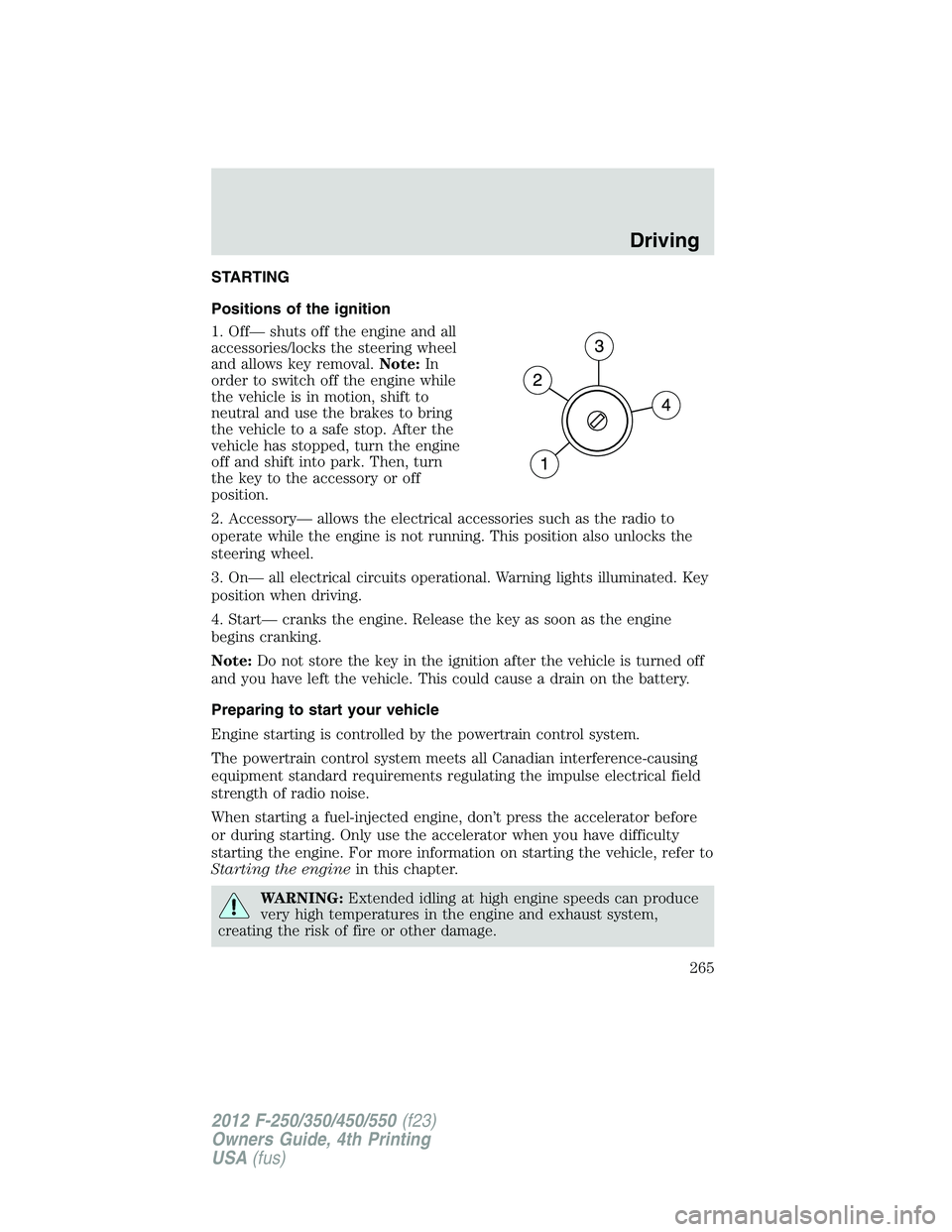
Positions of the ignition
1. Off— shuts off the engine and all
accessories/locks the steering wheel
and allows key removal. Note: In
order to switch off the engine while
the vehicle is in motion, shift to
neutral and use the brakes to bring
the vehicle to a safe stop. After the
vehicle has stopped, turn the engine
off and shift into park. Then, turn
the key to the accessory or off
position.
2. Accessory— allows the electrical accessories such as the radio to
operate while the engine is not running. This position also unlocks the
steering wheel.
3. On— all electrical circuits operational. Warning lights illuminated. Key
position when driving.
4. Start— cranks the engine. Release the key as soon as the engine
begins cranking.
Note: Do not store the key in the ignition after the vehicle is turned off
and you have left the vehicle. This could cause a drain on the battery.
Preparing to start your vehicle
Engine starting is controlled by the powertrain control system.
The powertrain control system meets all Canadian interference-causing
equipment standard requirements regulating the impulse electrical field
strength of radio noise.
When starting a fuel-injected engine, don’t press the accelerator before
or during starting. Only use the accelerator when you have difficulty
starting the engine. For more information on starting the vehicle, refer to
Starting the engine in this chapter.
WARNING: Extended idling at high engine speeds can produce
very high temperatures in the engine and exhaust system,
creating the risk of fire or other damage. Driving
265
2012 F-250/350/450/550 (f23)
Owners Guide, 4th Printing
USA (fus)
Page 267 of 448
2. Make sure the headlamps and electrical accessories are off.
• Make sure the parking brake is
set.
• Make sure the gearshift is in P
(Park).
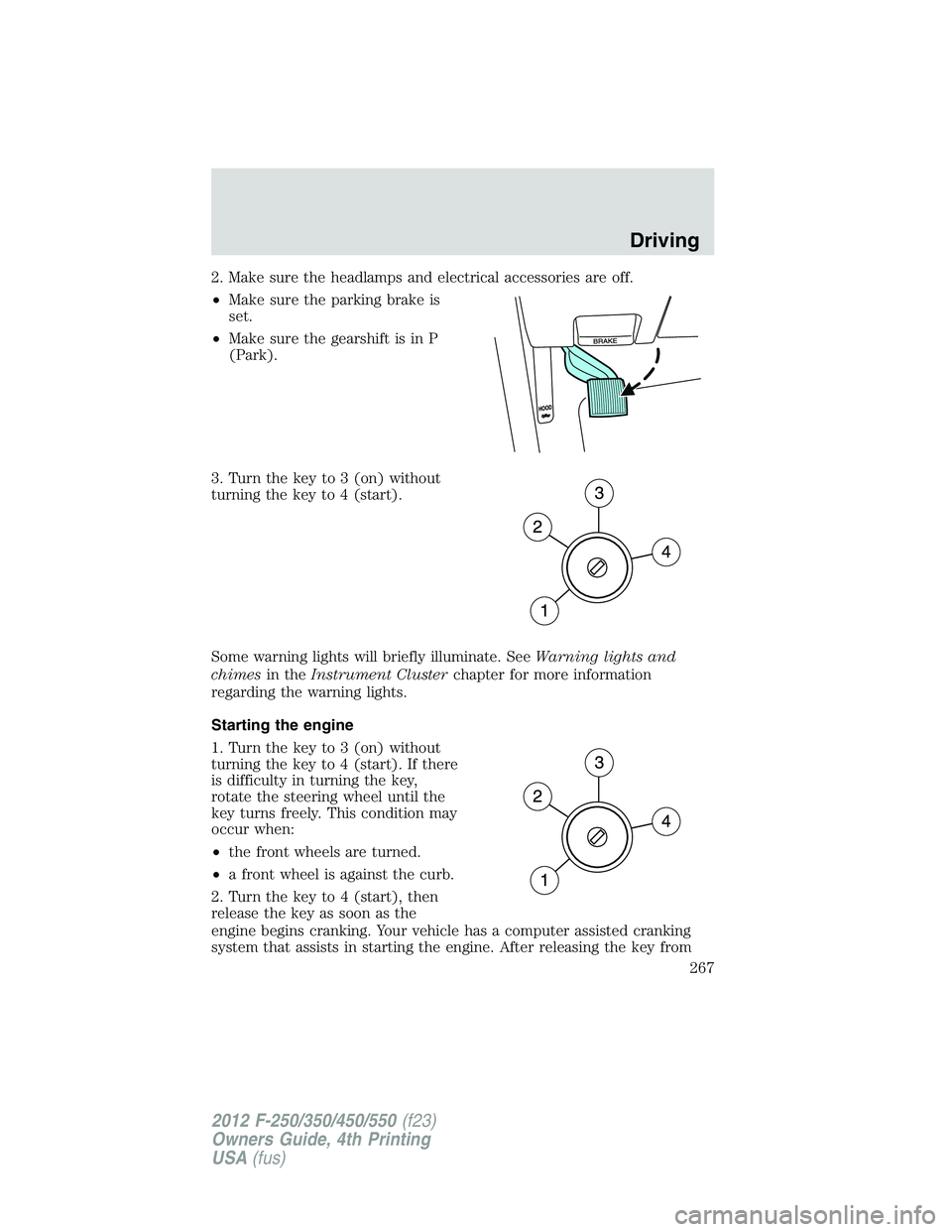
3. Turn the key to 3 (on) without
turning the key to 4 (start).
Some warning lights will briefly illuminate. See Warning lights and
chimes in the Instrument Cluster chapter for more information
regarding the warning lights.
Starting the engine
1. Turn the key to 3 (on) without
turning the key to 4 (start). If there
is difficulty in turning the key,
rotate the steering wheel until the
key turns freely. This condition may
occur when:
• the front wheels are turned.
• a front wheel is against the curb.
2. Turn the key to 4 (start), then
release the key as soon as the
engine begins cranking. Your vehicle has a computer assisted cranking
system that assists in starting the engine. After releasing the key from Driving
267
2012 F-250/350/450/550 (f23)
Owners Guide, 4th Printing
USA (fus)
Page 271 of 448
How to use the engine block heater
Ensure the receptacle terminals are clean and dry prior to use. To clean
them, use a dry cloth.
Depending on the type of factory installed equipment, your engine block
heater system may consume anywhere between 400 watts or 1000 watts
of power per hour. Your factory installed block heater system does not
have a thermostat; however, maximum temperature is attained after
approximately three hours of operation. Block heater operation longer
than three hours will not improve system performance and will
unnecessarily use additional electricity.
Make sure system is unplugged and properly stowed before driving the
vehicle. While not in use, make sure the protective cover seals the
prongs of the engine block heater cord plug.
BRAKES
Occasional brake noise is normal. If a metal-to-metal, continuous grinding
or continuous squeal sound is present, the brake linings may be worn-out
and should be inspected by an authorized dealer. If the vehicle has
continuous vibration or shudder in the steering wheel while braking, the
vehicle should be inspected by an authorized dealer.
Refer to Warning lights and
chimes in the Instrument Cluster
chapter for information on the brake
system warning light.
Four-wheel anti-lock brake system (ABS)
Your vehicle is equipped with an anti-lock braking system (ABS). This
system helps you maintain steering control during emergency stops by
keeping the brakes from locking. Noise from the ABS pump motor and
brake pedal pulsation may be observed during ABS braking and the
brake pedal may suddenly travel a little farther as soon as ABS braking is
done and normal brake operation resumes. These are normal
characteristics of the ABS and should be no reason for concern.
Using ABS
When hard braking is required, apply continuous force on the brake
pedal. Do not pump the brake pedal since this will reduce the
effectiveness of the ABS and will increase your vehicle’s stopping
distance. The ABS will be activated immediately, allowing you to retain
steering control during hard braking and on slippery surfaces. However,
the ABS does not decrease stopping distance. P!
BRAKE Driving
271
2012 F-250/350/450/550 (f23)
Owners Guide, 4th Printing
USA (fus)
Page 273 of 448
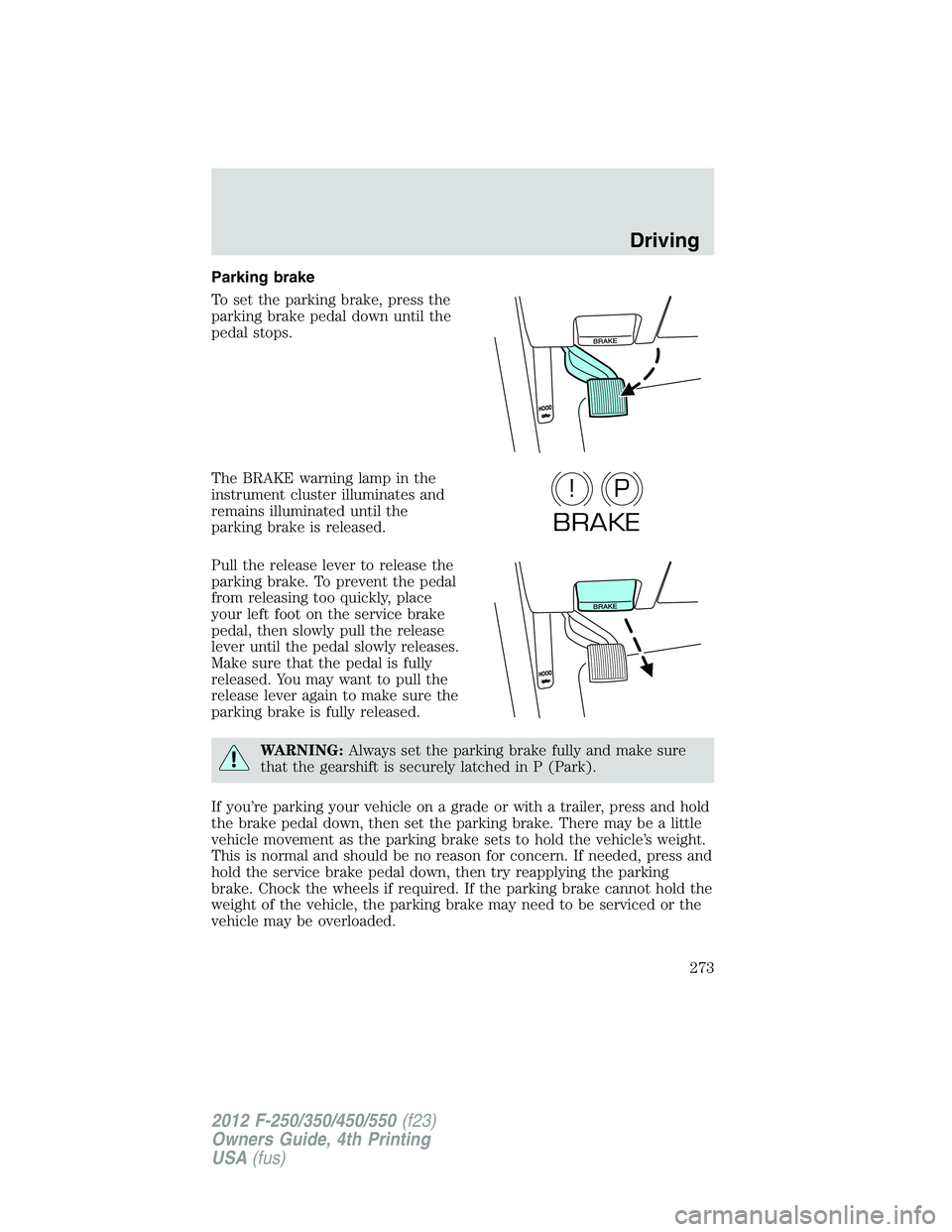
Parking brake
To set the parking brake, press the
parking brake pedal down until the
pedal stops.
The BRAKE warning lamp in the
instrument cluster illuminates and
remains illuminated until the
parking brake is released.
Pull the release lever to release the
parking brake. To prevent the pedal
from releasing too quickly, place
your left foot on the service brake
pedal, then slowly pull the release
lever until the pedal slowly releases.
Make sure that the pedal is fully
released. You may want to pull the
release lever again to make sure the
parking brake is fully released.
WARNING: Always set the parking brake fully and make sure
that the gearshift is securely latched in P (Park).
If you’re parking your vehicle on a grade or with a trailer, press and hold
the brake pedal down, then set the parking brake. There may be a little
vehicle movement as the parking brake sets to hold the vehicle’s weight.
This is normal and should be no reason for concern. If needed, press and
hold the service brake pedal down, then try reapplying the parking
brake. Chock the wheels if required. If the parking brake cannot hold the
weight of the vehicle, the parking brake may need to be serviced or the
vehicle may be overloaded. P!
BRAKE Driving
273
2012 F-250/350/450/550 (f23)
Owners Guide, 4th Printing
USA (fus)
Page 274 of 448
ENGINE ONLY TRACTION CONTROL (DUAL REAR WHEEL (DRW)
VEHICLES ONLY)
This system helps you maintain the stability and steerability of your
vehicle, especially on slippery road surfaces such as snow or ice-covered
roads and gravel roads. The system will allow your vehicle to make
better use of available traction in these conditions.
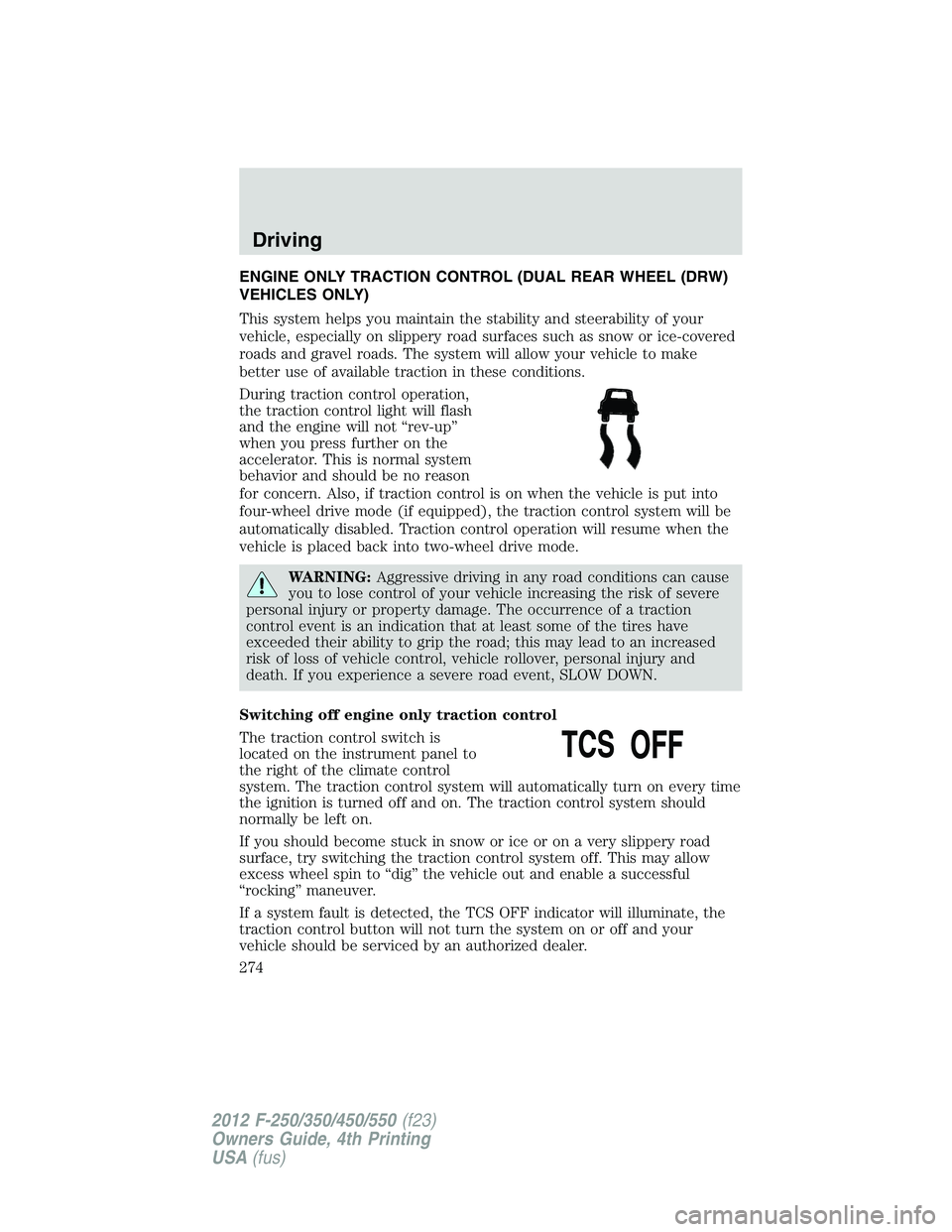
During traction control operation,
the traction control light will flash
and the engine will not “rev-up”
when you press further on the
accelerator. This is normal system
behavior and should be no reason
for concern. Also, if traction control is on when the vehicle is put into
four-wheel drive mode (if equipped), the traction control system will be
automatically disabled. Traction control operation will resume when the
vehicle is placed back into two-wheel drive mode.
WARNING: Aggressive driving in any road conditions can cause
you to lose control of your vehicle increasing the risk of severe
personal injury or property damage. The occurrence of a traction
control event is an indication that at least some of the tires have
exceeded their ability to grip the road; this may lead to an increased
risk of loss of vehicle control, vehicle rollover, personal injury and
death. If you experience a severe road event, SLOW DOWN.
Switching off engine only traction control
The traction control switch is
located on the instrument panel to
the right of the climate control
system. The traction control system will automatically turn on every time
the ignition is turned off and on. The traction control system should
normally be left on.
If you should become stuck in snow or ice or on a very slippery road
surface, try switching the traction control system off. This may allow
excess wheel spin to “dig” the vehicle out and enable a successful
“rocking” maneuver.
If a system fault is detected, the TCS OFF indicator will illuminate, the
traction control button will not turn the system on or off and your
vehicle should be serviced by an authorized dealer.Driving
274
2012 F-250/350/450/550 (f23)
Owners Guide, 4th Printing
USA (fus)