engine FORD F450 SUPER DUTY 2017 Owners Manual
[x] Cancel search | Manufacturer: FORD, Model Year: 2017, Model line: F450 SUPER DUTY, Model: FORD F450 SUPER DUTY 2017Pages: 642, PDF Size: 12.35 MB
Page 302 of 642
Note:When you try to restart your vehicleafter a fuel shutoff, your vehicle makes surethat various systems are safe to restart.Once your vehicle determines that thesystems are safe, then your vehicle willallow you to restart.
In the event of a moderate to severecollision, your vehicle is equipped with afuel pump shut-off feature that stops theflow of fuel to the engine. Not every impactwill cause a shutoff.
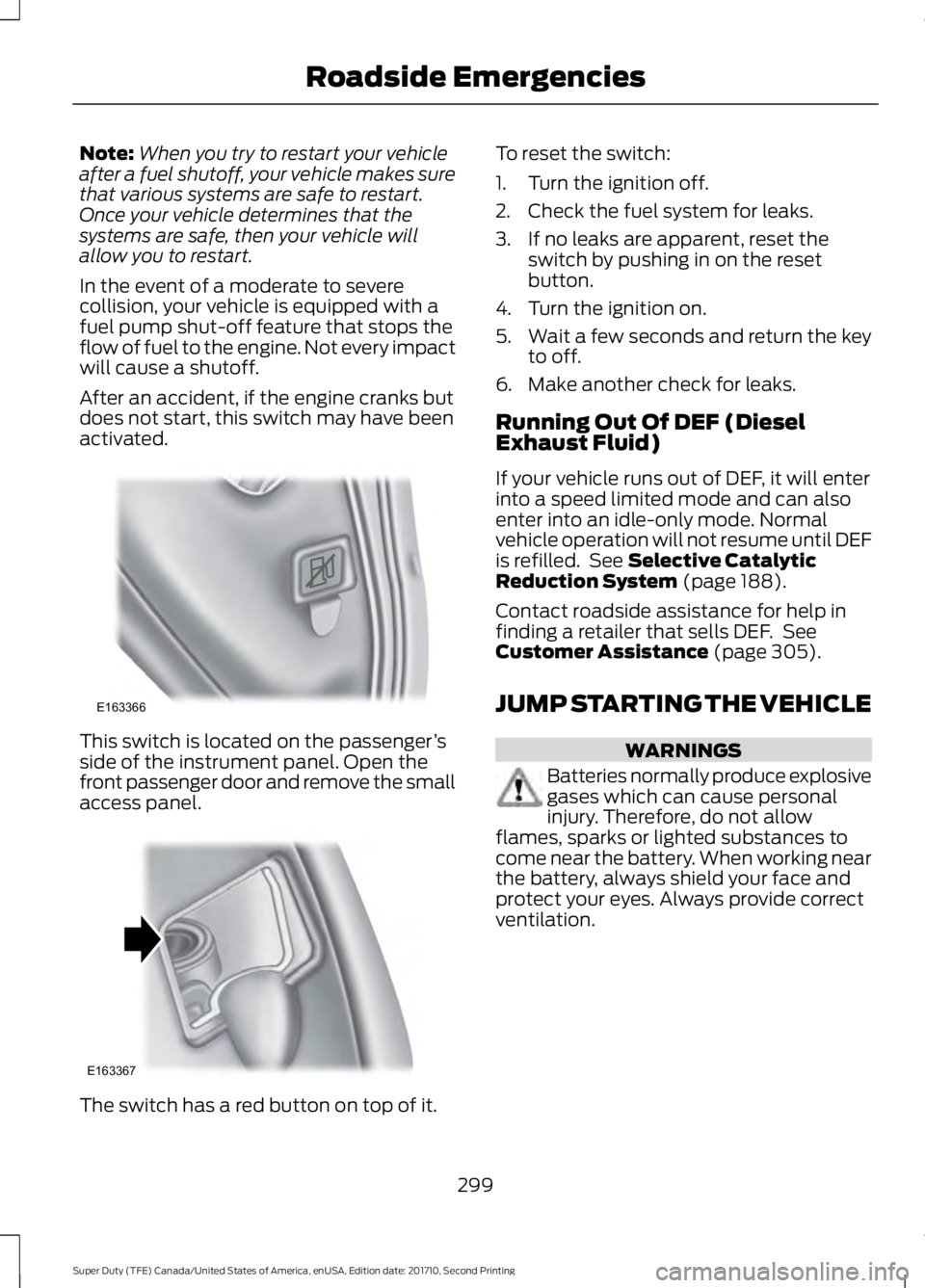
After an accident, if the engine cranks butdoes not start, this switch may have beenactivated.
This switch is located on the passenger’sside of the instrument panel. Open thefront passenger door and remove the smallaccess panel.
The switch has a red button on top of it.
To reset the switch:
1. Turn the ignition off.
2. Check the fuel system for leaks.
3. If no leaks are apparent, reset theswitch by pushing in on the resetbutton.
4. Turn the ignition on.
5.Wait a few seconds and return the keyto off.
6. Make another check for leaks.
Running Out Of DEF (DieselExhaust Fluid)
If your vehicle runs out of DEF, it will enterinto a speed limited mode and can alsoenter into an idle-only mode. Normalvehicle operation will not resume until DEFis refilled. See Selective CatalyticReduction System (page 188).
Contact roadside assistance for help infinding a retailer that sells DEF. SeeCustomer Assistance (page 305).
JUMP STARTING THE VEHICLE
WARNINGS
Batteries normally produce explosivegases which can cause personalinjury. Therefore, do not allowflames, sparks or lighted substances tocome near the battery. When working nearthe battery, always shield your face andprotect your eyes. Always provide correctventilation.
299
Super Duty (TFE) Canada/United States of America, enUSA, Edition date: 201710, Second Printing
Roadside EmergenciesE163366 E163367
Page 303 of 642
WARNINGS
Keep batteries out of reach ofchildren. Batteries contain sulfuricacid. Avoid contact with skin, eyes orclothing. Shield your eyes when workingnear the battery to protect against possiblesplashing of acid solution. In case of acidcontact with skin or eyes, flushimmediately with water for a minimum of15 minutes and get prompt medicalattention. If acid is swallowed, call aphysician immediately.
Use only adequately sized cableswith insulated clamps.
Preparing Your Vehicle
Do not attempt to push-start yourautomatic transmission vehicle.
Note:Attempting to push-start a vehiclewith an automatic transmission may causetransmission damage.
Note:Use only a 12-volt supply to start yourvehicle.
Note:Do not disconnect the battery of thedisabled vehicle as this could damage thevehicle electrical system.
Park the booster vehicle close to the hoodof the disabled vehicle, making sure thetwo vehicles do not touch.
Connecting the Jumper Cables
WARNINGS
Do not attach the cables to fuel lines,engine rocker covers, the intakemanifold or electrical componentsas grounding points. Stay clear of movingparts. To avoid reverse polarityconnections, make sure that you correctlyidentify the positive (+) and negative (-)terminals on both the disabled and boostervehicles before connecting the cables.
WARNINGS
Do not attach the end of the positivecable to the studs or L-shaped eyeletlocated above the positive (+)terminal of your vehicle’s battery. Highcurrent may flow through and causedamage to the fuses.
Do not connect the end of thesecond cable to the negative (-)terminal of the battery to be jumped.A spark may cause an explosion of thegases that surround the battery.
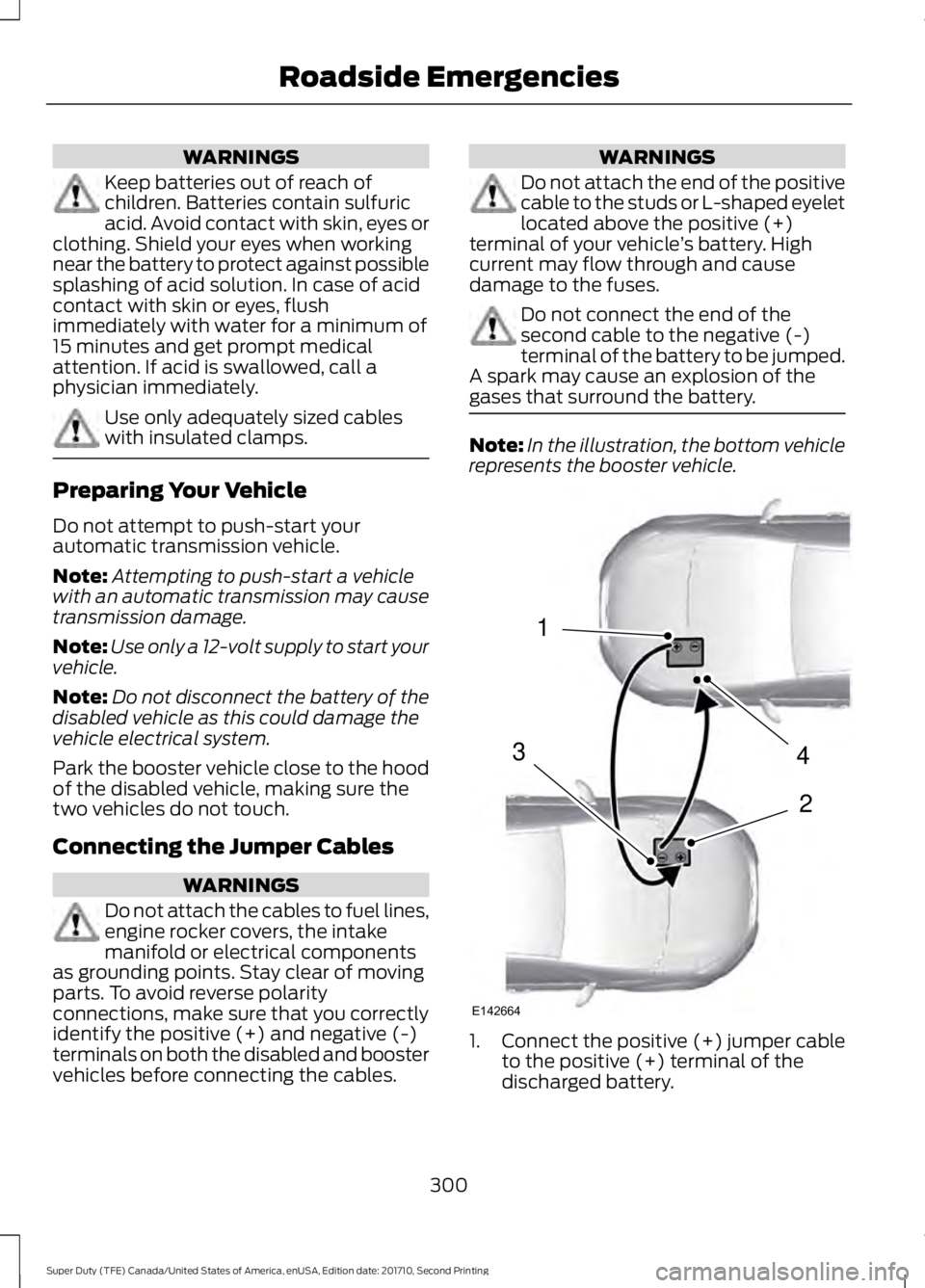
Note:In the illustration, the bottom vehiclerepresents the booster vehicle.
1.Connect the positive (+) jumper cableto the positive (+) terminal of thedischarged battery.
300
Super Duty (TFE) Canada/United States of America, enUSA, Edition date: 201710, Second Printing
Roadside Emergencies4
2
1
3
E142664
Page 304 of 642
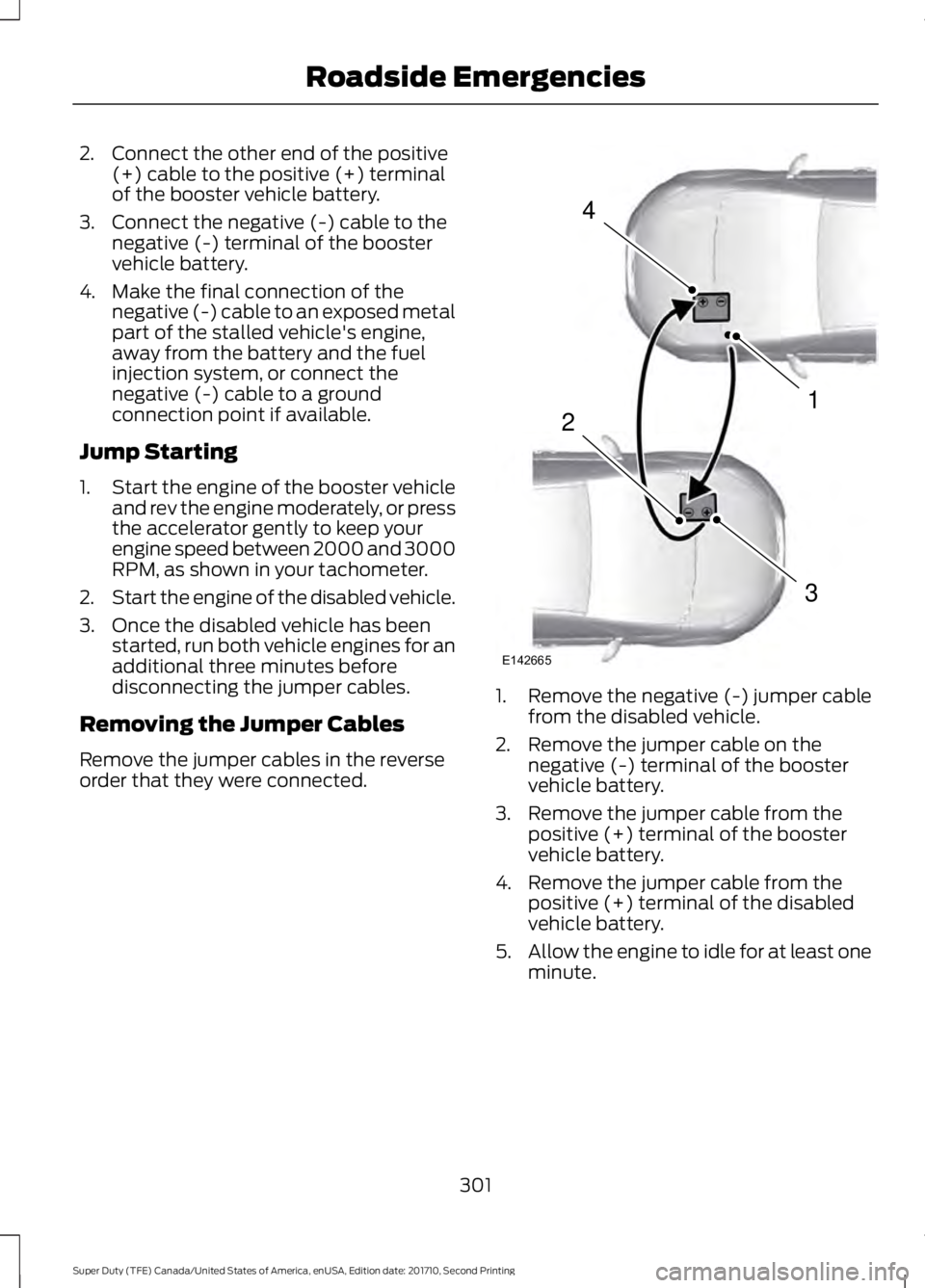
2. Connect the other end of the positive(+) cable to the positive (+) terminalof the booster vehicle battery.
3. Connect the negative (-) cable to thenegative (-) terminal of the boostervehicle battery.
4. Make the final connection of thenegative (-) cable to an exposed metalpart of the stalled vehicle's engine,away from the battery and the fuelinjection system, or connect thenegative (-) cable to a groundconnection point if available.
Jump Starting
1.Start the engine of the booster vehicleand rev the engine moderately, or pressthe accelerator gently to keep yourengine speed between 2000 and 3000RPM, as shown in your tachometer.
2.Start the engine of the disabled vehicle.
3. Once the disabled vehicle has beenstarted, run both vehicle engines for anadditional three minutes beforedisconnecting the jumper cables.
Removing the Jumper Cables
Remove the jumper cables in the reverseorder that they were connected.
1. Remove the negative (-) jumper cablefrom the disabled vehicle.
2. Remove the jumper cable on thenegative (-) terminal of the boostervehicle battery.
3. Remove the jumper cable from thepositive (+) terminal of the boostervehicle battery.
4. Remove the jumper cable from thepositive (+) terminal of the disabledvehicle battery.
5.Allow the engine to idle for at least oneminute.
301
Super Duty (TFE) Canada/United States of America, enUSA, Edition date: 201710, Second Printing
Roadside Emergencies4
1
3
2
E142665
Page 311 of 642
UTILIZING THE
MEDIATION/ARBITRATION
PROGRAM (CANADA ONLY)
For vehicles delivered to authorizedCanadian dealers. In those cases whereyou continue to feel that the efforts by Fordof Canada and the authorized dealer toresolve a factory-related vehicle serviceconcern have been unsatisfactory, Ford ofCanada participates in an impartial thirdparty mediation/arbitration programadministered by the Canadian MotorVehicle Arbitration Plan (CAMVAP).
The CAMVAP program is a straight forwardand relatively speedy alternative to resolvea disagreement when all other efforts toproduce a settlement have failed. Thisprocedure is without cost to you and isdesigned to eliminate the need for lengthyand expensive legal proceedings.
In the CAMVAP program, impartialthird-party arbitrators conduct hearings atmutually convenient times and places inan informal environment. These impartialarbitrators review the positions of theparties, make decisions and, whenappropriate, render awards to resolvedisputes. CAMVAP decisions are fast, fair,and final as the arbitrator’s award isbinding on both you and Ford of Canada.
CAMVAP services are available in allCanadian territories and provinces. Formore information, without charge orobligation, call your CAMVAP ProvincialAdministrator directly at 1-800-207-0685or visit www.camvap.ca.
GETTING ASSISTANCE
OUTSIDE THE U.S. AND
CANADA
Before exporting your vehicle to a foreigncountry, contact the appropriate foreignembassy or consulate. These officials caninform you of local vehicle registrationregulations and where to find unleadedfuel or petrol/gas engines or the propersulfur fuel for diesel engines.
If you cannot find the proper fuelrecommended for your vehicle, contactour Customer Relationship Center.
The use of improper fuels in your vehiclewithout proper conversion may damagethe effectiveness of your emission controlsystem and may cause engine knocking orserious engine damage. Ford MotorCompany or Ford of Canada is notresponsible for any damage caused by useof improper fuel. Using improper fuels mayalso result in difficulty importing yourvehicle back into the United States.
If your vehicle must be serviced while youare traveling or living in Asia-Pacific Region,Sub-Saharan Africa, U.S. Virgin Islandsand/or Puerto Rico , Central America, theCaribbean, and Israel and the Middle East,contact the nearest authorized dealer. Ifthe authorized dealer cannot help you,contact the corresponding Ford CustomerAssistance Center:
FORD MOTOR COMPANY
Customer Relationship Centers in:
308
Super Duty (TFE) Canada/United States of America, enUSA, Edition date: 201710, Second Printing
Customer Assistance
Page 315 of 642
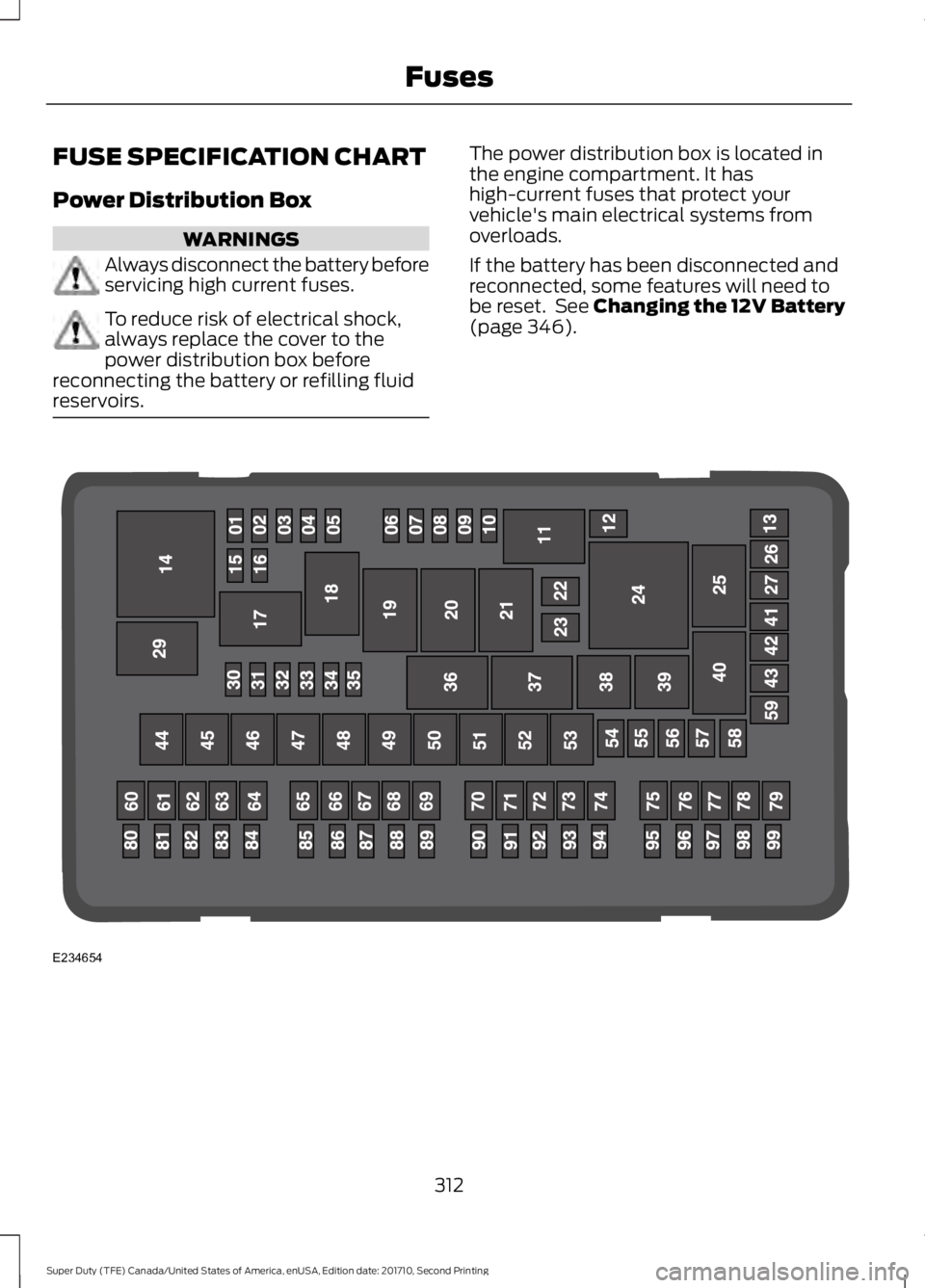
FUSE SPECIFICATION CHART
Power Distribution Box
WARNINGS
Always disconnect the battery beforeservicing high current fuses.
To reduce risk of electrical shock,always replace the cover to thepower distribution box beforereconnecting the battery or refilling fluidreservoirs.
The power distribution box is located inthe engine compartment. It hashigh-current fuses that protect yourvehicle's main electrical systems fromoverloads.
If the battery has been disconnected andreconnected, some features will need tobe reset. See Changing the 12V Battery(page 346).
312
Super Duty (TFE) Canada/United States of America, enUSA, Edition date: 201710, Second Printing
FusesE234654
Page 316 of 642
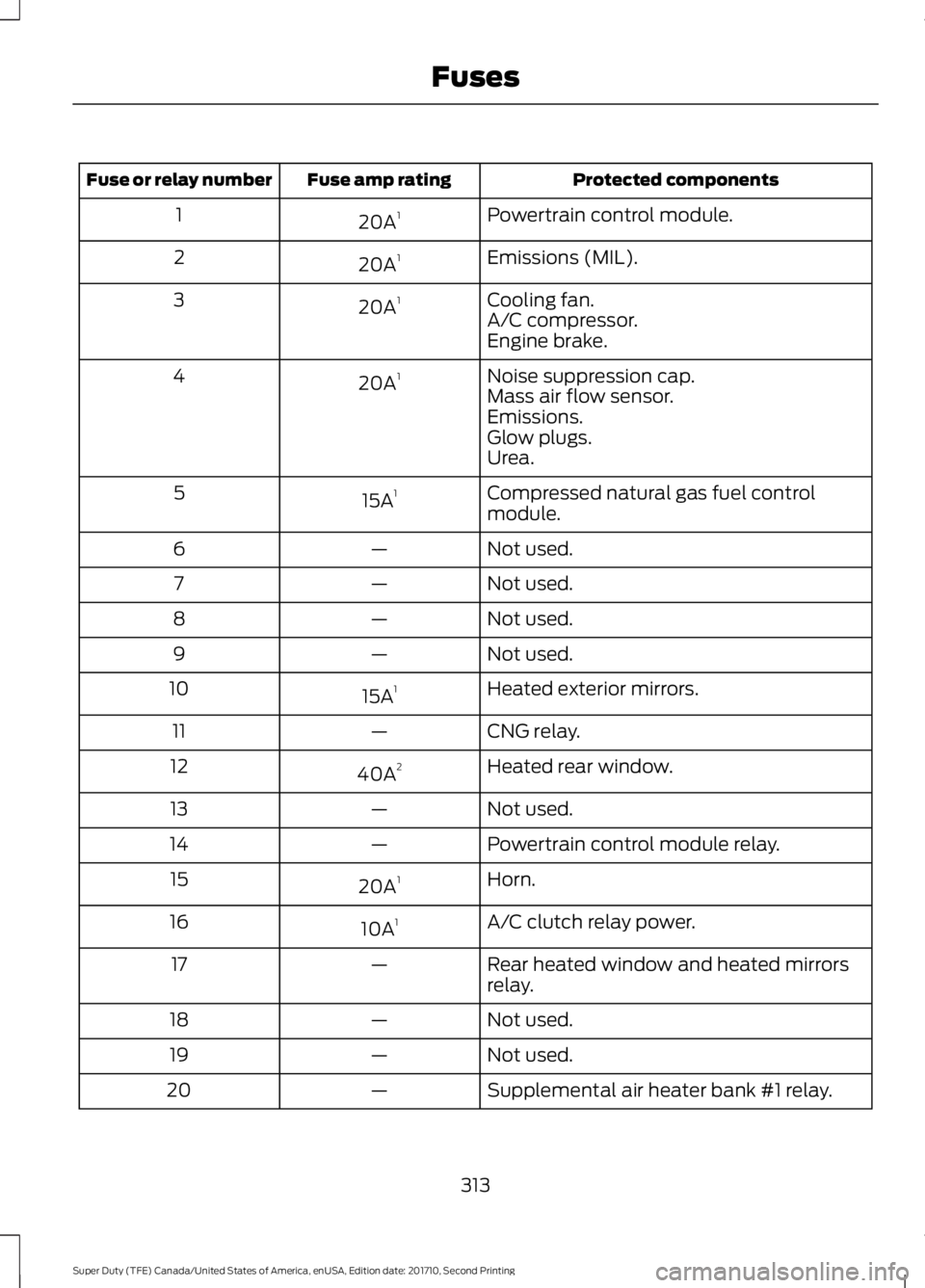
Protected componentsFuse amp ratingFuse or relay number
Powertrain control module.20A11
Emissions (MIL).20A12
Cooling fan.20A13A/C compressor.Engine brake.
Noise suppression cap.20A14Mass air flow sensor.Emissions.Glow plugs.Urea.
Compressed natural gas fuel controlmodule.15A15
Not used.—6
Not used.—7
Not used.—8
Not used.—9
Heated exterior mirrors.15A110
CNG relay.—11
Heated rear window.40A212
Not used.—13
Powertrain control module relay.—14
Horn.20A115
A/C clutch relay power.10A116
Rear heated window and heated mirrorsrelay.—17
Not used.—18
Not used.—19
Supplemental air heater bank #1 relay.—20
313
Super Duty (TFE) Canada/United States of America, enUSA, Edition date: 201710, Second Printing
Fuses
Page 317 of 642
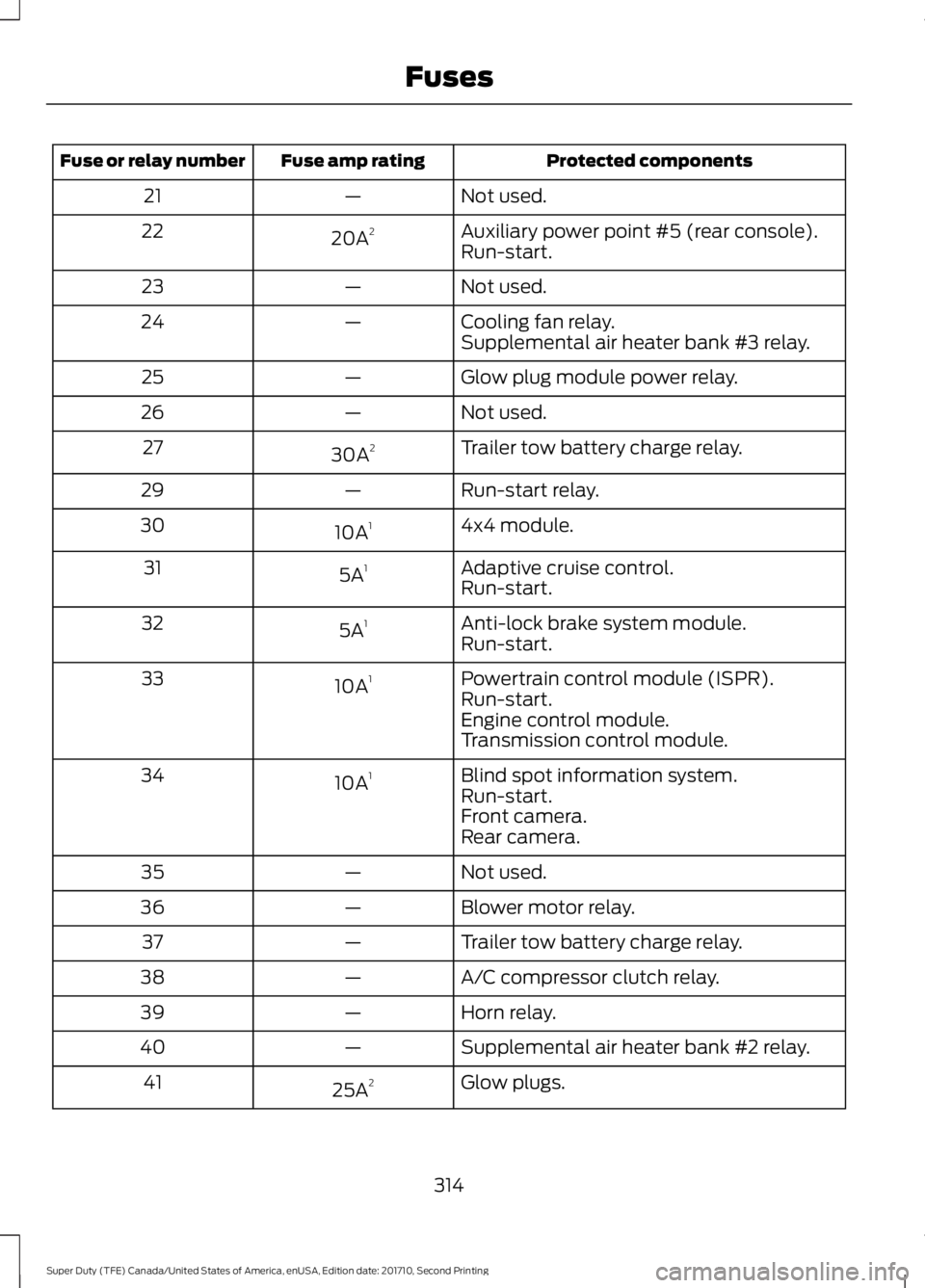
Protected componentsFuse amp ratingFuse or relay number
Not used.—21
Auxiliary power point #5 (rear console).20A222Run-start.
Not used.—23
Cooling fan relay.—24Supplemental air heater bank #3 relay.
Glow plug module power relay.—25
Not used.—26
Trailer tow battery charge relay.30A227
Run-start relay.—29
4x4 module.10A130
Adaptive cruise control.5A131Run-start.
Anti-lock brake system module.5A132Run-start.
Powertrain control module (ISPR).10A133Run-start.Engine control module.Transmission control module.
Blind spot information system.10A134Run-start.Front camera.Rear camera.
Not used.—35
Blower motor relay.—36
Trailer tow battery charge relay.—37
A/C compressor clutch relay.—38
Horn relay.—39
Supplemental air heater bank #2 relay.—40
Glow plugs.25A241
314
Super Duty (TFE) Canada/United States of America, enUSA, Edition date: 201710, Second Printing
Fuses
Page 325 of 642
GENERAL INFORMATION
Have your vehicle serviced regularly to helpmaintain its roadworthiness and resalevalue. There is a large network ofauthorized dealers that are there to helpyou with their professional servicingexpertise. We believe that their speciallytrained technicians are best qualified toservice your vehicle properly and expertly.They are supported by a wide range ofhighly specialized tools developedspecifically for servicing your vehicle.
If your vehicle requires professional service,an authorized dealer can provide thenecessary parts and service. Check yourwarranty information to find out whichparts and services are covered.
Use only recommended fuels, lubricants,fluids and service parts conforming tospecifications. Motorcraft® parts aredesigned and built to provide the bestperformance in your vehicle.
Precautions
•Do not work on a hot engine.
•Make sure that nothing gets caught inmoving parts.
•Do not work on a vehicle with theengine running in an enclosed space,unless you are sure you have enoughventilation.
•Keep all open flames and other burningmaterial (such as cigarettes) awayfrom the battery and all fuel relatedparts.
Working with the Engine Off
1.Set the parking brake and shift to park(P).
2. Switch off the engine.
3. Block the wheels.
Working with the Engine On
WARNING
To reduce the risk of vehicle damageand/or personal burn injuries, do notstart your engine with the air cleanerremoved and do not remove it while theengine is running.
1.Set the parking brake and shift to park(P).
2. Block the wheels.
OPENING AND CLOSING THE
HOOD
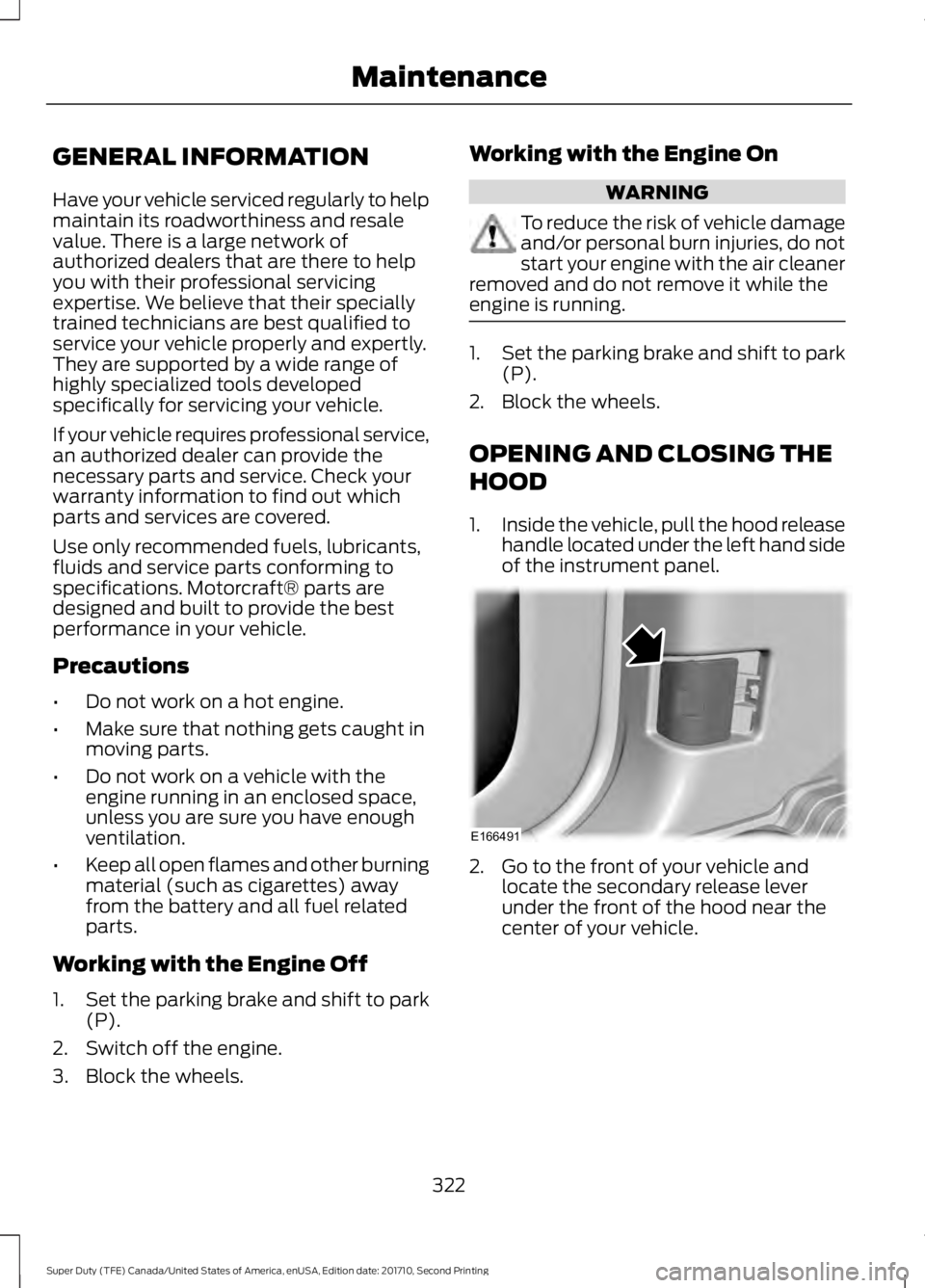
1.Inside the vehicle, pull the hood releasehandle located under the left hand sideof the instrument panel.
2. Go to the front of your vehicle andlocate the secondary release leverunder the front of the hood near thecenter of your vehicle.
322
Super Duty (TFE) Canada/United States of America, enUSA, Edition date: 201710, Second Printing
MaintenanceE166491
Page 326 of 642
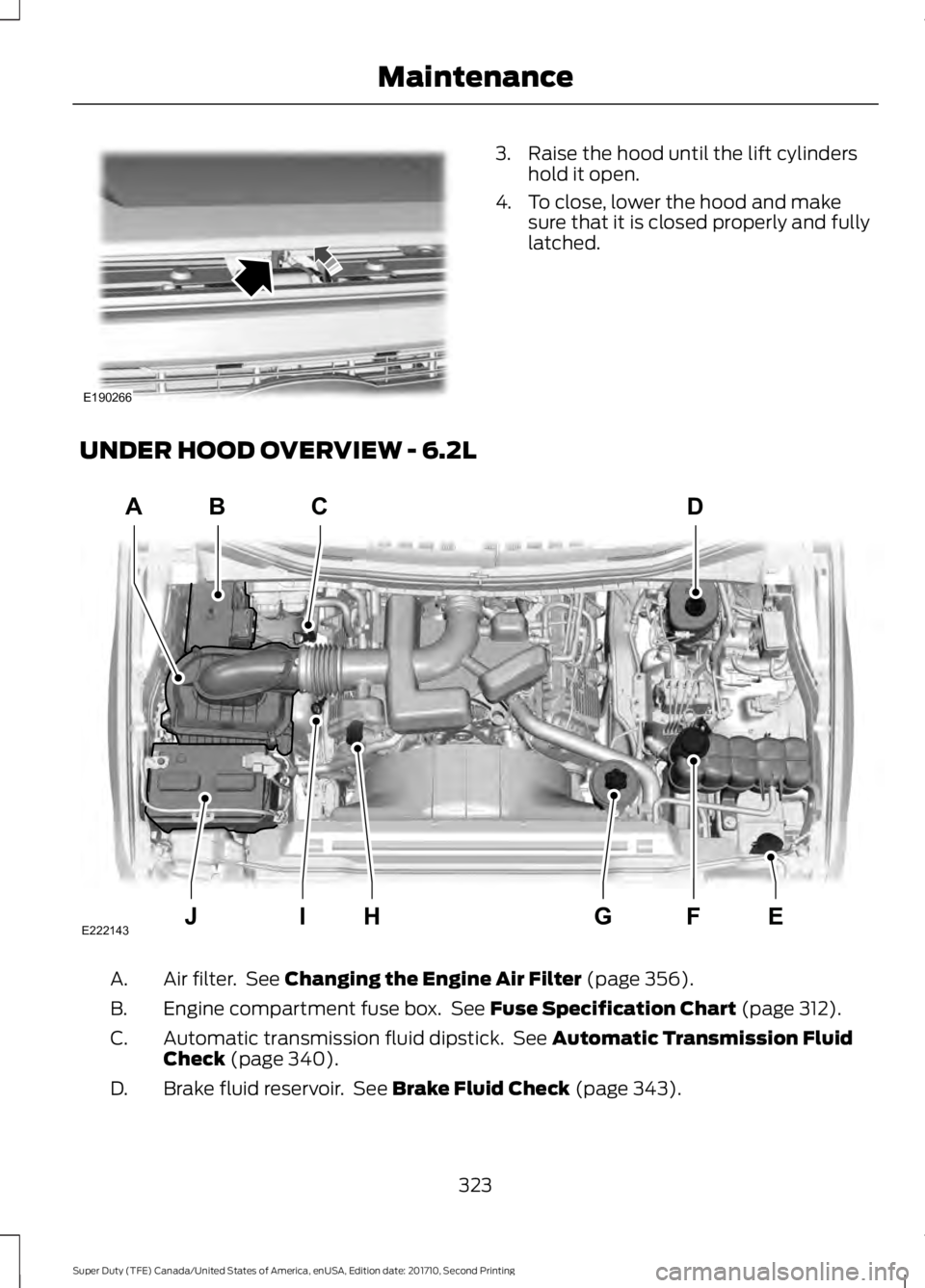
3. Raise the hood until the lift cylindershold it open.
4. To close, lower the hood and makesure that it is closed properly and fullylatched.
UNDER HOOD OVERVIEW - 6.2L
Air filter. See Changing the Engine Air Filter (page 356).A.
Engine compartment fuse box. See Fuse Specification Chart (page 312).B.
Automatic transmission fluid dipstick. See Automatic Transmission FluidCheck (page 340).C.
Brake fluid reservoir. See Brake Fluid Check (page 343).D.
323
Super Duty (TFE) Canada/United States of America, enUSA, Edition date: 201710, Second Printing
MaintenanceE190266 ABC
JEFHI
D
E222143
G
Page 327 of 642
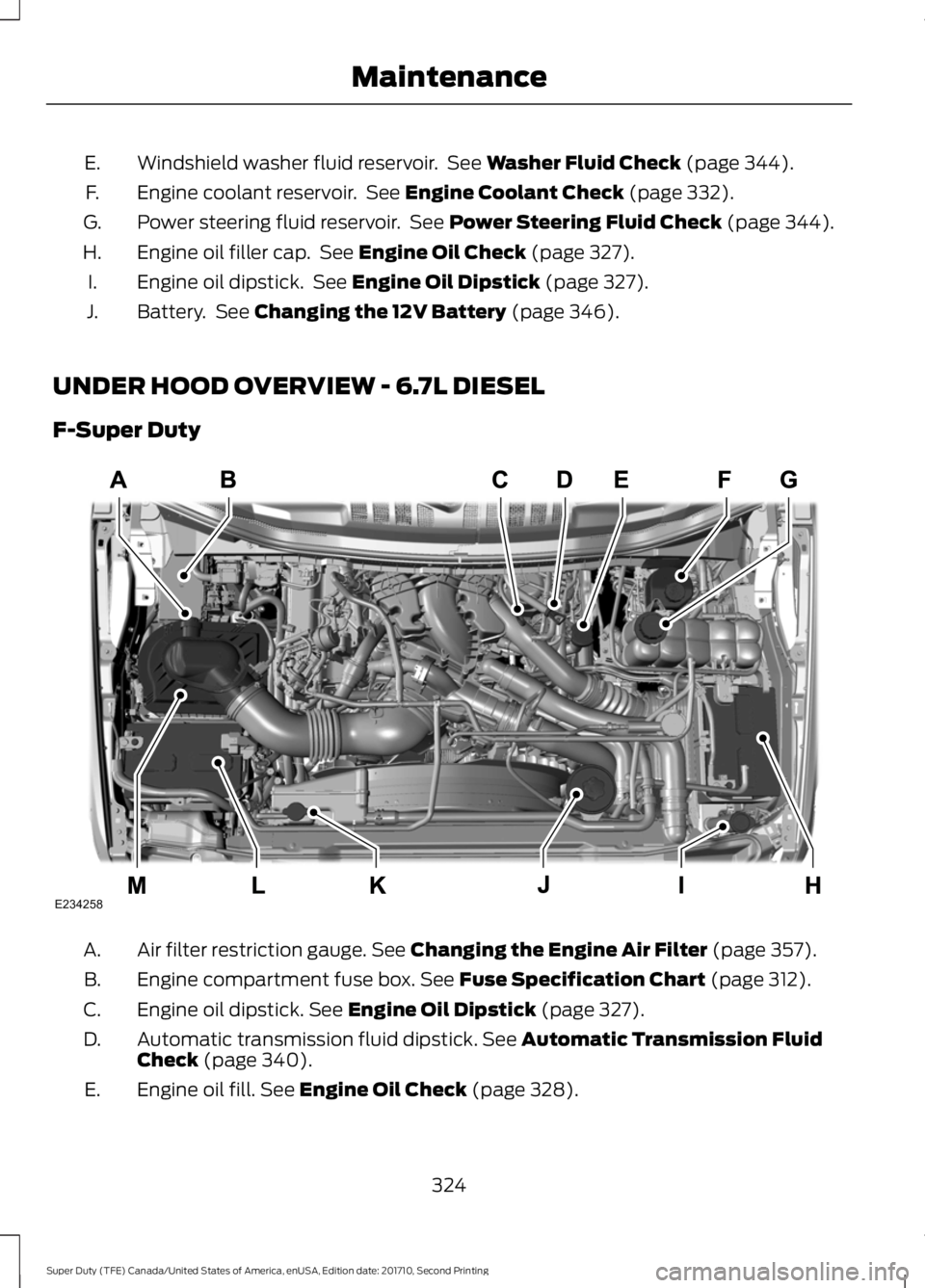
Windshield washer fluid reservoir. See Washer Fluid Check (page 344).E.
Engine coolant reservoir. See Engine Coolant Check (page 332).F.
Power steering fluid reservoir. See Power Steering Fluid Check (page 344).G.
Engine oil filler cap. See Engine Oil Check (page 327).H.
Engine oil dipstick. See Engine Oil Dipstick (page 327).I.
Battery. See Changing the 12V Battery (page 346).J.
UNDER HOOD OVERVIEW - 6.7L DIESEL
F-Super Duty
Air filter restriction gauge. See Changing the Engine Air Filter (page 357).A.
Engine compartment fuse box. See Fuse Specification Chart (page 312).B.
Engine oil dipstick. See Engine Oil Dipstick (page 327).C.
Automatic transmission fluid dipstick. See Automatic Transmission FluidCheck (page 340).D.
Engine oil fill. See Engine Oil Check (page 328).E.
324
Super Duty (TFE) Canada/United States of America, enUSA, Edition date: 201710, Second Printing
MaintenanceE234258