cooling FORD F450 SUPER DUTY 2017 Owner's Manual
[x] Cancel search | Manufacturer: FORD, Model Year: 2017, Model line: F450 SUPER DUTY, Model: FORD F450 SUPER DUTY 2017Pages: 642, PDF Size: 12.35 MB
Page 340 of 642
For vehicles with overflow coolant systemswith a non-pressurized cap on the coolantrecovery system, add coolant to thecoolant recovery reservoir when the engineis cool. Add prediluted coolant to themaximum level. For all vehicles which havea coolant degas system with a pressurizedcap, or if it is necessary to remove thecoolant pressure relief cap on the radiator,follow these steps to add engine coolant:
1. Turn the engine off and let it cool.
2. Unscrew the cap slowly. Any pressureescapes as you unscrew the cap.
3. Fill the coolant reservoir slowly withprediluted engine coolant to within theminimum and maximum range on theengine coolant reservoir. If youremoved the radiator cap in anoverflow system, fill the radiator untilthe coolant is visible and the radiatoris almost full. If coolant is added tobring the level within the minimum andmaximum range when the engine is notcold, the system may remain underfilled.
4.Replace the coolant reservoir cap, turnit clockwise until you feel a strongresistance.
5. Check the coolant level in the coolantreservoir the next few times you driveyour vehicle. If necessary, add enoughprediluted engine coolant to bring thecoolant level to the proper level.
Note:If prediluted coolant is not available,use the approved antifreeze concentratediluting it to 50/50 with distilled water. SeeCapacities and Specifications (page 427).Using water that has not been deionizedmay contribute to deposit formation,corrosion or plugging of the small coolingsystem passageways.
If you have to add more than 1.1 qt (1 L) ofengine coolant per month, have yourvehicle checked as soon as possible.Operating an engine with a low level ofcoolant can result in engine overheatingand possible engine damage.
Note:During normal vehicle operation, thecoolant may change color from orange topink or light red. As long as the coolant isclear and uncontaminated, this color changedoes not indicate the coolant has degradednor does it require the coolant to be drained,the system to be flushed, or the coolant tobe replaced.
Note:In case of emergency, you can add alarge amount of water without coolant inorder to reach a vehicle service location.Water alone, without coolant, can causeengine damage from corrosion, overheatingor freezing. When you reach a servicelocation, you must have the cooling systemdrained, flushed and refilled using thecorrect specification prediluted coolant orantifreeze concentrate. See Capacities andSpecifications (page 427).
Do not use the following as a coolantsubstitute:
•Alcohol.
•Methanol.
•Brine.
•Any coolant mixed with alcohol ormethanol antifreeze.
Alcohol and other liquids can cause enginedamage from overheating or freezing.
Do not add extra inhibitors or non-specifiedadditives to the coolant. These can beharmful and compromise the corrosionprotection of the coolant.
337
Super Duty (TFE) Canada/United States of America, enUSA, Edition date: 201710, Second Printing
Maintenance
Page 341 of 642
Engine and Secondary CoolingSystem Refill Procedure
The following procedure should be usedwhen refilling the engine or secondarycooling systems after it has been drainedor become extremely low:
1. Before you remove the cap, turn theengine off and let it cool.
2. When the engine is cool, wrap a thickcloth around the cap. Slowly turn capcounterclockwise until pressure beginsto release.
3.Step back while the pressure releases.
4.When you are sure that all the pressurehas been released, use the cloth to turnit counterclockwise and remove thecap.
5. Slowly add prediluted engine coolantto the coolant reservoir until thecoolant level is within the minimumand maximum range as listed on thereservoir.
6. Reinstall the pressure relief cap.
7. Start and run the engine at 2000 rpmfor 2 minutes.
8. Shut engine off, and remove thepressure relief cap as previouslyoutlined.
9. If required, add prediluted enginecoolant to the coolant reservoir untilthe coolant level is within the minimumand maximum range as listed on thereservoir.
10.Engine cooling system: RepeatStep 5 until the coolant level hasstabilized (is no longer dropping aftereach step) and the upper radiatorhose at the radiator is warm to thetouch (indicating that the enginethermostat is open and coolant isflowing through the radiator).
11.Check the secondary cooling system.Repeat Step 5 until the coolant levelhas stabilized (is no longer droppingafter each step) and the lowerpassenger side of the secondaryradiator is warm to the touch(indicating secondary thermostat isopen and coolant is flowing throughthe entire system).
12.Reinstall the pressure relief cap. Shutthe engine off and let it cool.
13. Check the coolant level in thereservoir before you drive your vehiclethe next few times.
14. If necessary, add prediluted enginecoolant to the coolant reservoir untilthe coolant level is within theminimum and maximum range aslisted on the reservoir. After anycoolant has been added, check thecoolant concentration.
Recycled Coolant
We do not recommend the use of recycledcoolant as an approved recycling processis not yet available.
Dispose of used engine coolant in anappropriate manner. Follow yourcommunity’s regulations and standardsfor recycling and disposing of automotivefluids.
Severe Climates
If you drive in extremely cold climates:
•It may be necessary to increase thecoolant concentration above 50%.
•A coolant concentration of 60%provides improved freeze pointprotection. Coolant concentrationsabove 60% decrease the overheatprotection characteristics of thecoolant and may cause enginedamage.
338
Super Duty (TFE) Canada/United States of America, enUSA, Edition date: 201710, Second Printing
Maintenance
Page 342 of 642
If you drive in extremely hot climates:
•You can decrease the coolantconcentration to 40%.
•Coolant concentrations below 40%decrease the freeze and corrosionprotection characteristics of thecoolant and may cause enginedamage.
Vehicles driven year-round in non-extremeclimates should use prediluted enginecoolant for optimum cooling system andengine protection.
Checking Coolant CorrosionInhibitor Additive Strength
At specific mileage intervals as listed in thescheduled maintenance informationchapter, the coolant corrosion inhibitoradditive should be checked. An informationmessage may display in the optionalinformation display at this time. Thepurpose of checking is to verify the correctengine coolant concentration (freeze pointprotection) and corrosion inhibitor additivelevel (strength) of the coolant formaximum engine performance andprotection.
Three products are available to confirmthe life and health of the coolant, one tool,a test kit and a coolant inhibitor additive:
•Robinair® Coolant and BatteryRefractometer 75240 –Recommended refractometer to testcoolant concentration. (Rotunda toolpart number: ROB75240).
•Rotunda 328-R071–ELC (AntifreezeCoolant ELC Contamination Kit) –Evaluates the corrosion inhibitoradditive strength. Note the first step isto verify the vehicle’s coolantconcentration is in the correct range of40 – 60%. Coolant concentrationsoutside this range will not provide validtest results. If the report results in apass, for example the cooling systemdoes not show excessivecontamination, the corrosion inhibitoradditive strength is sufficient, and noaction is required. If the report resultsas insufficient (does not pass), thecorrosion inhibitor additive strength ofthe coolant is too low. If the enginecooling system corrosion inhibitoradditive strength is low, add 47 fl oz(1.4 L) of Motorcraft Specialty OrangeEngine Coolant Revitalizer. If thesecondary cooling system corrosioninhibitor additive strength is low, add16 fl oz (0.47 L) of Motorcraft SpecialtyOrange Engine Coolant Revitalizer.
•Motorcraft Specialty Orange EngineCoolant Revitalizer – Additive toboost the corrosion inhibitor levelbased upon the test results of theAntifreeze Coolant ELC ContaminationKit. The Revitalizer may be added twotimes over the life of the coolant. Ifadditional dosages are required, thecooling system must be flushed andrefilled per the instructions in theWorkshop Manual.
Make sure to follow the proper coolant andadditive specifications. See Capacitiesand Specifications (page 415).
339
Super Duty (TFE) Canada/United States of America, enUSA, Edition date: 201710, Second Printing
Maintenance
Page 343 of 642
Coolant Change
At specific mileage intervals, as listed inthe scheduled maintenance information,the coolant should be changed. Theinformation display may display a messageto change coolant at this time. Addprediluted coolant approved to the correctspecification. See Capacities andSpecifications (page 415).
Engine-driven Cooling Fan (FanClutch)
Your vehicle may have an engine drivencooling fan drive (also called a fan clutch).This fan drive changes the fan speed tomatch the vehicle’s changing cooling airflow requirements. Fan speed, fan noiselevel and fuel consumption all will increasebased on the driving conditions thatinclude trailer towing, hill climbing, heavyloads, high speed and high ambienttemperature, individually or in combination.
The fan drive is designed to provide theminimum fan speed (and resultingminimum fan noise and fuel consumption)required to meet the ever changing vehiclecooling air flow requirements. You will hearthe amount of fan noise increasing anddecreasing as the engine powerrequirements and vehicle driving conditionschange as you drive. This is to be expectedas being normal to the operation of yourvehicle. High levels of fan noise might alsobe heard when your engine is first started,and should normally decrease after drivingfor a short time.
AUTOMATIC TRANSMISSION
FLUID CHECK
Have an authorized dealer check andchange the transmission fluid and filter atthe correct service interval. SeeScheduled Maintenance (page 573).
Do not use supplemental transmissionfluid additives, treatments or cleaningagents. The use of these materials mayaffect transmission operation and resultin damage to internal transmissioncomponents.
Checking Automatic TransmissionFluid
For scheduled intervals of the fluid checksand changes, See ScheduledMaintenance (page 573). Yourtransmission does not consume fluid.However, the fluid level should be checkedif the transmission is not working properly,i.e., if the transmission slips or shifts slowlyor if you notice some sign of fluid leakage.
Automatic transmission fluid expandswhen warmed. To obtain an accurate fluidcheck, drive the vehicle until it is at normaloperating temperature (approximately19 mi (30 km)). Verify that thetransmission fluid temperature gauge,located on the instrument cluster, is withinnormal range.
1. Drive the vehicle 19 mi (30 km)until itreaches normal operating temperature.
2.Park the vehicle on a level surface andengage the parking brake.
3.With the engine running, parking brakeengaged and your foot on the brakepedal, move the gearshift lever throughall of the gear ranges. Allow sufficienttime for each gear to engage.
4.Latch the gearshift lever in P and leavethe engine running.
5. Remove the dipstick, wiping it cleanwith a clean, dry lint free rag. Ifnecessary, refer to the Under HoodOverview in this chapter for thelocation of the dipstick.
340
Super Duty (TFE) Canada/United States of America, enUSA, Edition date: 201710, Second Printing
Maintenance
Page 375 of 642
Engine
•Change the engine oil and filter prior tostorage because used engine oilcontains contaminates which maycause engine damage.
•Start the engine every 15 days for aminimum of 15 minutes. Run at fast idlewith the climate controls set to defrostuntil the engine reaches normaloperating temperature.
•With your foot on the brake, shiftthrough all the gears while the engineis running.
•We recommend that you change theengine oil before you use your vehicleagain.
Fuel system
•Fill the fuel tank with high-quality fueluntil the first automatic shutoff of thefuel pump nozzle.
Cooling system
•Protect against freezing temperatures.
•When removing your vehicle fromstorage, check coolant fluid level.Confirm that there are no coolingsystem leaks and that fluid is at therecommended level.
Battery
•Check and recharge as necessary. Keepconnections clean.
•If storing your vehicle for more than 30days without recharging the battery,we recommend that you disconnectthe battery cables to maintain batterycharge for quick starting.
Note:It is necessary to reset memoryfeatures if battery cables are disconnected.
Brakes
•Make sure the brakes and parking brakerelease fully.
Tires
•Maintain recommended air pressure.
Miscellaneous
•Make sure all linkages, cables, leversand pins under your vehicle are coveredwith grease to prevent rust.
•Move vehicles at least 25 ft (7.5 m)every 15 days to lubricate working partsand prevent corrosion.
Removing Vehicle From Storage
When your vehicle is ready to come out ofstorage, do the following:
•Wash your vehicle to remove any dirtor grease film build-up on windowsurfaces.
•Check windshield wipers for anydeterioration.
•Check under the hood for any foreignmaterial that may have collectedduring storage such as mice or squirrelnests.
•Check the exhaust for any foreignmaterial that may have collectedduring storage.
•Check tire pressures and set tireinflation per the Tire Label.
•Check brake pedal operation. Driveyour vehicle 15 ft (4.5 m) back andforth to remove rust build-up.
•Check fluid levels (including coolant,oil and gas) to make sure there are noleaks, and fluids are at recommendedlevels.
•If you remove the battery, clean thebattery cable ends and check fordamage.
372
Super Duty (TFE) Canada/United States of America, enUSA, Edition date: 201710, Second Printing
Vehicle Care
Page 430 of 642
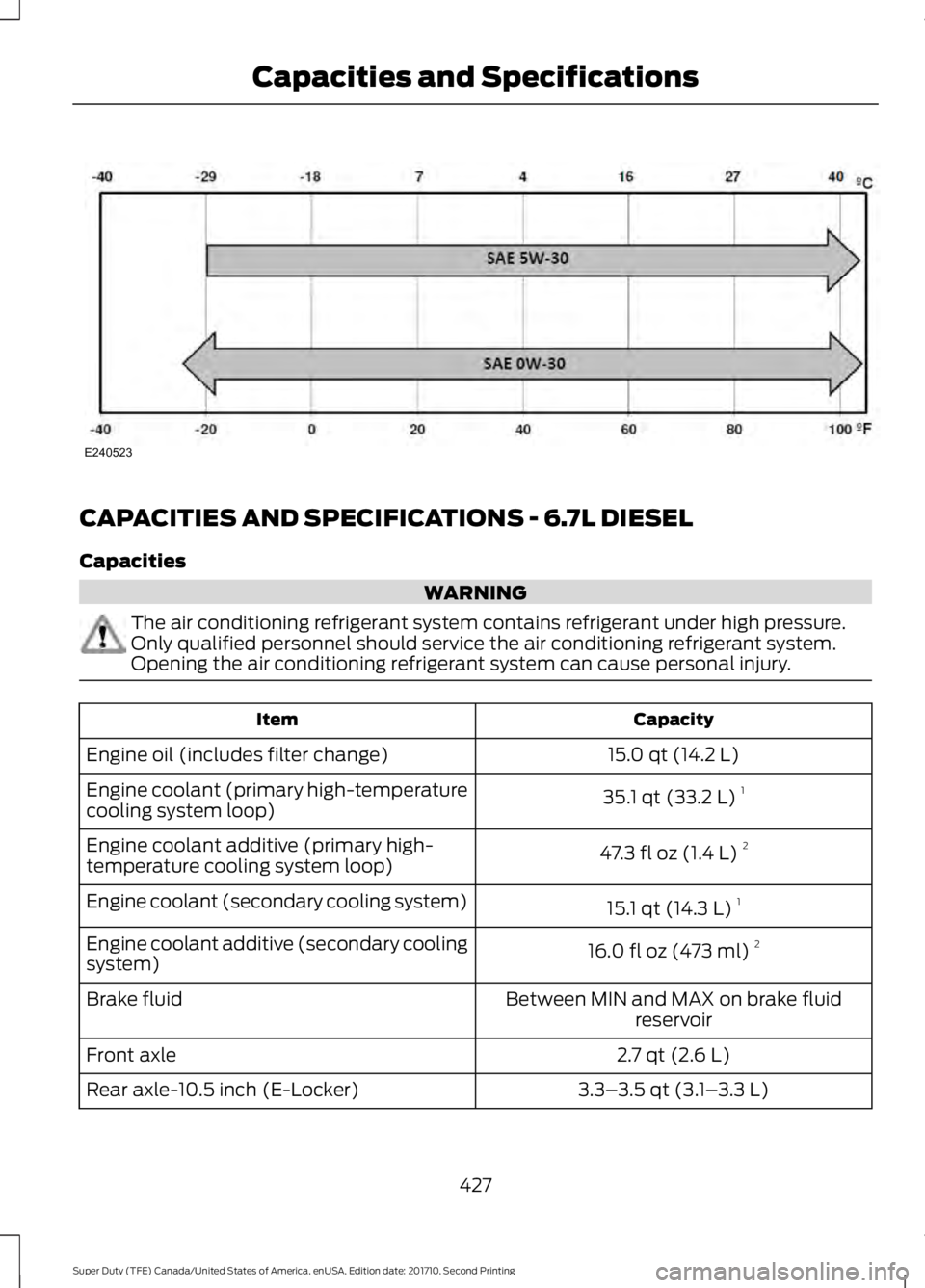
CAPACITIES AND SPECIFICATIONS - 6.7L DIESEL
Capacities
WARNING
The air conditioning refrigerant system contains refrigerant under high pressure.Only qualified personnel should service the air conditioning refrigerant system.Opening the air conditioning refrigerant system can cause personal injury.
CapacityItem
15.0 qt (14.2 L)Engine oil (includes filter change)
35.1 qt (33.2 L)1Engine coolant (primary high-temperaturecooling system loop)
47.3 fl oz (1.4 L)2Engine coolant additive (primary high-temperature cooling system loop)
15.1 qt (14.3 L)1Engine coolant (secondary cooling system)
16.0 fl oz (473 ml)2Engine coolant additive (secondary coolingsystem)
Between MIN and MAX on brake fluidreservoirBrake fluid
2.7 qt (2.6 L)Front axle
3.3–3.5 qt (3.1–3.3 L)Rear axle-10.5 inch (E-Locker)
427
Super Duty (TFE) Canada/United States of America, enUSA, Edition date: 201710, Second Printing
Capacities and SpecificationsE240523
Page 433 of 642
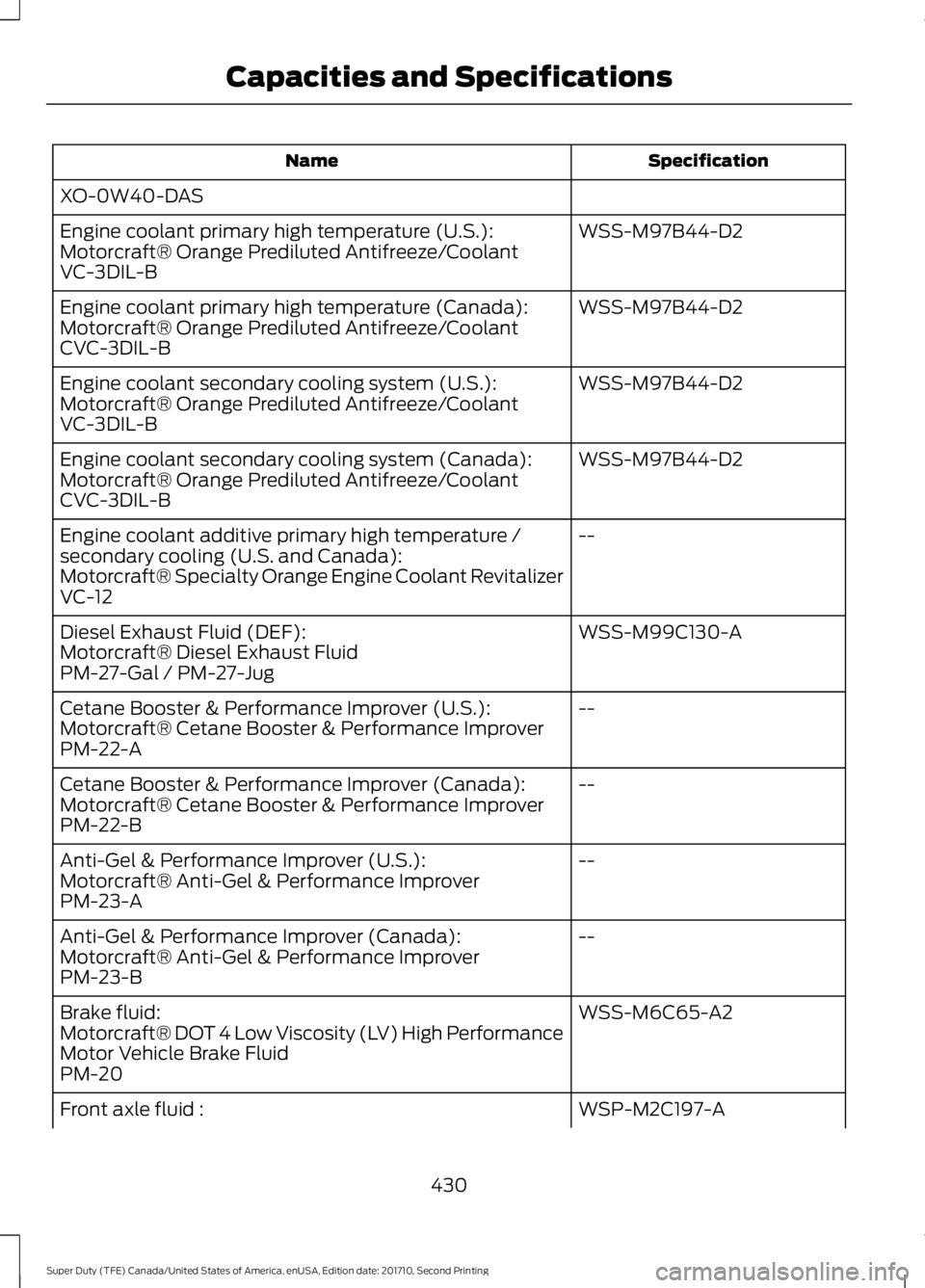
SpecificationName
XO-0W40-DAS
WSS-M97B44-D2Engine coolant primary high temperature (U.S.):Motorcraft® Orange Prediluted Antifreeze/CoolantVC-3DIL-B
WSS-M97B44-D2Engine coolant primary high temperature (Canada):Motorcraft® Orange Prediluted Antifreeze/CoolantCVC-3DIL-B
WSS-M97B44-D2Engine coolant secondary cooling system (U.S.):Motorcraft® Orange Prediluted Antifreeze/CoolantVC-3DIL-B
WSS-M97B44-D2Engine coolant secondary cooling system (Canada):Motorcraft® Orange Prediluted Antifreeze/CoolantCVC-3DIL-B
--Engine coolant additive primary high temperature /secondary cooling (U.S. and Canada):Motorcraft® Specialty Orange Engine Coolant RevitalizerVC-12
WSS-M99C130-ADiesel Exhaust Fluid (DEF):Motorcraft® Diesel Exhaust FluidPM-27-Gal / PM-27-Jug
--Cetane Booster & Performance Improver (U.S.):Motorcraft® Cetane Booster & Performance ImproverPM-22-A
--Cetane Booster & Performance Improver (Canada):Motorcraft® Cetane Booster & Performance ImproverPM-22-B
--Anti-Gel & Performance Improver (U.S.):Motorcraft® Anti-Gel & Performance ImproverPM-23-A
--Anti-Gel & Performance Improver (Canada):Motorcraft® Anti-Gel & Performance ImproverPM-23-B
WSS-M6C65-A2Brake fluid:Motorcraft® DOT 4 Low Viscosity (LV) High PerformanceMotor Vehicle Brake FluidPM-20
WSP-M2C197-AFront axle fluid :
430
Super Duty (TFE) Canada/United States of America, enUSA, Edition date: 201710, Second Printing
Capacities and Specifications
Page 527 of 642
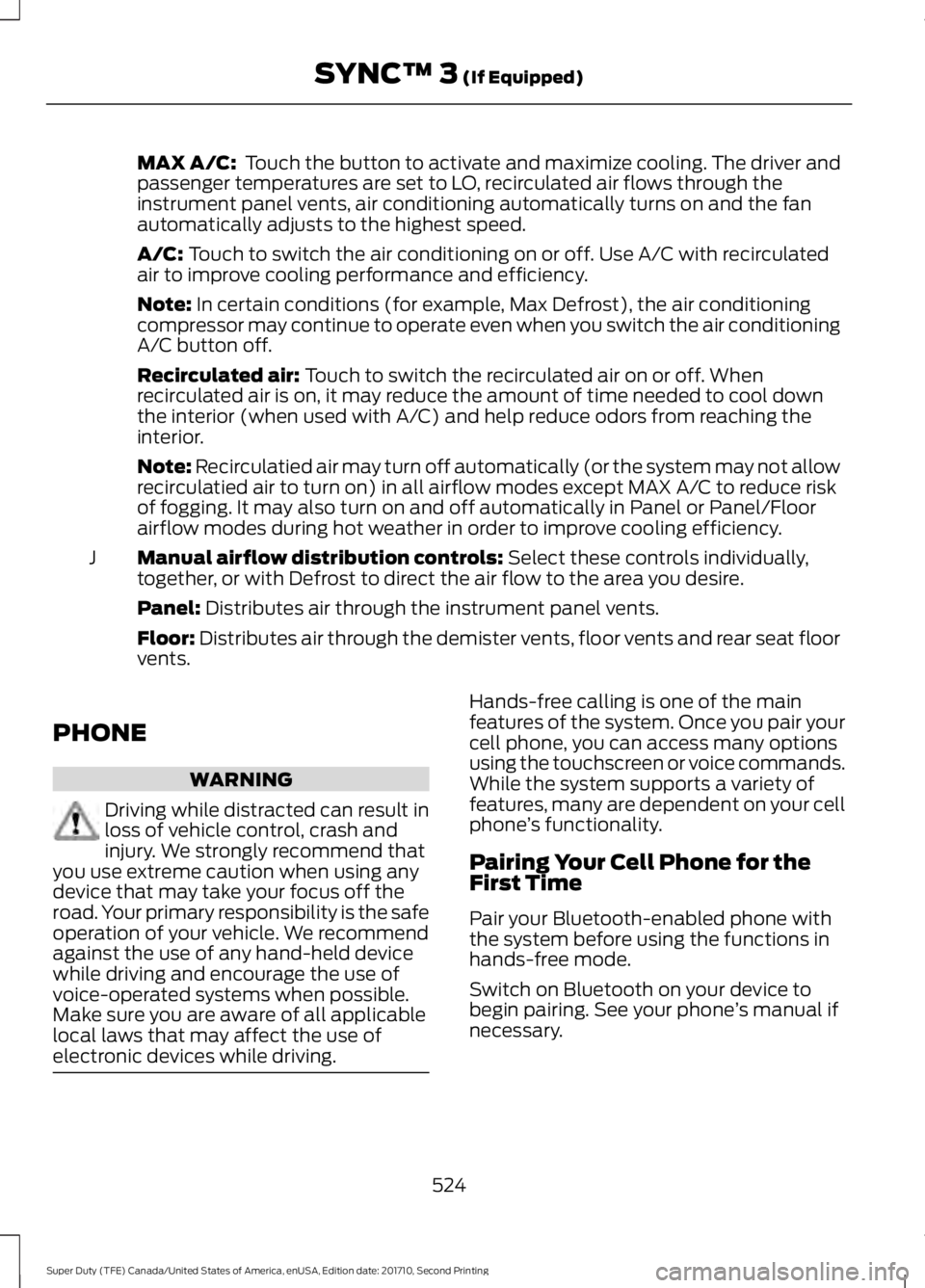
MAX A/C: Touch the button to activate and maximize cooling. The driver andpassenger temperatures are set to LO, recirculated air flows through theinstrument panel vents, air conditioning automatically turns on and the fanautomatically adjusts to the highest speed.
A/C: Touch to switch the air conditioning on or off. Use A/C with recirculatedair to improve cooling performance and efficiency.
Note: In certain conditions (for example, Max Defrost), the air conditioningcompressor may continue to operate even when you switch the air conditioningA/C button off.
Recirculated air: Touch to switch the recirculated air on or off. Whenrecirculated air is on, it may reduce the amount of time needed to cool downthe interior (when used with A/C) and help reduce odors from reaching theinterior.
Note: Recirculatied air may turn off automatically (or the system may not allowrecirculatied air to turn on) in all airflow modes except MAX A/C to reduce riskof fogging. It may also turn on and off automatically in Panel or Panel/Floorairflow modes during hot weather in order to improve cooling efficiency.
Manual airflow distribution controls: Select these controls individually,together, or with Defrost to direct the air flow to the area you desire.J
Panel: Distributes air through the instrument panel vents.
Floor: Distributes air through the demister vents, floor vents and rear seat floorvents.
PHONE
WARNING
Driving while distracted can result inloss of vehicle control, crash andinjury. We strongly recommend thatyou use extreme caution when using anydevice that may take your focus off theroad. Your primary responsibility is the safeoperation of your vehicle. We recommendagainst the use of any hand-held devicewhile driving and encourage the use ofvoice-operated systems when possible.Make sure you are aware of all applicablelocal laws that may affect the use ofelectronic devices while driving.
Hands-free calling is one of the mainfeatures of the system. Once you pair yourcell phone, you can access many optionsusing the touchscreen or voice commands.While the system supports a variety offeatures, many are dependent on your cellphone’s functionality.
Pairing Your Cell Phone for theFirst Time
Pair your Bluetooth-enabled phone withthe system before using the functions inhands-free mode.
Switch on Bluetooth on your device tobegin pairing. See your phone’s manual ifnecessary.
524
Super Duty (TFE) Canada/United States of America, enUSA, Edition date: 201710, Second Printing
SYNC™ 3 (If Equipped)
Page 582 of 642
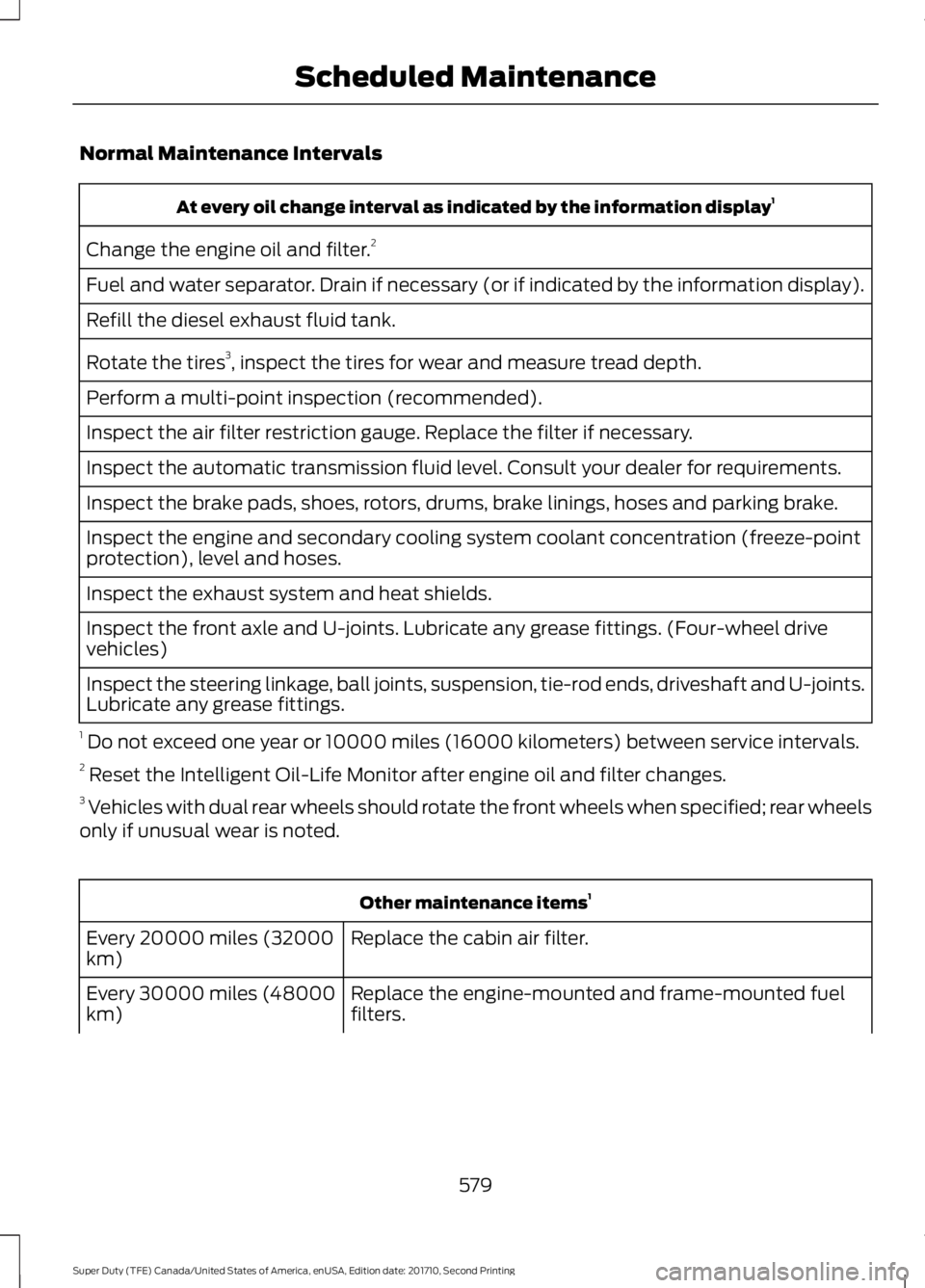
Normal Maintenance Intervals
At every oil change interval as indicated by the information display1
Change the engine oil and filter.2
Fuel and water separator. Drain if necessary (or if indicated by the information display).
Refill the diesel exhaust fluid tank.
Rotate the tires3, inspect the tires for wear and measure tread depth.
Perform a multi-point inspection (recommended).
Inspect the air filter restriction gauge. Replace the filter if necessary.
Inspect the automatic transmission fluid level. Consult your dealer for requirements.
Inspect the brake pads, shoes, rotors, drums, brake linings, hoses and parking brake.
Inspect the engine and secondary cooling system coolant concentration (freeze-pointprotection), level and hoses.
Inspect the exhaust system and heat shields.
Inspect the front axle and U-joints. Lubricate any grease fittings. (Four-wheel drivevehicles)
Inspect the steering linkage, ball joints, suspension, tie-rod ends, driveshaft and U-joints.Lubricate any grease fittings.
1 Do not exceed one year or 10000 miles (16000 kilometers) between service intervals.2 Reset the Intelligent Oil-Life Monitor after engine oil and filter changes.3 Vehicles with dual rear wheels should rotate the front wheels when specified; rear wheelsonly if unusual wear is noted.
Other maintenance items1
Replace the cabin air filter.Every 20000 miles (32000km)
Replace the engine-mounted and frame-mounted fuelfilters.Every 30000 miles (48000km)
579
Super Duty (TFE) Canada/United States of America, enUSA, Edition date: 201710, Second Printing
Scheduled Maintenance
Page 583 of 642
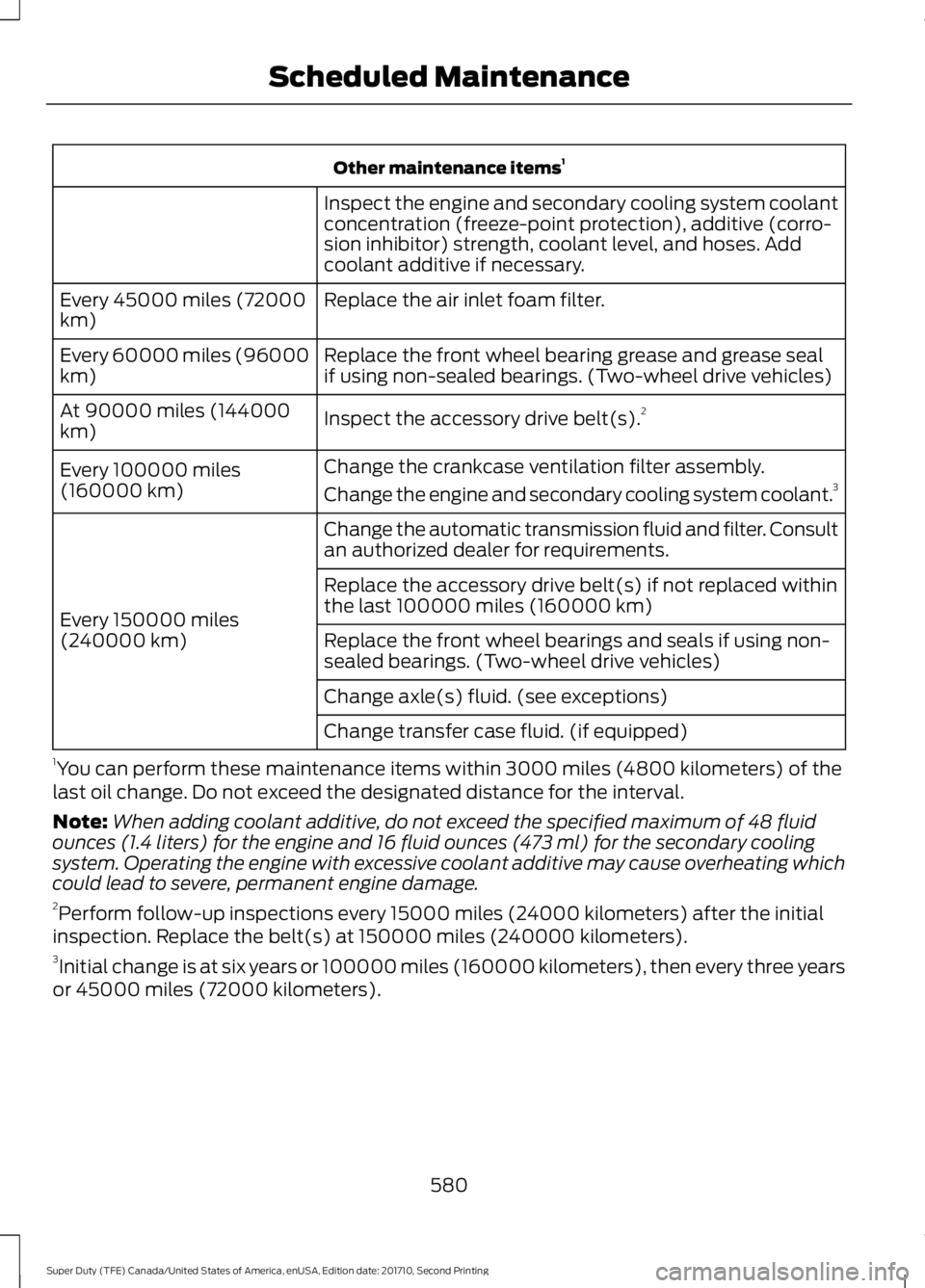
Other maintenance items1
Inspect the engine and secondary cooling system coolantconcentration (freeze-point protection), additive (corro-sion inhibitor) strength, coolant level, and hoses. Addcoolant additive if necessary.
Replace the air inlet foam filter.Every 45000 miles (72000km)
Replace the front wheel bearing grease and grease sealif using non-sealed bearings. (Two-wheel drive vehicles)Every 60000 miles (96000km)
Inspect the accessory drive belt(s).2At 90000 miles (144000km)
Change the crankcase ventilation filter assembly.Every 100000 miles(160000 km)Change the engine and secondary cooling system coolant.3
Change the automatic transmission fluid and filter. Consultan authorized dealer for requirements.
Every 150000 miles(240000 km)
Replace the accessory drive belt(s) if not replaced withinthe last 100000 miles (160000 km)
Replace the front wheel bearings and seals if using non-sealed bearings. (Two-wheel drive vehicles)
Change axle(s) fluid. (see exceptions)
Change transfer case fluid. (if equipped)
1You can perform these maintenance items within 3000 miles (4800 kilometers) of thelast oil change. Do not exceed the designated distance for the interval.
Note:When adding coolant additive, do not exceed the specified maximum of 48 fluidounces (1.4 liters) for the engine and 16 fluid ounces (473 ml) for the secondary coolingsystem. Operating the engine with excessive coolant additive may cause overheating whichcould lead to severe, permanent engine damage.2Perform follow-up inspections every 15000 miles (24000 kilometers) after the initial
inspection. Replace the belt(s) at 150000 miles (240000 kilometers).3Initial change is at six years or 100000 miles (160000 kilometers), then every three yearsor 45000 miles (72000 kilometers).
580
Super Duty (TFE) Canada/United States of America, enUSA, Edition date: 201710, Second Printing
Scheduled Maintenance