maintenance FORD F53 2017 Owner's Manual
[x] Cancel search | Manufacturer: FORD, Model Year: 2017, Model line: F53, Model: FORD F53 2017Pages: 164, PDF Size: 2.57 MB
Page 99 of 164
Chassis with gross vehicle weight ratings
of 20500 pounds (9299 kilograms),
22000 pounds (9979 kilograms), 24000
pounds (10886 kilograms) and 26000
pounds (11793 kilograms) are equipped
with Hydromax Brake Booster Systems
and must use Motorcraft DOT 5.1 Motor
Vehicle Brake Fluid or equivalent meeting
Ford Specification ESD-M6C57-A. See
Capacities and Specifications (page
129).
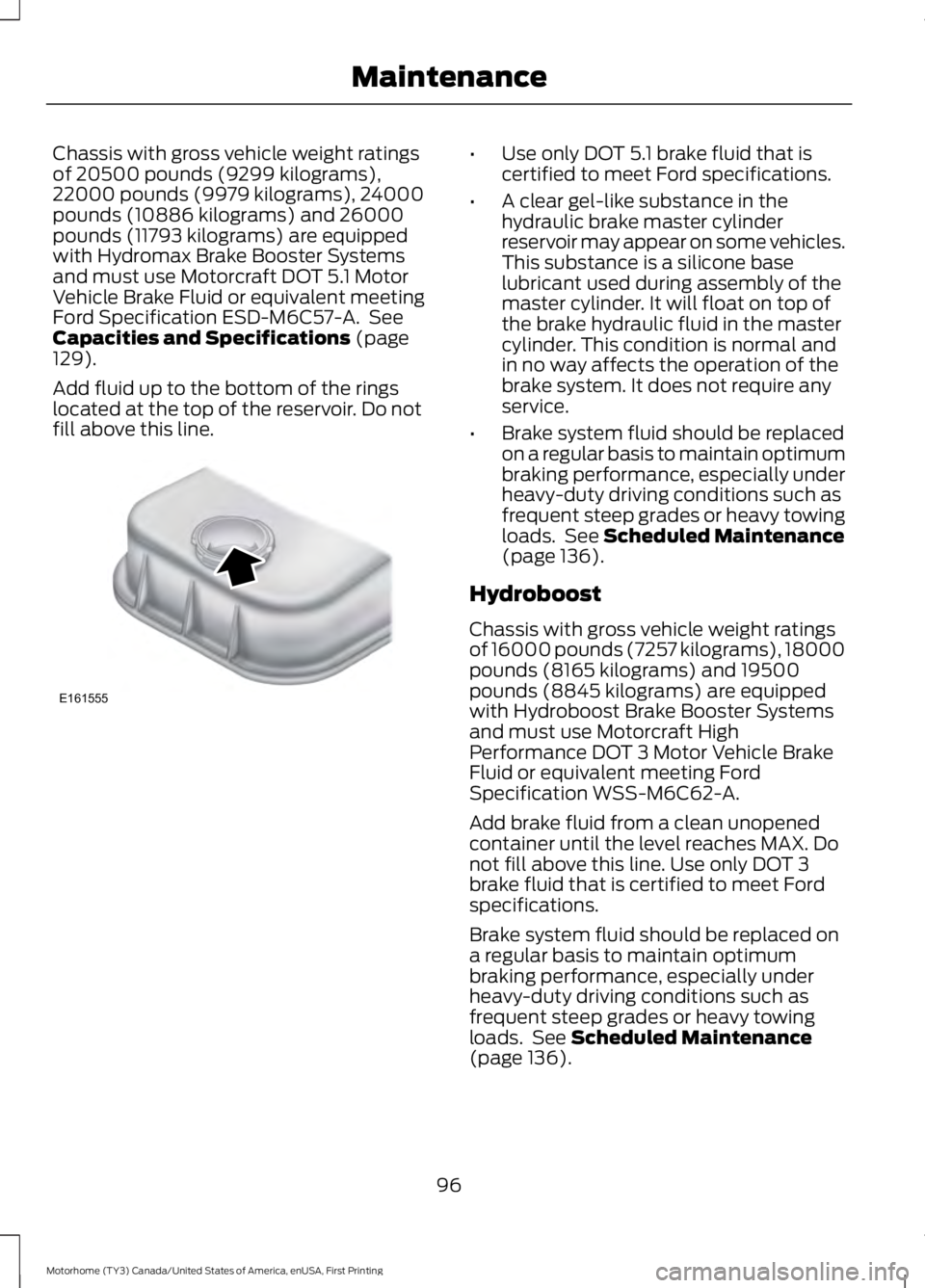
Add fluid up to the bottom of the rings
located at the top of the reservoir. Do not
fill above this line. •
Use only DOT 5.1 brake fluid that is
certified to meet Ford specifications.
• A clear gel-like substance in the
hydraulic brake master cylinder
reservoir may appear on some vehicles.
This substance is a silicone base
lubricant used during assembly of the
master cylinder. It will float on top of
the brake hydraulic fluid in the master
cylinder. This condition is normal and
in no way affects the operation of the
brake system. It does not require any
service.
• Brake system fluid should be replaced
on a regular basis to maintain optimum
braking performance, especially under
heavy-duty driving conditions such as
frequent steep grades or heavy towing
loads. See
Scheduled Maintenance
(page 136).
Hydroboost
Chassis with gross vehicle weight ratings
of 16000 pounds (7257 kilograms), 18000
pounds (8165 kilograms) and 19500
pounds (8845 kilograms) are equipped
with Hydroboost Brake Booster Systems
and must use Motorcraft High
Performance DOT 3 Motor Vehicle Brake
Fluid or equivalent meeting Ford
Specification WSS-M6C62-A.
Add brake fluid from a clean unopened
container until the level reaches MAX. Do
not fill above this line. Use only DOT 3
brake fluid that is certified to meet Ford
specifications.
Brake system fluid should be replaced on
a regular basis to maintain optimum
braking performance, especially under
heavy-duty driving conditions such as
frequent steep grades or heavy towing
loads. See
Scheduled Maintenance
(page 136).
96
Motorhome (TY3) Canada/United States of America, enUSA, First Printing MaintenanceE161555
Page 100 of 164
POWER STEERING FLUID
CHECK Note:
The power steering cap has both a
cold and hot indicator on the dipstick.
1. Start the engine and let it run until it reaches normal operating temperature
(the engine coolant temperature gauge
indicator will be near the center of the
normal area between H and C).
2. While the engine idles, turn the steering
wheel left and right several times.
3. Turn the engine off.
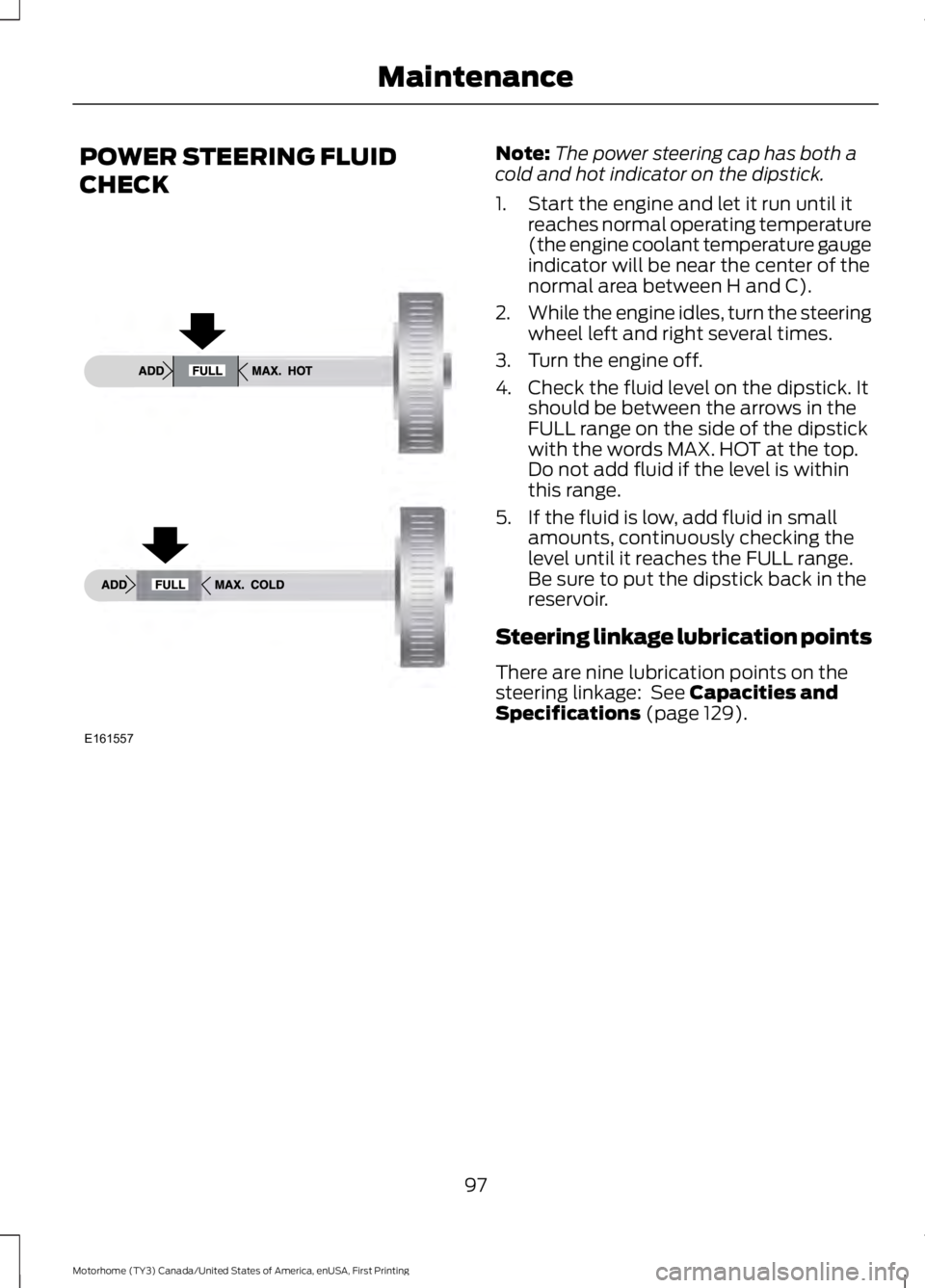
4. Check the fluid level on the dipstick. It should be between the arrows in the
FULL range on the side of the dipstick
with the words MAX. HOT at the top.
Do not add fluid if the level is within
this range.
5. If the fluid is low, add fluid in small amounts, continuously checking the
level until it reaches the FULL range.
Be sure to put the dipstick back in the
reservoir.
Steering linkage lubrication points
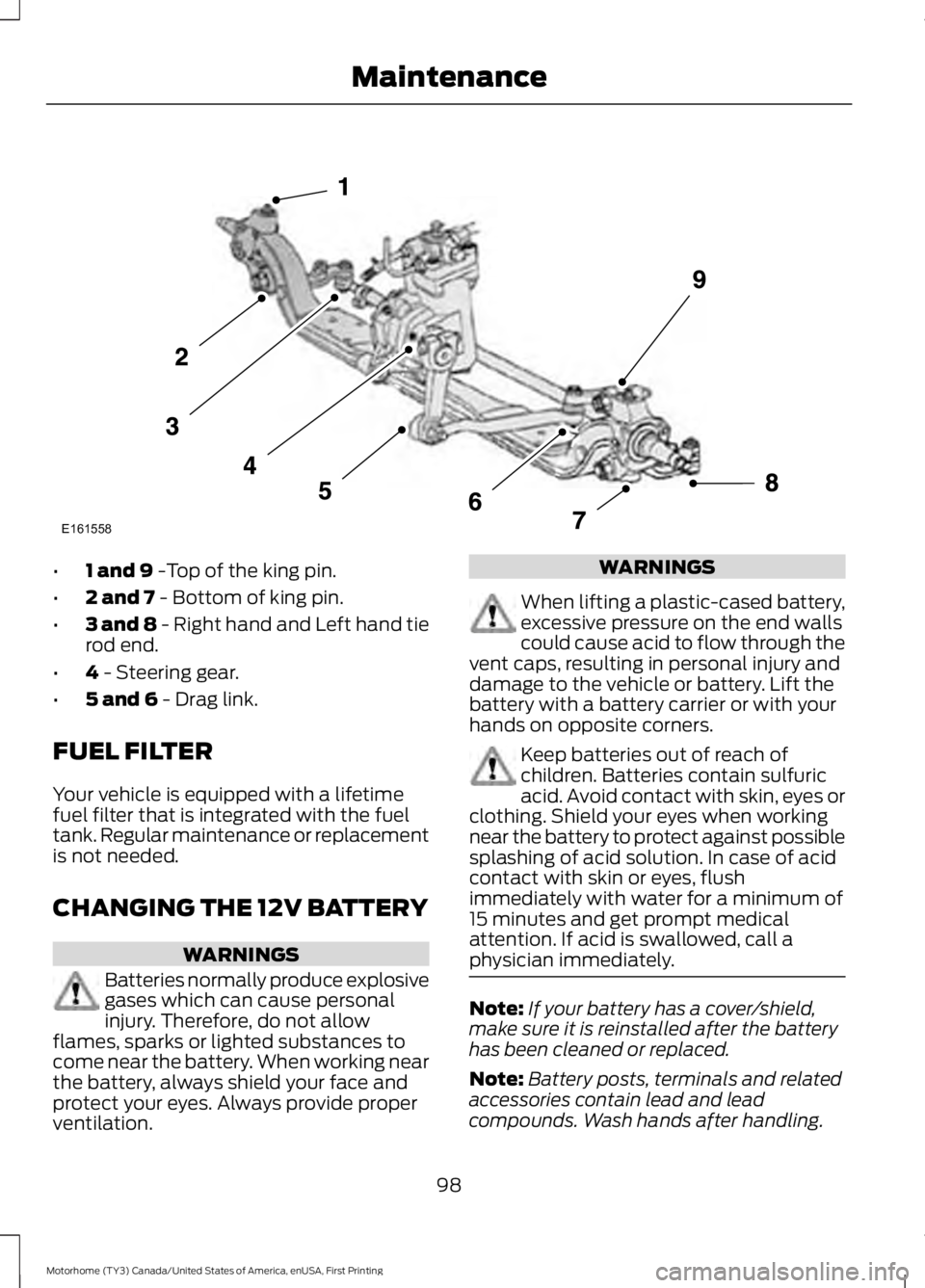
There are nine lubrication points on the
steering linkage: See Capacities and
Specifications (page 129).
97
Motorhome (TY3) Canada/United States of America, enUSA, First Printing MaintenanceE161557
Page 101 of 164
•
1 and 9 -Top of the king pin.
• 2 and 7
- Bottom of king pin.
• 3 and 8 - Right hand and Left hand tie
rod end.
• 4
- Steering gear.
• 5 and 6
- Drag link.
FUEL FILTER
Your vehicle is equipped with a lifetime
fuel filter that is integrated with the fuel
tank. Regular maintenance or replacement
is not needed.
CHANGING THE 12V BATTERY WARNINGS
Batteries normally produce explosive
gases which can cause personal
injury. Therefore, do not allow
flames, sparks or lighted substances to
come near the battery. When working near
the battery, always shield your face and
protect your eyes. Always provide proper
ventilation. WARNINGS
When lifting a plastic-cased battery,
excessive pressure on the end walls
could cause acid to flow through the
vent caps, resulting in personal injury and
damage to the vehicle or battery. Lift the
battery with a battery carrier or with your
hands on opposite corners. Keep batteries out of reach of
children. Batteries contain sulfuric
acid. Avoid contact with skin, eyes or
clothing. Shield your eyes when working
near the battery to protect against possible
splashing of acid solution. In case of acid
contact with skin or eyes, flush
immediately with water for a minimum of
15 minutes and get prompt medical
attention. If acid is swallowed, call a
physician immediately. Note:
If your battery has a cover/shield,
make sure it is reinstalled after the battery
has been cleaned or replaced.
Note: Battery posts, terminals and related
accessories contain lead and lead
compounds. Wash hands after handling.
98
Motorhome (TY3) Canada/United States of America, enUSA, First Printing MaintenanceE161558
Page 102 of 164
Your vehicle is equipped with a
Motorcraft® maintenance-free battery
which normally does not require additional
water during its life of service.
For longer, trouble-free operation, keep the
top of the battery clean and dry. Also,
make certain the battery cables are always
tightly fastened to the battery terminals.
If you see any corrosion on the battery or
terminals, remove the cables from the
terminals and clean with a wire brush. You
can neutralize the acid with a solution of
baking soda and water.
It is recommended that the negative
battery cable terminal be disconnected
from the battery if you plan to store your
vehicle for an extended period of time.
To ensure proper operation of the battery
management system (BMS), any electrical
devices that are added to the vehicle
should not have their ground connection
made directly at the negative battery post.
A connection at the negative battery post
can cause inaccurate measurements of
the battery condition and potential
incorrect system operation.
Note:
Electrical or electronic accessories
or components added to the vehicle by the
dealer or the owner may adversely affect
battery performance and durability and may
also affect the performance of other
electrical systems in the vehicle.
When a battery replacement is required,
the battery should only be replaced with
a Ford recommended replacement battery
that matches the electrical requirements
of the vehicle.
Note: Always dispose of automotive
batteries in a responsible manner. Follow
your local authorized standards for disposal.
Call your local authorized recycling center
to find out more about recycling automotive
batteries. Battery relearn
When the battery is disconnected or a new
battery installed:
•
The transmission must relearn its
adaptive strategy. As a result of this,
the transmission may shift firmly. This
operation is considered normal and will
not affect function or durability of the
transmission. Over time the adaptive
learning process will fully update
transmission operation to its optimum
shift feel.
• The clock and the preset radio stations
must be reset once the battery is
reconnected.
• Your vehicle ’s engine is electronically
controlled by a computer, some control
conditions are maintained by power
from the battery, the engine must
relearn its idle and fuel trim strategy.
When the battery is disconnected or a new
battery is installed, begin the battery
relearn process:
1. With the vehicle at a complete stop, set the parking brake.
2. Put the gearshift lever in P (Park), turn
off all accessories and start the engine.
3. Run the engine until it reaches normal operating temperature.
4. Allow the engine to idle for at least one
minute.
5. Turn the A/C on and allow the engine to idle for at least one minute.
6. Drive the vehicle to complete the relearning process.
•The vehicle may need to be driven
to relearn the idle and fuel trim
strategy.
99
Motorhome (TY3) Canada/United States of America, enUSA, First Printing Maintenance
Page 103 of 164
CHANGING THE ENGINE AIR
FILTER
WARNING
To reduce the risk of vehicle damage
and personal burn injuries, do not
start your engine with the air cleaner
removed and do not remove it while the
engine is running. Change the air filter element at the proper
interval. See Scheduled Maintenance
(page 136).
When changing the air filter element, use
only the air filter element listed. See
Capacities and Specifications
(page
125).
Note: Failure to use the correct air filter
element may result in severe engine
damage. The customer warranty may be
void for any damage to the engine if the
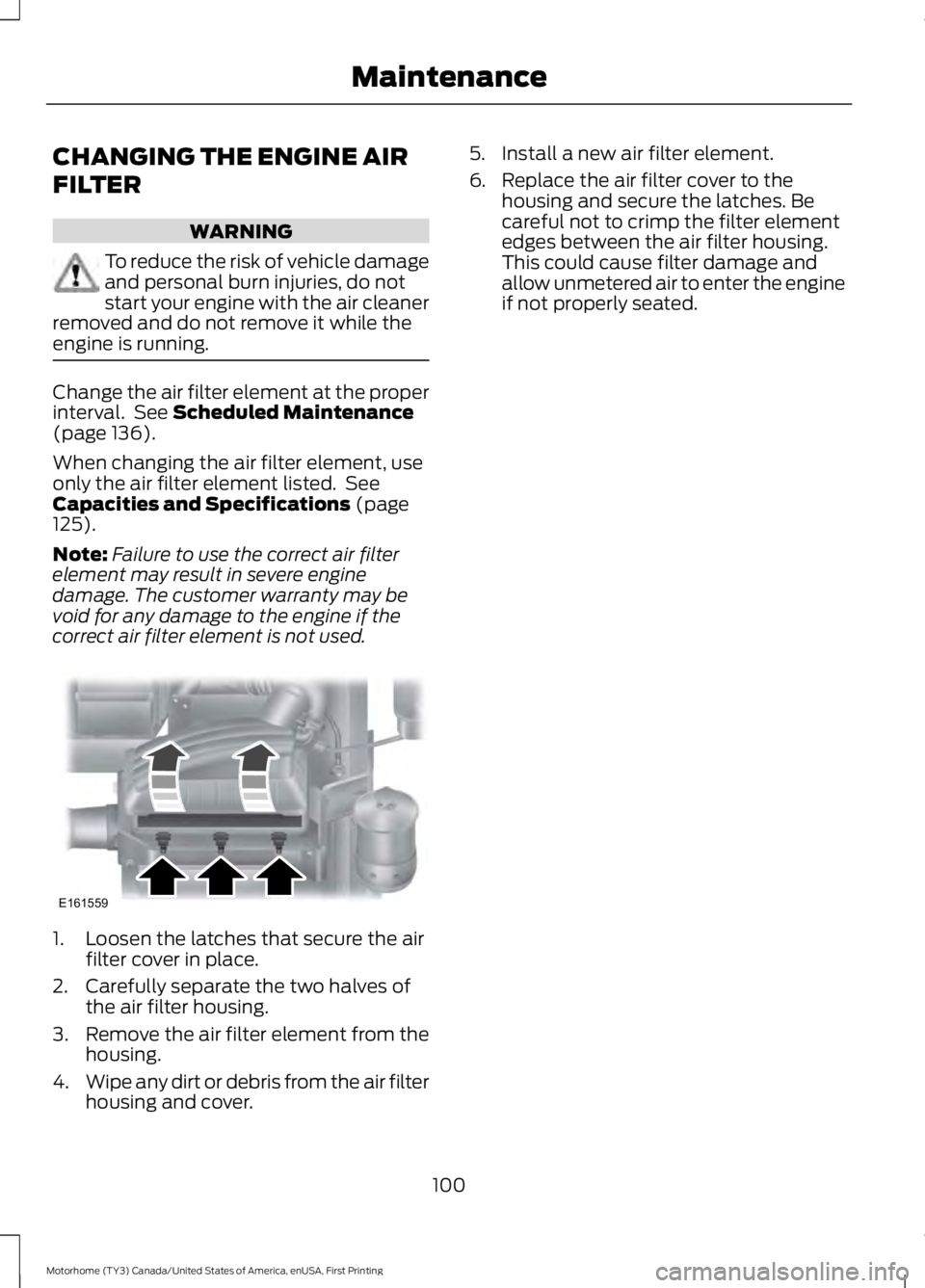
correct air filter element is not used. 1. Loosen the latches that secure the air
filter cover in place.
2. Carefully separate the two halves of the air filter housing.
3. Remove the air filter element from the
housing.
4. Wipe any dirt or debris from the air filter
housing and cover. 5. Install a new air filter element.
6. Replace the air filter cover to the
housing and secure the latches. Be
careful not to crimp the filter element
edges between the air filter housing.
This could cause filter damage and
allow unmetered air to enter the engine
if not properly seated.
100
Motorhome (TY3) Canada/United States of America, enUSA, First Printing MaintenanceE161559
Page 106 of 164
VEHICLE STORAGE
If you plan on storing your vehicle for 30
days or more, read the following
maintenance recommendations to make
sure your vehicle stays in good operating
condition.
We engineer and test all motor vehicles
and their components for reliable, regular
driving. Under various conditions,
long-term storage may lead to degraded
engine performance or failure unless you
use specific precautions to preserve engine
components.
General
•
Store all vehicles in a dry, ventilated
place.
• Protect from sunlight, if possible.
• If vehicles are stored outside, they
require regular maintenance to protect
against rust and damage.
Body
• Wash your vehicle thoroughly to
remove dirt, grease, oil, tar or mud from
exterior surfaces, rear-wheel housing
and the underside of front fenders.
• Periodically wash your vehicle if it is
stored in exposed locations.
• Touch-up exposed or primed metal to
prevent rust.
• Cover chrome and stainless steel parts
with a thick coat of auto wax to prevent
discoloration. Re-wax as necessary
when you wash your vehicle.
• Lubricate all hood, door and luggage
compartment hinges and latches with
a light grade oil.
• Cover interior trim to prevent fading.
• Keep all rubber parts free from oil and
solvents. Engine
•
Change the engine oil and filter prior to
storage because used engine oil
contains contaminates which may
cause engine damage.
• Start the engine every 15 days for a
minimum of 15 minutes. Run at fast idle
with the climate controls set to defrost
until the engine reaches normal
operating temperature.
• With your foot on the brake, shift
through all the gears while the engine
is running.
• We recommend that you change the
engine oil before you use your vehicle
again.
Fuel system
• Fill the fuel tank with high-quality fuel
until the first automatic shutoff of the
fuel pump nozzle.
Cooling system
• Protect against freezing temperatures.
• When removing your vehicle from
storage, check coolant fluid level.
Confirm that there are no cooling
system leaks and that fluid is at the
recommended level.
Battery
• Check and recharge as necessary. Keep
connections clean.
• If storing your vehicle for more than 30
days without recharging the battery,
we recommend that you disconnect
the battery cables to maintain battery
charge for quick starting.
Note: It is necessary to reset memory
features if battery cables are disconnected.
103
Motorhome (TY3) Canada/United States of America, enUSA, First Printing Vehicle Care
Page 118 of 164
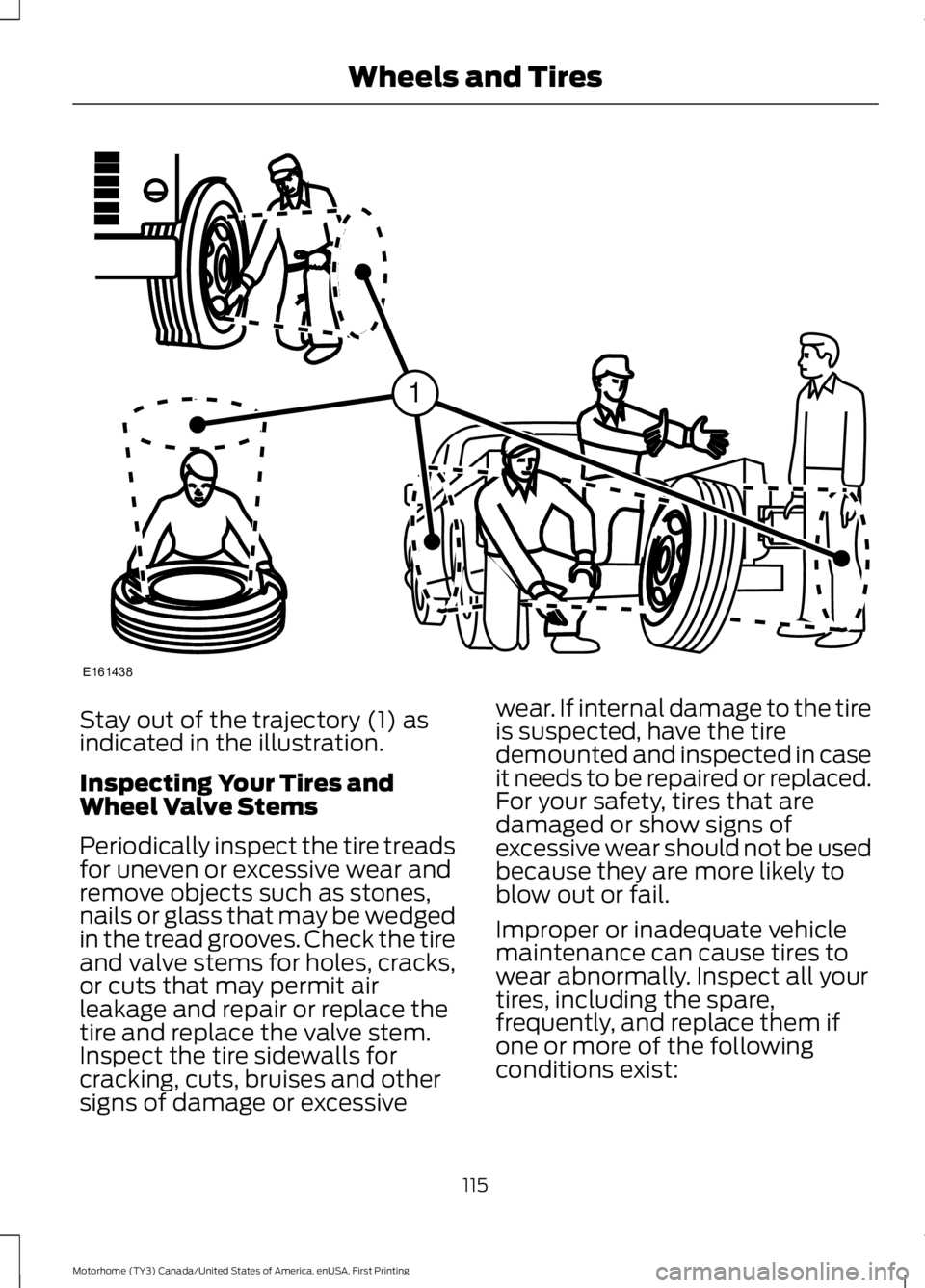
Stay out of the trajectory (1) as
indicated in the illustration.
Inspecting Your Tires and
Wheel Valve Stems
Periodically inspect the tire treads
for uneven or excessive wear and
remove objects such as stones,
nails or glass that may be wedged
in the tread grooves. Check the tire
and valve stems for holes, cracks,
or cuts that may permit air
leakage and repair or replace the
tire and replace the valve stem.
Inspect the tire sidewalls for
cracking, cuts, bruises and other
signs of damage or excessive
wear. If internal damage to the tire
is suspected, have the tire
demounted and inspected in case
it needs to be repaired or replaced.
For your safety, tires that are
damaged or show signs of
excessive wear should not be used
because they are more likely to
blow out or fail.
Improper or inadequate vehicle
maintenance can cause tires to
wear abnormally. Inspect all your
tires, including the spare,
frequently, and replace them if
one or more of the following
conditions exist:
115
Motorhome (TY3) Canada/United States of America, enUSA, First Printing Wheels and TiresE161438
1
Page 123 of 164
Rotating your tires at the
recommended interval (as
indicated in the Scheduled
Maintenance chapter) will help
your tires wear more evenly,
providing better tire performance
and longer tire life.
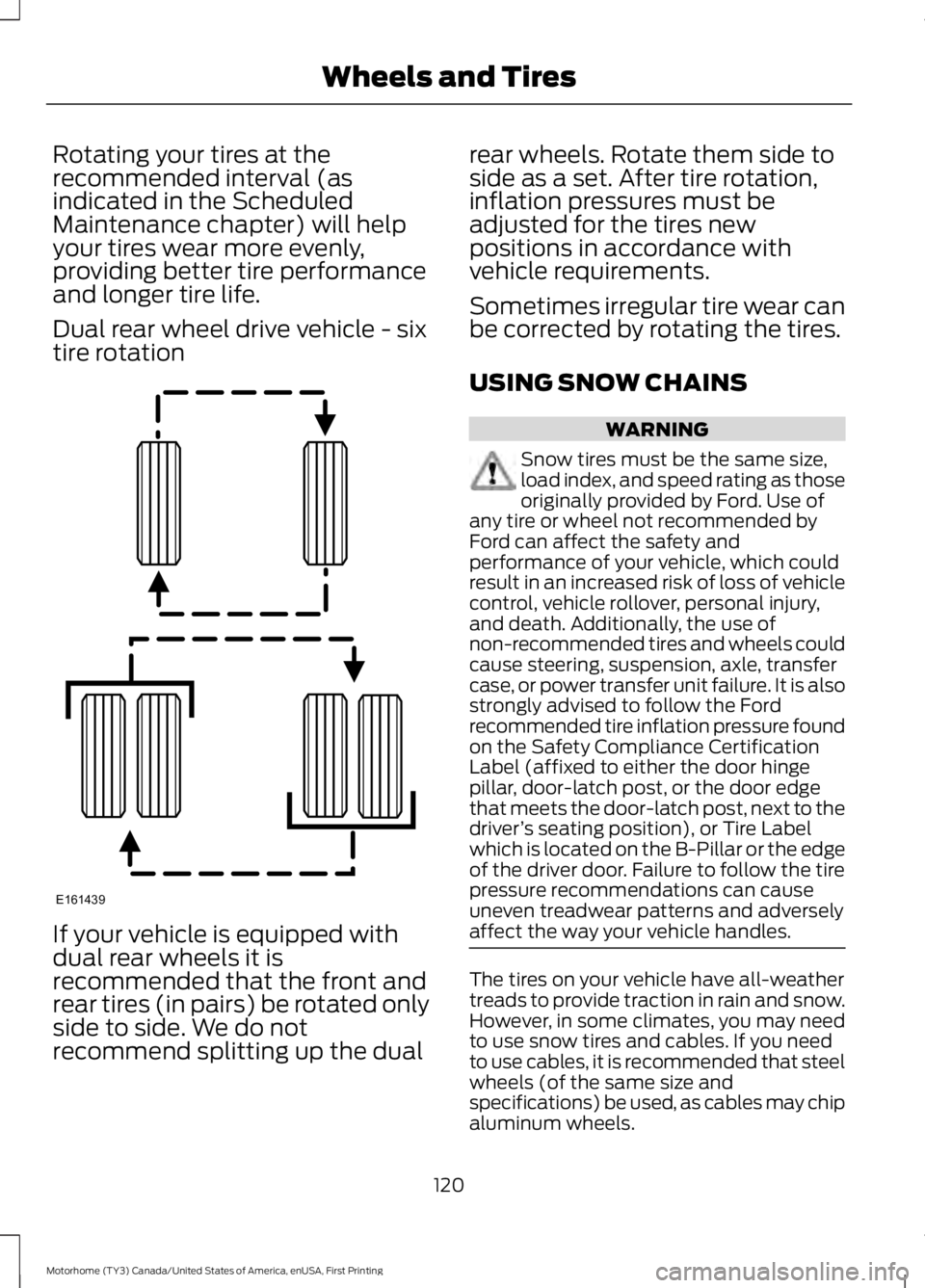
Dual rear wheel drive vehicle - six
tire rotation
If your vehicle is equipped with
dual rear wheels it is
recommended that the front and
rear tires (in pairs) be rotated only
side to side. We do not
recommend splitting up the dual rear wheels. Rotate them side to
side as a set. After tire rotation,
inflation pressures must be
adjusted for the tires new
positions in accordance with
vehicle requirements.
Sometimes irregular tire wear can
be corrected by rotating the tires.
USING SNOW CHAINS
WARNING
Snow tires must be the same size,
load index, and speed rating as those
originally provided by Ford. Use of
any tire or wheel not recommended by
Ford can affect the safety and
performance of your vehicle, which could
result in an increased risk of loss of vehicle
control, vehicle rollover, personal injury,
and death. Additionally, the use of
non-recommended tires and wheels could
cause steering, suspension, axle, transfer
case, or power transfer unit failure. It is also
strongly advised to follow the Ford
recommended tire inflation pressure found
on the Safety Compliance Certification
Label (affixed to either the door hinge
pillar, door-latch post, or the door edge
that meets the door-latch post, next to the
driver ’s seating position), or Tire Label
which is located on the B-Pillar or the edge
of the driver door. Failure to follow the tire
pressure recommendations can cause
uneven treadwear patterns and adversely
affect the way your vehicle handles. The tires on your vehicle have all-weather
treads to provide traction in rain and snow.
However, in some climates, you may need
to use snow tires and cables. If you need
to use cables, it is recommended that steel
wheels (of the same size and
specifications) be used, as cables may chip
aluminum wheels.
120
Motorhome (TY3) Canada/United States of America, enUSA, First Printing Wheels and TiresE161439
Page 129 of 164
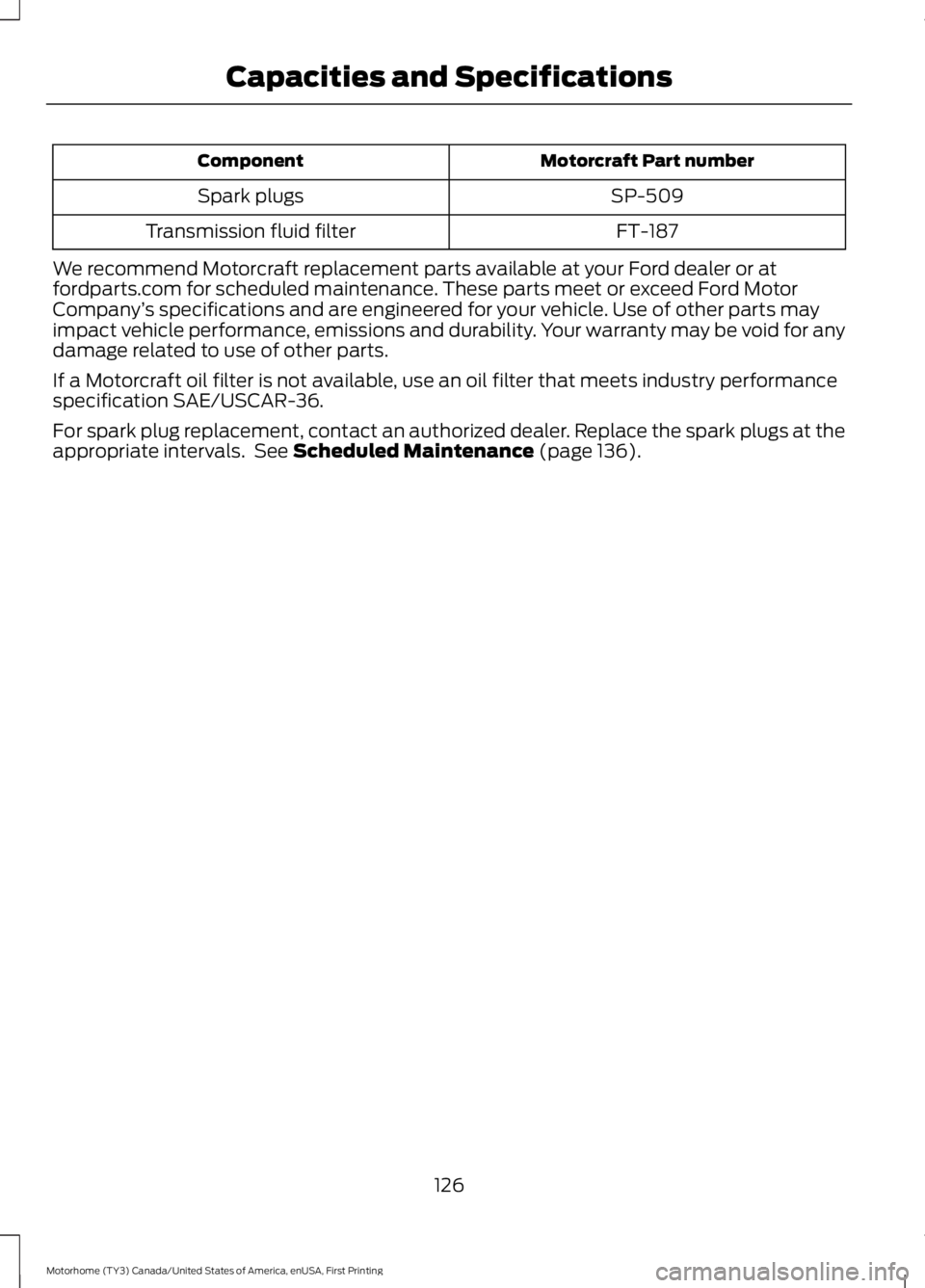
Motorcraft Part number
Component
SP-509
Spark plugs
FT-187
Transmission fluid filter
We recommend Motorcraft replacement parts available at your Ford dealer or at
fordparts.com for scheduled maintenance. These parts meet or exceed Ford Motor
Company ’s specifications and are engineered for your vehicle. Use of other parts may
impact vehicle performance, emissions and durability. Your warranty may be void for any
damage related to use of other parts.
If a Motorcraft oil filter is not available, use an oil filter that meets industry performance
specification SAE/USCAR-36.
For spark plug replacement, contact an authorized dealer. Replace the spark plugs at the
appropriate intervals. See Scheduled Maintenance (page 136).
126
Motorhome (TY3) Canada/United States of America, enUSA, First Printing Capacities and Specifications
Page 137 of 164
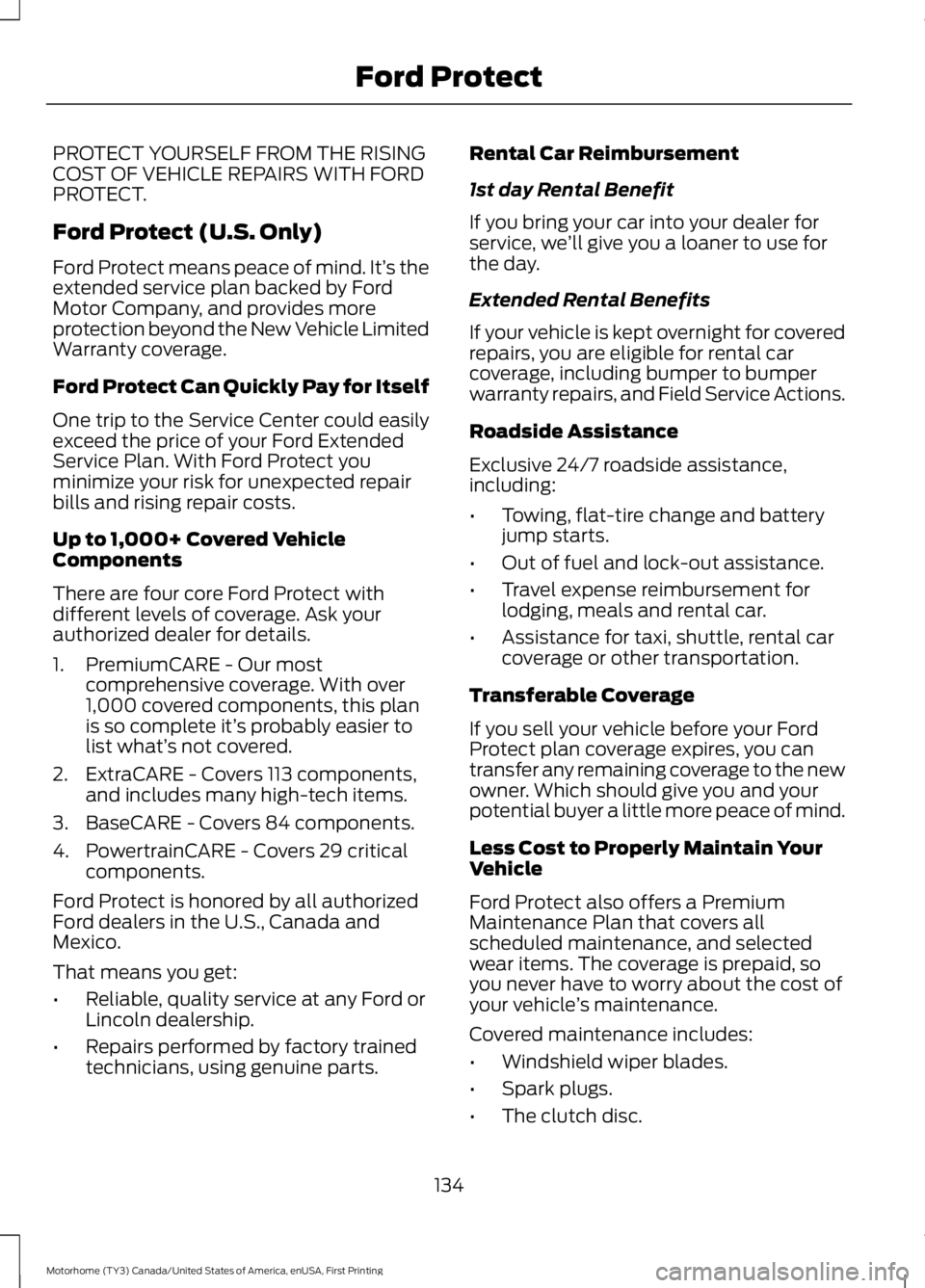
PROTECT YOURSELF FROM THE RISING
COST OF VEHICLE REPAIRS WITH FORD
PROTECT.
Ford Protect (U.S. Only)
Ford Protect means peace of mind. It’
s the
extended service plan backed by Ford
Motor Company, and provides more
protection beyond the New Vehicle Limited
Warranty coverage.
Ford Protect Can Quickly Pay for Itself
One trip to the Service Center could easily
exceed the price of your Ford Extended
Service Plan. With Ford Protect you
minimize your risk for unexpected repair
bills and rising repair costs.
Up to 1,000+ Covered Vehicle
Components
There are four core Ford Protect with
different levels of coverage. Ask your
authorized dealer for details.
1. PremiumCARE - Our most comprehensive coverage. With over
1,000 covered components, this plan
is so complete it’ s probably easier to
list what’ s not covered.
2. ExtraCARE - Covers 113 components, and includes many high-tech items.
3. BaseCARE - Covers 84 components.
4. PowertrainCARE - Covers 29 critical components.
Ford Protect is honored by all authorized
Ford dealers in the U.S., Canada and
Mexico.
That means you get:
• Reliable, quality service at any Ford or
Lincoln dealership.
• Repairs performed by factory trained
technicians, using genuine parts. Rental Car Reimbursement
1st day Rental Benefit
If you bring your car into your dealer for
service, we
’ll give you a loaner to use for
the day.
Extended Rental Benefits
If your vehicle is kept overnight for covered
repairs, you are eligible for rental car
coverage, including bumper to bumper
warranty repairs, and Field Service Actions.
Roadside Assistance
Exclusive 24/7 roadside assistance,
including:
• Towing, flat-tire change and battery
jump starts.
• Out of fuel and lock-out assistance.
• Travel expense reimbursement for
lodging, meals and rental car.
• Assistance for taxi, shuttle, rental car
coverage or other transportation.
Transferable Coverage
If you sell your vehicle before your Ford
Protect plan coverage expires, you can
transfer any remaining coverage to the new
owner. Which should give you and your
potential buyer a little more peace of mind.
Less Cost to Properly Maintain Your
Vehicle
Ford Protect also offers a Premium
Maintenance Plan that covers all
scheduled maintenance, and selected
wear items. The coverage is prepaid, so
you never have to worry about the cost of
your vehicle ’s maintenance.
Covered maintenance includes:
• Windshield wiper blades.
• Spark plugs.
• The clutch disc.
134
Motorhome (TY3) Canada/United States of America, enUSA, First Printing Ford Protect