lock FORD F53 2017 Owner's Guide
[x] Cancel search | Manufacturer: FORD, Model Year: 2017, Model line: F53, Model: FORD F53 2017Pages: 164, PDF Size: 2.57 MB
Page 102 of 164
Your vehicle is equipped with a
Motorcraft® maintenance-free battery
which normally does not require additional
water during its life of service.
For longer, trouble-free operation, keep the
top of the battery clean and dry. Also,
make certain the battery cables are always
tightly fastened to the battery terminals.
If you see any corrosion on the battery or
terminals, remove the cables from the
terminals and clean with a wire brush. You
can neutralize the acid with a solution of
baking soda and water.
It is recommended that the negative
battery cable terminal be disconnected
from the battery if you plan to store your
vehicle for an extended period of time.
To ensure proper operation of the battery
management system (BMS), any electrical
devices that are added to the vehicle
should not have their ground connection
made directly at the negative battery post.
A connection at the negative battery post
can cause inaccurate measurements of
the battery condition and potential
incorrect system operation.
Note:
Electrical or electronic accessories
or components added to the vehicle by the
dealer or the owner may adversely affect
battery performance and durability and may
also affect the performance of other
electrical systems in the vehicle.
When a battery replacement is required,
the battery should only be replaced with
a Ford recommended replacement battery
that matches the electrical requirements
of the vehicle.
Note: Always dispose of automotive
batteries in a responsible manner. Follow
your local authorized standards for disposal.
Call your local authorized recycling center
to find out more about recycling automotive
batteries. Battery relearn
When the battery is disconnected or a new
battery installed:
•
The transmission must relearn its
adaptive strategy. As a result of this,
the transmission may shift firmly. This
operation is considered normal and will
not affect function or durability of the
transmission. Over time the adaptive
learning process will fully update
transmission operation to its optimum
shift feel.
• The clock and the preset radio stations
must be reset once the battery is
reconnected.
• Your vehicle ’s engine is electronically
controlled by a computer, some control
conditions are maintained by power
from the battery, the engine must
relearn its idle and fuel trim strategy.
When the battery is disconnected or a new
battery is installed, begin the battery
relearn process:
1. With the vehicle at a complete stop, set the parking brake.
2. Put the gearshift lever in P (Park), turn
off all accessories and start the engine.
3. Run the engine until it reaches normal operating temperature.
4. Allow the engine to idle for at least one
minute.
5. Turn the A/C on and allow the engine to idle for at least one minute.
6. Drive the vehicle to complete the relearning process.
•The vehicle may need to be driven
to relearn the idle and fuel trim
strategy.
99
Motorhome (TY3) Canada/United States of America, enUSA, First Printing Maintenance
Page 105 of 164
Underbody
Flush the complete underside of your
vehicle frequently. Keep body and door
drain holes free of debris or foreign
material.
Under Hood
For removing black rubber marks from
under the hood we recommend Motorcraft
Wheel and Tire Cleaner or Motorcraft Bug
and Tar Remover.
CLEANING THE ENGINE
Engines are more efficient when they are
clean because grease and dirt buildup keep
the engine warmer than normal.
When washing:
•
Take care when using a power washer
to clean the engine. The high-pressure
fluid could penetrate the sealed parts
and cause damage.
• Do not spray a hot engine with cold
water to avoid cracking the engine
block or other engine components.
• Spray Motorcraft Engine Shampoo and
Degreaser on all parts that require
cleaning and pressure rinse clean. In
Canada, use Motorcraft Engine
Shampoo.
• Never wash or rinse the engine while it
is hot or running; water in the running
engine may cause internal damage.
• Never wash or rinse any ignition coil,
spark plug wire or spark plug well, or
the area in and around these locations.
• Cover the battery, power distribution
box, and air filter assembly to prevent
water damage when cleaning the
engine. CLEANING THE ALLOY
WHEELS (If Equipped)
Note: Do not apply a cleaning chemical to
warm or hot wheel rims and covers.
Note: Some automatic car washes may
cause damage to the finish on your wheel
rims and covers.
Note: Industrial-strength or heavy-duty
cleaners in combination with brush agitation
to remove brake dust and dirt, could wear
away the clear coat finish over a period time.
Note: Do not use hydrofluoric acid-based
or high caustic-based wheel cleaners, steel
wool, fuels or strong household detergents.
Note: If you intend parking your vehicle for
an extended period after cleaning the
wheels with a wheel cleaner, drive your
vehicle for a few minutes before doing so.
This will reduce the risk of increased
corrosion of the brake discs.
Alloy wheels and wheel covers are coated
with a clear coat paint finish. To maintain
their condition we recommend that you:
• Clean the wheels weekly using
Motorcraft Wheel and Tire Cleaner.
Apply using manufacturer's
instructions.
• Use a sponge to remove heavy
deposits of dirt and brake dust
accumulation.
• Rinse thoroughly with a strong stream
of water when you have completed the
cleaning process.
• To remove tar and grease, use
Motorcraft Bug and Tar Remover.
102
Motorhome (TY3) Canada/United States of America, enUSA, First Printing Vehicle Care
Page 125 of 164
Use of one of the dissimilar spare tires
listed above at any one wheel location can
lead to impairment of the following:
•
Handling, stability and braking
performance.
• Comfort and noise.
• Ground clearance and parking at curbs.
• Winter weather driving capability.
• Wet weather driving capability.
• All-wheel driving capability.
3. Full-size dissimilar spare without
label on wheel
When driving with the full-size dissimilar
spare wheel and tire assembly, do not:
• Exceed 70 mph (113 km/h).
• Use more than one dissimilar spare
wheel and tire assembly at a time.
• Use commercial car washing
equipment.
• Use snow chains on the end of the
vehicle with the dissimilar spare wheel
and tire assembly.
The usage of a full-size dissimilar spare
wheel and tire assembly can lead to
impairment of the following:
• Handling, stability and braking
performance.
• Comfort and noise.
• Ground clearance and parking at curbs.
• Winter weather driving capability.
• Wet weather driving capability.
• All-wheel driving capability.
When driving with the full-size dissimilar
spare wheel and tire assembly additional
caution should be given to:
• Towing a trailer.
• Driving vehicles equipped with a
camper body.
• Driving vehicles with a load on the
cargo rack. Drive cautiously when using a full-size
dissimilar spare wheel and tire assembly
and seek service as soon as possible.
Tire Change Procedure
WARNINGS
When one of the front wheels is off
the ground, the transmission alone
will not prevent the vehicle from
moving or slipping off the jack, even if the
transmission is in park (P). To help prevent the vehicle from
moving when you change a tire, be
sure to place the transmission in park
(P), set the parking brake and block (in
both directions) the wheel that is
diagonally opposite (other side and end of
the vehicle) to the tire being changed. Never get underneath a vehicle that
is supported only by a jack. If the
vehicle slips off the jack, you or
someone else could be seriously injured. Do not attempt to change a tire on
the side of the vehicle close to
moving traffic. Pull far enough off the
road to avoid the danger of being hit when
operating the jack or changing the wheel. Always use the jack provided as
original equipment with your vehicle.
If using a jack other than the one
provided as original equipment with your
vehicle, make sure the jack capacity is
adequate for the vehicle weight, including
any vehicle cargo or modifications. 1.
Park on a level surface, set the parking
brake and activate the hazard flashers.
2. Place the transmission in park (P) and
turn the engine off.
122
Motorhome (TY3) Canada/United States of America, enUSA, First Printing Wheels and Tires
Page 126 of 164
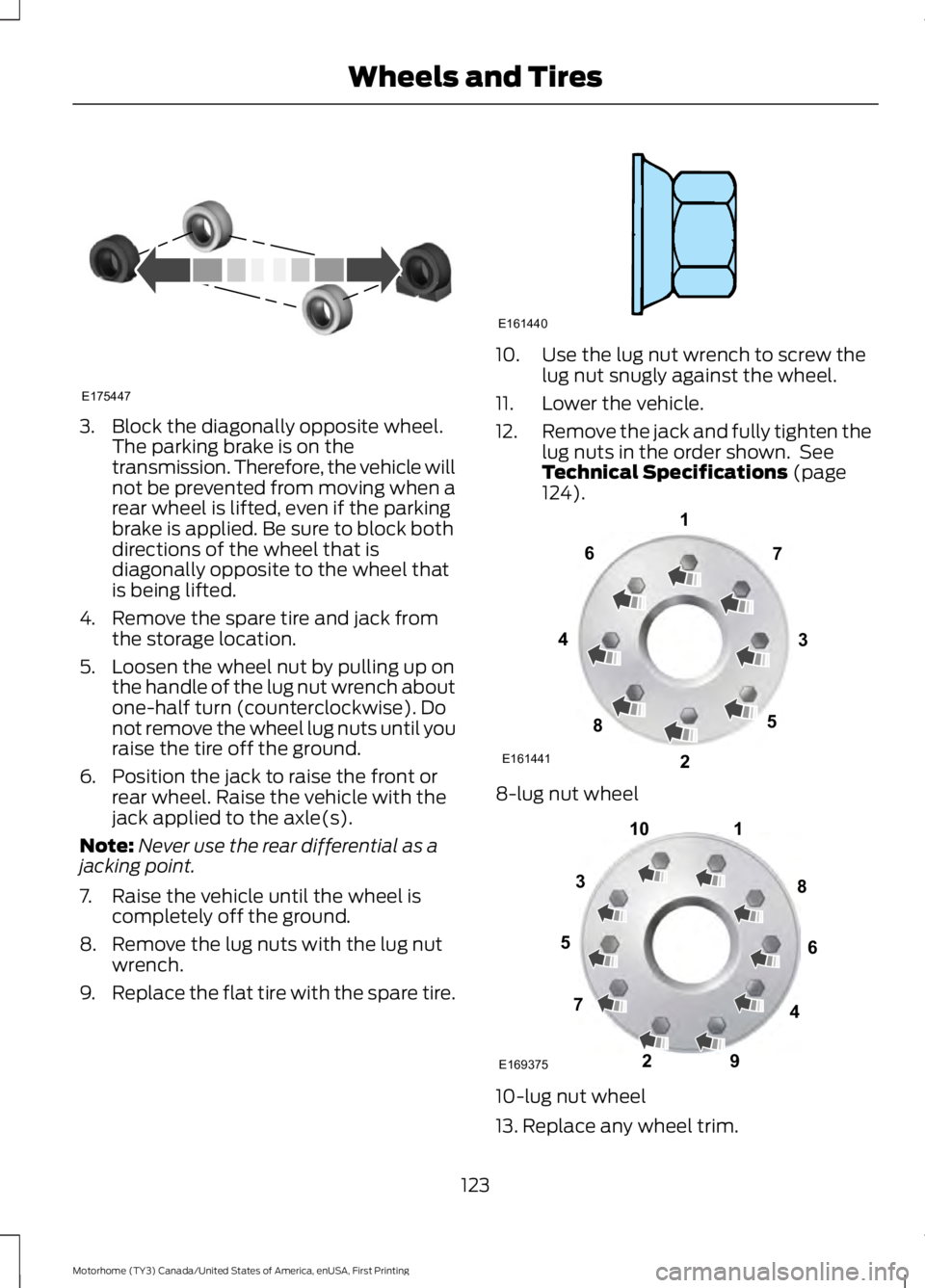
3. Block the diagonally opposite wheel.
The parking brake is on the
transmission. Therefore, the vehicle will
not be prevented from moving when a
rear wheel is lifted, even if the parking
brake is applied. Be sure to block both
directions of the wheel that is
diagonally opposite to the wheel that
is being lifted.
4. Remove the spare tire and jack from the storage location.
5. Loosen the wheel nut by pulling up on the handle of the lug nut wrench about
one-half turn (counterclockwise). Do
not remove the wheel lug nuts until you
raise the tire off the ground.
6. Position the jack to raise the front or rear wheel. Raise the vehicle with the
jack applied to the axle(s).
Note: Never use the rear differential as a
jacking point.
7. Raise the vehicle until the wheel is completely off the ground.
8. Remove the lug nuts with the lug nut wrench.
9. Replace the flat tire with the spare tire. 10. Use the lug nut wrench to screw the
lug nut snugly against the wheel.
11. Lower the vehicle.
12. Remove the jack and fully tighten the
lug nuts in the order shown. See
Technical Specifications (page
124). 8-lug nut wheel
10-lug nut wheel
13. Replace any wheel trim.
123
Motorhome (TY3) Canada/United States of America, enUSA, First Printing Wheels and TiresE175447 E161440 E161441
13
4
27
6
5
8 1
2
3
4
5
6
7 8
9
10
E169375
Page 127 of 164
14. Stow the jack, handle and lug wrench. 15. Unblock the wheels.
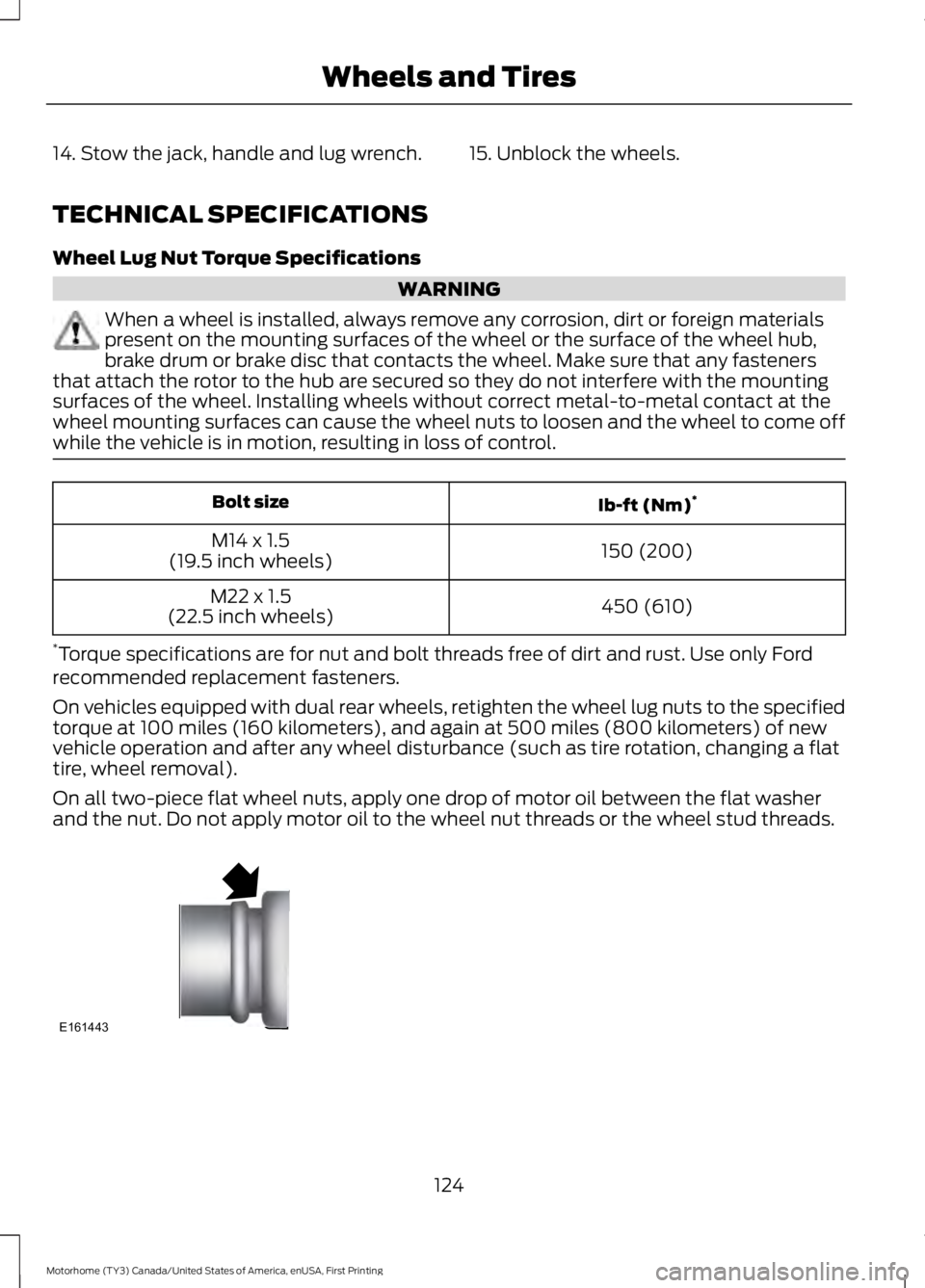
TECHNICAL SPECIFICATIONS
Wheel Lug Nut Torque Specifications
WARNING
When a wheel is installed, always remove any corrosion, dirt or foreign materials
present on the mounting surfaces of the wheel or the surface of the wheel hub,
brake drum or brake disc that contacts the wheel. Make sure that any fasteners
that attach the rotor to the hub are secured so they do not interfere with the mounting
surfaces of the wheel. Installing wheels without correct metal-to-metal contact at the
wheel mounting surfaces can cause the wheel nuts to loosen and the wheel to come off
while the vehicle is in motion, resulting in loss of control. Ib-ft (Nm)
*
Bolt size
150 (200)
M14 x 1.5
(19.5 inch wheels)
450 (610)
M22 x 1.5
(22.5 inch wheels)
* Torque specifications are for nut and bolt threads free of dirt and rust. Use only Ford
recommended replacement fasteners.
On vehicles equipped with dual rear wheels, retighten the wheel lug nuts to the specified
torque at 100 miles (160 kilometers), and again at 500 miles (800 kilometers) of new
vehicle operation and after any wheel disturbance (such as tire rotation, changing a flat
tire, wheel removal).
On all two-piece flat wheel nuts, apply one drop of motor oil between the flat washer
and the nut. Do not apply motor oil to the wheel nut threads or the wheel stud threads. 124
Motorhome (TY3) Canada/United States of America, enUSA, First Printing Wheels and TiresE161443
Page 137 of 164
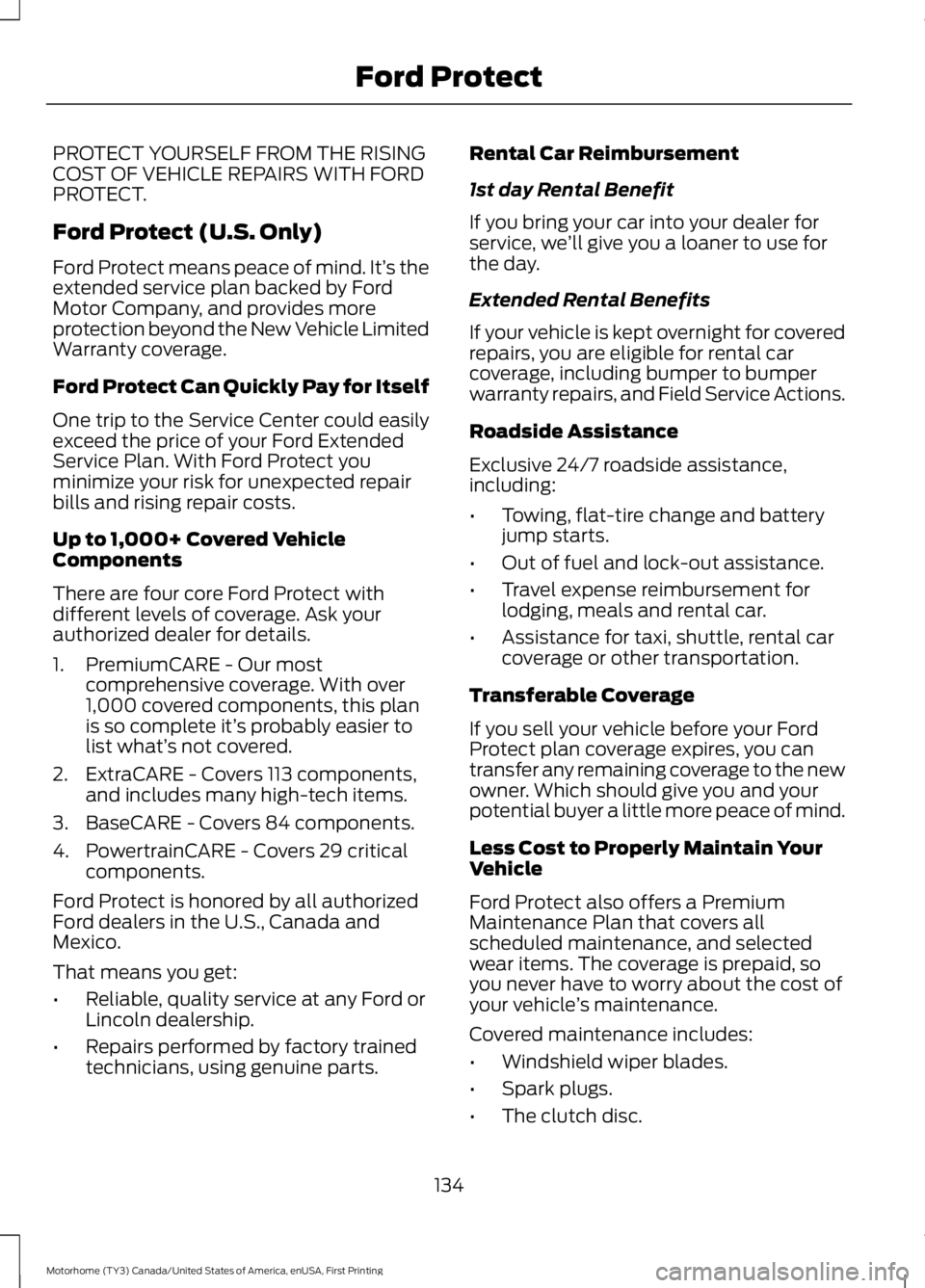
PROTECT YOURSELF FROM THE RISING
COST OF VEHICLE REPAIRS WITH FORD
PROTECT.
Ford Protect (U.S. Only)
Ford Protect means peace of mind. It’
s the
extended service plan backed by Ford
Motor Company, and provides more
protection beyond the New Vehicle Limited
Warranty coverage.
Ford Protect Can Quickly Pay for Itself
One trip to the Service Center could easily
exceed the price of your Ford Extended
Service Plan. With Ford Protect you
minimize your risk for unexpected repair
bills and rising repair costs.
Up to 1,000+ Covered Vehicle
Components
There are four core Ford Protect with
different levels of coverage. Ask your
authorized dealer for details.
1. PremiumCARE - Our most comprehensive coverage. With over
1,000 covered components, this plan
is so complete it’ s probably easier to
list what’ s not covered.
2. ExtraCARE - Covers 113 components, and includes many high-tech items.
3. BaseCARE - Covers 84 components.
4. PowertrainCARE - Covers 29 critical components.
Ford Protect is honored by all authorized
Ford dealers in the U.S., Canada and
Mexico.
That means you get:
• Reliable, quality service at any Ford or
Lincoln dealership.
• Repairs performed by factory trained
technicians, using genuine parts. Rental Car Reimbursement
1st day Rental Benefit
If you bring your car into your dealer for
service, we
’ll give you a loaner to use for
the day.
Extended Rental Benefits
If your vehicle is kept overnight for covered
repairs, you are eligible for rental car
coverage, including bumper to bumper
warranty repairs, and Field Service Actions.
Roadside Assistance
Exclusive 24/7 roadside assistance,
including:
• Towing, flat-tire change and battery
jump starts.
• Out of fuel and lock-out assistance.
• Travel expense reimbursement for
lodging, meals and rental car.
• Assistance for taxi, shuttle, rental car
coverage or other transportation.
Transferable Coverage
If you sell your vehicle before your Ford
Protect plan coverage expires, you can
transfer any remaining coverage to the new
owner. Which should give you and your
potential buyer a little more peace of mind.
Less Cost to Properly Maintain Your
Vehicle
Ford Protect also offers a Premium
Maintenance Plan that covers all
scheduled maintenance, and selected
wear items. The coverage is prepaid, so
you never have to worry about the cost of
your vehicle ’s maintenance.
Covered maintenance includes:
• Windshield wiper blades.
• Spark plugs.
• The clutch disc.
134
Motorhome (TY3) Canada/United States of America, enUSA, First Printing Ford Protect
Page 141 of 164
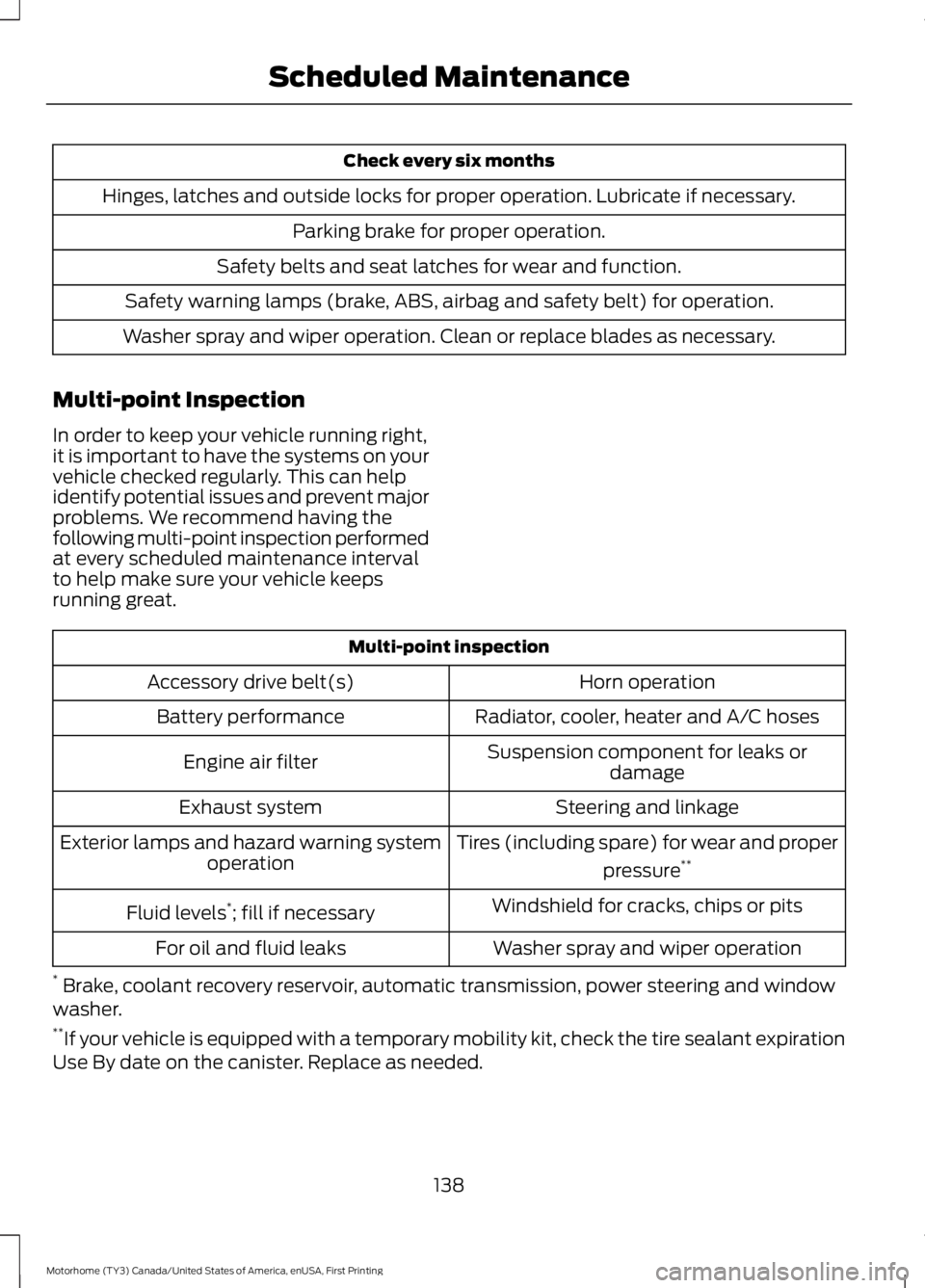
Check every six months
Hinges, latches and outside locks for proper operation. Lubricate if necessary. Parking brake for proper operation.
Safety belts and seat latches for wear and function.
Safety warning lamps (brake, ABS, airbag and safety belt) for operation.
Washer spray and wiper operation. Clean or replace blades as necessary.
Multi-point Inspection
In order to keep your vehicle running right,
it is important to have the systems on your
vehicle checked regularly. This can help
identify potential issues and prevent major
problems. We recommend having the
following multi-point inspection performed
at every scheduled maintenance interval
to help make sure your vehicle keeps
running great. Multi-point inspection
Horn operation
Accessory drive belt(s)
Radiator, cooler, heater and A/C hoses
Battery performance
Suspension component for leaks ordamage
Engine air filter
Steering and linkage
Exhaust system
Tires (including spare) for wear and properpressure**
Exterior lamps and hazard warning system
operation
Windshield for cracks, chips or pits
Fluid levels *
; fill if necessary
Washer spray and wiper operation
For oil and fluid leaks
* Brake, coolant recovery reservoir, automatic transmission, power steering and window
washer.
** If your vehicle is equipped with a temporary mobility kit, check the tire sealant expiration
Use By date on the canister. Replace as needed.
138
Motorhome (TY3) Canada/United States of America, enUSA, First Printing Scheduled Maintenance
Page 160 of 164
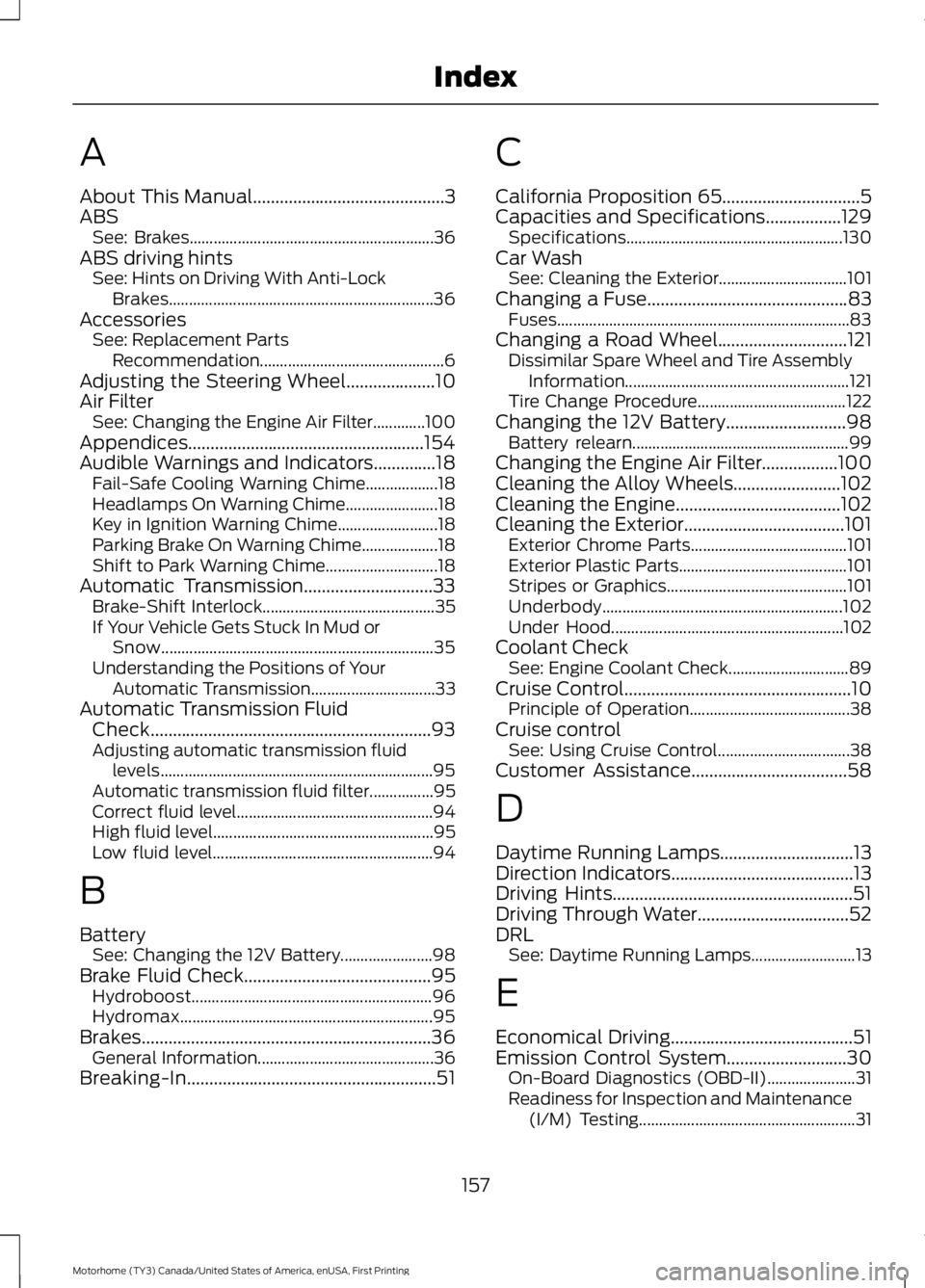
A
About This Manual...........................................3
ABS See: Brakes............................................................. 36
ABS driving hints See: Hints on Driving With Anti-Lock
Brakes.................................................................. 36
Accessories See: Replacement Parts
Recommendation.............................................. 6
Adjusting the Steering Wheel
....................10
Air Filter See: Changing the Engine Air Filter.............100
Appendices.....................................................154
Audible Warnings and Indicators
..............18
Fail-Safe Cooling Warning Chime.................. 18
Headlamps On Warning Chime....................... 18
Key in Ignition Warning Chime......................... 18
Parking Brake On Warning Chime................... 18
Shift to Park Warning Chime............................ 18
Automatic Transmission.............................33 Brake-Shift Interlock........................................... 35
If Your Vehicle Gets Stuck In Mud or Snow.................................................................... 35
Understanding the Positions of Your Automatic Transmission............................... 33
Automatic Transmission Fluid Check...............................................................93
Adjusting automatic transmission fluid levels.................................................................... 95
Automatic transmission fluid filter................95
Correct fluid level................................................. 94
High fluid level....................................................... 95
Low fluid level....................................................... 94
B
Battery See: Changing the 12V Battery....................... 98
Brake Fluid Check
..........................................95
Hydroboost............................................................ 96
Hydromax............................................................... 95
Brakes.................................................................36 General Information............................................ 36
Breaking-In........................................................51 C
California Proposition 65
...............................5
Capacities and Specifications.................129 Specifications...................................................... 130
Car Wash See: Cleaning the Exterior................................ 101
Changing a Fuse
.............................................83
Fuses........................................................................\
. 83
Changing a Road Wheel
.............................121
Dissimilar Spare Wheel and Tire Assembly
Information........................................................ 121
Tire Change Procedure..................................... 122
Changing the 12V Battery...........................98 Battery relearn...................................................... 99
Changing the Engine Air Filter.................100
Cleaning the Alloy Wheels
........................102
Cleaning the Engine.....................................102
Cleaning the Exterior....................................101 Exterior Chrome Parts....................................... 101
Exterior Plastic Parts.......................................... 101
Stripes or Graphics............................................. 101
Underbody............................................................ 102
Under Hood.......................................................... 102
Coolant Check See: Engine Coolant Check.............................. 89
Cruise Control
...................................................10
Principle of Operation........................................ 38
Cruise control See: Using Cruise Control................................. 38
Customer Assistance
...................................58
D
Daytime Running Lamps
..............................13
Direction Indicators.........................................13
Driving Hints......................................................51
Driving Through Water
..................................52
DRL See: Daytime Running Lamps.......................... 13
E
Economical Driving
.........................................51
Emission Control System...........................30
On-Board Diagnostics (OBD-II)...................... 31
Readiness for Inspection and Maintenance (I/M) Testing...................................................... 31
157
Motorhome (TY3) Canada/United States of America, enUSA, First Printing Index
Page 161 of 164
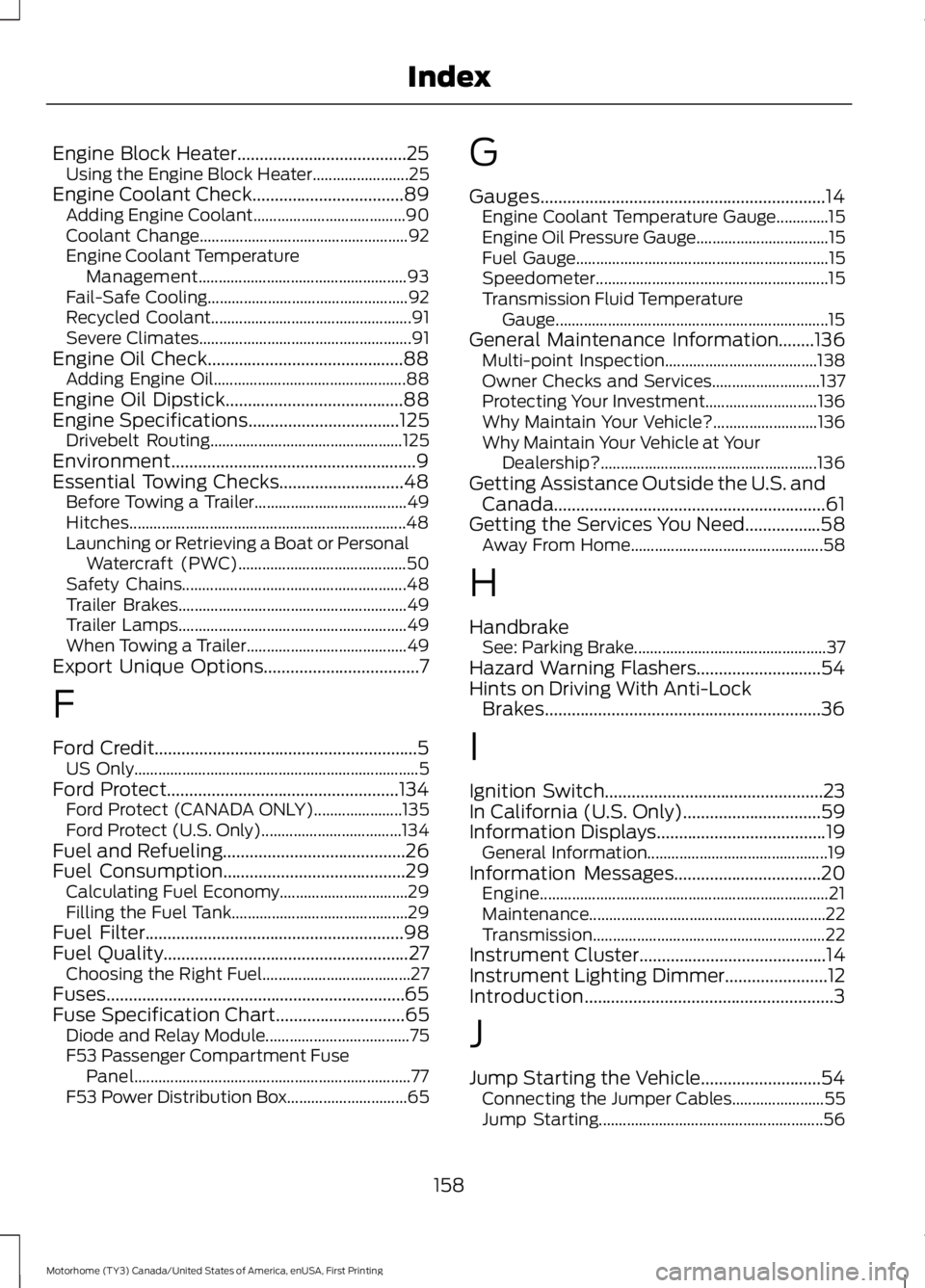
Engine Block Heater......................................25
Using the Engine Block Heater........................ 25
Engine Coolant Check..................................89
Adding Engine Coolant...................................... 90
Coolant Change.................................................... 92
Engine Coolant Temperature Management.................................................... 93
Fail-Safe Cooling.................................................. 92
Recycled Coolant.................................................. 91
Severe Climates..................................................... 91
Engine Oil Check............................................88 Adding Engine Oil................................................ 88
Engine Oil Dipstick
........................................88
Engine Specifications..................................125
Drivebelt Routing................................................ 125
Environment.......................................................9
Essential Towing Checks............................48 Before Towing a Trailer...................................... 49
Hitches..................................................................... 48
Launching or Retrieving a Boat or Personal Watercraft (PWC).......................................... 50
Safety Chains........................................................ 48
Trailer Brakes......................................................... 49
Trailer Lamps......................................................... 49
When Towing a Trailer........................................ 49
Export Unique Options
...................................7
F
Ford Credit...........................................................5 US Only....................................................................... 5
Ford Protect....................................................134 Ford Protect (CANADA ONLY)...................... 135
Ford Protect (U.S. Only)................................... 134
Fuel and Refueling.........................................26
Fuel Consumption
.........................................29
Calculating Fuel Economy................................ 29
Filling the Fuel Tank............................................ 29
Fuel Filter
..........................................................98
Fuel Quality.......................................................27
Choosing the Right Fuel..................................... 27
Fuses...................................................................65
Fuse Specification Chart
.............................65
Diode and Relay Module.................................... 75
F53 Passenger Compartment Fuse Panel..................................................................... 77
F53 Power Distribution Box.............................. 65G
Gauges
................................................................14
Engine Coolant Temperature Gauge.............15
Engine Oil Pressure Gauge................................. 15
Fuel Gauge............................................................... 15
Speedometer.......................................................... 15
Transmission Fluid Temperature Gauge.................................................................... 15
General Maintenance Information
........136
Multi-point Inspection...................................... 138
Owner Checks and Services........................... 137
Protecting Your Investment............................ 136
Why Maintain Your Vehicle?.......................... 136
Why Maintain Your Vehicle at Your Dealership?...................................................... 136
Getting Assistance Outside the U.S. and Canada.............................................................61
Getting the Services You Need
.................58
Away From Home................................................ 58
H
Handbrake See: Parking Brake................................................ 37
Hazard Warning Flashers............................54
Hints on Driving With Anti-Lock Brakes..............................................................36
I
Ignition Switch
.................................................23
In California (U.S. Only)...............................59
Information Displays
......................................19
General Information............................................. 19
Information Messages
.................................20
Engine........................................................................\
21
Maintenance........................................................... 22
Transmission.......................................................... 22
Instrument Cluster
..........................................14
Instrument Lighting Dimmer.......................12
Introduction........................................................3
J
Jump Starting the Vehicle...........................54 Connecting the Jumper Cables....................... 55
Jump Starting........................................................ 56
158
Motorhome (TY3) Canada/United States of America, enUSA, First Printing Index
Page 163 of 164
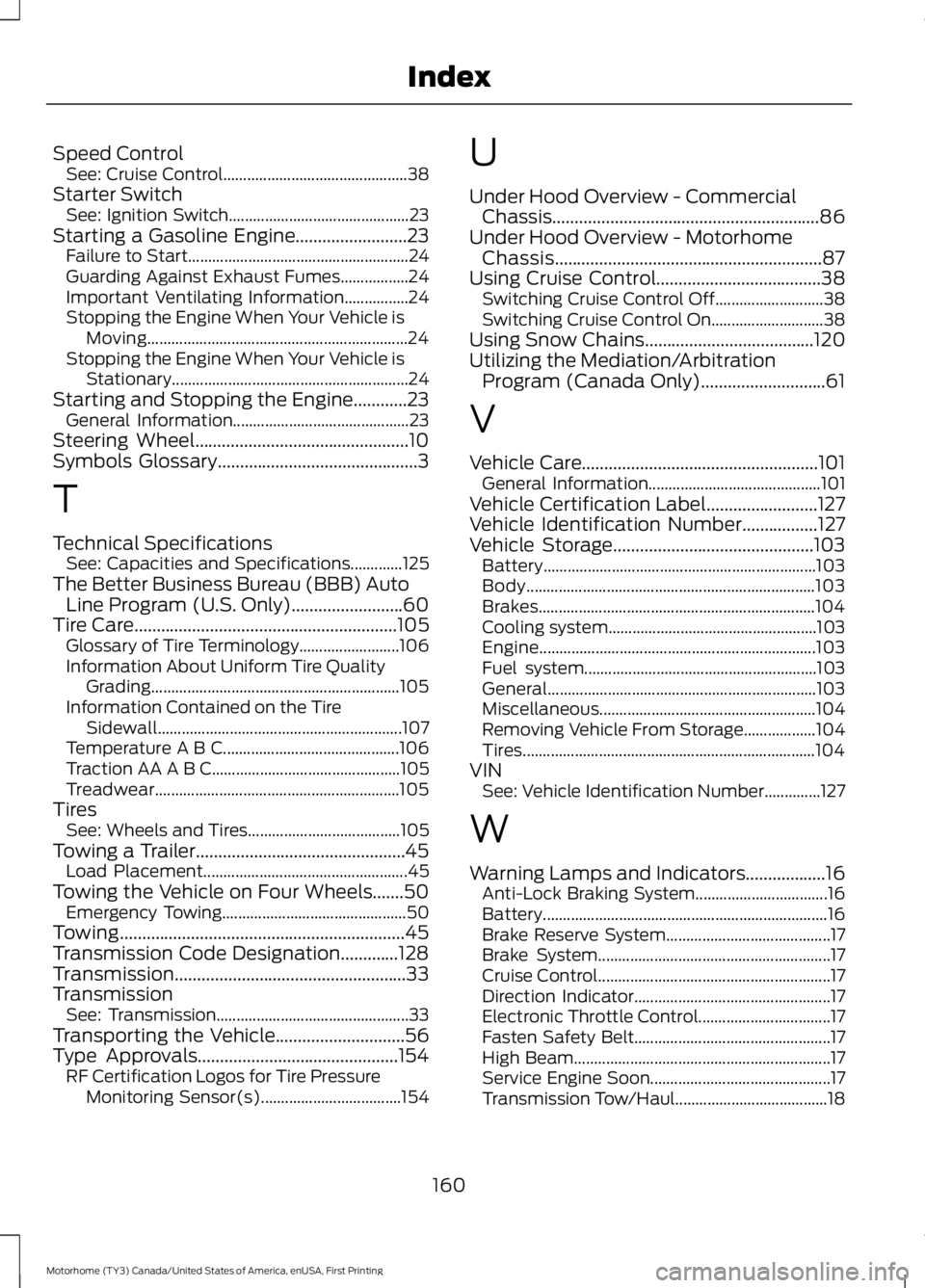
Speed Control
See: Cruise Control.............................................. 38
Starter Switch See: Ignition Switch............................................. 23
Starting a Gasoline Engine.........................23 Failure to Start....................................................... 24
Guarding Against Exhaust Fumes.................24
Important Ventilating Information................24
Stopping the Engine When Your Vehicle is Moving................................................................. 24
Stopping the Engine When Your Vehicle is Stationary........................................................... 24
Starting and Stopping the Engine............23 General Information............................................ 23
Steering Wheel................................................10
Symbols Glossary.............................................3
T
Technical Specifications See: Capacities and Specifications.............125
The Better Business Bureau (BBB) Auto Line Program (U.S. Only).........................60
Tire Care
...........................................................105
Glossary of Tire Terminology......................... 106
Information About Uniform Tire Quality Grading.............................................................. 105
Information Contained on the Tire Sidewall............................................................. 107
Temperature A B C............................................ 106
Traction AA A B C............................................... 105
Treadwear............................................................. 105
Tires See: Wheels and Tires...................................... 105
Towing a Trailer...............................................45 Load Placement................................................... 45
Towing the Vehicle on Four Wheels.......50 Emergency Towing.............................................. 50
Towing................................................................45
Transmission Code Designation.............128
Transmission....................................................33
Transmission See: Transmission................................................ 33
Transporting the Vehicle
.............................56
Type Approvals.............................................154
RF Certification Logos for Tire Pressure
Monitoring Sensor(s)................................... 154U
Under Hood Overview - Commercial
Chassis............................................................86
Under Hood Overview - Motorhome Chassis............................................................87
Using Cruise Control.....................................38 Switching Cruise Control Off........................... 38
Switching Cruise Control On............................ 38
Using Snow Chains
......................................120
Utilizing the Mediation/Arbitration Program (Canada Only)............................61
V
Vehicle Care.....................................................101 General Information........................................... 101
Vehicle Certification Label.........................127
Vehicle Identification Number
.................127
Vehicle Storage.............................................103 Battery.................................................................... 103
Body........................................................................\
103
Brakes..................................................................... 104
Cooling system.................................................... 103
Engine..................................................................... 103
Fuel system.......................................................... 103
General................................................................... 103
Miscellaneous...................................................... 104
Removing Vehicle From Storage.................. 104
Tires........................................................................\
. 104
VIN See: Vehicle Identification Number..............127
W
Warning Lamps and Indicators..................16 Anti-Lock Braking System................................. 16
Battery....................................................................... 16
Brake Reserve System......................................... 17
Brake System.......................................................... 17
Cruise Control.......................................................... 17
Direction Indicator................................................. 17
Electronic Throttle Control................................. 17
Fasten Safety Belt................................................. 17
High Beam................................................................ 17
Service Engine Soon............................................. 17
Transmission Tow/Haul...................................... 18
160
Motorhome (TY3) Canada/United States of America, enUSA, First Printing Index