transmission FORD F53 2017 Owner's Guide
[x] Cancel search | Manufacturer: FORD, Model Year: 2017, Model line: F53, Model: FORD F53 2017Pages: 164, PDF Size: 2.57 MB
Page 98 of 164
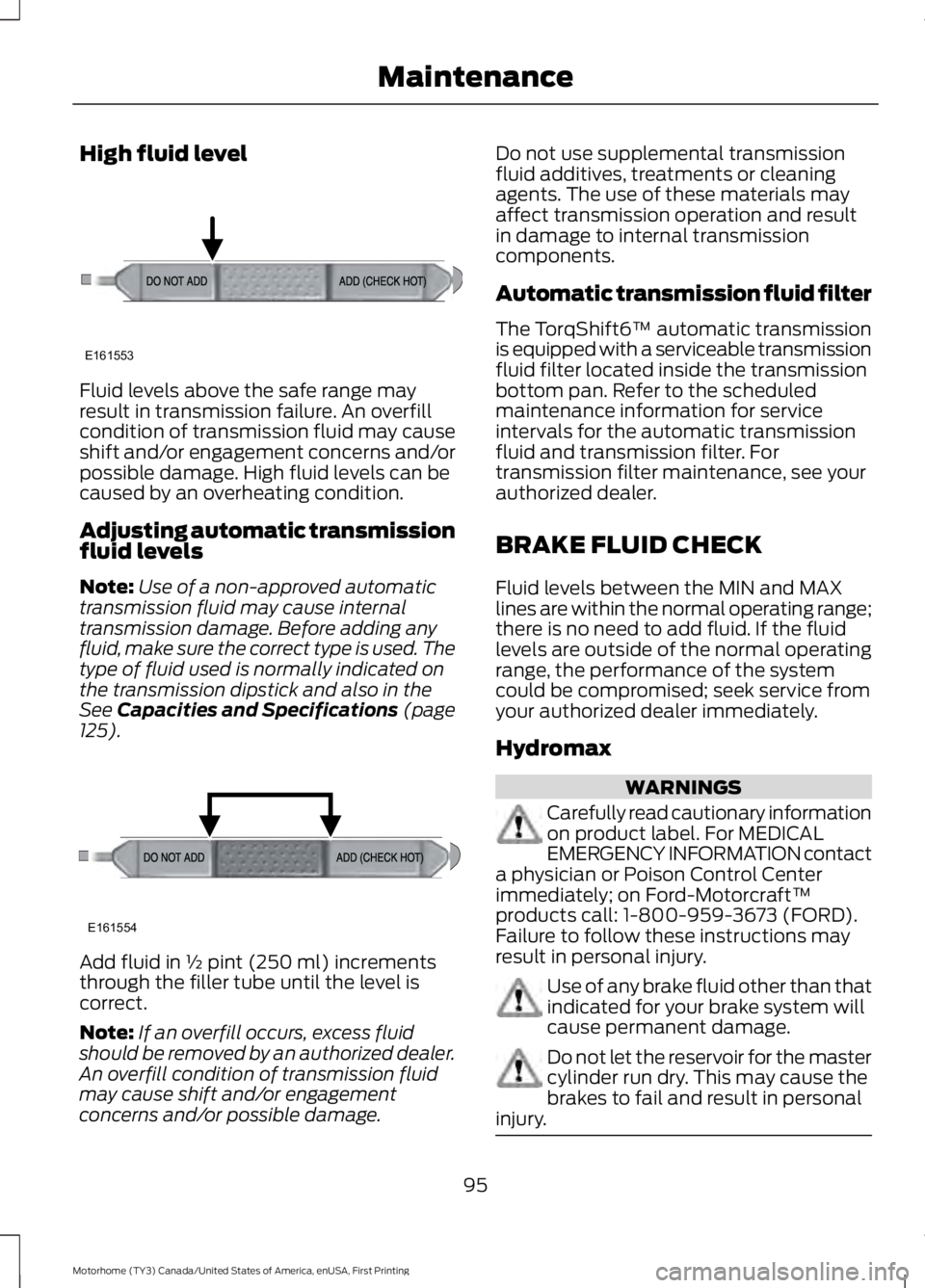
High fluid level
Fluid levels above the safe range may
result in transmission failure. An overfill
condition of transmission fluid may cause
shift and/or engagement concerns and/or
possible damage. High fluid levels can be
caused by an overheating condition.
Adjusting automatic transmission
fluid levels
Note:
Use of a non-approved automatic
transmission fluid may cause internal
transmission damage. Before adding any
fluid, make sure the correct type is used. The
type of fluid used is normally indicated on
the transmission dipstick and also in the
See Capacities and Specifications (page
125). Add fluid in ½ pint (250 ml) increments
through the filler tube until the level is
correct.
Note:
If an overfill occurs, excess fluid
should be removed by an authorized dealer.
An overfill condition of transmission fluid
may cause shift and/or engagement
concerns and/or possible damage. Do not use supplemental transmission
fluid additives, treatments or cleaning
agents. The use of these materials may
affect transmission operation and result
in damage to internal transmission
components.
Automatic transmission fluid filter
The TorqShift6™ automatic transmission
is equipped with a serviceable transmission
fluid filter located inside the transmission
bottom pan. Refer to the scheduled
maintenance information for service
intervals for the automatic transmission
fluid and transmission filter. For
transmission filter maintenance, see your
authorized dealer.
BRAKE FLUID CHECK
Fluid levels between the MIN and MAX
lines are within the normal operating range;
there is no need to add fluid. If the fluid
levels are outside of the normal operating
range, the performance of the system
could be compromised; seek service from
your authorized dealer immediately.
Hydromax
WARNINGS
Carefully read cautionary information
on product label. For MEDICAL
EMERGENCY INFORMATION contact
a physician or Poison Control Center
immediately; on Ford-Motorcraft™
products call: 1-800-959-3673 (FORD).
Failure to follow these instructions may
result in personal injury. Use of any brake fluid other than that
indicated for your brake system will
cause permanent damage.
Do not let the reservoir for the master
cylinder run dry. This may cause the
brakes to fail and result in personal
injury. 95
Motorhome (TY3) Canada/United States of America, enUSA, First Printing MaintenanceE161553 E161554
Page 102 of 164
Your vehicle is equipped with a
Motorcraft® maintenance-free battery
which normally does not require additional
water during its life of service.
For longer, trouble-free operation, keep the
top of the battery clean and dry. Also,
make certain the battery cables are always
tightly fastened to the battery terminals.
If you see any corrosion on the battery or
terminals, remove the cables from the
terminals and clean with a wire brush. You
can neutralize the acid with a solution of
baking soda and water.
It is recommended that the negative
battery cable terminal be disconnected
from the battery if you plan to store your
vehicle for an extended period of time.
To ensure proper operation of the battery
management system (BMS), any electrical
devices that are added to the vehicle
should not have their ground connection
made directly at the negative battery post.
A connection at the negative battery post
can cause inaccurate measurements of
the battery condition and potential
incorrect system operation.
Note:
Electrical or electronic accessories
or components added to the vehicle by the
dealer or the owner may adversely affect
battery performance and durability and may
also affect the performance of other
electrical systems in the vehicle.
When a battery replacement is required,
the battery should only be replaced with
a Ford recommended replacement battery
that matches the electrical requirements
of the vehicle.
Note: Always dispose of automotive
batteries in a responsible manner. Follow
your local authorized standards for disposal.
Call your local authorized recycling center
to find out more about recycling automotive
batteries. Battery relearn
When the battery is disconnected or a new
battery installed:
•
The transmission must relearn its
adaptive strategy. As a result of this,
the transmission may shift firmly. This
operation is considered normal and will
not affect function or durability of the
transmission. Over time the adaptive
learning process will fully update
transmission operation to its optimum
shift feel.
• The clock and the preset radio stations
must be reset once the battery is
reconnected.
• Your vehicle ’s engine is electronically
controlled by a computer, some control
conditions are maintained by power
from the battery, the engine must
relearn its idle and fuel trim strategy.
When the battery is disconnected or a new
battery is installed, begin the battery
relearn process:
1. With the vehicle at a complete stop, set the parking brake.
2. Put the gearshift lever in P (Park), turn
off all accessories and start the engine.
3. Run the engine until it reaches normal operating temperature.
4. Allow the engine to idle for at least one
minute.
5. Turn the A/C on and allow the engine to idle for at least one minute.
6. Drive the vehicle to complete the relearning process.
•The vehicle may need to be driven
to relearn the idle and fuel trim
strategy.
99
Motorhome (TY3) Canada/United States of America, enUSA, First Printing Maintenance
Page 125 of 164
Use of one of the dissimilar spare tires
listed above at any one wheel location can
lead to impairment of the following:
•
Handling, stability and braking
performance.
• Comfort and noise.
• Ground clearance and parking at curbs.
• Winter weather driving capability.
• Wet weather driving capability.
• All-wheel driving capability.
3. Full-size dissimilar spare without
label on wheel
When driving with the full-size dissimilar
spare wheel and tire assembly, do not:
• Exceed 70 mph (113 km/h).
• Use more than one dissimilar spare
wheel and tire assembly at a time.
• Use commercial car washing
equipment.
• Use snow chains on the end of the
vehicle with the dissimilar spare wheel
and tire assembly.
The usage of a full-size dissimilar spare
wheel and tire assembly can lead to
impairment of the following:
• Handling, stability and braking
performance.
• Comfort and noise.
• Ground clearance and parking at curbs.
• Winter weather driving capability.
• Wet weather driving capability.
• All-wheel driving capability.
When driving with the full-size dissimilar
spare wheel and tire assembly additional
caution should be given to:
• Towing a trailer.
• Driving vehicles equipped with a
camper body.
• Driving vehicles with a load on the
cargo rack. Drive cautiously when using a full-size
dissimilar spare wheel and tire assembly
and seek service as soon as possible.
Tire Change Procedure
WARNINGS
When one of the front wheels is off
the ground, the transmission alone
will not prevent the vehicle from
moving or slipping off the jack, even if the
transmission is in park (P). To help prevent the vehicle from
moving when you change a tire, be
sure to place the transmission in park
(P), set the parking brake and block (in
both directions) the wheel that is
diagonally opposite (other side and end of
the vehicle) to the tire being changed. Never get underneath a vehicle that
is supported only by a jack. If the
vehicle slips off the jack, you or
someone else could be seriously injured. Do not attempt to change a tire on
the side of the vehicle close to
moving traffic. Pull far enough off the
road to avoid the danger of being hit when
operating the jack or changing the wheel. Always use the jack provided as
original equipment with your vehicle.
If using a jack other than the one
provided as original equipment with your
vehicle, make sure the jack capacity is
adequate for the vehicle weight, including
any vehicle cargo or modifications. 1.
Park on a level surface, set the parking
brake and activate the hazard flashers.
2. Place the transmission in park (P) and
turn the engine off.
122
Motorhome (TY3) Canada/United States of America, enUSA, First Printing Wheels and Tires
Page 126 of 164
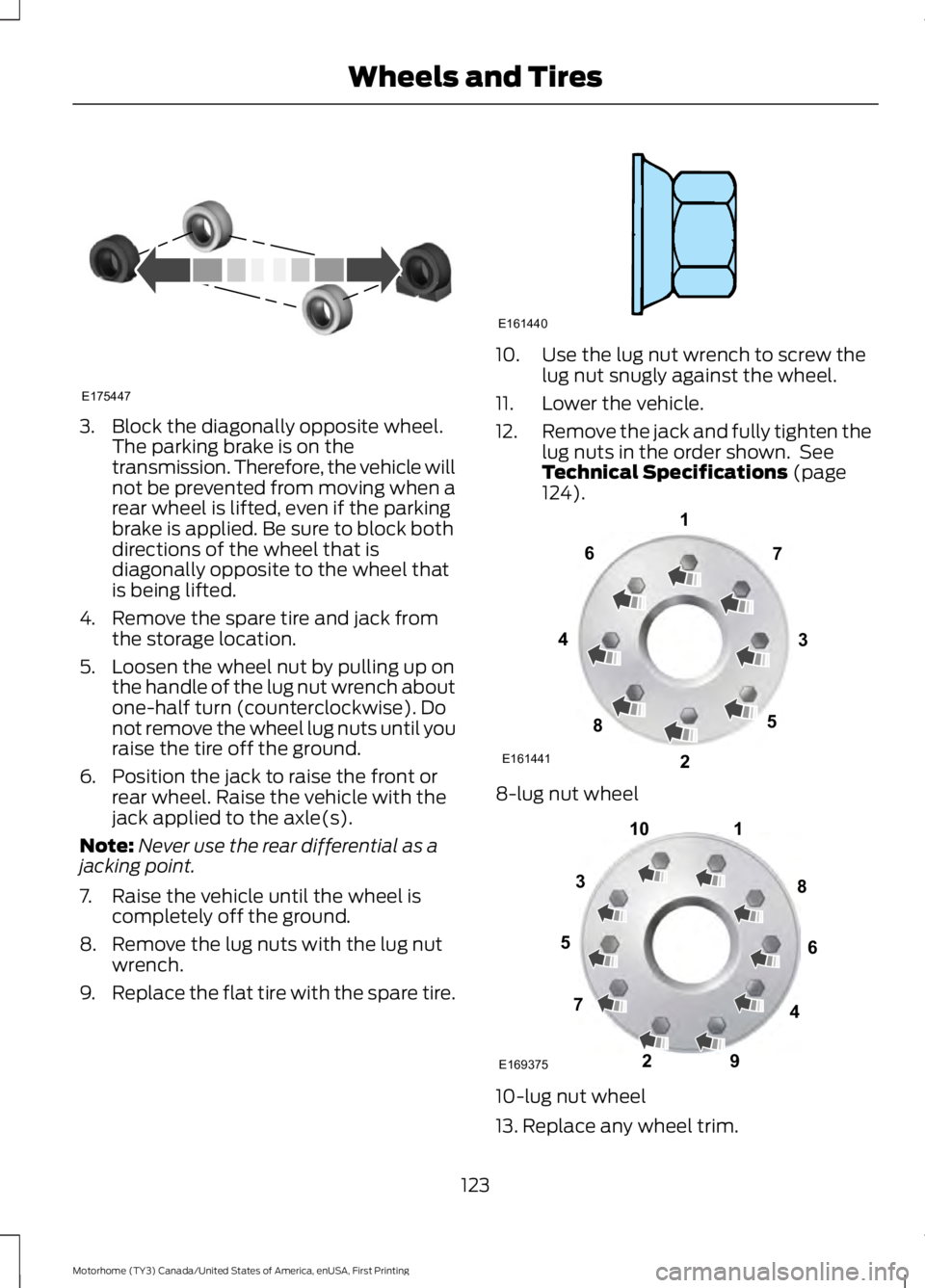
3. Block the diagonally opposite wheel.
The parking brake is on the
transmission. Therefore, the vehicle will
not be prevented from moving when a
rear wheel is lifted, even if the parking
brake is applied. Be sure to block both
directions of the wheel that is
diagonally opposite to the wheel that
is being lifted.
4. Remove the spare tire and jack from the storage location.
5. Loosen the wheel nut by pulling up on the handle of the lug nut wrench about
one-half turn (counterclockwise). Do
not remove the wheel lug nuts until you
raise the tire off the ground.
6. Position the jack to raise the front or rear wheel. Raise the vehicle with the
jack applied to the axle(s).
Note: Never use the rear differential as a
jacking point.
7. Raise the vehicle until the wheel is completely off the ground.
8. Remove the lug nuts with the lug nut wrench.
9. Replace the flat tire with the spare tire. 10. Use the lug nut wrench to screw the
lug nut snugly against the wheel.
11. Lower the vehicle.
12. Remove the jack and fully tighten the
lug nuts in the order shown. See
Technical Specifications (page
124). 8-lug nut wheel
10-lug nut wheel
13. Replace any wheel trim.
123
Motorhome (TY3) Canada/United States of America, enUSA, First Printing Wheels and TiresE175447 E161440 E161441
13
4
27
6
5
8 1
2
3
4
5
6
7 8
9
10
E169375
Page 129 of 164
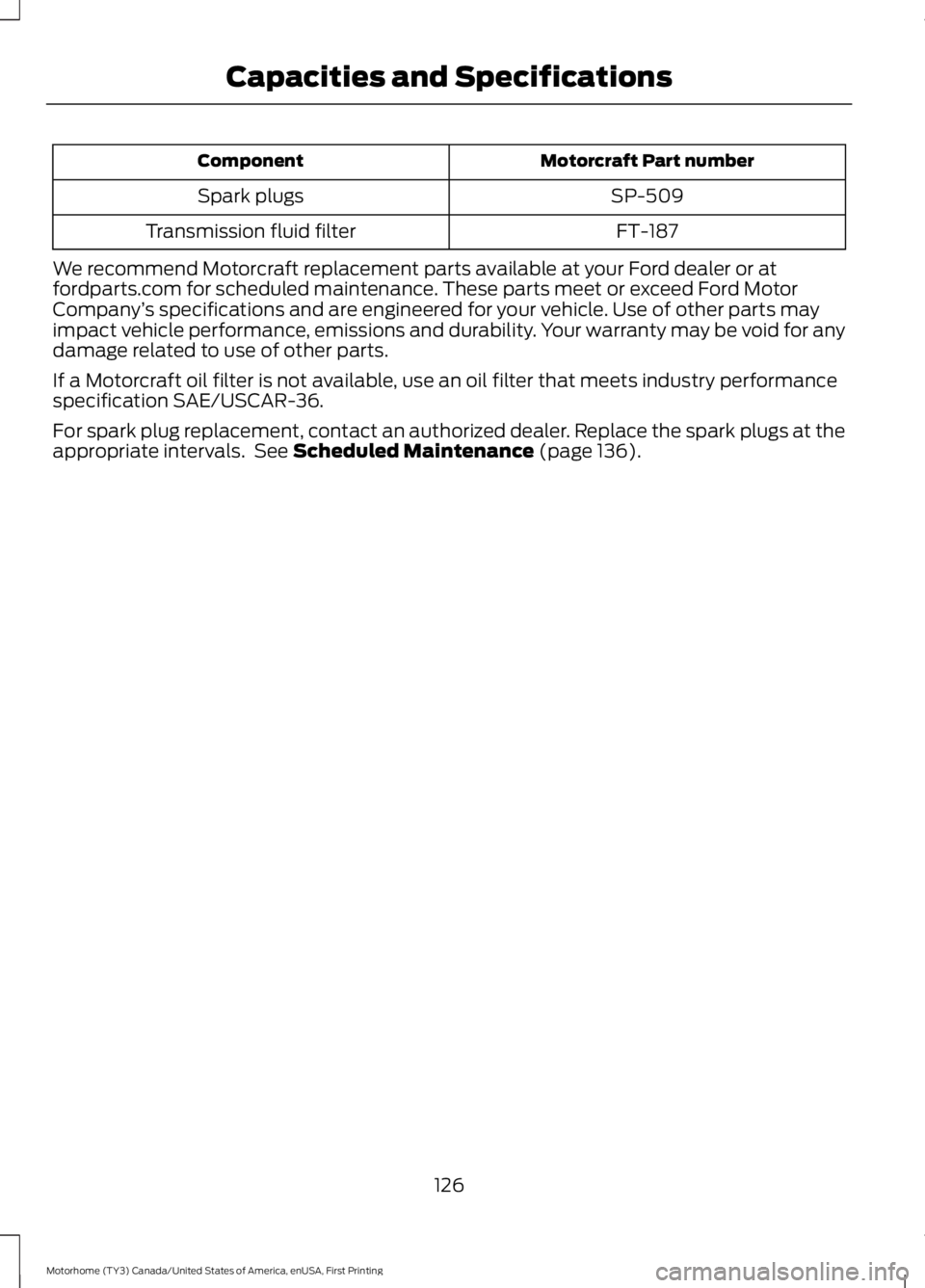
Motorcraft Part number
Component
SP-509
Spark plugs
FT-187
Transmission fluid filter
We recommend Motorcraft replacement parts available at your Ford dealer or at
fordparts.com for scheduled maintenance. These parts meet or exceed Ford Motor
Company ’s specifications and are engineered for your vehicle. Use of other parts may
impact vehicle performance, emissions and durability. Your warranty may be void for any
damage related to use of other parts.
If a Motorcraft oil filter is not available, use an oil filter that meets industry performance
specification SAE/USCAR-36.
For spark plug replacement, contact an authorized dealer. Replace the spark plugs at the
appropriate intervals. See Scheduled Maintenance (page 136).
126
Motorhome (TY3) Canada/United States of America, enUSA, First Printing Capacities and Specifications
Page 131 of 164
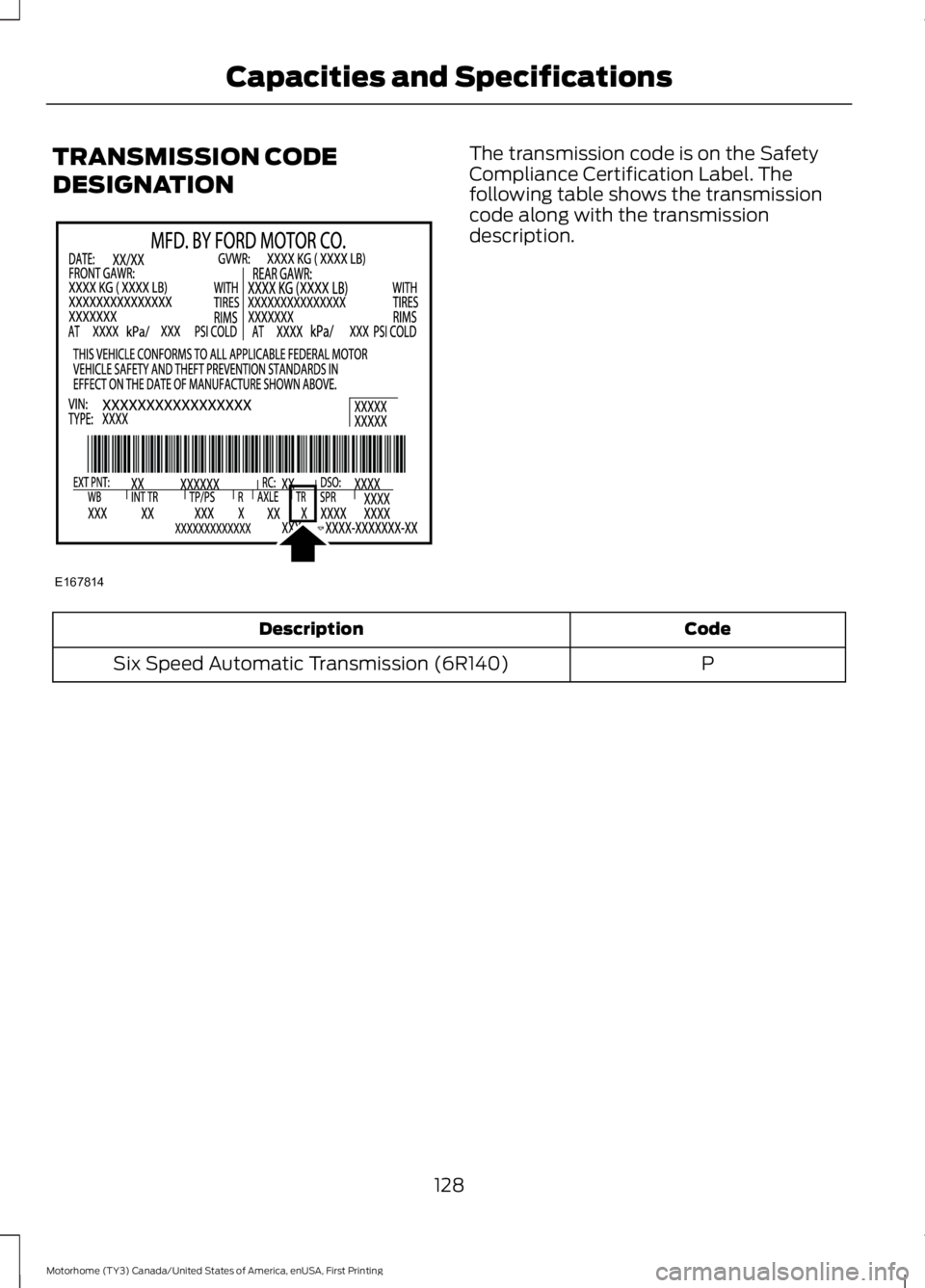
TRANSMISSION CODE
DESIGNATION The transmission code is on the Safety
Compliance Certification Label. The
following table shows the transmission
code along with the transmission
description.
Code
Description
P
Six Speed Automatic Transmission (6R140)
128
Motorhome (TY3) Canada/United States of America, enUSA, First Printing Capacities and SpecificationsE167814
Page 132 of 164
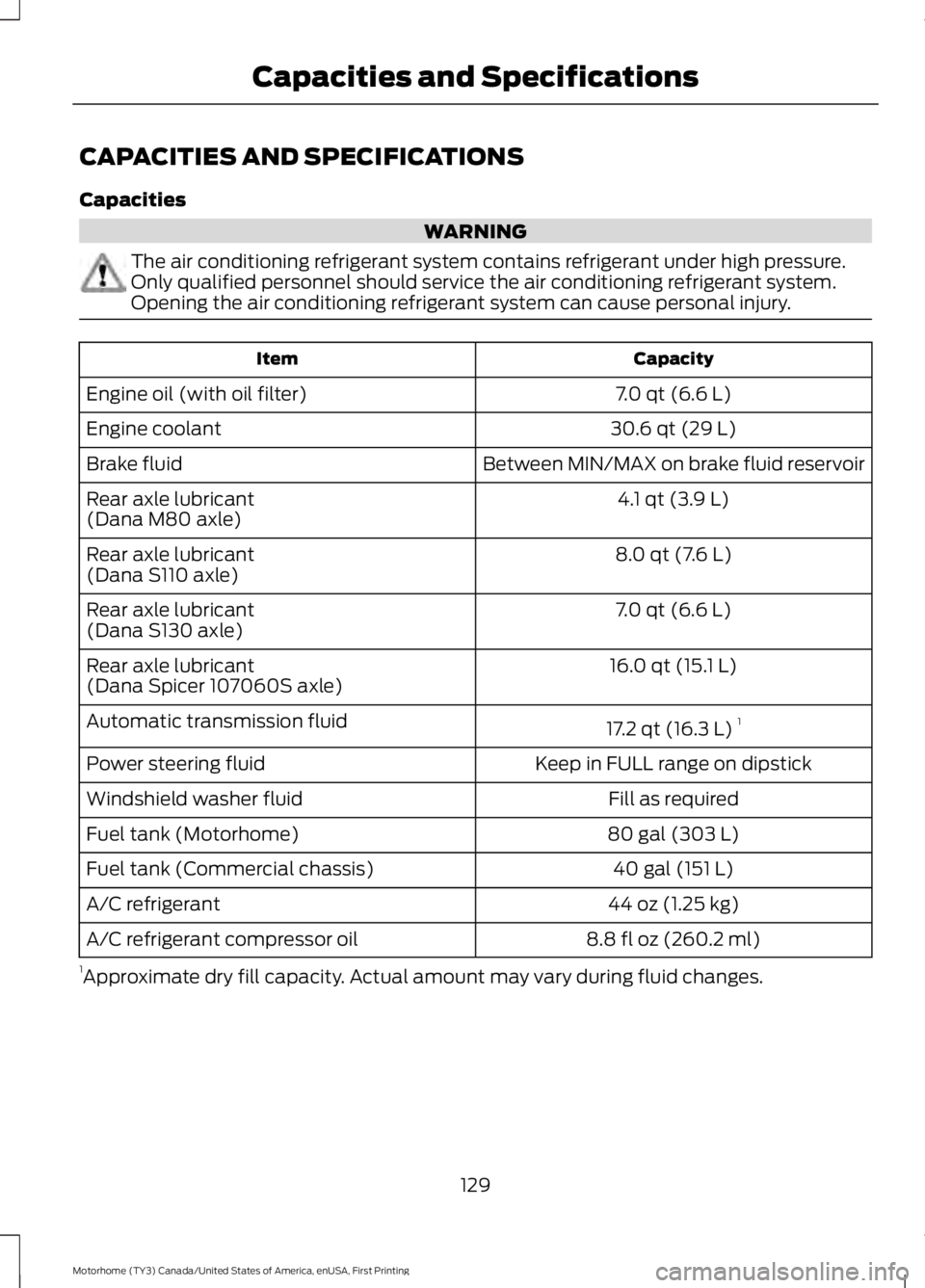
CAPACITIES AND SPECIFICATIONS
Capacities
WARNING
The air conditioning refrigerant system contains refrigerant under high pressure.
Only qualified personnel should service the air conditioning refrigerant system.
Opening the air conditioning refrigerant system can cause personal injury.
Capacity
Item
7.0 qt (6.6 L)
Engine oil (with oil filter)
30.6 qt (29 L)
Engine coolant
Between MIN/MAX on brake fluid reservoir
Brake fluid
4.1 qt (3.9 L)
Rear axle lubricant
(Dana M80 axle)
8.0 qt (7.6 L)
Rear axle lubricant
(Dana S110 axle)
7.0 qt (6.6 L)
Rear axle lubricant
(Dana S130 axle)
16.0 qt (15.1 L)
Rear axle lubricant
(Dana Spicer 107060S axle)
17.2 qt (16.3 L)1
Automatic transmission fluid
Keep in FULL range on dipstick
Power steering fluid
Fill as required
Windshield washer fluid
80 gal (303 L)
Fuel tank (Motorhome)
40 gal (151 L)
Fuel tank (Commercial chassis)
44 oz (1.25 kg)
A/C refrigerant
8.8 fl oz (260.2 ml)
A/C refrigerant compressor oil
1 Approximate dry fill capacity. Actual amount may vary during fluid changes.
129
Motorhome (TY3) Canada/United States of America, enUSA, First Printing Capacities and Specifications
Page 134 of 164
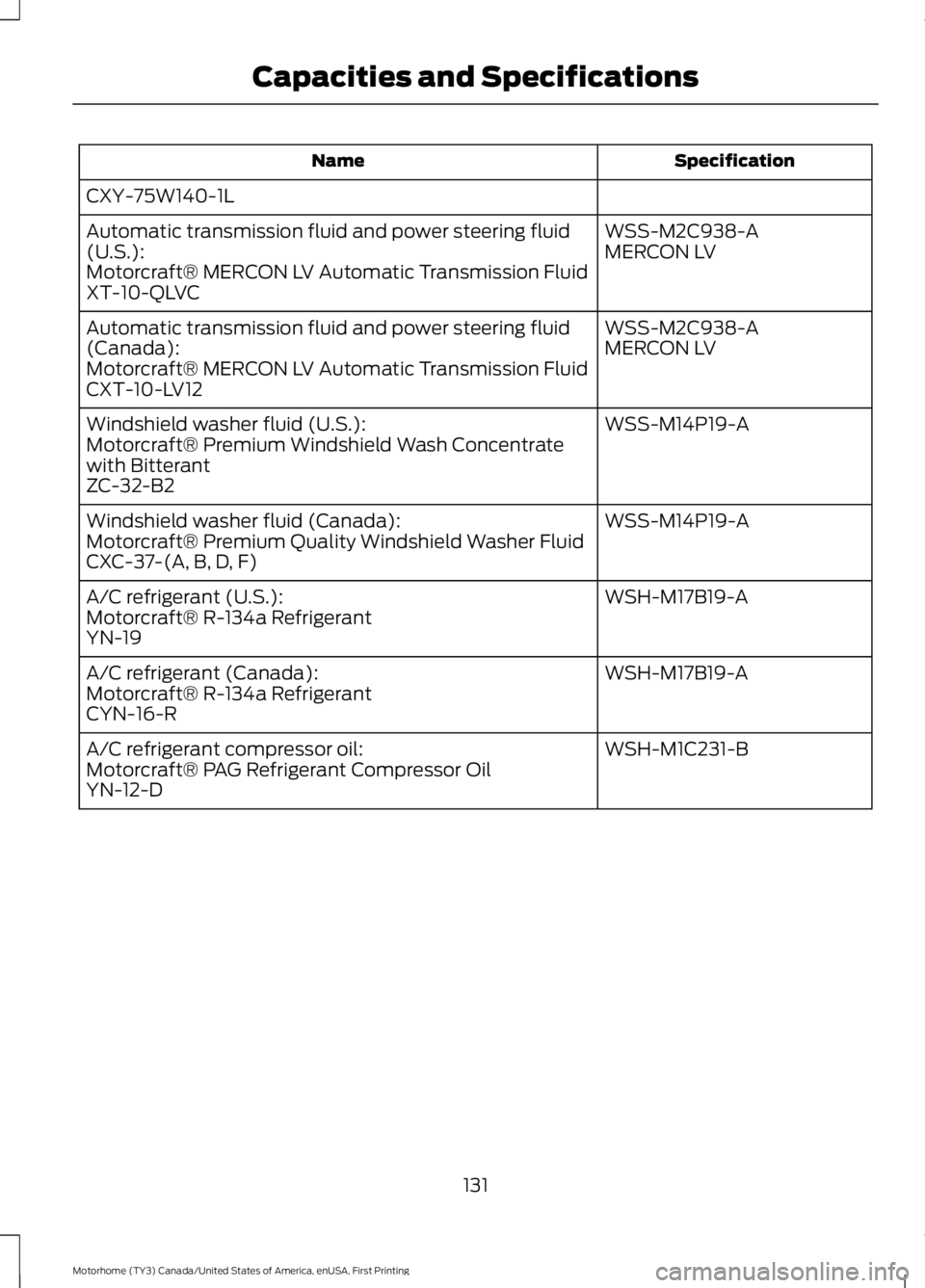
Specification
Name
CXY-75W140-1L WSS-M2C938-A
Automatic transmission fluid and power steering fluid
(U.S.): MERCON LV
Motorcraft® MERCON LV Automatic Transmission Fluid
XT-10-QLVC
WSS-M2C938-A
Automatic transmission fluid and power steering fluid
(Canada): MERCON LV
Motorcraft® MERCON LV Automatic Transmission Fluid
CXT-10-LV12
WSS-M14P19-A
Windshield washer fluid (U.S.):
Motorcraft® Premium Windshield Wash Concentrate
with Bitterant
ZC-32-B2
WSS-M14P19-A
Windshield washer fluid (Canada):
Motorcraft® Premium Quality Windshield Washer Fluid
CXC-37-(A, B, D, F)
WSH-M17B19-A
A/C refrigerant (U.S.):
Motorcraft® R-134a Refrigerant
YN-19
WSH-M17B19-A
A/C refrigerant (Canada):
Motorcraft® R-134a Refrigerant
CYN-16-R
WSH-M1C231-B
A/C refrigerant compressor oil:
Motorcraft® PAG Refrigerant Compressor Oil
YN-12-D
131
Motorhome (TY3) Canada/United States of America, enUSA, First Printing Capacities and Specifications
Page 135 of 164
Specification
Name
ESA-M1C75-B
Transmission, steering, parking linkages and pivots and
brake pedal shaft grease:
Premium Long-Life Grease
XG-1-E1
ESB-M1C93-B
Multi-purpose grease:
Motorcraft® Multi-Purpose Grease Spray
XL-5
1 Motorcraft® DOT 3 High Performance Motor Vehicle Brake Fluid is for vehicles with
Hydroboost brake booster systems. This include chassis with gross vehicle weight ratings
of 16,000 lb (7257 kg), 18,000 lb (8165 kg) and 19,500 lb (8845 kg).
2 Motorcraft® DOT 5.1 Motor Vehicle Brake Fluid is for vehicles with Hydromax brake
booster systems. This is includes chassis with gross vehicle weight ratings of 19,500 lb
(8845 kg), 20,500 lb (9299 kg), 22,000 lb (9979 kg), 24,000 lb (10886 kg) and 26,000
lb (11793 kg).
If you use oil and fluids that do not meet
the defined specification and viscosity
grade, this may lead to:
• Component damage which is not
covered by the vehicle warranty.
• Longer engine cranking periods.
• Increased emission levels.
• Reduced engine performance.
• Reduced fuel economy.
• Degraded brake performance.
We recommend Motorcraft® motor oil for
your vehicle. If Motorcraft® oil is not
available, use motor oils of the
recommended viscosity grade that meet
API SN requirements and display the API
Certification Mark for gasoline engines. Do
not use oil labeled with API SN service
category unless the label also displays the
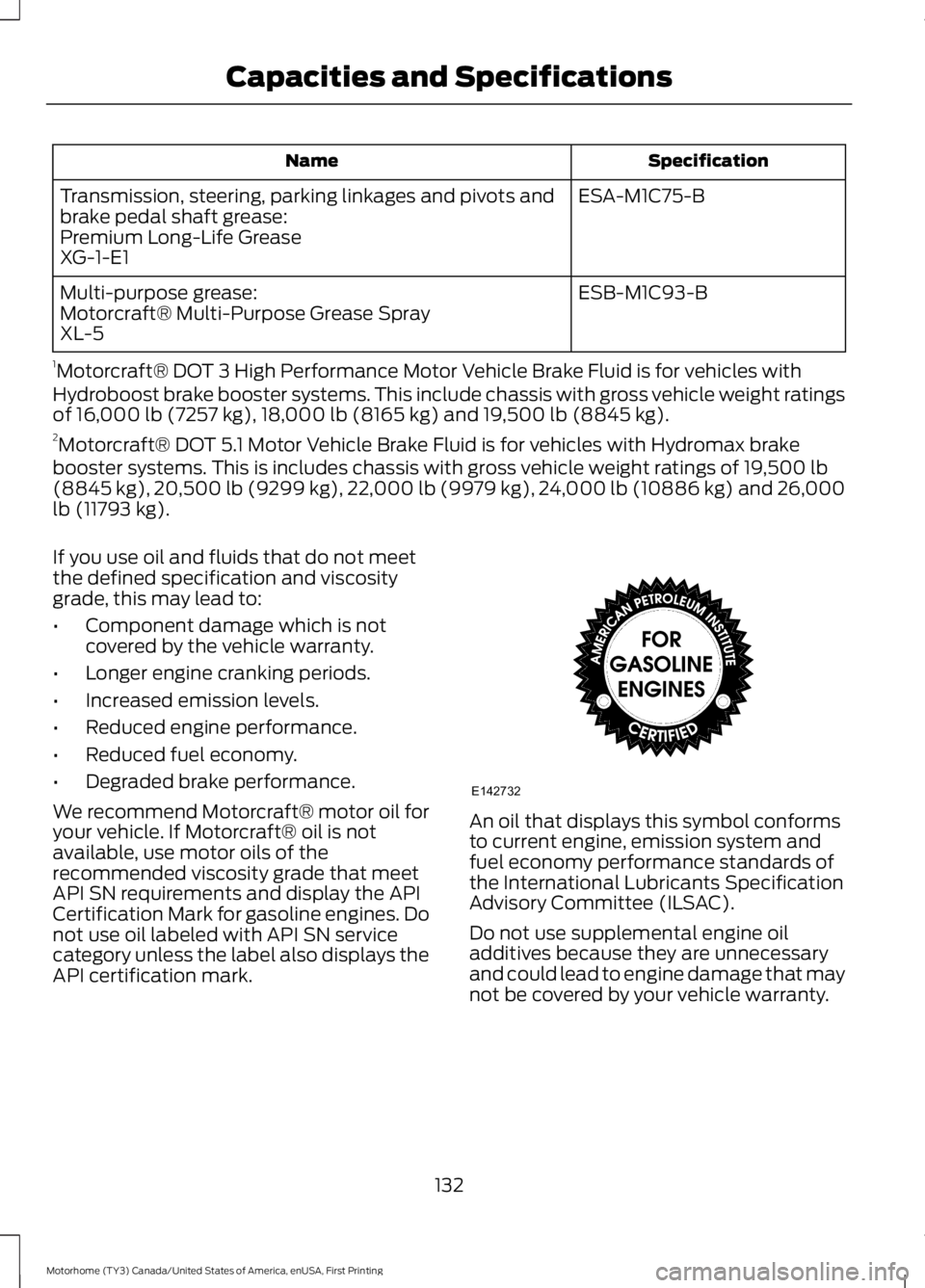
API certification mark. An oil that displays this symbol conforms
to current engine, emission system and
fuel economy performance standards of
the International Lubricants Specification
Advisory Committee (ILSAC).
Do not use supplemental engine oil
additives because they are unnecessary
and could lead to engine damage that may
not be covered by your vehicle warranty.
132
Motorhome (TY3) Canada/United States of America, enUSA, First Printing Capacities and SpecificationsE142732
Page 136 of 164
Note:
Ford recommends using DOT 3 High
Performance Brake Fluid or equivalent
meeting WSS-M6C65-A1 or DOT 5.1 Motor
Vehicle Brake Fluid WSS-M6C65-A3. Use
of any fluid other than the recommended
fluid may cause degraded brake
performance and not meet the Ford
performance standards. Keep brake fluid
clean and dry. Contamination with dirt,
water, petroleum products or other
materials may result in brake system
damage and possible failure.
Note: Automatic transmissions that require
MERCON LV transmission fluid should only
use MERCON LV transmission fluid. The
use of any other fluid may cause
transmission damage.
133
Motorhome (TY3) Canada/United States of America, enUSA, First Printing Capacities and Specifications