transmission FORD F53 2017 Owner's Manual
[x] Cancel search | Manufacturer: FORD, Model Year: 2017, Model line: F53, Model: FORD F53 2017Pages: 164, PDF Size: 2.57 MB
Page 60 of 164
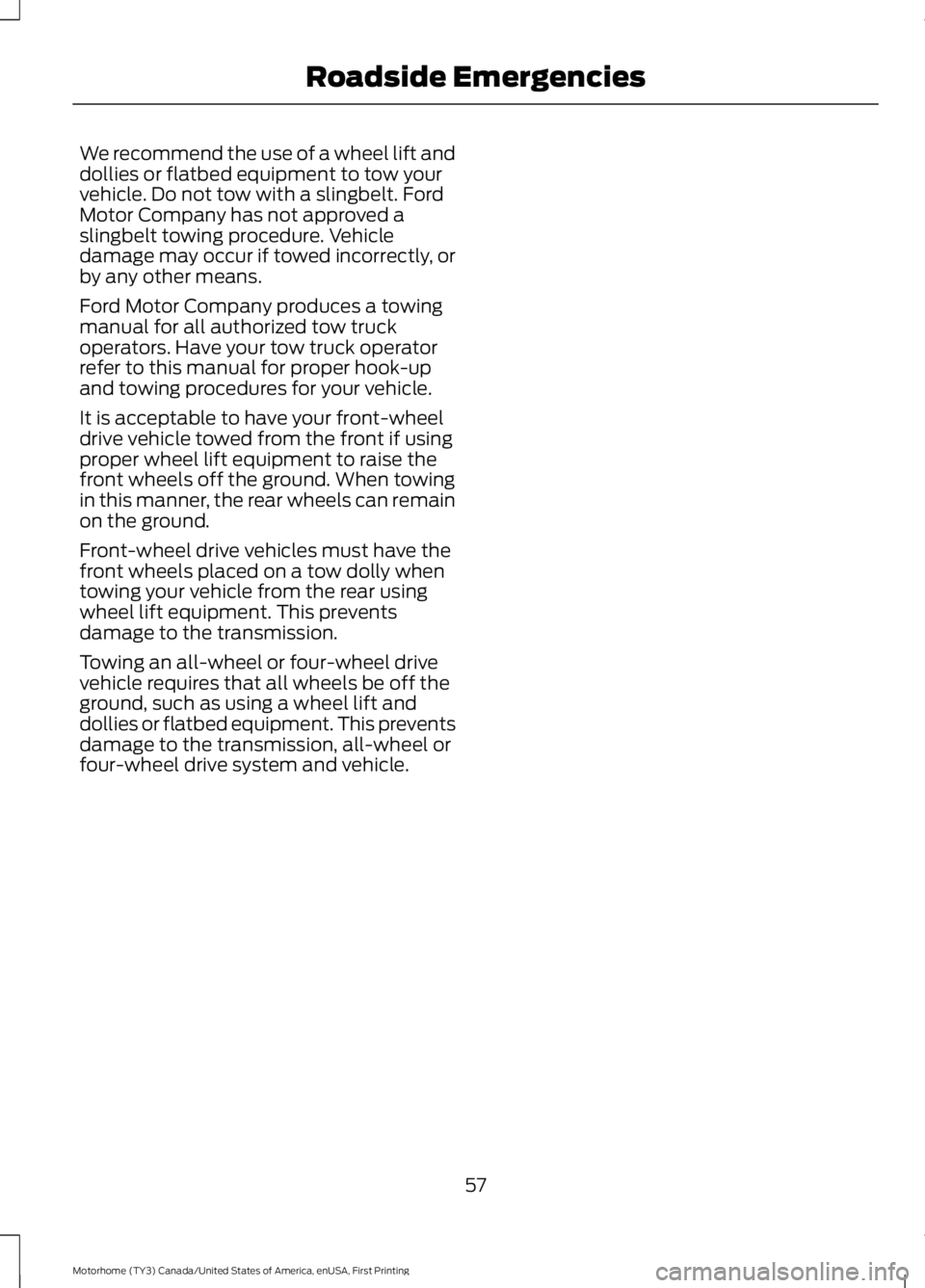
We recommend the use of a wheel lift and
dollies or flatbed equipment to tow your
vehicle. Do not tow with a slingbelt. Ford
Motor Company has not approved a
slingbelt towing procedure. Vehicle
damage may occur if towed incorrectly, or
by any other means.
Ford Motor Company produces a towing
manual for all authorized tow truck
operators. Have your tow truck operator
refer to this manual for proper hook-up
and towing procedures for your vehicle.
It is acceptable to have your front-wheel
drive vehicle towed from the front if using
proper wheel lift equipment to raise the
front wheels off the ground. When towing
in this manner, the rear wheels can remain
on the ground.
Front-wheel drive vehicles must have the
front wheels placed on a tow dolly when
towing your vehicle from the rear using
wheel lift equipment. This prevents
damage to the transmission.
Towing an all-wheel or four-wheel drive
vehicle requires that all wheels be off the
ground, such as using a wheel lift and
dollies or flatbed equipment. This prevents
damage to the transmission, all-wheel or
four-wheel drive system and vehicle.
57
Motorhome (TY3) Canada/United States of America, enUSA, First Printing Roadside Emergencies
Page 73 of 164
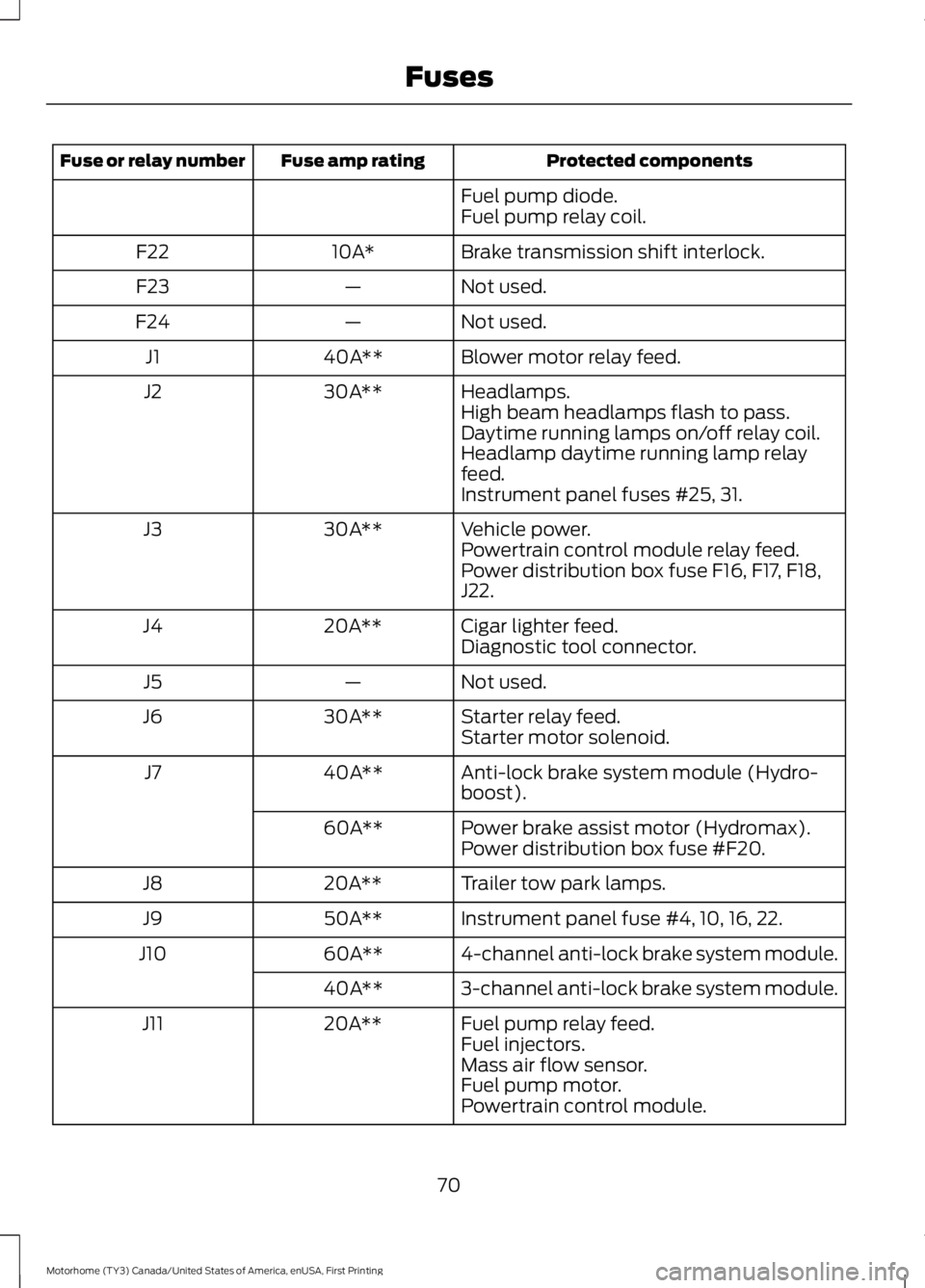
Protected components
Fuse amp rating
Fuse or relay number
Fuel pump diode.
Fuel pump relay coil.
Brake transmission shift interlock.
10A*
F22
Not used.
—
F23
Not used.
—
F24
Blower motor relay feed.
40A**
J1
Headlamps.
30A**
J2
High beam headlamps flash to pass.
Daytime running lamps on/off relay coil.
Headlamp daytime running lamp relay
feed.
Instrument panel fuses #25, 31.
Vehicle power.
30A**
J3
Powertrain control module relay feed.
Power distribution box fuse F16, F17, F18,
J22.
Cigar lighter feed.
20A**
J4
Diagnostic tool connector.
Not used.
—
J5
Starter relay feed.
30A**
J6
Starter motor solenoid.
Anti-lock brake system module (Hydro-
boost).
40A**
J7
Power brake assist motor (Hydromax).
60A**
Power distribution box fuse #F20.
Trailer tow park lamps.
20A**
J8
Instrument panel fuse #4, 10, 16, 22.
50A**
J9
4-channel anti-lock brake system module.
60A**
J10
3-channel anti-lock brake system module.
40A**
Fuel pump relay feed.
20A**
J11
Fuel injectors.
Mass air flow sensor.
Fuel pump motor.
Powertrain control module.
70
Motorhome (TY3) Canada/United States of America, enUSA, First Printing Fuses
Page 79 of 164
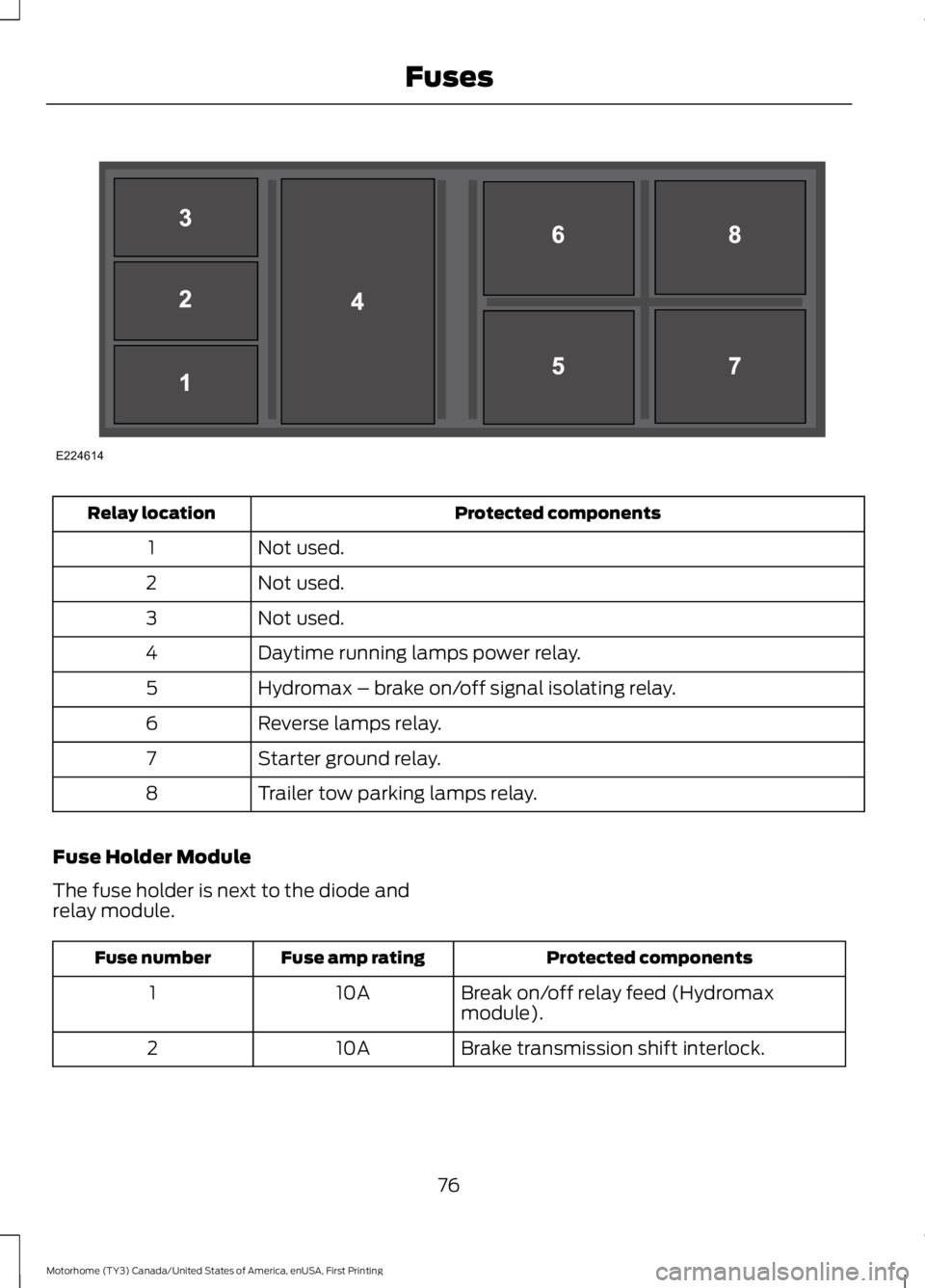
Protected components
Relay location
Not used.
1
Not used.
2
Not used.
3
Daytime running lamps power relay.
4
Hydromax – brake on/off signal isolating relay.
5
Reverse lamps relay.
6
Starter ground relay.
7
Trailer tow parking lamps relay.
8
Fuse Holder Module
The fuse holder is next to the diode and
relay module. Protected components
Fuse amp rating
Fuse number
Break on/off relay feed (Hydromax
module).
10A
1
Brake transmission shift interlock.
10A
2
76
Motorhome (TY3) Canada/United States of America, enUSA, First Printing FusesE224614
Page 82 of 164
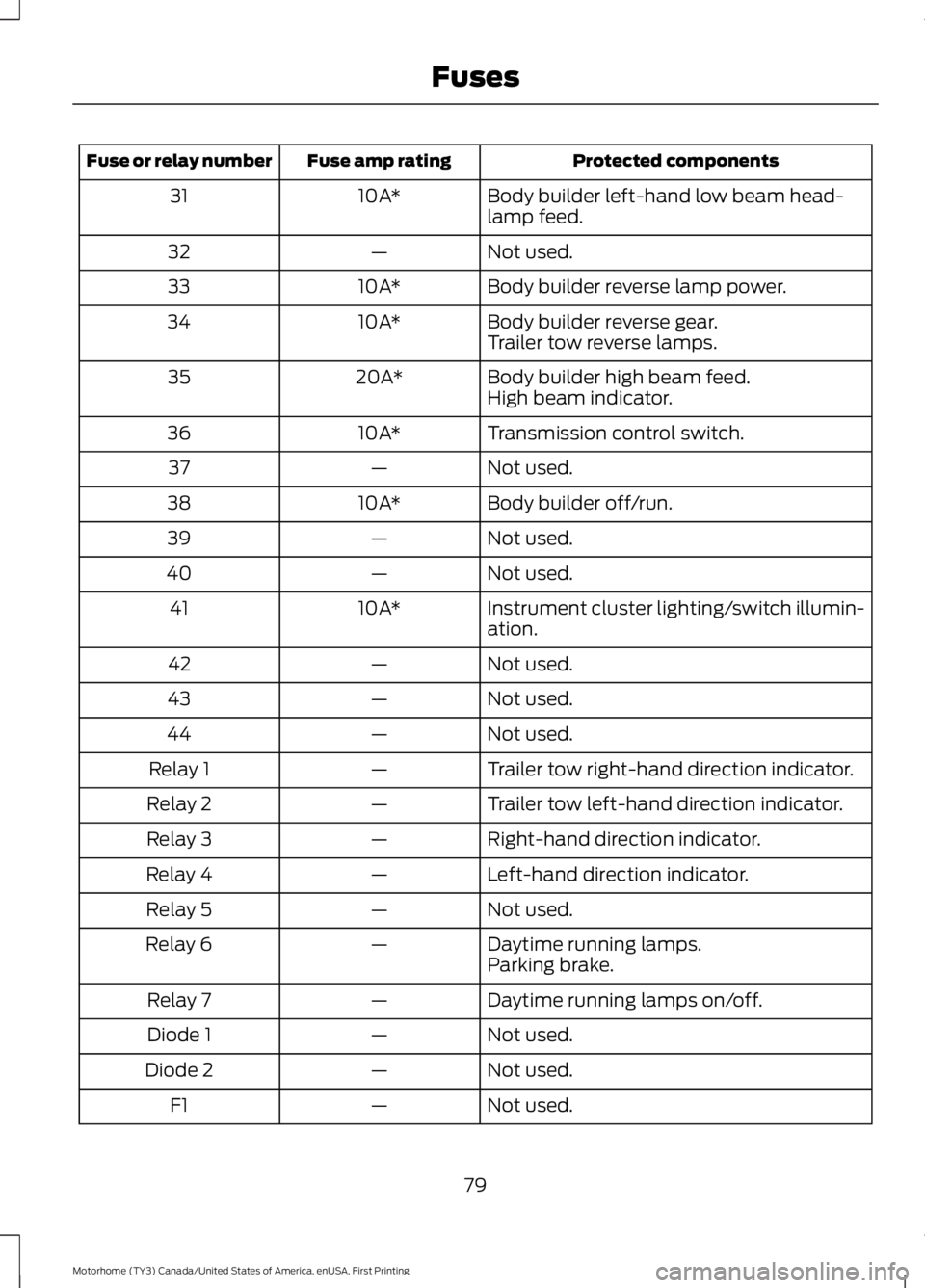
Protected components
Fuse amp rating
Fuse or relay number
Body builder left-hand low beam head-
lamp feed.
10A*
31
Not used.
—
32
Body builder reverse lamp power.
10A*
33
Body builder reverse gear.
10A*
34
Trailer tow reverse lamps.
Body builder high beam feed.
20A*
35
High beam indicator.
Transmission control switch.
10A*
36
Not used.
—
37
Body builder off/run.
10A*
38
Not used.
—
39
Not used.
—
40
Instrument cluster lighting/switch illumin-
ation.
10A*
41
Not used.
—
42
Not used.
—
43
Not used.
—
44
Trailer tow right-hand direction indicator.
—
Relay 1
Trailer tow left-hand direction indicator.
—
Relay 2
Right-hand direction indicator.
—
Relay 3
Left-hand direction indicator.
—
Relay 4
Not used.
—
Relay 5
Daytime running lamps.
—
Relay 6
Parking brake.
Daytime running lamps on/off.
—
Relay 7
Not used.
—
Diode 1
Not used.
—
Diode 2
Not used.
—
F1
79
Motorhome (TY3) Canada/United States of America, enUSA, First Printing Fuses
Page 85 of 164
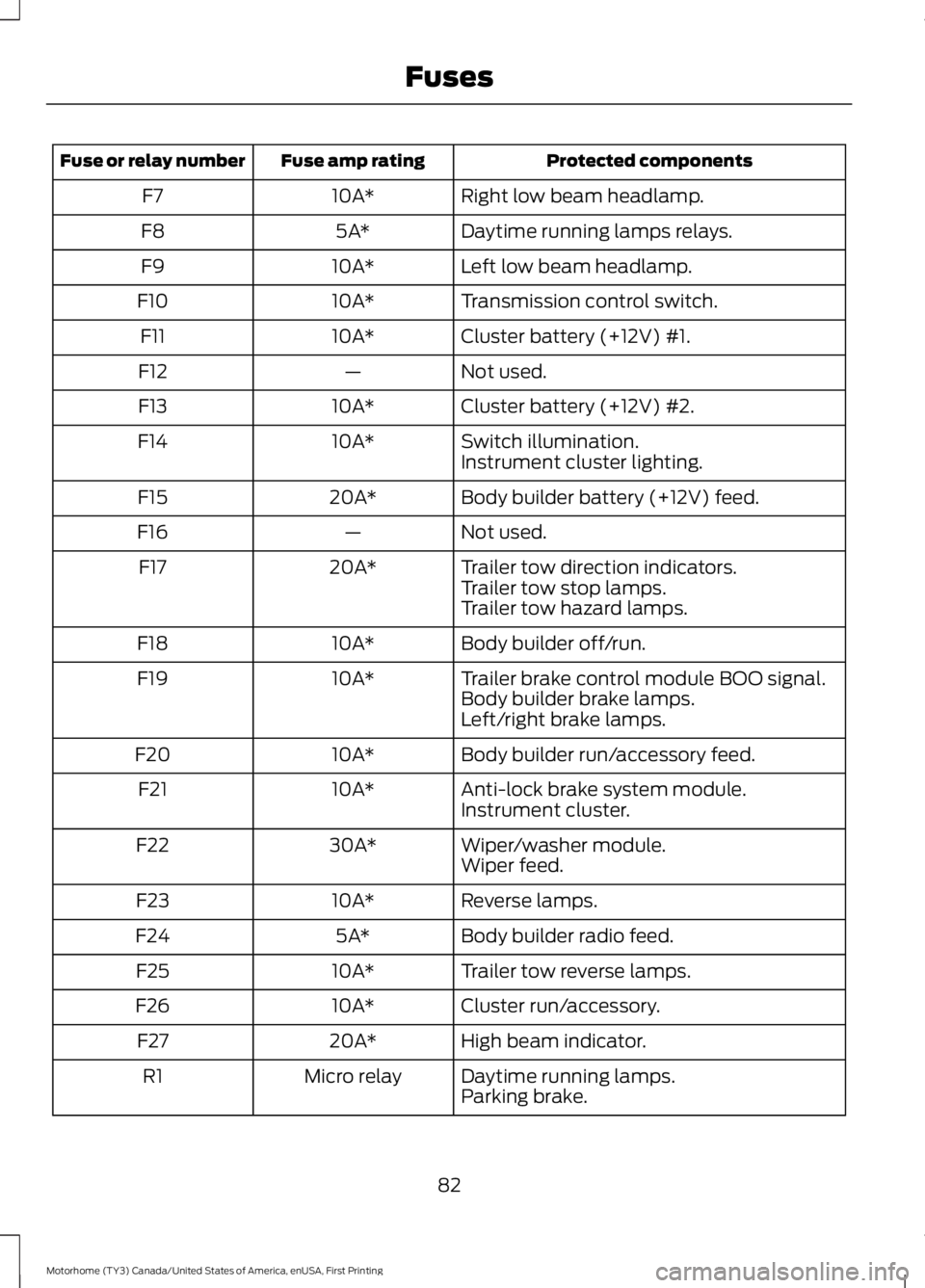
Protected components
Fuse amp rating
Fuse or relay number
Right low beam headlamp.
10A*
F7
Daytime running lamps relays.
5A*
F8
Left low beam headlamp.
10A*
F9
Transmission control switch.
10A*
F10
Cluster battery (+12V) #1.
10A*
F11
Not used.
—
F12
Cluster battery (+12V) #2.
10A*
F13
Switch illumination.
10A*
F14
Instrument cluster lighting.
Body builder battery (+12V) feed.
20A*
F15
Not used.
—
F16
Trailer tow direction indicators.
20A*
F17
Trailer tow stop lamps.
Trailer tow hazard lamps.
Body builder off/run.
10A*
F18
Trailer brake control module BOO signal.
10A*
F19
Body builder brake lamps.
Left/right brake lamps.
Body builder run/accessory feed.
10A*
F20
Anti-lock brake system module.
10A*
F21
Instrument cluster.
Wiper/washer module.
30A*
F22
Wiper feed.
Reverse lamps.
10A*
F23
Body builder radio feed.
5A*
F24
Trailer tow reverse lamps.
10A*
F25
Cluster run/accessory.
10A*
F26
High beam indicator.
20A*
F27
Daytime running lamps.
Micro relay
R1
Parking brake.
82
Motorhome (TY3) Canada/United States of America, enUSA, First Printing Fuses
Page 89 of 164
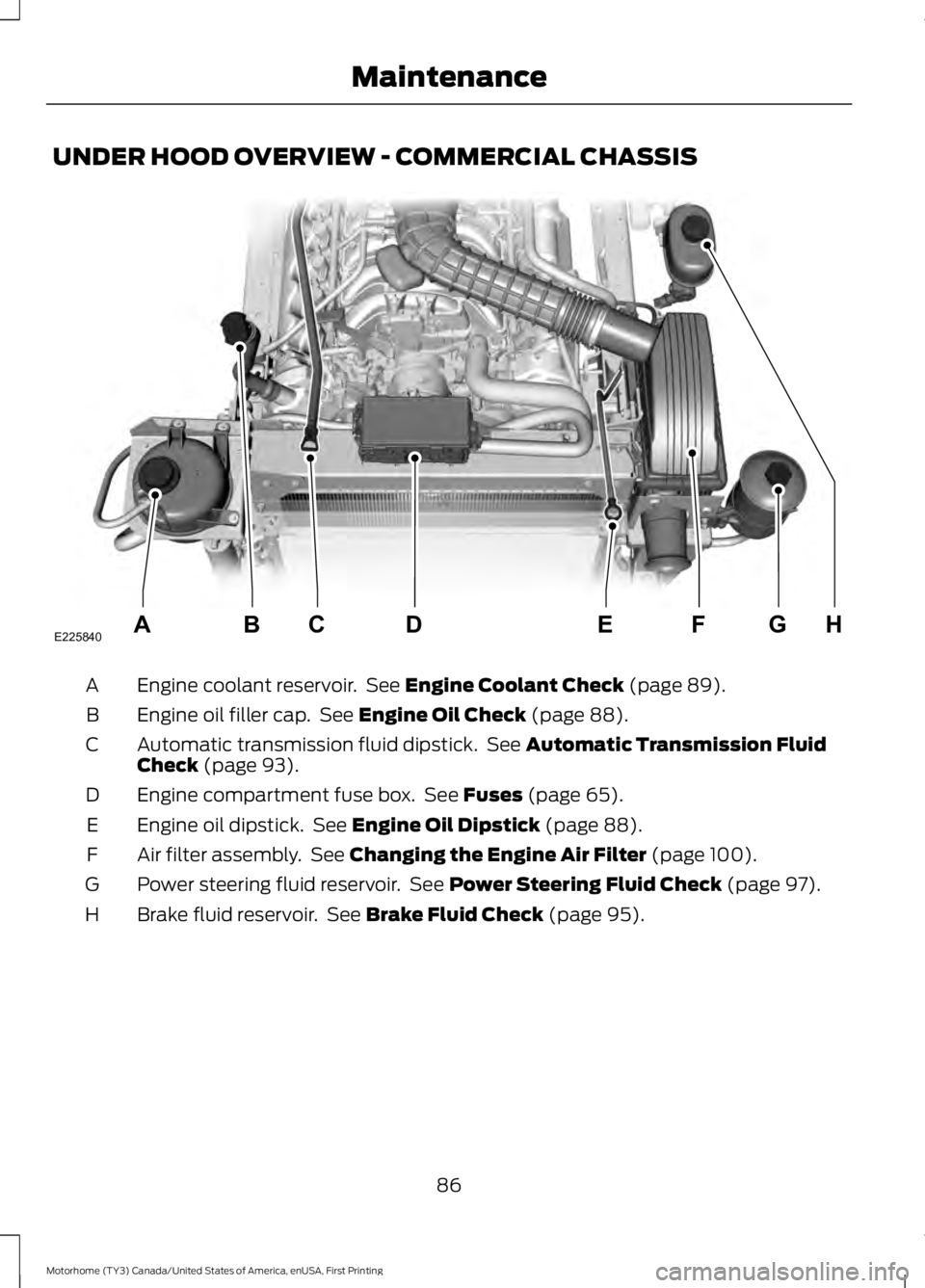
UNDER HOOD OVERVIEW - COMMERCIAL CHASSIS
Engine coolant reservoir. See Engine Coolant Check (page 89).
A
Engine oil filler cap. See
Engine Oil Check (page 88).
B
Automatic transmission fluid dipstick. See
Automatic Transmission Fluid
Check (page 93).
C
Engine compartment fuse box. See
Fuses (page 65).
D
Engine oil dipstick. See
Engine Oil Dipstick (page 88).
E
Air filter assembly. See
Changing the Engine Air Filter (page 100).
F
Power steering fluid reservoir. See
Power Steering Fluid Check (page 97).
G
Brake fluid reservoir. See
Brake Fluid Check (page 95).
H
86
Motorhome (TY3) Canada/United States of America, enUSA, First Printing MaintenanceE225840HGFEABCD
Page 90 of 164
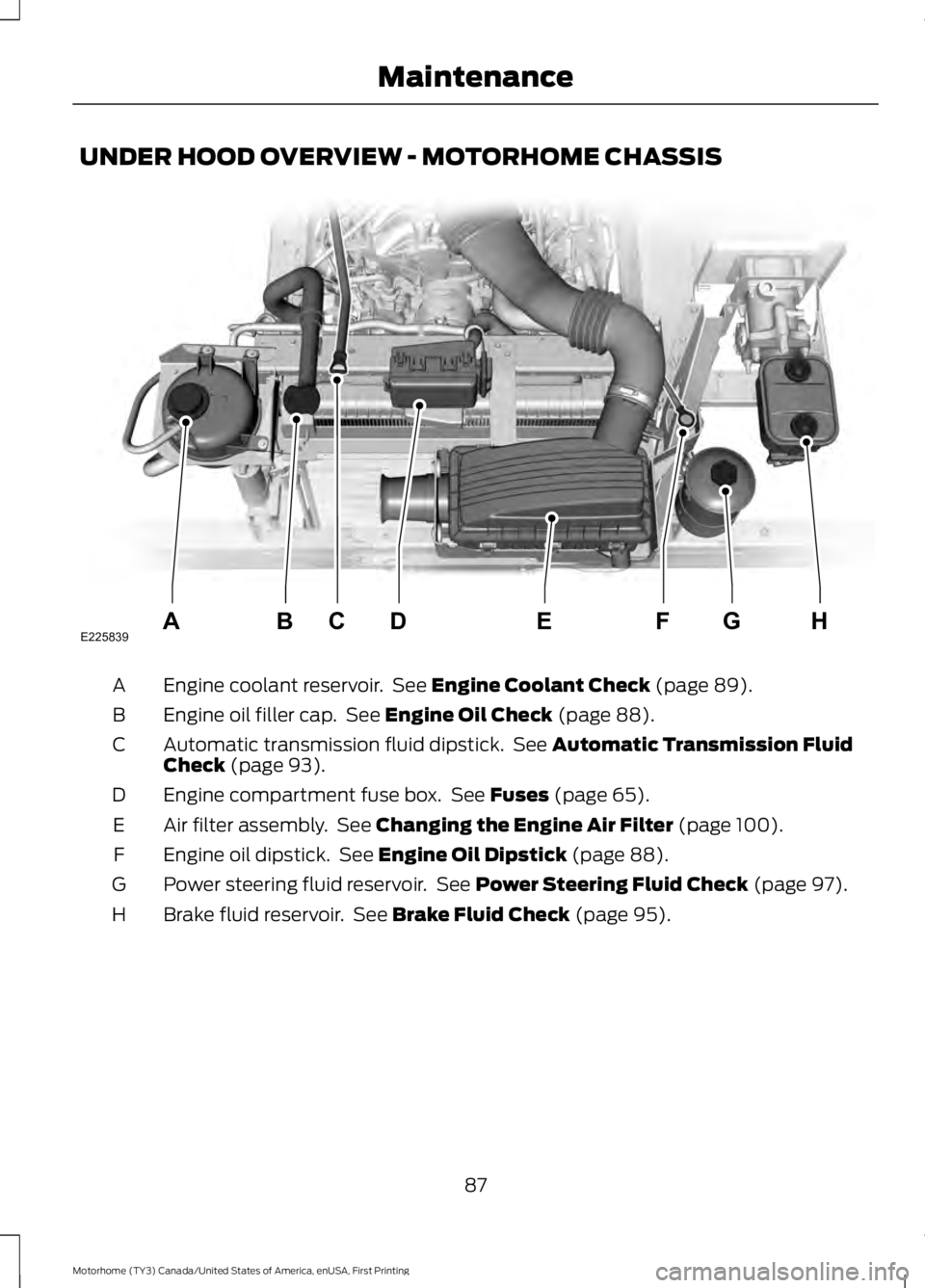
UNDER HOOD OVERVIEW - MOTORHOME CHASSIS
Engine coolant reservoir. See Engine Coolant Check (page 89).
A
Engine oil filler cap. See
Engine Oil Check (page 88).
B
Automatic transmission fluid dipstick. See
Automatic Transmission Fluid
Check (page 93).
C
Engine compartment fuse box. See
Fuses (page 65).
D
Air filter assembly. See
Changing the Engine Air Filter (page 100).
E
Engine oil dipstick. See
Engine Oil Dipstick (page 88).
F
Power steering fluid reservoir. See
Power Steering Fluid Check (page 97).
G
Brake fluid reservoir. See
Brake Fluid Check (page 95).
H
87
Motorhome (TY3) Canada/United States of America, enUSA, First Printing MaintenanceE225839HGFEABCD
Page 91 of 164
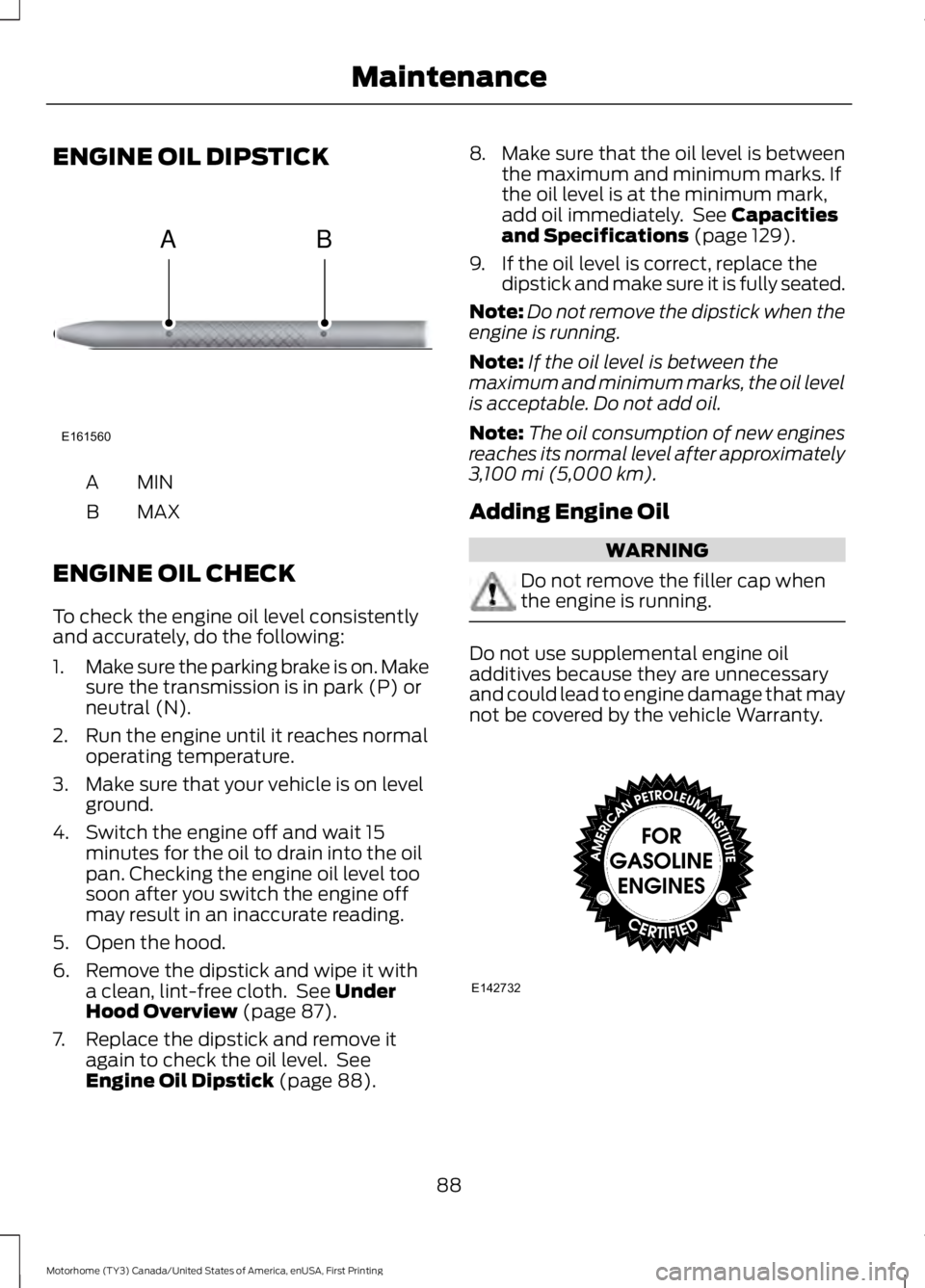
ENGINE OIL DIPSTICK
MINA
MAX
B
ENGINE OIL CHECK
To check the engine oil level consistently
and accurately, do the following:
1. Make sure the parking brake is on. Make
sure the transmission is in park (P) or
neutral (N).
2. Run the engine until it reaches normal operating temperature.
3. Make sure that your vehicle is on level ground.
4. Switch the engine off and wait 15 minutes for the oil to drain into the oil
pan. Checking the engine oil level too
soon after you switch the engine off
may result in an inaccurate reading.
5. Open the hood.
6. Remove the dipstick and wipe it with a clean, lint-free cloth. See Under
Hood Overview (page 87).
7. Replace the dipstick and remove it again to check the oil level. See
Engine Oil Dipstick
(page 88). 8.
Make sure that the oil level is between
the maximum and minimum marks. If
the oil level is at the minimum mark,
add oil immediately. See
Capacities
and Specifications (page 129).
9. If the oil level is correct, replace the dipstick and make sure it is fully seated.
Note: Do not remove the dipstick when the
engine is running.
Note: If the oil level is between the
maximum and minimum marks, the oil level
is acceptable. Do not add oil.
Note: The oil consumption of new engines
reaches its normal level after approximately
3,100 mi (5,000 km)
.
Adding Engine Oil WARNING
Do not remove the filler cap when
the engine is running.
Do not use supplemental engine oil
additives because they are unnecessary
and could lead to engine damage that may
not be covered by the vehicle Warranty.
88
Motorhome (TY3) Canada/United States of America, enUSA, First Printing MaintenanceE161560
AB E142732
Page 96 of 164
Engine Coolant Temperature
Management (If Equipped)
WARNING
To reduce the risk of crash and injury,
be prepared that the vehicle speed
may reduce and the vehicle may not
be able to accelerate with full power until
the coolant temperature reduces. If you tow a trailer with your vehicle, the
engine may temporarily reach higher a
temperature during severe operating
conditions, for example ascending a long
or steep grade in high ambient
temperatures.
At this time, you may notice the coolant
temperature gauge moves toward the red
zone and a message may appear in the
information display.
You may notice a reduction in vehicle
speed caused by reduced engine power.
In order to manage the engine coolant
temperature. Your vehicle may enter this
mode if certain high-temperature and
high-load conditions take place. The
amount of speed reduction depends on
vehicle loading, grade and ambient
temperature. If this occurs, there is no need
to pull off the road. You can continue to
drive your vehicle.
The air conditioning may automatically
turn on and off during severe operating
conditions to protect the engine from
overheating. When the coolant
temperature decreases to the normal
operating temperature, the air conditioning
turns on.
If the coolant temperature gauge moves
fully into the red zone, or if the coolant
temperature warning or service engine
soon messages appear in your information
display, do the following: 1. Pull off the road as soon as safely
possible and shift the transmission into
park (P).
2. Leave the engine running until the coolant temperature gauge needle
returns to the normal position. After
several minutes, if the temperature
does not drop, follow the remaining
steps.
3. Switch the engine off and wait for it to
cool. Check the coolant level.
4. If the coolant level is at or below the minimum mark, add prediluted coolant
immediately.
5. If the coolant level is normal, restart the engine and continue.
AUTOMATIC TRANSMISSION
FLUID CHECK WARNING
The dipstick cap and surrounding
components may be hot; gloves are
recommended.
Note:
Automatic transmission fluid
expands when warmed. To obtain an
accurate fluid check, drive the vehicle until
it is at normal operating temperature
(approximately 20 miles [30 km]). If your
vehicle has been operated for an extended
period at high speeds, in city traffic during
hot weather or pulling a trailer, the vehicle
should be turned off for about 30 minutes
to allow fluid to cool to normal operating
temperature 196°F - 215°F (91°C - 102°C)
before checking.
Refer to your scheduled maintenance
information for scheduled intervals for fluid
checks and changes.
93
Motorhome (TY3) Canada/United States of America, enUSA, First Printing Maintenance
Page 97 of 164
Your transmission does not consume fluid.
However, the fluid level should be checked
if the transmission is not working properly,
(i.e., if the transmission slips or shifts
slowly) or if you notice some sign of fluid
leakage. To check the fluid level:
1. Drive the vehicle 20 miles (30 km) or
until it reaches normal operating
temperature
2. Park the vehicle on a level surface and
engage the parking brake
3. With the engine running, parking brake
engaged and your foot on the brake
pedal, move the gearshift lever through
all of the gear ranges. Allow sufficient
time for each gear to engage
4. Latch the gearshift lever in P (Park) and leave the engine running.
5. Remove the dipstick, wiping it clean with a clean, dry lint free rag. If
necessary, refer to Under Hood
Overview in this chapter for the
location of the dipstick.
6. Install the dipstick making sure it is fully
seated in the filler tube.
7. Remove the dipstick and inspect the fluid level. The fluid should be in the
designated area for normal operating
temperature or ambient temperature.
Do not use supplemental transmission
fluid additives, treatments or cleaning
agents. The use of these materials may
affect transmission operation and result
in damage to internal transmission
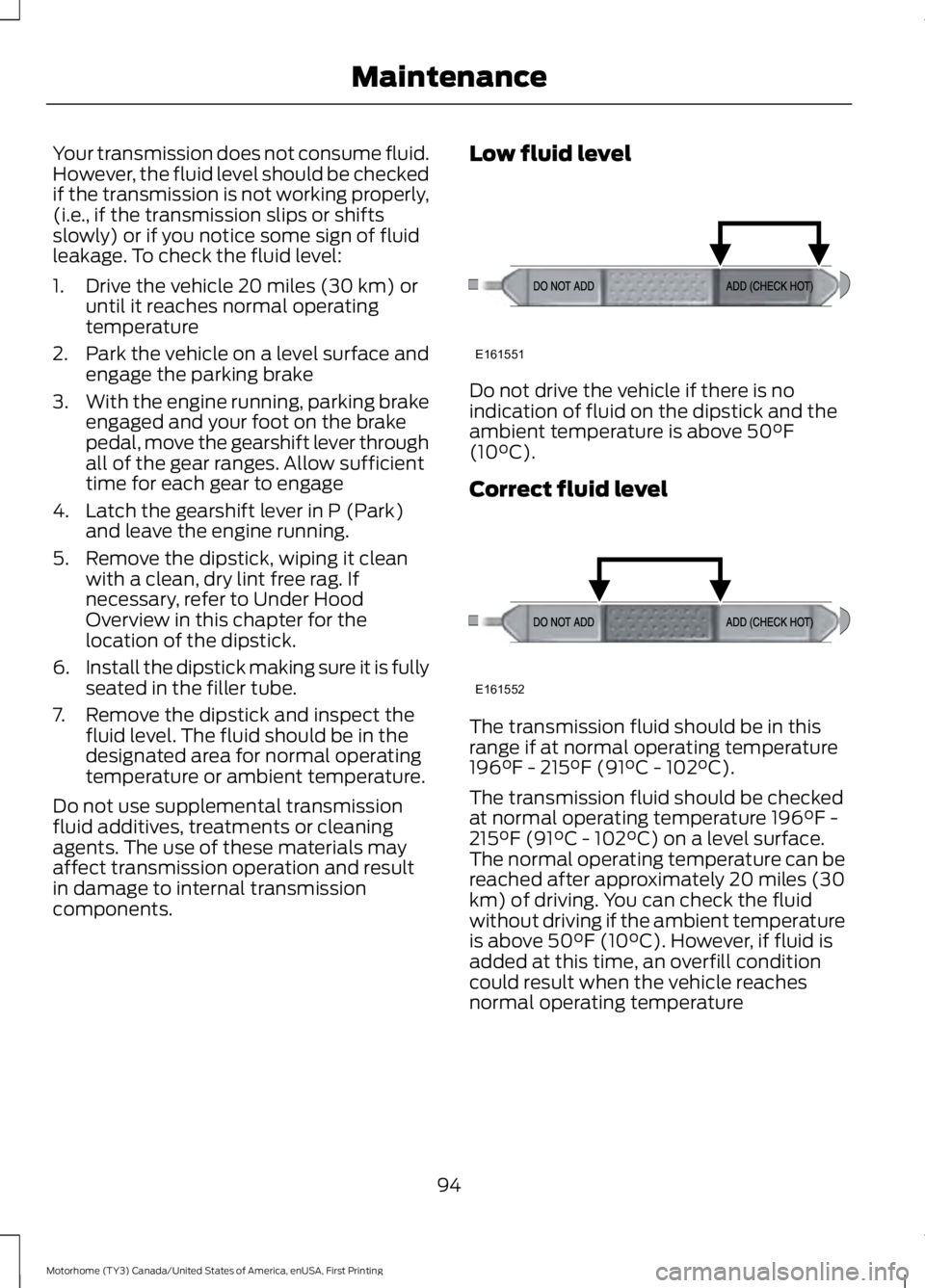
components. Low fluid level Do not drive the vehicle if there is no
indication of fluid on the dipstick and the
ambient temperature is above 50°F
(10°C).
Correct fluid level
The transmission fluid should be in this
range if at normal operating temperature
196°F - 215°F (91°C - 102°C).
The transmission fluid should be checked
at normal operating temperature 196°F -
215°F (91°C - 102°C) on a level surface.
The normal operating temperature can be
reached after approximately 20 miles (30
km) of driving. You can check the fluid
without driving if the ambient temperature
is above 50°F (10°C). However, if fluid is
added at this time, an overfill condition
could result when the vehicle reaches
normal operating temperature
94
Motorhome (TY3) Canada/United States of America, enUSA, First Printing MaintenanceE161551 E161552